
Introduction
This almanac page for Friday, March 19, 1971, pulls together various records created by the federal government and links to additional resources which can provide context about the events of the day.
Previous Date: Thursday, March 18, 1971
Next Date: Saturday, March 20, 1971
Schedule and Public Documents
The Daily Diary files represent a consolidated record of the President's activities. Visit the finding aid to learn more.
The President's day began at The White House - Washington, D. C.
The Weekly Compilation of Presidential Documents made available transcripts of the President's news conferences; messages to Congress; public speeches, remarks, and statements; and other Presidential materials released by the White House.
Digitized versions can be found at HathiTrust.
Each Public Papers of the Presidents volume contains the papers and speeches of the President of the United States that were issued by the White House Office of the Press Secretary during the time period specified by the volume. The material is presented in chronological order, and the dates shown in the headings are the dates of the documents or events. In instances when the release date differs from the date of the document itself, that fact is shown in the text note.
To ensure accuracy, remarks have been checked against audio recordings (when available) and signed documents have been checked against the original, unless otherwise noted. Editors have provided text notes and cross references for purposes of identification or clarity.
The Federal Register is the official daily publication for rules, proposed rules, and notices of federal agencies and organizations, as well as executive orders and other Presidential documents.
The Congressional Record is the official daily record of the debates and proceedings of the U.S. Congress.
Archival Holdings
Any selection of archival documents will necessarily be partial. You should use the documents and folders identified below as a starting place, but consult the linked collection finding aids and folder title lists and the collections themselves for context. Many documents to be found this way do not lend themselves to association with specific dates, but are essential to a complete understanding of the material.
Selective document listing
President's Office Files
The President's Office Files consists of materials drawn together by the Special Files Unit from several administrative subdivisions within the White House Office. It is the handwriting and sensitive papers sent to the Staff Secretary that now comprise much of the President's Office Files. Visit the finding aid to learn more.
- Annotated News Summaries, Box 30, News Summaries - March 1971 [1 of 2]
- Annotated News Summaries, Box 30, News Summaries - March 1971 [2 of 2] [During this period, the Staff Secretary only removed pages from the News Summaries which contained President Nixon's handwriting, often leaving the document with no date. In addition to the individual document(s) listed below, you should also consult the full folder for the month.]
- [3/19/71]
- News Summary, March 19, 1971, Television Report (Thursday night telecasts)
- [3/19/71]
- President's Daily Schedule, Box 101, [President's Daily Schedule, Mar.-May 1971] [1 of 3]
- The President's Schedule, Friday - March 19, 1971
The H. R. Haldeman Diaries consists of seven handwritten diaries, 36 dictated diaries recorded as sound recordings, and two handwritten audio cassette tape subject logs. The diaries and logs reflect H. R. Haldeman’s candid personal record and reflections on events, issues, and people encountered during his service in the Nixon White House. As administrative assistant to the President and Chief of Staff, Haldeman attended and participated in public events and private meetings covering the entire scope of issues in which the Nixon White House engaged in during the years 1969-1973. Visit the finding aid to learn more.
- Transcript of diary entry (PDF)
Friday, March 19.
The President had kept the morning clear for preparation for the press conference, which was canceled, so he had considerable free time. He had Ehrlichman and me in for quite a long session the first part of the morning, covering a lot of miscellaneous odds and ends, mainly regarding Cabinet therapy and a program for how to schedule Cabinet meetings. The final conclusion was that we'd go ahead with the plan for biweekly Cabinet meetings, but rather than having an open agenda as Bill Rogers had recommended, we would have a specific agenda under someone other than the President's control. For instance, next week we'll do one as a Domestic Council operation with Ehrlichman conducting the meeting, leaving a few minutes at the end for the President to summarize. There was also considerable discussion of the apparent insurrection within the Cabinet of the Romney group and the others who had been meeting secretly. Ehrlichman has now invited himself to their Monday morning breakfast, which is supposedly a culmination of the whole thing, and then he's going to schedule that as the topic for the Cabinet meeting on Friday before we leave for California. This ought to throw something of a wrench into their plans. The President is concerned about maintaining enough contact with especially the dissident-type Cabinet members––Romney, Volpe, Hardin, to a degree, Stans, Morton––but feels that the Rogers' plan is not a good way to do it. So we're going to try this other way.
We untangled, or partially so, the problem of Senator Allott's opposition to Schlesinger as Under Secretary of the Interior. The President feels that this is something Morton must handle, and that we should buck it back to the Interior Department and not worry about it at the White House. He also got into quite a discussion of what Arthur Burn's game is and what he's up to. It's clear that he's at least a part of the instigation of the Romney group and is using it to further his objectives of throwing over Shultz in some way.
The President also had Colson in to get caught up on his general activities, and had a couple of fairly long sessions with Henry and then an hour meeting with Arthur Burns just before he left for the funeral. The Dewey funeral trip was uneventful. The President met with Bill Rogers on the plane all the way back. He had me up most of the time on the way going up.
-------------------------------------------------------------------------------------------------------------------
PRIVACY- Reviewed and released under Deed of Gift, DR, NARA, September 11, 2014
Audio Cassette 5, Side B.
Duration: 1 minute 22 seconds
The Drown problem reopened as it appeared earlier in the day that Jack was staying through Sunday, so they could go to Camp David, and then was going to go home; but Helene was going to stay through the end of the week, and then apparently go back to California with us on Friday. As a result of this the President decided he couldn’t go to Camp David for the weekend. He then called Rose in, she came up with a plan and carried it out of calling Pat, who was up in New York with the Drowns during the day, and explaining the situation frankly with her. That the President needed to go to Camp David to work on his TV thing and would have to be there alone. Could not go if the Drowns were going. She said fine she’d take care of it. So we worked out a rather involved process whereby when the President returned from the Dewey funeral he went right to the NAB reception. Covered all of that and instead of going upstairs went down got in his car and drove over to the Pentagon helipad, and from there took a chopper up so that he could escape without having to make excuses or explain to the Drowns. Hopefully it’ll work out alright. He at least got there without being caught and-- so he’s got a chance for it to work.
-------------------------------------------------------------------------------------------------------------------
End of March 19. - Original audio recording (MP3)
The National Archives Catalog is the online portal to the records held at the National Archives, and information about those records. It is the main way of describing our holdings and also provides access to electronic records and digitized versions of our holdings.
The Catalog searches across multiple National Archives resources at once, including archival descriptions, digitized and electronic records, authority records, and web pages from Archives.gov and the Presidential Libraries. The Catalog also allows users to contribute to digitized historical records through tagging and transcription.
Nixon Library Holdings
All National Archives Units
National Security Documents
The President's Daily Brief is the primary vehicle for summarizing the day-to-day sensitive intelligence and analysis, as well as late-breaking reports, for the White House on current and future national security issues. Read "The President's Daily Brief: Delivering Intelligence to Nixon and Ford" to learn more.
The Foreign Relations of the United States series presents the official documentary historical record of major U.S. foreign policy decisions and significant diplomatic activity. Visit the State Department website for more information.
Vol. VII, Vietnam, July 1970-January 1972
Operational Lam Son 719, February 8-April 7, 1971
158. Backchannel Message From the President’s Deputy Assistant for National Security Affairs (Haig) to the President’s Assistant for National Security Affairs (Kissinger), Saigon, March 19, 1971
Source: National Archives, Nixon Presidential Materials, NSC Files, Box 549, Vietnam Country Files, Laos, Vol. VII. Top Secret; Sensitive; Eyes Only. The original is a retyped copy of backchannel message 640 from Saigon, 1310Z.
Vol. XIII, Soviet Union, October 1970-October 1971
"A Key Point in Our Relationship": Backchannel Talks on SALT, Berlin, and the Summit
147. Memorandum From Helmut Sonnenfeldt and William Hyland of the National Security Council Staff to the President’s Assistant for National Security Affairs (Kissinger), Washington, March 19, 1971
Source: National Archives, Nixon Presidential Materials, NSC Files, Box 714, Country Files, Europe, USSR, Vol. XII. Secret. Sent for information. Kissinger initialed the memorandum. According to an attached correspondence profile, the memorandum was “noted by HAK” on March 30.
Vol. XIX, Part 2, Japan, 1969-1972
December 1969-March 1971: Relations After the First Nixon-Sato Summit
71. Memorandum From the President’s Assistant for International Economic Affairs (Peterson) to President Nixon, Washington, March 19, 1971
Source: National Archives, Nixon Presidential Materials, White House Special Files, Staff Member and Office Files, Box 3, Peter Peterson, Subject Files, CIEP, Textiles, 4 of 5. Confidential. Concurred in by Dent, Ehrlichman, Flanigan, MacGregor, Kissinger, Shultz, State, CEA, and Commerce.
Vol. XXIII, Arab-Israeli Dispute, 1969-1972
217. Memorandum of Conversation, Washington, March 19, 1971, 12:50 p.m.
Source: National Archives, Nixon Presidential Materials, NSC Files, Box 656, Country Files, Middle East, Middle East Nodis/Cedar/Plus, Vol. I. Secret; Nodis; Cedar Plus. Drafted by Saunders on March 22. The meeting took place in Kissinger’s office. All brackets are in the original.
Vol. XXIX, Eastern Mediterranean, 1969-1972
Greece
308. Memorandum From Harold Saunders and Richard Kennedy of the National Security Council Staff to the Presidentʼs Assistant for National Security Affairs (Kissinger), Washington, March 19, 1971
Source: National Archives, Nixon Presidential Materials, NSC Institutional Files (H-Files), Senior Review Group Files, Meeting of March 19, 1971. Secret; Nodis. Sent for information. For the minutes of the Senior Review Group meeting, see Document 310.
Vol. E-1, Documents on Global Issues, 1969-1972
U.S. Policy Towards International Production and Trafficking in Illegal Drugs
184. Telegram 47398 From the Department of State to the Embassy in Burma, Washington, March 19, 1971, 0434Z
The Department instructed the Embassy to underline the U.S. commitment to containing international narcotics trafficking through periodic conversations with the Burmese Government.
Source: National Archives, RG 59, Central Files 1970-73, INCO-DRUGS BURMA. Secret; Exdis. Drafted by William F. Beachner (EA/TB); cleared in EA, in substance with BNDD, S/NM, and Defense; and approved by Wilson. Repeated to Bangkok, Phnom Phen, Saigon, Vientiane, Hong Kong, and CINCPAC.
Vol. E-2, Documents on Arms Control and Nonproliferation, 1969-1972
Chemical and Biological Warfare; Geneva Protocol; Biological Weapons Convention
218. Letter From the Assistant Secretary of Defense for International Security Affairs (Nutter) to Senator J. William Fulbright, Washington, March 19, 1971
Nutter explained the rescheduling of his appearance before Senator Fulbright’s Foreign Relations Committee to testify on the Geneva Protocol.
Source: Washington National Records Center, OSD Files: FRC 330–76–197, 370.64 CBR (Feb–Mar). No classification marking. Written at the bottom is, “Dick, “Capen has talked to Sen. Sparkman and Sen Aiken. They were not upset in the first place. This is a ‘non-issue’ contrived by Sen. Fulbright’s staff. REP [Robert E. Pursley].” A stamped notation on the memorandum indicated the Secretary of Defense saw it March 22.219. Memorandum From Richard Kennedy of the National Security Council Staff to the President’s Assistant for National Security Affairs (Kissinger), Washington, March 19, 1971
Kennedy highlighted the problems associated with the appointment of Assistant Secretary of Defense for International Security Nutter to testify in front of the Senate Foreign Relations Committee on the Geneva Protocol. Scheduling conflicts had prevented Nutter from testifying certain days and gave the Committee the impression that the Defense Department did not support ratification. If the Administration truly wanted ratification, the President needed to appoint a higher level DOD representative.
Source: National Archives, Nixon Presidential Materials, NSC Files, Box 312, Subject Files, Chemical, Biological Warfare (Toxins, etc.), Vol. IV [Part 1]. No classification marking. The attachments are not published. Kissinger wrote on the memorandum, “Talk to Pursley—that we want higher level representative.” In a March 20 note, Kennedy wrote at the bottom of the memorandum, “Dave—Adm Murphy advised that both Secretary Laird & Mr. Packard were already committed to appearances with the Hill on the 22nd. I informed Ted Curran that DOD had been urged to provide higher level representation but was unable to do so—for the delay in appearing would affront the Committee. Curran noted that he would make a note for the file to this effect and assume the matter was put to rest.” A note adjacent to “(Tab A)” in line one of the memorandum reads, “—destroyed—telcon of 3/17/71, jlj.”
Vol. E-4, Documents on Iran and Iraq, 1969-1972
Iran 1971
119. Telegram 2491 From the Embassy in the United Kingdom to the Department of State, London, March 19, 1971, 1532Z
Ambassador MacArthur informally proposed to Foreign Secretary Douglas-Home the introduction of an Iranian civilian presence on the disputed Gulf islands prior to the British withdrawal.
Source: National Archives, RG 59, Central Files 1970–73, POL 33 PERSIAN GULF. Secret; Exdis. Repeated to Tehran, Kuwait, Jidda, and Dharan. In Telegram 376 from Dhahran, March 27, Dinsmore reported that Murphy when in the Gulf Sheikdoms had heard repeatedly that Iranian seizure of the islands would present an opportunity for dissidents to rise up against the rule of the sheiks and that the “United States would be tarred with same brush because area’s people aware of close U.S.-Iranian ties and there is assumption that what Iran does is in line with US desires…” Under normal circumstances, after the UK’s withdrawal, “at least Sharja’s and Dubai’s rulers would probably turn to Iran for help in time of trouble. Seizure of islands would render this kind of relationship with Iran out of question … Iran is setting course toward seriously weakening its ties with Arabs.” (Ibid.)
The Kissinger telephone conversation transcripts consist of approximately 20,000 pages of transcripts of Kissinger’s telephone conversations during his tenure as Assistant to the President for National Security Affairs (1969-1974) and Secretary of State (1973-1974) during the administration of President Richard Nixon. Visit the finding aid for more information.
Digitized versions can be found in the National Archives Catalog.
Audiovisual Holdings
The White House Tapes are sound recordings of President Richard Nixon's telephone conversations and of meetings held in the Oval Office and the Cabinet Room in the White House, the President's office in the Old Executive Office Building (OEOB), the Lincoln Sitting Room in the residence section of the White House, and several locations at the Presidential retreat at Camp David, Maryland. These recordings document many of the major events and decisions of the Nixon Administration from February 16, 1971 to July 18, 1973. Visit the White House Tapes finding aid to learn about the taping system's operation and archival processing.
Cabinet Room
Oval Office
- 470-1; Unknown between 8:45 a.m. & 8:51 a.m.; Nixon, Richard M. (President); White House operator
- 470-2; Unknown between 8:45 a.m. & 8:51 a.m.; Nixon, Richard M. (President); Bull, Stephen B.
- 470-3; 8:51 a.m. - 9:05 a.m.; Nixon, Richard M. (President); Moorer, Thomas H. (Adm.)
- 470-4; 9:23 a.m. - 9:25 a.m.; Nixon, Richard M. (President); Butterfield, Alexander P.
- 470-5; Unknown between 9:25 a.m. & 11:15 a.m.; Nixon, Richard M. (President); Haldeman, H. R. ("Bob"); Ehrlichman, John D.; White House operator; McCracken, Paul W.; Bull, Stephen B.; Mills, Clarine (Billingsley); Dickson, Jack Mills; Dickson, Jack Mills (Mrs.); Young, Jack; Young, Jack (Mrs.); Davies, John S.; White House photographer; Carlson, Randy (Mrs.); Butterfield, Alexander P.
- 470-6; Unknown between 10:53 a.m. & 11:15 a.m.; Haldeman, H. R. ("Bob"); Sanchez, Manolo
- 470-7; Unknown between 10:53 a.m. & 11:45 a.m.; Nixon, Richard M. (President); Haldeman, H. R. ("Bob"); White House operator; Ehrlichman, John D.; Kissinger, Henry A.; Colson, Charles W.; [Unknown person(s)]
- 470-8; Unknown between 11:45 a.m. & 12:06 p.m.; Nixon, Richard M. (President); Kissinger, Henry A.; [Unknown person(s)]; Bull, Stephen B.
- 470-9; 12:15 p.m. - 12:16 p.m.; Nixon, Richard M. (President); Butterfield, Alexander P.
- 470-10; 12:32 p.m. - 12:32 p.m.; Nixon, Richard M. (President); White House operator
- 470-11; 12:33 p.m. - 12:33 p.m.; Nixon, Richard M. (President); White House operator
- 470-12; 12:33 p.m. - 12:35 p.m.; Nixon, Richard M. (President); Timmons, William E.
- 470-13; Unknown between 12:38 p.m. & 1:05 p.m.; Nixon, Richard M. (President); Haldeman, H. R. ("Bob"); White House operator; Ford, Gerald R.
- 470-14; Unknown between 12:52 p.m. & 1:05 p.m.; Nixon, Richard M. (President); White House operator
- 470-15; Unknown between 12:52 p.m. & 1:05 p.m.; Nixon, Richard M. (President); Sanchez, Manolo
- 470-16; Unknown between 12:52 p.m. & 1:05 p.m.; Nixon, Richard M. (President); Haldeman, H. R. ("Bob"); Woods, Rose Mary; Mills, Wilbur D.
- 470-17; Unknown between 1:08 p.m. & 1:30 p.m.; Nixon, Richard M. (President); Bull, Stephen B.
- 470-18; 1:30 p.m. - 2:12 p.m.; Nixon, Richard M. (President); Burns, Arthur F.; Bull, Stephen B.; Butterfield, Alexander P.; Sanchez, Manolo; Woods, Rose Mary
- 471-1; Unknown between 7:01 p.m. & 7:03 p.m.; Nixon, Richard M. (President); Kissinger, Henry A.
- 471-2; 7:03 p.m. - 7:27 p.m.; Nixon, Richard M. (President); Kissinger, Henry A.
- 471-3; Unknown between 7:27 p.m. & 7:30 p.m.; Nixon, Richard M. (President); [Unknown person(s)]
The White House Photo Office collection consists of photographic coverage of President Richard Nixon meeting with prominent social, political, and cultural personalities; speaking engagements and news conferences of the President and various high-ranking members of the White House staff and Cabinet; Presidential domestic and foreign travel, including Presidential vacations; social events and entertainment involving the First Family, including entertainers present; official portraits of the President, First Family, and high-ranking members of the Nixon administration; the 1969 and 1973 Inaugurals; the President’s 1972 Presidential election campaign appearances (including speeches) and other official activities of the White House staff and the President’s Cabinet from January 20, 1969 until August 9, 1974 at the White House and the Old Executive Office Building; other locations in Washington, DC, such as The Mall; and the Presidential retreats in Camp David, Maryland, Key Biscayne, Florida, and San Clemente, California. Visit the finding aid to learn more.
Roll WHPO-5895 Photographer: Atkins, Oliver | Color or B&W: B&W
- Frame(s): WHPO-5895-02-06, President Nixon with members of the family of Congressman Wilbur Mills. 3/19/1971, Washington, D.C. White House, Oval Office. President Nixon, Mrs. Wilbur Mills, Mills family members.
Roll WHPO-5896 Photographer: Atkins, Oliver | Color or B&W: B&W
- Frame(s): WHPO-5896-01-20, President Nixon signing H.J. Res. 16, National Week of Concern for POW - Prisoners of War/Missing in Action (Vietnam Prisoner of War, Missing in Action), while officials and POW/MIA family members look on. 3/19/1971, Washington, D.C. White House, Cabinet Room. President Nixon, Bill Brock, Roger Zion, John Myers, Mrs. Richard Morin, Iris Powers, officials, guests.
- Frame(s): WHPO-5896-13A, President Nixon signing H.J. Res. 16, National Week of Concern for POW - Prisoners of War/Missing in Action (Vietnam Prisoner of War, Missing in Action), while officials and POW/MIA family members look on. 3/19/1971, Washington, D.C. White House, Cabinet Room. President Nixon, Bill Brock, Roger Zion, John Myers, Mrs. Richard Morin, Iris Powers, officials, guests.
Roll WHPO-5897 Photographer: Kightlinger, Jack | Color or B&W: Color
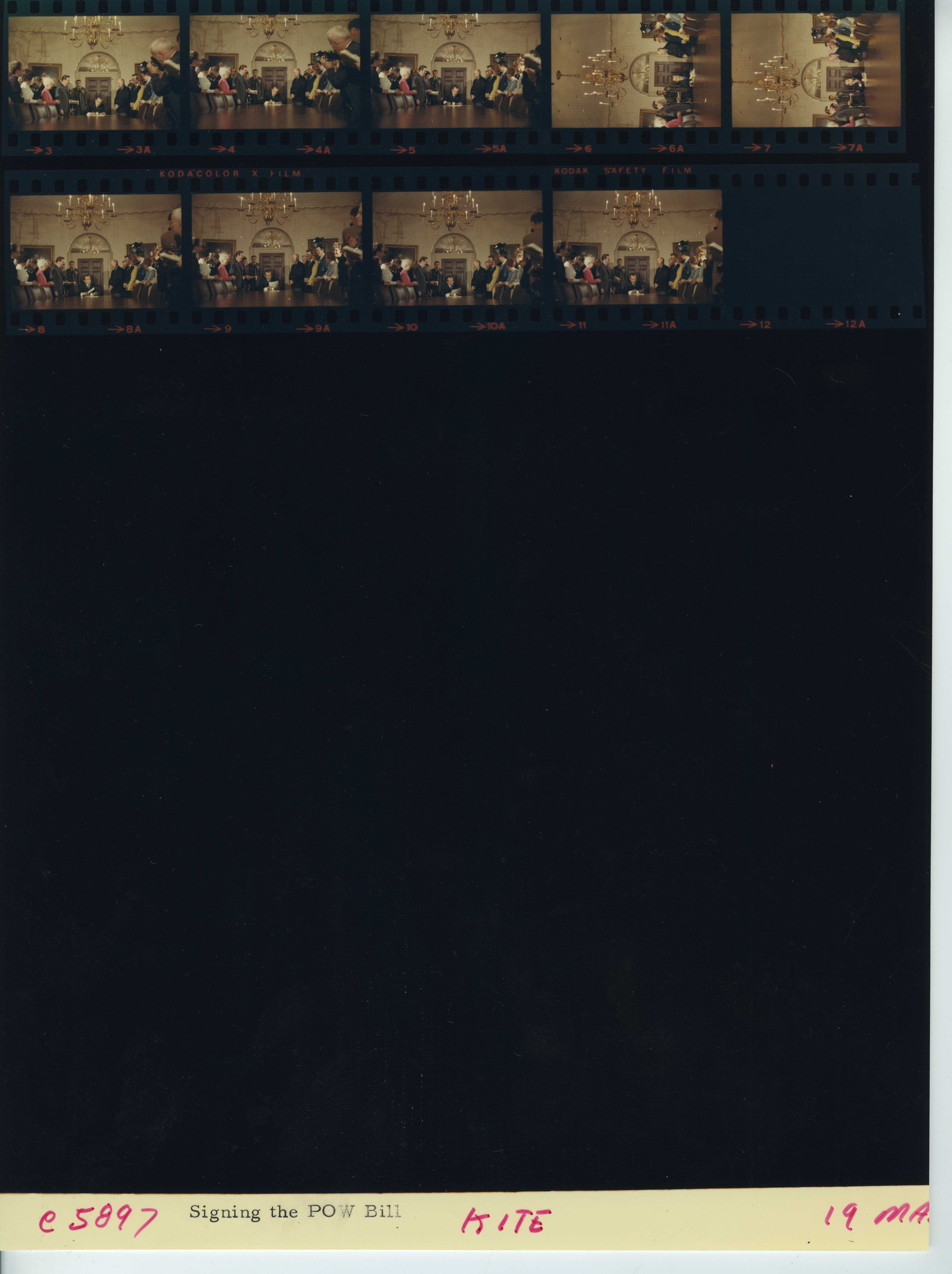
- Frame(s): WHPO-5897-03-11, President Nixon signing H.J. Res. 16, National Week of Concern for Prisoners of War/Missing in Action (Vietnam Prisoner of War, Missing in Action), while officials and POW/MIA family members look on. 3/19/1971, Washington, D.C. White House, Cabinet Room. President Nixon, Bill Brock, Rep. Roger Zion, John Myers, Mrs. Richard Morin, Iris Powers, officials, guests.
- Frame(s): WHPO-5897-04A, President Nixon signing H.J. Res. 16, National Week of Concern for Prisoners of War/Missing in Action (Vietnam Prisoner of War, Missing in Action), while officials and POW/MIA family members look on. 3/19/1971, Washington, D.C. White House, Cabinet Room. President Nixon, Bill Brock, Rep. Roger Zion, John Myers, Mrs. Richard Morin, Iris Powers, officials, guests.
Roll WHPO-5898 Photographer: Knudsen, Robert L. | Color or B&W: B&W
- Frame(s): WHPO-5898-03A-11A, President Nixon and Pat Nixon leaving St. James Episcopal Church after the funeral service and casket of Thomas E. Dewey has been carried out. 3/19/1971, New York, New York St. James Episcopal Church. President Nixon, Pat Nixon, mourners, reporters and photographers of the press corps.
- Frame(s): WHPO-5898-07, President Nixon and Pat Nixon leaving St. James Episcopal Church after the funeral service for Thomas E. Dewey. 3/19/1971, New York, New York St. James Episcopal Church. President Nixon, Pat Nixon, mourners, reporters and photographers of the press corps.
Roll WHPO-5899 Photographer: Kightlinger, Jack | Color or B&W: B&W
- Frame(s): WHPO-5899-03, President Nixon at a microphone addressing the National Alliance of Businessmen Reception guests. 3/19/1971, Washington, D.C. White House, State Dining Room. President Nixon, unidentified men.
Roll WHPO-5900 Photographer: Kightlinger, Jack | Color or B&W: B&W
- Frame(s): WHPO-5900-04-09, President Nixon in a receiving line at the National Alliance of Businessmen Reception. 3/19/1971, Washington, D.C. White House, State Dining Room. President Nixon, unidentified men.
- Frame(s): WHPO-5900-10-12, President Nixon making remarks at the National Alliance of Businessmen Reception. 3/19/1971, Washington, D.C. White House, State Dining Room. President Nixon, unidentified men.
The White House Communications Agency Sound Recordings Collection contains public statements that took place between 1969 and 1974. Visit the finding aid to learn more.
G - Cabinet Officer Briefings
- WHCA-SR-G-093
Press briefing by Secretary of Labor James D. Hodgson, with Ronald Ziegler. (3/19/1971, Press Center)
Runtime: 13:00
Production credits: Audio feed supplied by WHCA; Recorded by KAP (initials of WHCA engineer)
Original Format: 1/4-inch reel-to-reel audiotape. Original source type: Original. - WHCA-SR-G-094
Press briefing by Secretary of Labor James D. Hodgson and Ronald Ziegler. (3/19/1971, Press Center)
Runtime: 21:00
Production credits: Audio feed supplied by WHCA; Recorded by KAP (initials of WHCA engineer)
Original Format: 1/4-inch reel-to-reel audiotape. Original source type: Original.
I - Various Administration Events
- WHCA-SR-I-077
Funeral service for Governor Thomas Dewey at St. James Episcopal Church in New York. (3/19/1971, St. James Episcopal Church, New York, New York)
Runtime: [Nonelisted]
Keywords: Church service, worship service, prayer service, religion
Production credits: Audio feed supplied by WHCA; Recorded by JRS (initials of WHCA engineer)
Original Format: 1/4-inch reel-to-reel audiotape. Original source type: Original.
P - Formal Presidential Remarks
- WHCA-SR-P-710322
Remarks by President Nixon to Nat'l Assn. of Businessmen. (3/19/1971)
Runtime: 11:59
Original Format: 1/4-inch reel-to-reel audiotape. Original source type: Original.
The White House Communications Agency Videotape Collection contains “off-the-air” recordings of televised programs produced between 1968 and 1974. Visit the finding aid to learn more.
- WHCA-4227
Weekly News Summary, Tape II.
ALL NETWORKS
Runtime: 1:00
6. Smith/Geer: Middle East; Abba Eban. Time Code Start: 12:52. Keywords: Middle East, Mideast, war. Network: ABC.
7. Reasoner/Giggans: Laos. Time Code Start: 15:30. Keywords: Laos, Vietnam War. Network: ABC.
8. Smith: Cost of living figures for March. Time Code Start: 17:55. Keywords: economy, economics, budgets, finances, recession, inflation, money, wages, costs, unemployment, prices, statistics. Network: ABC.
9. Smith/Pergman: Supersonic Transport (SST), the French & Russian planes. Time Code Start: 18:13. Keywords: Soviet Union, Russia, USSR, Supersonic Transport, SST, aircraft, speed of sound, subsonic airliners, investigations, reports. Network: ABC.
10. Reasoner/Jarriel: Dewey funeral. Time Code Start: 20:40. Keywords: death memorials, burials, internments, religious services, funerals. Network: ABC.
11. Smith: Commentary about spinoffs on basic research. Time Code Start: 22:08. Keywords: science, scientific, statistics, inferences, rumours. Network: ABC.
12. McGee/Striethorst: Laos and Mai Lai 4. Time Code Start: 24:12. Keywords: Laos, Vietnam War. Network: NBC.
13. Brinkley: Commentary on Supersonic Transport (SST); Supersonic Transport (SST); House votes 215-204 against funding SST; vote believed final blow. Time Code Start: 27:11. Keywords: Supersonic Transport, SST, aircraft, speed of sound, subsonic airliners. Network: NBC.
14. Brinkley: Pentagon weapons spending; Government auditors report to Congress 61 weapons, estimated by Pentagon to cost $83 billion, actually cost $117 billion. Time Code Start: 29:28. Keywords: United States Department of Defense headquarters, Armed Forces, military, weapons, budgets, spending, costs, audits,. Network: NBC.
15. McGee: Middle East & Abba Eban. Time Code Start: 30:42. Keywords: Middle East, Mideast, war. Network: NBC.
16. McGee: Cost of Living figures for March. Time Code Start: 31:31. Keywords: economy, economics, budgets, finances, recession, inflation, money, wages, costs, unemployment, prices, statistics. Network: NBC.
17. Cronkite/Schieffer: Laos, Pentagon comments, Cambodia, POW mail, Fairfax's trip to Laos. Time Code Start: 32:27. Keywords: United States Department of Defense headquarters, Armed Forces, Vietnam War, Vietnam Prisoner of War, Laos, Cambodia, travel, trips. Network: CBS.
18. Cronkite: Supersonic Transport (SST) comments & Pentagon spending. Time Code Start: 37:03. Keywords: United States Department of Defense headquarters, Armed Forces, military, espionage, spies, operatives, investigations. Network: CBS.
19. Cost of living figures. Time Code Start: 41:11. Keywords: economy, economics, budgets, finances, recession, inflation, money, wages, costs, unemployment, prices, reports. Network: CBS.
20. Cronkite/Pierpoint: Dewey's funeral. Time Code Start: 42:05. Keywords: death memorials, burials, internments, religious services, funerals. Network: CBS.
21. Cronkite: Vice President Agnew comments on CBS; Bob Dole concurs. Time Code Start: 43:43. Keywords: Vice Presidents, speeches, statements, media, television, interviews. Network: CBS.
22. Benton: Middle East report, Eban and Secretary of State Rogers. Time Code Start: 47:51. Keywords: Middle East, Mideast, war, cabinet, advisors. Network: CBS.
Context (External Sources)
The Vanderbilt Television News Archive is the world's most extensive and complete archive of television news. They have been recording, preserving and providing access to television news broadcasts of the national networks since August 5, 1968.
Wikipedia is a free encyclopedia that anyone can edit.