
Introduction
This almanac page for Friday, March 17, 1972, pulls together various records created by the federal government and links to additional resources which can provide context about the events of the day.
Previous Date: Thursday, March 16, 1972
Next Date: Saturday, March 18, 1972
Schedule and Public Documents
The Daily Diary files represent a consolidated record of the President's activities. Visit the finding aid to learn more.
The President's day began at The White House - Washington, D. C.
The Weekly Compilation of Presidential Documents made available transcripts of the President's news conferences; messages to Congress; public speeches, remarks, and statements; and other Presidential materials released by the White House.
Digitized versions can be found at HathiTrust.
Each Public Papers of the Presidents volume contains the papers and speeches of the President of the United States that were issued by the White House Office of the Press Secretary during the time period specified by the volume. The material is presented in chronological order, and the dates shown in the headings are the dates of the documents or events. In instances when the release date differs from the date of the document itself, that fact is shown in the text note.
To ensure accuracy, remarks have been checked against audio recordings (when available) and signed documents have been checked against the original, unless otherwise noted. Editors have provided text notes and cross references for purposes of identification or clarity.
The Federal Register is the official daily publication for rules, proposed rules, and notices of federal agencies and organizations, as well as executive orders and other Presidential documents.
The Congressional Record is the official daily record of the debates and proceedings of the U.S. Congress.
Archival Holdings
Any selection of archival documents will necessarily be partial. You should use the documents and folders identified below as a starting place, but consult the linked collection finding aids and folder title lists and the collections themselves for context. Many documents to be found this way do not lend themselves to association with specific dates, but are essential to a complete understanding of the material.
Selective document listing
President's Office Files
The President's Office Files consists of materials drawn together by the Special Files Unit from several administrative subdivisions within the White House Office. It is the handwriting and sensitive papers sent to the Staff Secretary that now comprise much of the President's Office Files. Visit the finding aid to learn more.
- Annotated and Unmarked News Summaries [Note: Although there was no News Summary on this date, due to the way News Summary products were compiled, you should also consult nearby days for potentially relevant materials.]
- President's Daily Schedule, Box 102, [President's Daily Schedule, Jan.-Mar. 1972] [2 of 3]
- The President's Schedule, Friday - March 17, 1972
The H. R. Haldeman Diaries consists of seven handwritten diaries, 36 dictated diaries recorded as sound recordings, and two handwritten audio cassette tape subject logs. The diaries and logs reflect H. R. Haldeman’s candid personal record and reflections on events, issues, and people encountered during his service in the Nixon White House. As administrative assistant to the President and Chief of Staff, Haldeman attended and participated in public events and private meetings covering the entire scope of issues in which the Nixon White House engaged in during the years 1969-1973. Visit the finding aid to learn more.
- Transcript of diary entry (PDF)
Friday, March 17.
The President had an NSC meeting this morning, kept him occupied until noon. At noon we had to tell him that Jack Drown was arriving this afternoon for the weekend, and that threw him into a state of panic, and said he has to do something tomorrow to escape. Especially for dinner, and wanted to work out some kind of excuse so he could get away for the weekend. He will do Pat's birthday party tonight and that's it.
He and Henry discussed the NSC meeting. Apparently the President really put the fear of God into Jerry Smith on the line he's going to take. He took a much stronger position than he intends to, to get Smith shook up a little. He called Ehrlichman in and told him to be more aggressive in the briefings on the busing thing that he was afraid they weren't really making the sale. There was a leadership meeting this morning before the NSC, and that didn't come over very strongly, because Shultz handled the briefing.
On the ITT question, Colson reports that we've gotten a bad break and that the Senators aren't going to go to Denver because of the possibility of a vote in the Senate, so I pushed hard for his trying to get a sworn statement from her and trying to get that out, which he said he would do. Their plan had been, after getting the Senators to get their testimony from Dita Beard on Monday, that on Tuesday the ITT lawyers would have a press conference and first present the deposition of Dita's secretary, saying this isn't the memo she typed. And then put before the press Mrs. Titell, the typewriter expert, saying that the memo was not typed in June, the ribbon didn't exist until November, and it's the same as one used on January 25, therefore this blows the memo. Then Hruska will go on the Senate floor, with th-- saying this is the great outrage of the century, a hoax, the Senate's been used. Then on Wednesday the Committee resumes, Republicans say they won't go any further, this is a fraud, Kleindienst isn't confirmed-- should be confirmed, we should investigate Anderson. Later in the day it turned out that the Dita Beard statement was taken and released and that made some news tonight, so we got a little mileage out of that, and that's thrown some doubt into the whole thing.
On the ITT thing, he wanted Buchanan and Colson to get their people going on some good solid editorial columns regarding the double standard regarding Congressional hearings. Press saying that during the Nixon era and then the McCarthy era, when they were investigating Communists, the committee was constantly attacked regarding their failure to follow the rules of court and taking evidence. That where are those attacks now? That when the President of the United States is slandered, or the Attorney General, or a business leader, no one raises his voice, but when a Communist spy does it, they all scream. Thinks we can really work something up on that.
They had the Pat Nixon birthday party tonight with the Drowns and Roger Johnsons as the guests. President apparently stayed for an hour and then went over to the EOB and hid until they went to the movie and then came back and went to his room.
End of March 17. - Original audio recording (MP3)
The National Archives Catalog is the online portal to the records held at the National Archives, and information about those records. It is the main way of describing our holdings and also provides access to electronic records and digitized versions of our holdings.
The Catalog searches across multiple National Archives resources at once, including archival descriptions, digitized and electronic records, authority records, and web pages from Archives.gov and the Presidential Libraries. The Catalog also allows users to contribute to digitized historical records through tagging and transcription.
Nixon Library Holdings
All National Archives Units
National Security Documents
The President's Daily Brief is the primary vehicle for summarizing the day-to-day sensitive intelligence and analysis, as well as late-breaking reports, for the White House on current and future national security issues. Read "The President's Daily Brief: Delivering Intelligence to Nixon and Ford" to learn more.
The Foreign Relations of the United States series presents the official documentary historical record of major U.S. foreign policy decisions and significant diplomatic activity. Visit the State Department website for more information.
Vol. IV, Foreign Assistance, International Development, Trade Policies, 1969-1972
Foreign Assistance Policy, 1969-1972
88. Memorandum From the President’s Assistant for National Security Affairs (Kissinger) to Secretary of Defense Laird, Washington, March 17, 1972
Source: National Archives, Nixon Presidential Materials, NSC Files, Subject Files, Box 324, Foreign Aid, Volume II 1972. No classification marking. Forwarded to Kissinger under cover of a March 14 memorandum from Kennedy and Lehman, who noted that “if we allow Laird’s interpretation to become the common wisdom then we will pay a heavy bureaucratic price in the future” and recommended Kissinger sign the memorandum to Laird. Also attached is a March 17 memorandum from Haig to General Pursley transmitting the memorandum.
Coordinating Committee on Export Controls, 1969-1972
378. Memorandum From Secretary of Defense Laird to the President’s Assistant for National Security Affairs (Kissinger), Washington, March 17, 1972
Source: National Archives, Nixon Presidential Materials, NSC Files, Country Files-Europe, Box 729, UK, Volume VII 9/71-9/72. Top Secret. Copies were sent to the Secretaries of State and Commerce.
Vol. XIV, Soviet Union, October 1971-May 1972
Preparing for Moscow and Nixon's Trip to China, January 1-March 29, 1972
62. Memorandum of Conversation, Washington, March 17, 1972, 1 p.m.
Source: National Archives, Nixon Presidential Materials, NSC Files, Box 493, President’s Trip Files, Dobrynin/Kissinger, 1972, Vol. 10. Top Secret; Sensitive; Exclusively Eyes Only. The meeting was held in the Map Room at the White House. A notation on the memorandum indicates the President saw it. Kissinger sent a March 28 summary memorandum of this meeting to Nixon. (Ibid.) Kissinger’s Record of Schedule gives the time of the meeting from 1:10 to 3:10 p.m. (Library of Congress, Manuscript Division, Kissinger Papers, Box 438, Miscellany, 1968–1976)
Vol. XXIII, Arab-Israeli Dispute, 1969-1972
Proximity Talks and the Backchannel: Separate Department of State and White House Negotiating Tricks
281. Memorandum of Conversation, Washington, March 17, 1972, 1 p.m.
Source: National Archives, Nixon Presidential Materials, NSC Files, Box 493, President’s Trip Files, Dobrynin/Kissinger, 1972, Vol. 10. Top Secret; Sensitive; Exclusively Eyes Only. A stamped notation on the memorandum indicates the President saw it. All brackets are in the original except those indicating text omitted by the editors and “[Dobrynin]”, added for clarity. The meeting took place in the White House Map Room. The President left the meeting before the discussion of the Middle East. For the full text of the memorandum of conversation, see Foreign Relations, 1969–1976, volume XIV, Soviet Union, October 1971–May 1972, Document 62.
Vol. XXIX, Eastern Mediterranean, 1969-1972
Cyprus
411. Telegram From the Embassy in Greece to the Department of State, Athens, March 17, 1972, 1546Z
Source: National Archives, Nixon Presidential Materials, NSC Files, Box 594, Country Files—Middle East, Greece, Vol. III Jan 72–Oct 73. Secret; Exdis. Repeated to Nicosia, Ankara, London, USNATO, and USUN. Another copy is ibid., RG 59, Central Files 1970–73, POL 27 CYP.
Vol. XXXII, SALT I, 1969-1972
Narrowing the Issues, October 19, 1971-April 18, 1972
240. Memorandum for the Record, Washington, March 17, 1972, 10:15-11:55 a.m.
Source: National Archives, Nixon Presidential Materials, NSC Files, NSC Institutional Files (H-Files), Box H–110, NSC Meeting Minutes, NSC Minutes Originals 1971 thru 6–20–74. Top Secret; Sensitive. The meeting took place in the Cabinet Room.
Vol. E-1, Documents on Global Issues, 1969-1972
International Cooperation in Space, 1969-1972
277. Information Memorandum From the Director of the Bureau of Scientific and Technological Affairs (Pollack) to Secretary of State Rogers, Washington, March 17, 1972
Pollack alerted Rogers that cooperation with the Europeans in the post-Apollo program was endangered because the White House staff was skeptical that European participation in the development of hardware for the space shuttle and other elements was desirable.
Source: National Archives, RG 59, Central Files 1970-73, SP 10 US. Confidential. Drafted by Pollack. Copies were sent to U. Alexis Johnson, Samuels, and Hillenbrand. In a separate March 17 memorandum to Flanigan, March 17, the Executive Secretary of NASA, outlined in detail the NASA position on European participation. Printed in Logsdon (ed.), Exploring the Universe, Vol. II, External Relations, as Document I-25.
Vol. E-2, Documents on Arms Control and Nonproliferation, 1969-1972
Chemical and Biological Warfare; Geneva Protocol; Biological Weapons Convention
253. Transcript of Telephone Conversation Between the President’s Assistant for National Security Affairs (Kissinger) and the Soviet Ambassador (Dobrynin), Washington, March 17, 1972
Dobrynin pressed Kissinger for a decision on Nixon’s attending the signing ceremony for the Biological Weapons Convention.
Source: Library of Congress, Manuscript Division, Kissinger Papers, Box 395, Telephone Conversations, Dobrynin, September 1971–April 1972. No classification marking.254. Conversation Between President Nixon and the President’s Chief of Staff (Haldeman), Washington, March 17, 1972, 3:05-4:37 p.m.
During this discussion, Haldeman convinced the President to attend the signing ceremony for the Biological Weapons Convention.
Source: National Archives, Nixon Presidential Materials, White House Tapes, Conversation No. 323–33. No classification marking. The editors transcribed the portion of the tape recording published here specifically for this volume.
Vol. E-7, Documents on South Asia, 1969-1972
U.S. Relations with India and Pakistan, 1972
236. Memorandum From Secretary of State Rogers to President Nixon, Washington, March 17, 1972
Rogers conveyed to Nixon an assessment of the Pakistani proposals for closer military collaboration and policy recommendations based on the assessment.
Source: National Archives, Nixon Presidential Materials, NSC Files, Box 627, Country Files, Middle East, Pakistan, Vol. IX, Jan–31 Aug 72. Secret; Exdis.
The Kissinger telephone conversation transcripts consist of approximately 20,000 pages of transcripts of Kissinger’s telephone conversations during his tenure as Assistant to the President for National Security Affairs (1969-1974) and Secretary of State (1973-1974) during the administration of President Richard Nixon. Visit the finding aid for more information.
Digitized versions can be found in the National Archives Catalog.
Audiovisual Holdings
Visit the White House Tapes finding aid to learn about the taping system's operation and archival processing.
Cabinet Room
- 95-1; Unknown between 12:00 a.m. & 9:54 a.m.; Nixon, Richard M. (President); Richardson, Elliot L.; Kleindienst, Richard G.; Shultz, George P.; Mansfield, Michael J. ("Mike"); Scott, Hugh; Byrd, Robert C.; Griffin, Robert P.; Javits, Jacob K.; Hruska, Roman L.; Eastland, James O.; Albert, Carl B.; Ford, Gerald R.; Quie, Albert H.; McCulloch, William M.; Ehrlichman, John D.; MacGregor, Clark; Timmons, William E.; Korologos, Thomas C.; Cook, Richard K.; Morgan, Edward L.; O'Neill, Paul H.; Buchanan, Patrick J.; Dam, Kenneth W.; Garment, Leonard; Klein, Herbert G.; White House photographer
- 95-2; Unknown between 10:13 a.m. & 11:54 a.m.; Nixon, Richard M. (President); National Security Council; Agnew, Spiro T. (Vice President); Rogers, William P.; Laird, Melvin R.; Lincoln, George A. (Gen.); Connally, John B.; Irwin, John N., II; Helms, Richard M.; Moorer, Thomas H. (Adm.); Spiers, Ronald I.; Kennedy, David M.; Smith, Gerard C.; Farley, Philip J.; Keeny, Spurgeon M., Jr.; [Name withdrawn]; Allison, Royal B. (Gen.); Nitze, Paul H.; Kissinger, Henry A.; Kennedy, Richard T. (Col.); Odeen, Philip A.; Sonnenfeldt, Helmut ("Hal"); Tucker, Gardiner L.
Old Executive Office Building
- 323-29; Unknown between 1:45 p.m. & 2:45 p.m.; Nixon, Richard M. (President); Sanchez, Manolo
- 323-30; Unknown between 1:45 p.m. & 2:45 p.m.; Nixon, Richard M. (President); [Unknown person(s)]
- 323-31; 2:45 p.m. - 3:02 p.m.; Nixon, Richard M. (President); Ziegler, Ronald L.
- 323-32; Unknown between 3:02 p.m. & 3:05 p.m.; Nixon, Richard M. (President); Russell, Howard
- 323-33; 3:05 p.m. - 4:37 p.m.; Nixon, Richard M. (President); Haldeman, H. R. ("Bob"); [Unknown person(s)]; Sanchez, Manolo; Kissinger, Henry A.; Ehrlichman, John D.; White House operator
- 323-34; Unknown between 4:37 p.m. & 5:25 p.m.; Sanchez, Manolo; [Unknown person(s)]
- 324-1; Unknown between 5:25 p.m. & 5:29 p.m.; Nixon, Richard M. (President); White House operator
- 324-2; Unknown between 5:25 p.m. & 5:32 p.m.; Nixon, Richard M. (President); Butterfield, Alexander P.; Bull, Stephen B.
- 324-3; Unknown between 5:32 p.m. & 5:36 p.m.; Nixon, Richard M. (President); White House operator
- 324-4; Unknown between 5:32 p.m. & 5:36 p.m.; Nixon, Richard M. (President); [Unknown person(s)]
- 324-5; 5:36 p.m. - 5:40 p.m.; Nixon, Richard M. (President); Eisenhower, Julie Nixon
- 324-6; Unknown between 5:40 p.m. & 5:47 p.m.; Nixon, Richard M. (President); Sanchez, Manolo
- 324-7; 5:47 p.m. - 6:13 p.m.; Nixon, Richard M. (President); Woods, Rose Mary; Haldeman, H. R. ("Bob")
Oval Office
- 686-1; Unknown between 7:51 a.m. & 7:58 a.m.; Nixon, Richard M. (President); [Unknown person(s)]
- 686-2; Unknown between 7:51 a.m. & 7:58 a.m.; Nixon, Richard M. (President); Bull, Stephen B.
- 686-3; Unknown between 7:51 a.m. & 7:58 a.m.; Nixon, Richard M. (President); Bull, Stephen B.
- 686-4; 7:58 a.m. - 8:04 a.m.; Nixon, Richard M. (President); Ziegler, Ronald L.; Haldeman, H. R. ("Bob")
- 686-5; Unknown between 9:54 a.m. & 9:56 a.m.; Nixon, Richard M. (President); Bull, Stephen B.
- 686-6; 9:56 a.m. - 10:08 a.m.; Nixon, Richard M. (President); Franklin, Barbara H.; Kaufman, Judy; Gutwillig, Jacqueline G.; Allan, Virginia R.; Arnold, Margaret Long (Dr.); Bethel, Paul (Mrs.); Blair, Lorraine L.; Connor, Julie Casterman; Cunningham, Sarah Jane; Griffin, Robert A.; Hacke, Maxine R.; Hamel, Charles M. (Mrs.); Mealey, Margaret J.; Palmer, Hazel; Revercomb, Chapman (Mrs.); Wasserman, Daniel H. (Mrs.); Wischer, Irene; Koontz, Elizabeth D.; East, Catherine; Whittaker, Bertha; White House photographer
- 686-7; 10:09 a.m. - 10:13 a.m.; Nixon, Richard M. (President); Kissinger, Henry A.
- 686-8; 11:55 a.m. - 12:00 p.m.; Nixon, Richard M. (President); Butterfield, Alexander P.
- 686-9; Unknown between 12:00 p.m. & 12:05 p.m.; Nixon, Richard M. (President); Bull, Stephen B.
- 686-10; Unknown between 12:05 p.m. & 12:11 p.m.; Nixon, Richard M. (President); Warnack, William; Haig, Alexander M., Jr.; Smoak, Marion H.; White House photographer
- 686-11; Unknown between 12:16 p.m. & 12:19 p.m.; Nixon, Richard M. (President); Diver, Tina; Diver, Neil; White, Margita E.
- 686-12; Unknown between 12:36 p.m. & 12:42 p.m.; Nixon, Richard M. (President); Kissinger, Henry A.; Haldeman, H. R. ("Bob"); Butterfield, Alexander P.
- 687-2; 12:16 p.m. - 12:19 p.m.; Diver, Tina; Diver, Neil; White, Margita E.
- 687-3; 12:19 p.m. - 1:14 p.m.; Nixon, Richard M. (President); Haldeman, H. R. ("Bob"); Bull, Stephen B.; Kissinger, Henry A.; Ehrlichman, John D.
- 687-4; 1:14 p.m. - 1:14 p.m.; Bull, Stephen B.; United States Secret Service agents
White House Telephone
- 21-101; 4:34 p.m. - 4:34 p.m.; Nixon, Richard M. (President); White House operator
- 21-102; 4:34 p.m. - 4:34 p.m.; Nixon, Richard M. (President); White House operator
- 21-103; Unknown between 4:34 p.m. & 5:29 p.m.; Nixon, Richard M. (President); White House operator
- 21-104; 5:29 p.m. - 5:30 p.m.; Nixon, Richard M. (President); Bull, Stephen B.
- 21-105; Unknown between 5:30 p.m. & 5:36 p.m.; Nixon, Richard M. (President); White House operator
- 21-106; 5:36 p.m. - 5:40 p.m.; Nixon, Richard M. (President); Eisenhower, Julie Nixon
- 21-107; 8:17 p.m. - 8:18 p.m.; Nixon, Richard M. (President); Cox, Tricia Nixon
The White House Photo Office collection consists of photographic coverage of President Richard Nixon meeting with prominent social, political, and cultural personalities; speaking engagements and news conferences of the President and various high-ranking members of the White House staff and Cabinet; Presidential domestic and foreign travel, including Presidential vacations; social events and entertainment involving the First Family, including entertainers present; official portraits of the President, First Family, and high-ranking members of the Nixon administration; the 1969 and 1973 Inaugurals; the President’s 1972 Presidential election campaign appearances (including speeches) and other official activities of the White House staff and the President’s Cabinet from January 20, 1969 until August 9, 1974 at the White House and the Old Executive Office Building; other locations in Washington, DC, such as The Mall; and the Presidential retreats in Camp David, Maryland, Key Biscayne, Florida, and San Clemente, California. Visit the finding aid to learn more.
Roll WHPO-8731 Photographer: Atkins, Oliver | Color or B&W: B&W
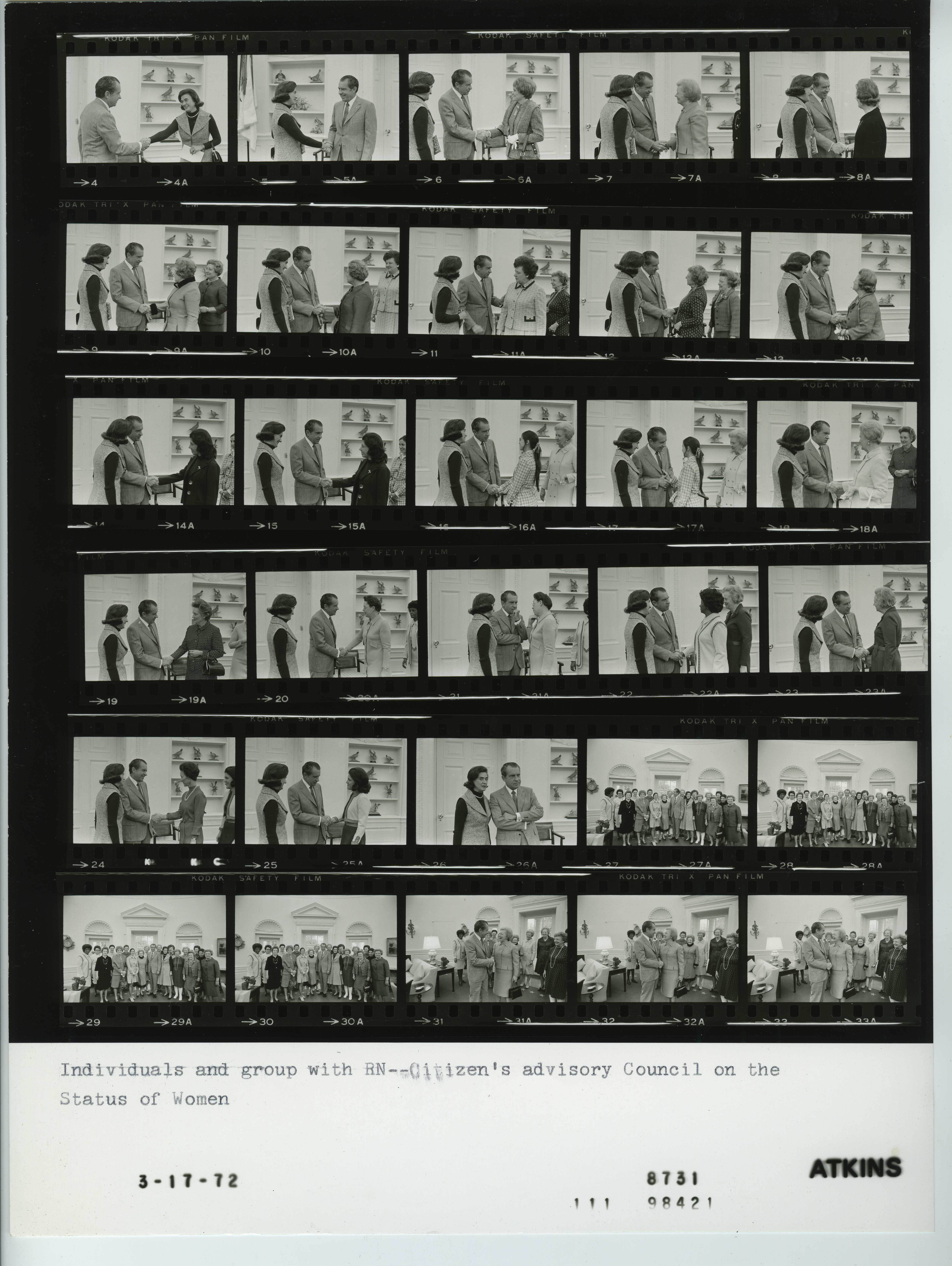
- Frame(s): WHPO-8731-04-26, President Nixon greeting individual members of the Citizen's Advisory Council on the Status of Women in the Oval Office. 3/17/1972, Washington, D.C. White House, Oval Office. President Nixon, advisory council members: Mrs. Elizabeth D. Koontz (Deputy Assistant Secretary of Labor Women's Bureau), Miss Hazel Palmer (Attorney), Irene Wischer (President Paladin Pipeline Co.), Julie Casterman Connor (school teacher), Dr. Margeret Long Arnold (President General Federation of Women's Clubs New York), Mrs. Jacqueline G. Gutwillig (Chairman, Arizona), Mrs. Lorraine L. Blair (President, Lorraine Blair, Inc., Investments; Illinois), Mrs. Chapman Revercomb (Civic Leader, West Virginia), Mrs. Daniel H. Wasserman (Civic Leader; Ohio), Second Row: Mrs. Catherine East (Advisory Council Executive Secretary), Sarah Jane Cunningham (Attorney; Nebraska), Mrs. Robert A. Griffin (Civic Leader; North Carolina), Mrs. Charles M. Hamel, (Vice President, Hamel's Dairy & Ice Cream Company, Inc.; Louisiana), Miss Nola A. Allen (Attorney; Indiana), Miss Maxine R. Hacke (Warren Petroleum Corporation; Oklahoma), Miss Margaret J. Mealey (Executive Director, National Council of Catholic Women; Washington, D. C.), Mrs. Bertha Whittaker (Deputy to Catherine East), Mrs. Paul Bethel (U. S. Citizens' Committee for Free Cuba: Florida).
- Frame(s): WHPO-8731-27-33, President Nixon posing for a group portrait with members of the Citizen's Advisory Council on the Status of Women. 3/17/1972, Washington, D.C. White House, Oval Office. President Nixon, advisory council members: Mrs. Elizabeth D. Koontz (Deputy Assistant Secretary of Labor Women's Bureau), Miss Hazel Palmer (Attorney), Irene Wischer (President Paladin Pipeline Co.), Julie Casterman Connor (school teacher), Dr. Margeret Long Arnold (President General Federation of Women's Clubs New York), Mrs. Jacqueline G. Gutwillig (Chairman, Arizona), Mrs. Lorraine L. Blair (President, Lorraine Blair, Inc., Investments; Illinois), Mrs. Chapman Revercomb (Civic Leader, West Virginia), Mrs. Daniel H. Wasserman (Civic Leader; Ohio), Second Row: Mrs. Catherine East (Advisory Council Executive Secretary), Sarah Jane Cunningham (Attorney; Nebraska), Mrs. Robert A. Griffin (Civic Leader; North Carolina), Mrs. Charles M. Hamel, (Vice President, Hamel's Dairy & Ice Cream Company, Inc.; Louisiana), Miss Nola A. Allen (Attorney; Indiana), Miss Maxine R. Hacke (Warren Petroleum Corporation; Oklahoma), Miss Margaret J. Mealey (Executive Director, National Council of Catholic Women; Washington, D. C.), Mrs. Bertha Whittaker (Deputy to Catherine East), Mrs. Paul Bethel (U. S. Citizens' Committee for Free Cuba: Florida).
Roll WHPO-8732 Photographer: Atkins, Oliver | Color or B&W: B&W
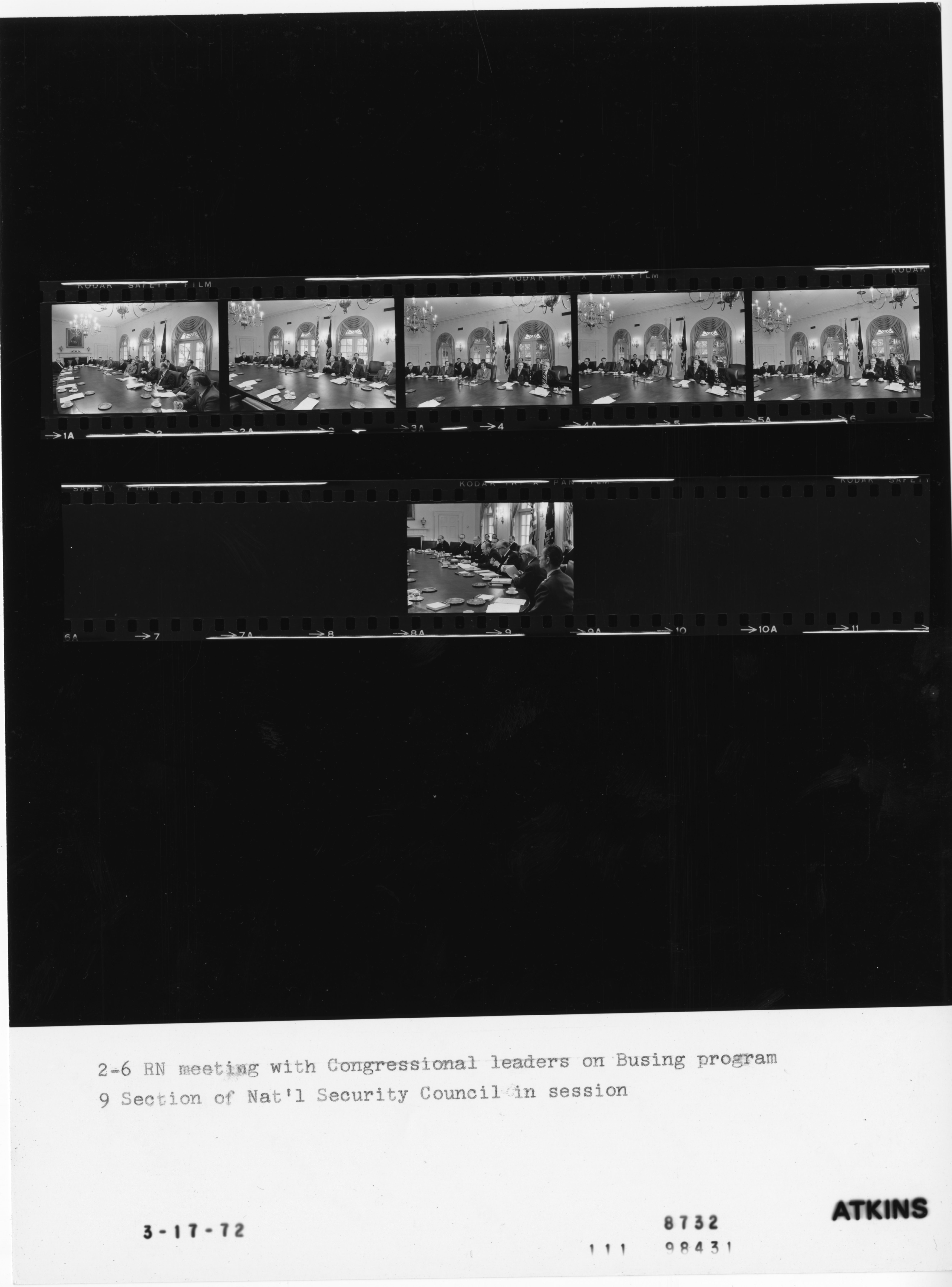
- Frame(s): WHPO-8732-02-06, President Nixon attending a meeting of bipartisan Congressional leaders discussing busing legislation. 3/17/1972, Washington, D.C. White House, Cabinet Room. President Nixon,Representatives James Eastland, Roman Hruska, Robert Griffin, Robert Byrd, Hugh Scott, Carl Albert, Mike Mansfield, Gerald Ford, William McCulloch, Albert Quie, George Lincoln, John Irwin II, William Rogers, Laird ,Thomas Moorer, unidentified officials possibly Pat Buchanan in background.
- Frame(s): WHPO-8732-06, President Nixon attending a meeting of bipartisan Congressional leaders discussing busing legislation. 3/17/1972, Washington, D.C. White House, Cabinet Room. President Nixon,Representatives Hugh Scott, Carl Albert, Mike Mansfield, Gerald Ford, Robert Byrd, unidentified officials, possibly Pat Buchanan in background.
- Frame(s): WHPO-8732-09, President Nixon attending a meeting of the National Security Council (NSC). 3/17/1972, Washington, D.C. White House, Cabinet Room. President Nixon, James Eastland, Roman Hruska, Robert Griffin, Robert Byrd, Hugh Scott, Carl Albert, Mike Mansfield, Gerald Ford, William McCulloch, Albert Quie, George Lincoln, John Irwin II, William Rogers, Laird ,Thomas Moorer, unidentified officials.
Roll WHPO-8733 Photographer: Schumacher, Karl | Color or B&W: B&W
- Frame(s): WHPO-8733-, Portrait of a group of unidentified youths standing on the White House Diplomatic Entrance area steps. 3/17/1972, Washington, D.C. steps, Diplomatic Entrance, White House. unidentified youths, adults.
Roll WHPO-8734 Photographer: Knudsen, Robert L. | Color or B&W: B&W
- Frame(s): WHPO-8734-, President Nixon receiving St. Patrick's Day gifts from Irish Ambassador William Warnock and Mrs. Warnock. 3/17/1972, Washington, D.C. White House, Oval Office. President Nixon, William Warnock, Mrs. Warnock.
- Frame(s): WHPO-8734-22, President Nixon receiving St. Patrick's Day gifts from Irish Ambassador William Warnock and Mrs. Warnock. Mrs. Warnock affixes a pin on President Nixon's lapel. 3/17/1972, Washington, D.C. White House, Oval Office. President Nixon, William Warnock, Mrs. Warnock.
Roll WHPO-8735 Photographer: Atkins, Oliver | Color or B&W: B&W
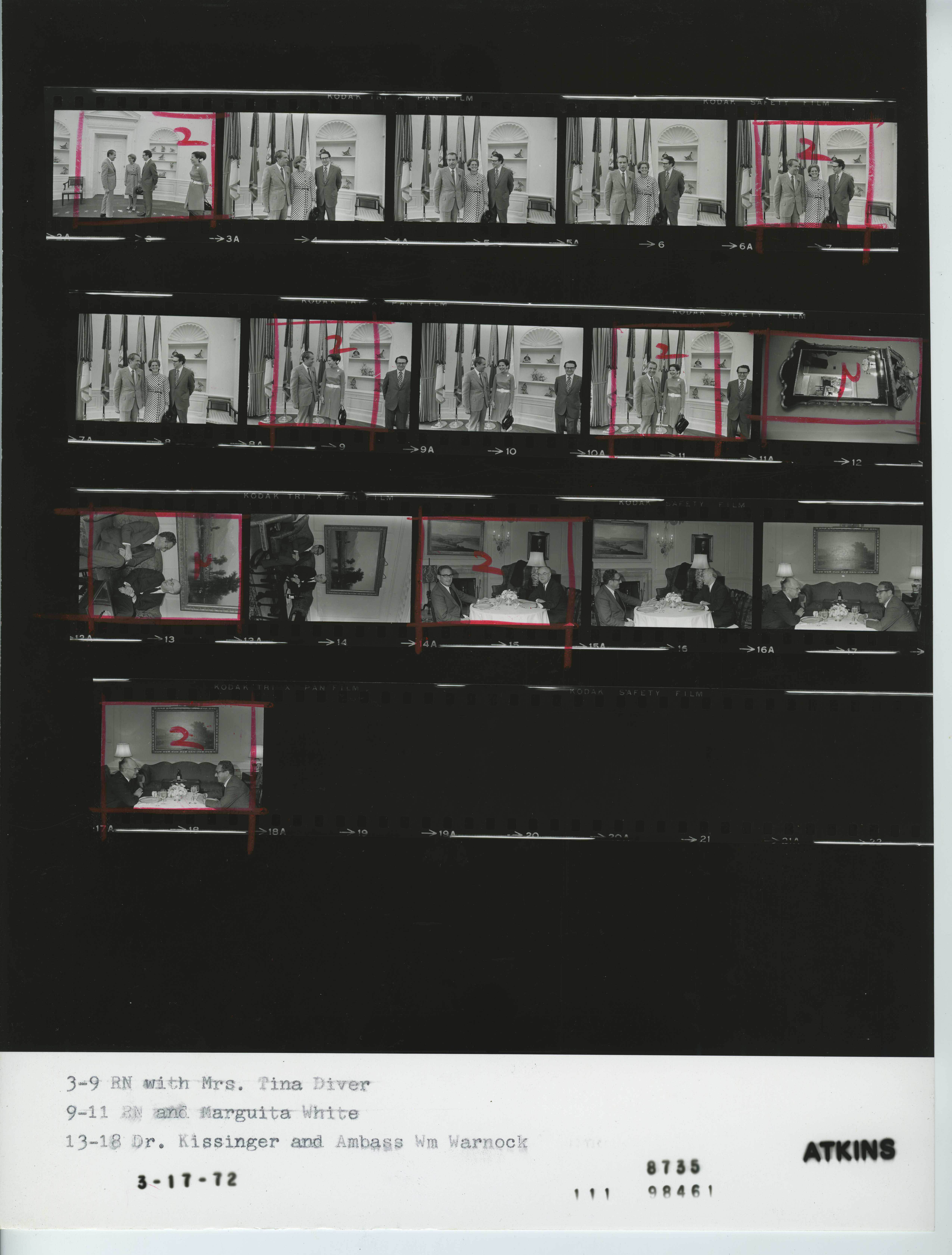
- Frame(s): WHPO-8735-02-12, President Nixon standing with Tina Diver, Neil Diver, and Margita White in various shots. 3/17/1972, Washington, D.C. White House, Oval Office; unknown. President Nixon, Tina Diver, Neil Diver, Margita White, Kissinger, William Warnock.
- Frame(s): WHPO-8735-13-18, Henry Kissinger and Anatoly Dobrynin seated on a sofa and at a small table. 3/17/1972, Washington, D.C. White House, Map Room. Henry Kissinger, Anatoly Dobrynin.
The White House Communications Agency Sound Recordings Collection contains public statements that took place between 1969 and 1974. Visit the finding aid to learn more.
G - Cabinet Officer Briefings
- WHCA-SR-G-158
Press briefing by Ronald Ziegler, John D. Ehrlichman, George Shultz, Sec. Elliot Richardson (Health, Education and Welfare) and Richard Kleindeinst on busing, with Mr. Edward and Mr. Hastings. (3/17/1972, East Room)
Runtime: 1:25:00
Production credits: Audio feed supplied by WHCA; Recorded by RSM (initials of WHCA engineer)
Original Format: 1/4-inch reel-to-reel audiotape. Original source type: Original. - WHCA-SR-G-159
Briefing in Herb Klein's office by Secretary of Health, Education and Welfare Elliot Richardson on the constitutionality of busing. (3/17/1972, Herb Klein's Office)
Runtime: 55:00:00
Production credits: Audio feed supplied by WHCA; Recorded by LDH (initials of WHCA engineer)
Original Format: 1/4-inch reel-to-reel audiotape. Original source type: Original.
H - White House Staff Member Recordings
- WHCA-SR-H-539
Briefing by Patrick Buchanan on busing. (3/17/1972, Room 160, Executive Office Building)
Runtime: 44:00:00
Keywords: busing, bills, laws, legislation, segregation, desegregation, racism, African Americans, schools, students, transportation, Briefings, public briefings, statements to the press (see also Press conferences, news conferences, interviews, media)
Production credits: Audio feed supplied by WHCA; Recorded by ATF (initials of WHCA engineer)
Original Format: 1/4-inch reel-to-reel audiotape. Original source type: Original.
The White House Communications Agency Videotape Collection contains “off-the-air” recordings of televised programs produced between 1968 and 1974. Visit the finding aid to learn more.
- WHCA-5220
Weekly News Summary, Tape I.
ALL NETWORKS
Runtime: 01:34:40
1. Smith/Jarriel: President Nixon briefs Congress on proposed building legislation. Time Code Start: 00:00. Keywords: Presidents, House of Representatives, meetings. Network: ABC.
2. Smith/Clark: Will Congress pass the anti-busing bill?. Time Code Start: 02:43. Keywords: House of Representative, voting, bills, laws, legislation, desegregation, racism, racial discrimination, African Americans, schools, students, transportation, reports. Network: ABC.
3. Reynolds: Busing and the candidates (Governor George Wallace, Hubert Humphrey, Muskie, McGovern, Jackson). Time Code Start: 04:35. Keywords: Senators, Governors, bills, laws, legislation, desegregation, racism, racial discrimination, African Americans, schools, students, transportation, reports, Presidential elections, campaigns, primaries, candidates. Network: ABC.
4. Smith/Matney: Busing in Richmond, Virgina. Time Code Start: 09:28. Keywords: bills, laws, legislation, desegregation, racism, racial discrimination, African Americans, schools, students, transportation, reports. Network: ABC.
5. Smith/Donaldson: Reactions to President Nixon's anti-busing bill (Roy Wilkins of NAACP, Richardson, Goldberg). Time Code Start: 12:42. Keywords: organizations, National Association for the Advancement of Colored People (NAACP), leaders, officials, bills, legislation, segretation, schools, students, transportation, reports. Network: ABC.
6. Smith: Senator Scott on the International Telephone & Telegraph (ITT Corporation) investigation. Time Code Start: 16:34. Keywords: International Telephone & Telegraph, communications, world, corporations, conglomerates, campaign funding, investigations. Network: ABC.
7. Smith: Commentary on busing. Time Code Start: 18:00. Keywords: bills, laws, legislation, desegregation, racism, racial discrimination, African Americans, schools, students, transportation, reports. Network: ABC.
8. Chancellor: Dita Beard memo… a hoax?. Time Code Start: 19:52. Keywords: International Telephone & Telegraph (ITT Corporation), communications, world, corporations, conglomerates, campaign funding, investigations. Network: NBC.
9. Nessen: Schools and busing. Time Code Start: 21:00. Keywords: bills, laws, legislation, desegregation, racism, racial discrimination, African Americans, schools, students, transportation, reports. Network: NBC.
10. Duke: Senator Scott, the Dita Beard memo. Time Code Start: 22:32. Keywords: International Telephone & Telegraph (ITT Corporation), communications, world, corporations, conglomerates, campaign funding, investigations. Network: NBC.
11. Chancellor: President Nixon message on busing (Governor George Wallace, Jackson, Humphrey, Muskie, McGovern, Roy Wilkins of NAACP). Time Code Start: 25:35. Keywords: Senators, Governors, Presidential elections, campaigns, primaries, candidates, organizations, National Association for the Advancement of Colored People (NAACP), officials, leaders. Network: NBC.
12. Chancellor/Levine: Phase II, Grayson and food prices. Time Code Start: 32:07. Keywords: food, wage and price controls, freezes, prices, costs, increases, decreases, economy, economics, budgets, finances, recession, inflation, money. Network: NBC.
13. Chancellor/Utley: Wisconsin primary (Hubert Humphrey). Time Code Start: 34:22. Keywords: Presidential elections, campaigns, campaigning, primaries, candidates, voting, speeches. Network: NBC.
14. Cronkite/Strawser: Dita Beard memo (Scott, Anderson). Time Code Start: 37:49. Keywords: International Telephone & Telegraph (ITT Corporation), communications, world corporations, conglomerates, campaign funding, investigations. Network: CBS.
15. Cronkite/Rather: President Nixon's message on busing (Richardson). Time Code Start: 40:50. Keywords: bills, laws, legislation, desegregation, racism, racial discrimination, African Americans, schools, students, transportation, reports. Network: CBS.
16. Cronkite/Dick/Walker: Candidates on President Nixon plan (Governor George Wallace, Jackson, New York Mayor Lindsay, Senators Humphrey, Muskie, McGovern, McCarthy, Griffin, Thurmond, & Brooke). Time Code Start: 43:20. Keywords: Senators, Governors, Presidential elections, campaigns, primaries, candidates. Network: CBS.
17. Cronkite: Vietnam; Lt. Norris Charles. Time Code Start: 50:00. Keywords: POWs/MIAs, Vietnam Prisoner of War/Missing in Action, Indochina War, Vietnam War, military. Network: CBS.
Context (External Sources)
The Vanderbilt Television News Archive is the world's most extensive and complete archive of television news. They have been recording, preserving and providing access to television news broadcasts of the national networks since August 5, 1968.
Wikipedia is a free encyclopedia that anyone can edit.