
Introduction
This almanac page for Monday, March 13, 1972, pulls together various records created by the federal government and links to additional resources which can provide context about the events of the day.
Previous Date: Sunday, March 12, 1972
Next Date: Tuesday, March 14, 1972
Schedule and Public Documents
The Daily Diary files represent a consolidated record of the President's activities. Visit the finding aid to learn more.
The President's day began at The White House - Washington, D. C.
The Weekly Compilation of Presidential Documents made available transcripts of the President's news conferences; messages to Congress; public speeches, remarks, and statements; and other Presidential materials released by the White House.
Digitized versions can be found at HathiTrust.
Each Public Papers of the Presidents volume contains the papers and speeches of the President of the United States that were issued by the White House Office of the Press Secretary during the time period specified by the volume. The material is presented in chronological order, and the dates shown in the headings are the dates of the documents or events. In instances when the release date differs from the date of the document itself, that fact is shown in the text note.
To ensure accuracy, remarks have been checked against audio recordings (when available) and signed documents have been checked against the original, unless otherwise noted. Editors have provided text notes and cross references for purposes of identification or clarity.
The Federal Register is the official daily publication for rules, proposed rules, and notices of federal agencies and organizations, as well as executive orders and other Presidential documents.
No Federal Register published on this date
The Congressional Record is the official daily record of the debates and proceedings of the U.S. Congress.
Archival Holdings
Any selection of archival documents will necessarily be partial. You should use the documents and folders identified below as a starting place, but consult the linked collection finding aids and folder title lists and the collections themselves for context. Many documents to be found this way do not lend themselves to association with specific dates, but are essential to a complete understanding of the material.
Selective document listing
President's Office Files
The President's Office Files consists of materials drawn together by the Special Files Unit from several administrative subdivisions within the White House Office. It is the handwriting and sensitive papers sent to the Staff Secretary that now comprise much of the President's Office Files. Visit the finding aid to learn more.
- News Summaries, Annotated News Summaries, Box 34, March 11-16, 1972 [1 of 4] [Note: Due to the way News Summary products were compiled, you should also consult nearby days for potentially relevant materials.]
- Weekend News Review, March 13, 1972
- President's Daily Schedule, Box 102, [President's Daily Schedule, Jan.-Mar. 1972] [2 of 3]
- The President's Schedule, Monday - March 13, 1972
The H. R. Haldeman Diaries consists of seven handwritten diaries, 36 dictated diaries recorded as sound recordings, and two handwritten audio cassette tape subject logs. The diaries and logs reflect H. R. Haldeman’s candid personal record and reflections on events, issues, and people encountered during his service in the Nixon White House. As administrative assistant to the President and Chief of Staff, Haldeman attended and participated in public events and private meetings covering the entire scope of issues in which the Nixon White House engaged in during the years 1969-1973. Visit the finding aid to learn more.
- Transcript of diary entry (PDF)
Monday, March 13.
International Telephone and Telegraph [ITT] was the big item again at the staff meeting. We got into a sort of a round robin discussion on what the general perception of the senior staff group was. They all seem to feel the American Telephone and Telegraph [AT&T] attack by Dole was counterproductive, that we just escalate the issue by counterattacking. They think Anderson has been very effective. Rumsfeld argued we should take our losses and get out. Finch argued we should keep the drumbeat to stand by the decision, the more we deplore raising the President’s name, the more it gets tighter connected to the case. Most of them seem to feel that bringing American Telephone and Telegraph [AT&T] in, it indicates there must be something to the International Telephone and Telegraph [ITT] deal, otherwise we wouldn't be counterattacking. Question is whether we can turn the hearing to the merits of the decision. Problem is that we have no administrative-- Administration spokesman, such as the Star story or Geneen talking to McCracken and so forth, also we need a facts sheet explaining how the antitrust operation works. Maybe we should call in the wires and the network bureau chiefs, and point out their misstatements of facts. Our speakers need witnesses to quote, saying this was a sound settlement, such as past antitrust heads. Kennedy apparently is now asking for Price Commission data on International Telephone and Telegraph [ITT] requests, because they've asked for more than anyone. Also suggested by MacGregor that we should sell our subcommittee data, where Geneen testified and all, since that would help us. Mitchell feels that we're not in too bad shape that the American Telephone and Telegraph [AT&T] thing helped, because it confused the issue, and that we have renounced the hotel contributions, but there will remain in the end a way out, by demanding that the Democrats do likewise. President didn't seem overly concerned about that whole issue today, although he did have a long session with Colson this afternoon on it.
Rogers called me this morning at the-- before the start of the staff meeting, and he was really furious, because he said that some Congressmen were up at Clark MacGregor's last night for dinner, and he was, too. And an argument arose about the Kissinger briefing on Wednesday, at the House Foreign Affairs Committee, and Rogers had heard nothing about such a briefing. Rogers says therefore he won't testify on Tuesday, as he's scheduled to do. He says Wayne Hays and some others said they wouldn't go to Kissinger’s briefing that they were on Rogers's side, and so on. Problem is Reilly Evans was sitting there listening to all this. He thinks there's a problem with Kissinger having a private briefing, Rogers does, so he's going to cancel his own committee appearance. He thinks it's going to make a huge flap. He thought the understanding was that he would be handling the Hill. But there's a problem of doing it both ways, one in public and one in private, and that we shouldn't have this kind of thing, that we can go on through it before, and so on. I found out that State was aware of the Kissinger briefing plan. That Charlie Browd from State sat in the meeting on Friday that Henry insisted on doing the meeting after Rogers testified, so he wouldn't interfere with Rogers' testimony. And Dave Asher regularly attends the Kissinger briefings of this kind, so Rogers really has no complaint other than once again his own ego.
The President, I raised this with him this morning, and he felt we should postpone the House meeting on Wednesday, but that Kissinger has to see the House group at some time. We should postpone it because Throckmorton can’t make it. Have MacGregor put it off, and then when we do schedule it, include the House leaders as well as the committee members.
President had MacGregor in a little later, and raised the same point with him. Said that if the problem is, that if Kissinger doesn't meet with the committees, then we're going to have the constitutional issue on the White House mystery man, which does us even more harm, so we've got to work it out.
The President asked me to talk to Mitchell today about disclosure of campaign contributors, and I did raise it with John. He said we'd have a substantial problem if we did that, because our money was raised on the basis that we would not report it. He thinks we should just say that we'll follow the statutes, and we should just straight-arm it, saying we're complying with the law. Our answer would be that the President’s not involved, this is a private committee for his reelection. He thinks it will all go away April 7 when we start reporting. We'll include all the dollars we've collected then, and since we've had a mass mailing, we should have a large number of people, which we can also mention, although we won't give them names. He thinks the whole issue will go away April 7, and it's just not possible for us to do anything any other way than by straight-arming it as of now.
President felt that we should work up a statement for Stans on the contributions, using the line that we will report everything according to the law, that we have absolutely nothing to hide, that we are setting up the machinery now for reporting, mention that the President’s not doing any campaigning now in the primary campaigns.
President also got into the Gridiron some more, he seems to be glad he's made the decision to go. And he decided today to give the Chinese panda bears to the National Zoo in Washington, called Crosby Noyes to tell him so, quoting my story about the pandas needing to have mating lessons before they came over.
-------------------------------------------------------------------------------------------------------------------
PRIVACY- Reviewed and released under Deed of Gift, DR, NARA, September 11, 2014
Audio Cassette 19, Side B.
Duration: 6 seconds
The President left for the day went over to the EOB to have dinner so as to escape Helene Drown.
-------------------------------------------------------------------------------------------------------------------
End of March 13. - Original audio recording (MP3)
The National Archives Catalog is the online portal to the records held at the National Archives, and information about those records. It is the main way of describing our holdings and also provides access to electronic records and digitized versions of our holdings.
The Catalog searches across multiple National Archives resources at once, including archival descriptions, digitized and electronic records, authority records, and web pages from Archives.gov and the Presidential Libraries. The Catalog also allows users to contribute to digitized historical records through tagging and transcription.
Nixon Library Holdings
All National Archives Units
National Security Documents
The President's Daily Brief is the primary vehicle for summarizing the day-to-day sensitive intelligence and analysis, as well as late-breaking reports, for the White House on current and future national security issues. Read "The President's Daily Brief: Delivering Intelligence to Nixon and Ford" to learn more.
The Foreign Relations of the United States series presents the official documentary historical record of major U.S. foreign policy decisions and significant diplomatic activity. Visit the State Department website for more information.
Vol. VIII, Vietnam, January-October 1972
Before the Easter Offensive, January 20-March 29, 1972
40. Memorandum From the Special Assistant for Vietnamese Affairs, Central Intelligence Agency (Carver), to Director of Central Intelligence Helms, Washington, March 13, 1972
Source: Central Intelligence Agency, Files of the Deputy Director for Intelligence, Job 80–R01720R, Box 7, GAC [George A. Carver] Chronology, March 1972. Top Secret. Copies were sent to Colby, Karamessines, and Nelson.
Vol. XVII, China, 1969-1972
China, March-December 1972
212. Conversation Among President Nixon, his Assistant for National Security Affairs (Kissinger), and his Chief of Staff (Haldeman), Washington, March 13, 1972, 8:23-8:28 a.m.
Source: National Archives, Nixon Presidential Materials, White House Tapes, Oval Office, Conversation No. 683–4. No classification marking. The editor transcribed the portion of the conversation printed here specifically for this volume.
Vol. XX, Southeast Asia, 1969-1972
Thailand
155. Telegram From the Embassy in Indonesia to the Department of State, Djakarta, March 13, 1972, 0515Z
Source: National Archives, RG 59, Central Files 1970–73, POL 7 US/GREEN. Secret; Exdis. Repeated to Bangkok.
Indonesia
330. Telegram From the Embassy in Indonesia to the Department of State, Djakarta, March 13, 1972, 1130Z
Source: National Archives, RG 59, Central Files 1970–73, POL 7 US/NIXON. Secret; Priority; Exdis.
Vol. XXIV, Middle East Region and Arabian Peninsula, 1969-1972; Jordan, September 1970
Persian Gulf States
113. Memorandum From the President’s Assistant for National Security Affairs (Kissinger) to President Nixon, Washington, March 13, 1972
Source: National Archives, Nixon Presidential Materials, NSC Files, NSC Institutional Files (H-Files), Box H–220, National Security Decision Memoranda, NSDM 92. Secret. Sent for information. A notation on the memorandum indicates that the President saw it.
Vol. E-1, Documents on Global Issues, 1969-1972
Oceans Policy
424. National Security Decision Memorandum 157, Washington, March 13, 1972
The President approved instructions for the U.S. delegation to the preparatory meeting for the 1973 Law of the Sea Conference and requested a report to guide the development of subsequent negotiating positions.
Source: National Archives, Nixon Presidential Materials, NSC Files, Box 364, Subject Files, National Security Defense Memoranda, Nos. 145-264. Secret. A copy was sent to the Director of Central Intelligence.
Vol. E-10, Documents on American Republics, 1969-1972
Cuba
256. Study Prepared in the Department of State, Washington, March 13, 1972., Washington, March 13, 1972
The Bureau of Politico-Military Affairs at the Department of State prepared a study on Soviet Naval Deployments to the Caribbean.
Source: National Archives, Nixon Presidential Materials, NSC Files, NSC Institutional Files (H-Files), Box H–189, National Security Study Memoranda (NSSM), NSSM 144. Top Secret. It was sent under a covering March 13 memorandum from Ronald I. Spiers, in his capacity as Chairman of the NSC/IPMG, to Kissinger in response to NSSM 144, January 14. (Ibid.)
Vol. E-10, Documents on American Republics, 1969-1972
Haiti
406. Briefing Memorandum From the Director of the Office of Caribbean Countries (Broderick) to the Assistant Secretary of State for Inter-American Affairs (Meyer), Washington, March 13, 1972., Washington, March 13, 1972
Director of the Office of Caribbean Countries Broderick provided Assistant Secretary Meyer with a current overview and assessment of U.S. policy toward Haiti, in anticipation of a March 14 meeting with an official visit by Haitian officials.
Source: National Archives, RG 59, Central Files 1970–73, POL 7 HAI. Confidential. Sent through Hurwitch. Drafted on March 13 by Ross; cleared by ARA/CAR, ARA–LA/CAR, LA/DP, and AA/LA.
Vol. E-13, Documents on China, 1969-1972
117. Telegram 625 From the Embassy in France to the White House, March 13, 1972, 1219Z, March 13, 1972, 1219Z
Ambassador to France Watson asked how he should handle press inquiries about his talks with the Chinese.
Source: National Archives, Nixon Presidential Materials, NSC Files, Box 1037, Files for the President-China Material, China, March 10, 1972-April 1973. Secret; Eyes Only. Sent to the White House eyes only for Kissinger. A handwritten notation on the telegram reads: “HAK, Haig, Lord.”118. Telegram 626 From the Embassy in France to the White House, March 13, 1972, 1219Z, March 13, 1972, 1219Z
Ambassador to France Watson informed President’s Assistant for National Security Affairs Kissinger of his first meeting with Chinese Ambassador to France Huang Chen and relayed Huang’s relief that their talks in the future would only be shared with Kissinger and President Nixon.
Source: National Archives, Nixon Presidential Materials, NSC Files, Box 1037, Files for the President-China Material, China, March 10, 1972-April 1973. Secret; Eyes Only. Sent to the White House eyes only for Kissinger. A handwritten notation on the telegram reads: “HAK, Haig, Lord.”
The Kissinger telephone conversation transcripts consist of approximately 20,000 pages of transcripts of Kissinger’s telephone conversations during his tenure as Assistant to the President for National Security Affairs (1969-1974) and Secretary of State (1973-1974) during the administration of President Richard Nixon. Visit the finding aid for more information.
Digitized versions can be found in the National Archives Catalog.
Audiovisual Holdings
Visit the White House Tapes finding aid to learn about the taping system's operation and archival processing.
Old Executive Office Building
- 323-8; Unknown between 6:05 p.m. & 6:07 p.m.; Nixon, Richard M. (President); Sanchez, Manolo
- 323-9; 6:07 p.m. - 6:08 p.m.; Nixon, Richard M. (President); Haldeman, H. R. ("Bob")
- 323-10; 6:12 p.m. - 6:17 p.m.; Nixon, Richard M. (President); Kissinger, Henry A.
- 323-11; Unknown between 6:17 p.m. & 6:22 p.m.; Nixon, Richard M. (President); White House operator
- 323-12; 6:22 p.m. - 6:28 p.m.; Nixon, Richard M. (President); Ziegler, Ronald L.
- 323-13; 6:28 p.m. - 6:28 p.m.; Nixon, Richard M. (President); White House operator
- 323-14; 6:29 p.m. - 6:34 p.m.; Nixon, Richard M. (President); Colson, Charles W.
- 323-15; Unknown between 6:34 p.m. & 8:09 p.m.; Nixon, Richard M. (President); [Unknown person(s)]
- 323-16; Unknown between 6:34 p.m. & 8:09 p.m.; Nixon, Richard M. (President); Sanchez, Manolo
- 323-17; Unknown between 6:34 p.m. & 8:09 p.m.; Nixon, Richard M. (President); Sanchez, Manolo
- 323-18; Unknown between 6:34 p.m. & 8:09 p.m.; Nixon, Richard M. (President); Haldeman, H. R. ("Bob")
- 323-19; Unknown between 6:34 p.m. & 8:09 p.m.; Nixon, Richard M. (President); Sanchez, Manolo
- 323-20; Unknown between 6:34 p.m. & 8:09 p.m.; Nixon, Richard M. (President); Sanchez, Manolo
- 323-21; Unknown between 6:34 p.m. & 8:09 p.m.; Nixon, Richard M. (President); Sanchez, Manolo
- 323-22; Unknown between 6:34 p.m. & 8:09 p.m.; Nixon, Richard M. (President); [Unknown person(s)]
- 323-23; Unknown between 6:34 p.m. & 8:09 p.m.; Nixon, Richard M. (President)
- 323-24; Unknown between 6:34 p.m. & 8:09 p.m.; Nixon, Richard M. (President); Sanchez, Manolo
Oval Office
- 683-1; Unknown between 8:54 a.m. & 9:41 a.m.; Nixon, Richard M. (President); Ehrlichman, John D.
- 683-2; Unknown between 8:54 a.m. & 9:41 a.m.; Nixon, Richard M. (President); Bull, Stephen B.
- 683-3; 9:41 a.m. - 10:15 a.m.; Nixon, Richard M. (President); Ziegler, Ronald L.; Bull, Stephen B.; Eisenhower, Julie Nixon
- 683-4; 10:15 a.m. - 12:01 p.m.; Nixon, Richard M. (President); Haldeman, H. R. ("Bob"); Butterfield, Alexander P.; Bull, Stephen B.; Ziegler, Ronald L.; White House operator; Noyes, Croby S.; Stuart, Constance M.; Kissinger, Henry A.
- 683-5; Unknown between 12:02 p.m. & 12:05 p.m.; Bull, Stephen B.; Butterfield, Alexander P.; [Unknown person(s)]
- 683-6; Unknown between 12:02 p.m. & 12:17 p.m.; Nixon, Richard M. (President); Bull, Stephen B.; [Unknown person(s)]; Whitman, Marina von Neumann; Whitman, Robert (Dr.); Whitman, Malcolm; Whitman, Laura; Pierce, Josephine; Stein, Herbert; Solomon, Ezra; Shultz, George P.; Safire, William L.; Franklin, Barbara H.; McArdle, Paul; White House photographer
- 683-7; 12:18 p.m. - 1:07 p.m.; Nixon, Richard M. (President); Berman, Ronald S.; Garment, Leonard; Powell, William J.; Sanchez, Manolo
- 683-8; Unknown between 1:07 p.m. & 1:10 p.m.; Nixon, Richard M. (President); Sanchez, Manolo
- 683-9; 1:10 p.m. - 2:02 p.m.; Nixon, Richard M. (President); Haldeman, H. R. ("Bob"); [Unknown person(s)]; MacGregor, Clark; Sanchez, Manolo
- 683-10; 2:50 p.m. - 2:54 p.m.; Nixon, Richard M. (President); Butterfield, Alexander P.
- 683-11; 2:54 p.m. - 3:02 p.m.; Nixon, Richard M. (President); Ziegler, Ronald L.
- 683-12; Unknown between 3:02 p.m. & 3:05 p.m.; Nixon, Richard M. (President); Bull, Stephen B.
- 683-13; 3:05 p.m. - 3:12 p.m.; Nixon, Richard M. (President); Bull, Stephen B.; Murray, Grover E.; Bradford, John R.; Cook, Richard K.; Nidecker, John E.; White House photographer
- 683-14; Unknown between 3:12 p.m. & 3:15 p.m.; Nixon, Richard M. (President); [Unknown person(s)]
- 683-15; 3:15 p.m. - 3:41 p.m.; Nixon, Richard M. (President); Passman, Otto E.; Kissinger, Henry A.; Cook, Richard K.; White House photographer
- 683-16; Unknown between 3:41 p.m. & 3:48 p.m.; Nixon, Richard M. (President); Bull, Stephen B.
- 683-17; Unknown between 3:41 p.m. & 3:48 p.m.; Nixon, Richard M. (President); Ehrlichman, John D.
- 683-18; Unknown between 3:41 p.m. & 3:48 p.m.; Nixon, Richard M. (President); Bull, Stephen B.
- 683-19; Unknown between 3:41 p.m. & 3:48 p.m.; Nixon, Richard M. (President); White House operator
- 683-20; 3:48 p.m. - 4:58 p.m.; Nixon, Richard M. (President); Colson, Charles W.; Clawson, Kenneth W.; Keogh, James; Sanchez, Manolo
- 683-21; Unknown between 2:54 p.m. & 3:02 p.m.; Bull, Stephen B.
- 684-1; Unknown between 3:48 p.m. & 6:03 p.m.; Nixon, Richard M. (President); Colson, Charles W.; Clawson, Kenneth W.; White House operator; Haldeman, H. R. ("Bob"); Nixon, Thelma C. ("Pat") (Ryan); Bull, Stephen B.; Sanchez, Manolo
- 684-2; Unknown between 6:03 p.m. & 6:05 p.m.; Nixon, Richard M. (President); Haldeman, H. R. ("Bob"); Butterfield, Alexander P.
- 684-3; Unknown between 6:03 p.m. & 6:05 p.m.; Nixon, Richard M. (President); [Unknown person(s)]
White House Telephone
- 21-48; 10:06 a.m. - 10:07 a.m.; Nixon, Richard M. (President); Eisenhower, Julie Nixon; [Unknown person(s)]
- 21-49; Unknown between 10:07 a.m. & 11:16 a.m.; Nixon, Richard M. (President); White House operator
- 21-50; 11:16 a.m. - 11:21 a.m.; Nixon, Richard M. (President); Noyes, Croby S.
- 21-51; Unknown between 11:21 a.m. & 3:50 p.m.; Haldeman, H. R. ("Bob"); White House operator
- 21-52; Unknown between 11:21 a.m. & 3:50 p.m.; Haldeman, H. R. ("Bob"); Stuart, Constance M.
- 21-53; Unknown between 11:21 a.m. & 3:50 p.m.; Nixon, Richard M. (President); White House operator
- 21-54; 3:50 p.m. - 3:52 p.m.; Nixon, Richard M. (President); Keogh, James
- 21-55; Unknown between 3:52 p.m. & 5:11 p.m.; Nixon, Richard M. (President); White House operator
- 21-56; 5:11 p.m. - 5:12 p.m.; Nixon, Richard M. (President); Nixon, Thelma C. ("Pat") (Ryan)
- 21-57; 6:07 p.m. - 6:08 p.m.; Nixon, Richard M. (President); Haldeman, H. R. ("Bob")
- 21-58; 6:12 p.m. - 6:17 p.m.; Nixon, Richard M. (President); Kissinger, Henry A.
- 21-59; Unknown between 6:17 p.m. & 6:22 p.m.; Nixon, Richard M. (President); White House operator
- 21-60; 6:22 p.m. - 6:28 p.m.; Nixon, Richard M. (President); Ziegler, Ronald L.
- 21-61; 6:28 p.m. - 6:28 p.m.; Nixon, Richard M. (President); White House operator
- 21-62; 6:29 p.m. - 6:34 p.m.; Nixon, Richard M. (President); Colson, Charles W.
The White House Photo Office collection consists of photographic coverage of President Richard Nixon meeting with prominent social, political, and cultural personalities; speaking engagements and news conferences of the President and various high-ranking members of the White House staff and Cabinet; Presidential domestic and foreign travel, including Presidential vacations; social events and entertainment involving the First Family, including entertainers present; official portraits of the President, First Family, and high-ranking members of the Nixon administration; the 1969 and 1973 Inaugurals; the President’s 1972 Presidential election campaign appearances (including speeches) and other official activities of the White House staff and the President’s Cabinet from January 20, 1969 until August 9, 1974 at the White House and the Old Executive Office Building; other locations in Washington, DC, such as The Mall; and the Presidential retreats in Camp David, Maryland, Key Biscayne, Florida, and San Clemente, California. Visit the finding aid to learn more.
Roll WHPO-8699 Photographer: Knudsen, Robert L. | Color or B&W: B&W
- Frame(s): WHPO-8699-, Jewish Media and Publication editors. 3/13/1972, Washington, D.C. Jacqueline Kennedy Garden, White House. editors.
Roll WHPO-8700 Photographer: Knudsen, Robert L. | Color or B&W: B&W
- Frame(s): WHPO-8700-02A, The swearing-in ceremony for Marina von Neumann Whitman as a member of the Council of Economic Advisers. 3/13/1972, Washington, D.C. White House, Oval Office. President Nixon, Marina von Neumann Whitman, Judge Paul McArdle, Robert Whitman.
- Frame(s): WHPO-8700-18A-22A, President Nixon standing and seated at his desk with Ronald Berman. 3/13/1972, Washington, D.C. White House, Oval Office. President Nixon, Marina von Neumann Whitman, Judge Paul McArdle, Whitman family members, Herb Stein, Ezra Solomon, Ronald Berman, Len Garment.
- Frame(s): WHPO-8700-2A-14A, The swearing-in ceremony for Marina von Neumann Whitman as a member of the Council of Economic Advisers. 3/13/1972, Washington, D.C. White House, Oval Office. President Nixon, Marina von Neumann Whitman, Judge Paul McArdle, Whitman family members, Herb Stein, Ezra Solomon, Ronald Berman, Len Garment.
Roll WHPO-8701 Photographer: Atkins, Oliver | Color or B&W: B&W
- Frame(s): WHPO-8701-02-05, President Nixon standing in the Oval Office with Texas Congressman George Mahon, Texas Tech President Grover Murray and John Bradford, Dean of Engineering at Texas Tech University. 3/13/1972, Washington, D.C. White House, Oval Office. President Nixon, George H. Mahon, Grover E. Murray, John Bradford, Assistants: Richard K. Cook, John E. Nidecker.
- Frame(s): WHPO-8701-05, President Nixon standing in the Oval Office with Texas Congressman George Mahon, Texas Tech President Grover Murray and John Bradford, Dean of Engineering at Texas Tech University. 3/13/1972, Washington, D.C. White House, Oval Office. President Nixon, George H. Mahon, Grover E. Murray, John Bradford, Assistants.
- Frame(s): WHPO-8701-08-14, President Nixon standing and seated at his Oval office desk during a meeting with Congressman Otto Passman. 3/13/1972, Washington, D.C. White House, Oval Office. President Nixon, Rep. Otto E. Passman.
- Frame(s): WHPO-8701-11, President Nixon seated at his Oval Office desk during a meeting with Congressman Otto Passman. 3/13/1972, Washington, D.C. White House, Oval Office. President Nixon, Rep. Otto E. Passman.
Roll WHPO-8702 Photographer: Atkins, Oliver | Color or B&W: B&W
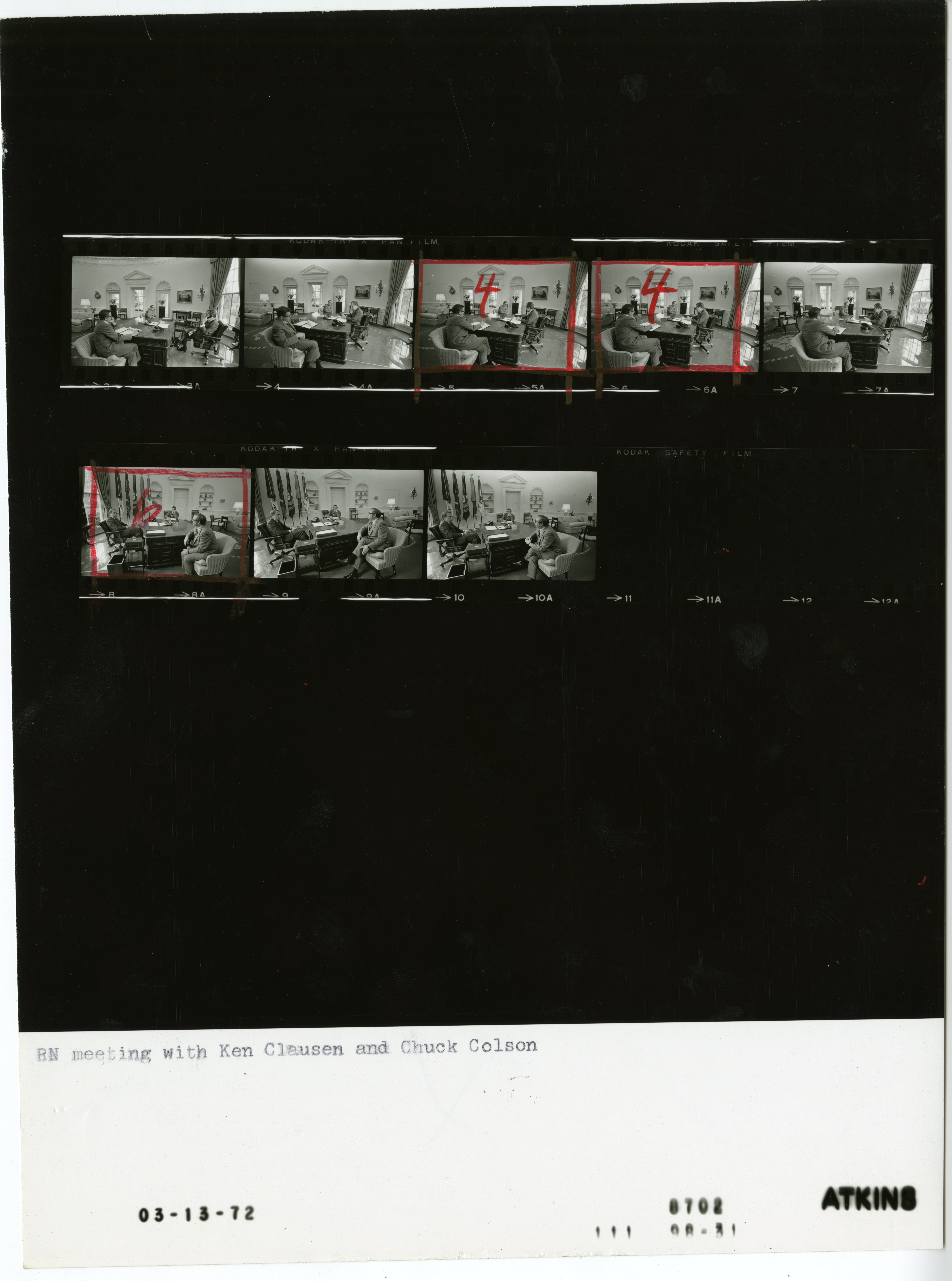
- Frame(s): WHPO-8702-, President Nixon seated at his desk during a meeting with Charles Colson and Ken Clawson. 3/13/1972, Washington, D.C. White House, Oval Office. President Nixon, Charles W. Colson, Ken Clawson.
Roll WHPO-8703 Photographer: Kightlinger, Jack | Color or B&W: Color
- Frame(s): WHPO-8703-, Pat Nixon in a receiving line and group photos with members of the St. Louis Symphony, of the University of Missouri Chorus, and other persons from Missouri. 3/13/1972, Washington, D.C. entrance and interior, State Dining Room. Pat Nixon, symphony members, chorus members, Missourians.
Roll WHPO-8704 Photographer: Knudsen, Robert L. | Color or B&W: B&W
- Frame(s): WHPO-8704-, Herb Klein greeting with Jewish Media and Publication editors. 3/13/1972, Washington, D.C. unidentified room, White House. Herb Klein, editors.
Roll WHPO-8705 Photographer: Knudsen, Robert L. | Color or B&W: B&W
- Frame(s): WHPO-8705-, Herb Klein shaking hands with Jewish Media and Publication editors. 3/13/1972, Washington, D.C. unidentified room, White House. Herb Klein, editors.
Roll WHPO-8708 Photographer: Knudsen, Robert L. | Color or B&W: B&W
- Frame(s): WHPO-8708-02A, Unidentified Jewish Media and Publication editors walking. 3/13/1972, Washington, D.C. White House. Jewish editors.
The White House Communications Agency Sound Recordings Collection contains public statements that took place between 1969 and 1974. Visit the finding aid to learn more.
H - White House Staff Member Recordings
- WHCA-SR-H-533
Briefing to the Jewish press by Herbert Klein and William Safire. (3/13/1972, Indian Treaty Room, Executive Office Building)
Runtime: 40:00:00
Keywords: Press conferences, news conferences, interviews, media
Production credits: Audio feed supplied by WHCA; Recorded by DAS (initials of WHCA engineer)
Original Format: 1/4-inch reel-to-reel audiotape. Original source type: Original. - WHCA-SR-H-534
Briefing to the Jewish press by Herbert Klein, Leonard Garment, Paul McCracken, Vic Davies, and Ronald Berman. (3/13/1972, Family Theater, White House)
Runtime: 4:00:00
Keywords: Press conferences, news conferences, interviews, media
Production credits: Audio feed supplied by WHCA; Recorded by RWF (initials of WHCA engineer)
Original Format: 1/4-inch reel-to-reel audiotape. Original source type: Original.
P - Formal Presidential Remarks
- WHCA-SR-P-720302
Remarks by President Nixon to Nat'l Health Forum. (3/13/1972)
Runtime: 0:52
Keywords: health care, health insurance
Original Format: 1/4-inch reel-to-reel audiotape. Original source type: Original.
The White House Communications Agency Videotape Collection contains “off-the-air” recordings of televised programs produced between 1968 and 1974. Visit the finding aid to learn more.
- WHCA-5190
"Not To My Kid You Don't". three segments from "60 Minutes"
Post-Newsweek Stations, Inc.
Runtime: 01:00:55 - WHCA-5191
"Who Do You Think You Are - A Birds Eye View of California". FTN: U.S. Representative Paul McCloskey (R-CA) and John Ashbrook (R-OH); "MTP": Governor of Florida Reuben Askew; "I&A": U.S. Senator George McGovern (D-SD).
CBS, NBC, ABC
Runtime: 00:29:40 - WHCA-5206
Weekly News Summary, Tape I.
ALL NETWORKS
Runtime: 01:35:27
35. Reasoner/Chapman: China and U.S. meet in Paris. Time Code Start: 86:50. Keywords: Paris Peace Talks, Vietnam War, treaty, treaties, negotiations, government, officials, People's Republic of China. Network: ABC.
36. Smith: Florida Reports: Bell: Governor George Wallace; Donaldson: Hubert H. Humphrey; Matney - Senator McGovern; Jackson - Mayor John Lindsay; Zimmerman: Congresswoman Shirley Chisholm; Zimmerman: Senator Jackson. Time Code Start: 88:57. Keywords: Senators, Governors, Mayors, Presidential elections, campaigns, campaigning, candidates, nominees, debates, speeches, women, African Americans, primaries, candidates, Feminism, Feminist movement, women's rights, Womens Liberation, equality, equal rights, . Network: ABC. - WHCA-5207
Weekly News Summary, Tape II.
ALL NETWORKS
Runtime: 01:33:20
1. Smith: Commentary on how primaries are confusing. Time Code Start: 00:00. Keywords: Presidential elections, campaigns, campaigning, candidates, primaries, voting. Network: ABC.
2. Chancellor/Mackin: Florida. Time Code Start: 01:48. Keywords: elections, campaigns, campaigning, primaries, candidates, voting. Network: NBC.
3. Chancellor: White House and busing. Time Code Start: 05:30. Keywords: President Nixon, statements, segregation, racism, racial discrimination, African Americans, schools, students, transportation, desegregation. Network: NBC.
4. Brinkley: Busing in Florida; statements by Governor George Wallace against busing. Time Code Start: 06:00. Keywords: Governors, bills, laws, legislation, desegregation, racism, racial discrimination, African Americans, schools, students, transportation, reports, Presidential elections, campaigns, primaries, candidates. Network: NBC.
5. Chancellor/Palmer: The Black Convention votes against busing. Time Code Start: 09:40. Keywords: African Americans, leaders, voting, bills, laws, legislation, dedesegregation, racism, schools, students, transportation. Network: NBC.
6. Chancellor/Kaplan: British/China relations; U.S. and Chinese ambassadors meet in Paris. Time Code Start: 12:00. Keywords: Paris Peace Talks, Vietnam War, treaty, treaties, negotiations, government, officials, People's Republic of China. Network: NBC.
7. Cronkite: Florida primary. Time Code Start: 14:27. Keywords: elections, campaigns, campaigning, primaries, candidates, speeches. Network: CBS.
8. Cronkite: Busing (Governor George Wallace, Jackson, Lindsay, Muskie, Hubert Humphrey, McGovern). Time Code Start: 19:57. Keywords: Governors, Senators, bills, laws, legislation, desegregation, racism, racial discrimination, African Americans, schools, students, transportation, reports, Presidential elections, campaigns, primaries, candidates. Network: CBS.
9. Rather/Pierpoint: White House to release stand on busing (Ron Ziegler). Time Code Start: 24:13. Keywords: bills, laws, legislation, desegregation, racism, racial discrimination, African Americans, schools, students, transportation, reports. Network: CBS.
10. Rather/Dunning: Captured Australian photographer released; Vietnam. Time Code Start: 26:45. Keywords: Vietnam War, photographers, kidnappings, releases, prisoners, media, journalists. Network: CBS.
11. Sevareid: Commentary on busing. Time Code Start: 30:05. Keywords: bills, laws, legislation, desegregation, racism, racial discrimination, African Americans, schools, students, transportation, reports. Network: CBS.
Context (External Sources)
The Vanderbilt Television News Archive is the world's most extensive and complete archive of television news. They have been recording, preserving and providing access to television news broadcasts of the national networks since August 5, 1968.
Wikipedia is a free encyclopedia that anyone can edit.