

Introduction
This almanac page for Thursday, March 11, 1971, pulls together various records created by the federal government and links to additional resources which can provide context about the events of the day.
Previous Date: Wednesday, March 10, 1971
Next Date: Friday, March 12, 1971
Schedule and Public Documents
The Daily Diary files represent a consolidated record of the President's activities. Visit the finding aid to learn more.
The President's day began at The White House - Washington, D. C.
The Weekly Compilation of Presidential Documents made available transcripts of the President's news conferences; messages to Congress; public speeches, remarks, and statements; and other Presidential materials released by the White House.
Digitized versions can be found at HathiTrust.
Each Public Papers of the Presidents volume contains the papers and speeches of the President of the United States that were issued by the White House Office of the Press Secretary during the time period specified by the volume. The material is presented in chronological order, and the dates shown in the headings are the dates of the documents or events. In instances when the release date differs from the date of the document itself, that fact is shown in the text note.
To ensure accuracy, remarks have been checked against audio recordings (when available) and signed documents have been checked against the original, unless otherwise noted. Editors have provided text notes and cross references for purposes of identification or clarity.
The Federal Register is the official daily publication for rules, proposed rules, and notices of federal agencies and organizations, as well as executive orders and other Presidential documents.
The Congressional Record is the official daily record of the debates and proceedings of the U.S. Congress.
Archival Holdings
Any selection of archival documents will necessarily be partial. You should use the documents and folders identified below as a starting place, but consult the linked collection finding aids and folder title lists and the collections themselves for context. Many documents to be found this way do not lend themselves to association with specific dates, but are essential to a complete understanding of the material.
Selective document listing
President's Office Files
The President's Office Files consists of materials drawn together by the Special Files Unit from several administrative subdivisions within the White House Office. It is the handwriting and sensitive papers sent to the Staff Secretary that now comprise much of the President's Office Files. Visit the finding aid to learn more.
- Annotated News Summaries, Box 30, News Summaries - March 1971 [1 of 2] [During this period, the Staff Secretary only removed pages from the News Summaries which contained President Nixon's handwriting, often leaving the document with no date. In addition to the individual document(s) listed below, you should also consult the full folder for the month.]
- Wire Reports, March 11, 1971
- [3/11/71]
- [3/11/71]
- Annotated News Summaries, Box 30, News Summaries - March 1971 [2 of 2]
- [3/11/71]
- President's Daily Schedule, Box 101, [President's Daily Schedule, Mar.-May 1971] [1 of 3]
- The President's Schedule, Thursday - March 11, 1971
President's Personal File
The President's Personal File is essentially a President's secretary's file, kept by Rose Mary Woods, personal secretary to the President, for two purposes: (1) preserving for posterity a collection of documents particularly close to the President, whether because he dictated or annotated them, or because of the importance of the correspondent or the event concerned and (2) giving appropriate attention–letters of gratitude, invitations to White House social events, and the like–to members and important friends and supporters of the Nixon administration. This generalization does not describe all the varied materials of a file group which is essentially a miscellany, but it does identify the reason for the existence of the file group's core. Visit the finding aid to learn more.
- President's Speech File
The H. R. Haldeman Diaries consists of seven handwritten diaries, 36 dictated diaries recorded as sound recordings, and two handwritten audio cassette tape subject logs. The diaries and logs reflect H. R. Haldeman’s candid personal record and reflections on events, issues, and people encountered during his service in the Nixon White House. As administrative assistant to the President and Chief of Staff, Haldeman attended and participated in public events and private meetings covering the entire scope of issues in which the Nixon White House engaged in during the years 1969-1973. Visit the finding aid to learn more.
- Transcript of diary entry (PDF)
Thursday, March 11th. The main feature of the day was the law speech to the American Judicial Council in Williamsburg. We choppered down and back. The trip went pretty well, no major problems, a few demonstrators, but we had enough of a crowd of our own people that they didn't get any play. The President gave a good speech. Tom Clark introduced him and closed the meeting and was practically in ecstasy over just the fact that the President was there, let alone his remarks. The President did a very good job of the personal opening with some good humor and off-the-cuff comments before he got into his basic text.
The big problem of the day was the textile question, which got stirred up at staff meeting this morning; and took a good part of the President's morning as he met with Flanigan and Ehrlichman right after the staff meeting; and got into the question with them of what needs to be done now on the basis purely of the political decision; and it was agreed to have John Byrnes come in with Bryce Harlow and MacGregor at 11:00 to work out an approach along lines, apparently developed by Harlow and Byrnes in a long discussion last night. Their thought is for Byrnes to assemble the caucus of the minority members of the Ways and Means Committee and, in effect, repudiate Mills, which is a very drastic move and could be very effective; but it depended on the President meeting with Byrnes first, so he agreed to do so. Then, they, as a result of the morning meeting, developed a Presidential statement on the subject, and Byrnes did some of his action apparently during the day while we were gone, then came back at 4:00 in the afternoon after we returned, met very briefly with the President, then they went out released the President's statement, and Byrnes met with the press. In the meantime, the President had also had Henry draft what was originally to be a letter and ended up being a cable to Sato...
-------------------------------------------------------------------------------------------------------------------
DECLASSIFIED - E.O. 13526, Sect. 3.4: by MS, NARA, June 12, 2013
Audio Cassette 5, Side B, Withdrawn Item Number 5 [AC-5(B) Sel 5-1]
Duration: 24 seconds
...telling him that he had, in effect welched on his promises to the President. It was very tough and I would think, would really think, would shake up the folks in Japan.
-------------------------------------------------------------------------------------------------------------------
Kissinger was in for a session this afternoon also, after we returned. He got into some detail on Laos, where he's concerned that the Vietnamese now have decided to pull out as quickly as they can, because they're afraid that the North Vietnamese are massing for a big attack and that their guys are going to get trapped and slaughtered. Henry is most anxious that if there's any way we can hang in for another three weeks or so that we do so, because they can inflict so much more damage and buy so much more time for us down the road. The problem, of course, is that if it's a real disaster, it'll hurt Thieu politically, and we can't afford to let that happen either. They're sending Haig over on Sunday to check the whole thing out and, hopefully, to get the South Vietnamese to hang in for three to four weeks. If they do, we can then time the removal of ARVN from Laos to the President's April troop withdrawal statement and make it all into one big ending the war type deal. They also got into the Mideast, where Henry's concerned that we should not try to go for a comprehensive solution, but rather should work on it bit by bit going now for the Suez settlement and...
-------------------------------------------------------------------------------------------------------------------
DECLASSIFIED - E.O. 13526, Sect. 3.4: by MS, NARA, June 12, 2013
Audio Cassette 5, Side B, Withdrawn Item Number 5 [AC-5(B) Sel 5-2]
Duration: 2 seconds
...then putting it to the Israelis.
------------------------------------------------------------------------------------------------------------------
He thinks that we can get more done that way, and that it can be more effective in dealing with the Russians. His point, however, is that it's got to be worked out on the basis of trust with Israel, and that the Israelis don't trust anybody except the President. Therefore the President will have to meet with Rabin and work it out, and then send a letter to Mrs. Meir.
Henry and the President then got into another chapter in their running discussion of World War II German generals. The President has read one of Churchill's histories of the war recently and has become a great expert on the relative merits of the various German generals, a subject which, of course, Henry dearly loves to discuss.
The other major item today was Lockheed's problems. The President had a meeting with Connally and has agreed with his recommendation to go ahead and try to save Lockheed. We're giving up on Rolls Royce and letting them collapse; we'll have to do it all here in the US So the President agreed that Connally should remain in charge of this, that Flanigan should be the White House man on it, and, of course, Packard at Defense. He called all of them on the phone late this afternoon and confirmed this view and made the point that we've got to pump in whatever money is necessary to save Lockheed, and that we can justify it on the use of federal money, because if Lockheed collapsed, we'd have as much of a loss in tax revenue as the cost would be to us of propping Lockheed up at this point. This will be a ticklish maneuver, and it will be interesting to see how Connally does in running it.
End of, oh, no, the other thing today was the deal with the women's press. After we got back in at 5:00, the President spent an hour with the selected group of eight or nine press ladies, discussing Mrs. Nixon and women in government, and so on. Then at 8:00 tonight he had a 38 minute interview with Barbara Walters for the Today show. Apparently both went very well, although they got into more depth than was originally contemplated. I'm sure we'll make some points and probably create some problems as a result.
End of March 11th. - Original audio recording (MP3)
The National Archives Catalog is the online portal to the records held at the National Archives, and information about those records. It is the main way of describing our holdings and also provides access to electronic records and digitized versions of our holdings.
The Catalog searches across multiple National Archives resources at once, including archival descriptions, digitized and electronic records, authority records, and web pages from Archives.gov and the Presidential Libraries. The Catalog also allows users to contribute to digitized historical records through tagging and transcription.
Nixon Library Holdings
All National Archives Units
National Security Documents
The President's Daily Brief is the primary vehicle for summarizing the day-to-day sensitive intelligence and analysis, as well as late-breaking reports, for the White House on current and future national security issues. Read "The President's Daily Brief: Delivering Intelligence to Nixon and Ford" to learn more.
The Foreign Relations of the United States series presents the official documentary historical record of major U.S. foreign policy decisions and significant diplomatic activity. Visit the State Department website for more information.
Vol. II, Organization and Management of U.S. Foreign Policy, 1969-1972
Managing the Department of State
332. Letter From the Ambassador to Nepal (Laise) to the Deputy Under Secretary of State for Administration (Macomber), Kathmandu, March 11, 1971
Source: National Archives, RG 59, Office of the Deputy Under Secretary for Management, Management Reform Task Force Papers: Lot 74 D 394, Task Force File, March 1971. Unclassified; Official–Informal. Carol Laise served as Ambassador to Nepal from 1966 to 1973.
Vol. V, United Nations, 1969-1972
Chinese Representation in the United Nations
336. Telegram From the Mission to the United Nations to the Department of State, New York, March 11, 1971, 2208Z
Source: National Archives, RG 59, Central Files 1970–73, UN 6 CHICOM. Secret. Repeated to Taipei.
Vol. XIX, Part 2, Japan, 1969-1972
December 1969-March 1971: Relations After the First Nixon-Sato Summit
70. Telegram From the Department of State to the Embassy in Japan, Washington, March 11, 1971, 2130Z
Source: National Archives, RG 59, Central Files 1970–73, INCO FIBERS 17 US–JAPAN. Secret; Nodis; Flash. Drafted and approved by U. Alexis Johnson, cleared by Eliot and by Kissinger in draft. Meyer delivered Nixon’s letter to Sato shortly after noon on March 12. Meyer’s report of this meeting in telegram 2238 from Tokyo, March 12, indicates, “[Sato] is under no illusions as to US displeasure and need to make amends via meaningful unilateral restraint program reflecting US requirements as set forth in Ushiba–Flanigan discussions.” (Ibid.)
Vol. XX, Southeast Asia, 1969-1972
Thailand
110. Telegram From the Embassy in Thailand to the Department of State, Bangkok, March 11, 1971, 0957Z
Source: National Archives, RG 59, Central Files 1970–73, POL 7 US/KENNEDY. Secret; Priority. Repeated to Singapore.
Vol. XXXII, SALT I, 1969-1972
From Stalemate to Breakthrough, August 24, 1970-May 20, 1971
138. National Security Decision Memorandum 102, Washington, March 11, 1971
Source: National Archives, Nixon Presidential Materials, NSC Files, Box 363, Subject Files, National Security Decision Memoranda, NSDMs 97–144. Top Secret; Nodis; SALT. Copies were sent to the Chairman of the Joint Chiefs of Staff and to the senior members of the U.S. SALT Delegation.
139. Conversation Among President Nixon, the President’s Assistant for National Security Affairs (Kissinger), and the Assistant to the President (Haldeman), Washington, March 11, 1971
Source: National Archives, Nixon Presidential Materials, White House Tapes, Oval Office, Conversation No. 466–12. No classification marking. According to the President’s Daily Diary, Nixon met with Kissinger and Haldeman from 4 to 4:45 p.m. (Ibid, White House Central Files) The editor transcribed the portion of the conversation printed here specifically for this volume.
The Kissinger telephone conversation transcripts consist of approximately 20,000 pages of transcripts of Kissinger’s telephone conversations during his tenure as Assistant to the President for National Security Affairs (1969-1974) and Secretary of State (1973-1974) during the administration of President Richard Nixon. Visit the finding aid for more information.
Digitized versions can be found in the National Archives Catalog.
Audiovisual Holdings
The White House Tapes are sound recordings of President Richard Nixon's telephone conversations and of meetings held in the Oval Office and the Cabinet Room in the White House, the President's office in the Old Executive Office Building (OEOB), the Lincoln Sitting Room in the residence section of the White House, and several locations at the Presidential retreat at Camp David, Maryland. These recordings document many of the major events and decisions of the Nixon Administration from February 16, 1971 to July 18, 1973. Visit the White House Tapes finding aid to learn about the taping system's operation and archival processing.
Oval Office
- 466-1; 9:16 a.m. - 9:17 a.m.; Nixon, Richard M. (President); Acker, Marjorie P.
- 466-2; 9:19 a.m. - 11:12 a.m.; Nixon, Richard M. (President); Butterfield, Alexander P.; Haldeman, H. R. ("Bob"); White House operator; Flanigan, Peter M.; Ehrlichman, John D.; [Unknown person(s)]; MacGregor, Clark; Kissinger, Henry A.; Colson, Charles W.
- 466-3; 11:12 a.m. - 11:12 a.m.; [Unknown person(s)]
- 466-4; 11:12 a.m. - 11:42 a.m.; Nixon, Richard M. (President); [Unknown person(s)]; Byrnes, John W.; Ehrlichman, John D.; MacGregor, Clark; Flanigan, Peter M.; Harlow, Bryce N.; Ziegler, Ronald L.
- 466-5; Unknown between 11:42 a.m. & 11:47 a.m.; Nixon, Richard M. (President); Sanchez, Manolo
- 466-6; Unknown between 11:04 a.m. & 12:19 p.m.; Nixon, Richard M. (President); Butterfield, Alexander P.; Connally, John B.; [Unknown person(s)]; Sanchez, Manolo
- 466-7; 12:22 p.m. - 12:24 p.m.; Nixon, Richard M. (President); Smith, Gerard C.; Haig, Alexander M., Jr.; White House photographer
- 466-8; 12:24 p.m. - 12:26 p.m.; Nixon, Richard M. (President); Butterfield, Alexander P.
- 466-9; 12:26 p.m. - 12:44 p.m.; Nixon, Richard M. (President); Connally, John B.; Shultz, George P.
- 466-10; Unknown between 12:44 p.m. & 12:46 p.m.; Nixon, Richard M. (President); Butterfield, Alexander P.; [Unknown person(s)]
- 466-11; Unknown between 12:46 p.m. & 12:48 p.m.; [Unknown person(s)]
- 466-12; 4:00 p.m. - 4:55 p.m.; Nixon, Richard M. (President); Haldeman, H. R. ("Bob"); Kissinger, Henry A.; Sanchez, Manolo; Ziegler, Ronald L.; Bull, Stephen B.; Byrnes, John W.; White House photographer
- 466-13; Unknown between 4:55 p.m. & 5:18 p.m.; Nixon, Richard M. (President); Ziegler, Ronald L.; Sanchez, Manolo; [Unknown person(s)]
- 466-14; Unknown between 4:55 p.m. & 5:18 p.m.; Bull, Stephen B.; Ziegler, Ronald L.
- 466-15; 5:18 p.m. - 6:17 p.m.; Ziegler, Ronald L.; Lewine, Frances; Thomas, Helen A.; Conroy, Sarah Booth; Beale, Betty; LaHay, Wauhillau; Crawford, Claire; Hutchinson, Louise; McLaughlin, Marya; Wells, Fay G.; Sanchez, Manolo; White House photographer; Bull, Stephen B.; [Unknown person(s)]
- 466-16; 6:17 p.m. - 6:20 p.m.; Nixon, Richard M. (President); Butterfield, Alexander P.
- 466-17; 6:20 p.m. - 6:25 p.m.; Nixon, Richard M. (President); Ziegler, Ronald L.
- 466-18; Unknown between 6:25 p.m. & 6:35 p.m.; Nixon, Richard M. (President); Butterfield, Alexander P.; Woods, Rose Mary
- 466-19; Unknown between 6:25 p.m. & 6:35 p.m.; Nixon, Richard M. (President); Woods, Rose Mary
- 466-20; 6:35 p.m. - 6:35 p.m.; Nixon, Richard M. (President); White House operator
- 466-21; 6:35 p.m. - 6:35 p.m.; Nixon, Richard M. (President); White House operator
- 466-22; 6:35 p.m. - 6:36 p.m.; Nixon, Richard M. (President); Cox, Tricia Nixon
- 466-23; Unknown between 6:41 p.m. & 6:44 p.m.; Nixon, Richard M. (President); Burger, Warren E.
- 466-24; Unknown between 6:44 p.m. & 6:48 p.m.; Nixon, Richard M. (President); White House operator
- 466-25; Unknown between 6:48 p.m. & 7:17 p.m.; Nixon, Richard M. (President); Connally, John B.; Haldeman, H. R. ("Bob"); White House operator; [Unknown person(s)]; Nixon, Thelma C. ("Pat") (Ryan); Sanchez, Manolo; Flanigan, Peter M.; Ziegler, Ronald L.
The White House Photo Office collection consists of photographic coverage of President Richard Nixon meeting with prominent social, political, and cultural personalities; speaking engagements and news conferences of the President and various high-ranking members of the White House staff and Cabinet; Presidential domestic and foreign travel, including Presidential vacations; social events and entertainment involving the First Family, including entertainers present; official portraits of the President, First Family, and high-ranking members of the Nixon administration; the 1969 and 1973 Inaugurals; the President’s 1972 Presidential election campaign appearances (including speeches) and other official activities of the White House staff and the President’s Cabinet from January 20, 1969 until August 9, 1974 at the White House and the Old Executive Office Building; other locations in Washington, DC, such as The Mall; and the Presidential retreats in Camp David, Maryland, Key Biscayne, Florida, and San Clemente, California. Visit the finding aid to learn more.
Roll WHPO-5842 Photographer: Knudsen, Robert L. | Color or B&W: B&W
- Frame(s): WHPO-5842-02-04, President Nixon with unidentified couple. 3/11/1971, Williamsburg, Virginia Williamsburg Conference Center grounds, Williamsburg Inn helipad. President Nixon, unidentified persons.
- Frame(s): WHPO-5842-05-06, President Nixon greeting the crowd. 3/11/1971, Williamsburg, Virginia Williamsburg Conference Center grounds, Williamsburg Inn helipad. President Nixon, Linwood Holton, unidentified persons, crowd.
- Frame(s): WHPO-5842-07-12, President Nixon standing with Gov. Linwood Holton and others after delivering remarks at the National Conference on the Judiciary. 3/11/1971, Williamsburg, Virginia Williamsburg Conference Center grounds, Williamsburg Inn helipad. President Nixon, Linwood Holton, crowd.
- Frame(s): WHPO-5842-12A, President Nixon standing with Virginia Governor Linwood Holton and others after delivering remarks at the National Conference on the Judiciary. 3/11/1971, Williamsburg, Virginia Williamsburg Conference Center grounds, Williamsburg Inn helipad. President Nixon, Linwood Holton, unidentified officials.
- Frame(s): WHPO-5842-13-20, President Nixon departing by helicopter. 3/11/1971, Williamsburg, Virginia Williamsburg Conference Center grounds, Williamsburg Inn helipad. President Nixon, unidentified persons.
- Frame(s): WHPO-5842-21, Unidentified men on the presidential helicopter. 3/11/1971, air presidential helicopter. unidentified men.
Roll WHPO-5843 Photographer: Knudsen, Robert L. | Color or B&W: B&W
- Frame(s): WHPO-5843-02A-06A, President Nixon being greeted upon arrival by Gov. Linwood Holton and others. 3/11/1971, Williamsburg, Virginia Williamsburg Inn, helipad. President Nixon, Linwood Holton, Warren Burger, unidentified officials, band members, aides.
- Frame(s): WHPO-5843-07A-08A, President Nixon standing with Chief Justice Warren Burger and others. 3/11/1971, Williamsburg, Virginia Williamsburg Inn, helipad. President Nixon, Linwood Holton, Warren Burger, unidentified officials, band members, aides.
- Frame(s): WHPO-5843-09A-12A, President Nixon shaking hands with colonial band members. 3/11/1971, Williamsburg, Virginia Williamsburg Inn, helipad. President Nixon, Linwood Holton, Warren Burger, unidentified officials, band members, aides.
- Frame(s): WHPO-5843-13A-29A, Associate Justice Tom Clark, Gov. Linwood Holton, and President Nixon addressing the attendees at the National Conference on the Judiciary. 3/11/1971, Williamsburg, Virginia Williamsburg Conference Center. President Nixon, Tom Clark, Linwood Holton, officials, attendees.
Roll WHPO-5844 Photographer: Knudsen, Robert L. | Color or B&W: B&W
- Frame(s): WHPO-5844-01A, President Nixon being greeted by Gov. Linwood Holton after arriving in Williamsburg.. 3/11/1971, Williamsburg, Virginia Williamsburg Inn helipad, Williamsburg Conference Center. President Nixon, Linwood Holton, officials, attendees, aides.
- Frame(s): WHPO-5844-02A-16A, President Nixon addressing the National Conference on the Judiciary. 3/11/1971, Williamsburg, Virginia Williamsburg Inn helipad, Williamsburg Conference Center. President Nixon, Linwood Holton, officials, attendees, aides.
- Frame(s): WHPO-5844-03, President Nixon at the podium addressing the National Conference on the Judiciary. 3/11/1971, Williamsburg, Virginia Williamsburg Inn helipad, Williamsburg Conference Center. President Nixon, Linwood Holton, officials, attendees, aides.
- Frame(s): WHPO-5844-17A, President Nixon leaving the conference center. 3/11/1971, Williamsburg, Virginia Williamsburg Inn helipad, Williamsburg Conference Center. President Nixon, Linwood Holton, officials, attendees, aides.
Roll WHPO-5845 Photographer: Atkins, Oliver | Color or B&W: B&W
- Frame(s): WHPO-5845-02-06, President Nixon sitting at his desk with Rep. John Byrnes looking over his shoulder. 3/11/1971, Washington, D.C. White House, Oval Office. President Nixon, John Byrnes.
Roll WHPO-5846 Photographer: Atkins, Oliver | Color or B&W: B&W
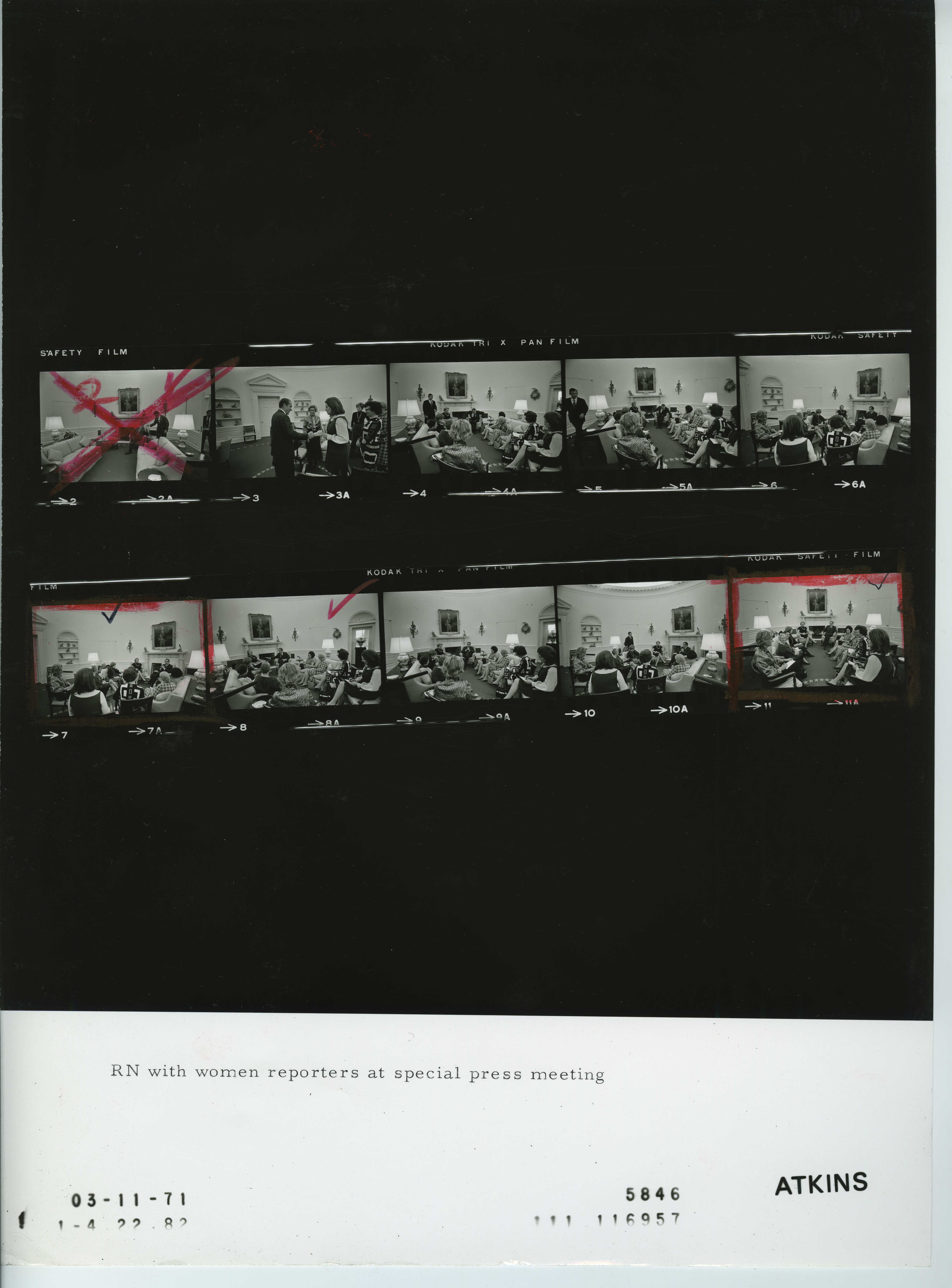
- Frame(s): WHPO-5846-03-11, President Nixon sitting with women reporters, including Frances Lewine, Helen Thomas, Sarah Booth Conroy, Betty Beale, Wauhillau LaHay, Claire Crawford, Louise Hutchinson, Marya McLaughlin, Fay Wells, at a special press meeting. 3/11/1971, Washington, D.C. White House, Oval Office. President Nixon, Frances Lewine, Helen Thomas, Sarah Booth Conroy, Betty Beale, Wauhillau LaHay, Claire Crawford, Louise Hutchinson, Marya McLaughlin, Fay Wells.
- Frame(s): WHPO-5846-09, President Nixon sitting with women reporters, including Frances Lewine, Helen Thomas, Sarah Booth Conroy, Betty Beale, Wauhillau LaHay, Claire Crawford, Louise Hutchinson, Marya McLaughlin, Fay Wells, at a special press meeting. 3/11/1971, Washington, D.C. White House, Oval Office.
Roll WHPO-5847 Photographer: Kightlinger, Jack | Color or B&W: Color
- Frame(s): WHPO-5847-03-06, President Nixon and Barbara Walters getting ready for a filmed interview. 3/11/1971, Washington, D.C. White House, Blue Room. President Nixon, Barbara Walter, aides.
- Frame(s): WHPO-5847-07-12, President Nixon and Barbara Walters sitting on a couch during a filmed interview. 3/11/1971, Washington, D.C. White House, Blue Room. President Nixon, Barbara Walter, aides.
- Frame(s): WHPO-5847-09, President Nixon and Barbara Walters sitting on a couch during a filmed interview. 3/11/1971, Washington, D.C. White House, Blue Room.
Roll WHPO-5868 Photographer: Atkins, Oliver | Color or B&W: B&W
- Frame(s): WHPO-5868-02-09, President Nixon sitting at his desk with Ambassador Gerard Smith prior to his attending SALT talks. 3/11/1971, Washington, D.C. White House, Oval Office. President Nixon, Gerard Smith.
The White House Communications Agency Sound Recordings Collection contains public statements that took place between 1969 and 1974. Visit the finding aid to learn more.
C - First Lady
- WHCA-SR-C-063
Pre-recorded remarks by Pat Nixon to White House tourists. (3/11/1971, Family Theatre, The White House)
Runtime: 0:02:48
Production credits: Audio feed supplied by WHCA; Recorded by BAC (initials of WHCA engineer)
Original Format: 1/4-inch reel-to-reel audiotape. Original source type: Original.
H - White House Staff Member Recordings
- WHCA-SR-H-354
Press briefing by Peter Flanigan and Congressman Burns regarding Japanese textile negotiations. (3/11/1971, Press Center, White House)
Runtime: 20:00
Keywords: Press conferences, news conferences, interviews, media
Production credits: Audio feed supplied by WHCA; Recorded by JLS (initials of WHCA engineer)
Original Format: 1/4-inch reel-to-reel audiotape. Original source type: Original.
P - Formal Presidential Remarks
- WHCA-SR-P-710313
Remarks by President Nixon to the Nat'l Conference on the Judiciary in Williamsburg. (3/11/1971)
Runtime: 27:06:00
Original Format: 1/4-inch reel-to-reel audiotape. Original source type: Original. - WHCA-SR-P-710314
Interview with ladies of the press. (3/11/1971)
Runtime: 65:04:00
Original Format: 1/4-inch reel-to-reel audiotape. Original source type: Original. - WHCA-SR-P-710315
Taped interview for Today show with Barbara Walters. (3/11/1971)
Runtime: 45:55:00
Original Format: 1/4-inch reel-to-reel audiotape. Original source type: Original.
The White House Communications Agency Videotape Collection contains “off-the-air” recordings of televised programs produced between 1968 and 1974. Visit the finding aid to learn more.
- WHCA-4217
Weekly News Summary, Tape I.
ALL NETWORKS
Runtime: 1:30
43. Reasoner/Farmer: Indochina. Time Code Start: 78:20. Keywords: Laos, Cambodia, Vietnam War. Network: ABC.
44. Reasoner/Jarriel: Success in Laos. Time Code Start: 80:20. Keywords: Laos, Vietnam War. Network: ABC.
45. Reasoner/Gill: Trade talks with Japan. Time Code Start: 81:15. Keywords: Japanese, meetings, business, exchanges, agreements, contracts, profits, finance, sales, buying, selling. Network: ABC.
46. Smith/Geer: President Nixon in Williamsburg, Virginia speaking on the courts. Time Code Start: 84:16. Keywords: Presidents, travel, trips, Nixon trips, domestic, speeches. Network: ABC.
47. Chancellor/Striethorst: Laos. Time Code Start: 86:46. Keywords: Laos, Vietnam War. Network: NBC.
48. Chancellor: Japanese textile limitations. Time Code Start: 89:59. Keywords: Japanese, trade, textiles. Network: NBC.
49. President Nixon speaking before Judiciary Conference. Time Code Start: 90:49. Keywords: judges, justices, courts, Senate committee hearings. Network: NBC. - WHCA-4218
Weekly News Summary, Tape II.
ALL NETWORKS
Runtime: 00:33:30
1. Cronkite/Williams: Laos. Time Code Start: 00:00. Keywords: Laos, Vietnam War. Network: CBS.
2. Cronkite: Japanese textile limitations. Time Code Start: 03:48. Keywords: dry goods, materials, silks, textiles, exports, Japanese. Network: CBS.
3. Rather: President Nixon speaking before Judiciary Conference. Time Code Start: 03:54. Keywords: judges, justices, courts, Senate committee hearings. Network: CBS.
4. Sevaride: Commentary on New Isolationism. Time Code Start: 07:11. Keywords: foreign policy, policies, restricted alliances, restrictions, isolated, contact prohibitions. Network: CBS.
Context (External Sources)
The Vanderbilt Television News Archive is the world's most extensive and complete archive of television news. They have been recording, preserving and providing access to television news broadcasts of the national networks since August 5, 1968.
Wikipedia is a free encyclopedia that anyone can edit.