
Introduction
This almanac page for Thursday, June 10, 1971, pulls together various records created by the federal government and links to additional resources which can provide context about the events of the day.
Previous Date: Wednesday, June 9, 1971
Next Date: Friday, June 11, 1971
Schedule and Public Documents
The Daily Diary files represent a consolidated record of the President's activities. Visit the finding aid to learn more.
The President's day began at The White House - Washington, D. C.
The Weekly Compilation of Presidential Documents made available transcripts of the President's news conferences; messages to Congress; public speeches, remarks, and statements; and other Presidential materials released by the White House.
Digitized versions can be found at HathiTrust.
The Federal Register is the official daily publication for rules, proposed rules, and notices of federal agencies and organizations, as well as executive orders and other Presidential documents.
The Congressional Record is the official daily record of the debates and proceedings of the U.S. Congress.
Archival Holdings
Any selection of archival documents will necessarily be partial. You should use the documents and folders identified below as a starting place, but consult the linked collection finding aids and folder title lists and the collections themselves for context. Many documents to be found this way do not lend themselves to association with specific dates, but are essential to a complete understanding of the material.
Selective document listing
President's Office Files
The President's Office Files consists of materials drawn together by the Special Files Unit from several administrative subdivisions within the White House Office. It is the handwriting and sensitive papers sent to the Staff Secretary that now comprise much of the President's Office Files. Visit the finding aid to learn more.
- Annotated News Summaries, Box 30, News Summaries - June 1971 [1 of 2]
- Annotated News Summaries, Box 30, News Summaries - June 1971 [2 of 2] [During this period, the Staff Secretary only removed pages from the News Summaries which contained President Nixon's handwriting, often leaving the document with no date. Although there are no specific documents with this date, you should also consult the full folder for the month.]
- President's Daily Schedule, Box 101, [President's Daily Schedule, June-Aug. 1971] [1 of 3]
- The President's Schedule, Thursday - June 10, 1971
The H. R. Haldeman Diaries consists of seven handwritten diaries, 36 dictated diaries recorded as sound recordings, and two handwritten audio cassette tape subject logs. The diaries and logs reflect H. R. Haldeman’s candid personal record and reflections on events, issues, and people encountered during his service in the Nixon White House. As administrative assistant to the President and Chief of Staff, Haldeman attended and participated in public events and private meetings covering the entire scope of issues in which the Nixon White House engaged in during the years 1969-1973. Visit the finding aid to learn more.
- Transcript of diary entry (PDF)
Thursday, June 10th. The President this morning got into a discussion of how we're going to have to make a shift, as of now, throughout our entire shop to begin a totally oriented commitment to relating everything we do to the political side, without appearing to do so. This has got to apply to everything. The question to be asked in weighing every answer is, Does this help us politically? He says it's okay to do a few nice things, but damn few. And even if they don't directly help us politically. If the answer is no, it doesn't help us politically, but that failure to do it looks political in the act of failing to do it, then we should do it because we have to.
Regarding scheduling and programs, he wants to decide on what we want to get across, pick one or two things, and have them in front of us at all times. We haven't yet focused adequately; we need some very hard direction. This relates to what battles we fight in the Congress. We've got to quit zigzagging and establish a cutting edge and go on some specifics. We've got to realize there are splits in the country. We do too much of coming up with the consensus. We have to recognize our line in terms of left and right. The President is not on the left. We've got to watch that we don't blunt the cutting edge. Ehrlichman has to take a hard look at the domestic things and force consideration in these terms. He wants me to talk to Rogers about this, explain it to him and make the point that we do, that the President will do nothing except on the big plays.
Regarding the polls, he doesn't buy Ehrlichman's figures on pollution and is just not convinced, no matter what anyone tells him. He doesn't believe it's worth five billion dollars to clean up the Potomac. He thinks that we ought to look at this whole area very carefully. He thinks it's better just to talk about it and not waste the money. Our whole problem on image is one of trying, of being clear-cut. We just aren't. We have to satisfy some people. We can't just avoid dissatisfying everybody. In this regard, the press wants a blurred image because they're building the idea of the indecisive President, and they know that defeats us. We can't be concerned when people squeal.
Then, he got into some discussion of the press situation on the wedding. He wanted Ziegler to find out who the network anchorman would be, because he thought he might go down to the box to talk with them ahead of time or have them over to the EOB office to show them the family pictures just for background purposes. He was very distressed that someone had put Candy Stroud of the Women's World Daily on the pool for the first dance, and he wanted her taken off. Tricia had ordered her taken off. Ziegler was arguing that she should be left on, because she was going to do a TV commentary, and it would be better to have her in on something. But the President's rule is that she's never to be in a pool for any social event.
Late in the afternoon, he decided to take the Sequoia out for dinner to avoid the pre-wedding dinner parties and, at the last minute, had me ask Connally and Rogers, and then he added Ehrlichman, and Flanigan, and me. The start of the boat ride was a report from Rogers on his trip to NATO, and a report from Connally on his trip to Europe and some general discussion on that, with Connally arguing that we've got to be concerned about the formation of the European Economic Community as a third world power with its own currency. And Rogers arguing that this is desirable and we should encourage it, because it's our policy to encourage it.
-------------------------------------------------------------------------------------------------------------------
DECLASSIFIED - E.O. 13526, Sect. 3.4: by MS, NARA, June 12, 2013
Audio Cassette 9, Side A, Withdrawn Item Number 10 [AC-9(A) Sel 5]
Duration: 18 seconds
Connally's basis for concern is that they are closer geographically and potentially closer politically to the Russians and that we could run into a lot of trouble if we let this union get set up and establish any real strength.
-------------------------------------------------------------------------------------------------------------------
Rogers feels very much the other way.
At dinner, Rogers leveled an incredible blast with some pretty strong language at Maurice Stans and the whole Commerce Department, saying that their personnel abroad were terrible, that their whole setup was very bad, that Stans was incredibly stupid, and so on. This sort of shocked everybody there, and no one knew exactly how to respond to it. Connally developed an argument that...
-------------------------------------------------------------------------------------------------------------------
DECLASSIFIED - E.O. 13526, Sect. 3.4: by MS, NARA, June 12, 2013
Audio Cassette 9, Side A, Withdrawn Item Number 11 [AC-9(A) Sel 6-1]
Duration: 26 seconds
...in discussion of the whole expropriation committee that question that we should hold up on our loan to Chile; that we are going to get into the whole expropriation of bauxite in Guyana and Jamaica, if we let Chile go. And the net result will be that we'll have no bauxite source at all under US control, which would be a disaster to the aluminum industry.
-------------------------------------------------------------------------------------------------------------------
Connally's argument is that we've got to fight for our own interest. Rogers counters that we've got to stay with our basic policy which is that we'd permit expropriation if there's remuneration. The President raised the question of...
-------------------------------------------------------------------------------------------------------------------
DECLASSIFIED - E.O. 13526, Sect. 3.4: by MS, NARA, June 12, 2013
Audio Cassette 9, Side A, Withdrawn Item Number 11 [AC-9(A) Sel 6-2]
Duration: 29 seconds
...getting together with the Germans to build the SST, giving then our R&D up to this point, and letting them go ahead with the completion of the prototype. Everybody was very much intrigued by the possibility although they felt Japan was a more likely partner, but that obviously Germany was a more desirable partner. That again raised the concern of the, appearing to try to break up the European Economic Community, which the group divided sides on.
-------------------------------------------------------------------------------------------------------------------
Rogers also got into quite a defense of the State Department, particularly on the drug business. He's concerned that at the Monday meeting of Ambassadors, on trying to stop drug production and traffic, that we be very careful not to be critical of the drug producing countries, but rather to be, appear to be trying to work cooperatively with them. Ehrlichman zapped him a bit by saying that he was shocked at a meeting they had on drugs, when the State Department representative said that it's okay to put sanctions on some of the countries...
-------------------------------------------------------------------------------------------------------------------
DECLASSIFIED - E.O. 13526, Sect. 3.4: by MS, NARA, June 12, 2013
Audio Cassette 9, Side A, Withdrawn Item Number 11 [AC-9(A) Sel 6-3]
Duration: 3 seconds
...but not to get into any restrictions on Thailand, because it would...
-------------------------------------------------------------------------------------------------------------------
...cripple their basic economy, if we hurt them in their drug traffic. Rogers was astonished that a State Department person would have said this, said that he didn't believe it and asked who it was. Ehrlichman paused a minute and then said Alexis Johnson, which really shook Rogers. Over all, Bill did not distinguish himself at this session, and I don't think that he gained much in the eyes of the President.
End of June 10th. - Original audio recording (MP3)
The National Archives Catalog is the online portal to the records held at the National Archives, and information about those records. It is the main way of describing our holdings and also provides access to electronic records and digitized versions of our holdings.
The Catalog searches across multiple National Archives resources at once, including archival descriptions, digitized and electronic records, authority records, and web pages from Archives.gov and the Presidential Libraries. The Catalog also allows users to contribute to digitized historical records through tagging and transcription.
Nixon Library Holdings
All National Archives Units
National Security Documents
The President's Daily Brief is the primary vehicle for summarizing the day-to-day sensitive intelligence and analysis, as well as late-breaking reports, for the White House on current and future national security issues. Read "The President's Daily Brief: Delivering Intelligence to Nixon and Ford" to learn more.
The Foreign Relations of the United States series presents the official documentary historical record of major U.S. foreign policy decisions and significant diplomatic activity. Visit the State Department website for more information.
Vol. II, Organization and Management of U.S. Foreign Policy, 1969-1972
The NSC System
151. National Security Decision Memorandum 112, Washington, June 10, 1971
Source: National Archives, Nixon Presidential Materials, NSC Files, NSC Institutional Files (H-Files), Box H–224, National Security Decision Memoranda, NSDM 112. Confidential. NSDM 112 was reissued on August 24 with revisions noted in footnotes 2 and 3 below. (Ibid.) Agreement between NSC and State on the revisions was finally reached on August 19 following two months of discussions within and among State, NSC, and DOD that are documented in Documents 152, 155–157, and 160–162.
Vol. XIII, Soviet Union, October 1970-October 1971
"One of Two Routes": Soviet-American Relations and Kissinger's Secret Trip to China, April 23-July 18, 1971
255. Memorandum for the President’s File, Washington, June 10, 1971
Source: National Archives, Nixon Presidential Materials, White House Special Files, Staff Member and Office Files, President’s Office Files, Box 85, President’s Meeting File, Beginning June 6, 1971. Secret. Sent for information. Drafted by Sonnenfeldt.
Vol. XXIII, Arab-Israeli Dispute, 1969-1972
238. Telegram From the Interests Section in Egypt to the Department of State, Cairo, June 10, 1971, 1300Z
Source: National Archives, Nixon Presidential Materials, NSC Files, Box 1163, Saunders Files, Middle East Negotiations Files, Middle East—Jarring Talks, June 1–18, 1971. Secret; Immediate; Nodis; Cedar Plus. All brackets are in the original except “[ USG ?]”, added for clarity.
Vol. XXIX, Eastern Mediterranean, 1969-1972
Cyprus
371. Information Memorandum From the Assistant Secretary of State for Near Eastern and South Asian Affairs (Sisco) to the Under Secretary of State (Irwin), Washington, June 10, 1971
Source: National Archives, RG 59, Central Files 1970–73, POL 27 CYP. Secret. Drafted by Davis and Long on June 8; concurred in by Churchill, Pugh, and Davies.
Vol. E-10, Documents on American Republics, 1969-1972
Panama
547. Memorandum From the National Security Council Undersecretaries Committee to President Nixon, Washington, June 10, 1971., Washington, June 10, 1971
In this 5 page memorandum, the Undersecretaries Committee presented their recommendations for negotiating new Panama Canal treaties. This report identifies those cases in which the recommendations from the Department of State and Defense differ and focuses its analysis on the following issues: the possible duration of a new agreement, jurisdiction, control, and defense over the Canal, canal capacity expansion, and potential economic benefits.
Source: National Archives, Nixon Presidential Materials, NSC Files, NSC Institutional Files (H-Files), Box H–261, Under Secretaries Committee Memorandum File, Under Secretaries Study Memorandums, U/SM 97–99. Secret; Exdis.
The Kissinger telephone conversation transcripts consist of approximately 20,000 pages of transcripts of Kissinger’s telephone conversations during his tenure as Assistant to the President for National Security Affairs (1969-1974) and Secretary of State (1973-1974) during the administration of President Richard Nixon. Visit the finding aid for more information.
Digitized versions can be found in the National Archives Catalog.
Audiovisual Holdings
The White House Tapes are sound recordings of President Richard Nixon's telephone conversations and of meetings held in the Oval Office and the Cabinet Room in the White House, the President's office in the Old Executive Office Building (OEOB), the Lincoln Sitting Room in the residence section of the White House, and several locations at the Presidential retreat at Camp David, Maryland. These recordings document many of the major events and decisions of the Nixon Administration from February 16, 1971 to July 18, 1973. Visit the White House Tapes finding aid to learn about the taping system's operation and archival processing.
Cabinet Room
- 60-3; Unknown between 11:01 a.m. & 11:59 p.m.; Nixon, Richard M. (President); Biaggini, Benjamin F.; Rice, Tom; Fishwick, Jack; Moore, William H.; Watkins, Hays; Johnson, William; Barnette, Frank; Menk, Louis; Reed, John; Ailes, Stephen; Volpe, John A.; Krogh, Egil ("Bud"), Jr.; Clapp, Charles; Crawford, George; Flanigan, Peter M.
- 60-4; Unknown between 12:21 p.m. & 11:59 p.m.; White House tour group
Old Executive Office Building
Oval Office
- 516-1; Unknown between 9:08 a.m. & 9:11 a.m.; Nixon, Richard M. (President); [Unknown person(s)]
- 516-2; 9:11 a.m. - 10:56 a.m.; Nixon, Richard M. (President); Haldeman, H. R. ("Bob"); Woods, Rose Mary; Butterfield, Alexander P.; Bull, Stephen B.; Beam, Jacob D.; Sonnenfeldt, Helmut ("Hal"); Atkins, Oliver F. ("Ollie")
- 516-3; 10:56 a.m. - 11:01 a.m.; Nixon, Richard M. (President); Bull, Stephen B.; Flanigan, Peter M.
- 516-4; 12:21 p.m. - 12:23 p.m.; Nixon, Richard M. (President); Butterfield, Alexander P.; Flanigan, Peter M.
- 516-5; 12:26 p.m. - 12:29 p.m.; Nixon, Richard M. (President); Hampton, Horace; Krogh, Egil ("Bud"), Jr.; White House photographer
- 516-6; 12:29 p.m. - 12:56 p.m.; Nixon, Richard M. (President); Butterfield, Alexander P.; Bull, Stephen B.; Collier, Everett D.; Warner, Philip G.; Klein, Herbert G.; White House photographer; Sanchez, Manolo
- 516-7; 12:56 p.m. - 12:56 p.m.; Nixon, Richard M. (President); [Unknown person(s)]
- 516-8; 1:00 p.m. - 1:34 p.m.; Nixon, Richard M. (President); Haldeman, H. R. ("Bob"); Bull, Stephen B.
- 516-9; Unknown between 1:35 p.m. & 3:06 p.m.; Nixon, Richard M. (President); Bull, Stephen B.; Butterfield, Alexander P.; Haldeman, H. R. ("Bob"); Woods, Rose Mary; Colson, Charles W.; White House operator; Humphrey, Hubert H.
- 516-10; 3:08 p.m. - 4:24 p.m.; Nixon, Richard M. (President); Ehrlichman, John D.; Krogh, Egil ("Bud"), Jr.; Donfeld, Jeffrey; Weber, Arnold R.; Jaffe, Jerome H. (Dr.); Sanchez, Manolo; White House operator; Hardin, Clifford M.
- 516-11; 4:25 p.m. - 5:18 p.m.; Nixon, Richard M. (President); Ehrlichman, John D.; Krogh, Egil ("Bud"), Jr.; Flanigan, Peter M.; Butterfield, Alexander P.
- 516-12; 5:20 p.m. - 6:01 p.m.; Nixon, Richard M. (President); Woods, Rose Mary; Haldeman, H. R. ("Bob"); White House operator; Flanigan, Peter M.; Bull, Stephen B.; Sanchez, Manolo; Butterfield, Alexander P.
- 516-13; Unknown between 11:01 a.m. & 12:21 p.m.; [Unknown person(s)]
- 516-14; 1:34 p.m. - 1:35 p.m.; United States Secret Service agents
- 516-15; Unknown between 6:01 p.m. & 11:00 p.m.; United States Secret Service agents
White House Telephone
- 5-1; Unknown between 9:08 a.m. & 2:53 p.m.; Nixon, Richard M. (President); White House operator
- 5-2; 2:53 p.m. - 2:57 p.m.; Nixon, Richard M. (President); Humphrey, Hubert H.
- 5-3; Unknown between 2:57 p.m. & 4:17 p.m.; Nixon, Richard M. (President); White House operator
- 5-4; 4:17 p.m. - 4:22 p.m.; Nixon, Richard M. (President); Hardin, Clifford M.
- 5-5; Unknown between 4:22 p.m. & 6:02 p.m.; Haldeman, H. R. ("Bob"); White House operator
- 5-6; Unknown between 4:22 p.m. & 6:02 p.m.; Haldeman, H. R. ("Bob"); Flanigan, Peter M.
The White House Photo Office collection consists of photographic coverage of President Richard Nixon meeting with prominent social, political, and cultural personalities; speaking engagements and news conferences of the President and various high-ranking members of the White House staff and Cabinet; Presidential domestic and foreign travel, including Presidential vacations; social events and entertainment involving the First Family, including entertainers present; official portraits of the President, First Family, and high-ranking members of the Nixon administration; the 1969 and 1973 Inaugurals; the President’s 1972 Presidential election campaign appearances (including speeches) and other official activities of the White House staff and the President’s Cabinet from January 20, 1969 until August 9, 1974 at the White House and the Old Executive Office Building; other locations in Washington, DC, such as The Mall; and the Presidential retreats in Camp David, Maryland, Key Biscayne, Florida, and San Clemente, California. Visit the finding aid to learn more.
Roll WHPO-6523 Photographer: Schumacher, Karl | Color or B&W: B&W
- Frame(s): WHPO-6523-02-03, Vice President Agnew arriving at the US Air Force Academy. 6/10/1971, Colorado Springs, Colorado US Air Force Academy, tarmac. Spiro Agnew, military personnel, aides.
- Frame(s): WHPO-6523-05-23, Vice President Agnew touring the US Air Force Academy. 6/10/1971, Colorado Springs, Colorado US Air Force Academy. Spiro Agnew, military personnel, aides.
- Frame(s): WHPO-6523-24-26, Vice President Agnew preparing to depart the US Air Force Academy. 6/10/1971, Colorado Springs, Colorado US Air Force Academy, tarmac. Spiro Agnew, military personnel, aides.
Roll WHPO-6524 Photographer: Schumacher, Karl | Color or B&W: B&W
- Frame(s): WHPO-6524-01-03, Vice President Agnew arriving at the US Air Force Academy. 6/10/1971, Colorado Springs, Colorado US Air Force Academy, tarmac. Spiro Agnew, military personnel, aides, POW (Vietnam Prisoner of War) wives.
- Frame(s): WHPO-6524-04-18, Vice President Agnew touring the US Air Force Academy. 6/10/1971, Colorado Springs, Colorado US Air Force Academy. Spiro Agnew, military personnel, aides, POW (Vietnam Prisoner of War) wives.
- Frame(s): WHPO-6524-19-22, Vice President Agnew with POW (Vietnam Prisoner of War) wives. 6/10/1971, Colorado Springs, Colorado US Air Force Academy. Spiro Agnew, military personnel, aides, POW (Vietnam Prisoner of War) wives.
Roll WHPO-6525 Photographer: Schumaker, Byron | Color or B&W: B&W
- Frame(s): WHPO-6525-01-08, Robert Finch swearing in Douglas Kinsey as Commissioner of General Services Administration (GSA). 6/10/1971, Washington, D.C. unknown. Robert Finch, Douglas Kinsey, Kinsey family members, guests.
Roll WHPO-6526 Photographer: Schumaker, Byron | Color or B&W: B&W
- Frame(s): WHPO-6526-02-09, President Nixon meeting with railroad executives, including Benjamin Biaggini, President of Southern Pacific Railroad, Graham Claytor, President of Southern Railway, Lou Menk, President of Burlington Northern Railroad, John Reed, President of Santa Fe Railroad, Jack Fishwick, President of Norfolk and Western Railroad, and Bill Moore, President of Penn Central. 6/10/1971, Washington, D.C. White House, Cabinet Room. President Nixon, Benjamin Biaggini, Graham Claytor, Lou Menk, John Reed, Jack Fishwick, Bill Moore, railroad executives.
- Frame(s): WHPO-6526-08A, President Nixon meeting with railroad executives, including Benjamin Biaggini, President of Southern Pacific Railroad, Graham Claytor, President of Southern Railway, Lou Menk, President of Burlington Northern Railroad, John Reed, President of Santa Fe Railroad, Jack Fishwick, President of Norfolk and Western Railroad, and Bill Moore, President of Penn Central. 6/10/1971, Washington, D.C. White House, Cabinet Room. President Nixon, Benjamin Biaggini, Graham Claytor, Lou Menk, John Reed, Jack Fishwick, Bill Moore, railroad executives.
Roll WHPO-6527 Photographer: Atkins, Oliver | Color or B&W: B&W
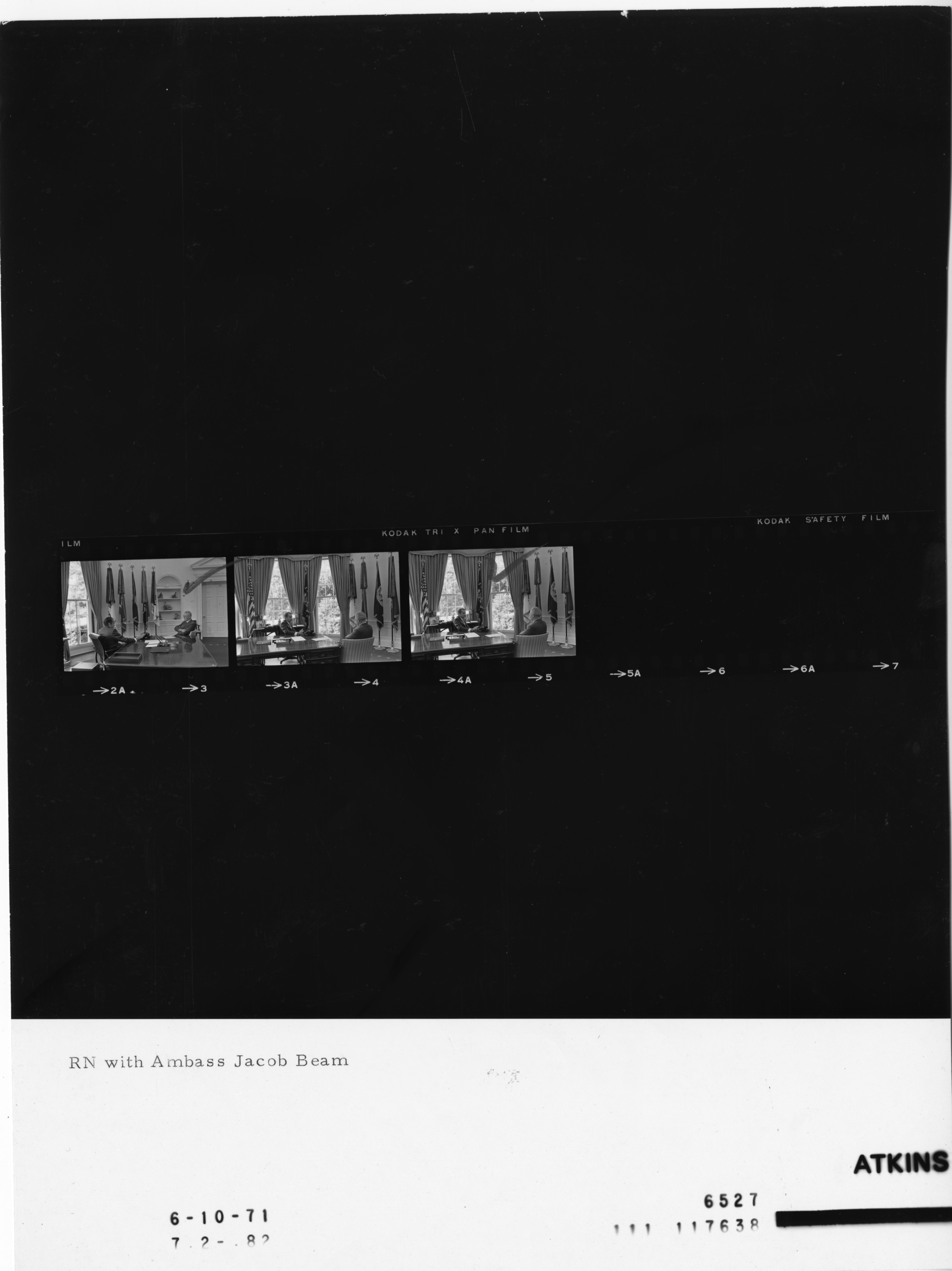
- Frame(s): WHPO-6527-02A-04A, President Nixon sitting at his desk with U.S. Ambassador to the U.S.S.R. Jacob Beam. 6/10/1971, Washington, D.C. White House, Oval Office. President Nixon, Jacob Beam.
Roll WHPO-6528 Photographer: Atkins, Oliver | Color or B&W: B&W
- Frame(s): WHPO-6528-02-07, President Nixon meeting with railroad executives, including Benjamin Biaggini, President of Southern Pacific Railroad, Graham Claytor, President of Southern Railway, Lou Menk, President of Burlington Northern Railroad, John Reed, President of Santa Fe Railroad, Jack Fishwick, President of Norfolk and Western Railroad, and Bill Moore, President of Penn Central. 6/10/1971, Washington, D.C. White House, Cabinet Room. President Nixon, Benjamin Biaggini, Graham Claytor, Lou Menk, John Reed, Jack Fishwick, Bill Moore, railroad executives.
Roll WHPO-6529 Photographer: Schumacher, Karl | Color or B&W: B&W
- Frame(s): WHPO-6529-02-08, Portraits of James Falk. 6/10/1971, Washington, D.C. White House, North Grounds. Mr. Falk.
Roll WHPO-6530 Photographer: Atkins, Oliver | Color or B&W: B&W
- Frame(s): WHPO-6530-02-05, President Nixon with Horace Hampton, retiring Director of Government Communications Services of the Chesapeake and Potomac Telephone Company. 6/10/1971, Washington, D.C. White House, Oval Office. President Nixon, Horace Hampton, Everett Collier, Philip Warner, Egil Krogh.
- Frame(s): WHPO-6530-07-10, President Nixon with Everett Collier, the Editor of the "Houston Chronicle" and Philip Warner, Executive Assistant to the Editor of the Houston Chronicle. 6/10/1971, Washington, D.C. White House, Oval Office. President Nixon, Horace Hampton, Everett Collier, Philip Warner, President Nixon.
Roll WHPO-6531 Photographer: Atkins, Oliver | Color or B&W: B&W
- Frame(s): WHPO-6531-05A-19A, President Nixon with his valet, Manolo Sanchez and wife Fina Sanchez. 6/10/1971, Washington, D.C. White House, West Colonnade. President Nixon, Manolo Sanchez, Fina Sanchez.
- Frame(s): WHPO-6531-10A, President Nixon with his valet, Manolo Sanchez, and Sanchez's wife Fina Sanchez. 6/10/1971, Washington, D.C. White House, West Colonnade. President Nixon, Manolo Sanchez, Fina Sanchez.
- Frame(s): WHPO-6531-20A-21A, President Nixon talking to a workman who is laying a sub-carpet for Tricia Nixon and Edward Cox's wedding altar. 6/10/1971, Washington, D.C. White House, West Colonnade. President Nixon, unidentified workman.
- Frame(s): WHPO-6531-21A, President Nixon talking to a workman who is laying a sub-carpet for Tricia Nixon and Edward Cox's wedding altar. 6/10/1971, Washington, D.C. White House, West Colonnade. President Nixon, unidentified workman.
Roll WHPO-6532 Photographer: Schumaker, Byron | Color or B&W: B&W
- Frame(s): WHPO-6532-01-03, President Nixon sitting at his Oval Office desk during a meeting with Jerome Jaffe (Assistant Professor at the University of Chicago) and Arnold Weber Associate Director of the Office of Management & Budget (OMB), Ehrlichman, Haldeman and Jeff Donfeld. 6/10/1971, Washington, D.C. White House, Oval Office. President Nixon, Jerome Jaffe, Arnold Weber, John Ehrlichman, Harry Robbins Haldeman, Jeffrey Donfeld.
Roll WHPO-6533 Photographer: Knudsen, Robert L. | Color or B&W: Color
- Frame(s): WHPO-6533-02-04, Workman laying down a white carpet for the wedding. 6/10/1971, Washington, D.C. White House, Rose Garden. unidentified man.
- Frame(s): WHPO-6533-05-07, Men and women near the carpet. 6/10/1971, Washington, D.C. White House, Rose Garden. Tricia Nixon, unidentified men and women.
- Frame(s): WHPO-6533-08-09, Men and women walking down the colonnade. 6/10/1971, Washington, D.C. White House, West Wing colonnade. unidentified men, unidentified women.
- Frame(s): WHPO-6533-10-15, Tricia Nixon greeting her bridesmaids and others. 6/10/1971, Washington, D.C. White House, Yellow Oval Room, President's Dining Room, kitchen. Tricia Nixon, Pat Nixon, Mrs. Howard Cox, Julie Eisenhower, bridesmaids.
- Frame(s): WHPO-6533-14A, Tricia Nixon greeting her bridesmaids and others. 6/10/1971, Washington, D.C. Yellow Oval Room. Tricia Nixon, Julie Nixon Eisenhower, Pat Nixon.
- Frame(s): WHPO-6533-16-19, Unidentified men around a table laden with food and candles. 6/10/1971, Washington, D.C. White House, kitchen. unidentified men.
- Frame(s): WHPO-6533-20-35, Pastry chefs mixing and baking Tricia Nixon's wedding cake. 6/10/1971, Washington, D.C. White House, kitchen. chefs.
The White House Communications Agency Sound Recordings Collection contains public statements that took place between 1969 and 1974. Visit the finding aid to learn more.
G - Cabinet Officer Briefings
- WHCA-SR-G-049
Briefing on the family assistance plan by John Veneman, with Ronald Ziegler and Secretary of Agriculture Clifford Hardin. (6/10/1970, Press Center)
Runtime: 37:00:00
Production credits: Audio feed supplied by WHCA; Recorded by KLM (initials of WHCA engineer)
Original Format: 1/4-inch reel-to-reel audiotape. Original source type: Original.
H - White House Staff Member Recordings
- WHCA-SR-H-193
Briefing by Nixon's Vietnam fact-finding commission by Herbert Klein, John Love, Senator Howard Cannon, Congressman Price, and Ray Shafer regarding Vietnam. (6/10/1970, Press Center, White House)
Runtime: 22:00
Keywords: Briefings, public briefings, statements to the press (see also Press conferences, news conferences, interviews, media)
Production credits: Audio feed supplied by WHCA; Recorded by KLM (initials of WHCA engineer)
Original Format: 1/4-inch reel-to-reel audiotape. Original source type: Original.
P - Formal Presidential Remarks
- WHCA-SR-P-700608
Announcement of staff changes with GS, CW, Robert Mayo. (6/10/1970)
Runtime: 7:00
Original Format: 1/4-inch reel-to-reel audiotape. Original source type: Original.
The White House Communications Agency Videotape Collection contains “off-the-air” recordings of televised programs produced between 1968 and 1974. Visit the finding aid to learn more.
- WHCA-4428
"The Dick Cavett Show", Part I. a discussion of the problems of Vietnam veterans with a panel of veterans U.S. Representative Paul McCloskey.
Undetermined
Runtime: 01:29:00
Context (External Sources)
The Vanderbilt Television News Archive is the world's most extensive and complete archive of television news. They have been recording, preserving and providing access to television news broadcasts of the national networks since August 5, 1968.
Wikipedia is a free encyclopedia that anyone can edit.