
Introduction
This almanac page for Thursday, July 6, 1972, pulls together various records created by the federal government and links to additional resources which can provide context about the events of the day.
Previous Date: Wednesday, July 5, 1972
Next Date: Friday, July 7, 1972
Schedule and Public Documents
The Daily Diary files represent a consolidated record of the President's activities. Visit the finding aid to learn more.
The President's day began at San Clemente, California
The Weekly Compilation of Presidential Documents made available transcripts of the President's news conferences; messages to Congress; public speeches, remarks, and statements; and other Presidential materials released by the White House.
Digitized versions can be found at HathiTrust.
The Federal Register is the official daily publication for rules, proposed rules, and notices of federal agencies and organizations, as well as executive orders and other Presidential documents.
Archival Holdings
Any selection of archival documents will necessarily be partial. You should use the documents and folders identified below as a starting place, but consult the linked collection finding aids and folder title lists and the collections themselves for context. Many documents to be found this way do not lend themselves to association with specific dates, but are essential to a complete understanding of the material.
Selective document listing
President's Office Files
The President's Office Files consists of materials drawn together by the Special Files Unit from several administrative subdivisions within the White House Office. It is the handwriting and sensitive papers sent to the Staff Secretary that now comprise much of the President's Office Files. Visit the finding aid to learn more.
- Annotated and Unmarked News Summaries [Note: Although there was no News Summary on this date, due to the way News Summary products were compiled, you should also consult nearby days for potentially relevant materials.]
- President's Daily Schedule, Box 102, [President's Daily Schedule, Apr.-July 1972] [3 of 3]
- The President's Schedule, Thursday - July 6, 1972
The H. R. Haldeman Diaries consists of seven handwritten diaries, 36 dictated diaries recorded as sound recordings, and two handwritten audio cassette tape subject logs. The diaries and logs reflect H. R. Haldeman’s candid personal record and reflections on events, issues, and people encountered during his service in the Nixon White House. As administrative assistant to the President and Chief of Staff, Haldeman attended and participated in public events and private meetings covering the entire scope of issues in which the Nixon White House engaged in during the years 1969-1973. Visit the finding aid to learn more.
- Transcript of diary entry (PDF)
Thursday, July 6.
We had our MacGregor meetings today starting at about 10:40 with MacGregor, Malek, Timmons and Ehrlichman. The President got into a discussion of how Timmons should make the legislative points, the specifics on our legislative program, and so on for the press. Told him to signal some vetoes, that he should hit the Democratic tactic of overloading the bills so that we will veto regardless of the purpose of the bill, if it's on a reckless course of exceeding budget request. The President considers that more important than all legislative proposals is to hold down the cost of living and avoid a tax increase. So he will examine each bill with this thought in mind. It's time to call a halt, and with the support of responsible members of Congress who will not do these cynical things in the election year. There'll be no compromise on HR 1 under any circumstances. He says the purpose between the conventions should be to get a vote up or down in the Congress. We should avoid putting partisan politics above the public interest. Congress owes it to the country to vote the President's propositions up or down. The top of the list is busing. Any Congressman or Senator who votes for any increase over the budget must assume the responsibility for rising prices, and for the possibility of leading to a tax increase.
That gave Timmons his attack plan, and he left. We then went into the general discussion of the MacGregor operation. The President raised first the question of relations with Mitchell. Made the point we must not embarrass him, but we need great decisiveness in what we're doing. The President questioned Magruder as Chief of Staff and MacGregor assured him that that's not his role, that will be Malek's role. We talked about the Democratic organization. He uses the front for big names and as a legitimate instrument for enlisting Democrats in the key states. That it should vary state by state, and the President mentioned the Paul Ziffren possibility in California, where Henry Kissinger apparently has talked to Ziffren, and he is willing to come out for us. Maybe we should pluralize it with a member of different Democratic operations. That's a possibility. Tell MacGregor to get the Colson operation under control but let people think they're running it.
On women, MacGregor said he was using Hutar as a recruiter and was considering the question of a woman as co-campaign chairman. The President said he wasn't satisfied with Hutar. On surrogates the President pointed out the problem is to give them worthwhile things to do. That we should use Cabinet and White House wives to do telephoning, set up a phone network and work the small states, and that we should be getting women on TV more. That we should maintain a low visibility at the Democratic Convention. No truth squad or anything of that sort. MacGregor should not be tied to the office running the details and all. That Malek should do that. MacGregor should concentrate on the big plays, and he said that very few make the move onto the national scene effectively because they think parochially, and it's important that MacGregor not fall into that trap. He urged Clark to build up some personal surrogates to himself, who will do some of the speaking and handling for him. Let them cover the small states. As far as the President's time, he will make no appearances with other candidates unless that helps us. There will be no effort to win Senate seats and so on. Others must do this.
On Agnew, we had a sensitive problem. We should use Mitchell. I should work out arrangements for the Vice President’s schedule planning. We should give word to all speakers that they should not hit McGovern this week during the Democratic Convention. We should use Finch's judgment regarding California problems, but keep him out of operations in the state. That pretty well wrapped up the MacGregor meeting.
The President and I then met for a couple of hours with Ehrlichman afterwards. Got into the Watergate caper problem. Walters apparently has finked out and spilled the beans to Pat Gray, which complicates the issue substantially. The President then made the point that on the campaign issues, the economic issue is their ground not ours, and we should not play to it. We want the debate first on foreign policy, Vietnam, amnesty, POW's, bugout, Defense, and so on. Then we want a debate on busing, where it matters, on redistribution of wealth, discretely handled, on abortion, amnesty, pot, and the whole homosexual thing. He pointed out that we need to get Scranton into the Pennsylvania campaign. He's concerned about Colson overplaying the unemployment figures which are very good this week, but will get bad again next month.
He says he wants to consider the possibility of meeting with the Japanese Prime Minister, the new one, maybe in Hawaii and also meeting with the Italian in Washington.
He got into the subject of the acceptance speech and says he wants a draft from four or five people, not just a Price draft. He wants Buchanan, Hallett, and Andrews to try it. Get their ideas, not long philosophical advice but drafts of what they think he should say. He felt the 4th of July speech was rather sophomoric and not a good speech.
End of July 6. - Original audio recording (MP3)
The National Archives Catalog is the online portal to the records held at the National Archives, and information about those records. It is the main way of describing our holdings and also provides access to electronic records and digitized versions of our holdings.
The Catalog searches across multiple National Archives resources at once, including archival descriptions, digitized and electronic records, authority records, and web pages from Archives.gov and the Presidential Libraries. The Catalog also allows users to contribute to digitized historical records through tagging and transcription.
Nixon Library Holdings
All National Archives Units
National Security Documents
The President's Daily Brief is the primary vehicle for summarizing the day-to-day sensitive intelligence and analysis, as well as late-breaking reports, for the White House on current and future national security issues. Read "The President's Daily Brief: Delivering Intelligence to Nixon and Ford" to learn more.
The Foreign Relations of the United States series presents the official documentary historical record of major U.S. foreign policy decisions and significant diplomatic activity. Visit the State Department website for more information.
Vol. IV, Foreign Assistance, International Development, Trade Policies, 1969-1972
Expropriation Policy, 1969-1972
180. Memorandum From President Nixon to Secretary of the Treasury Shultz, Washington, July 6, 1972
Source: National Archives, RG 59, Central Files 1970-73, E 1 US. No classification marking. Except as noted below, the language in the text printed here is identical to that proposed by OMB on April 10, and at variance with what Hormats recommended to Kissinger on April 12. See Document 177.
Vol. VIII, Vietnam, January-October 1972
The North Vietnamese Offensive Falters, Negotiations Resume, May 8-July 18, 1972
202. Transcript of a Telephone Conversation Between the Chairman of the Joint Chiefs of Staff (Moorer) and the Commander, Military Assistance Command, Vietnam (Weyand), Washington, July 6, 1972, 9:13 a.m.
Source: National Archives, RG 218, Records of the Chairman, Moorer Diary, July 1970–July 1974. Top Secret.
Vol. XX, Southeast Asia, 1969-1972
Philippines
255. Telegram From the Embassy in the Philippines to the Department of State, Manila, July 6, 1972, 0425Z
Source: National Archives, Nixon Presidential Materials, NSC Files, Box 557, Country Files, Far East, Philippines, Vol. IV. Secret; Priority; Exdis.
Vol. XXVIII, Southern Africa
Regional Issues
72. Memorandum From Richard T. Kennedy and Melvin H. Levine of the National Security Council Staff to the President’s Assistant for National Security Affairs (Kissinger), Washington, July 6, 1972
Source: National Archives, Nixon Presidential Materials, Box 744, Country Files, Africa, South Africa, Vol. II. Confidential. Sent for action. The tabs are attached but not printed.
Vol. E-7, Documents on South Asia, 1969-1972
U.S. Relations with India and Pakistan, 1972
276. Telegram 5868 From the Embassy in Pakistan to the Department of State, Islamabad, July 6, 1972, 1222Z
The cable reported on former Treasury Secretary Connally’s exchange with Indian Finance Minister Y. B. Chavan on July 4. The conversation dealt with international monetary and trade reform and with India’s perception that the rules governing economic assistance were inequitable and worked to the disadvantage of third world countries.
Source: National Archives, RG 59, Central Files 1970–73, POL 7 US/Connally. Confidential; Exdis. Also designated CONTO 240. Repeated to New Delhi, Dacca, Bombay, Madras, Caltigta, Belgrade for Rogers, the White House for Davis, and Treasury for Dixon.
Bangladesh, December 1971-December 1972
425. Telegram CONTO 237 From the Embassy in Pakistan to the Department of State, Islamabad, July 6, 1972, 0852Z
Former Treasury Secretary Connally reported on his July 3 conversation with Bangladesh Foreign Minister Samad.
Source: National Archives, RG 59, Central Files 1970–73, POL 7 US/Connally. Confidential; Exdis. Also numbered telegram 5842. Repeated to Bangkok, Bombay, Budapest for the Secretary’s party, Dacca, Calcutta, New Delhi, Kuala Lumpur, Madras, Rangoon, Singapore, and USUN. Sent to the White House for Davis, to the Treasury for Dixon, and to the Department of State for A/OPR, S/S, and NEA. John Connally resigned as Secretary of the Treasury on May 16. Thereafter he visited a number of countries around the world at President Nixon’s request to review matters of mutual interest with host governments. Included on his itinerary were stops in Bangladesh, India, Pakistan, and Afghanistan.
The Kissinger telephone conversation transcripts consist of approximately 20,000 pages of transcripts of Kissinger’s telephone conversations during his tenure as Assistant to the President for National Security Affairs (1969-1974) and Secretary of State (1973-1974) during the administration of President Richard Nixon. Visit the finding aid for more information.
Digitized versions can be found in the National Archives Catalog.
Audiovisual Holdings
The White House Photo Office collection consists of photographic coverage of President Richard Nixon meeting with prominent social, political, and cultural personalities; speaking engagements and news conferences of the President and various high-ranking members of the White House staff and Cabinet; Presidential domestic and foreign travel, including Presidential vacations; social events and entertainment involving the First Family, including entertainers present; official portraits of the President, First Family, and high-ranking members of the Nixon administration; the 1969 and 1973 Inaugurals; the President’s 1972 Presidential election campaign appearances (including speeches) and other official activities of the White House staff and the President’s Cabinet from January 20, 1969 until August 9, 1974 at the White House and the Old Executive Office Building; other locations in Washington, DC, such as The Mall; and the Presidential retreats in Camp David, Maryland, Key Biscayne, Florida, and San Clemente, California. Visit the finding aid to learn more.
Roll WHPO-9537 Photographer: Schumacher, Karl | Color or B&W: Color
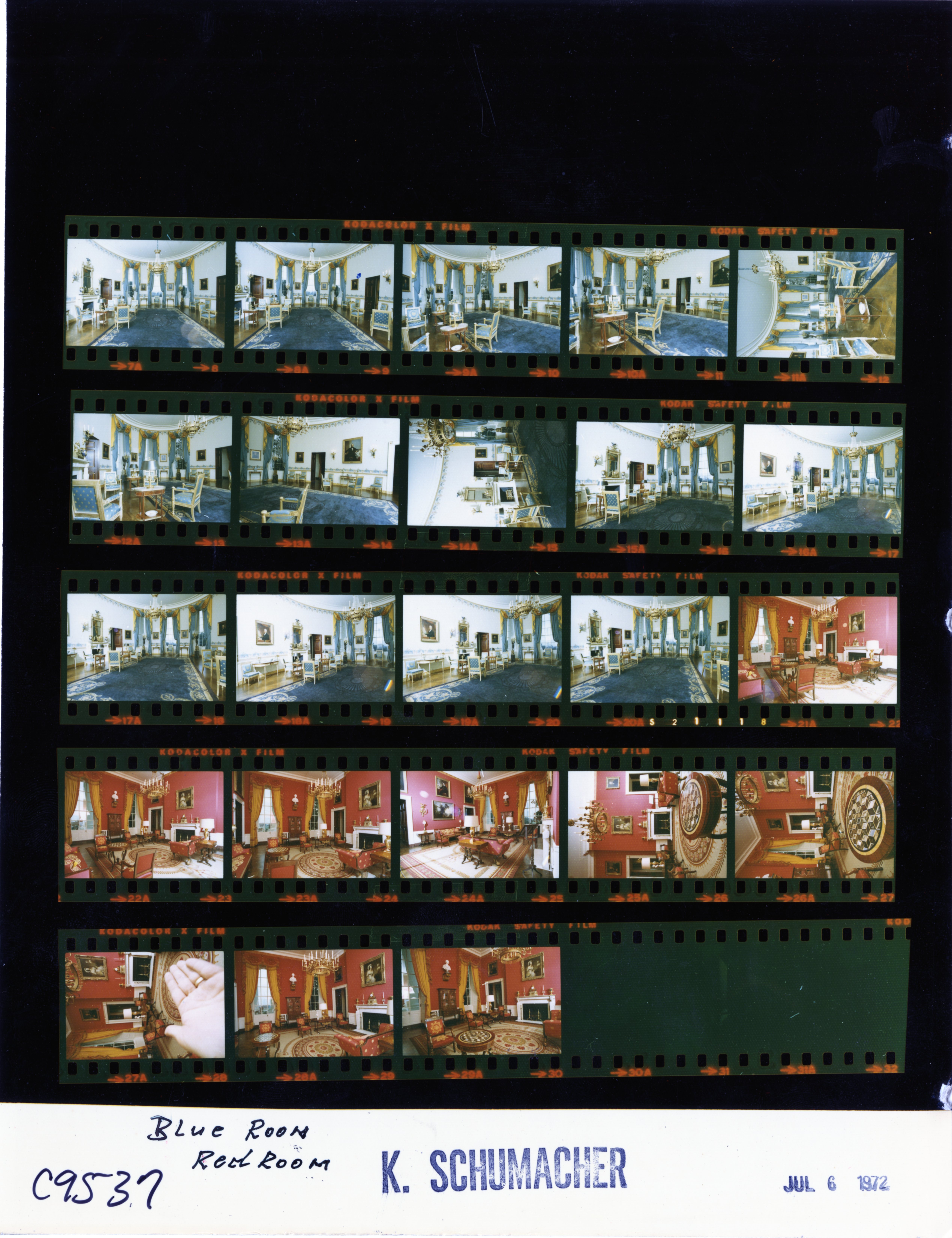
- Frame(s): WHPO-9537-07A-20A No negatives - contact sheet only., The interior of an unoccupied Blue Room (7A-20A) and unoccupied. Red Room (21A-29A). 7/6/1972, Washington, D.C. White House, Blue Room, Red Room.
Roll WHPO-9541 Photographer: Atkins, Oliver | Color or B&W: B&W
- Frame(s): WHPO-9541-, President Nixon seated at his desk with Clark MacGregor, John Ehrlichman, H.R. Haldeman, and Malek. 7/6/1972, San Clemente, California Presidential Office, San Clemente Compound. President Nixon, Clark MacGregor, John Ehrlichman, H.R. Haldeman, Malek.
- Frame(s): WHPO-9541-10, President Nixon seated at his desk with Clark MacGregor, John Ehrlichman, H.R. Haldeman, and Malek. 7/6/1972, San Clemente, California Presidential Office, San Clemente Compound. President Nixon, Clark MacGregor, John Ehrlichman, H.R. Haldeman, Malek.
Roll WHPO-9542 Photographer: Atkins, Oliver | Color or B&W: B&W
- Frame(s): WHPO-9542-, President Nixon seated informally during a meeting with Sir Robert Thompson, Alexnder Haig and Henry Kissinger. 7/6/1972, San Clemente, California Presidential Office, San Clemente Compound. President Nixon, Haig, Kissinger, Robert Thompson.
- Frame(s): WHPO-9542-05, President Nixon seated informally during a meeting with Sir Robert Thompson, Alexnder Haig and Henry Kissinger while the President's Irish Setter dog King Timahoe lies on the carpet nearby taking a nap. 7/6/1972, San Clemente, California Presidential Office, San Clemente Compound. President Nixon, Haig, Kissinger, Robert Thompson, King Timahoe.
Roll WHPO-9543 Photographer: Schumacher, Karl | Color or B&W: Color
- Frame(s): WHPO-9543-, Room interiors at 716 Jackson Place, owned by the U.S. Government, known as the Presidential Townhouse. located across from the White House, part of complex forming the western border of Lafayette Square between Pennsylvania Avenue and H Street, NW, beginning just south of Connecticut Avenue. 7/6/1972, Washington, D. C. rooms, Presidential Townhouse.
Roll WHPO-9562 Photographer: Atkins, Oliver | Color or B&W: B&W
- Frame(s): WHPO-9562-, President Nixon standing with Clark MacGregor and Mrs. MacGregor both in his office and on the compound grounds. 7/6/1972, San Clemente, California Presidential Office, lawn, San Clemente Compound. President Nixon, MacGregor, Mrs. MacGregor.
The White House Communications Agency Sound Recordings Collection contains public statements that took place between 1969 and 1974. Visit the finding aid to learn more.
H - White House Staff Member Recordings
- WHCA-SR-H-610
Press briefing by Ronald Ziegler and William Timmons. (7/6/1972, San Clemente, California)
Runtime: [Nonelisted]
Keywords: Press conferences, news conferences, interviews, media, press secretary
Production credits: Audio feed supplied by WHCA; Recorded by JAD (initials of WHCA engineer)
Original Format: 1/4-inch reel-to-reel audiotape. Original source type: Original. - WHCA-SR-H-611
Ray Price, Chief, Writing and Research Staff, speaks to a group of summer interns. (7/6/1972, Room 450, Executive Office Building)
Runtime: 53:00:00
Keywords: Briefings, private briefings
Production credits: Audio feed supplied by WHCA; Recorded by JMM (initials of WHCA engineer)
Original Format: 1/4-inch reel-to-reel audiotape. Original source type: Original.
The White House Communications Agency Videotape Collection contains “off-the-air” recordings of televised programs produced between 1968 and 1974. Visit the finding aid to learn more.
- WHCA-5524
"30 Minutes" with Caspar Weinberger.
N/A
Runtime: 00:31:02 - WHCA-5527
Weekly News Summary, Tape III.
N/A
Runtime: 1:00
14. Report on California, Illinois delegate challenges. Time Code Start: 24:19. Keywords: Presidential elections, campaigns, campaigning, candidates, primaries, voting, conventions, delegations, delegates. Network: NBC.
15. Secretary of Defense Laird attacks McGovern counter-defense budget. Time Code Start: 24:53. Keywords: military, cabinet, advisors, reports, economy, economics, budgets, finances, money. Network: NBC.
16. "Vice Presidential hopefuls". Time Code Start: 27:17. Keywords: Presidential elections, campaigns, campaigning, candidates. Network: NBC.
17. Film report on cadidates setting up headquarters in Miami hotels. Time Code Start: 27:57. Keywords: conventions, Presidential elections, campaigns, primaries, voting, speeches. Network: NBC.
18. Report on battle for Quang Tri, Vietnam. Time Code Start: 30:29. Keywords: Vietnam War. Network: NBC.
19. Report on Shultz meeting with food executives on prices. Time Code Start: 32:06. Keywords: cabinet, advisors, meetings, food, manufacturing, businesses, executives, wage and price controls, freezes, prices, costs, increases, decreases, economy, economics, budgets, finances, recession, inflation, money. Network: NBC.
20. Chief Justice Burger stays lower court on delegate challenges pending possible Supreme Court review. Time Code Start: 35:44. Keywords: law officials, judges, justices, courts, trials, investigations, rulings, decisions, Presidential elections, campaigns, campaigning, candidates, primaries, voting, conventions, delegations, delegates. Network: CBS.
21. Report on Governor George Wallace's last day in Holy Cross Hospital. Time Code Start: 39:26. Keywords: Governors, Presidential elections, campaigns, primaries, candidates, reports, assassinations, shootings. Network: CBS.
22. Report on South Vietnamese recapture of Quang Tri city. Time Code Start: 41:57. Keywords: Vietnam War. Network: CBS.
23. Film report on refugees under Communist control. Time Code Start: 44:58. Keywords: Communism, immigration, immigrants. Network: CBS.
24. Sevareid: Commentary on delegate challenges. Time Code Start: 45:14. Keywords: Presidential elections, campaigns, campaigning, candidates, primaries, voting, conventions, delegations, delegates. Network: CBS.
25. Film report on arrival of non-delegates in Miami, Florida; "Resurrection City" with interview with Reverend Ralph Abernathy; poet activist Allen Ginsberg sings. Time Code Start: 47:16. Keywords: Vote, voters, voting, Presidential elections, campaigns, primaries, voting, housing, demonstrations, rally, protesters, demonstraters, students, Vietnam War, anti-war, authors, celebrities, music, performance. Network: CBS. - WHCA-5528
"The Nixon Doctrine", Part I.
ALL NETWORKS
Runtime: 01:05:40
Context (External Sources)
The Vanderbilt Television News Archive is the world's most extensive and complete archive of television news. They have been recording, preserving and providing access to television news broadcasts of the national networks since August 5, 1968.
Wikipedia is a free encyclopedia that anyone can edit.