
Introduction
This almanac page for Wednesday, July 29, 1970, pulls together various records created by the federal government and links to additional resources which can provide context about the events of the day.
Previous Date: Tuesday, July 28, 1970
Next Date: Thursday, July 30, 1970
Schedule and Public Documents
The Daily Diary files represent a consolidated record of the President's activities. Visit the finding aid to learn more.
The President's day began at San Clemente, California
The Weekly Compilation of Presidential Documents made available transcripts of the President's news conferences; messages to Congress; public speeches, remarks, and statements; and other Presidential materials released by the White House.
Bill Signings
- District of Columbia Court Reform and Criminal Procedure Act of 1970 (6 Weekly Comp. Pres. Doc. 997, July 29, 1970)
The President's Remarks Upon Signing the Bill Into Law.
Acts Approved by the President
- H.R. 12758 -- Public Law 91-357
Volunteers in the Parks Act of 1969. - S. 2601 -- Public Law 91-358
District of Columbia Court Reform and Criminal Procedure Act of 1970.
Checklist of White House Press Releases
The releases listed below, made public by the Office of the White House Press Secretary during the period covered by this issue, are not included in the issue.
- Press conference of George P. Shultz, Director, Office of Management and Budget, on the wholesale price index.
Digest of Other White House Announcements
Following is a listing of items of general interest which were announced in the press but not made public as formal White House press releases during the period covered by this issue. Appointments requiring Senate approval are not included since they appear in the list of nominations submitted to the Senate, below.
- President Nixon will meet with President Diaz Ordaz of Mexico in Puerto Vallarta, Mexico, on August 20 and 21.
Each Public Papers of the Presidents volume contains the papers and speeches of the President of the United States that were issued by the White House Office of the Press Secretary during the time period specified by the volume. The material is presented in chronological order, and the dates shown in the headings are the dates of the documents or events. In instances when the release date differs from the date of the document itself, that fact is shown in the text note.
To ensure accuracy, remarks have been checked against audio recordings (when available) and signed documents have been checked against the original, unless otherwise noted. Editors have provided text notes and cross references for purposes of identification or clarity.
The Federal Register is the official daily publication for rules, proposed rules, and notices of federal agencies and organizations, as well as executive orders and other Presidential documents.
The Congressional Record is the official daily record of the debates and proceedings of the U.S. Congress.
Archival Holdings
Any selection of archival documents will necessarily be partial. You should use the documents and folders identified below as a starting place, but consult the linked collection finding aids and folder title lists and the collections themselves for context. Many documents to be found this way do not lend themselves to association with specific dates, but are essential to a complete understanding of the material.
Selective document listing
President's Office Files
The President's Office Files consists of materials drawn together by the Special Files Unit from several administrative subdivisions within the White House Office. It is the handwriting and sensitive papers sent to the Staff Secretary that now comprise much of the President's Office Files. Visit the finding aid to learn more.
- Annotated News Summaries, Box 29, News Summaries - July 1970 [During this period, the Staff Secretary only removed pages from the News Summaries which contained President Nixon's handwriting, often leaving the document with no date. Although there are no specific documents with this date, you should also consult the full folder for the month.]
- President's Daily Schedule, Box 100, [President's Daily Schedule, July-Aug. 1970] [2 of 3]
- The President's Schedule, Wednesday - July 29, 1970
President's Personal File
The President's Personal File is essentially a President's secretary's file, kept by Rose Mary Woods, personal secretary to the President, for two purposes: (1) preserving for posterity a collection of documents particularly close to the President, whether because he dictated or annotated them, or because of the importance of the correspondent or the event concerned and (2) giving appropriate attention–letters of gratitude, invitations to White House social events, and the like–to members and important friends and supporters of the Nixon administration. This generalization does not describe all the varied materials of a file group which is essentially a miscellany, but it does identify the reason for the existence of the file group's core. Visit the finding aid to learn more.
- President's Speech File
The H. R. Haldeman Diaries consists of seven handwritten diaries, 36 dictated diaries recorded as sound recordings, and two handwritten audio cassette tape subject logs. The diaries and logs reflect H. R. Haldeman’s candid personal record and reflections on events, issues, and people encountered during his service in the Nixon White House. As administrative assistant to the President and Chief of Staff, Haldeman attended and participated in public events and private meetings covering the entire scope of issues in which the Nixon White House engaged in during the years 1969-1973. Visit the finding aid to learn more.
- Transcript of diary entry (PDF)
Wednesday, July 29.
San Clemente. Very long morning meeting regarding domestic budget. Ended up at four and a half hours. President impressed with fact that our real problem is not what we're doing - but that we have not done an adequate job of getting it across. This apparently came through clearly in Ed Harper's briefing.
This led to a lot of notes regarding need a better use of our PR apparatus - especially to concentrate attack on several key subjects and get it orchestrated. Can't let Ziegler just stay on defensive and just react.
Agreed to send letter to Pastore to get him to switch on ABM.
Planned to go up to Century Plaza at 5:00 – then President discovered Helene Drowns was at the house – so he decided to go early. Ended up sitting on his office patio working on briefing book, and leaving at 5:30. I showed him Wall Street Journal column by Yale editor that really makes the right case regarding campus dissent - he was ecstatic, wants it widely distributed, etc. Does a great job of refuting Heard thesis of blaming it all on government.
At Century Plaza. President holed up for whole evening. No word until after midnight, when he called me to ask for sleeping pills. - Handwritten diary entry (JPG)
The National Archives Catalog is the online portal to the records held at the National Archives, and information about those records. It is the main way of describing our holdings and also provides access to electronic records and digitized versions of our holdings.
The Catalog searches across multiple National Archives resources at once, including archival descriptions, digitized and electronic records, authority records, and web pages from Archives.gov and the Presidential Libraries. The Catalog also allows users to contribute to digitized historical records through tagging and transcription.
Nixon Library Holdings
All National Archives Units
National Security Documents
The President's Daily Brief is the primary vehicle for summarizing the day-to-day sensitive intelligence and analysis, as well as late-breaking reports, for the White House on current and future national security issues. Read "The President's Daily Brief: Delivering Intelligence to Nixon and Ford" to learn more.
The Foreign Relations of the United States series presents the official documentary historical record of major U.S. foreign policy decisions and significant diplomatic activity. Visit the State Department website for more information.
Vol. VII, Vietnam, July 1970-January 1972
The Aftermath of the Cambodian Incursion, July 21-October 7, 1970
6. Memorandum From the President’s Assistant for National Security Affairs (Kissinger) to President Nixon, Washington, July 29, 1970
Source: National Archives, Nixon Presidential Materials, NSC Files, Box 749, Presidential Correspondence, 1969–1974, Cambodia, Prime Minister, Lon Nol (1970). Top Secret; Sensitive. Sent for information.
Vol. XXIII, Arab-Israeli Dispute, 1969-1972
The Cease-Fire Agreement
139. Telegram From the Department of State to All Diplomatic Posts, Washington, July 29, 1970, 1720Z
Source: National Archives, Nixon Presidential Materials, NSC Files, Box 1155, Saunders Files, Middle East Negotiations Files, June Initiative Vol. II, July 24–August 8, 1970. Secret; Limdis. Drafted by Stephanie C. Perry (NEA/PRO) and approved by Thomas D. Boyatt (NEA).
Vol. XXIV, Middle East Region and Arabian Peninsula, 1969-1972; Jordan, September 1970
Persian Gulf States
87. Memorandum From the Assistant Secretary of State for Near Eastern Affairs and South Asian (Sisco) to Secretary of State Rogers, Washington, July 29, 1970
Source: National Archives, RG 59, Central Files 1970–73, POL 15–1 OMAN. Confidential. Drafted by Wrampelmeier and cleared by Atherton, Murphy, Greenwald (L/NEA), and Aldrich (L). Sisco added a handwritten note under the subject line: “A hopeful development.” The memorandum was forwarded to Kissinger under a July 30 covering memorandum from Eliot. (Ibid., POL 23–9 MUSCAT & OMAN)
Vol. E-1, Documents on Global Issues, 1969-1972
Oceans Policy
379. Memorandum From the Legal Adviser of the Department of State (Stevenson) to Secretary of State Rogers, Washington, July 29, 1970
Stevenson forwarded a draft Law of the Sea treaty prepared by an inter-agency task force.
Source: National Archives, RG 59, S/S-I Files: Lot 73 D 288, Box 9, General Files on NSC Matters, NSC/Misc-Seabed. No classification indicated. Sent for information. Sent through S/S. For Attachment 1, see Document 376. Attachments 2 and 4 are dated July 29. Attachment 3, August 3, is entitled, “Draft United Nations Convention on the International Seabed Area, Working Paper” and is available as UN Document A/AC.138/25.
Vol. E-4, Documents on Iran and Iraq, 1969-1972
Iran 1970
79. Memorandum From the Assistant Secretary of Defense for International Security Affairs (Nutter) to the Director, Joint Staff (Vogt), Washington, July 29, 1970
Nutter requested that the JCS prepare a plan to reduce the size of the U.S. Military Advisory Group in Iran.
Source: Washington National Records Center, OASD Files, ISA Files, Box 19, FRC 330–73A, 1975, Iran 000.1—, 333, 1970, 320.2, Iran. Secret. Drafted by Colonel Aguilar. This document, a copy, has a stamp indicating that Nutter signed the original.
Vol. E-5, Part 1, Documents on Sub-Saharan Africa, 1969-1972
Congo
234. Memorandum From the Presidentʼs Assistant for National Security Affairs (Kissinger) to President Nixon, Washington, July 29, 1970
This briefing paper provided talking points for Nixonʼs meeting with Congo President Mobutu. Kissinger considered the Congo to be one of the U.S. foreign policy successes in Africa. He noted Mobutuʼs concern about Communist influence in Africa and his desire to obtain military and naval equipment.
Source: National Archives, Nixon Presidential Materials, NSC Files, Box 944, VIP Visits, Congo, Mobutu Visit, Aug 4, 70, 1 of 3. Confidential.
Vol. E-7, Documents on South Asia, 1969-1972
India and Pakistan: Pre-Crisis, January 1969-February 1971
73. Telegram 122180 From the Department of State to the Embassy in India, Washington, July 29, 1970, 2210Z
The Department transmitted the text of a letter from Indian Foreign Minister Singh to Secretary of State Rogers in which Singh expressed his interest in improving Indo-U.S. relations but warned that a U.S. decision to resume arms sales to Pakistan would have “serious repercussions.”
Source: National Archives, RG 59, Central Files 1970–73, POL 15–1 INDIA. Limited Official Use; Limdis. Drafted on July 28 by R. Grant Smith (NEA/INC), cleared by M. Gordon Tiger (NEA/INC) and by Craig Baxter (NEA/PAF), and approved by Van Hollen. Repeated to Rawalpindi.
Vol. E-10, Documents on American Republics, 1969-1972
Dominican Republic
286. Telegram 1893 From the Embassy in the Dominican Republic to the Department of State, July 29, 1970, 2325Z., July 29, 1970, 2325Z
In a discussion with Secretary of State for the Armed Forces General Pérez y Pérez regarding an apparently planned program of terrorism and counter-terrorism, Ambassador Meloy discouraged him from taking repressive actions that might alienate the Dominican population.
Source: National Archives, RG 59, Central Files 1970–73, POL 23–8 DOM REP. Confidential.
The Kissinger telephone conversation transcripts consist of approximately 20,000 pages of transcripts of Kissinger’s telephone conversations during his tenure as Assistant to the President for National Security Affairs (1969-1974) and Secretary of State (1973-1974) during the administration of President Richard Nixon. Visit the finding aid for more information.
Digitized versions can be found in the National Archives Catalog.
Audiovisual Holdings
The White House Photo Office collection consists of photographic coverage of President Richard Nixon meeting with prominent social, political, and cultural personalities; speaking engagements and news conferences of the President and various high-ranking members of the White House staff and Cabinet; Presidential domestic and foreign travel, including Presidential vacations; social events and entertainment involving the First Family, including entertainers present; official portraits of the President, First Family, and high-ranking members of the Nixon administration; the 1969 and 1973 Inaugurals; the President’s 1972 Presidential election campaign appearances (including speeches) and other official activities of the White House staff and the President’s Cabinet from January 20, 1969 until August 9, 1974 at the White House and the Old Executive Office Building; other locations in Washington, DC, such as The Mall; and the Presidential retreats in Camp David, Maryland, Key Biscayne, Florida, and San Clemente, California. Visit the finding aid to learn more.
Roll WHPO-4026 Photographer: Grove, Andrew | Color or B&W: B&W
- Frame(s): WHPO-4026-01-32, Harkness Ballet performing during the Summer in the Parks programs. 7/29/1970, Washington, D.C. White House, South Lawn. Rebekah Harkness Ballet troupe, school children, unidentified others.
Roll WHPO-4027 Photographer: Grove, Andrew | Color or B&W: Color
- Frame(s): WHPO-4027-02A-15A, Photographs of Woodrow Wilson's portrait. 7/29/1970, Washington, D.C. North Entrance, Main Stairway, White House. none.
Roll WHPO-4034 Photographer: Atkins, Oliver | Color or B&W: B&W
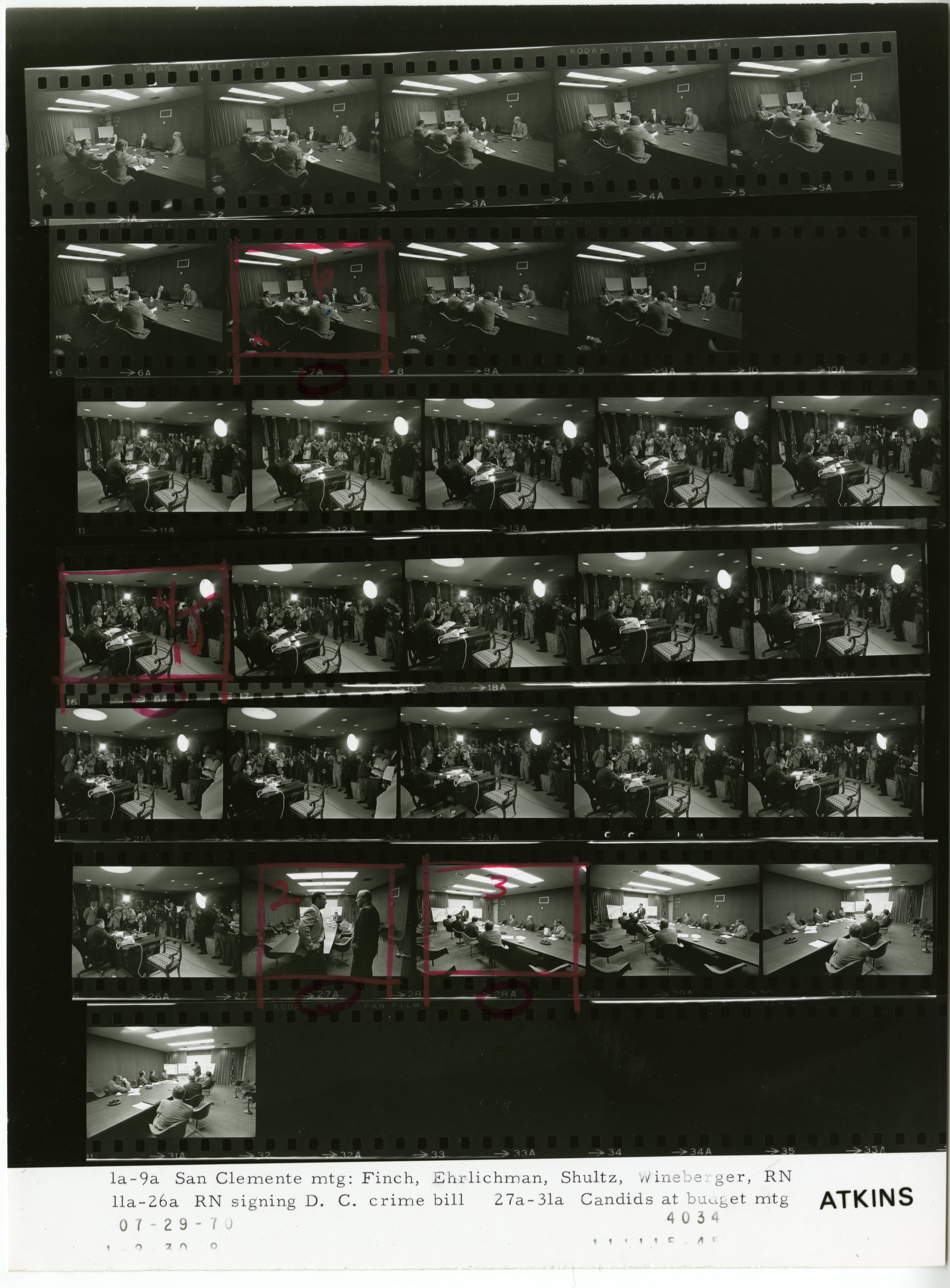
- Frame(s): WHPO-4034-01A-09A, President Nixon meeting with Domestic Budget Review Committee. 7/29/1970, San Clemente, CA Western White House, Conference room. President Nixon, George P. Shultz, Casper Weinberger, John D. Ehrlichman, Kenneth Cole.
- Frame(s): WHPO-4034-07A, President Nixon meeting with Domestic Budget Review Committee. 7/29/1970, San Clemente, CA Western White House, Conference room. President Nixon, George P. Shultz, Casper Weinberger, John D. Ehrlichman, Dick Nathan, Kenneth R. Cole.
- Frame(s): WHPO-4034-16A, President Nixon signing the District of Columbia Crime Bill in a ceremony in his office. 7/29/1970, San Clemente, CA. Western White House, Presidential Office.
- Frame(s): WHPO-4034-16A-26A, President Nixon signing the District of Columbia Crime Bill in a ceremony in his office. 7/29/1970, San Clemente, CA. Western White House, Presidential Office. President Nixon and members of the press.
Roll WHPO-4035 Photographer: Atkins, Oliver | Color or B&W: B&W
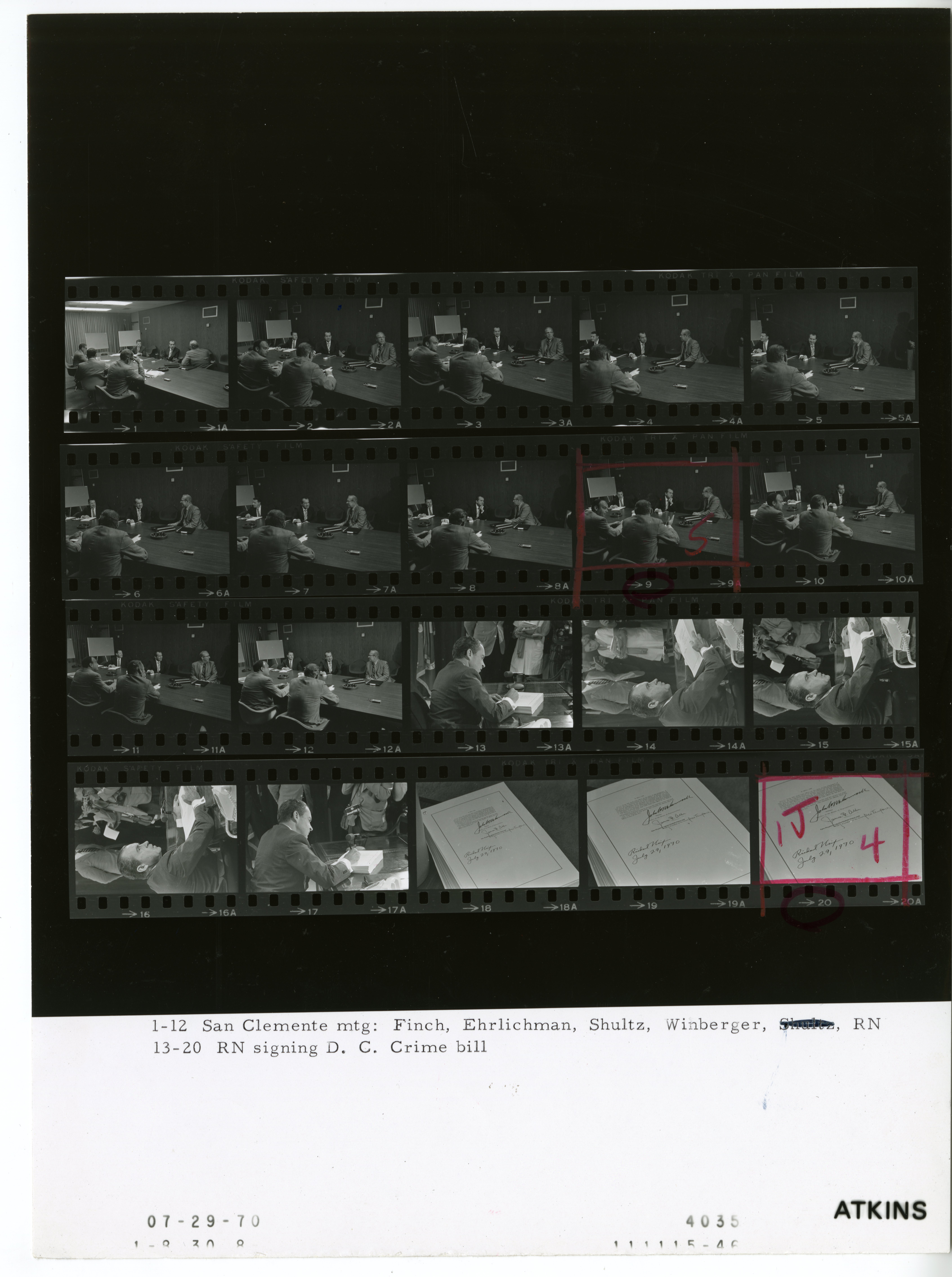
- Frame(s): WHPO-4035-01-12, President Nixon meeting with Domestic Budget Review Committee. 7/29/1970, San Clemente, CA Western White House, Conference room. President Nixon, George P. Shultz, Casper Weinberger, John D. Ehrlichman, Kenneth Cole.
- Frame(s): WHPO-4035-13-20, President Nixon signing the District of Columbia Crime Bill in a ceremony in his office. 7/29/1970, San Clemente, CA. Western White House, Presidential Office. President Nixon and members of the press.
Roll WHPO-4036 Photographer: Knudsen, Robert L. | Color or B&W: B&W
- Frame(s): WHPO-4036-02A-12A, President Nixon meeting with Robert H. Finch, White House Counselor and Robert Monagan, Speaker of the California Assembly. 7/29/1970, San Clemente, California Western White House, Presidential Office. President Nixon, Robert H. Finch and Robert Monagan.
The White House Communications Agency Sound Recordings Collection contains public statements that took place between 1969 and 1974. Visit the finding aid to learn more.
J - Entertainment at the White House
- WHCA-SR-J-131
The Harkness Ballet. (7/29/1970)
Runtime: 58:30:00
Keywords: Musician, musicians, music, celebrities, performance, classical music, dance
Original Format: 1/4-inch reel-to-reel audiotape. Original source type: Original.
P - Formal Presidential Remarks
- WHCA-SR-P-700722
Remarks by President Nixon at the signing ceremony for the Washington D.C. Crime Bill. (7/29/1970, Western White House, San Clemente, Californai)
Runtime: 0:04:33
Production credits: Audio feed and mult feed supplied by WHCA; Recorded byBJB (initials of WHCA engineer)
Original Format: 1/4-inch reel-to-reel audiotape. Original source type: Original.
The White House Communications Agency Videotape Collection contains “off-the-air” recordings of televised programs produced between 1968 and 1974. Visit the finding aid to learn more.
- WHCA-3808
Weekly News Summary, Tape I.
All networks
Runtime: 1:00
33. Scali: Middle East. Time Code Start: 43:23. Keywords: Middle East, Mideast, war, Israeli, truces, treaties, negotiations. Network: ABC.
34. Smith: Washington, D.C. Crime Bill (no audio from network). Time Code Start: 44:47. Keywords: bills, laws, House of Representatives, anti-crime, offences, infractions, criminals, criminality, law breaking. Network: ABC.
35. Gill: Washington, D.C. Crime Bill (President Nixon) (no audio 1st part, from network). Time Code Start: --. Keywords: bills, laws, House of Representatives, anti-crime, offences, infractions, criminals, criminality, law breaking. Network: ABC.
36. Pitcock: Martha Mitchell. Time Code Start: 46:40. Keywords: cabinet, advisors, law officials, families, wife, statements, Watergate, Senate committee hearings, investigations. Network: ABC.
37. Downs: Campaign 1970 (Secretary of Defense Laird). Time Code Start: 49:14. Keywords: cabinet, advisors, military, Cambodia, Vietnam War, conferences, speeches, statements. Network: ABC.
38. Smith: Commentary on the the Washington D.C. Crime Bill, preventive detention and "no-knock" search clauses, streamlining courts and adding judges. Time Code Start: 50:27. Keywords: bills, laws, House of Representatives, anti-crime, searching procedures, criminals, criminality. Network: ABC.
39. Brinkley: President Nixon signs Washington, D.C. crime bill, wants more anti-crime legislature. Time Code Start: 52:18. Keywords: bills, laws, House of Representatives, law breaking, signings, ceremonies. Network: NBC.
40. Kaplow: Washington D.C. Crime Bill. Time Code Start: --. Keywords: bills, laws, House of Representatives, anti-crime, offences, infractions, criminals, criminality, law breaking. Network: NBC.
41. Pomeroy: Middle East. Time Code Start: 54:39. Keywords: Middle East, Mideast, war, Israeli, truces, treaties, negotiations. Network: CBS.
42. Cronkite: President Nixon signs Washington D.C. controversial Crime Bill, wants more anti-crime legislation; criticizes Congress. Time Code Start: 56:31. Keywords: bills, laws, Presidents, signings. Network: CBS.
43. Rather: Washington D.C. Crime Bill (President Nixon). Time Code Start: --. Keywords: bills, laws, House of Representatives, anti-crime, offences, infractions, criminals, criminality, law breaking. Network: CBS.
44. Cronkite: Campaign 1970. Time Code Start: 58:46. Keywords: elections, campaigns, campaigning, candidates. Network: CBS.
45. Mudd: Campaign 1970; Democratic party seeks 18 yr old voters; party chairman Lawrence O'Brien regrets supporting Vietnam War. Time Code Start: --. Keywords: Vote, voters, voting, elections, campaigns, campaigning, candidates, youth, voting. Network: CBS.
Context (External Sources)
The Vanderbilt Television News Archive is the world's most extensive and complete archive of television news. They have been recording, preserving and providing access to television news broadcasts of the national networks since August 5, 1968.
Wikipedia is a free encyclopedia that anyone can edit.