
Introduction
This almanac page for Saturday, July 24, 1971, pulls together various records created by the federal government and links to additional resources which can provide context about the events of the day.
Previous Date: Friday, July 23, 1971
Next Date: Sunday, July 25, 1971
Schedule and Public Documents
The Daily Diary files represent a consolidated record of the President's activities. Visit the finding aid to learn more.
The President's day began at The White House - Washington, D. C.
The Weekly Compilation of Presidential Documents made available transcripts of the President's news conferences; messages to Congress; public speeches, remarks, and statements; and other Presidential materials released by the White House.
Digitized versions can be found at HathiTrust.
Each Public Papers of the Presidents volume contains the papers and speeches of the President of the United States that were issued by the White House Office of the Press Secretary during the time period specified by the volume. The material is presented in chronological order, and the dates shown in the headings are the dates of the documents or events. In instances when the release date differs from the date of the document itself, that fact is shown in the text note.
To ensure accuracy, remarks have been checked against audio recordings (when available) and signed documents have been checked against the original, unless otherwise noted. Editors have provided text notes and cross references for purposes of identification or clarity.
The Federal Register is the official daily publication for rules, proposed rules, and notices of federal agencies and organizations, as well as executive orders and other Presidential documents.
The Congressional Record is the official daily record of the debates and proceedings of the U.S. Congress.
Archival Holdings
Any selection of archival documents will necessarily be partial. You should use the documents and folders identified below as a starting place, but consult the linked collection finding aids and folder title lists and the collections themselves for context. Many documents to be found this way do not lend themselves to association with specific dates, but are essential to a complete understanding of the material.
Selective document listing
President's Office Files
The President's Office Files consists of materials drawn together by the Special Files Unit from several administrative subdivisions within the White House Office. It is the handwriting and sensitive papers sent to the Staff Secretary that now comprise much of the President's Office Files. Visit the finding aid to learn more.
- Annotated News Summaries, Box 30, News Summaries - July 1971 [1 of 2]
- Annotated News Summaries, Box 30, News Summaries - July 1971 [2 of 2] [During this period, the Staff Secretary only removed pages from the News Summaries which contained President Nixon's handwriting, often leaving the document with no date. Although there are no specific documents with this date, you should also consult the full folder for the month.]
- President's Daily Schedule, Box 101, [President's Daily Schedule, June-Aug. 1971] [2 of 3]
- The President's Schedule, Saturday - July 24, 1971
The H. R. Haldeman Diaries consists of seven handwritten diaries, 36 dictated diaries recorded as sound recordings, and two handwritten audio cassette tape subject logs. The diaries and logs reflect H. R. Haldeman’s candid personal record and reflections on events, issues, and people encountered during his service in the Nixon White House. As administrative assistant to the President and Chief of Staff, Haldeman attended and participated in public events and private meetings covering the entire scope of issues in which the Nixon White House engaged in during the years 1969-1973. Visit the finding aid to learn more.
- Transcript of diary entry (PDF)
Saturday, July 24.
The big stir this morning, before the tax meeting, was a reaction to a Beecher story in The New York Times yesterday that was based on a leaked memo regarding SALT. The President had called Ehrlichman early this morning to really stir things up, told him to line up everybody who had access to the memo and get them polygraphed before the weekend was out. Cancel all their tennis games and trips to Bermuda, and order them all back in, line them up and run them through the lie detector. He also got into quite a stir about some Porter leak that Henry mentioned to him––or a leak about Porter's appointment to Paris––but in checking out, I found that wasn't really a valid one to be stirred up about. We brought Bud Krogh in on the whole thing and, after some discussion, managed to simmer it down, because it turns out that Defense has a prime suspect on the case, and will move on him and then widen it as necessary, rather than going on a broad side attack. Poor Al Haig was practically beside himself, afraid we were going to go ahead on the original basis. And apparently they had some real flaps in Defense in the old days about lie detectors, and Haig was determined to try and save us from a repetition.
President’s also pushing for getting some more leaks out to Chicago Trib, and so on, rather than worrying about the building of legal cases. He’s pushing hard to use the polygraph ruthlessly, also to set up a system so that everybody who has access to the secret documents, sign an agreement ahead of time that they will take a polygraph test. He wants to move immediately on this with State and Defense and NSC. Go to all the people and make the point that if any document which has been in my possession is leaked, I agree to take a polygraph test as a condition of my clearance. So we got some stuff stirred that way.
We got into quite a continuing Kissinger-Ehlichman flap, starting yesterday at the staff meeting when Shultz and Ehrlichman jumped on me, because Henry wasn't available for the Defense section of the budget meeting and was causing them to shift all their plans around, etcetera. So I asked Henry to come in and join us. Ehrlichman then jumped on him pretty hard, on not only that, but also the intelligence thing and the international drug problem, and the fact that Henry piles stuff up and is not available to sign off on it himself and won't let anyone else sign off on it. Ehrlichman says that since we have this logjam, there's nothing he can do but go around Henry to the other people. At this point, Henry blew and said as long as he's here, nobody's going to go around him, and he is not going to permit anybody to sign off for him on these things. Ehrlichman got a little more rough on him, and that resulted in Henry saying Ehrlichman couldn't talk to him that way, and getting up and stalking out of the meeting. I tried to stop him on the basis that walking out wasn't going to accomplish anything either, but it was too late for that.
I talked to Henry, later in the day yesterday, and told him I felt both he and John had been wrong, and that we did have to work this out. He didn't back off very much. Again this morning, we got into it a little, but Henry's now on his way to Paris for another one of the secret meetings, so there isn't much opportunity to get it worked out now. In any event, at the budget meeting yesterday, the President jumped all over Henry on the Defense budget, as will be shown in my notes a little later when I get tomorrow mornings notes included in here-- or yesterday morning's notes included in here. But the problem still exists. I think a chunk of it, from Ehrlichman's viewpoint at least, results from irritation on his part towards Henry for being knocked off the China trip, which John feels is completely unreasonable.
Then we started the tax meeting this morning. Pete Flanigan made the main presentation. He reviewed first the value-added tax in some detail, making the point that it will take at least a year, maybe 18 months, for this to become effective. We could probably announce within six months and impose it in a year, if Congress OK'd it immediately. Then he got into the area of tax initiatives to accomplish social purposes. First of these being property tax relief: the problem being it's regressive, and it's high and the levels are rising. We could do this by additional federal support tied to property tax reduction, such as education, where we could change the revenue sharing formula, or by tax credit. A second initiative would be to liberalize child care expenses and encourage working mothers. The President was strongly opposed to this. The third would be relief for tuition costs, making the point that we could provide either a deduction or a credit. Specific proposal was a $200 credit which would cost $2.5 billion, but about 8 million people would benefit from it. Fourth, was to adjust the payroll tax on the lower middle income, that is the Social Security tax. It's now very regressive, especially on the blue collars.
The third area of general discussion was simplification of the personal income tax, and this is the––where the radical changes were, other than value-added. The proposal would be to eliminate capital gains, eliminate deductions, raise exemptions, and lower the tax rate from the range of 14-70 percent now, down to 12-35 percent. This would be quite earthshaking, but would accomplish a lot of things. The fourth general area were tax changes to stimulate the economy, such as in depreciation, R&D and acceleration of reductions.
After Flanigan's review, the President charged into the thing, saying the only way a value-added tax will have any salability is if it has a result of overall reducing taxes. He then said you've got to get new people in the Treasury Department; everybody you've got there now is opposed to any change. We either have to make a massive move, or none at all. The Mickey Mouse stuff won't work. The only one of the things you've talked about with any political moxie is the deduction or credit for education, and that even can be a mixed bag. What we need to do is think in terms of very gre-- a very great shift in the whole approach. We need to move in a dramatic way, substituting value-added for income tax and property tax. On that basis we'd have some chance to make it sail.
What we need is a revolutionary change in the old tax, such as a 20 percent value-added tax. Really go all out. The problem with the Flanigan presentation is that you're thinking of what's possible, but the next Congress isn't going to do anything anyway; so instead, we should make the issue, rather than just being totally responsible. At the present time, we've got to direct what we do towards people. We should try to do something that will evoke the reaction of: thank God, they're thinking big: something bold, something new. We don't want to do any more half-assed tinkering with the tax system. We should start with the proposition that the present tax system is lousy. Now start out from scratch with something new. Connally then jumped in to make the point that what we had presented was-- is revolutionary, and he agrees that the only way to sell a new tax is to reduce the old one, that we need now to get a feel of the President's overall objectives.
So the President went into it and said, look at the value-added tax, for instance. The things that we ought to modify, if we're going to put in a value-added tax, are first, to get at the property tax reduction in terms of property tax on homes. Second, look for things to goose up the economy, such as an investment tax credit. We need something with a payoff soon, not a long-term payoff. Problem with the R&D proposal, for instance, is that there's no immediate payout. Third, we need to help specific industries, but those with a broad effect, the railroads, and so forth: the excise tax on autos, if it will produce a price reduction. Forget about the telephone excise tax, because removing it won't do any good. Forget about daycare centers. Fourth, consider the tuition question. The real crunch here is the primary school, not the colleges. Primary and secondary. Don't worry about the Social Security tax.
Connally suggested that we work on the plan to tax dividend income only once to encourage more private investment, and that was favorably considered. Speeding up depreciation appeals to the President; he thinks that's better than the investment tax credit. President then said that priorities are: first, what affects the economy; and second, the credits, and so forth, that people can understand and that will be felt to be of great value to those concerned. Leave out the complicated ones and the ones that don't help our constituents. Connally then made the point that we have to start selling the concept that this nation can't exist with the cost of government over 35 percent, and we're almost to that point now. The meeting adjourned on that note, and President left shortly thereafter for Camp David, where we spent the night, and I had no further contact with him.
End of July 24. - Original audio recording (MP3)
The National Archives Catalog is the online portal to the records held at the National Archives, and information about those records. It is the main way of describing our holdings and also provides access to electronic records and digitized versions of our holdings.
The Catalog searches across multiple National Archives resources at once, including archival descriptions, digitized and electronic records, authority records, and web pages from Archives.gov and the Presidential Libraries. The Catalog also allows users to contribute to digitized historical records through tagging and transcription.
Nixon Library Holdings
All National Archives Units
National Security Documents
The President's Daily Brief is the primary vehicle for summarizing the day-to-day sensitive intelligence and analysis, as well as late-breaking reports, for the White House on current and future national security issues. Read "The President's Daily Brief: Delivering Intelligence to Nixon and Ford" to learn more.
The Foreign Relations of the United States series presents the official documentary historical record of major U.S. foreign policy decisions and significant diplomatic activity. Visit the State Department website for more information.
Vol. V, United Nations, 1969-1972
Chinese Representation in the United Nations
381. Telegram From the Department of State to the Embassy in the Republic of China, Washington, July 24, 1971, 1702Z
Source: National Archives, RG 59, Central Files 1970–73, UN 6 CHICOM. Secret; Immediate; Nodis. Drafted by Shoesmith, cleared by Assistant Secretary De Palma and Executive Secretary Eliot, and approved by Secretary Rogers. Repeated to Tokyo and USUN.
Vol. XI, South Asia Crisis, 1971
South Asia Crisis, 1971
106. Telegram From the Department of State to the Embassy in India, Washington, July 24, 1971, 1438Z
Source: National Archives, RG 59, Central Files 1970–73, POL INDIA–PAK. Secret; Nodis. Drafted on July 23 by Schneider and approved by Van Hollen. Repeated to Islamabad, Kathmandu, and Colombo.
107. Telegram Fromthe Department of State to the Embassy in Pakistan, Washington, July 24, 1971, 1035Z
Source: National Archives, RG 59, Central Files 1970–73, AID (US) 15–8 PAK. Confidential; Exdis. Drafted on July 23 by Laingen, cleared in AID by MacDonald, and approved by Van Hollen.
The Kissinger telephone conversation transcripts consist of approximately 20,000 pages of transcripts of Kissinger’s telephone conversations during his tenure as Assistant to the President for National Security Affairs (1969-1974) and Secretary of State (1973-1974) during the administration of President Richard Nixon. Visit the finding aid for more information.
Digitized versions can be found in the National Archives Catalog.
Audiovisual Holdings
The White House Tapes are sound recordings of President Richard Nixon's telephone conversations and of meetings held in the Oval Office and the Cabinet Room in the White House, the President's office in the Old Executive Office Building (OEOB), the Lincoln Sitting Room in the residence section of the White House, and several locations at the Presidential retreat at Camp David, Maryland. These recordings document many of the major events and decisions of the Nixon Administration from February 16, 1971 to July 18, 1973. Visit the White House Tapes finding aid to learn about the taping system's operation and archival processing.
Cabinet Room
Oval Office
- 545-1; 9:43 a.m. - 10:36 a.m.; Nixon, Richard M. (President); Haldeman, H. R. ("Bob"); Kissinger, Henry A.; Butterfield, Alexander P.; Ehrlichman, John D.
- 545-2; Unknown between 12:28 p.m. & 12:36 p.m.; Connally, John B.
- 545-3; 12:36 p.m. - 1:03 p.m.; Nixon, Richard M. (President); Ehrlichman, John D.; Haldeman, H. R. ("Bob"); Krogh, Egil ("Bud"), Jr.
The White House Photo Office collection consists of photographic coverage of President Richard Nixon meeting with prominent social, political, and cultural personalities; speaking engagements and news conferences of the President and various high-ranking members of the White House staff and Cabinet; Presidential domestic and foreign travel, including Presidential vacations; social events and entertainment involving the First Family, including entertainers present; official portraits of the President, First Family, and high-ranking members of the Nixon administration; the 1969 and 1973 Inaugurals; the President’s 1972 Presidential election campaign appearances (including speeches) and other official activities of the White House staff and the President’s Cabinet from January 20, 1969 until August 9, 1974 at the White House and the Old Executive Office Building; other locations in Washington, DC, such as The Mall; and the Presidential retreats in Camp David, Maryland, Key Biscayne, Florida, and San Clemente, California. Visit the finding aid to learn more.
Roll WHPO-6852 Photographer: Schumaker, Byron | Color or B&W: B&W
- Frame(s): WHPO-6852-02A-09A, President Nixon greeting Gerald Warren and his family. 7/24/1971, Washington, D.C. White House, Rose Garden. President Nixon, Gerald L. Warren, Mrs. Warren, Gerald B. Warren, Mia Warren, H. E. Warren, unidentified men.
- Frame(s): WHPO-6852-10A-11A, Men walking to the helipad. 7/24/1971, Washington, D.C. White House, South Grounds. President Nixon, Gerald L. Warren, Mrs. Warren, Gerald B. Warren, Mia Warren, H. E. Warren, unidentified men.
Roll WHPO-6859 Photographer: Schumaker, Byron | Color or B&W: B&W
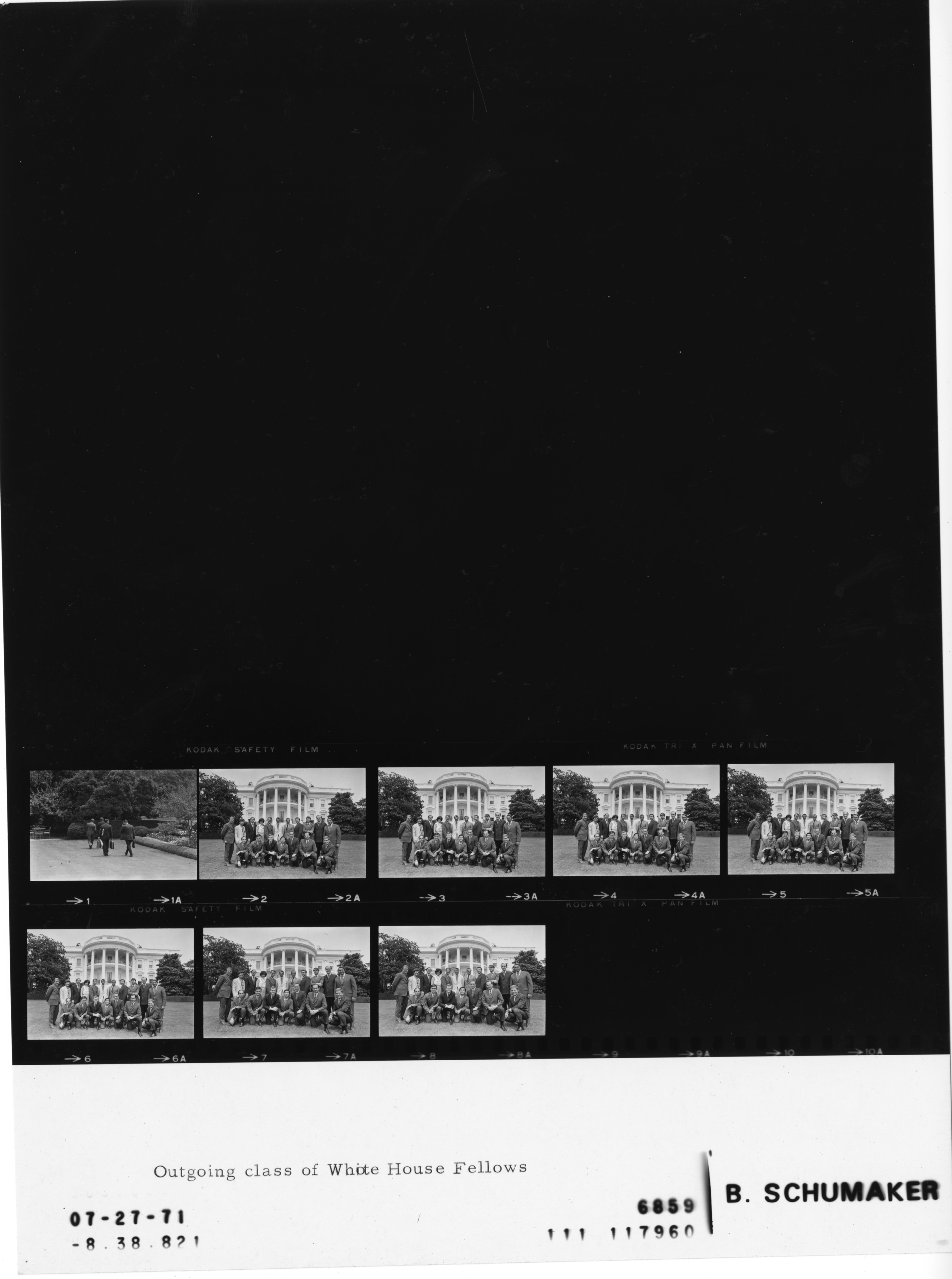
- Frame(s): WHPO-6859-01, unidentified men walking toward the White House south grounds helipad. 7/24/1971, Washington, D.C. White House, South Grounds. unidentified men.
Roll WHPO-6891 Photographer: Schumacher, Karl | Color or B&W: B&W
- Frame(s): WHPO-6891-02A-09A, Vice President Agnew being greeted upon arrival. 7/24/1971, Rabat, Morocco airport, tarmac. Spiro Agnew, officials, unidentified persons.
- Frame(s): WHPO-6891-10A-15A, Vice President Agnew and others on a golf course. 7/24/1971, Rabat, Morocco golf course. Spiro Agnew, officials, unidentified persons.
Roll WHPO-6892 Photographer: Schumacher, Karl | Color or B&W: B&W
- Frame(s): WHPO-6892-03A-17A, Vice President Agnew being greeted upon arrival. 7/24/1971, Rabat, Morocco airport. Spiro Agnew, officials, unidentified persons.
- Frame(s): WHPO-6892-18A-20A, Vice President Agnew and others on a golf course. 7/24/1971, Rabat, Morocco golf course. Spiro Agnew, officials, unidentified persons.
Roll WHPO-6893 Photographer: Schumacher, Karl | Color or B&W: Color
- Frame(s): WHPO-6893-06-11, Vice President Agnew being greeted upon arrival. 7/24/1971, Rabat, Morocco airport. Spiro Agnew, officials, unidentified persons.
Context (External Sources)
The Vanderbilt Television News Archive is the world's most extensive and complete archive of television news. They have been recording, preserving and providing access to television news broadcasts of the national networks since August 5, 1968.
Wikipedia is a free encyclopedia that anyone can edit.