
Introduction
This almanac page for Monday, July 2, 1973, pulls together various records created by the federal government and links to additional resources which can provide context about the events of the day.
Previous Date: Sunday, July 1, 1973
Next Date: Tuesday, July 3, 1973
Schedule and Public Documents
The Daily Diary files represent a consolidated record of the President's activities. Visit the finding aid to learn more.
The President's day began at San Clemente, California
The Weekly Compilation of Presidential Documents made available transcripts of the President's news conferences; messages to Congress; public speeches, remarks, and statements; and other Presidential materials released by the White House.
Digitized versions can be found at HathiTrust.
Each Public Papers of the Presidents volume contains the papers and speeches of the President of the United States that were issued by the White House Office of the Press Secretary during the time period specified by the volume. The material is presented in chronological order, and the dates shown in the headings are the dates of the documents or events. In instances when the release date differs from the date of the document itself, that fact is shown in the text note.
To ensure accuracy, remarks have been checked against audio recordings (when available) and signed documents have been checked against the original, unless otherwise noted. Editors have provided text notes and cross references for purposes of identification or clarity.
The Federal Register is the official daily publication for rules, proposed rules, and notices of federal agencies and organizations, as well as executive orders and other Presidential documents.
Archival Holdings
Any selection of archival documents will necessarily be partial. You should use the documents and folders identified below as a starting place, but consult the linked collection finding aids and folder title lists and the collections themselves for context. Many documents to be found this way do not lend themselves to association with specific dates, but are essential to a complete understanding of the material.
Selective document listing
President's Office Files
The President's Office Files consists of materials drawn together by the Special Files Unit from several administrative subdivisions within the White House Office. It is the handwriting and sensitive papers sent to the Staff Secretary that now comprise much of the President's Office Files. Visit the finding aid to learn more.
- News Summaries, Unmarked News Summaries, Box 58, News Summaries - July 1973 [1 of 15] [Note: Due to the way News Summary products were compiled, you should also consult nearby days for potentially relevant materials.]
- Weekend News Review, July 2, 1973
- Digest of Weekend News Comment
- Press Comment on RN/Brezhnev Summit, July 2, 1973
- News Summaries, Unmarked News Summaries, Box 58, News Summaries - July 1973 [2 of 15]
- Magazine/Column Review, Week of July 2, 1973
The National Archives Catalog is the online portal to the records held at the National Archives, and information about those records. It is the main way of describing our holdings and also provides access to electronic records and digitized versions of our holdings.
The Catalog searches across multiple National Archives resources at once, including archival descriptions, digitized and electronic records, authority records, and web pages from Archives.gov and the Presidential Libraries. The Catalog also allows users to contribute to digitized historical records through tagging and transcription.
Nixon Library Holdings
All National Archives Units
National Security Documents
The President's Daily Brief is the primary vehicle for summarizing the day-to-day sensitive intelligence and analysis, as well as late-breaking reports, for the White House on current and future national security issues. Read "The President's Daily Brief: Delivering Intelligence to Nixon and Ford" to learn more.
The Foreign Relations of the United States series presents the official documentary historical record of major U.S. foreign policy decisions and significant diplomatic activity. Visit the State Department website for more information.
Vol. X, Vietnam, January 1973-July 1975
Congressional Restrictions, General Warfare, June 19, 1973-February 25, 1975
90. Memorandum From William Stearman of the National Security Council Staff to the President’s Assistant for National Security Affairs (Kissinger), Washington, July 2, 1973
Source: National Archives, Nixon Presidential Materials, NSC Files, Box 164, Vietnam Country Files, Vietnam, May–September 1973. Secret; Sensitive. Sent for information. Kissinger’s initials appear at the top of the page. According to the attached correspondence profile, he noted the memorandum on July 11.
Vol. XXV, Arab-Israeli Crisis and War, 1973
Arab-Israeli Crisis and War, 1973
76. Memorandum From the President’s Assistant for National Security Affairs (Kissinger) to President Nixon, Washington, July 2, 1973
Source: National Archives, Nixon Presidential Materials, NSC Files, Box 621, Country Files, Middle East, Lebanon, Vol. III, Jan. 71–Oct. 73. Secret. Sent for action. Saunders forwarded this memorandum to Kissinger under a covering memorandum of June 28 that recommended that Kissinger send it to the President as soon as possible.
Vol. XXVII, Iran; Iraq, 1973-1976
Iran, January-August 1973
20. Telegram From the Embassy in Iran to the Department of State, Tehran, July 2, 1973, 1283Z
Source: National Archives, Nixon Presidential Materials, NSC Files, Box 603, Country Files—Middle East, Iran, Vol. V, May–December 1973. Confidential; Exdis.
Vol. E-9, Part 2, Documents on the Middle East Region, 1973-1976
Saudi Arabia
90. Memorandum of Conversation, Washington, July 2, 1973
Summary: Governor Anwar Ali of the Saudi Arabian Monetary Agency met with officials from the Department to discuss U.S.-Saudi investment policies and future projects.
Source: National Archives, RG 59, Central Foreign Policy File, 1970–73, FN 9 Saudi Arabia. Confidential. Drafted by Wrampelmeier; cleared by Atherton; approved in E on July 6. Ali also met separately with Dickman on June 27. (Ibid., POL 7 Saudi Arabia)
Vol. E-11, Part 2, Documents on South America, 1973-1976
Uruguay
335. Telegram 2025 From the Embassy in Uruguay to the Department of State, Montevideo, July 2, 1973, 2034Z
Summary: The Embassy reported that the Uruguayan crisis, which culminated in the June 27 closure of Congress, had reached a decisive stage but it was unclear what the final outcome would be. Ortiz recommended that, if President Bordaberry and Foreign Minister Blanco made the traditional courtesy call at the Embassy on July 4, he emphasize the “common commitment to democratic ideals” shared by the two countries.
Source: National Archives, RG 59, Central Foreign Policy File, [no film number]. Confidential; Immediate; Limdis. Repeated for information to La Paz.
Vol. E-12, Documents on East and Southeast Asia, 1973-1976
Japan
175. Memorandum From the President’s Assistant for National Security Affairs (Kissinger) and the President’s Assistant for International Economic Affairs (Flanigan) to President Nixon, Washington, July 2, 1973., Washington, July 2, 1973
Kissinger and Flanigan forwarded Secretary Rogers’s memorandum about the upcoming ministerial meeting with Japan. Nixon approved the proposed agenda.
Source: National Archives, Nixon Presidential Materials, NSC Files, Box 539, Country Files, Far East, Japan, July 1973–December 31, 1974 (sic), vol. 10. Confidential. Sent for action. Nixon initialed his approval of the recommendation. Rogers’s memorandum, June 22, is attached Tab A, but is not published.
The Kissinger telephone conversation transcripts consist of approximately 20,000 pages of transcripts of Kissinger’s telephone conversations during his tenure as Assistant to the President for National Security Affairs (1969-1974) and Secretary of State (1973-1974) during the administration of President Richard Nixon. Visit the finding aid for more information.
Digitized versions can be found in the National Archives Catalog.
Audiovisual Holdings
The White House Photo Office collection consists of photographic coverage of President Richard Nixon meeting with prominent social, political, and cultural personalities; speaking engagements and news conferences of the President and various high-ranking members of the White House staff and Cabinet; Presidential domestic and foreign travel, including Presidential vacations; social events and entertainment involving the First Family, including entertainers present; official portraits of the President, First Family, and high-ranking members of the Nixon administration; the 1969 and 1973 Inaugurals; the President’s 1972 Presidential election campaign appearances (including speeches) and other official activities of the White House staff and the President’s Cabinet from January 20, 1969 until August 9, 1974 at the White House and the Old Executive Office Building; other locations in Washington, DC, such as The Mall; and the Presidential retreats in Camp David, Maryland, Key Biscayne, Florida, and San Clemente, California. Visit the finding aid to learn more.
Roll WHPO-E1144 Photographer: Knudsen, Robert L. | Color or B&W: Color
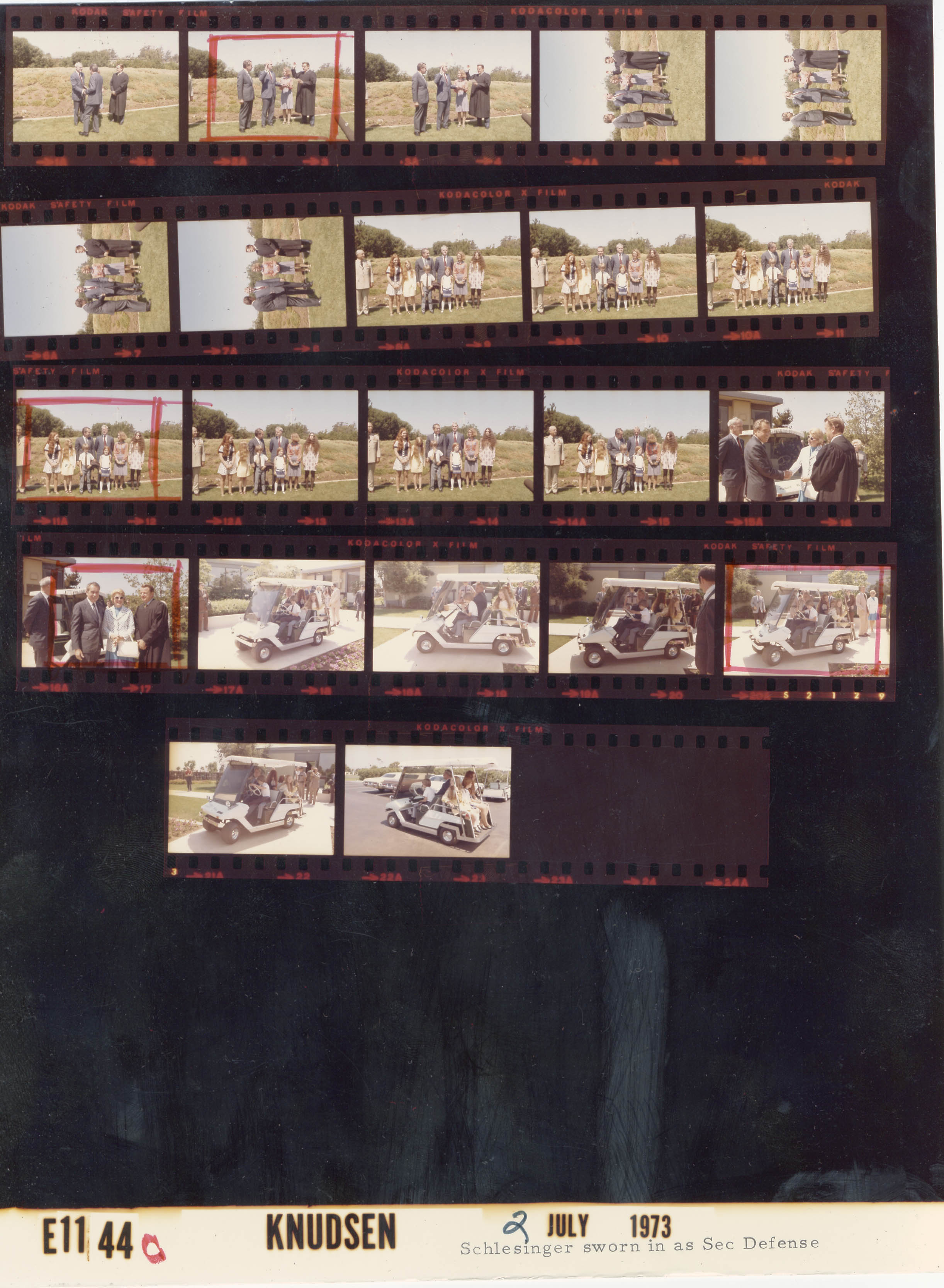
- Frame(s): WHPO-E1144-, President Nixon attending the swearing-in ceremony of James R. Schlesinger as Secretary of Defense. 7/2/1973, Washington D.C. Lawn outside the Oval Office. President Nixon, James Schlesinger, Rachel Schlesinger, Judge Spencer Williams.
- Frame(s): WHPO-E1144-03, President Nixon attending the swearing-in ceremony of James R. Schlesinger as Secretary of Defense. 7/2/1973, Washington D.C. Lawn outside the Oval Office. President Nixon, James Schlesinger, Rachel Schlesinger, Judge Spencer Williams.
The White House Communications Agency Sound Recordings Collection contains public statements that took place between 1969 and 1974. Visit the finding aid to learn more.
P - Formal Presidential Remarks
- WHCA-SR-P-730701
Swearing-in ceremony at western White House for JS as Secretary of Defense with JS. (7/2/1973)
Runtime: 6:00
Original Format: 1/4-inch reel-to-reel audiotape. Original source type: Original.
S - White House Press Office Briefings (continuation of the L-series)
- WHCA-SR-S-172
Press briefing by Ronald Ziegler. (7/2/1973, San Clemente Press Center)
Runtime: 49:00:00
Keywords: Press conferences, news conferences, interviews, media, press secretary
Production credits: Audio feed supplied by WHCA; Recorded by GET (initials of WHCA engineer)
Original Format: 1/4-inch reel-to-reel audiotape. Original source type: Original.
The White House Communications Agency Videotape Collection contains “off-the-air” recordings of televised programs produced between 1968 and 1974. Visit the finding aid to learn more.
- WHCA-6411
Weekly News Summary, Tape I.
ALL NETWORKS
Runtime: 01:28:30
27. Reasoner/Jarriel: President Nixon will respond to Watergate. Time Code Start: 64:45. Keywords: Watergate, Senate committee hearings, investigations, testimony, testify, cover-ups, break-in, burglary, theft, plumbers, scandals, impeachment, resignations. Network: ABC.
28. Reasoner/Clark: Colby questioned by Senator Symington for Central Intelligence Agency (CIA) post. Time Code Start: 66:50. Keywords: national security, intelligence gathering, covert activities, spying, espionage, leaders, nominees, hearings. Network: ABC.
29. Reasoner: Commentary on food shortage. Time Code Start: 68:38. Keywords: food, shortages. Network: ABC.
30. Reasoner/Chapman: Soybean exports to Japan. Time Code Start: 70:43. Keywords: agriculture, food, grains, exports, Japanese. Network: ABC.
31. Reasoner/Bennent: Bombing in Cambodia. Time Code Start: 72:40. Keywords: Cambodia, Vietnam War, military, bombings. Network: ABC.
32. Reasoner/Snell: Energy crisis, allocation of fuel. Time Code Start: 74:40. Keywords: energy crisis, oil crisis, petroleum, oil supply, gasoline, fuel, shortages, rationing, allocations. Network: ABC.
33. Reasoner/O'Donald: Kavanaugh POW. Time Code Start: 77:00. Keywords: Vietnam War, Vietnam Prisoner of War. Network: ABC.
38. Chancellor/Valeriani: President Nixon may respond to Ervin Committee, Secretary of Defense Schlesinger sworn in. Time Code Start: 87:55. Keywords: officials, swearings in, sworn in, ceremony, Watergate, Senate committee hearings, investigations, testimony, testify, cover-ups, break-in, burglary, theft, plumbers, scandals, impeachment, resignations. Network: NBC. - WHCA-6412
Weekly News Summary, Tape II.
ALL NETWORKS
Runtime: 01:30:15
1. Chancellor/Nessen: Nine years after the war on poverty declared, Howard Phillips on Office of Economic Opportunity. Time Code Start: 00:00. Keywords: homelessness, anti-poverty, destitution, lifestyles, economy, economics, budgets, finances, recession, inflation, money, wages, costs, unemployment, prices, reports. Network: NBC.
2. Mudd/McLaughlin/Chase/Duval/Quint/Dawl: Cost of food conference forsees food rationing. Time Code Start: 02:46. Keywords: food, shortages, rationing, cost of living. Network: CBS.
3. Mudd/Stahl: John Mitchell knew about Watergate hush money. Time Code Start: 08:27. Keywords: Watergate, Senate committee hearings, investigations, testimony, testify, cover-ups, break-in, burglary, theft, plumbers, scandals, impeachment, resignations. Network: CBS.
4. Schieffer: Watergate committee members getting fan mail. Time Code Start: 10:00. Keywords: U.S. Postal Service, U.S. Post Office, letters, Watergate, Senate committee hearings, investigations, testimony, testify, cover-ups, break-in, burglary, theft, plumbers, scandals, impeachment, resignations. Network: CBS.
5. Jones: William Colby appointed head of Central Intelligence Agency (CIA). Time Code Start: 11:49. Keywords: appointees, appointments, national security, intelligence gathering, covert activities, spying, espionage. Network: CBS.
Context (External Sources)
The Vanderbilt Television News Archive is the world's most extensive and complete archive of television news. They have been recording, preserving and providing access to television news broadcasts of the national networks since August 5, 1968.
Wikipedia is a free encyclopedia that anyone can edit.