
Introduction
This almanac page for Tuesday, January 5, 1971, pulls together various records created by the federal government and links to additional resources which can provide context about the events of the day.
Previous Date: Monday, January 4, 1971
Next Date: Wednesday, January 6, 1971
Schedule and Public Documents
The Daily Diary files represent a consolidated record of the President's activities. Visit the finding aid to learn more.
The President's day began at The White House - Washington, D. C.
The Weekly Compilation of Presidential Documents made available transcripts of the President's news conferences; messages to Congress; public speeches, remarks, and statements; and other Presidential materials released by the White House.
Digitized versions can be found at HathiTrust.
Each Public Papers of the Presidents volume contains the papers and speeches of the President of the United States that were issued by the White House Office of the Press Secretary during the time period specified by the volume. The material is presented in chronological order, and the dates shown in the headings are the dates of the documents or events. In instances when the release date differs from the date of the document itself, that fact is shown in the text note.
To ensure accuracy, remarks have been checked against audio recordings (when available) and signed documents have been checked against the original, unless otherwise noted. Editors have provided text notes and cross references for purposes of identification or clarity.
The Federal Register is the official daily publication for rules, proposed rules, and notices of federal agencies and organizations, as well as executive orders and other Presidential documents.
Archival Holdings
Any selection of archival documents will necessarily be partial. You should use the documents and folders identified below as a starting place, but consult the linked collection finding aids and folder title lists and the collections themselves for context. Many documents to be found this way do not lend themselves to association with specific dates, but are essential to a complete understanding of the material.
Selective document listing
President's Office Files
The President's Office Files consists of materials drawn together by the Special Files Unit from several administrative subdivisions within the White House Office. It is the handwriting and sensitive papers sent to the Staff Secretary that now comprise much of the President's Office Files. Visit the finding aid to learn more.
- Annotated News Summaries, Box 29, News Summaries - January 1971 [During this period, the Staff Secretary only removed pages from the News Summaries which contained President Nixon's handwriting, often leaving the document with no date. Although there are no specific documents with this date, you should also consult the full folder for the month.]
- President's Daily Schedule, Box 101, [President's Daily Schedule, Jan.-Feb. 1971] [1 of 3]
- The President's Schedule, Tuesday - January 5, 1971
The H. R. Haldeman Diaries consists of seven handwritten diaries, 36 dictated diaries recorded as sound recordings, and two handwritten audio cassette tape subject logs. The diaries and logs reflect H. R. Haldeman’s candid personal record and reflections on events, issues, and people encountered during his service in the Nixon White House. As administrative assistant to the President and Chief of Staff, Haldeman attended and participated in public events and private meetings covering the entire scope of issues in which the Nixon White House engaged in during the years 1969-1973. Visit the finding aid to learn more.
- Transcript of diary entry (PDF)
Two, three, four, five.
Tuesday, January 5, 1971
Day of Cabinet meeting. Our first of the new plan of having biweekly meetings at 8:00 in the morning lasting for just an hour. The President carried this one on for an hour and a half, because he's just not able to convince himself that you can hold the thing to an hour and keep everybody happy. It went very well, in any event. The Vice President opened the meeting after the group gave the President a standing round of applause because of his TV last night. And the Vice President launched into quite a laudatory statement regarding the television. And the President discussed that some.
He told the Cabinet he's going to make a new troop announcement on April 15, and then launched into some views on the economy. He made the point that his kids had not been terribly impressed with the TV, and that they preferred press conferences, that Eddie Cox had called Tricia. And the President identified him as a Harvard law type and said: I doubt if those Harvard law types understand-- understood--any more of what I was saying about the economy last night than I did. Then he referred to Wilson as the most intellectual of all Presidents and said, of course, that was because of his education, or perhaps in spite of it. Then he said who knows what Lincoln might have been if he'd gone to school, it probably would have ruined him. He told the Cabinet to funnel any ideas they have regarding Presidential TV appearances to me, that he wants suggestions on this subject.
He then led them into quite a discussion of the economy, which lasted about an hour. He hit the theory that there is no formula for low unemployment without war, and said that this is the one thing we are going to accomplish, and it will be a marvelous achievement. He raised the point of the possibility of further changes in the Cabinet and said there would be no more at the President's request, that this is the team that we have here now, unless any of you decide you want to leave.
In referring to the deficit, he said, that's what I used to talk about before I understood these things. He made the point regarding the need for selling revenue sharing, said it would have be the most concerted selling effort ever; everyone would have to get into it whole hog. He told them a drastic reorganization was coming up in the State of the Union, that it would be very traumatic. Ehrlichman intervened to tell him not to say anything about it, that there must be an absolute lid on this whole business, because the President must move first on these changes. The President warned them not to start a backfire on reorganization, because the decision's already made, and referred to the new plans as being the first new model in government in a hundred years.
Elliot Richardson got into a discussion of how we can better influence commentators and opinion leaders to give them a better feel for the depth and range of the President's knowledge and understanding, for example, of economics. He was making the point that the people would be greatly enlightened if they could see the President in action, the way the Cabinet just had this morning. He felt we have to use more ingenuity to get a better understanding in depth, at least among key people. And there was some discussion of meetings with editorial boards of Fortune, Kiplinger, Business Week, and so forth, to sell them and get them to go out and sell others. The President concluded by saying he'd tell them a story that he had planned to tell last night on TV that he had developed for Sevareid, but Sevareid was so profound he didn't give me time to say it.
After the Cabinet meeting, the President had a series of appointments that kept him busy through the rest of the morning. And we left about 12:20 for the airport and on to San Clemente. When he came in this morning before the Cabinet meeting, he was obviously very tired and had had hardly any sleep last night, and he really showed it. When he got aboard the plane, he apparently had a couple of Bloody Mary's, and when he called me up, shortly after takeoff, he was pretty relaxed. He decided he wanted to stop at Lincoln, Nebraska, on the way back from California to present their football team with a plaque for being number one and then for him to make a speech at a University convocation. He feels it's a good chance to give a speech playing on the theme of the 18 year old vote and their new participation in politics. And he wants not to give a speech on dissent but, rather one bringing the challenge to them of playing the game to win, fighting hard, learning to lose and to win, that Nebraska was this kind of team. They'd never been number one before but they'd never quit, and that this is the kind of spirit that keeps the country going, etcetera. He also wants to make the point that his European friend’s quote that America's problem is war but Europe's problem is peace. And that peace is not as easy as it sounds, we have to have great goals and great purposes, etcetera.
He also mentioned that he talked to Ambassador Freeman this morning about the possibility of the President going on a two-on-one interview with BBC and the independent network in Britain, which he's intrigued with pursuing.
He discussed general plans for '71. He wants to use this as the year to fill the canvas, as he puts it. We can do all we want now and, if there is any objection to over-activity on the TV, etcetera, we can refer back to the bitching earlier when they said the President wasn't doing enough. We should use this year to hit all the leadership and image things that we feel we need to do.
He asked me to call Connally and have a long talk with him about his views on our PR needs, and also to get an analysis of the President's television last night. He also wanted me to call Jim Shepley and ask for the agency commission on the plug the President gave Life last night, then hit them on the unfairness that Life has been showing towards us and see if he thinks it would be productive to have a meeting of the Time, Life, and Fortune editors.
He completely approved my request to slip out to Palm Springs and try and get some work done for the next few days, so I left very shortly after we got to San Clemente. And I'm over at Smoke Tree with Chapin, hopefully for the rest of the week.
End of January 5. - Original audio recording (MP3)
The National Archives Catalog is the online portal to the records held at the National Archives, and information about those records. It is the main way of describing our holdings and also provides access to electronic records and digitized versions of our holdings.
The Catalog searches across multiple National Archives resources at once, including archival descriptions, digitized and electronic records, authority records, and web pages from Archives.gov and the Presidential Libraries. The Catalog also allows users to contribute to digitized historical records through tagging and transcription.
Nixon Library Holdings
All National Archives Units
National Security Documents
The President's Daily Brief is the primary vehicle for summarizing the day-to-day sensitive intelligence and analysis, as well as late-breaking reports, for the White House on current and future national security issues. Read "The President's Daily Brief: Delivering Intelligence to Nixon and Ford" to learn more.
The Foreign Relations of the United States series presents the official documentary historical record of major U.S. foreign policy decisions and significant diplomatic activity. Visit the State Department website for more information.
Vol. V, United Nations, 1969-1972
Committee of 24
67. Circular Telegram From the Department of State to Certain Posts, Washington, January 5, 1971, 0120Z
Source: National Archives, RG 59, Central Files 1970–73, POL 19 UN. Confidential. Drafted by Peale, Walker, Peter C, and Frank R. Golino; cleared by Witman, Goott, McNutt, Geraldine Jenkins, Stanley D. Schiff, and Morris Rothenberg; and approved by Assistant Secretary De Palma. Sent to Abidjan, Addis Ababa, Bamako, Brussels, Canberra, Caracas, Dar es Salaam, Freetown, The Hague, Kabul, Lisbon, London, Madrid, New Delhi, Oslo, Paris, Port-of-Spain, Quito, Rome, Stockholm, Tananarive, Tehran, Tokyo, Tunis, and Wellington; and repeated to Belgrade, Moscow, Sofia, Warsaw, USUN, and all other African and Latin American posts.
Vol. XX, Southeast Asia, 1969-1972
Thailand
103. Telegram From the Embassy in Thailand to the Embassy in France, Bangkok, January 5, 1971, 1233Z
Source: National Archives, RG 59, Central Files 1970–73, POL 23 THAI. Secret; Priority;Nodis. Repeated to the Department of State and to CINCPAC.
Vol. E-16, Documents on Chile, 1969-1973
Cool and Correct: The U.S. Response to the Allende Administration, November 5, 1970-December 31, 1972
44. Telegram From the Embassy in Chile to the Department of State, Santiago, January 5, 1971, 2154Z
Summary: In the first of four related telegrams titled “The Evident Becomes Obvious,” Korry discussed the changes instituted by the early Allende administration, noting that the administration had attained every initial goal of its program to make Chile a socialist state using non-violent, democratic means. Moreover, the early successes enjoyed by the administration had earned the support of the military, the Church, the bourgeoisie, and the international community.
Source: National Archives, RG 59, Central Files 1970–73, POL 2–2 CHILE. Secret; Limdis. Repeated to Asunción, Bogotá, Bonn, Brasilia, Buenos Aires, Canberra, Caracas, Guatemala, Kingston, La Paz, Lima, London, Madrid, Managua, Melbourne, Mexico City, Montevideo, Ottawa, Panama, Paris, Port au Prince, Port of Spain, Quito, Rio de Janeiro, Rome, San José, San Salvador, Santo Domingo, Tegucigalpa, and USCINCSO. Parts II, III, and IV are Documents 45–47.45. Telegram From the Embassy in Chile to the Department of State, Santiago, January 5, 1971, 2324Z
Summary: In this second of four related telegrams titled “The Evident Becomes Obvious,” Korry reported on the media and financial counterattack of anti-Communist opponents of Allende. Specifically, Korry noted that the conservative Chilean paper, El Mercurio, had ended its truce with the administration and was engaged in a final battle with Allende. As a result of its political attacks, advertisers had stopped investing in the newspaper and the paper was having difficulties paying its employees.
Source: National Archives, RG 59, Central Files 1970–73, POL 2–2 CHILE. Secret; Limdis. Repeated to Asunción, Bogotá, Bonn, Brasilia, Buenos Aires, Canberra, Caracas, Guatemala, Kingston, La Paz, Lima, London, Madrid, Managua, Melbourne, Mexico City, Montevideo, Ottawa, Panama, Paris, Port au Prince, Port of Spain, Quito, Rio de Janeiro, Rome, San José, San Salvador, Santo Domingo, Tegucigalpa, and USCINCSO. Reference telegram 43 from Santiago, January 5, Part I of the series, is Document 44.
The Kissinger telephone conversation transcripts consist of approximately 20,000 pages of transcripts of Kissinger’s telephone conversations during his tenure as Assistant to the President for National Security Affairs (1969-1974) and Secretary of State (1973-1974) during the administration of President Richard Nixon. Visit the finding aid for more information.
Digitized versions can be found in the National Archives Catalog.
Audiovisual Holdings
The White House Photo Office collection consists of photographic coverage of President Richard Nixon meeting with prominent social, political, and cultural personalities; speaking engagements and news conferences of the President and various high-ranking members of the White House staff and Cabinet; Presidential domestic and foreign travel, including Presidential vacations; social events and entertainment involving the First Family, including entertainers present; official portraits of the President, First Family, and high-ranking members of the Nixon administration; the 1969 and 1973 Inaugurals; the President’s 1972 Presidential election campaign appearances (including speeches) and other official activities of the White House staff and the President’s Cabinet from January 20, 1969 until August 9, 1974 at the White House and the Old Executive Office Building; other locations in Washington, DC, such as The Mall; and the Presidential retreats in Camp David, Maryland, Key Biscayne, Florida, and San Clemente, California. Visit the finding aid to learn more.
Roll WHPO-5431 Photographer: Atkins, Oliver | Color or B&W: B&W
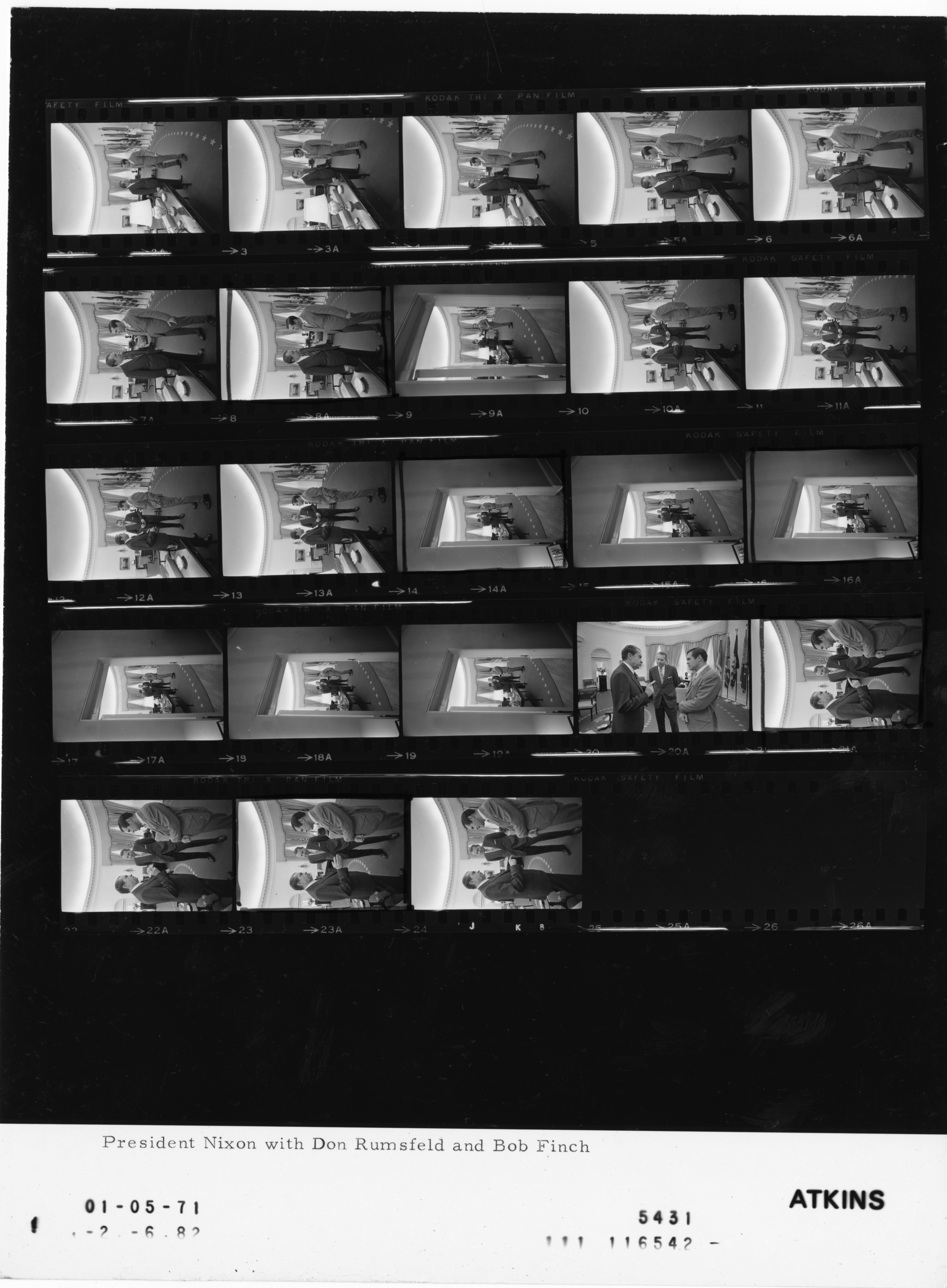
- Frame(s): WHPO-5431-02-24, President Nixon standing in the Oval Office during a meeting with Donald Rumsfeld and Robert Finch. 1/5/1971, Washington, D.C. White House, Oval Office. President Nixon, Donald Rumsfeld, Robert Finch.
Roll WHPO-5432 Photographer: Schumaker, Byron | Color or B&W: B&W
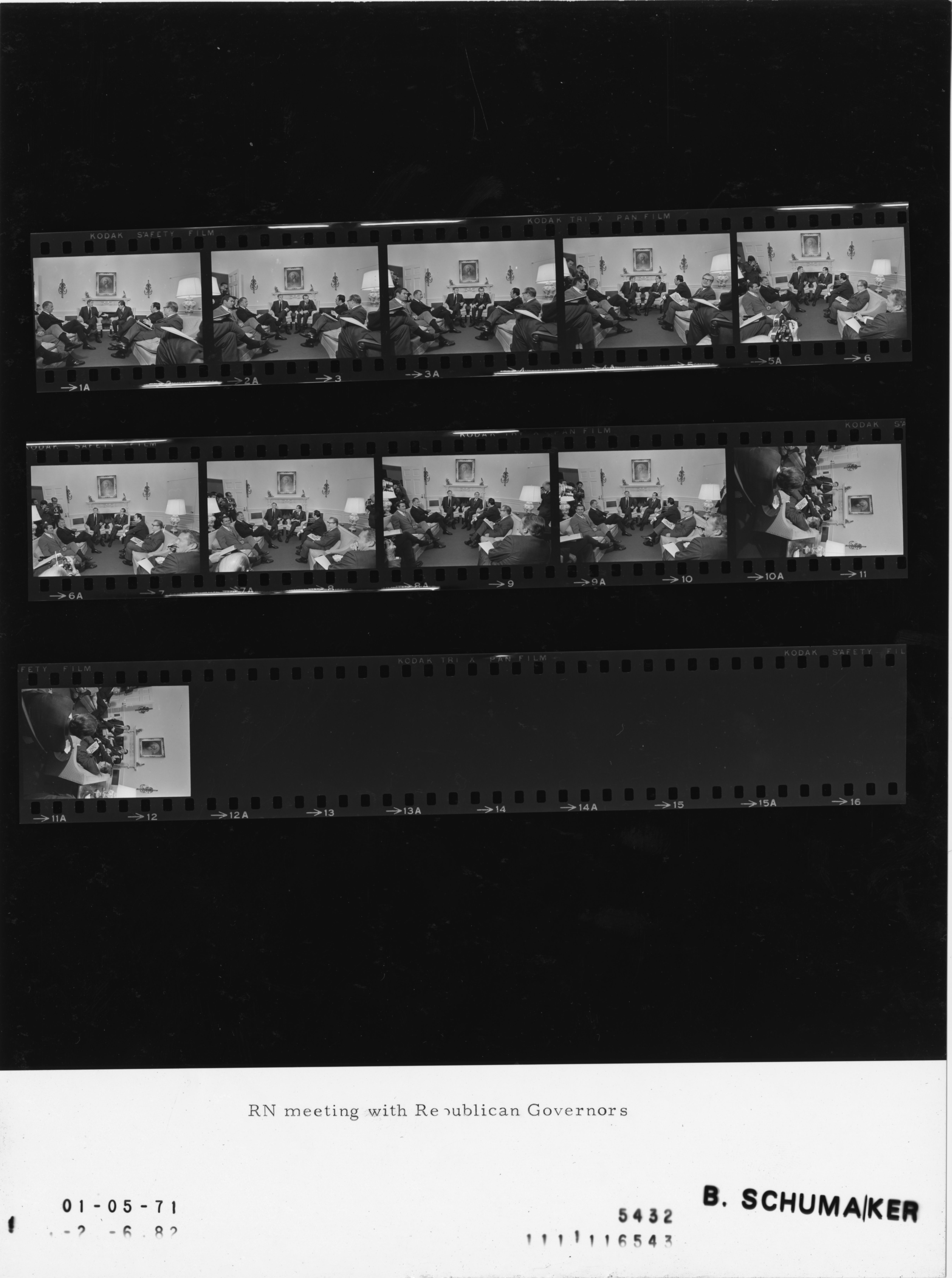
- Frame(s): WHPO-5432-01A-11A, President Nixon seated in the Oval Office during a meeting Republican Governors that includes Vice President Agnew, Governor Nelson Rockefeller, Governor Raymond Shafer, Governor Louie Nunn, Director of the OMB George P. Shultz, John D. Ehrlichman, Donald Rumsfeld, Special Assistant Edward Harper, Vice President Agnew's Assistant C.D. Ward and William L. Safire. 1/5/1971, Washington, D.C. White House, Oval Office. President Nixon, Nelson Rockefeller, Vice President Agnew, Governor Nelson Rockefeller, Raymond Shafer, Louie Nunn, George P. Shultz, John D. Ehrlichman, Donald Rumsfeld, Edward Harper, C.D. Ward, William L. Safire.
- Frame(s): WHPO-5432-08, President Nixon and Vice President Agnew seated in the Oval Office during a meeting with Republican Governors. 1/5/1971, Washington, D.C. White House, Oval Office. President Nixon, Vice President Agnew, Governor Nelson Rockefeller, Raymond Shafer, Louie Nunn, Donald Rumsfeld; possibly George P. Shultz, Edward Harper, John Ehrlichman, C.D. Ward, or William L. Safire.
Roll WHPO-5433 Photographer: Schumaker, Byron | Color or B&W: B&W
- Frame(s): WHPO-5433-01-15, President Nixon signing the H. R. 17901 Establishing Circuit Court Executives. 1/5/1971, Washington, D.C. White House, Oval Office. President Nixon.
- Frame(s): WHPO-5433-09, Close-up of President Nixon signing the H. R. 17901 Establishing Circuit Court Executives. 1/5/1971, Washington, D.C. White House, Oval Office. President Nixon.
Roll WHPO-5434 Photographer: Schumaker, Byron | Color or B&W: B&W
- Frame(s): WHPO-5434-01-10, President Nixon signing H. R. 17901, Establishing Circuit Court Executives while flanked by Chief Justice Warren Burger, and others. 1/5/1971, Washington, D.C. White House, Oval Office. President Nixon, Supreme Court Justice Warren Burger, Judge Alfred Murrah, Rowland Kirks.
- Frame(s): WHPO-5434-07, President Nixon signing H. R. 17901, Establishing Circuit Court Executives while flanked by Chief Justice Warren Burger, and others. 1/5/1971, Washington, D.C. White House, Oval Office. President Nixon, Supreme Court Justice Warren Burger, Judge Alfred Murrah, Rowland Kirks.
- Frame(s): WHPO-5434-11-15, President Nixon meeting with Ambassador John Freeman. 1/5/1971, Washington, D.C. White House, Oval Office. President Nixon, John Freeman.
Roll WHPO-5435 Photographer: Atkins, Oliver | Color or B&W: B&W
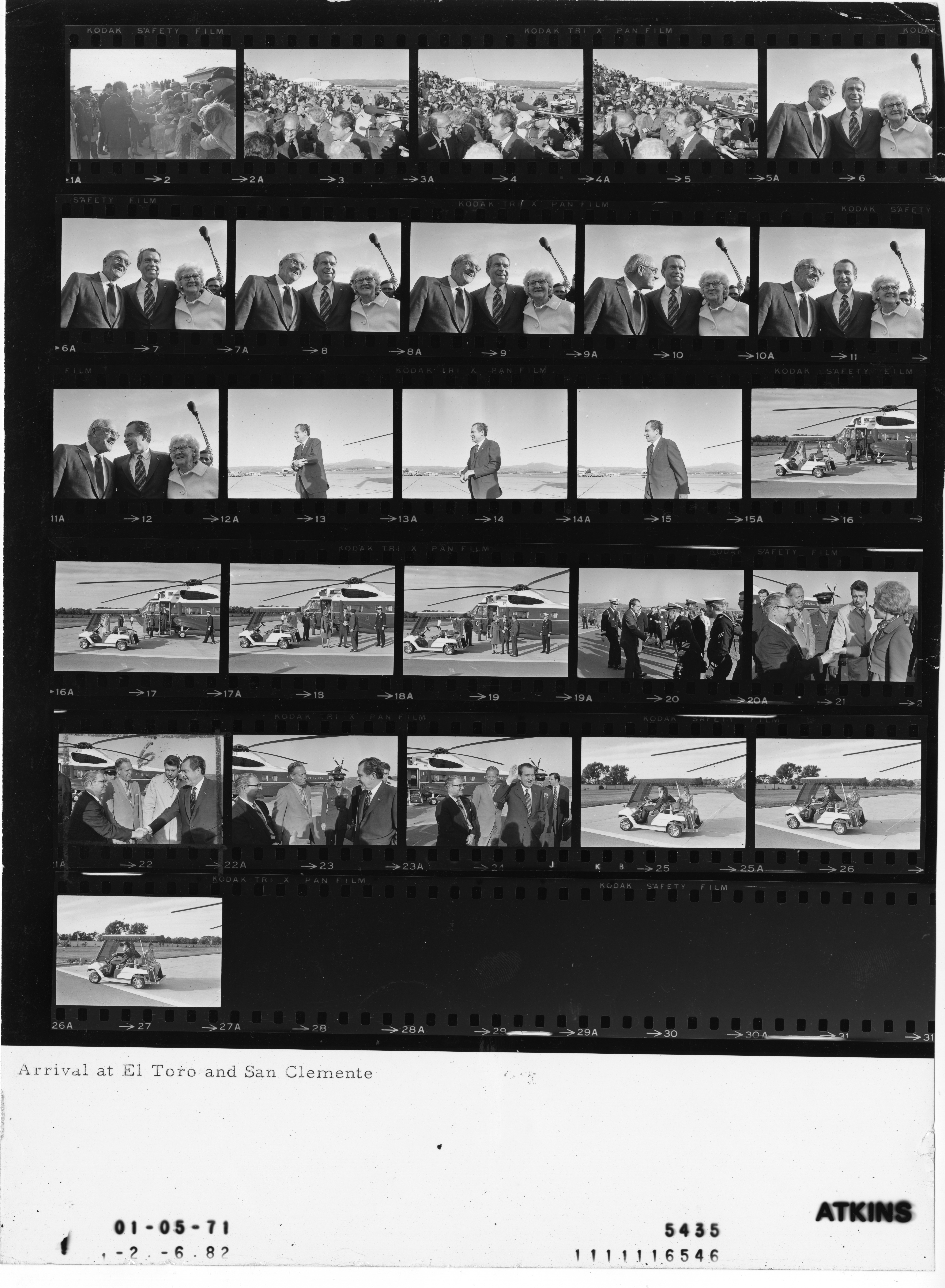
- Frame(s): WHPO-5435-01A-14A, President Nixon arriving and greeting the crowd at El Toro Marine Corps Air Station. 1/5/1971, Santa Ana, California El Toro Marine Air Base (MCAS). President Nixon, Pat Nixon, Tricia Nixon, unidentified aides, military personnel, crowd.
- Frame(s): WHPO-5435-15A-26A, President Nixon arriving at San Clemente. 1/5/1971, Santa Ana, California San Clemente helipad. President Nixon, Pat Nixon, Tricia Nixon, unidentified aides, military personnel, crowd.
The White House Communications Agency Sound Recordings Collection contains public statements that took place between 1969 and 1974. Visit the finding aid to learn more.
H - White House Staff Member Recordings
- WHCA-SR-H-317
Remarks by Herbert Klein in a CBS interview. (1/5/1971, CBS Studios)
Runtime: 10:00
Keywords: interviews, media, television
Production credits: Audio feed supplied by "VTR"; Recorded by BAC (initials of WHCA engineer)
Original Format: 1/4-inch reel-to-reel audiotape. Original source type: Original.
The White House Communications Agency Videotape Collection contains “off-the-air” recordings of televised programs produced between 1968 and 1974. Visit the finding aid to learn more.
- WHCA-4076
Weekly News Summary Week, Tape I.
ALL NETWORKS
Runtime: 1:00
12. Jarriel: President Nixon's day. Time Code Start: 21:24. Keywords: Presidents, media, newspapers, magazines, the press, television, TV, interviews. Network: ABC.
13. Reasoner: Commentary on welfare reform. Time Code Start: 23:33. Keywords: bills, laws, Family Assistance Programs, government aid, financial aid, health and welfare assistance, financial aid. Network: ABC.
14. Brinkley: President Nixon reported in good health; attacks record of last Congress. Time Code Start: 25:34. Keywords: Presidents, health, fitness, medical, exams, House of Representatives, criticisms. Network: NBC.
15. Collingwood: U.S.-Soviet relations. Time Code Start: 26:36. Keywords: diplomacy, politics, Soviet Union, Russia USSR. Network: CBS.
16. Collingwood/Schieffer/Kalb: POWs and the Administration position and Secretary of Defense Laird before leaving for Vietnam. Time Code Start: 28:38. Keywords: military, cabinet, advisors, travel, trips, Vietnam War, Vietnam Prisoner of War. Network: CBS.
17. Collingwood/Walker: President Nixon and Congress. Time Code Start: 36:32. Keywords: Presidents, House of Representatives. Network: CBS.
18. Collingwood: Labor Secretary Hobson on rail strikes. Time Code Start: 39:52. Keywords: railroads, trains, railroad industry, rail cars, mass transit, transportation, strikes, economy, recession, inflation, money, wages, costs, unemployment. Network: CBS.
19. Sevareid: Commentary on "A Conversation with the President". Time Code Start: 40:23. Keywords: Presidents, media, press conferences, news conferences, interviews, television, TV. Network: CBS.
Context (External Sources)
The Vanderbilt Television News Archive is the world's most extensive and complete archive of television news. They have been recording, preserving and providing access to television news broadcasts of the national networks since August 5, 1968.
Wikipedia is a free encyclopedia that anyone can edit.