

Introduction
This almanac page for Friday, January 24, 1969, pulls together various records created by the federal government and links to additional resources which can provide context about the events of the day.
Previous Date: Thursday, January 23, 1969
Next Date: Saturday, January 25, 1969
Schedule and Public Documents
The Daily Diary files represent a consolidated record of the President's activities. Visit the finding aid to learn more.
The President's day began at The White House - Washington, D. C.
The Weekly Compilation of Presidential Documents made available transcripts of the President's news conferences; messages to Congress; public speeches, remarks, and statements; and other Presidential materials released by the White House.
Appointments and Nominations
- Rural Electrification Administration (5 Weekly Comp. Pres. Doc. 164, January 24, 1969)
Announcement of Nomination of David A. Hamil as Administrator. - Agricultural Stabilization and Conservation Service (5 Weekly Comp. Pres. Doc. 166, January 24, 1969)
Announcement of Appointment of William Eugene Galbraith as Deputy Administrator for State and County Operations.
Letters, Memorandums, Etc.
- Trans-Pacific Route Investigation (5 Weekly Comp. Pres. Doc. 164, January 24, 1969)
The President's Letter to the Chairman of the Civil Aeronautics Board Rescinding Prior Action Pending His Final Decision.
Checklist of White House Press Releases
The releases listed below, made public by the Office of the White House Press Secretary during the period covered by this issue, are not included in the issue.
- List of 67 Air Force officers to be nominated to the temporary grade of Brigadier General.
Nominations Submitted to the Senate
Does not include promotions of members of the Uniformed Services, nominations to the Service Academies, or nominations of Foreign Service Officers.
- DAVID M. KENNEDY, Of Illinois, to be United States Governor of the International Monetary Fund for a term of five years; United States Governor of the International Bank for Reconstruction and Development for a term of five years; and a Governor of the Inter-American Development Bank for a term of five years and until his successor has been appointed.
- DAVID M. KENNEDY, of Illinois, to be United States Governor of the Asian Development Bank.
- U. ALEXIS JOHNSON, Of California, to be United States Alternate Governor of the International Monetary Fund for a term of five years and United States Alternate Governor of the International Bank for Reconstruction and Development for a term of five years.
Each Public Papers of the Presidents volume contains the papers and speeches of the President of the United States that were issued by the White House Office of the Press Secretary during the time period specified by the volume. The material is presented in chronological order, and the dates shown in the headings are the dates of the documents or events. In instances when the release date differs from the date of the document itself, that fact is shown in the text note.
To ensure accuracy, remarks have been checked against audio recordings (when available) and signed documents have been checked against the original, unless otherwise noted. Editors have provided text notes and cross references for purposes of identification or clarity.
The Federal Register is the official daily publication for rules, proposed rules, and notices of federal agencies and organizations, as well as executive orders and other Presidential documents.
The Congressional Record is the official daily record of the debates and proceedings of the U.S. Congress.
Archival Holdings
Any selection of archival documents will necessarily be partial. You should use the documents and folders identified below as a starting place, but consult the linked collection finding aids and folder title lists and the collections themselves for context. Many documents to be found this way do not lend themselves to association with specific dates, but are essential to a complete understanding of the material.
Selective document listing
President's Office Files
The President's Office Files consists of materials drawn together by the Special Files Unit from several administrative subdivisions within the White House Office. It is the handwriting and sensitive papers sent to the Staff Secretary that now comprise much of the President's Office Files. Visit the finding aid to learn more.
- President's Handwriting, Box 1, President's Handwriting, January 1969 [1 of 2]
- Memo; Bud Krogh to John Ehrlichman re: Inaugural Parade Disturbance. January 24, 1969. 3 pgs.
- Agenda; Cabinet Committee on Economic Growth, January 24, 1969, 4:00 p.m. 1 pg.
- Memo; Stephen Bull to H. R. Haldeman re: Illumination of the White House. January 24, 1969. 1 pg.
- President's Handwriting, Box 1, President's Handwriting, January 1969 [2 of 2]
- Memo; Raymond K. Price, Jr. to James Keogh re: State of the Union message. January 24, 1969. 2 pgs.
- Memo; Thomas Kelley to Egil Krogh. January 24, 1969. 3 pgs.
- Annotated News Summaries, Box 28, News Summaries - January 1969 [During this period, the Staff Secretary only removed pages from the News Summaries which contained President Nixon's handwriting, often leaving the document with no date. In addition to the individual document listed below, you should also consult the full folder for the month.]
- Hard News (Morning), January 24, 1969.
- President's Meetings File, Box 73, Memoranda for the President--Beginning January 21, 1969
- Bryce Harlow to The Record, Presidential Luncheon, January 24. 1/24/1969, 12:16 p.m. [per President's Daily Diary]. 1 pg.
- Lee A. DuBridge to The President, Re: Topics we discussed together (with Mr. Haldeman present) at our meeting Friday afternoon, January 24. 1/24/1969, 2:29 p.m. [per President's Daily Diary]. 3 pgs.
- Safire to Haldeman, First Meeting of Cabinet Committee on Economic Policy, January 24, Cabinet Room. 1/24/1969, 4:03 p.m. [per President's Daily Diary]. 8 pgs.
President's Personal File
The President's Personal File is essentially a President's secretary's file, kept by Rose Mary Woods, personal secretary to the President, for two purposes: (1) preserving for posterity a collection of documents particularly close to the President, whether because he dictated or annotated them, or because of the importance of the correspondent or the event concerned and (2) giving appropriate attention–letters of gratitude, invitations to White House social events, and the like–to members and important friends and supporters of the Nixon administration. This generalization does not describe all the varied materials of a file group which is essentially a miscellany, but it does identify the reason for the existence of the file group's core. Visit the finding aid to learn more.
- President's Speech File
Selective document listing
The White House Press Office during the Presidency of Richard Nixon was responsible for daily communication with the White House press corps. Ronald L. Ziegler was the Press Secretary to the President for Nixon's entire term in office from January 1969 to August 1974 and Gerald Warren served as the Deputy Press Secretary. The office held daily briefings for the press and produced the White House’s press releases. Visit the finding aid to learn more.
- White House Press Releases, Box 1
- FOR IMMEDIATE RELEASE JANUARY 24, 1969
OFFICE OF THE WHITE HOUSE PRESS SECRETARY
THE WHITE HOUSE
REMARKS OF THE PRESIDENT AT THE SWEARING-IN CEREMONY OF WALTER J. HICKEL, SECRETARY OF THE INTERIOR
THE EAST ROOM
AT 10:00 A.M. EST
Mr. Chief Justice, Mr. Vice President, all of our distinguished guests this morning: This is an historic moment in the history not only of this administration, its early history, but also in the history of the country.
For the first time a member of the Cabinet comes from the largest State of the Union and one of the newest States, the State of Alaska.
It is also of historical note to mention that this is somewhat of a precedent, at least for two Administrations, because he succeeds Secretary Udall who came from the 49th State to be admitted, the State of Arizona in 1923, and Alaska, of course, was the 49th.
In presenting the Secretary to the Chief Justice for his oath, I would also like to be permitted just another remark with regard to his presence here.
It will be noted that he is alone insofar as his taking the oath. But all of his colleagues are here with him and the distinguished members of the Senate and House leadership and particularly the members of the Senate and House Interior Committees are here.
I am sure that enough editorial note has been taken of the fact that his confirmation has taken a little longer than some of the other members of the Cabinet. If I may paraphrase him, however , that doesn't concern us. We are not interested in confirmation for confirmation sake.
I should also point out that he takes an office which, throughout the history of this country, has been somewhat controversial. We all recall some of the great Secretaries of the Interior.
I recall particularly -- and some of the older members of the press as well as some of the older people in political life will -- Secretary Ickes. He felt that he had a number of responsibilities, not only to handle his office, which he did with some controversy and considerable distinction, but
also to keep the press in line. He once referred to columnists as Public Enemies No. 1. Secretary Hickel will never do that, I am sure.
He also considered it his responsibility to keep the President humble. Secretary Ickes was the one who once said that the President is not a descendant of a Sun Goddess. And I am sure that Secretary Hickel will assume that great responsibility to see· that this President also remains humble.
But I should point, out, too, that he already has rendered service far beyond the call of duty. In the first four days of this Administration he, rather than I, has been the subject of the Herb Block cartoons. I am grateful for that.
So if I may present him now with the Biblical scripture. The last shill be first, as far as this Administration is concerned. Secretary Hickel.
(The Chief Justice administered the oath of office.)
END (AT 10 : 06 A.M. EST) - FOR IMMEDIATE RELEASE JANUARY 24, 1969
Office of the White House Press Secretary
THE WHITE HOUSE
The President today directed the Chairman of the Civil Aeronautics Board to stay the effective date of the certificates in the Trans-Pacific Route Investigation and to submit to the President for final decision the Board's recommendation in that case.
The text of the President's letter, which was delivered to the Chairman of the C. A. B. this afternoon, follows:
"Upon a review of the actions taken by your Board and President Johnson in connection with the Trans-Pacific route investigation (your Docket 16242 et al) I have come to the conclusion that it is both appropriate and necessary for me to rescind the prior Presidential action taken and recall the matter for my further review and decision.
"Please do not take any further action in connection with the international aspects of this matter until I have had an opportunity to finally advise you of my decision upon the merits."
# # # - FOR IMMEDIATE RELEASE JANUARY 24, 1969
Office of the White House Press Secretary
THE WHITE HOUSE
President Nixon today announced the appointment of William Eugene Galbraith, livestock feeder and farmer of Beemer, Nebraska, as a deputy administrator of the Agricultural Stabilization and Conservation Service of the U.S. Department of Agriculture.
Mr. Galbraith, 43, will serve as the agency's Deputy Administrator for State and County Operations. The Agricultural Stabilization and Conservation Service carries out farm action programs in the fields of production adjustment, conservation assistance and price, market and farm income stabilization. The agency's work is carried on with the aid of State, county and community
farmer committees and includes much of the operation of the Commodity Credit Corporation.
Born in Beemer on January 22, 1926, Mr. Galbraith graduated from the University of Nebraska with a degree in Agricultural Extension and Technical Science. He was an agricultural instructor at West Point, Nebraska, High School from 1949 to 1960, and during this same period, he managed and operated the family farm which his great grandfather originally homesteaded after the Civil War. On the farm, which has 320 acres of cropland, he has fed from 200 to 500 head of cattle a year and has raised up to 700 hogs annually. He took over ownership of the farm in 1960, and in his operations he has made use of USDA programs. Mr. Galbraith also is a director of the Community Development Corporation, which was organized to bring industry to Beemer.
A World War II Navy veteran, Mr. Galbraith is immediate past National Commander of the American Legion. He also has served as chairman of the Nebraska Centennial Commission, co-chairman of the Governor's Conference on Education, as first president of the Nebraska Swine Producers Organization in 1964, and as a director of the Nebraska Youth Council. He has also served as a local 4-H Club leader. In 1965, the Nebraska State Education Association presented two awards to Mr. Galbraith for outstanding contributions to education as a layman.
Mr. Galbraith currently is active in the Nebraska Livestock Feeders Association.
Mr. Galbraith is married to the former Gwen Jean Taylor of Pawnee City, Nebraska. They have two children, Claudia Jean Galbraith, 20, and William Deane Galbraith, 19, both students at the University of Nebraska.
# # # - FOR IMMEDIATE RELEASE JANUARY 24, 1969
Office of the White House Press Secretary
THE WHITE HOUSE
President Nixon today nominated David A. Hamil of Denver, Colorado, to be Administrator of the Rural Electrification Administration in the U. S. Department of Agriculture. Mr. Hamil previously served as REA Administrator under President Eisenhower from June 26, 1956, to February 3, 1961.
Mr. Hamil presently is Executive Director of the Department of Institutions for the State of Colorado. He was appointed to that position January 8, 1963, by Governor John A. Love.
The Administrator-designate since college days has been a rancher engaged in the cattle-feeding business in Logan County, Colorado, where he was born December 3, 1908. He and a brother, Don, operate 4,500 acres, about 1,000 of which are irrigated. Their principal business is the fattening of cattle with about 5,000 head on hand at all times. They also are producers of sugar beets, alfalfa, and corn.
Mr. Hamil was REA's sixth Administrator since the Agency was created by Executive Order in 1935. He succeeded Ancher Nelsen of Minnesota who now represents the Second Congressional District of Minnesota in the U. S. House of Representatives. With Senate confirmation, Mr. Hamil will
become the eighth Administrator of REA.
At the time of his appointment as REA Administrator in 1956, Mr. Hamil was speaker of the Colorado House of Representatives, a position he had held since 1951. He was first elected to the Colorado General Assembly in 1938 and with exception of a two-year term in 1948-49 he had served in it continuously.
He first became active in the rural electrification program in 1939 when he helped organize a section of the Highline Electric Association of Holyoke, Colorado. He served as director of the Association for five years during which time its consumer membership grew from 180 to 4,000 .
During Mr. Hamil's tenure as REA Administrator for more than four and one-half years, nearly a half million rural consumers were added to the lines of REA-financed rural electric systems, and hundreds of thousands of others received improved service. In the rural telephone program, the number of subscribers receiving new and improved service tripled from about 370, 000 to more than 1.1 million.
Mr. Hamil received the Bachelor of Arts degree from Hastings College, Hastings, Nebraska, in 1930.
He is married to the former Genevieve Robinson of Denver. He has lived in Denver since 1963, but also maintains his home at Sterling, Colorado. He and Mrs. Hamil have three children: Mrs. Jo Ann Ostwald, 33, wife of Dr. Donald A. Ostwald, a veterinarian of Fort Morgan, Colorado; Donald William Hamil, 31, of Sterling, Colorado, who is associated with his uncle in the farming and ranch business, and Staff Sergeant Jack R. Hamil, Z 7, who is stationed with the U.S. Air Force in Osan, Korea. All three are graduates of Colorado State University.
# # # - FOR IMMEDIATE RELEASE JANUARY 24, 1969
Office of the White House Press Secretary
THE WHITE HOUSE
EXECUTIVE ORDER
ESTABLISHING THE CABINET COMMITTEE ON ECONOMIC POLICY
By virtue of the authority vested in me by the Constitution and statutes of the United States, and as President of the United States, it is ordered as follows:
Section 1. Establishment of the Committee. (a) There is hereby established the Cabinet Committee on Economic Policy (hereinafter referred to as "the Committee'').
(b) The President shall preside over meetings of the Committee. The Vice President shall preside in the absence of the President.
(c) The Committee shall be composed of the following:
The Vice President
Secretary of the Treasury
Secretary of Agriculture
Secretary of Commerce
Secretary of Labor
Director of the Bureau of the Budget
Chairman of the Council of Economic Advisers
Counsellor to the President
and such other heads of departments and agencies as the President may from
time to time designate.
Section 2. Functions of the Committee. The Committee shall advise and assist the President in the development and coordination of national economic programs and policies and shall perform such other duties as the President may from time to time prescribe. In addition to such duties, the Committee shall:
(1) Assist the President in the formulation of the basic goals and objectives of national economic policy;
(2) Develop recommendations for the basic strategy of national economic policy.to serve as guides for decisions concerning specific economic programs and policies;
(3) Promote the coordination of Federal economic programs;
(4) Consult with individuals from academic, agricultural, business, consumer, labor and other groups to assure the consideration of a wide range of views about national economic policy; and
(5) Recommend procedures for evaluating the effectiveness of Federal programs in contributing to our national economic objectives.
Sec. 3. Administrative Arrangements. (a) The Chairman of the Council of Economic Advisers will coordinate the work of the Committee.
(b) In compliance with provisions of applicable law, and as necessary to effectuate the purposes of this order, (1) The White House Office shall provide or arrange for supporting clerical administrative and other staff services for the Committee, and (2) each Federal department and agency which is represented on the Committee shall furnish the Committee such information and other assistance as may be available.
Sec. 4. Construction. Nothing in this order shall be construed as subjecting any department, establishment, or other instrumentality of the executive branch of the Federal Government or the head thereof, or any function vested by law in or assigned pursuant to law to any such agency or head, to the authority of any other such agency or head or as abrogating. modifying, or restricting any such function in any manner.
/s/ Richard M. Nixon
THE WHITE HOUSE,
January 24, 1969
# # # - FOR IMMEDIATE RELEASE JANUARY 24, 1969
Office of the White House Press Secretary
THE WHITE HOUSE
President Nixon will transmit to the Senate Monday a list of 67 Air Force officers for promotion to the temporary grade of Brigadier General. Of the 67, sixty-one are line officers, two are from the office of the Judge Advocate General and four are from the Medical Corps.
They include:
NAME / AGE / CURRENT ASSIGNMENT
HEIMSTRA, Fred A., Colonel / 53 / Director, Plans and Hospitalization, Office of the Surgeon General
DOUGLAS, Paul P., Jr., Colonel / 49 / Inspector General, 12 Air Force, Tactical Air Command
FRANKOSKY, James O., Colonel / 49 / Deputy Director, Strategic and Defense Forces, Deputy Chief of Staff/Research and Development
CABAS, Victor N., Colonel / 49 / Inspector General, Pacific Air Forces
YOUNG, Kendall S., Colonel / 49 / Commander, 363 Tac Reconnaissance Wing, Tactical Air Command
JACK, William A., Colonel / 47 / Assistant Deputy Chief of Staff, Supply, Air Force Logistics Command
JOHN, Ernest F., Colonel / 47 / Director of Collections, Assistant Chief of Staff, Intelligence
HALLENBECK, Ralph J., Colonel / 49 / Deputy Chief of Staff, Personnel, Military Airlift Command
SERENATI, Quintino J., Colonel / 56 / Surgeon, Tactical Air Command
PRICE, Harold L, Colonel / 50 / Operations and Plans Staff Officer (Director of Inspection Services).
DAVIS, Woodard E. Jr., Colonel / 47 / Commander, 835 Air Division, Tactical Air Command
COLE, Ray M., Colonel / 45 / Executive to the Deputy Chief of Staff, Personnel
McCARTHY, Michael C., Colonel / 47 / Commander, 3615 Pilot Training Wing, Air Training Command
LOWE, Jessup D., Colonel / 48 / Commander, Air Force Satellite Control Facility, Air Force Unit Post Office
GAYLORD, Donald A., Colonel / 48 / Chief of Staff, Military Airlift Command
TURNER, Vernon R., Colonel / 49 / Commander, Air Force Data Systems Design Center, OMR
UNDERWOOD, Edgar H., Jr., Col / 50 / Commander, Wilford Hall USAF Hospital, Air Force Systems Command
WILLIAMS, Coleman O., Jr., Col. / 47 / Commander, 2750 Air Base Wing , Air Force Logistics Command
WESTBERG, Leslie J., Colonel / 48 / Commander, 460 Tac Reconnaissance Wing, Pacific Air Forces
SYKES, George K., Colonel / 47 / Deputy Chief of Staff, Intelligence, United States Air Forces in Europe
BEVAN, Wendell L., Jr., Colonel / 48 / Commander, 432 Tac Reconnaissance Wing, Pacific Air Forces
COMSTOCK, William P., Colonel / 50 / Deputy Director, Alaskan Region, Federal Aviation Administration
CATLEDGE, Richard C., Colonel / 48 / Commander, 4510 Combat Crew Training Wing, Tactical Air Command
McBRAYER, Madison M., Colonel / 48 / Commander, 45 Air Division, Strategic Air Command
HOLT, William H., Colonel / 49 / Assistant Deputy Director, Air Force Command Post, Deputy Chief of Staff/Plans and Operations,
WATKINS, James H., Colonel / 49 / Commander, 3510 Flying Training Wing, Air Training Command
JOHNSON, Warren D., Colonel / 46 / Director, Personnel Resources and Distribution, USAF Military Personnel Center
WATSON, Paul C., Colonel / 50 / Chief, Pacific Division, J-3, Joint Chiefs of Staff
STEEL, Maxwell W., Jr., Colonel / 50 / Deputy Commander, Malcolm Grow USAF Hospital
GAMBLE, Jack K., Colonel / 46 / Commander, 52 Fighter Group, Aerospace Defense Command
FULLILIVE, William C., Colonel / 45 / Commandant, Squadron Officers School, Air University
YEAGER, Charles E., Colonel / 45 / Commander, 4 Tac Fighter Wing, Tactical Air Command
VAGUE, Harold R., Colonel / 48 / Judge Advocate General, Fifteenth Air Force, Strategic Air Command
GALENTINE, Paul G., Jr. / 47 / Chief, National Military Command Systems Support Center, Defense Communications Agency
SMITH, Foster L, Colonel / 46 / Air Force Member, Chairman, Personnel Staff Group, Joint Chiefs of Staff
COLEMAN, Thomas P., Colonel / 50 / Public Affairs Officer, Pacific Command
HANSEN, Homer K., Colonel / 46 / Commander, 3 Tac Fighter Wing, Pacific Air Forces
DeLONGA, Peter R., Colonel / 47 / Chief, Logistic Operations Division, Deputy Chief of Staff, Systems and Logistics
HARGROVE, Clifford W., Colonel / 49 / Commander, 72 Bomb Wing, Strategic Air Command
THOMASSON, Samuel M., Colonel / 47 / Deputy Judge Advocate General, Air Force Systems Command
HUYSER, Robert E., Colonel / 44 / Director, Command/Control, Strategic Air Command
EVANS, William J., Colonel / 44 / Assistant Deputy Director of Readiness, Defense Communications Planning Group, Defense Communications Agency
MORGAN, Thomas W., Colonel / 47 / Manager, Apollo Application Program, National Aeronautic and Space Administration
GOADE, William R., Colonel / 46 / Commander, 3646 Pilot Training Wing, Air Training Command
BENNETT, Charles I., Jr., Colonel / 46 / Executive to Chief of Staff, Hq United States Air Force
WINN, Otis E. , Colonel / 46 / Chief, Transportation Division, J-4, US European Command
ABBOTT, Woodrow A., Colonel / 49 / Commander, 93 Bomb Wing, Strategic Air Command
PUGH, James R., Jr., Colonel / 50 / Chief, Procurement and Production Division, F-111 System Program Office, Air Force Systems Command
LUKEMAN, Robert P., Colonel / 47 / Special Assistant for Joint Matters, Joint Chiefs of Staff
PRICE, James L, Colonel / 47 / Commander, Air Defense Weapons Center, Aerospace Defense Command
ROBERTS, John W., Colonel / 48 / Commander, 366 Tac Fighter Wing, Pacific Air Forces
GUNDERSON, Brian S., Colonel / 45 / Executive Assistant to the Secretary of the Air Force
CHEADLE, Geoffrey, Colonel / 44 / Executive to Commander, Air Force Systems Command
TROGDON, Floyd H., Colonel / 44 / Vice Commander, Electronic Systems Division, Air Force Systems Command,
BRETT, Devol, Colonel / 45 / Commander, 81 Tac Fighter Wing, United States Air Forces in Europe
PATCH, Paul F., Colonel / 48 / Chief, Plans Division/ Special Assistant for Strategic Mobility, Joint Chiefs of Staff
COLLINS, Harold E., Colonel / 44 / Chief, Aerospace Systems Division, Deputy Chief of Staff, Research and Development
BELLIS, Benjamin N., Colonel / 44 / Deputy for Reconnaissance, Aeronautical Systems Division Air Force Systems Command
FELICIES, Salvador E., Colonel / 45 / Commander, 306 Bomb Wing, Strategic Air Command
CROSS, Richard G., Jr., Colonel / 48 / Commander, 36 Tac Fighter Wing, United States Air Forces in Europe
ALLEN, Lew, Jr., Colonel / 43 / Deputy Director, Advanced Plans, Directorate of Special Projects, Office, Secretary of the Air Force
COLLADAY, Martin G., Colonel / 43 / Assistant for General Officer Matters, Deputy Chief of Staff, Personnel
PATTILLO, Charles C., Colonel / 44 / Commander, 8 Tac Fighter Wing, Pacific Air Forces
McGARVEY, Billie J., Colonel / 45 / Deputy Chief of Staff, Civil Engineering, Air Force Logistics Command
HUGHES, James D., Colonel / 46 / Aide to the President
ALLEN, James R., Colonel / 43 / Deputy Assistant for National Security Council Matters, Deputy Chief of Staff, Plans and Operations
PURSLEY, Robert E., Colonel / 41 / Military Assistant to the Secretary of Defense
- FOR IMMEDIATE RELEASE JANUARY 24, 1969
- White House Press Conferences, Box 55
- News Conference #13 at the White House with Ron Ziegler, January 24, 1969, 11:30 A.M. EST. 11 pgs.
NEWS CONFERENCE #13
AT THE WHITE HOUSE
WITH RON ZIEGLER, PRESS SECRETARY
AT 11:30 A.M. EST
JANUARY 24, 1969
FRIDAY
MR. ZIEGLER: The President arrived here in the West Wing at his Office at about 7:45 this morning. He worked there until Secretary Hickel was sworn in.
I will give you a rundown on today's schedule. The President will meet with Dr. Lee DuBridge, Science Adviser to the President, this afternoon at 5:15.
The President has a meeting scheduled with Congressman Ford, Congressman Glenn R. Davis, Congressman John W. Byrnes and former Congressman Don Jackson at 2:45.
Q Where is Congressman Jackson from?
MR. ZIEGLER: California.
Q What is that meeting about?
MR. ZIEGLER: They are going to discuss the Chowdered Marching Society.
Q They are going to invite him to come up and speak?
MR. ZIEGLER: The President is the Charter Member, as you know.
The rest of the schedule we will have for you at the 4 o'clock briefing. The President does plan a meeting with some of his economic advisers this afternoon at about 4:00. I will have details for you on that at the 4 o'clock briefing.
Q Will Arthur Burns sit in on that?
MR. ZIEGLER: The President is now meeting with Dr. Burns and Paul McCracken, Chairman of the Council of Economic Advisers and staff members.
Q Was Jackson defeated or did he choose not to run?
MR. ZIEGLER: Congressman Jackson retired.
Today the President will transmit to the Senate the following nominations. These will be available in the bin. These are nominations which are transitional:
For the Secretary of the Treasury, David Kennedy is for nomination to be United States Governor of the International Monetary Fund for a term of five years and to be United States Governor of the Asian Development Bank;
Ambassador Johnson of California to be the United States Alternate Governor of the International Monetary Fund for a term of five years. The details on that will be in the bin.
Q Is that Alexis Johnson?
MR. ZIEGLER: Yes, Ambassador Alexis Johnson.
That is all I have for you this morning.
Q Who are these economic advisers the President is meeting with today?
MR. ZIEGLER: Of course Secretary of the Treasury Kennedy will be there. Secretary of Commerce Stans will be there. Director of the Budget Mayo will be there. Paul McCracken will also be there. Anything other than that I will provide to you at the 4 o'clock briefing.
Q Can you tell us something about the meeting with Dr. Burns and Dr. McCracken this morning? What are they meeting on?
MR. ZIEGLER: They are discussing a number of things which I can't provide you with the details on right now. Some of it is centered around the economic problems and their area of concentration.
Q Can you nail down for us possibly this afternoon whether that meeting also involved the task force recommendations? I asked since McCracken was closely involved in that as well.
MR. ZIEGLER: The meeting this afternoon?
Q The meeting now.
MR. ZIEGLER: I am sure it is not on the task force recommendations. That is not the purpose of the meeting.
Yesterday, Dr. Burns referred to some headings in his report. He referred to 14 of those headings.
I will read the rest of those headings for you: His report had the headings of Electoral Reform, Government Organization, Federal Expenditures, Federal Taxations, Federal Debt, Federal Credit Programs, Resources and Environment, Science and Technology, Transportation, Manpower Policy, Education, Urban Affairs, Social Security and Veterans Payments, Health Care, Welfare Programs, Business Regulation, Crime and Law Enforcement, International Economic Relations.
I think Dr. Burns gave you some 14. That will round out the list for you.
Q Ron, is the story correct that the Mayor of Fresno is going to be appointed the head of the Model Cities? I lost his name. The Times had it this morning.
MR. ZIEGLER: I cannot confirm that for you now, Carroll.
Q Did he have lunch with President Nixon yesterday?
MR. ZIEGLER: No, he did not.
Q Ron, will he have lunch with the President today?
MR. ZIEGLER: The President is in his Office in a meeting now and has no formal luncheon plans on the schedule.
Q Is the President going to send the nomination of Ambassador Lodge to the Senate? What will his specific status be?
MR. ZIEGLER: He doesn't require it. He is the representative of the President. He has the status of Ambassador.
Q Doesn't he have to be confirmed if he has a status of Ambassador?
MR. ZIEGLER: He is given the rank of Ambassador, Walter, but his role in Paris is that of the personal representative of the President and the head of the Paris Peace Talks.
Q Ron, do you expect the President to comment on, to have a position on, the proposals now before the Senate for changing the manner of electing a President?
MR. ZIEGLER: As you know, he made some statements on that during the campaign. We have no statement planned at this point.
Q Is it fair, then, to infer that his position on the kind of reform that is desirable is the same as the one that he stated during the campaign?
MR. ZIEGLER: It is a matter which is under discussion in the Senate. I am sure it will be under some
discussion here.
So, of course, what he indicated in the campaign points to his general thinking on it.
Q Ron, what is going to be the plan on major policy issues like that? For instance, certainly the country is vitally interested in his course in Vietnam.
Will at some point the President lay this out as a Nixon policy either in a special message or an address to the Nation or at a press conference or something?
MR. ZIEGLER: This is our fourth day here. A lot of conversation and discussions are going on -- absolutely. As the days go on, the President will be expressing his views on many things, both in the form of press conferences and in other forms.
Q So that we can look forward to a series of firm statements of Nixon positions?
MR. ZIEGLER: Surely. However, the past days have been involved with organizational discussions and structuring of the President's staff and the Cabinet subcommittees and so forth to address themselves to these problems.
Q Do you have any sense of timing? I am particularly interested in Vietnam since it is so urgent.
MR. ZIEGLER: As you know, the National Security Council met last week and it is going to meet on Saturday. There is a great deal of consideration being given to all of these matters.
Q Do you expect you would have -- looking to planning for tomorrow -- something for us at a briefing about that meeting?
MR. ZIEGLER: No. The policy will be that the National Security Council meeting content will not be made available.
Q What would you advise for planning purposes for tomorrow in terms of what you are likely to have at the briefing? Will it be kind of just a Saturday affair?
MR. ZIEGLER: What I propose for tomorrow is one thing which I was going to propose at 4 o'clock. But I will do it now since you brought it up: That we have a briefing at noon instead of at 11 o'clock and have only one briefing tomorrow because the schedule as it stands now calls only for the National Security Council meeting in the morning.
I will have a better idea at noon what the rest of the day will hold. I think if we brief at noon for tomorrow, chances are the President will be doing staff work after the National Security Council meeting and we can put a lid on for the rest of the day.
Q Could you give us an idea of what the status is of the instructions that Dr. Kissinger said the President will be sending to the Embassy and to Paris and to the military commanders in Vietnam?
MR. ZIEGLER: I don't have a status for you on that.
Q Ron, can you describe the President's views on this Brooklyn Navy Yard project that was announced this morning? What is the President's role in it and his views on the idea?
MR. ZIEGLER: The President's role in it, of course, was the delegation to the Vice President of the United States to address himself to the Federal and State-city relations. The Vice President is moving ahead on that as was demonstrated this morning in what the Vice President said.
Q But President Nixon has approved the idea of introducing legislation to achieve the purpose?
MR. ZIEGLER: Of course, the President is very much aware of what the Vice President is doing.
Q Ron, going back to this policy comment, how about Biafra, which is a little more immediate and
specific and the majority of the Senate, including a lot of Republicans, have urged the President to increase the steps to be taken to relieve starvation?
MR. ZIEGLER: Again, the President had a statement on Biafra during the campaign. Of course, he fully shares the deep humanitarian concerns expressed by the Senate resolution. He has requested a comprehensive review of our current relief effort and urges recommendations on what more can be done to expedite and enlarge the flow of effective relief to the suffering.
Q Ron, what is the status here in the White House and what is the President's attitude toward the Nuclear Non-Proliferation Treaty? Has President Nixon talked to any of the Senators and urged that they act on that?
MR. ZIEGLER: I don't have anything for you on the Non-Proliferation Treaty today, Bob.
Q Today is there any significance in that? Do you think it will be coming up tomorrow at the NSC meeting?
MR. ZIEGLER: I think it is a priority item as I indicated at the Pierre in New York. It is a priority
item for discussion, yes.
Q Is it the President's plan to visit Mr. Johnson at his Ranch often enough to require the maintenance of special equipment at the landing strip there?
MR. ZIEGLER: Tom Johnson and George Christian suggested I call them at any time for help. But I haven't discussed that with them, no. I am not aware of any special maintenance down there for that purpose.
Q Ron, do you plan to announce any more nominations this afternoon, say, or tomorrow? Could you give us a little guidance on that?
MR. ZIEGLER: We will have some Senate nominations going up, yes.
Q Ron, I would like to return to the earlier question. Some of the equipment on President Johnson's Ranch was installed at the taxpayers expense for the President of the United States. Is that going to remain on the Ranch or if you don't know, could you get a reading for us?
MR. ZIEGLER: I don't know, obviously. This is the first time I am aware of it. I simply don't know.
Q Could you get a reading on what the President's attitude is towards that, whether it should be removed?
MR. ZIEGLER: What the President's attitude toward the landing pad and so forth is?
Q Toward the equipment that is owned by the taxpayers which is on former President Johnson's Ranch, what his attitude is, whether it should stay there or whether it should be removed?
MR. ZIEGLER: I wouldn't approach the President directly on that. But I will check it out.
Q Has there been any discussion asking for legislation to deal with the dock strike?
MR. ZIEGLER: The Secretary of Labor and the Administration would hope that progress would be made in that area. I have nothing else on that.
Q Ron, when the President nominated Mr. James Johnson to be a member of the Civil Service Commission, was he aware, as reported yesterday and today, that he had used a Birch Society member as a reference and had spoken at the Birch Society-sponsored meeting as reported?
MR. ZIEGLER: That was reported this morning, wasn't it?
Q It was also reported yesterday.
MR. ZIEGLER: Mr. Johnson, as you know, served on the administration of Governor Reagan of California and was head of the Veterans Affairs Department. In order to receive that post, he was confirmed by a duly constituted legislative body in California which, at that time, was composed of a Democratic majority. So I think that that would indicate that that is not a problem.
Q You are not suggesting, are you, that a fitness of a man to serve in the Nixon Administration is to be determined by action of the legislative bodies at State level?
MR. ZIEGLER: No. I was just referring, Chuck, to the fact that this man has good qualifications and was felt to have good qualifications by a duly constituted governing body.
Q Does that also imply, as I understand it, that you see affiliation with the Birch Society as being no obstacle for a post in the Nixon Administration?
MR. ZIEGLER: No, because I have no knowledge of this at all. The report I am not aware of.
Q My question was, was the President aware of this information at the time?
MR. ZIEGLER: I don't believe he would be.
Q Ron, what is the reaction of President Nixon to Senator Kennedy's suggestion in California that Red China be seated in the United Nations and that Nationalist China be taken out of the Security Council?
MR. ZIEGLER: I have no comment on that.
Q Ron, is it going to be your policy from time to time to cut material out of the official transcripts of these briefings? There was two sentences and at least one phrase eliminated from yesterday's 1:00 briefing by Moynihan.
MR. ZIEGLER: I was not aware of that and it certainly isn't a policy. Maybe they missed it. We don't intend to do that.
Q He said they would have an announced news conference. Have you any idea when it is going to be?
MR . ZIEGLER: No. We will announce that.
Q Ron, Senator Packwood said this morning that he felt his defeated opponent, Senator Morse, would best be used to serve on an ad hoc committee, particularly the dock strike. He said he had mentioned this to the Nixon Administration. Do you know anything about a forthcoming appointment for Senator Morse on such a committee?
MR. ZIEGLER : No, I don't.
Q Ron, with two meetings on economics today, are you anticipating any kind of announcement after this afternoon's meeting?
MR. ZIEGLER : There may be an announcement at the 4 o'clock briefing. I am not sure, but there may be.
Q Who is conducting the review of the Biafran relief thing that he called for?
MR. ZIEGLER: The discussion on this, of course, has been held with Dr. Kissinger. I am not aware of it at this time. I will check that out for you.
Q Can you give us any guidance of what we will have on Sunday?
MR. ZIEGLER: We have church services Sunday morning and nothing beyond that.
Q That will be in the White House?
MR. ZIEGLER: Yes , in the East Room. Dr. Billy Graham will be the guest minister.
Q Will that be coverable?
MR. ZIEGLER : We will cover that with a pool.
Q What time is that?
MR. ZIEGLER: It will be handled as we have handled previous church services and with no photographs or cameras.
Q Is that a family service?
MR. ZIEGLER: Yes.
Q What time is that?
MR. ZIEGLER ~ 11 o'clock.
Q Ron, so far every question about the dock strike has met a non-commital answer. Can you tell us whether the President has asked Secretary Shultz or anybody else to inform him on the status of that dispute and give him recommendations on what he ought to do?
MR. ZIEGLER: He is, of course, informed on it and is being kept up to date on the dock strike. I just
have nothing for you on that. I have no announcement to make on that subject.
Q Ron, before the inauguration, the feeling was that guidance and instruction to the negotiating team in Paris and the command in Saigon would have to go out immediately after President Nixon took over. What is the feeling on that now?
MR. ZIEGLER: As you know, Ambassador Lodge met with the President on the Sunday prior to the inauguration and they discussed the talks at that time. Since that time, the National Security Council has met and is scheduled to meet again on Saturday.
Q Does Lodge already have his basic instructions then?
MR. ZIEGLER: I think I indicated this previously. Ambassador Lodge and the President discussed the talks and the views for the initial talks, and there is additional information to follow.
Q Will Ambassador Lodge have a freer hand in the negotiations than his predecessor, a wider latitude in negotiating?
MR. ZIEGLER: That would be very difficult for me to answer. I am not aware of how free a hand that Ambassador had there. I think Ambassador Lodge will have a free hand to operate as our representative there, sure.
Q Could you say whether they are talking daily by phone?
MR . ZIEGLER: The President and the Ambassador?
Q Yes.
MR. ZIEGLER: They are not, but they are in daily communication.
Q Does the President plan to have a seven-day week schedule or is he going to relax sometime?
MR. ZIEGLER: Are you asking that for your guidance?
Q No.
MR. ZIEGLER: My view is I think he will relax some.
I have one final announcement:
The President will attend the Alfalfa Dinner on Saturday night.
Q Tomorrow night?
MR. ZIEGLER: Yes.
Q Where.
MR. ZIEGLER: Statler Hilton.
Q Is he going to the Press Club tonight, by any chance?
MR. ZIEGLER: We have no plan to, no.
Q In connection with the withdrawal of those nominations yesterday, we have received reports from our Justice Department man of considerable dismay among the former Johnson officials who understood that there had been some kind of an understanding that the five judges would not be withdrawn. Have you any comment on that?
MR. ZIEGLER: An understanding with whom?
Q With some officials of the incoming Administration.
MR . ZIEGLER: An understanding with whom?
Q Between the old gang and the new gang.
MR. ZIEGLER: There was no such understanding at all.
Q As to California, can you shed any new light on the Cecil Poole nomination?
MR . ZIEGLER: No more than I gave you yesterday. Incidentally, one thing: I noticed in the transcript yesterday and also in some news reports -- apparently I inferred at the number. The number of Postmasters was 471, not 147.
Q Ron, at the ceremony this morning, was the band instructed not to play "Hail to the Chief"?
MR. ZIEGLER: Yes, they were.
Q Why?
MR. ZIEGLER: The President requested ---
Q He doesn't like it?
MR . ZIEGLER: You said that. The President requested a quiet ceremony this morning.
Q Requested what?
MR . ZIEGLER: A quiet ceremony.
Q Just for this morning?
MR . ZIEGLER : That is correct. "Hail to the Chief" and "Ruffles and Flourishes" you will hear a substantial amount of.
Q What was the number on the Federal Judges.
MR. ZIEGLER: You will have the other numbers simply by looking at the release I gave you yesterday. There were 471 Postmaster nominations which were withdrawn together with the names of the individuals shown on the release we gave you yesterday.
Q Are there any Johnson nominations now outstanding still before the Senate to your knowledge?
MR. ZIEGLER: It is my understanding that a number of foreign service officers, including foreign service PIOs, were left before the Senate.
Q Ron, is the President going to speak at the dinner tomorrow night or is he just attending it?
MR. ZIEGLER: He will have some remarks. I think it is traditional that he does.
Q Are they on the record?
MR. ZIEGLER: No. It is also traditional that they not be on the record.
Q Could you say whether there would be coverage on that?
MR. ZIEGLER: It is traditional that there is no coverage on that. It is a very traditional thing of which I am sure you know more about than I do. You have a lid until 3:30.
THE PRESS: Thank you.
END (AT 12:00 noon.) - News Conference #14 at the White House with Ron Ziegler, January 24, 1969, 4:38 P.M. EST. 10 pgs.
NEWS CONFERENCE #14
AT THE WHITE HOUSE
WITH RON ZIEGLER, PRESS SECRETARY
4:38 P.M. EST
JANUARY 24, 1969
FRIDAY
MR. ZIEGLER: Gentlemen, we have quite a bit for you this afternoon.
First of all, the President adjusted the schedule a little bit today. He lunched at the Mansion with
Congressmen Ford, Davis, Byrnes and former Congressman Jackson. I mentioned earlier that they were going to meet in the afternoon, but they elected to have lunch at the Mansion.
The President is currently meeting with a group of economic advisers that I mentioned this morning. The President today signed an Executive Order establishing the Cabinet Committee on Economic Policy. This Executive Order will be available for you immediately after the briefing.
Members of the Cabinet Committee on Economic Policy are: the Vice President, the Secretary of the Treasury, the Secretary of Agriculture, the Secretary of Commerce, the Secretary of Labor, the Director of the Bureau of the Budget, the Chairman of the Council of Economic Advisers, Dr. Paul McCracken, and Dr. Burns, who was announced yesterday as Counsellor to the President.
Also sitting in on today's meeting that is being held in the Cabinet Room are Dr. Herbert Stein, a Fellow from Brookings Institute, and Mr. Hendriks Houthakker, Professor of Economics from Harvard. They are members, as you know, of the Council of Economic Advisers.
As the Executive Order indicates, the Cabinet Committee on Economic Policy will be concerned with the coordination of the economic functions an a broad-range and on-going basis, whereas the Quadriad, which was announced yesterday, will be concerned with the current economic
developments on an immediate basis.
The President today also, by letter, directed the Chairman of the Civil Aeronautics Board to stay the effective date of the certificates in the Trans-Pacific Route Investigation and to submit to the President for final decision the Board's recommendation in that case. A copy of the text of the President's letter, which was delivered to the Chairman of the CAB this afternoon, will be available immediately after the briefing in the bins.
Q Ron, is the President asking the CAB to reconsider and change its recommendations or simply to resubmit the recommendations they sent to Mr. Johnson?
MR. ZIEGLER: No. The matter is now at the CAB and he is recalling it back to the White House.
Q Why?
Q On that point, if we can clear that up, the CAB submitted its recommendations to President Johnson who acted on them and made changes in them and sent the matter back to the CAB to have these certificates put into effect. What the President is doing is, A, staying the issuance of
the certificates?
MR. ZIEGLER: That is correct.
Q But you say he has asked them to submit their recommendations. Does the President just want the package back or does he want what they recommended in the first place, which is different than what Mr. Johnson requested?
MR. ZIEGLER: I will read the letter.
"Upon a review of the actions taken by your Board and President Johnson in connection with the Trans-Pacific route investigation (your Docket 16242 et al) I have come to the conclusion that it is both appropriate and necessary for me to rescind the prior Presidential action taken and recall the matter for my further review and decision.
"Please do not take any further action in connection with the international aspects of this matter until I have had an opportunity to finally advise you of my decision upon the merits."
So I think that answers your question
Q He wants to decide it on the merits?
Q Is it the expectation that the Civil Aeronautics Board will also hold back any actions on the domestic aspects of the case?
MR. ZIEGLER: Bruce, I am not familiar with the case and have just become involved in discussions on it this afternoon. So I wouldn't be in a position to comment beyond that.
Q Can we get anything more on why President Nixon considered it appropriate and necessary to call this back?
MR. ZIEGLER: This matter has been thoroughly discussed with the President this afternoon. This is the information that we are releasing on it.
Q That is a very controversial case, as you know, and it has been for several months. Can you get more details of why this would be rescinded and called back?
MR. ZIEGLER: This is the information we are making available on this today.
Q You arc not going to elaborate further on it?
MR. ZIEGLER: That is correct.
Q Can you say who it was that discussed it?
MR. ZIEGLER: I was referring to a conversation I was just having with the President in his office.
Q Who is advising the President on this matter?
MR. ZIEGLER: Members of the staff.
Q Can we assume it is his legal counsel?
MR. ZIEGLER: Of course, John Ehrlichman.
Q Is there any precedent for this sort of action.
MR. ZIEGLER : I am not aware of any precedent.
Q Was today the deadline?
MR. ZIEGLER: Yes. This was the deadline. This is the letter that has gone to the CAB and I think stands clear as it is stated.
The President today also announced the appointment of William Eugene Galbraith, livestock feeder and farmer of Beemer, Nebraska, as a deputy administrator of the Agricultural Stabilization and Conservation Service of the United States Department of Agriculture.
Q Agricultural Stabilization?
MR. ZIEGLER: That is correct.
Q He is the deputy administrator?
MR. ZIEGLER: That is correct. Biographical information and so forth are available in the bin.
The President is also today announcing the fact that David A. Hamil of Denver, Colorado, to be Administrator of the Rural Electrification Administration in the United States Department of Agriculture.
Mr. Hamil previously served as REA Administrator under President Eisenhower and a complete biographical on that is available to you.
President Nixon will transmit to the Senate Monday a list of 67 Air Force officers for promotion to the temporary grade of Brigadier General. Of the 67, 61 are line officers, two are from the Office of the Judge Advocate, and four are from the Medical Corps. A list of these individuals is available in the bin.
One thing you may want to note when you are looking over the list is that amongst the individuals is Colonel Don Hughes, who is President Nixon's Military Adviser in the White House.
The President will hold a press conference this Monday at 11:00 a.m. in the East Room of the White House. It is available for full coverage, if you so desire. For those who want to have live television cameras in the East Room, you are certainly welcome. Al Scott is here to work with the broadcast and Tim Elbourne will work with you on making arrangements for that.
Tomorrow at the 12:00 briefing, Secretary Romney will be here with the announcements for his Department. We will do it in this room. They will also be available, following the discussion in this room, for the television cameras out in the lobby.
Q Is this for staff appointments?
MR. ZIEGLER: Yes, at the Under Secretary level.
The National Security Council will meet tomorrow at 10:00 a.m. The President has nothing else on the schedule at this time, other than the Alfalfa Dinner which will be held at the Statler Hilton Hotel tomorrow evening. I believe it begins at 7 o'clock.
Q What kind of coverage is that?
MR. ZIEGLER : There is no coverage, traditionally, of the Alfalfa Dinner. It is my understanding that they didn't invite members of the press to attend.
Q Except those that are members of the Alfalfa Club and there are some. So there will be some coverage.
MR. ZIEGLER: That is correct.
Q By those who are members of the club?
MR. ZIEGLER: Right.
Q There have been charges, Ron, printed to the effect that some of the CAB allocations which President Johnson joined in were done unfairly in order to favor certain friends and former associates of the President. Are we to interpret Mr. Nixon's order of today to indicate that he, himself, fears this may be the case, that there was some favoritism in these allocations?
MR. ZIEGLER: I wouldn't go beyond what the President's letter indicates on this, Bob.
Q Is the President going to Baltimore tonight to the Agnew dance?
MR. ZIEGLER: No, he is not.
It is not an Agnew dance. It is the Vice President's Inauguration Ball.
Q He is not going?
MR. ZIEGLER: No, he is not.
Q What is the difference?
MR. ZIEGLER: At an Inaugural Ball, you don't dance.
Q Ron, when may we expect the President to act on this CAB matter? Will he review it soon or at his leisure?
MR. ZIEGLER: I don't know the exact timing on his review of it. I think the thing is, he is reviewing it as he indicates in the letter.
Q Can you tell us, other than Ehrlichman, who might have advised him on this?
MR. ZIEGLER: No, I wouldn't get into that.
Q The problem is that it is so early in the Administration that you can't be sure that the normal structure for handling these international airline decisions is fully operative yet. Normally, they go through what was called the Special Counsel's Office and I think the concern here is to find out who are the people who staff this for the President.
MR. ZIEGLER: The one individual who I mentioned who is Counsel to the President, John Ehrlichman, of course was involved in this. He was the individual who was involved in the discussions.
Q Did he talk to Senator Griffin about it?
MR. ZIEGLER: I have no other information on this, Bob, other than what I have given you.
Q Were there discussions between the White House or President Nixon's staff members and any airline industry representatives on this case before this step was taken to discuss the subject?
MR. ZIEGLER: Not that I am aware of, Bruce.
Q What about with any members of President Johnson's staff or with President Johnson, himself? Was there ever any discussions about this case between the two Administrations?
MR. ZIEGLER: Not that I am aware of.
Q You indicated this morning that you would try to get some information for us concerning the various installed equipment at the LBJ Ranch and what the disposal would be. Could you tell us today?
MR . ZIEGLER : Since that question was asked this morning; I did look into it a little bit. I am still in
that process.
Q Has there been any contact between President Nixon and former President Johnson since the Inauguration?
MR. ZIEGLER: No, there has not been.
Q Is there any reaction on the recognition of Red China by you?
MR. ZIEGLER: I would have no comment on that.
Q Ron, does President Nixon want to see the $25 million Department of Transportation grant to the Illinois Central held up pending review of all circumstances, including the hiring of former Secretary Boyd as President?
MR. ZIEGLER: I am aware of the news accounts on that, Ted. But I have no information for you on that this afternoon.
Q Can you tell us whether or not it will be reviewed or investigated?
MR. ZIEGLER: I have no information on it this afternoon.
Q Has the White House been in touch with the Department of Transportation?
MR. ZIEGLER: The matter has been called to our attention by the news report on the matter. It has been called to our attention. I have nothing for you on it today beyond the fact that we are aware of the news report on the matter.
Q Is it fair for us to assume that in view of the postmaster announcement yesterday and this CAB announcement today that the White House staff is reviewing all of the decisions that were made, that could be undone, by the Johnson Administration?
MR. ZIEGLER: I wouldn't make that dramatic of a conclusion.
Q Ron, does the President plan to replace the current Governor of the Virgin Islands, who is a Democrat?
MR. ZIEGLER: The UPI bureau got a query from the Virgin Islands. Do you have his name?
Q It is Ralph Paiewonsky.
MR. ZIEGLER: That is the thing I would have to check out for you. I haven't discussed the Virgin Islands.
Q Could you come back to that question about review?
You said you wouldn't put it in quite so dramatic a sense. Can you give us some idea how far this review for pending or past action will go?
MR. ZIEGLER: My response there was the fact that these -- a pretty traditional thing occurred when the nominations on the postmasters were recalled and the CAB matter. My response there indicated that this should not indicate that, as the question suggested, that there is a full-scale review going on to attempt to undo everything that had been done previously. That was the response.
Q But it would be fair for us to infer that there will be some examination of the Illinois Central matter now that it has been brought to your attention?
MR. ZIEGLER: That is correct.
Q You implied that the holding up of the postmasters and judgeships yesterday was more or less a routine sort of thing. You are not implying that with the railroad or the CAB or the Trans-Pacific?
MR. ZIEGLER: No.
Q The CAB again could you tell us, to question in another way, who recommended to the President that he stay those certificates?
MR. ZIEGLER: It is a decision that the President made. I think we have been around already in the briefing what the process leading to the decision was.
Q Ron, getting back to the Illinois Central, did you say that it is correct to assume that an investigation of the matter will take place?
MR. ZIEGLER: No. I am glad you brought that up because I hope that there is no confusion on that. What I am saying on the Illinois Central thing -- let me make it very clear on this -- is that the news report on this matter has been called to our attention.
Obviously, we have seen the news report. I have no other comment on that today.
Q Ron, has office space next door been found yet for the President?
MR. ZIEGLER: It has been looked at.
Q What has been looked at?
MR. ZIEGLER: The question was has office space been found in the EOB. The President, I think you are all aware, suggested he would do some work over there. Offices over there have been looked at.
There is a lot of construction work going on over at the EOB. I have indicated to several members of the press who have asked me on this, "has a final decision been made on which office it will be?" There is a good indication as to which office it will he. But no final decision has been made.
When it is, we will announce it.
Q Is he leaning towards the suite that was used by the Vice President in the last Administration?
MR. ZIEGLER: I wouldn't say he is leaning toward the suite. In the discussions I have been involved in, the President is not looking for a suite to work in over there. He is looking for a working office.
Q Let me refine the question: Is he considering using the room that was used by the Vice President for his private office as part of the Vice Presidential suite over there in the last Administration?
MR. ZIEGLER: Again, I think I have indicated this to some: That that is a part of the consideration.
However, that should not be interpreted as to be the final decision.
Q Is there any thought of moving the press over there?
Q I had the impression you said that the Illinois Central matter was being looked into. Now you say it isn't.
MR. ZIEGLER: That is why I restated what I said. I understand how you may have drawn that conclusion.
I think my final statement on this is clear and there should be no confusion on it.
Q Are you saying you are not saying either?
MR. ZIEGLER: No. Let's not get tied up in semantics. I just said -- and I grant you, I led you down this path a little bit -- I have been here only four days.
The point on the Department of Transportation and Boyd: We are aware of it from news reports. And I have no other statement to make on that.
Q Are you not looking into the news reports to find out if they are accurate?
MR. ZIEGLER: Yes. I think I indicated the fact that we are aware of it by news reports. We are certainly going to determine this.
Q You trailed off there, Ron. What?
MR. ZIEGLER: We are certainly going to find out what the news report is about.
Q So you are going to investicate it?
MR. ZIEGLER : I wouldn't use the term "investigate," but to check out the news story.
Q Will there be further examination?
MR. ZIEGLER: Yes.
Q You said yes?
MR. ZIEGLER: That is correct.
Q The implication of these things is that something is wrong?
MR. ZIEGLER: We won't know that until we look into it.
Q Do you have any reason to believe that there is something wrong in either case?
MR. ZIEGLER: None, whatsoever.
Q Why were they held up?
MR. ZIEGLER: Are you talking about now?
Q I am talking about the CAB?
MR. ZIEGLER: He is talking about the CAB.
Q Which were you answering?
MR. ZIEGLER: I was answering Department of Transportation.
Q Now the CAB?
MR. ZIEGLER: On the CAB, as I have indicated earlier, I will not add more than what is in the letter.
Q Can you tell us if Ehrlichman is the one who is looking into the news reports on the Illinois Central?
MR. ZIEGLER: I think it is time for the briefing to be concluded.
Q That is a departmental matter, isn't it, that the Illinois Central is a departmental matter? It is not
a license or a certificate. It is a grant of money by the department of the Federal Government. Is that correct?
MR. ZIEGLER: I am not sure. I haven't had a chance to read the news report that carefully.
Q If it were, that would be looked into by the Department of Transportation?
MR. ZIEGLER: I would assume.
Q Has the White House been in touch with the Department of Transportation on this matter today?
MR. ZIEGLER: No, not at this point.
Q Was the CAB matter one of Dr. Burns' early recommendations for Executive action by the President?
MR. ZIEGLER: No. I don't know. It was not involved in Dr. Burns' material.
Q That was one of the transportation recommendations.
Q. May I get in a question now?
MR. ZIEGLER: Yes.
Q The word is around in Cincinnati that attorney Sherman Unger has been picked as counsel for HUD. Is that correct?
MR. ZIEGLER: I wouldn't confirm that. I think everyone is aware that Sherman Unger has been very much involved in the Nixon campaign with President Nixon for quite some time.
Q Is that one of those that will be confirmed tomorrow?
MR. ZIEGLER: I wouldn't go that far.
Q Do we have to wait until tomorrow to find out about the Mayor of Fresno?
MR. ZIEGLER: I think most of you are aware of a lot of these speculative stories. But when they are announced, they will be confirmed.
Q How many appointments will there be tomorrow?
MR. ZIEGLER: Tomorrow?
Q Yes.
MR. ZIEGLER: Do you mean announced appointments?
Q Yes, how many names?
MR. ZIEGLER: I think at least three, still.
Q Ron, we never did pin down Dr. Burns' salary. Do you know what it is?
MR. ZIEGLER : If anyone is interested in Dr. Burns' salary, it is Level 2. I think it is the $30,000 level.
THE PRESS: Thank you.
END (AT 5 P.M. EST)
- News Conference #13 at the White House with Ron Ziegler, January 24, 1969, 11:30 A.M. EST. 11 pgs.
The H. R. Haldeman Diaries consists of seven handwritten diaries, 36 dictated diaries recorded as sound recordings, and two handwritten audio cassette tape subject logs. The diaries and logs reflect H. R. Haldeman’s candid personal record and reflections on events, issues, and people encountered during his service in the Nixon White House. As administrative assistant to the President and Chief of Staff, Haldeman attended and participated in public events and private meetings covering the entire scope of issues in which the Nixon White House engaged in during the years 1969-1973. Visit the finding aid to learn more.
- Transcript of diary entry (PDF)
Friday, January 24.
Hickel sworn in finally - President had some very good gags - all his own notes.
Meeting with Harlow and Ehrlichman, added Burns and McCracken regarding procedures for developing programs. Agreed Burns would develop directives to implement his program points by the departments. Also need Presidential message to Congress regarding reorganization authority renewal. President ordered all of us to read Burns' book tonight. Very determined to get things moving-- wants action. Burns is great, has good effect on President.
DuBridge meeting -general report. President again pushed for what can we do now, i.e. raise National Science Foundation ceiling.
Economic Policy group meeting delayed by Ehrlichman who was held up at the Mansion with Mrs. Nixon, and was late to President's office to review two Executive Orders - one holding up CAB (Civil Aeronautics Board) route case (major impact, first big decision, Ehrlichman sat on couch in Oval Office imperturbably reviewing the papers while President - determined to be at Economic Policy meeting on time - fidgeted); and the other formalizing the Economic Council which became the Cabinet Committee on Economic Policy. The Order had been drawn at the last minute because this Committee wanted same status as Urban Affairs and they had an Executive Order.
Pete Flanigan made his farewell report - President at last minute had Chowder and Marching group to lunch - and also at last minute had Rose to dinner.
President ready for haircut tomorrow but worried about the White House barber, wanted to know if he really did LBJ and JFK - did he really have full instructions from the President's California barber, etc. Finally set appointment for 3:00 Saturday.
President came up with the idea of a writer type in each major meeting to do a memo for his file on the tone and flavor of the meeting, and to consult about what to say to press and how to get follow-up mileage.
Wants all Ambassadors to resign, especially Carter Burgess. Wants high appointments to move ahead. Bliss settled.
Discussed procedure for press conference preparation. First one will be Monday. He wants precise answer input from all departments. Book to President 6:00 Sunday, then all staff meet Monday morning 7:30 - key people with President at 9:30. Press conference at 11:00. - Handwritten diary entry (JPG)
The National Archives Catalog is the online portal to the records held at the National Archives, and information about those records. It is the main way of describing our holdings and also provides access to electronic records and digitized versions of our holdings.
The Catalog searches across multiple National Archives resources at once, including archival descriptions, digitized and electronic records, authority records, and web pages from Archives.gov and the Presidential Libraries. The Catalog also allows users to contribute to digitized historical records through tagging and transcription.
Nixon Library Holdings
All National Archives Units
National Security Documents
The President's Daily Brief is the primary vehicle for summarizing the day-to-day sensitive intelligence and analysis, as well as late-breaking reports, for the White House on current and future national security issues. Read "The President's Daily Brief: Delivering Intelligence to Nixon and Ford" to learn more.
- President's Daily Brief of 24 January 1969 [consult link for visuals and extent of redactions]
The President's Daily Brief
24 January 1969
19
I. MAJOR PROBLEMS
MIDDLE EAST
Gunnar Jarring, obviously worried about the impact of the great power consultations proposed by France, told a US Embassy officer in Moscow on 22 January that the Soviets had reassured him that they wanted to see his mission continue and the Security Council remain engaged in the Middle East problem. [REDACTED]
Jarring had intended to renew his individual talks with Eban and the Arab foreign ministers in Europe in mid-February. The great power talks--if they materialize--may cause some further slippage in these plans.
U Thant is also anxious to keep the UN's hand in in the search for a Middle East settlement. He told Ambassador Yost on 23 January that, even though he thought four-power talks would be "appropriate and useful," the participants should meet "explicitly as permanent members of the Security Council."
* * *
[REDACTED]
EUROPE
A high Belgian official says the European Community is moving "straight toward" adoption of a tax on soybeans and related products. US companies annually sell about $500 million worth of these products in Community countries. Community officials see the tax as a necessity, despite the outcry they know it will cause, in order to deal with growing butter surpluses in Western Europe. This question may come up in next week's Council of Ministers meeting, which will also open a new round of bitter haggling over the Community's own agricultural policies.
[REDACTED]
SOVIET AFFAIRS
The latest tally shows that more than 75 new SA-3 low-altitude surface-to-air missile sites have been built in the USSR and at Soviet installations in Eastern Europe since mid-1967, when deployment of this system was resumed. Deployment had been suspended in 1965, after about 100 sites had been built.
The resumption of deployment may have resulted from a review of Soviet air defense requirements, including an examination of US fighter-bomber tactics in Vietnam. In addition, the original SA-3 system may have been improved. Testing of the missile continued after 1965.
* * *
[REDACTED] preparations are being made--under tight security wraps--for an international conference to be held in East Berlin from 28 through 31 January. This could be the often-postponed meeting of the Warsaw Pact's political leaders, or possibly a summit conference of the members of the Council for Economic Mutual Assistance (CEMA).
In either case, the discussions will probably center on steps to re-establish unity under Moscow's leadership. It will be a difficult meeting regardless of whether the emphasis is military or economic, because of strong diversity of views among the participants. [REDACTED]
* * *
Preparations continue for the funeral tomorrow of the young suicide victim, Jan Palach. There is no other public demonstration under way except for the silent thousands filing by the coffin, which is placed beneath a statue of Jan Hus, an early hero of Czechoslovakia's fight for independence. Five minutes of silence was observed at noon in Prague factories and in the main squares. The government has announced that yet another young man, the seventh, set himself on fire yesterday.
Few policemen are in evidence, and there is apparently no truth to rumors that substantial Soviet forces are moving back into Prague. Nevertheless, disquiet over possible anti-Soviet disturbances tomorrow continues. Today's appeal by Dubcek for law and order was seconded by student leaders who warned of provocations, but neither Dubcek nor the students could guarantee to control the populace.
VIETNAM
[REDACTED]
* * *
Although no major ground engagements or shellings occurred in South Vietnam on 13-24 January, allied forces continued to encounter stiff enemy resistance to a cordon operation in southern coastal I Corps.
II. OTHER IMPORTANT DEVELOPMENTS
PERU
The generals will be meeting before the end of January to decide whether to retain Velasco in the presidency, and it appears that the moderates who oppose Velasco's noisy nationalism have the upper hand. Their leader, Prime Minister Montagne, has said more than once, however, that he would prefer to leave Velasco in office for a few months to absorb the economic and political repercussions
of the expropriation of the International Petroleum Company. We consider it fairly certain that Velasco will eventually be replaced, but we have no good indication when this will take place.
NIGERIA
At annex is a discussion of the worsening situation in Nigeria.
SOUTH KOREA
President Pak's supporters, looking toward the 1971 elections, have launched a program to eliminate the constitutional barrier to a third term and to neutralize the opposition. Leaders of his party have decided to introduce a constitutional amendment in the National Assembly this May and to hold ·a national referendum in August--when the potentially volatile students are dispersed on vacation.
Pak himself has not publicly committed himself on the third term issue. His supporters, however, by getting an early start hope to put him in a position where refusal would be difficult. Whether they can minimize opposition and avoid a national political crisis depends largely on the manner in which their campaign is carried out. Heavy-handed tactics against politicians, students and the press would almost certainly benefit opposition forces.
NIGERIA
SIGNIFICANCE: Washington's efforts to steer clear of any direct involvement in the Nigerian civil war while implicitly supporting the principle of Nigerian unity has drawn the opprobrium of both sides in the struggle. The Soviet Union, posing as Nigeria's friend in need, has furnished considerable military
materiel and gained points accordingly. The French, in a smaller way, have done likewise with the Biafrans. No end to the war is in sight, and mass starvation in Biafra seems probable in the coming months. As the situation worsens, the US will come under increasing pressure to provide humanitarian assistance which will, in turn, further reduce its influence in Lagos.
* * *
There is no sign of an early end to the 18-monthold war in Nigeria. Stiffened by increased quantities
of arms reaching them over the French-facilitated air bridge from Gabon and Ivory Coast, the Biafrans have since September completely stalled the more powerful Federal armies. With the courage of their conviction that they face racial extermination if they lose, the Ibo tribesmen who predominate in Biafra are likely to go on fighting even if their remaining major population centers are captured. At the moment, neither side appears ready to break the four-month stalemate around the shrunken Biafran perimeter.
Despite the military stalemate and increased international pressure for peace negotiations, the federal authorities are as determined as ever to achieve a military victory, and prospects for a negotiated settlement remain dim. Federal leader Gowon in a New Year's Day speech said he may soon order a general mobilization, presumably to include conscription. Gowon is sensitive to an increasing war-weariness, particularly among Yoruba tribesmen in the Western State, and to frustration among the Nigerian war hawks. These latter tend to blame the prolongation of the war· on Western, particularly US, support for Biafra, and have accused the US of embracing a policy of imperialism aimed at balkanizing Nigeria. Gowon himself probably does not believe this, but he is aware that there are those who do, and that they could threaten his own position should the stalemate continue. Yoruba
war-weariness, a less personal danger to Gowon, is probably viewed by the Biafrans as justification of their strategy to hold on until internal strains cause the disintegration of the remainder of the Nigerian federation.
While the US has become more suspect in the eyes of many Nigerians, the USSR has been building a reputation as Nigeria's friend in need. The Soviets have furnished Nigeria with considerable military materiel, including some 25 jet fighter aircraft, and last November a Soviet military attache took up residence in Lagos. Nigeria had for many years kept the Soviets at arm's length, and Gowon would probably have preferred to obtain his military supplies from Nigeria's traditional sources. As the demands of the war effort multiplied, however, the Nigerians found the British to be too slow in fulfilling their requirements, and the US has refused outright to issue permits for arms sales to Lagos.
The Soviets have increased their diplomatic presence in Nigeria since the civil war, and in November a Nigeria-USSR economic assistance agreement was signed. As the military stalemate forces Gowon even further toward "nonalignment," the Soviet position will be enhanced while the US and UK lose ground.
[REDACTED]
The refugee problem resulting from the war will probably worsen within the next few months. The Ibo exodus that preceded the federal troops' advance on Biafra's cities has crammed some 7 million people into approximately 7,500 square miles, and starvation has become a serious problem. Nigeria has accepted the necessity of foreign participation in relief for the refugees, but most Nigerians probably disapprove of any relief to the Ibos, even the ICRC operation from Fernando Po, which was suspended earlier this month by Equatorial Guinea. The federal authorities strongly resent the activities of several independent relief agencies flying supplies from Sao Tome, from where some arms are also being flown to the Biafrans.
Federal sensitivity to relief activities was recently demonstrated when Gowon reacted strongly to the US provision of aircraft to relief agencies flying to Biafra. Gowon told the US ambassador in Lagos that this move was further evidence that the US is changing to a position of support for Biafra, and stressed that it could have "serious consequences" for US-Nigerian relations. Gowon probably wants continued good relations with the US, but he will almost certainly be faced with growing anti-US sentiment, both from jingoists seeking a scapegoat for the federal inability to win the war and from those genuinely fearful of US support for Biafra.
The Foreign Relations of the United States series presents the official documentary historical record of major U.S. foreign policy decisions and significant diplomatic activity. Visit the State Department website for more information.
Vol. VI, Vietnam, January 1969-July 1970
Vietnam, January 1969-July 1970
6. Memorandum Prepared in the Central Intelligence Agency , Washington, January 24, 1969
Source: National Archives, Nixon Presidential Materials, NSC Files, Box 63, Vietnam Subject Files, 2–C General Military Activity. Secret; Sensitive. Helms sent this memorandum to Kissinger under cover of a January 24 note in which he wrote: “Herewith are two copies of a study on Vietnam, which Bill Bundy requested some days ago. I wanted you to have these immediately since I think you will find this effort a useful updating of the situation. A copy has been sent to the Secretary of State.”
7. Telegram From the Embassy in Vietnam to the Department of State, Saigon, January 24, 1969, 0444Z
Source: National Archives, RG 59, Central Files 1967–69, POL 27–14 VIET. Secret; Nodis.
8. Memorandum From the President’s Assistant for National Security Affairs (Kissinger) to President Nixon , Washington, January 24, 1969
Source: National Archives, Nixon Presidential Materials, NSC Files, Box 74, Vietnam Subject Files, Vietnam, Memos to the President for NSC, 1969. Secret. Nixon wrote the following notes on the first page of the memorandum: “1. Helms should stay. 2. Police forces. 3. V. Nam training.”
9. Memorandum From the President’s Assistant for National Security Affairs (Kissinger) to President Nixon, Washington, January 24, 1969
Source: National Archives, Nixon Presidential Materials, NSC Files, Box 136, Vietnam Country Files, Vietnam, Vol. I, Through 3/19/69. Secret. Nixon wrote “Excellent” on the memorandum. Kissinger sent an identical memorandum to Rogers dated January 28. (Ibid., RG 59, Central Files 1967–69, POL 1 US–VIET S)
Vol. XL, Germany and Berlin, 1969-1972
Germany and Berlin, 1969-1972
4. Memorandum From the President’s Assistant for National Security Affairs (Kissinger) to President Nixon, Washington, January 24, 1969
Source: National Archives, Nixon Presidential Materials, NSC Files, Box 681, Country Files, Europe, Germany, Vol. I. Confidential. Sent for action. According to another copy, Sonnenfeldt drafted the memorandum. (Ibid.) For Kissinger’s account of the decision-making process, see White House Years, p. 406.
Vol. E-2, Documents on Arms Control and Nonproliferation, 1969-1972
Nuclear Non-Proliferation Treaty; Implementation of Safeguard System
2. Memorandum From Spurgeon Keeny of the National Security Council Staff to the President’s Assistant for National Security Affairs (Kissinger) , Washington, January 24, 1969
In this memorandum, Kenny analyzed each paragraph of the NPT provisions and provided a nuanced discussion of the potential problems of the proposed treaty. He focused his analysis specifically on those issues that were likely to effect U.S.-Federal Republic of Germany relations, IAEA/EURATOM safeguards arrangements, and PNEs (Peaceful Nuclear Explosives).
Source: National Archives, Nixon Presidential Materials, NSC Files, Box 366, Subject Files, Non-Proliferation Treaty through March 1969. Secret. The attachments are not published. Copies were sent to Halperin and Sonnenfeldt. The memorandum was forwarded to the President by Kissinger under cover of a January 28 memorandum in which Kissinger suggested Nixon would want to skim through the memorandum prior to the NSC meeting the next day.
Vol. E-10, Documents on American Republics, 1969-1972
Brazil
117. Information Memorandum From the Acting Assistant Secretary of State for Inter-American Affairs (Vaky) to Secretary of State Rogers, Washington, January 24, 1969. , Washington, January 24, 1969
Acting Assistant Secretary Vaky discussed political repression and the potential for future anti-Americanism in Brazil.
Source: National Archives, Office of Brazilian Affairs Files: Lot 75 D 277, Originals, Memos & Memcons, 1969. Confidential. Drafted on January 23 by Kubisch and Lippincott. Copies sent to Richardson and U. Alexis Johnson. A note in an unknown hand after the subject line reads: “For your 12 appointment with Ambassador Tuthill.” A record of the Rogers-Tuthill conversation has not been found.
Jamaica
410. Airgram A–13 From the Embassy in Jamaica to the Department of State, Kingston, January 24, 1969. , Kingston, January 24, 1969
In Part I of its Country Analysis and Strategy Paper for Fiscal Year 1971, the Embassy identified the significance of Jamaica to the United States.
Source: National Archives, RG 59, Central Files 1967–69, POL 1 JAM–US. Confidential; LOU attachment. Drafted on January 22 by DCM David Wilken; cleared by Arthur L. Jacobs, Charles H. Taquey, Kenneth N. Rogers, Dennis C. Goodman, Homer G. Gayne, Nancy Ostrander, Defense Attaché H. Watts, William B. Paxson, William L. Carr, and Haviland Smith, Jr; and approved by DCM Wilken. Stamped notations on the Airgram indicate that it was received at the Department of State at 1:57 p.m. on January 27, at the Bureau of Inter-American Affairs on January 28, and at the AN/RS Analysis Branch. Attached but not published at Enclosure 1 is a July 1968 Peace Corps Program Memorandum.
The Kissinger telephone conversation transcripts consist of approximately 20,000 pages of transcripts of Kissinger’s telephone conversations during his tenure as Assistant to the President for National Security Affairs (1969-1974) and Secretary of State (1973-1974) during the administration of President Richard Nixon. Visit the finding aid for more information.
Chronological File, Box 1, Folder January 21-31, 1969 [1 of 2]
- 10:30 AM, Secretary Rogers; Mr. Kissinger
Secretary Rogers
Mr. Kissinger
1-24-69 10:30 AM
Discussed story in paper today about Galo Plaza's meeting with Pres. Rogers was concerned - not with what he said but the fact that he quoted the President and Rogers. R wondered if Vaky gave this out. K said GP had called him yesterday and told him he had had meeting with OAS Ambs and gave them a brief rundown - he is sure the story came from GP. R said he had some question about Vaky. K said he could assure R that he has told his staff that any contact with the press is cause for immediate dismissal - that he will not tolerate it. He said Pedersen had been at his first staff meeting and Knot only told the staff they could not leak anything to the press but they cannot see the press. He also made clear to the staff that the contact within State should be Pedersen and Read.
R said he would be seeing K at 2:00 and they could discuss other things
jm - 10:35 AM, Secy Laird; Mr. Kissinger
Secy Laird
Mr. Kissinger
1/24/69 10 35 am
HAK told Secy Laird that the President would like to have the SIOP briefing Monday at 2:00 pm, from 2:00 to 4:00. From our side, HAK would be accompanying the President. Meeting will be at Defense.
Secy Laird will let us have a list of who will be there from Defense (presumably, Laird, the Chiefs, and Dr. Carl Walske). HAK said he would not contact Gen Wheeler, but would leave that up to Laird.
The visit to Defense will be a briefing visit. (State is especially anxious that the President's first official visit be to State.)
(HAK mentioned to Secy Laird that the Pres would pay another visit to Defense at a later date, to meet senior Defense people.) - 11:35 AM, Mr. Bendall; Mr. Kissinger
Mr . Bendall
Mr. Kissinger
1/24/69 11 35 am
Mr. Bendall said that Michael hopes to send HAK something on the subject he mentioned--also on the international monetary business--this will have no standing--it will be a non-paper.
Edward Tomkins will let us know when the paper comes, and HAK suggested he bring it over--he'd like to meet him.
Bendall will be taking over Western Europe-NATO when he goes back.
(Minister Tomkins of the British Embassy) - 6:00 PM, Richard Helms; Mr. Kissinger
Richard hlelms
Mr. Kissinger
1- 24-69 6:00 PM
Discussed Helms' briefing at NSC tomorrow morning. Helms will confine his briefing to North Vietnam, Laos and Cambodia, North Vietnam objectives and tie-in with NLF and will keep it to 20
minutes.
K told Helms about meeting on 303 Committee with President on January 30 from we 11:00 AM to 12:00 N.
jm - 7:45 PM, Secy Rogers; Mr. Kissinger
Secy Rogers
Mr. Kissinger
1/24/69 7:45 pm
Secy Rogers said he would be inclined to take out "that whole sentence starting with 'and'" and send telegram to Bunker that he can give President's personal assurance to Thieu that this is what we would put down in negotiation -- but the President wanted the statement as simple as possible. But authorize Bunker to give his personal assurance that he will put in all safeguards...
HAK said that, rather than going to the President, since he doesn't think they should bother him with it, he goes along with Rogers' judgment; he supports it.
Rogers: In view of the fact he doesn't want to start out with a collision with the South Vietnamese, and they've accepted everything but this one condition...
HAK: In an ideal situation, if we could do it all over again, I'd rather move towards it from a bland and meaningless one to get them to wonder what the hell we do mean. But this goes so far towards the basic conception that, given all the elements of the US effort that have supported it and given the tight deadline....
Rogers: Given the President's view that he doesn't want to start out with having trouble with the South...
HAK: Bill, I think this is something we should do. - 9:45 PM, Sim Fentriss, TIME Magazine; Mr. Kissinger
Sim Fentriss, TIME Magazine
Mr. Kissinger
1/24/69 9:45 pm
Fentriss is going to call on Monday, again. HAK agreed to see him for the TIME Mag piece. He wants to talk to the President about it, too. HAK told Fentriss maybe they could start on this sometime next week (probably a couple of sessions per week).
Audiovisual Holdings
The White House Photo Office collection consists of photographic coverage of President Richard Nixon meeting with prominent social, political, and cultural personalities; speaking engagements and news conferences of the President and various high-ranking members of the White House staff and Cabinet; Presidential domestic and foreign travel, including Presidential vacations; social events and entertainment involving the First Family, including entertainers present; official portraits of the President, First Family, and high-ranking members of the Nixon administration; the 1969 and 1973 Inaugurals; the President’s 1972 Presidential election campaign appearances (including speeches) and other official activities of the White House staff and the President’s Cabinet from January 20, 1969 until August 9, 1974 at the White House and the Old Executive Office Building; other locations in Washington, DC, such as The Mall; and the Presidential retreats in Camp David, Maryland, Key Biscayne, Florida, and San Clemente, California. Visit the finding aid to learn more.
Roll WHPO-0068 Photographer: Atkins, Oliver | Color or B&W: B&W
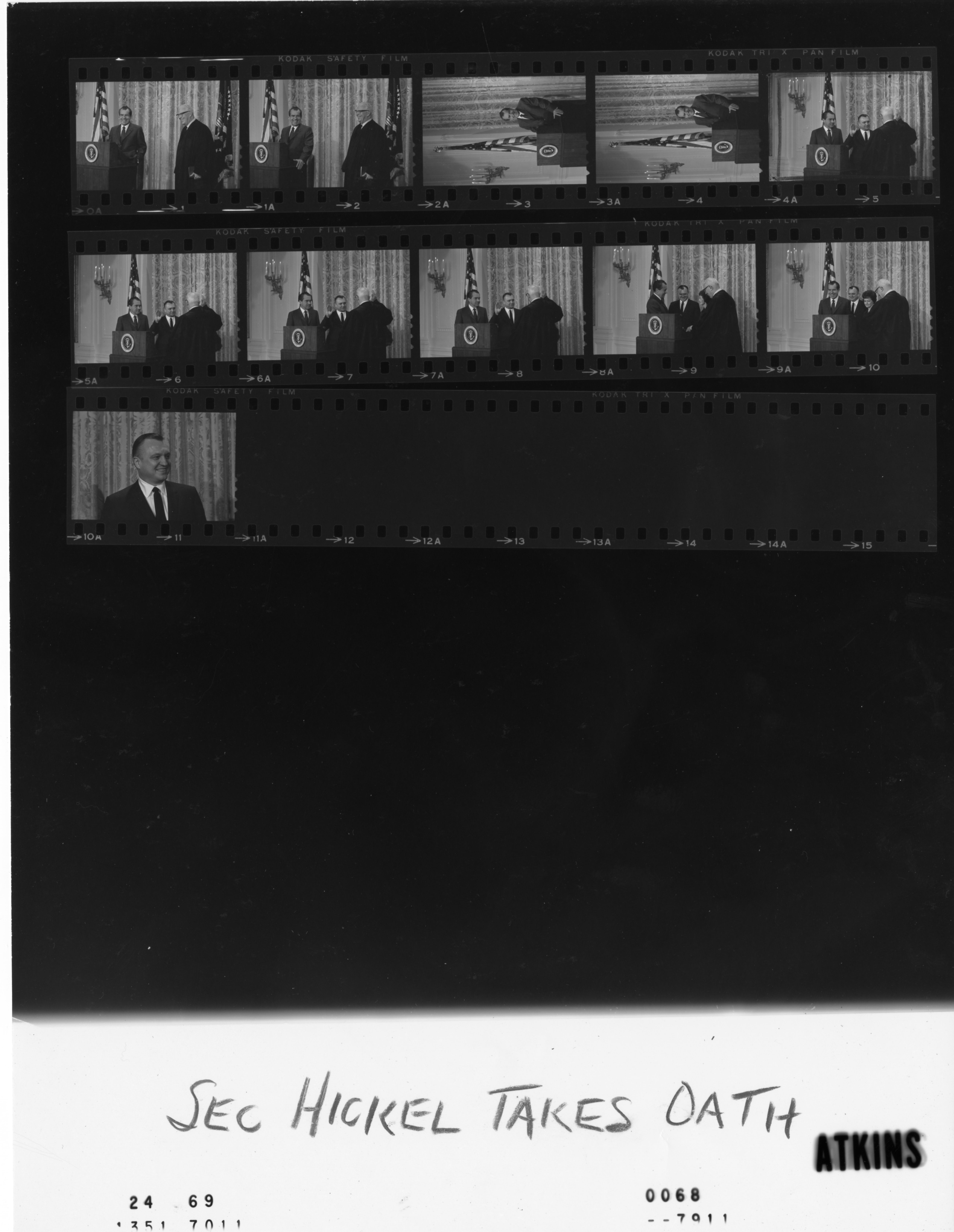
- Frame(s): WHPO-0068-01-02, President Nixon and Chief Justice Earl Warren at the podium, prior to the Swearing-in ceremony of Walter J. Hickel, Secretary of the Interior. 1/24/1969, Washington, D.C. White House, East Room. President Nixon, Earl Warren.
- Frame(s): WHPO-0068-03-04, President Nixon smiling at the podium, prior to the Swearing-in ceremony of Walter J. Hickel, Secretary of the Interior. 1/24/1969, Washington, D.C. White House, East Room. President Nixon, Earl Warren.
- Frame(s): WHPO-0068-05-10, Swearing-in ceremony of Walter J. Hickel, Secretary of the Interior, conducted by Chief Justice Earl Warren, President Nixon attending nearby. 1/24/1969, Washington, D.C. White House, East Room. President Nixon, Walter Hickel, Mrs. Hickel, Earl Warren.
- Frame(s): WHPO-0068-07, Swearing-in ceremony of Walter J. Hickel, Secretary of the Interior, conducted by Chief Justice Earl Warren, President Nixon attending nearby. 1/24/1969, Washington, D.C. White House, East Room. President Nixon, Walter Hickel, Earl Warren.
- Frame(s): WHPO-0068-11, Closeup portrait of Walter J. Hickel, Secretary of the Interior, after his Swearing-in ceremony. 1/24/1969, Washington, D.C. White House, East Room. Walter J. Hickel.
Roll WHPO-0069 Photographer: Atkins, Oliver | Color or B&W: B&W
- Frame(s): WHPO-0069-01A-10A, Informal seated portrait of Domestic Council member Ken Cole. 1/24/1969, Washington, D.C. unknown office. Kenneth R. Cole.
- Frame(s): WHPO-0069-11A-28A, Closeup informal portraits of Domestic Council member Ken Cole. (Head and shoulders). 1/24/1969, Washington, D.C. unknown office. Kenneth R. Cole.
Roll WHPO-0070 Photographer: Atkins, Oliver | Color or B&W: B&W
- Frame(s): WHPO-0070-01A-14A, Vice President Spiro Agnew and New York City Mayor, John V. Lindsay, holding a press conference for reporters and news photographers, on the Brooklyn Navy Yard's return to New York jurisdiction. 1/24/1969, Washington, D.C. Building exterior. Center L-R: Spiro Agnew, Mayor John Lindsay. Unidentified Press reporters, photographers, news cameramen.
Roll WHPO-0071 Photographer: Atkins, Oliver | Color or B&W: B&W
- Frame(s): WHPO-0071-01A-04A, White House Press office assistant J. Bruce Whelihan watching Vice President Agnew and New York City Mayor, John V. Lindsay, (both unseen) during a press conference on the Brooklyn Navy Yard's return to New York jurisdiction. 1/24/1969, Washington, D.C. White House, building exterior. J. Bruce Whelihan, unidentified press reporters.
- Frame(s): WHPO-0071-05A-14A, Vice President Agnew and New York City Mayor, John V. Lindsay, holding a press conference on the Brooklyn Navy Yard's return to New York jurisdiction. 1/24/1969, Washington, D.C. White House, building exterior. Center L-R: Spiro Agnew, Mayor John Lindsay, Press reporters, photographers, news cameramen.
Roll WHPO-0072 Photographer: Atkins, Oliver | Color or B&W: B&W
- Frame(s): WHPO-0072-01-04, President Nixon with military aides, Jack Brennan, Jim Hughes, Vernon Coffey, Charles Larson. 1/24/1969, Washington, D.C. White House, Oval Office. L-R: Maj. John V. Brennan (AKA) Jack Brennan, James D. Hughes, President Nixon, Vernon Coffey, Charles Larson.
Roll WHPO-0073 Photographer: Knudsen, Robert L. | Color or B&W: B&W
- Frame(s): WHPO-0073-02A-15A, Vice President Spiro Agnew and New York City Mayor, John V. Lindsay, holding a press conference on the Brooklyn Navy Yard's return to New York jurisdiction. 1/24/1969, Washington, D.C. White House, building exterior. Center L-R: Spiro Agnew, Mayor John Lindsay, unidentified Press reporters, photographers, news cameramen.
Roll WHPO-0074 Photographer: Knudsen, Robert L. | Color or B&W: B&W
- Frame(s): WHPO-0074-02-12, Vice President Spiro Agnew and New York City Mayor, John V. Lindsay, holding a press conference on the Brooklyn Navy Yard's return to New York jurisdiction. 1/24/1969, Washington, D.C. White House, building exterior. Center L-R: Spiro Agnew, Mayor John Lindsay, unidentified Press reporters, photographers, news cameramen.
Roll WHPO-0075 Photographer: Atkins, Oliver | Color or B&W: B&W
- Frame(s): WHPO-0075-02A-08A, First press briefing given by Gerry Van der Heuvel, Pat Nixon's Press Secretary. 1/24/1969, Washington, D.C. White House, East Wing library room. Gerry Van der Heuvel (standing) and unidentified women, press corps reporters.
Roll WHPO-0100 Photographer: Kightlinger, Jack | Color or B&W: B&W
- Frame(s): WHPO-0100-03-12, Vice President Agnew and New York City Mayor, John V. Lindsay's press conference on the Brooklyn Navy Yard's return to New York jurisdiction. 1/24/1969, Washington, D.C. Frame 03A, Center L-R: Spiro Agnew, Mayor John Lindsay, unidentified officials and White House press reporters.
Roll WHPO-0101 Photographer: Kightlinger, Jack | Color or B&W: B&W
- Frame(s): WHPO-0101-03-17, Vice President Agnew and New York City Mayor, John V. Lindsay's press conference on the Brooklyn Navy Yard's return to New York jurisdiction. Secretary of Commerce Maurice Stans, Senator Jacob Javits, Representative Emanuel Celler stand nearby. 1/24/1969, Washington, D.C. Spiro Agnew, John Lindsay, Maurice Stans, Jacob Javits, Emanuel Celler.
- Frame(s): WHPO-0101-18-22, Vice President Agnew and New York City Mayor, John V. Lindsay's press conference on the Brooklyn Navy Yard's return to New York jurisdiction. congresswoman Shirley Chisholm speaking at the microphone. 1/24/1969, Washington, D.C. Spiro Agnew, John Lindsay, Representative Shirley Chisholm, Maurice Stans.
- Frame(s): WHPO-0101-23-26, Vice President Agnew and New York City Mayor, John V. Lindsay's press conference on the Brooklyn Navy Yard's return to New York jurisdiction. Agnew speaking, Representative Shirley Chisholm, Secretary of Commerce Maurice Stans, Senator Jacob Javits, Representative Emanuel Celler stand nearby. 1/24/1969, Washington, D.C. Spiro Agnew, John Lindsay, Maurice Stans, Jacob Javits, Emanuel Celler, Shirley Chisholm.
Roll WHPO-0751 Photographer: Knudsen, Robert L. | Color or B&W: Color
- Frame(s): WHPO-0751-, President Nixon talking from a podium. 1/24/1969, Washington, D.C. President Nixon.
- Frame(s): WHPO-0751-[DASH], President Nixon talking from a podium. 1/24/1969, Washington, D.C.
Roll WHPO-0755 Photographer: Knudsen, Robert L. | Color or B&W: Color
- Frame(s): WHPO-0755-, President Nixon smiling while standing at a podium. 1/24/1969, Washington, D.C. President Nixon.
- Frame(s): WHPO-0755-[DASH], President Nixon smiling while standing at a podium. 1/24/1969, Washington, D.C.
The White House Communications Agency Sound Recordings Collection contains public statements that took place between 1969 and 1974. Visit the finding aid to learn more.
B - Vice-Presidential (Agnew and Ford)
- WHCA-SR-B-003
Remarks to the press-WHPL/John Lindsay. (1/24/1969)
Runtime: 20:00
Original Format: 1/4-inch reel-to-reel audiotape. Original source type: Original.
P - Formal Presidential Remarks
- WHCA-SR-P-690111
Remarks by President Nixon at the swearing-in ceremony for Walter Hickel as Secretary of Interior. (1/24/1969, White House East Room)
Runtime: 0:06:20
Production credits: Audio feed supplied by WHCA
Original Format: 1/4-inch reel-to-reel audiotape. Original source type: Original.
Context (External Sources)
The Vanderbilt Television News Archive is the world's most extensive and complete archive of television news. They have been recording, preserving and providing access to television news broadcasts of the national networks since August 5, 1968.
Wikipedia is a free encyclopedia that anyone can edit.