
Introduction
This almanac page for Thursday, January 21, 1971, pulls together various records created by the federal government and links to additional resources which can provide context about the events of the day.
Previous Date: Wednesday, January 20, 1971
Next Date: Friday, January 22, 1971
Schedule and Public Documents
The Daily Diary files represent a consolidated record of the President's activities. Visit the finding aid to learn more.
The President's day began at The White House - Washington, D. C.
The Weekly Compilation of Presidential Documents made available transcripts of the President's news conferences; messages to Congress; public speeches, remarks, and statements; and other Presidential materials released by the White House.
Digitized versions can be found at HathiTrust.
Each Public Papers of the Presidents volume contains the papers and speeches of the President of the United States that were issued by the White House Office of the Press Secretary during the time period specified by the volume. The material is presented in chronological order, and the dates shown in the headings are the dates of the documents or events. In instances when the release date differs from the date of the document itself, that fact is shown in the text note.
To ensure accuracy, remarks have been checked against audio recordings (when available) and signed documents have been checked against the original, unless otherwise noted. Editors have provided text notes and cross references for purposes of identification or clarity.
The Federal Register is the official daily publication for rules, proposed rules, and notices of federal agencies and organizations, as well as executive orders and other Presidential documents.
The Congressional Record is the official daily record of the debates and proceedings of the U.S. Congress.
Archival Holdings
Any selection of archival documents will necessarily be partial. You should use the documents and folders identified below as a starting place, but consult the linked collection finding aids and folder title lists and the collections themselves for context. Many documents to be found this way do not lend themselves to association with specific dates, but are essential to a complete understanding of the material.
Selective document listing
President's Office Files
The President's Office Files consists of materials drawn together by the Special Files Unit from several administrative subdivisions within the White House Office. It is the handwriting and sensitive papers sent to the Staff Secretary that now comprise much of the President's Office Files. Visit the finding aid to learn more.
- Annotated News Summaries, Box 29, News Summaries - January 1971 [During this period, the Staff Secretary only removed pages from the News Summaries which contained President Nixon's handwriting, often leaving the document with no date. In addition to the individual document(s) listed below, you should also consult the full folder for the month.]
- [1/21/71]
- Wall Street Journal, editorial, "Camelot Reappraised," January 21, 1971
- Wire Reports, January 21, 1971
- President's Daily Schedule, Box 101, [President's Daily Schedule, Jan.-Feb. 1971] [1 of 3]
- The President's Schedule, Thursday - January 21, 1971
The H. R. Haldeman Diaries consists of seven handwritten diaries, 36 dictated diaries recorded as sound recordings, and two handwritten audio cassette tape subject logs. The diaries and logs reflect H. R. Haldeman’s candid personal record and reflections on events, issues, and people encountered during his service in the Nixon White House. As administrative assistant to the President and Chief of Staff, Haldeman attended and participated in public events and private meetings covering the entire scope of issues in which the Nixon White House engaged in during the years 1969-1973. Visit the finding aid to learn more.
- Transcript of diary entry (PDF)
Thursday, January 21.
The President spent the whole day at the EOB working on the speech. He got into the Life editorial again today, as apparently Henry got into a discussion of it with him. He wanted some follow-up on who the Life guys had talked with. It turned out to be only Kissinger and Ehrlichman. He wanted to put a complete freeze on Time-Life for a while. Also wants an analysis of what Time has done since December 1st versus Newsweek, and so on. He's extremely disturbed by this whole thing. He wants to get a hold of Keogh and Shepley and analyze with them, and also Hobe Lewis, the question of how we should handle our battle with Life. He thinks it's really a problem for us, and that we ought to, for instance, at least cut Sidey off and probably cut off the whole Time and Life group.
He reacted at first quite indifferently to news of Teddy Kennedy's defeat as Majority Whip in the Senate, and said he didn't think it would have the significance that the commentators would probably try to give it. He made the point that you don't kill a man who's been built up the way Teddy has, by a defeat, any more than you killed Nixon by his defeat in California. He thinks it will provide a momentary setback, but that Teddy will move ahead in spite of it, with considerable strength.
We had a new Rogers-Kissinger flap today regarding Laos, as Henry came in this morning to say he had discovered that Rogers and Laird had met secretly with Alexis Johnson yesterday, and had decided to send a cable to our Ambassador as an attempt to try to turn off the planned Laotian operations. Alex Johnson felt so guilty about it, he ended up calling Henry and telling him; and we put out an all-points bulletin to make sure that the cable didn't get to the President, since Rogers had said that he was not going to send the cable in through the system, but would get it cleared directly with the President. We had everything covered, but in spite of that, the President got the cable. We later found out Rose Woods had taken it to him because Rogers' secretary had called her and said that they were sending this over in a sealed envelope marked "EYES ONLY", and it was to be delivered directly to the President, not through any individual or department. So Rose did it. As soon as the President opened it, he reacted exactly as he should have, and called Henry over, said the President would not approve this, and that it was up to Henry to handle it through his system. This, of course, delighted Henry and probably turned out to be the best thing that could have happened; but I'm sure that's not what Rogers had intended. Henry took the matter to the WSAG meeting and brought it up there, as the President had told him to, and as should have been done to begin with. Before the President called Henry over, however, he—he Henry—had been in my office highly upset about the whole business; and later, he said he thought I had probably briefed the President on how to handle it if it did come in, which, of course, I had not done because I thought we had set it up so it wouldn't get in to begin with. The President talked with me about it a little later, and was really quite disturbed that Rogers had pulled this; and he still doesn't know about the maneuver of slipping it in through the secretaries, which I will now have to cover with him so we have a chance, really, to jump on this.
We got word today that we also got a follow-up opportunity on Newsweek's lousy article this week. Life is letting George Romney to do a two page editorial to counter theirs. Newsweek will let Elliot Richardson do a similar kind of thing; so we're busily getting those written now. The President is just extremely pleased by that development and said tonight on the phone that he wanted to get a little medal developed for the guys who perform beyond the call of duty in this way, find some kind of little thing to give them as a token of the President's appreciation.
Richard Russell died today, but the Senate and House leadership agreed that they should go ahead with the plans for the State of the Union tomorrow night anyway. The funeral will be in Georgia on Sunday, and the President wants to go down; so we'll have to work something out vis-à-vis the White House Church services that day.
The President seems to be reasonably pleased with the speech as it's developing. He's on the basis of about two drafts a day now; he goes over them quite thoroughly, gives them back to Ray and makes Ray go to work on them. In the meanwhile, the President deals with his other business, which is a much less taxing way of dealing with the speech than the super-agonizing he's done in the past, although he's still putting a lot more into these than he probably should be. The State of the Union, of course, is an exception to the rule in any event. He has decided he's getting kind of tired and wants to head for Florida the weekend after next; and so we're setting that up.
End of January 21. - Original audio recording (MP3)
The National Archives Catalog is the online portal to the records held at the National Archives, and information about those records. It is the main way of describing our holdings and also provides access to electronic records and digitized versions of our holdings.
The Catalog searches across multiple National Archives resources at once, including archival descriptions, digitized and electronic records, authority records, and web pages from Archives.gov and the Presidential Libraries. The Catalog also allows users to contribute to digitized historical records through tagging and transcription.
Nixon Library Holdings
All National Archives Units
National Security Documents
The President's Daily Brief is the primary vehicle for summarizing the day-to-day sensitive intelligence and analysis, as well as late-breaking reports, for the White House on current and future national security issues. Read "The President's Daily Brief: Delivering Intelligence to Nixon and Ford" to learn more.
The Foreign Relations of the United States series presents the official documentary historical record of major U.S. foreign policy decisions and significant diplomatic activity. Visit the State Department website for more information.
Vol. VII, Vietnam, July 1970-January 1972
Planning and Decisions for Operations in Cambodia and Laos, October 9, 1970-February 7, 1971
107. Memorandum From the President’s Assistant for National Security Affairs (Kissinger) to President Nixon, Washington, January 21, 1971
Source: National Archives, Nixon Presidential Materials, NSC Files, Box 208, Agency Files, CIA, Vol. IV. Secret; Sensitive; Contains Codeword Material. A stamped notation on the memorandum reads, “The President has seen.”
108. Minutes of a Meeting of the Washington Special Actions Group, Washington, January 21, 1971, 4 p.m.
Source: National Archives, Nixon Presidential Materials, NSC Files, NSC Institutional Files (H-Files), Box H–115, WSAG Meetings Minutes, Originals, 1971. Top Secret; Sensitive; Eyes Only. The meeting took place in the Situation Room of the White House. It ended at 5:23 p.m. (Library of Congress, Manuscript Division, Kissinger Papers, Box 438, Miscellany, 1968–76, Record of Schedule)
Vol. XIII, Soviet Union, October 1970-October 1971
"A Key Point in Our Relationship": Backchannel Talks on SALT, Berlin, and the Summit
102. Memorandum From the President’s Assistant for National Security Affairs (Kissinger) to the White House Chief of Staff (Haldeman), Washington, January 21, 1971
Source: National Archives, Nixon Presidential Materials, NSC Files, Box 405, Subject Files, USSR (Jewish Defense League). Confidential; Sensitive; Outside System. Printed from a copy that indicates Haig signed the original for Kissinger.
Vol. XXI, Chile, 1969-1973
Cool and Correct: The U.S. Response to the Allende Administration, November 5, 1970-December 31, 1972
198. Backchannel Message From the Ambassador to Chile (Korry) to the Under Secretary of State for Political Affairs (Johnson) and the President’s Assistant for National Security Affairs (Kissinger), Santiago, January 21, 1971
Source: National Archives, Nixon Presidential Materials, NSC Files, Box 774, Country Files, Latin America, Chile, Vol. III. Secret; Sensitive; Eyes Only. Forwarded to Kissinger with a note from Haig stating that Nachmanoff would include the issue on the agenda of the next 40 Committee meeting. (Ibid.)
Vol. XXIII, Arab-Israeli Dispute, 1969-1972
197. Telegram From the Department of State to the Interests Section in the United Arab Republic, Washington, January 21, 1971, 2107Z
Source: National Archives, Nixon Presidential Materials, NSC Files, Box 636, Country Files, Middle East, UAR, Vol. V. Secret; Exdis. Drafted by Sterner and W.B. Smitt II (NEA/UAR); cleared by Sisco, De Palma, and Kissinger; and approved by Rogers. All brackets are in the original except “[Asyut]”, added for clarity.
Vol. XXVIII, Southern Africa
Regional Issues
43. Telegram From the Department of State to the Embassy in Zambia, Washington, January 21, 1971, 2200Z
Source: National Archives, RG 59, Central Files 1970–73, SOC 14 S AFR. Limited Official Use. Drafted by Coote on December 12, 1970, cleared by Newsom, and approved by Curran. The text was initially received from the White House.
Vol. E-2, Documents on Arms Control and Nonproliferation, 1969-1972
Nuclear Test Ban Issues; Peaceful Nuclear Explosions
298. Memorandum From the Assistant Director of the Science and Technology Bureau, Arms Control and Disarmament Agency (Keeny) to the Director of the Arms Control and Disarmament Agency (Smith), Washington, January 21, 1971
Keeny discussed the Canadian reports of radioactive material detected in the atmosphere resulting from U.S. venting following the December 18, 1970 Baneberry underground nuclear test.
Source: Washington National Records Center, Office of the Director, Subject Files of the Former Executive Director Office, January–December 1971: FRC 383–98–5, Underground Nuclear Testing–Venting December 1970–December 1971. Drafted by P.J. Long (ACDA/ST). The attached memorandum of conversation is not published. The Canadian minister stated that their readings did not indicate conclusively that the increase in radioactivity was a result of venting from the Nevada tests, but they considered it probable because the radioactivity resulted from “fresh venting.”
Vol. E-5, Part 1, Documents on Sub-Saharan Africa, 1969-1972
The Horn
308. Memorandum From Marshall Wright of the National Security Council Staff to the Presidentʼs Assistant for National Security Affairs (Kissinger), Washington, January 21, 1971
Wright gave Kissinger an update on the Ethiopian Security Situation.
Source: National Archives, Nixon Presidential Materials, NSC Files, Country Files, Africa, Ethiopia, Vol. I. Sent for action. Kissinger wrote: “Also a [unclear] assessment of what to do when Haile Selassie dies—make another NSSM.” He crossed most of this out and wrote to the side, “See it is in NSSM.” Below, he also wrote, “Good job—Marshall!” Tab A is Document 309. Tab B is not published.
Vol. E-5, Part 2, Documents on North Africa, 1969-1972
Algeria
28. Telegram 113 From the Interests Section in Algeria to the Department of State, Algiers, January 21, 1971, 1420Z
The Interests Section warned the Department that, owing to the continued delay in FPC approval of the El Paso project, the momentum generated by improving U.S.-Algerian relations was slowing and that the delay could cause disillusionment in Algeria.
Source: National Archives, RG 59, Central Files 1970–73, POL ALG-US. Secret. It was repeated to Cairo, Khartoum, London, Paris, Tripoli, Tunis, and Rabat.
The Kissinger telephone conversation transcripts consist of approximately 20,000 pages of transcripts of Kissinger’s telephone conversations during his tenure as Assistant to the President for National Security Affairs (1969-1974) and Secretary of State (1973-1974) during the administration of President Richard Nixon. Visit the finding aid for more information.
Digitized versions can be found in the National Archives Catalog.
Audiovisual Holdings
The White House Photo Office collection consists of photographic coverage of President Richard Nixon meeting with prominent social, political, and cultural personalities; speaking engagements and news conferences of the President and various high-ranking members of the White House staff and Cabinet; Presidential domestic and foreign travel, including Presidential vacations; social events and entertainment involving the First Family, including entertainers present; official portraits of the President, First Family, and high-ranking members of the Nixon administration; the 1969 and 1973 Inaugurals; the President’s 1972 Presidential election campaign appearances (including speeches) and other official activities of the White House staff and the President’s Cabinet from January 20, 1969 until August 9, 1974 at the White House and the Old Executive Office Building; other locations in Washington, DC, such as The Mall; and the Presidential retreats in Camp David, Maryland, Key Biscayne, Florida, and San Clemente, California. Visit the finding aid to learn more.
Roll WHPO-5499 Photographer: Atkins, Oliver | Color or B&W: B&W
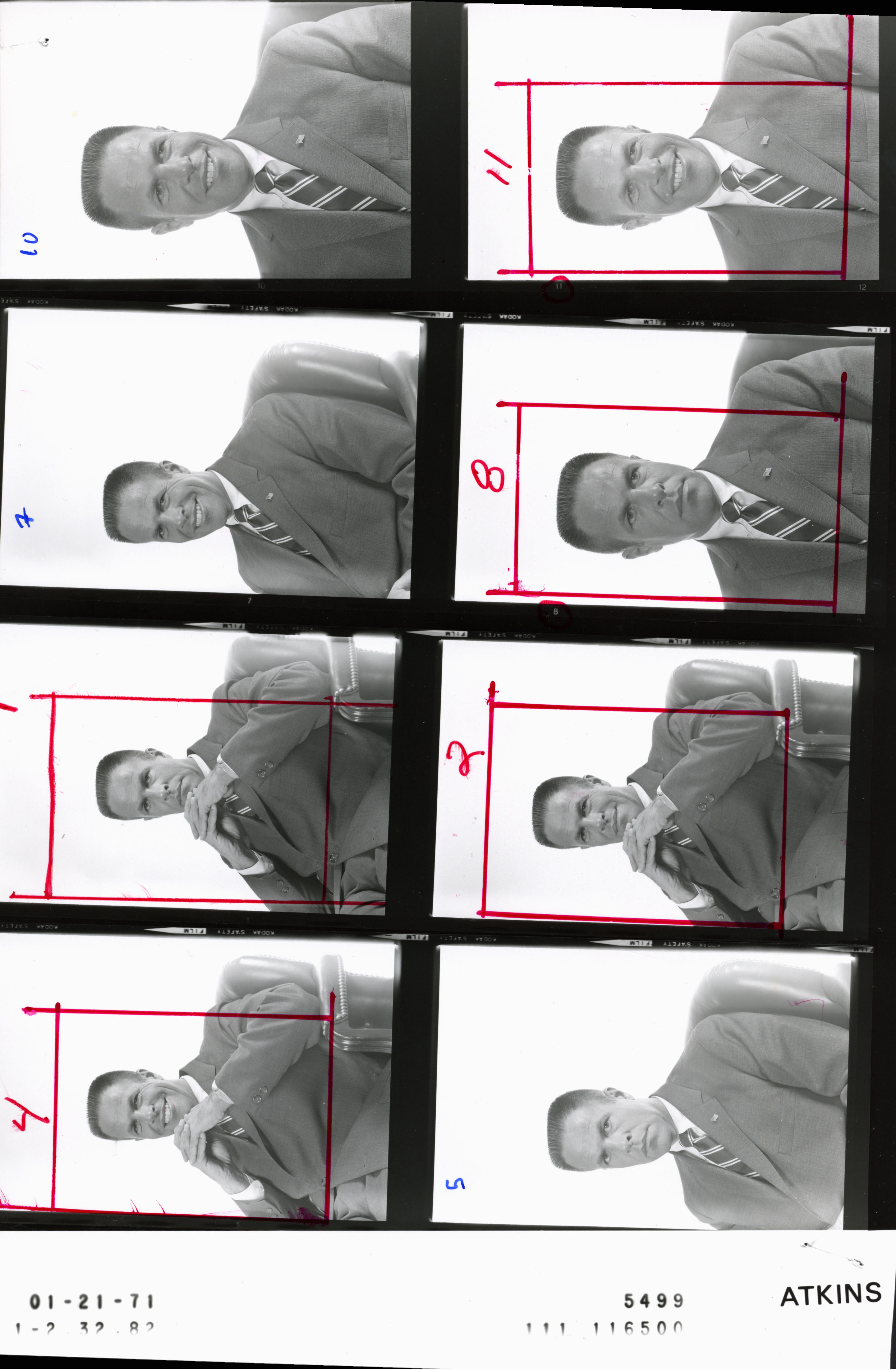
- Frame(s): WHPO-5499-, Seated portraits of H.R. Haldeman. 1/21/1971, Washington, D.C. White House, Roosevelt Room. H.R. Haldeman.
Roll WHPO-5500 Photographer: Atkins, Oliver | Color or B&W: Color
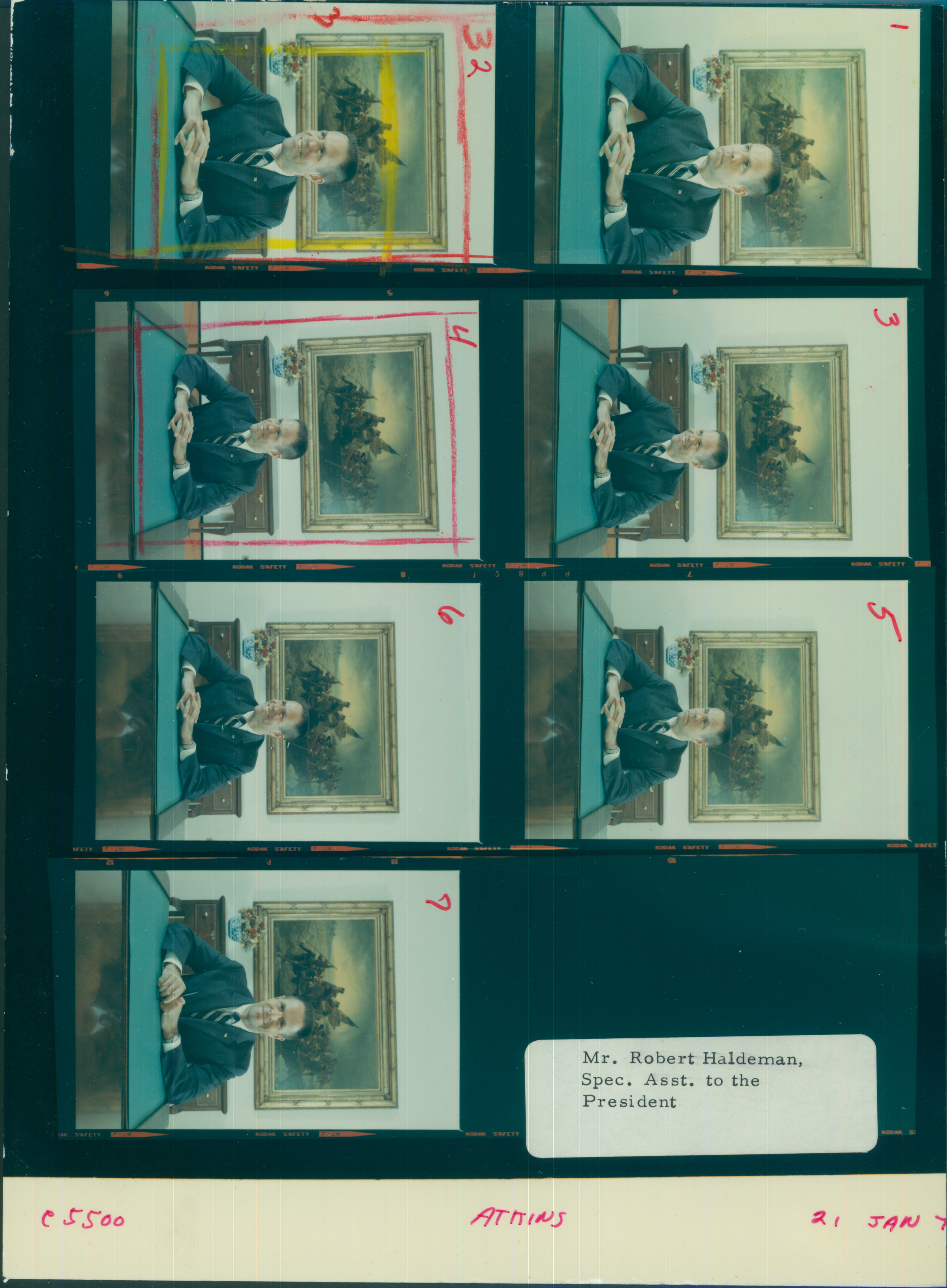
- Frame(s): WHPO-5500-01-07, H.R. Haldeman sitting at a desk in front of a painting of men on horseback. 1/21/1971, Washington, D.C. White House, Roosevelt Room. H.R. Haldeman.
- Frame(s): WHPO-5500-02, H.R. Haldeman sitting at a desk, smiling in front of a painting of men on horseback. 1/21/1971, Washington, D.C. White House, Roosevelt Room. H.R. Haldeman.
Roll WHPO-5501 Photographer: Atkins, Oliver | Color or B&W: Color
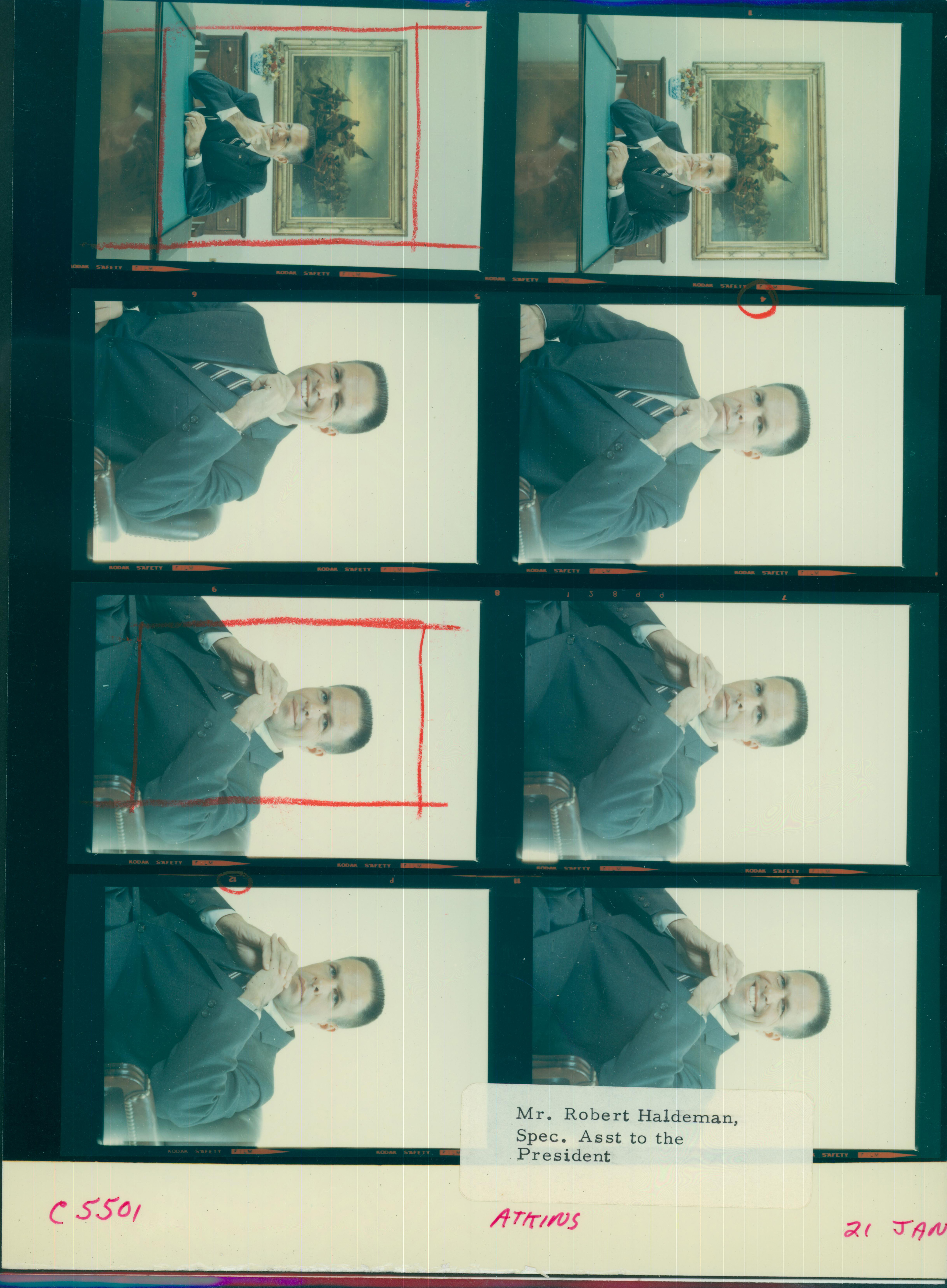
- Frame(s): WHPO-5501-01-12, Portrait of H.R. Haldeman. 1/21/1971, Washington, D.C. White House, Roosevelt Room. H.R. Haldeman.
Roll WHPO-5503 Photographer: Schumacher, Karl | Color or B&W: B&W
- Frame(s): WHPO-5503-03-13, Mrs. Davies at a desk, wearing a string of pearls. 1/21/1971, Washington, D.C. unknown. Mrs. Davies.
Roll WHPO-5504 Photographer: Atkins, Oliver | Color or B&W: B&W
- Frame(s): WHPO-5504-02-10, President Nixon working on his State of the Union Address. 1/21/1971, Washington, D.C. Executive Office Building, Presidential Office. President Nixon.
- Frame(s): WHPO-5504-09, President Nixon sitting in the Oval Office, working on his State of the Union Address. A gavel and elephant statue are visible on the desk. 1/21/1971, Washington, D.C. Executive Office Building, Presidential Office. President Nixon.
The White House Communications Agency Sound Recordings Collection contains public statements that took place between 1969 and 1974. Visit the finding aid to learn more.
G - Cabinet Officer Briefings
- WHCA-SR-G-074
Briefing by Secretary of Health, Education and Welfare Elliot Richardson and Secretary of Agriculture Clifford Hardin, with Ronald Ziegler. (1/21/1971, Press Center)
Runtime: 42:00:00
Production credits: Audio feed supplied by WHCA; Recorded by LRR (initials of WHCA engineer)
Original Format: 1/4-inch reel-to-reel audiotape. Original source type: Original.
H - White House Staff Member Recordings
- WHCA-SR-H-322
Remarks by George Shultz and Senator Lowell Weicker. (1/21/1971, Family Theater, White House)
Runtime: 31:00:00
Production credits: Audio feed supplied by WHCA; Recorded by LRR (initials of WHCA engineer)
Original Format: 1/4-inch reel-to-reel audiotape. Original source type: Original.
The White House Communications Agency Videotape Collection contains “off-the-air” recordings of televised programs produced between 1968 and 1974. Visit the finding aid to learn more.
- WHCA-4100
"The Turned On Crisis", Part I: 'Because That's My Way'.
Undetermined
Runtime: 1:00 - WHCA-4101
"The Turned On Crisis", Part II: 'The First Dimension'. Ted Williams, Mercedes McCambridge, Ben Gazarra, The Brothers Kane.
Daphne Productions and Roland & Jaffee Productions
Runtime: 1:00 - WHCA-4102
"The Turned On Crisis", Part III: 'Say What?'.
Undetermined
Runtime: 1:00 - WHCA-4103
"The Turned On Crisis", Part IV: 'The Shade of A Toothpick'.
Undetermined
Runtime: 00:59:59 - WHCA-4104
"The Turned On Crisis", Part VI: 'To Keep It You Have to Give It Away'.
Undetermined
Runtime: 00:59:40 - WHCA-4105
"The Turned On Crisis", Part VI: 'The Concept'.
Undetermined
Runtime: 00:59:28 - WHCA-4112
Weekly News Summary, Tape II.
ALL NETWORKS
Runtime: 1:00
5. Smtih/Clark/Donalson: 92nd Congress. Time Code Start: 16:22. Keywords: House of Representatives, sessions. Network: ABC.
6. Reasoner/Tuckner: Cambodia and Laos. Time Code Start: 21:54. Keywords: Laos, Cambodia, Vietnam War. Network: ABC.
7. Smith/Geer: Senator Russell dies. Time Code Start: 24:55. Keywords: Senator, Senate, officials, death. Network: ABC.
8. Smith: Cambodia. Time Code Start: 27:22. Keywords: Cambodia, Vietnam War. Network: ABC.
9. Reasoner: Commentary on Senator Russell. Time Code Start: 27:51. Keywords: Senator, Senate, officials, death, reports, documentary. Network: ABC.
10. Brinkley: Democratic Whip Senator Ted Kennedy voted out of job by Senator Robert Byrd; Senator Carl Albert elected Speaker of House; Hawaii Senator Fong says Hawaii Senator Inouye guilty of racism. Time Code Start: 29:44. Keywords: Senate, elections, voting, leaders, Hawaiian, Senators, criticisms, accusations, racial profiling, racial discrimination, civil rights, Japanese, Chinese. Network: NBC.
11. Chancellor: Senator Russell dies. Time Code Start: 32:31. Keywords: Senator, Senate, officials, death. Network: NBC.
12. Cronkite: Democratic Whip Senator Ted Kennedy out. Time Code Start: 33:19. Keywords: Presidential elections, campaigns, campaigning, candidates,. Network: CBS.
13. Rather: Senator Ted Kennedy in 1972?. Time Code Start: 36:38. Keywords: Presidential elections, campaigns, campaigning, candidates. Network: CBS.
14. Cronkite/Hart: Senator Russell Dies. Time Code Start: 37:38. Keywords: Senator, Senate, officials, death. Network: CBS.
Context (External Sources)
The Vanderbilt Television News Archive is the world's most extensive and complete archive of television news. They have been recording, preserving and providing access to television news broadcasts of the national networks since August 5, 1968.
Wikipedia is a free encyclopedia that anyone can edit.