

Introduction
This almanac page for Tuesday, January 19, 1971, pulls together various records created by the federal government and links to additional resources which can provide context about the events of the day.
Previous Date: Monday, January 18, 1971
Next Date: Wednesday, January 20, 1971
Schedule and Public Documents
The Daily Diary files represent a consolidated record of the President's activities. Visit the finding aid to learn more.
The President's day began at The White House - Washington, D. C.
The Weekly Compilation of Presidential Documents made available transcripts of the President's news conferences; messages to Congress; public speeches, remarks, and statements; and other Presidential materials released by the White House.
Digitized versions can be found at HathiTrust.
Each Public Papers of the Presidents volume contains the papers and speeches of the President of the United States that were issued by the White House Office of the Press Secretary during the time period specified by the volume. The material is presented in chronological order, and the dates shown in the headings are the dates of the documents or events. In instances when the release date differs from the date of the document itself, that fact is shown in the text note.
To ensure accuracy, remarks have been checked against audio recordings (when available) and signed documents have been checked against the original, unless otherwise noted. Editors have provided text notes and cross references for purposes of identification or clarity.
- Memorandum Establishing the Council on International Economic Policy.
- Remarks Announcing Appointment of Peter G. Peterson as Assistant to the President for International Economic Affairs and Executive Director, Council on International Economic Policy
- Statement About Halting Construction of the Cross Florida Barge Canal
- Executive Order 11579—Overseas Private Investment Corporation
The Federal Register is the official daily publication for rules, proposed rules, and notices of federal agencies and organizations, as well as executive orders and other Presidential documents.
Archival Holdings
Any selection of archival documents will necessarily be partial. You should use the documents and folders identified below as a starting place, but consult the linked collection finding aids and folder title lists and the collections themselves for context. Many documents to be found this way do not lend themselves to association with specific dates, but are essential to a complete understanding of the material.
Selective document listing
President's Office Files
The President's Office Files consists of materials drawn together by the Special Files Unit from several administrative subdivisions within the White House Office. It is the handwriting and sensitive papers sent to the Staff Secretary that now comprise much of the President's Office Files. Visit the finding aid to learn more.
- Annotated News Summaries, Box 29, News Summaries - January 1971 [During this period, the Staff Secretary only removed pages from the News Summaries which contained President Nixon's handwriting, often leaving the document with no date. In addition to the individual document(s) listed below, you should also consult the full folder for the month.]
- January 19, 1971
- [1/19/71]
- President's Daily Schedule, Box 101, [President's Daily Schedule, Jan.-Feb. 1971] [1 of 3]
- The President's Schedule, Tuesday - January 19, 1971
The H. R. Haldeman Diaries consists of seven handwritten diaries, 36 dictated diaries recorded as sound recordings, and two handwritten audio cassette tape subject logs. The diaries and logs reflect H. R. Haldeman’s candid personal record and reflections on events, issues, and people encountered during his service in the Nixon White House. As administrative assistant to the President and Chief of Staff, Haldeman attended and participated in public events and private meetings covering the entire scope of issues in which the Nixon White House engaged in during the years 1969-1973. Visit the finding aid to learn more.
- Transcript of diary entry (PDF)
Tuesday, January 19th. Cabinet meeting this morning for three hours to cover the State of the Union presentation. Ehrlichman and his crew ran the show and did an excellent job of presenting our general budget plans and then reviewing the main new programs in revenue sharing, executive reorganization, health, and environment. Then Ed Morgan did a pitch on how the whole plan is to be sold. Cap and Shultz had some darned good comparisons on the budget thing, showing the shifts from defense spending to human resources, the increases in expenditures on pollution, crime, and medical, all of them very effective. The revenue sharing pitch was pretty well done; executive reorganization, also very well done. By the time they got to Richardson on health, and then Train on environment, things were lagging along a bit, and it didn't go too well. The point was made by Shultz, in regard to reorganization, that the suggestions we were coming up with had, in one form or another, been proposed frequently by earlier commissions and councils, but no other President has had the courage to do anything about it until now. In the middle of the health presentation, the President made the point that we should not provide full free health care because, most of the time, when someone's got a pain, he'd be a hell of a lot better off not to go to the doctor, it'll just make it worse. At another point in the discussion, the President urged putting this together in very brief and simple form, saying that most Congressmen and Senators won't have time to understand this, even if they had the capacity. It became clear, as the presentation went on, that our biggest problem at the moment is the lack of a handle for the whole program, and we've got to develop one.
This afternoon, Zig--, Ziegler was in to get some guidelines on how to handle Cambodia. We're being accused in the press of a credibility problem again, because we have stepped up air activity and they're trying to pretend that this is a change in policy. The President told Ron to hit the credibility question directly and to hit it hard. Make the point that the press constantly tries to raise a straw man on this that the President has done everything he said he would do and is going, is doing in this instance. We've already clearly pointed out there would be no American ground action and no American advisors in Cambodia. We said we would assist Cambodia, and this was okayed by Congress with dollars and logistic assistance. We also said we would continue air activities, where necessary, for the purpose of inhibiting the enemy from reestablishing their sanctuaries. That was presented to Congress and was written into the legislation. He wanted Ron to refer to the Stennis-Fulbright colloquy on this. He's always said that US activity would be limited to air and only where necessary to prevent reestablishing the sanctuaries. The President wanted to be sure Ron hit this hard, making the point that the Pres--, the press, at another point, had said that the bombing in North Vietnam was new, which was not true. The President had said it November 3rd and eight times after that. Yet some of the press wrote that it was a surprise, which they knew was not true. He also told Ron to get out the line of the President's frequent contact with Rogers to try to shoot down the New York Times series that's implying that all the control has shifted away from State and to Henry Kissinger's operation.
A little later, Kissinger was in and there was quite a discussion of Muskie and the results of his trip. The President obviously is not pleased with the reception Muskie was given by the Soviets and by Willy Brandt. He wants to have Muskie hit on the total irresponsibility of his statement, or his proposed statement, on a standstill in the nuclear, or in the disarmament talks. He should be hit on his amazing ignorance. Say it's unprecedented for a Senator to do this. We should get a Senator to hit him when the proposal comes out. The President's also decided that Ambassador Beam has to go. He played Muskie's line too much while he was in the Soviet Union. He made the point that we've got to recognize that the Soviets will play a role in US politics. They definitely want to get Nixon out, and will do what they can to see that that happens. Kissinger argues that they have to balance this against their fear that Nixon may win and they'll have to live with him another four years. The President says, I'm willing to try the negotiations and so on...
-------------------------------------------------------------------------------------------
DECLASSIFIED - E.O. 13526, Sect. 3.4: by MS, NARA, June 12, 2013
Audio Cassette 3, Side A, Withdrawn Item Number 14 [AC-3(A) Sel 7]
Duration: 16 seconds
...but we can't believe them and it's better to turn on them now. The President raised the question of whether we shouldn't accept the Chinese invitation, but Henry po--, points out that the problem of having to agree to some change on Taiwan, prohibits that.
-------------------------------------------------------------------------------------------------------------
We got into the polling question. The President is disturbed, obviously, by the Gallup Poll, which only shows him up 4 points while our poll shows an increase of 11. He's suggesting now that we should probably build our own established poll, such as ORC, on a continuing basis, so that we have a third poll that's taken regularly to counteract Gallup and Harris.
Continued on the next...
[End of tape reel AC-3A]
[Begin tape reel AC-3B]
Continuing January 19th, 1971. I was commenting on the President's feeling that we need a third established poll of our own to counteract Gallop and Harris such as ORC who we'd use on a continuing basis. He makes the point that the results of the polls directly affect our ability to govern, because of their influence on Congressmen, foreign leaders, etcetera. And that it's important that we keep the published polls honest, and that we know ourselves exactly what the actual poll status is.
The President went over to the EOB in early afternoon and worked for a while on the State of the Union. Then called about 4:15 to say that he had sent it back for another draft, and wanted to get Finch, Rumsfeld, Ehrlichman, Shultz, and Weinberger in for a general discussion in the EOB office, which we did. And it lasted for a couple of hours. Mainly, he got into the follow-up on the discussion this morning and the need for getting ready to follow up further on the State of the Union. First, however, he got into the point of whether we ought to have some sort of thing tomorrow to celebrate the second anniversary of January 20th. He suggested a group in the Oval Office, or something like that, that might be spontaneous. We ended up with a general staff briefing in the theater, at which the President would drop by, allow press coverage of his remarks, which would be along the same inspirational nature as his closing remarks at the Cabinet meeting today, which were really extremely good. He had made the point there, and will again tomorrow, that this whole program we're presenting in the State of the Union is the most substantive State of the Union ever presented. And that if Congress steps up to what we're giving them, they could become the greatest Congress in the history of the nation. It's the first time we've turned the direction of government back to the people, away from Washington, and it really can have quite an effect if we get it going right.
That was the reason for his wanting to discuss the necessity of all of this group really getting into the selling activity, and the rest of the meeting related to that. He strongly made the point that Finch and Rumsfeld should take on, as their major task, the need to be as public as possible, especially on TV. They should concentrate, however, on building up the President's ideas, not the programs. We also talked about the need to find ways for Shultz, Ehrlichman, and Weinberger to use public appearances. But then agreed that Ehrlichman probably fell into the same category as Kissinger and should not be used as a public spokesman, but could be used intensively for backgrounders of the press, Congress, and our own people before they go out on the road. The President then got into a discussion of setting up locations for conferences, small meetings, meals, cocktails, etcetera and wanted them to start using his EOB office and everything else. I talked him out of that, but he did agree to let the outer EOB office be set up as a conference room, and also to make the library and the theater in the Residence available for Presidential staff to use in holding these briefing meetings.
In reviewing the whole thing, the President made the point that our economic policy is just riding on a wing and a prayer, it either will work or it won't. We think we're right, but we don't know. We have to ride with that. The places where we can effect change are in these new programs, and we've really got to put them over. He makes the point that this is the first significant change in the structure of government since the country began, and this is the kind of thing we've got to develop the ways to sell. Our biggest problem, still, is the need for a name for the whole thing.
The President had a dinner in his honor given by the Cabinet at Blair House tonight, as they did last year on the anniversary. We'll have our White House thing in the session he has tomorrow morning.
We launched Pete Peterson today as Assistant to the President for International Economic Policy.
And, that does it for January 19th. - Original audio recording (MP3)
The National Archives Catalog is the online portal to the records held at the National Archives, and information about those records. It is the main way of describing our holdings and also provides access to electronic records and digitized versions of our holdings.
The Catalog searches across multiple National Archives resources at once, including archival descriptions, digitized and electronic records, authority records, and web pages from Archives.gov and the Presidential Libraries. The Catalog also allows users to contribute to digitized historical records through tagging and transcription.
Nixon Library Holdings
All National Archives Units
National Security Documents
The President's Daily Brief is the primary vehicle for summarizing the day-to-day sensitive intelligence and analysis, as well as late-breaking reports, for the White House on current and future national security issues. Read "The President's Daily Brief: Delivering Intelligence to Nixon and Ford" to learn more.
The Foreign Relations of the United States series presents the official documentary historical record of major U.S. foreign policy decisions and significant diplomatic activity. Visit the State Department website for more information.
Vol. II, Organization and Management of U.S. Foreign Policy, 1969-1972
Managing the Department of State
329. Telegram From the Department of State to All Posts, Washington, January 19, 1971, 1600Z
Source: National Archives, RG 59, Office of the Deputy Under Secretary of State for Management, Management Subject Files: Lot 76 D 210, ORG 8 Task Force Recommendations. Unclassified. Drafted by Robert Foulton, Chief of the Management Staff in Macomber’s office, and approved by Macomber.
Vol. VII, Vietnam, July 1970-January 1972
Planning and Decisions for Operations in Cambodia and Laos, October 9, 1970-February 7, 1971
105. Memorandum for the Record, Washington, January 19, 1971, noon
Source: National Archives, Nixon Presidential Materials, NSC Files, Box 83, Vietnam Subject Files, Special Operations File, Vol I. Top Secret; Sensitive. The meeting took place in the Situation Room of the White House. The meeting ended at 12:50 p.m. (Library of Congress, Manuscript Division, Kissinger Papers, Box 438, Miscellany, 1968–76, Record of Schedule) In a memorandum to Kissinger, January 19, Haig noted that the primary purpose of the meeting was to initiate Washington level planning and coordination for the dry season offensive and that it was being restricted to WSAG principals only. (National Archives, Nixon Presidential Materials, NSC Files, NSC Institutional Files (H-Files), Box H–79, WSAG Meetings, (Principals Only) Vietnam 1–19–71)
Vol. XIII, Soviet Union, October 1970-October 1971
"A Key Point in Our Relationship": Backchannel Talks on SALT, Berlin, and the Summit
101. Memorandum of Conversation, Washington, January 19, 1971, 3:30 p.m.
Source: National Archives, RG 59, Rogers’ Office Files: Lot 73 D 443, Box 1, Memoranda of Conversation for Record. Confidential. According to Rogers’ Appointment Book, his special assistant, Peter B. Johnson, also attended the meeting. (Personal Papers of William P. Rogers) Johnson presumably drafted the memorandum of conversation. According to an attached note, dated February 1, Rogers decided to show the memorandum on an “EYES ONLY” basis to Hillenbrand and Sisco.
Vol. XXXVI, Energy Crisis, 1969-1974
March 10, 1970-April 2, 1971
75. Telegram From the Under Secretary of State (Irwin) to the Department of State, Kuwait, January 19, 1971, 2335Z
Source: National Archives, RG 59, Central Files 1970–73, PET 3 OPEC. Secret; Immediate; Nodis. Repeated to London, Jidda, Dhahran, Tehran, Tripoli, and Paris.
76. Telegram From the Under Secretary of State (Irwin) to the Department of State, Kuwait, January 19, 1971, 0230Z
Source: National Archives, Nixon Presidential Materials, NSC Files, Box 1271, Saunders Files, Middle East Oil, 1/1/71–2/1/71. Secret; Immediate; Nodis.
Vol. E-4, Documents on Iran and Iraq, 1969-1972
Iran 1971
112. Telegram 301 From the Embassy in Iran to the Department of State, Tehran, January 19, 1971, 1510Z
Ambassador MacArthur summarized his briefing with the consortium negotiators, in which he recommended concessions on the scope of the oil agreement.
Source: National Archives, RG 59, Central Files 1970–73, PET 3 OPEC. Secret; Immediate; Exdis. Also sent to London and Kuwait City. Repeated to EC Brussels, Dhahran, The Hague, Jidda, OECD Paris, Paris, and Tripoli. In Telegram 302 from Tehran, January 19, the Embassy reported a consortium representative’s remark that Amouzegar had been convinced by his talks with Irwin that Washington agreed that Gulf oil negotiations should proceed before consortium talks with Mediterranean producers began, a view which MacArthur himself seemed to share. MacArthur protested, “I gave company reps Iranian viewpoint firmly held by Shah and Amouzegar, that negotiations should proceed first with Gulf group… For them now to imply to their principals that this position (consistently held by Shah) is result of Under Secretary’s talks here yesterday and my own views today seems self serving and rather devious.” (Ibid.)
The Kissinger telephone conversation transcripts consist of approximately 20,000 pages of transcripts of Kissinger’s telephone conversations during his tenure as Assistant to the President for National Security Affairs (1969-1974) and Secretary of State (1973-1974) during the administration of President Richard Nixon. Visit the finding aid for more information.
Digitized versions can be found in the National Archives Catalog.
Audiovisual Holdings
The White House Photo Office collection consists of photographic coverage of President Richard Nixon meeting with prominent social, political, and cultural personalities; speaking engagements and news conferences of the President and various high-ranking members of the White House staff and Cabinet; Presidential domestic and foreign travel, including Presidential vacations; social events and entertainment involving the First Family, including entertainers present; official portraits of the President, First Family, and high-ranking members of the Nixon administration; the 1969 and 1973 Inaugurals; the President’s 1972 Presidential election campaign appearances (including speeches) and other official activities of the White House staff and the President’s Cabinet from January 20, 1969 until August 9, 1974 at the White House and the Old Executive Office Building; other locations in Washington, DC, such as The Mall; and the Presidential retreats in Camp David, Maryland, Key Biscayne, Florida, and San Clemente, California. Visit the finding aid to learn more.
Roll WHPO-5492 Photographer: Atkins, Oliver | Color or B&W: B&W
- Frame(s): WHPO-5492-01-04, President Nixon attending a Cabinet meeting. 1/19/1971, Washington, D.C. White House, Cabinet Room. President Nixon, Cabinet members, aides.
Roll WHPO-5493 Photographer: Kightlinger, Jack | Color or B&W: Color
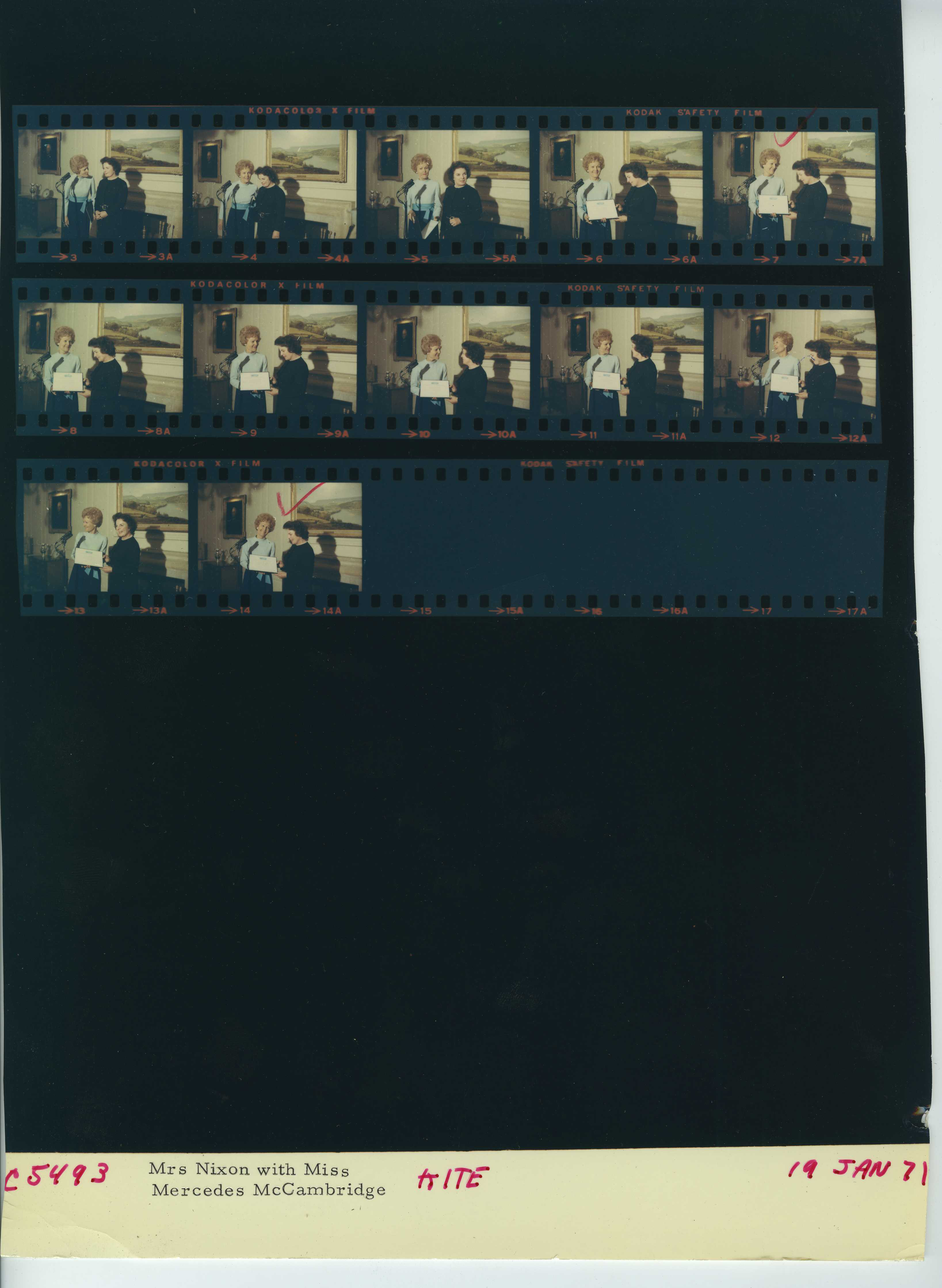
- Frame(s): WHPO-5493-03-14, Pat Nixon presenting actress Mercedes McCambridge, a member of the National Council on Alcoholism, with a volunteer certificate. 1/19/1971, Washington, D.C. White House, Map Room. Pat Nixon, Mercedes McCambridge.
Roll WHPO-5494 Photographer: unknown | Color or B&W: B&W
- Frame(s): WHPO-5494-07A-12A, Pat Nixon greeting crowd during a photo session. 1/19/1971, Washington, D.C. Smithsonian museum. Pat Nixon, crowd.
Roll WHPO-5495 Photographer: Kightlinger, Jack | Color or B&W: B&W
- Frame(s): WHPO-5495-06-10, President Nixon and Pat Nixon arriving at a Cabinet member dinner honoring the 2nd anniversary of Nixon's inauguration. 1/19/1971, Washington, D.C. Blair House reception room. President Nixon, Pat Nixon, Spiro Agnew, George Shultz, Martha Mitchell, George Romney, John Volpe, officials, wives.
- Frame(s): WHPO-5495-10A, President Nixon listens to Vice President Agnew read from a paper (others hold as well) before a Cabinet member dinner honoring the 2nd anniversary of Nixon's inauguration. 1/19/1971, Washington, D.C. Blair House reception room. President Nixon, Spiro Agnew, Judy Agnew, George Shultz, Martha Mitchell, George Romney, Mrs. Romney, John Volpe, Melvin Laird, Mrs. Laird, Ruckelshaus, other officials & wives.
Roll WHPO-5496 Photographer: Knudsen, Robert L. | Color or B&W: B&W
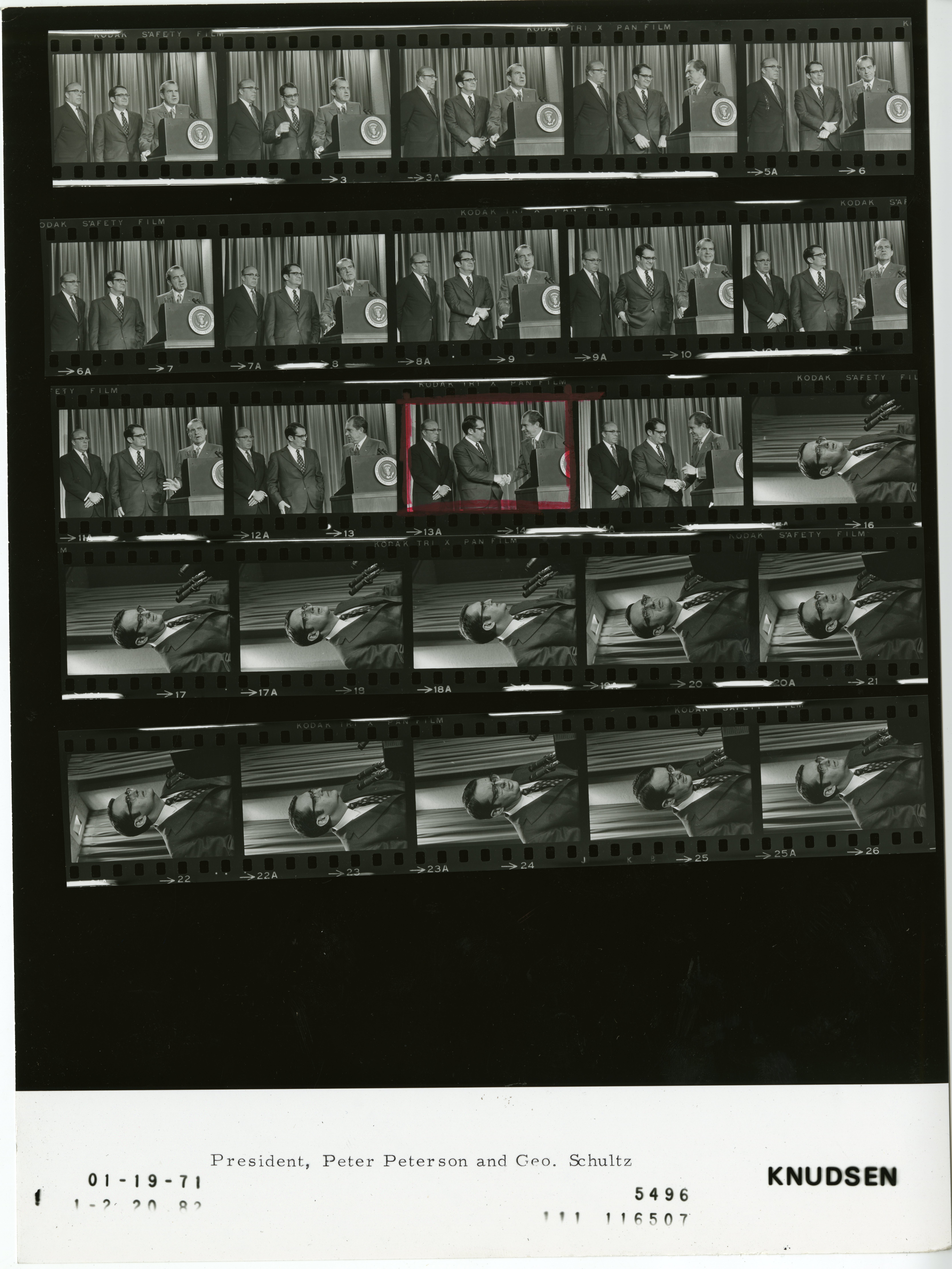
- Frame(s): WHPO-5496-01A-14A, President Nixon, George Shultz, and Peter Peterson, the newly appointed Executive Director of the Council on International Economic Affairs, at a podium. 1/19/1971, Washington, D.C. White House, Press Lobby. President Nixon, George Shultz, Peter Peterson.
- Frame(s): WHPO-5496-14, President Nixon shaking hands with Peter Peterson, the newly appointed Executive Director of the Council on International Economic Affairs at a podium. George Shultz stands nearby, behind Peterson. 1/19/1971, Washington, D.C. White House, Press Lobby. President Nixon, George Shultz, Peter Peterson.
- Frame(s): WHPO-5496-15A-25A, Peter Peterson, the newly appointed Executive Director of the Council on International Economic Affairs, speaking at a podium. 1/19/1971, Washington, D.C. White House, Press Lobby. President Nixon, George Shultz, Peter Peterson.
Roll WHPO-5497 Photographer: Knudsen, Robert L. | Color or B&W: B&W
- Frame(s): WHPO-5497-03-09, Robert Finch standing with the Los Angeles Delegation. 1/19/1971, Washington, D.C. unknown. Robert Finch, Los Angeles Delegation members.
Roll WHPO-5502 Photographer: Schumacher, Karl | Color or B&W: Color
- Frame(s): WHPO-5502-02-18, Pat Nixon and Ollie Atkins viewing "The First Two Years: A Photographic Impression of the Presidency.". 1/19/1971, Washington, D.C. unknown. Pat Nixon, Ollie Atkins, crowd.
The White House Communications Agency Sound Recordings Collection contains public statements that took place between 1969 and 1974. Visit the finding aid to learn more.
C - First Lady
- WHCA-SR-C-058
Remarks by Pat Nixon at presentation of an award to Mercedes McCambridge in the Map Room. (1/19/1971, Map Room, The White House)
Runtime: 0:50
Production credits: Audio feed supplied by WHCA; Recorded by RRS (Bob Schroder, WHCA engineer)
Original Format: 1/4-inch reel-to-reel audiotape. Original source type: Original.
P - Formal Presidential Remarks
- WHCA-SR-P-710105
Announcement of PP as head of Intl. Economic Policy Council with PP, GS. (1/19/1971)
Runtime: 5:37
Original Format: 1/4-inch reel-to-reel audiotape. Original source type: Original.
The White House Communications Agency Videotape Collection contains “off-the-air” recordings of televised programs produced between 1968 and 1974. Visit the finding aid to learn more.
- WHCA-4094
Rick Potter Demo: "Nixon at Tennessee State" and "Nixon Message to Voters". Senator Robert Dole, Republican National Committee Chairman.
CBS
Runtime: 33:07 - WHCA-4095
"Thirty Minutes".
CBS
Runtime: - WHCA-4096
"The David Frost Show" with guest Pierre Salinger. Richard Nixon, Walter Cronkite.
Undetermined
Runtime: 00:34:34 - WHCA-4111
Weekly News Summary, Tape I.
ALL NETWORKS
Runtime: 1:00
18. Reasoner/Tuckner: Laos. Time Code Start: 31:10. Keywords: Laos, Vietnam War. Network: ABC.
19. Smith/Jarriel: Cambodia. Time Code Start: 33:58. Keywords: Cambodia, Vietnam War. Network: ABC.
20. Brinkley: Democratic Presidential candidate Senator McGovern says candidates' strengths not determined until after 3rd or 4th primary. Time Code Start: 36:34. Keywords: Senators, speeches, Presidential elections, campaigns, campaigning, candidates. Network: NBC.
21. Chancellor: Bombing of North Vietnam and film report. Time Code Start: 38:22. Keywords: Vietnam War, bombs, bombings. Network: NBC.
22. Cronkite: Cambodia. Time Code Start: 43:00. Keywords: Cambodia, Vietnam War. Network: CBS.
23. Schieffer: Cambodia. Time Code Start: 43:50. Keywords: Cambodia, Vietnam War. Network: CBS.
24. Rather: White House spokesman says air war escalation not a change in policy; no restrictions ever stated as to use of United States air power in Cambodia. Time Code Start: --. Keywords: Vietnam War, Cambodian, bombings. Network: CBS.
25. Sevareid: Commentary on White House reaction. Time Code Start: 45:50. Keywords: Presidents, statements, reactions. Network: CBS.
26. Cronkite: Commentary on White House reaction. Time Code Start: --. Keywords: Presidents, statements, reactions. Network: CBS.
Context (External Sources)
The Vanderbilt Television News Archive is the world's most extensive and complete archive of television news. They have been recording, preserving and providing access to television news broadcasts of the national networks since August 5, 1968.
Wikipedia is a free encyclopedia that anyone can edit.