
Introduction
This almanac page for Sunday, January 14, 1973, pulls together various records created by the federal government and links to additional resources which can provide context about the events of the day.
Previous Date: Saturday, January 13, 1973
Next Date: Monday, January 15, 1973
Schedule and Public Documents
The Daily Diary files represent a consolidated record of the President's activities. Visit the finding aid to learn more.
The President's day began at Key Biscayne, Florida
The Weekly Compilation of Presidential Documents made available transcripts of the President's news conferences; messages to Congress; public speeches, remarks, and statements; and other Presidential materials released by the White House.
Digitized versions can be found at HathiTrust.
The Federal Register is the official daily publication for rules, proposed rules, and notices of federal agencies and organizations, as well as executive orders and other Presidential documents.
No Federal Register published on this date
Archival Holdings
Any selection of archival documents will necessarily be partial. You should use the documents and folders identified below as a starting place, but consult the linked collection finding aids and folder title lists and the collections themselves for context. Many documents to be found this way do not lend themselves to association with specific dates, but are essential to a complete understanding of the material.
Selective document listing
President's Office Files
The President's Office Files consists of materials drawn together by the Special Files Unit from several administrative subdivisions within the White House Office. It is the handwriting and sensitive papers sent to the Staff Secretary that now comprise much of the President's Office Files. Visit the finding aid to learn more.
- Annotated and Unmarked News Summaries [Note: Although there was no News Summary on this date, due to the way News Summary products were compiled, you should also consult nearby days for potentially relevant materials.]
The H. R. Haldeman Diaries consists of seven handwritten diaries, 36 dictated diaries recorded as sound recordings, and two handwritten audio cassette tape subject logs. The diaries and logs reflect H. R. Haldeman’s candid personal record and reflections on events, issues, and people encountered during his service in the Nixon White House. As administrative assistant to the President and Chief of Staff, Haldeman attended and participated in public events and private meetings covering the entire scope of issues in which the Nixon White House engaged in during the years 1969-1973. Visit the finding aid to learn more.
- Transcript of diary entry (PDF)
Sunday, January 15th [sic]. The President had me, called me at 9:00, said to come over as soon as I could, that he wanted to fill me in before he met with Henry and me. And he wanted me to sit in the Henry's session, but wanted to position me first. He said he had a one and a half hour session last night with Henry and Haig, which had gone very well. I got over at the house about 9:40. The President was sitting in the living room with a fire going in the fireplace, said that he had read the Fairlie book, or a good part of it, and he thinks that all of our key assistants should read it, because it makes a good point on the need for dissenting views, and he's concerned that maybe we don't handle that adequately. Fairlie makes the point that we do a good job in our Administration through the NSC, which Kennedy did not do, but he also thinks someone ought to talk to Fairlie and make the point to him of the differences between our bureaucracy and the British; that he'd be good to write the story on the reorganization.
He then got into some discussion of schedule for handling the Vietnam thing. He wants to have a Leaders' meeting with just the five, briefly, immediately following the Cabinet meeting; then the President makes his speech on television and announces it. He feels he must characterize it and not be nit-picked, so he can't be questioned by Fulbright, any questioning would be negative. Our concern is what the country thinks, not the Congress, and the Congress will follow the country if we lead it right. The Cabinet, therefore, would meet in the Cabinet Room, and then the five Leaders in the Oval Office afterwards. Then the next day Kissinger would brief the full Bipartisan Leaders. There will be no briefing before or after the President goes on on Tuesday night; the Kissinger briefing would be on Wednesday and with television. Kissinger has it set that the TV announcement time is 10:00 on Tuesday night. And then he feels that the Cabinet should meet on Thursday on domestic matters, and the Bipartisan Leaders on Friday on domestic. The GOP Leaders should meet Wednesday afternoon with Kissinger. So Wednesday we'd have a 9:00 bipartisan leaders Kissinger briefing, and the President went around and ended up that he ought to be there: that'd be the five, plus the Committee Chairman, plus possibly the Whips, but not Moss and those people. Then at noon the press briefing with Kissinger only in the EOB briefing room on live television. He says that opponents are all going to have to build their defenses now. They all said that the bombing wouldn't work, so now they have to prove that the settlement is no good.
At that point, Kissinger and Haig arrived; there was some discussion of the wording on the bombing stop announcement, and then on the Thieu letter wording. The President strengthened the wording that Kissinger had drafted—apparently he reviewed it last night- by saying in effect I have approved every section, and so forth. He wants to take out the offer to meet with Thieu, let Haig use that as a bargaining point in discussion, but not put it in the letter. His strategy there is to keep the whole approach with Thieu on our terms, and we don't want to appear to be begging, especially on the record. He wants to be sure that we get people that stop talking about the inaugural as being a deadline point by which we wanted to have an agreement; we should kill that line. Haig made the point that we've got to, or he, the President made the point that Haig must take a very hard line on Thieu; that he's here only as a messenger, not to negotiate. That the President has been totally in charge of all of this, and he will go ahead regardless of what Thieu does. The only diplomacy that Haig should exercise is to trick Thieu, if it looks like he's not going with us. In regard to shooting his mouth off before the Inaugural, he's got to work out some way to stop him from doing that. If he takes on Kissinger or the agreement, he takes on the President, personally, and he's got to understand that.
This session had gone for about 15 minutes when Ziegler arrived, and they took a break for a picture. And then we resumed, making the point that Kennedy-- oh, the President started the resume session, making a really general point, as a matter of policy from now on, that all messages from the President or mentioning the President that go to other countries must be cleared with the President before they're transmitted.
-------------------------------------------------------------------------------------------------------------------
DECLASSIFIED - E.O. 13526, Sect. 3.4: by MS, NARA, June 12, 2013
Audio Cassette 29, Side B, Withdrawn Item Number 13 [AC 29(B) Sel 13-1]
Duration: 10 seconds
Also, it must be made clear that the President will see no Australians, Swedish, or Canadian representatives.
-------------------------------------------------------------------------------------------------------------------
The President then made the point that Kissinger is now the hottest property in the world. From now to the 23rd, all the Senators etcetera will need us more than we need them, and regarding Congress, Kissinger should not call the leaders and inform them. Instead the procedure should be a matter of fact call by Kennedy, and just have, read the Ziegler announcement to say that Kissinger will not brief while the negotiations are in progress, and the Secretary of State, nor anyone else, will either. The President made the point that our enemies now will desperately try to sabotage us on this. He said that Kissinger must order the operators that he will accept no calls from Congress, press, etcetera, and that when Kissinger goes out is on the 24th for the press briefing. That’s the first time Kissinger goes out, then after all, he should brief all-out, both friends and enemies. Kissinger agreed completely with this; said he will see no press or Congress would accept no calls, attend no functions. I suggested increasing Kissinger's Secret Service, in order to help keep the press away from him, and I'm concerned about the problem with the social functions like at the inaugural. On the Kennedy calls for notification, he should read Ziegler's announcement; say that the President is meeting with Kissinger in Florida, and I'm calling to inform you of the decision that he's made. Ziegler will make his announcement at 11:30 tomorrow morning, saying that Kissinger is in Florida conferring with the President, will inform no one until 9:00 Monday morning.
-------------------------------------------------------------------------------------------------------------------
DECLASSIFIED - E.O. 13526, Sect. 3.4: by MS, NARA, June 12, 2013
Audio Cassette 29, Side B, Withdrawn Item Number 13 [AC 29(B) Sel 13-2]
Duration: 21 seconds
The form of the agreement calls for continuing reconnaissance flights that--, on the mining, the existing mines will stay in, but there will be no new placements. The mines will remain in place until the final settlements through.
-------------------------------------------------------------------------------------------------------------------
Kissinger made the point that you have no idea how tense and nervous the North Vietnamese are on all of this. Then there was some discussion of the question of whether to change the wording to clarify mining, but it was agreed that we shouldn't do anything to change the wording, because they are so uptight.
-------------------------------------------------------------------------------------------------------------------
DECLASSIFIED - E.O. 13526, Sect. 3.4: by MS, NARA, June 12, 2013
Audio Cassette 29, Side B, Withdrawn Item Number 13 [AC 29(B) Sel 13-3]
Duration: 9 seconds
The President told Kissinger to get a message to Dobrynin and the Chinese tonight.
-------------------------------------------------------------------------------------------------------------------
Ziegler is to add to the announcement that, in order to get the Congress and the press in position, and straight-arm any questions that go beyond on this, that by mutual agreement, there will be no discussion of any details of the negotiations, because we will take no step that would jeopardize the peace. There will be no briefing of the Leaders by mutual agreement.
-------------------------------------------------------------------------------------------------------------------
DECLASSIFIED - E.O. 13526, Sect. 3.4: by MS, NARA, June 12, 2013
Audio Cassette 29, Side B, Withdrawn Item Number 13 [AC 29(B) Sel 13-4]
Duration: 20 seconds
Henry said there's a technical problem, because the text that we're releasing is not the same as the--, well there are two different texts, and there'll be some confusion on that, and of course the text…
-------------------------------------------------------------------------------------------------------------------
...won't be released until 9:00 in the morning, not; it won’t be released the night the President's on television, which will stir them up. That’s good because it forces the news to carry just what the President says and no backup. The plan then would be no Kissinger briefing on the 23rd, the President would do the Big Five for five minutes and the Cabinet for five minutes, then at 10:00 on the 24th, Kissinger briefs the Bipartisan Leaders, and at 12:00 he goes on TV in the EOB for a press conference.
Henry raised the point of considering moving the release time to noon, instead of 9:00 am, so they wouldn't have it to study ahead of time, and that wasn't resolved. And then there was discussion of Kissinger's trip for signing. He leaves Paris at 3:00, arrives DC, he says, at 6:00 our time, and actually I think would be earlier. He'll be on, the President will be on at 10:00. At the time Kissinger leaves Paris, we can go ahead and request TV time. Then there was some discussion of the announcement on the 18th, where it says, we will resume private negotiations on the January 23rd in Paris in order to conclude the agreement. Some suggestions we should say, for the purpose of working out the final details, or to conclude the final details, or for the purpose of the final details, but we went back to the original wording again as to not upset the North Vietnamese by unnecessary changes.
We got into the problem of release of the pictures. The North Vietnamese wanted to release the pictures they took at their meetings last week on Saturday. Now they've agreed to release them on the 19th. Ziegler's view is that we should wait until the 23rd, but again we can't really do much about it. They also wanted an official picture of the initialing, but have agreed not to release that until the 24th. When Henry goes to Hanoi, we have to send our photographer and film crew and a press man. And the President made a neat pitch for having Klein be that press man, and it worked very well.
At that point, the aide brought in Finch's memo regarding tone of announcement and procedure and all, which I read, and there was some discussion about that. Henry made the point that it would be bad to follow Finch's line, because the President should not be nailed totally to this...
-------------------------------------------------------------------------------------------------------------------
DECLASSIFIED - E.O. 13526, Sect. 3.4: by MS, NARA, June 12, 2013
Audio Cassette 29, Side B, Withdrawn Item Number 13 [AC 29(B) Sel 13-5]
Duration: 12 seconds
…because we're dealing with maniacs and they may not keep the bargain. We can't make too much out of this, because it might mouse-trap us at a later point.
-------------------------------------------------------------------------------------------------------------------
Kissinger says that we should do this in two stages. On the 23rd we have only the President's speech and the Kissinger backgrounder; then we should shut up until after the signing. Then after the 28th, with the International Commission in place, get selected people in to write the story, and so on. Henry, the President made the point that Henry must remember the purpose of his briefing is to stick it to our opponents, not to explain the intricacies of the settlement. He must say that the President got all of his objectives, risked his political career to do it, and so on. The point is that the President can't go out and say all this, because he can't screw up this peace. The first objective is to develop pride in the settlement, its soundness, and so forth—Haig made this point.
Then the President said don't let any of the recommendations of the staff and our friends get to the President, because he has to be responsible for what's right, they don't. Our liberal opponent want to kill our foreign policy based on patriotism and national honor and so forth, and they resent that Nixon is doing this instead of John Kennedy. Then he had me review the Vice President's offer to settle the Mideast, which was received as a big joke. The President said that he had decided on no trip to Europe, just let them come here; it isn't worth taking the risk now. Kissinger said don't worry, the Presidential image is not going to be tarnished as a result of the bombing, once this has come full cycle.
Regarding the President meeting with Thieu, he said he can't go to Midway, but he will send the Vice President or he would see Thieu at San Clemente.
-------------------------------------------------------------------------------------------------------------------
DECLASSIFIED - E.O. 13526, Sect. 3.4: by MS, NARA, June 12, 2013
Audio Cassette 29, Side B, Withdrawn Item Number 13 [AC 29(B) Sel 13-6]
Duration: 21 seconds
Henry thinks there's a three out of four chance that if we play it right, Hanoi will be a jewel to deal with like Peking; that they want a permanent relationship with us, and economic aid. We’re now the only ones they respect. They don't respect China or the Soviet, and they want to play us off against them.
-------------------------------------------------------------------------------------------------------------------
The President says we should have no illusions, we'll never get this across, the story that is, even to our own people. Kissinger says, no we will get it across like we did with SALT. He then turned to the Rogers problem and how to handle it. He decided that Kissinger should talk to Rogers, Laird, and Moorer. Kennedy should talk to Agnew. This would be done; Henry would do this in two pieces. This afternoon he'll call Rogers and say that they have met, and give a brief fill-in. And then late tonight he'll call him and tell him the President has looked the whole thing over and has now ordered a suspension of the bombing, and that he's called Moorer and is suspending it for 24 hours, and then tomorrow he'll make it a permanent suspension until the agreement's settled.
He's concerned in calling Rogers that he'll try to get the thing lined up so that State gets the credit. But, the President said remind him, that since he said at the NSC that it would take four to six weeks, and that there's no agreement until there's an agreement, Henry should tell him that we've settled the principles, but there's still some difficult details to workout.
They then made the point that Laird's testimony last week could have killed the agreement, except that it happened to come on the day that the North Vietnamese had caved in. If it had come before, Laird would have probably sunk the agreement with his comment that we don't need an agreement anymore, because North Vietname--, North, South Vietnam is now able to take care of itself.
He should tell Rogers that there is to be no testimony to anyone; that Kissinger will do nothing regarding press, Congress, and so forth. The President warned that the silence is going to be very difficult, because everybody, press, Congress, and so on, will be screaming, but it's good, because it builds the deal. Henry then said absolutely no purpose is served by saying one word.
The President then made a long comparison to this whole, of this whole thing to a poker game, and told us of the time he once had a royal flush in a five card stud game, with the ace in the hole, and then on the next four cards up he drew the king and the queen, then the jack, then ten of diamonds. Another guy had a full house. The President played his hand as if he had nothing, in order to keep the other people in the game, and thus built up the stake. He said we're sitting on a royal flush now, but we won't get a big pot unless we're mum. It's the time to bluff is when you have nothing. The time to keep quiet is when you have the cards. Kissinger said, well that's right; I had to use my prestige back in November, and so on, to keep them confused, but now there's absolutely no need to do that. But after it's signed, Kissinger should do an extensive briefing. Henry suggested that we should put together a chronology of all that happened: at no time did the President disagree with the agreement; he had always...
[End of dictation]
----------------------------------------------------------------------------------
[Begin background conversation]
Unknown: Bob?
Haldeman: Yes!
Unknown: It's twenty-five after.
Haldeman: Alright.
[End of background conversation]
----------------------------------------------------------------------------------
[Resume dictated portion]
he had always seen the Saigon problem; and the Communists changed their ground, but now we've got them. Kissinger could, the week of the 23rd, do some exclusive backgrounders to keep our story out, to tip the specials our way, maybe meet with Severaid, Chancellor, and Smith, and so on. Also, Kissinger has got to brief our own people, Bush, Scali, Ehrlichman, Shultz, Ash, and so on; and he should call Connally and do that alone. The President wants me to call Connally in the morning. And then after the meeting, he got me aside and said to call him tonight; also, Billy Graham, Rockefeller, Reagan, and Johnson. Alex should call the Cabinet. Kennedy calls the Big Five Leaders and the VP. Kissinger takes care of Rogers, Laird, and Moorer.
The President raised the question of whether on the 18th we should say that the President will brief the Congress on the Kissinger's return, and it was agreed that we should not, because that would imply an agreement is already set. Henry made the point that the President took the toughest course in December, he turned on both of the Vietnams, which was what was the best for us for the long haul, but the hardest thing to do at the time. Henry then reviewed the whole schedule: on Monday we suspend the bombing that will be acknowledged by the DRV in a conciliatory statement. Tuesday and Wednesday they do the protocol work on the technical matters. Thursday there's a joint announcement with the DRV at noon regarding the meeting on the 23rd, and there will be a regular session of the peace talks in Paris. Friday we inform the French that we want Avenue Claibert House for Tuesday meeting, and we've agreed to tell them nothing of substance. On Tuesday they meet at 9:30, initial at 12:30, leave at 2:15, Kissinger is on the plane by 3:00 and airborne, and then we request TV time and announce the meeting with the leaders and Cabinet; the TV announcement is at 10:00 our time that night. We announce that the agreement is settled and that it will be signed on the 27th, and that the cease-fire will begin at, I guess we don't announce the cease-fire at that time. The President told Kissinger to write two versions of the television speech of 700 maximum word length, one with Thieu going along, the other without Thieu. Then Wednesday we publish the text, there is a Kissinger briefing with the press on TV, the diplomatic activities, setting up the signing, and so on. Thursday, we cancel the peace talks, Friday, Rogers goes to Paris, Saturday is the signing ceremony in Paris, two different ceremonies, one in the morning, and one in the afternoon. then and at midnightSaturday night, Greenwich Mean Time, which is 6:00 our time, the cease-fire goes into effect, Sunday the control commission arrives in South Vietnam and meets. Wednesday, the 31st, we announce Henry's trip to Hanoi for postwar relationships; he leaves on the 4th, Sunday, and arrives on the 8th.
The President raised the question of considering sending Agnew to Saigon to handle the time Henry goes, or after Henry goes to Hanoi as a counterbalance. He decided to tie Henry's Peking trip to his Hanoi trip, but not, he should not go to Japan, maybe also to Bangkok, or Agnew go to Bangkok. Henry's promised a Presidential message to the North Vietnam regarding principles governing our actions on economic aid. This will be done as a voluntary action by us after the signing, and none of that will start until the prisoners are back. The President then read from the Farley book regarding our NSC system and Kissinger's operation. There was some general discussion, the point being that the great block, blot on America is not the bombing, but would have been if we had followed Laird's course and ended up fighting the whole war just to get the prisoners back.
-------------------------------------------------------------------------------------------------------------------
DECLASSIFIED - E.O. 13526, Sect. 3.4: by MS, NARA, June 12, 2013
Audio Cassette 29, Side B, Withdrawn Item Number 13 [AC 29(B) Sel 13-7]
Duration: 29 seconds
Kissinger says if we can keep the peace afloat for a year, and we certainly can't keep it for a lot longer than that, we'll have a totally different world to deal in. Now we have to move to dealing with China; to build some pressure against the Soviet. China doesn’t want Indochina run from Hanoi, so we now have a good arrangement with them. The President said now we have to turn to the Middle East. Rogers is just panting to do something there; we have to work it out. Kissinger said the only way to settle it is pressure on Israel.
-------------------------------------------------------------------------------------------------------------------
There was some discussion of how Haig has to hard line the whole thing with Thieu, making the point that again, that it's not something optional for him to decide; that he's got to do it, and he's got to understand it. Kissinger had made this point to Thieu's envoys and thinks effectively so. The President said the line the opposition will put out is that Congress forced the mad-bomber President to stop the mining and bombing, and as a result of his stopping we were able to get the settlement, so Kissinger will have to use some very precise briefings after the announcement, but we, he should let us schedule his time. The objective here is the honor of this country, and a country without honor has no authority.
We then all walked out and had some general conversation and that ended the meeting four hours after it started.
End of January 14th.
Monday, January 15th; no, correction, continuation of Sunday, January 14th. After I dictated the report for Sunday, I had dinner with Kissinger, which I scheduled in order to keep him from going out to dinner and getting caught in the public down here, so we ate in his villa. Had a three hour chat alone, which was quite productive, went through the whole history, story, and status on the Vietnam thing, which he likes to reiterate. Then got into a lot of the details of, and specifics on, the announcement, schedule, and timing; and then reviewed personnel, the ambassador appointments, State Department changes, and that sort of thing.
Henry really wanted, however, to get into a long discussion with me, which he did, regarding the question of the President's confidence in him. He's concerned that the stories that he keeps reading may be partly or totally true, that is: that the President has lost confidence in him; that there is a division between the two of them; that there are problems there. And he constantly seeks reassurance on this point, because it does bother him. I told him that there wasn't any problem with the President having confidence in him substantively, but the President does get concerned about the whole business of Henry talking to the Left-Wing set and the campuses and the media, etcetera. And that it's not because he's influenced by, or influences, the Left Wing, but rather it gives them status to have that contact with Kissinger, and that that's to our disinterest, and that that's what bothers the President on that subject. He basically understands, but is compulsively unable to do anything about it. Although he protests over and over that he understands the point of this week of having no contact with any of these people, and promises that he won't, I think he'll try to follow-up on that, I’m not sure he's constitutionally able to do so. The point of his concern is basically valid, but there's nothing much that can be done about it, unless he decides to do so.
End of January 14th. - Original audio recording (MP3)
The National Archives Catalog is the online portal to the records held at the National Archives, and information about those records. It is the main way of describing our holdings and also provides access to electronic records and digitized versions of our holdings.
The Catalog searches across multiple National Archives resources at once, including archival descriptions, digitized and electronic records, authority records, and web pages from Archives.gov and the Presidential Libraries. The Catalog also allows users to contribute to digitized historical records through tagging and transcription.
Nixon Library Holdings
All National Archives Units
National Security Documents
The President's Daily Brief is the primary vehicle for summarizing the day-to-day sensitive intelligence and analysis, as well as late-breaking reports, for the White House on current and future national security issues. Read "The President's Daily Brief: Delivering Intelligence to Nixon and Ford" to learn more.
- No President's Daily Brief delivered on this date
The Foreign Relations of the United States series presents the official documentary historical record of major U.S. foreign policy decisions and significant diplomatic activity. Visit the State Department website for more information.
Vol. IX, Vietnam, October 1972-January 1973
America Leaves the War, December 30, 1972-January 27, 1973
277. Diary Entry by the Assistant to the President (Haldeman), Key Biscayne, Florida, January 14, 1973
Source: Haldeman Diaries: Multimedia Edition.
278. Letter From President Nixon to South Vietnamese President Thieu, Washington, January 14, 1973
Source: National Archives, Nixon Presidential Materials, NSC Files, Box 860, For the President’s Files (Winston Lord)—China Trip/Vietnam, Sensitive Camp David, Vol. XXIV. No classification marking. Haig was to personally hand the letter to Thieu when the two met in Saigon on January 16.
The Kissinger telephone conversation transcripts consist of approximately 20,000 pages of transcripts of Kissinger’s telephone conversations during his tenure as Assistant to the President for National Security Affairs (1969-1974) and Secretary of State (1973-1974) during the administration of President Richard Nixon. Visit the finding aid for more information.
Digitized versions can be found in the National Archives Catalog.
Audiovisual Holdings
The White House Photo Office collection consists of photographic coverage of President Richard Nixon meeting with prominent social, political, and cultural personalities; speaking engagements and news conferences of the President and various high-ranking members of the White House staff and Cabinet; Presidential domestic and foreign travel, including Presidential vacations; social events and entertainment involving the First Family, including entertainers present; official portraits of the President, First Family, and high-ranking members of the Nixon administration; the 1969 and 1973 Inaugurals; the President’s 1972 Presidential election campaign appearances (including speeches) and other official activities of the White House staff and the President’s Cabinet from January 20, 1969 until August 9, 1974 at the White House and the Old Executive Office Building; other locations in Washington, DC, such as The Mall; and the Presidential retreats in Camp David, Maryland, Key Biscayne, Florida, and San Clemente, California. Visit the finding aid to learn more.
Roll WHPO-D1209 Photographer: Kightlinger, Jack | Color or B&W: B&W
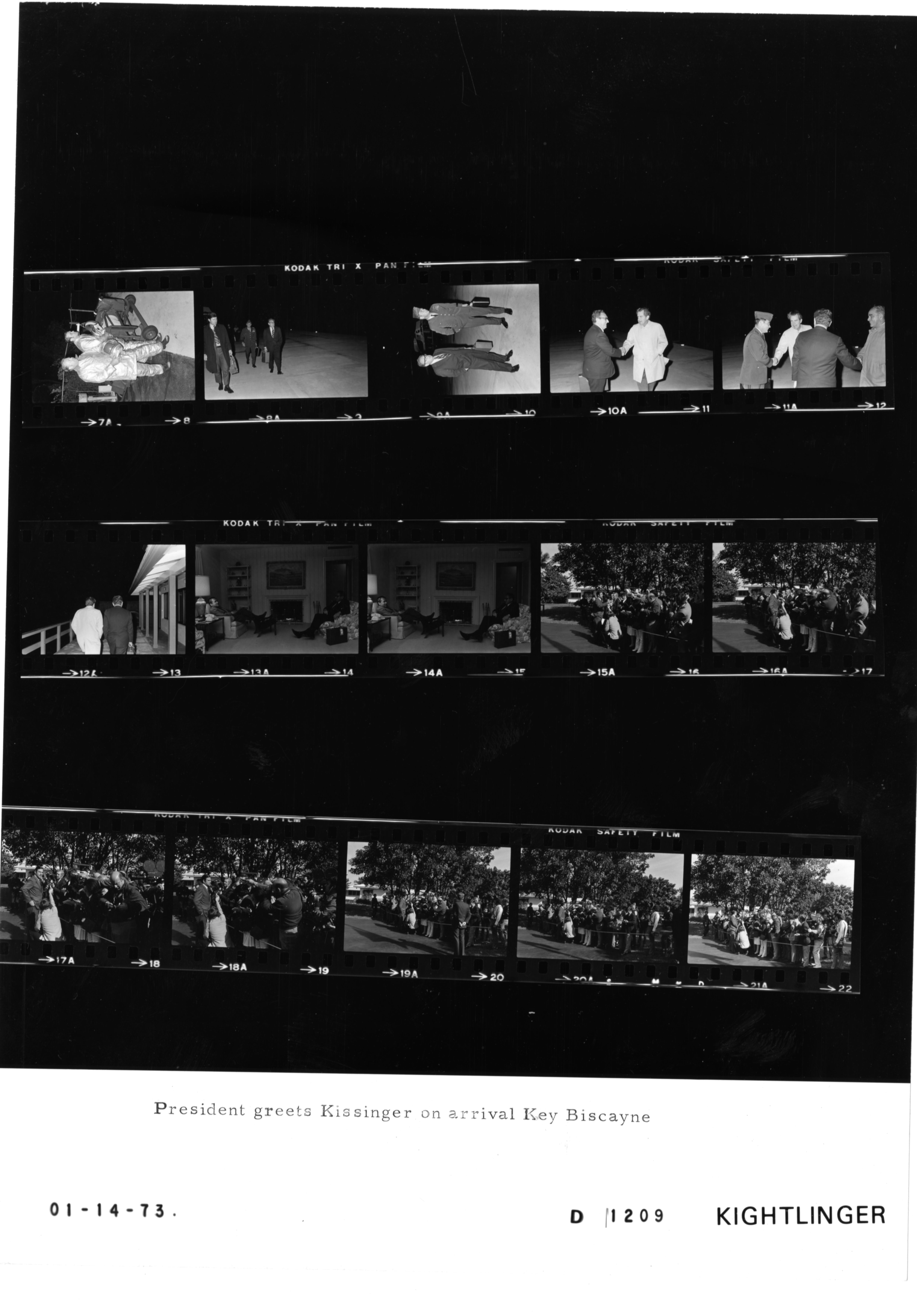
- Frame(s): WHPO-D1209-07A, Two unidentified men wearing hazardous material HAZMAT firefighter suits. 1/14/1973, Key Biscayne, Florida unknown. unidentified men.
- Frame(s): WHPO-D1209-08A-09A, Henry Kissinger and assistant arrive in Key Biscayne. 1/14/1973, Key Biscayne, Florida helipad, residence, Key Biscayne Compound. President Nixon, Henry Kissinger, Alexander Haig, Bebe Rebozo.
- Frame(s): WHPO-D1209-10A, President Nixon and Henry Kissinger shaking hands at the Key Biscayne helipad. 1/14/1973, Key Biscayne, Florida helipad, residence, Key Biscayne Compound. President Nixon, Henry Kissinger.
- Frame(s): WHPO-D1209-10A-14A, President Nixon and Henry Kissinger at helipad. 1/14/1973, Key Biscayne, Florida helipad, residence, Key Biscayne Compound. President Nixon, Henry Kissinger, Alexander Haig, Bebe Rebozo, Ron Ziegler, press corps members.
- Frame(s): WHPO-D1209-13A-14A, President Nixon and Henry Kissinger relax in easy chairs. 1/14/1973, Key Biscayne, Florida helipad, residence, Key Biscayne Compound. President Nixon, Henry Kissinger.
- Frame(s): WHPO-D1209-15A-21A, Ron Ziegler talking to the large crowd of press photograhers and reporters. 1/14/1973, Key Biscayne, Florida helipad, residence, Key Biscayne Compound. Ron Ziegler, press corps members.
Roll WHPO-D1210 Photographer: Kightlinger, Jack | Color or B&W: Color
- Frame(s): WHPO-D1210-05A-19A, President Nixon walking and standing with Haig and Kissinger. 1/14/1973, Key Biscayne, Florida grounds, Key Biscayne Compound. President Nixon, Henry Kissinger, Alexander Haig.
The White House Communications Agency Sound Recordings Collection contains public statements that took place between 1969 and 1974. Visit the finding aid to learn more.
L - White House Press Office Briefings
- WHCA-SR-L-106
Press briefing by Ronald Ziegler. (1/14/1973, Key Biscayne Compound, Florida)
Keywords: Press conferences, news conferences, interviews, media, press secretary
Original Format: 1/4-inch reel-to-reel audiotape. Original source type: Original.
The White House Communications Agency Videotape Collection contains “off-the-air” recordings of televised programs produced between 1968 and 1974. Visit the finding aid to learn more.
- WHCA-5996
"Meet the Press".
CBS
Runtime: 00:30:20 - WHCA-5997
"Face the Nation".
CBS
Runtime: 00:30:40 - WHCA-5998
"Issues and Answers".
CBS
Runtime: 0:30 - WHCA-5999
"60 Minutes".
NBC
Runtime: 01:00:04
Context (External Sources)
The Vanderbilt Television News Archive is the world's most extensive and complete archive of television news. They have been recording, preserving and providing access to television news broadcasts of the national networks since August 5, 1968.
Wikipedia is a free encyclopedia that anyone can edit.