

Introduction
This almanac page for Wednesday, January 14, 1970, pulls together various records created by the federal government and links to additional resources which can provide context about the events of the day.
Previous Date: Tuesday, January 13, 1970
Next Date: Thursday, January 15, 1970
Schedule and Public Documents
The Daily Diary files represent a consolidated record of the President's activities. Visit the finding aid to learn more.
The President's day began at The White House - Washington, D. C.
The Weekly Compilation of Presidential Documents made available transcripts of the President's news conferences; messages to Congress; public speeches, remarks, and statements; and other Presidential materials released by the White House.
Executive Orders
- Federal Executive Salary Schedule (6 Weekly Comp. Pres. Doc. 44, January 14, 1970)
Executive Order 11504.
Digest of Other White House Announcements
Following is a listing of items of general interest which were announced in the press but not made public as formal White House press releases during the period covered by this issue. Appointments requiring Senate approval are not included since they appear in the list of nominations submitted to the Senate, below.
- The President today announced the recess appointment of A. Roby Hadden of Tyler, Tex., to be United States Attorney for the Eastern District of Texas, replacing Richard B. Hardee who resigned.
- The President has accepted with regret the resignation of Paul Cherington, Assistant Secretary of Transportation for Policy and International Affairs.
Each Public Papers of the Presidents volume contains the papers and speeches of the President of the United States that were issued by the White House Office of the Press Secretary during the time period specified by the volume. The material is presented in chronological order, and the dates shown in the headings are the dates of the documents or events. In instances when the release date differs from the date of the document itself, that fact is shown in the text note.
To ensure accuracy, remarks have been checked against audio recordings (when available) and signed documents have been checked against the original, unless otherwise noted. Editors have provided text notes and cross references for purposes of identification or clarity.
The Federal Register is the official daily publication for rules, proposed rules, and notices of federal agencies and organizations, as well as executive orders and other Presidential documents.
Archival Holdings
Any selection of archival documents will necessarily be partial. You should use the documents and folders identified below as a starting place, but consult the linked collection finding aids and folder title lists and the collections themselves for context. Many documents to be found this way do not lend themselves to association with specific dates, but are essential to a complete understanding of the material.
Selective document listing
President's Office Files
The President's Office Files consists of materials drawn together by the Special Files Unit from several administrative subdivisions within the White House Office. It is the handwriting and sensitive papers sent to the Staff Secretary that now comprise much of the President's Office Files. Visit the finding aid to learn more.
- Annotated News Summaries, Box 29, News Summaries - January 1970 [1 of 2]
- Annotated News Summaries, Box 29, News Summaries - January 1970 [2 of 2] [During this period, the Staff Secretary only removed pages from the News Summaries which contained President Nixon's handwriting, often leaving the document with no date. Although there are no specific documents with this date, you should also consult the full folder for the month.]
- President's Daily Schedule, Box 99, [President's Daily Schedule, Jan.-Feb. 1970] [1 of 3]
- The President's Schedule, Wednesday - January 14, 1970
The H. R. Haldeman Diaries consists of seven handwritten diaries, 36 dictated diaries recorded as sound recordings, and two handwritten audio cassette tape subject logs. The diaries and logs reflect H. R. Haldeman’s candid personal record and reflections on events, issues, and people encountered during his service in the Nixon White House. As administrative assistant to the President and Chief of Staff, Haldeman attended and participated in public events and private meetings covering the entire scope of issues in which the Nixon White House engaged in during the years 1969-1973. Visit the finding aid to learn more.
- Transcript of diary entry (PDF)
Wednesday, January 14.
Since President was supposed to go to Camp David last night, he had nothing on the schedule for today. Managed to fritter away the morning, mostly by reviewing a long list of things with me, which he had apparently produced last night (he worked late at the house). Then spent about a half hour at noon trying to settle on a departure time and whether to go over to EOB first. Settled on 4:00 and no EOB, then got bored and left at 3:30. Long discussion of the work pattern for the Camp David period. Absolutely no staff, and no calls from anyone - except I check in at 12:30 and 5:30 with any necessary stuff. Kissinger wanted to see him and he keeps putting him off - finally said he'd call him from Camp David at 5:30. Said to have Ehrlichman and Kissinger work out the budget problems and settle them without bothering him. Did spend some time with Ehrlichman on budget guidance.
Finally decided to get Safire and Buchanan cranking on the speech, as well as Price. Says he needs more input - at first wanted bits and pieces by noon tomorrow. Then called me at dinner, and said to have them each do a draft. He'd read the book of past State of the Union speeches and decided he wanted his to be Wilsonian - which apparently means short. Maximum 3000 words, 25 minutes. Thematic instead of programmatic, with strong uplift, etc. At least he's starting to get a feel of the thing. Worked late into the night.
Some discussion with Ehrlichman regarding OEM and Mayo, and Ash's recommendation that we leave Bob as the man to take the job, until we get through the 60 day Congressional veto period. Then take him on during the 90 day organization period. President agreed with this, the only way to be sure we keep it on the track. Now I have to tell Mayo not to commit any people to new posts, so we don't get locked in. Best way to handle - but will be a real problem when we try to untangle it. Trouble is, Mayo is just not the right guy for the job plus there's no way around it - maybe can find something else for him by then.
Concerned about use of Kissinger's time, especially with press. Wants me to take over his schedule guidance for public and PR things - get him to see the right press people and not waste time on the unwinnables.
Had long PR staff session on philosophy and approach and told President about it - he was fascinated with the whole discussion. This is always at the top of his interest level. - Handwritten diary entry (JPG)
The National Archives Catalog is the online portal to the records held at the National Archives, and information about those records. It is the main way of describing our holdings and also provides access to electronic records and digitized versions of our holdings.
The Catalog searches across multiple National Archives resources at once, including archival descriptions, digitized and electronic records, authority records, and web pages from Archives.gov and the Presidential Libraries. The Catalog also allows users to contribute to digitized historical records through tagging and transcription.
Nixon Library Holdings
All National Archives Units
National Security Documents
The President's Daily Brief is the primary vehicle for summarizing the day-to-day sensitive intelligence and analysis, as well as late-breaking reports, for the White House on current and future national security issues. Read "The President's Daily Brief: Delivering Intelligence to Nixon and Ford" to learn more.
The Foreign Relations of the United States series presents the official documentary historical record of major U.S. foreign policy decisions and significant diplomatic activity. Visit the State Department website for more information.
Vol. II, Organization and Management of U.S. Foreign Policy, 1969-1972
Managing the Department of State
313. Memorandum From W. Anthony Lake of the National Security Council Staff to the President’s Assistant for National Security Affairs (Kissinger) , Washington, January 14, 1970
Source: Library of Congress, Manuscript Division, Kissinger Papers, Box CL 2, Chron File. No classification marking. A handwritten notation at the top of the page reads: “Action OBE”. Kissinger wrote at the top of page 1: “Good paper Tony.”
Vol. V, United Nations, 1969-1972
Chinese Representation in the United Nations
286. Telegram From the Department of State to the Embassy in the Republic of China, Washington, January 14, 1970, 0008Z
Source: National Archives, RG 59, Central Files 1970–73, UN 6 CHINAT. Confidential. Drafted by Long; cleared by Richard R. Hart, Paul H. Kreisberg, Frank P. Lockhart, Jr., William H. Gleysteen, and John A. Armitage; and approved by Assistant Secretary De Palma. Repeated to USUN, Bogota, Tokyo, and Hong Kong.
Vol. VI, Vietnam, January 1969-July 1970
Vietnam, January 1969-July 1970
169. Transcript of Telephone Conversation Between President Nixon and his Assistant for National Security Affairs (Kissinger) , Washington, January 14, 1970, 5:40 p.m.
Source: National Archives, Nixon Presidential Materials, NSC Files, Box 106, Kissinger Office Files, Country Files, Far East, Vietnam, “S” Mister, Vol. 2. No classification marking.
Vol. XVII, China, 1969-1972
China, 1970
61. Memorandum From Secretary of State Rogers to President Nixon, Washington, January 14, 1970
Source: National Archives, RG 59, Central Files 1970–73, POL CHICOM–US. Secret; Nodis. Drafted by Anderson (EA/ACA) on January 13, and cleared by Swank, Green, and U. Alexis Johnson. A typed notation at the top of the memorandum reads: “Cable cleared and sent WH—Mr. Kissinger cleared. Changes made in cable per Green/Kissinger telcon 1/17/70. (RLBrown to FHess)” According to a January 17, 11:40 a.m. telephone conversation between Green and Kissinger, Kissinger’s major problem with the draft instruction—and the President endorsed Kissinger’s view—was with the “tone.” Kissinger told Green, “It seems we are trying a little too hard to prove our good intentions.” Green replied, “You mean we are defensive?” Kissinger agreed, “that is a better word—we are protesting too hard. I think we will be more impressive to them if we give the feeling of moderation produced by strength.” Kissinger then went on to suggest a number of specific language changes. Kissinger also told Green that he had checked “this idea of eventually reducing our presence on Taiwan with the President, and he thought that was fine.” (Library of Congress, Manuscript Division, Kissinger Papers, Box 361, Telephone Conversations, Chronological File)
Vol. XX, Southeast Asia, 1969-1972
Indonesia
279. Telegram From the Embassy in Australia to the Department of State, Canberra, January 14, 1970, 1610Z
Source: National Archives, RG 59, Central Files 1970–73, POL 7 US/AGNEW. Secret; Immediate.
Vol. XXXVI, Energy Crisis, 1969-1974
February 20, 1969-February 19, 1970
38. Memorandum From David R. Young of the National Security Council Staff to the President’s Assistant for National Security Affairs (Kissinger) , Washington, January 14, 1970
Source: National Archives, Nixon Presidential Materials, NSC Files, Box 367, Subject Files, Oil 1970. Secret; Eyes Only.
Vol. E-5, Part 1, Documents on Sub-Saharan Africa, 1969-1972
Nigerian Civil War
159. Transcript of Telephone Conversation , Washington, January 14, 1970, 5:40 p.m.
In a conversation with Assistant to the President for National Security Affairs Kissinger, President Nixon approved Secretary of State Rogersʼ proposed trip to Lagos but believed he had to be strong with Major General Gowon, Chairman of the Supreme Military Council of Nigeria. The President emphasized that Rogers should stress U.S. interest in humanitarian concerns.
Source: Library of Congress, Manuscript Division, Kissinger Papers, Box 361, Telephone Conversations, Chronological File, 3–14 Jan 1970. No classification marking.160. Telegram From the Central Intelligence Agency to the White House Situation Room, Washington, January 14, 1970, 2026Z
Director of Central Intelligence Helms forwarded an intelligence report that he believed showed “such cynicism on the part of the French” that Assistant to the President for National Security Affairs Kissinger might want to bring it to the attention of the President. The report stated that there were no plans at present for French support to Biafran guerrilla resistance. The rationale, it was reported, was that the French supported Biafra because of oil, not the Ibo revolution.
Source: National Archives, Nixon Presidential Materials, NSC Files, Box 742, Country Files, Africa, Nigeria, Vol. I. Secret; Noforn Dissem; Controlled Dissem. The telegram was forwarded to Deputy Assistant to the President for National Security Affairs Haig by his secretary under cover of a January 14 memorandum which stated that DCI Helms had called and left the following message for Haig: “It seems to me that this item, although raw intelligence, shows such cynicism on the part of the French, Dr. Kissinger might want to bring it to the attention of the President.”161. Memorandum for the Record , Washington, January 14, 1970
Morris reported to the NSC Staff that many relief operations in Nigeria had been blacklisted. Kissinger wanted to maintain a moral stance and stress our concern. The United States could not accept the concept that whatever Lagos did was right.
Source: Library of Congress, Manuscript Division, Kissinger Papers, Box CL 314, NSC 14, Meetings Staff Meetings 1969–1971. Secret.162. Memorandum From Roger Morris of the National Security Council Staff to the Under Secretary of State (Richardson) , Washington, January 14, 1970
In this memorandum on “Next Steps in Nigerian Relief,” Morris outlined numerous relief effort possibilities while expressing concern about possible domestic criticism. He stressed the Western Report as the basis for determining food needs in Biafra while doubting the capabilities of the Federal Military Government (FMG). Tab A is not published.
Source: National Archives, RG 59, Central files 1970–73, POL 27–9, Biafra-Nigeria. Secret; Eyes Only.
The Kissinger telephone conversation transcripts consist of approximately 20,000 pages of transcripts of Kissinger’s telephone conversations during his tenure as Assistant to the President for National Security Affairs (1969-1974) and Secretary of State (1973-1974) during the administration of President Richard Nixon. Visit the finding aid for more information.
Chronological File, Box 3, Folder January 3-14, 1970 [2 of 2]
- AM, Secretary Packard
- 11:03 AM, Secretary Rogers
- 5:40 PM, The President
- 8:25 PM, Secretary Packard
- 8:30 PM, Director Helms
- 8:50 PM, Secretary Packard
- PM, Ehrlichman
- PM, Haldeman
- PM, Rogers
Audiovisual Holdings
The White House Photo Office collection consists of photographic coverage of President Richard Nixon meeting with prominent social, political, and cultural personalities; speaking engagements and news conferences of the President and various high-ranking members of the White House staff and Cabinet; Presidential domestic and foreign travel, including Presidential vacations; social events and entertainment involving the First Family, including entertainers present; official portraits of the President, First Family, and high-ranking members of the Nixon administration; the 1969 and 1973 Inaugurals; the President’s 1972 Presidential election campaign appearances (including speeches) and other official activities of the White House staff and the President’s Cabinet from January 20, 1969 until August 9, 1974 at the White House and the Old Executive Office Building; other locations in Washington, DC, such as The Mall; and the Presidential retreats in Camp David, Maryland, Key Biscayne, Florida, and San Clemente, California. Visit the finding aid to learn more.
Roll WHPO-2746 Photographer: Atkins, Oliver | Color or B&W: B&W
- Frame(s): WHPO-2746-, President Nixon leaves White House for Camp David. 1/14/1970, Washington, D.C. White House, grounds. President Nixon, LCDR Larson.
Roll WHPO-2747 Photographer: Kightlinger, Jack | Color or B&W: Color
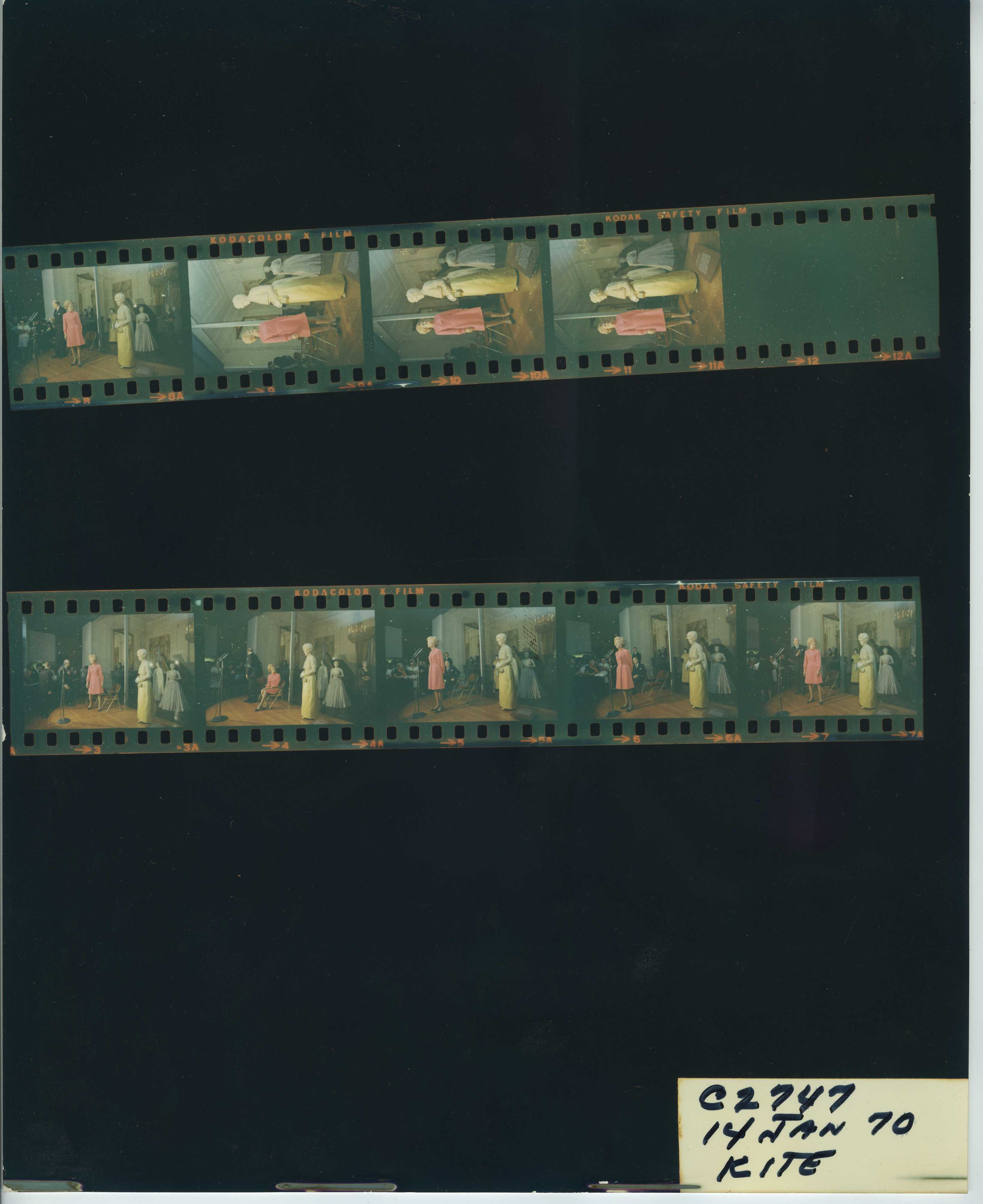
- Frame(s): WHPO-2747-03-11, Pat Nixon speaking from an exhibit area to present her Inaugural ball gown to the Smithsonian Institution. The gold gown with bolero jacket is displayed on a mannequin behind her. 1/14/1970, Washington, D.C. Smithsonian Institution. Pat Nixon, unidentified museum officials.
Roll WHPO-2748 Photographer: Kightlinger, Jack | Color or B&W: Color
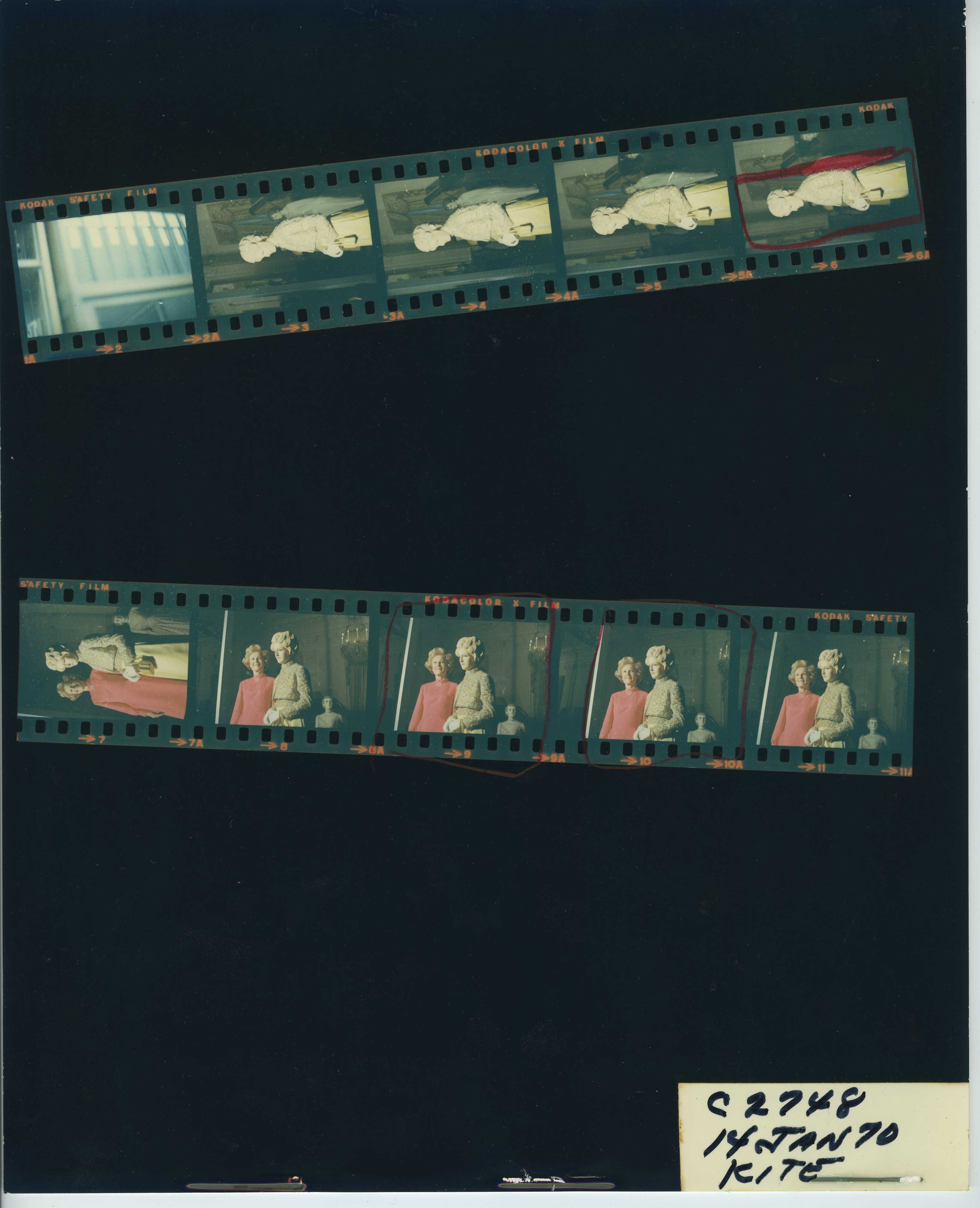
- Frame(s): WHPO-2748-, The First Lady Presents her Inaugural ball gown to the Smithsonian Institute. 1/14/1970, Washington, D.C. Smithsonian.
The White House Communications Agency Sound Recordings Collection contains public statements that took place between 1969 and 1974. Visit the finding aid to learn more.
B - Vice-Presidential (Agnew and Ford)
- WHCA-SR-B-053
Presentation of moon rock to the PM of Australia-Canberra, Australia. (1/14/1970)
Runtime: 1:15
Keywords: NASA, National Aeronautics and Space Administration, space program, astronauts, moon rocks
Original Format: 1/4-inch reel-to-reel audiotape. Original source type: Original. - WHCA-SR-B-054
Remarks to personnel of the AmEmbassy-Canberra, Australia. (1/14/1970)
Runtime: 5:12
Original Format: 1/4-inch reel-to-reel audiotape. Original source type: Original.
C - First Lady
- WHCA-SR-C-021
Remarks by Pat Nixon at the presentation of her Inaugural gown in the Smithsonian's Museum of History and Technology, with additional remarks by S. Dillon Ripley. (1/14/1970, Smithsonian Institute, Washington D.C.)
Runtime: 0:07:37
Production credits: Audio feed supplied by WHCA; Recorded by KAP (initials of WHCA engineer)
Original Format: 1/4-inch reel-to-reel audiotape. Original source type: Original. - WHCA-SR-C-068
Remarks by Pat Nixon at a film showing in the Family Theatre, with H.R. Haldeman and J. Carter Brown. (1/14/1970, Family Theatre)
Runtime: 7:21
Production credits: Audio feed supplied by WHCA; Recorded by JLS (initials of WHCA engineer)
Original Format: 1/4-inch reel-to-reel audiotape. Original source type: Original.
The White House Communications Agency Videotape Collection contains “off-the-air” recordings of televised programs produced between 1968 and 1974. Visit the finding aid to learn more.
- WHCA-3598
Weekly News Summary - Excerpts. 1/12/1970 to 1/16/1970.
All networks
Runtime: 00:16:37
5. Report on Budget. Time Code Start: 08:07. Keywords: reports, economy, economics, budgets, finances, recession, inflation, money, wages, costs, unemployment, prices, payments. Network: CBS. - WHCA-3605
Weekly News Summary on V.P. Agnew's Asian trip. Vice President Spiro Agnew, Bill Gill.
All networks
Runtime: 00:33:00
8. Vice President Agnew in Australia. Time Code Start: 22:12. Keywords: Vice Presidents, travel, trips, Asia, Southeast Asia, Philippines, Vietnam, Taiwan, Australia. Network: ABC.
9. Vice President Agnew Return from Asian Trip. Time Code Start: 24:10. Keywords: Vice Presidents, travel, trips, Asia, Southeast Asia, Philippines, China, Thailand, Nepal, Afghanistan, Malaysia, Singapore, Indonesia, Australia, New Zealand. Network: CBS.
Context (External Sources)
The Vanderbilt Television News Archive is the world's most extensive and complete archive of television news. They have been recording, preserving and providing access to television news broadcasts of the national networks since August 5, 1968.
Wikipedia is a free encyclopedia that anyone can edit.