
Introduction
This almanac page for Monday, February 8, 1971, pulls together various records created by the federal government and links to additional resources which can provide context about the events of the day.
Previous Date: Sunday, February 7, 1971
Next Date: Tuesday, February 9, 1971
Schedule and Public Documents
The Daily Diary files represent a consolidated record of the President's activities. Visit the finding aid to learn more.
The President's day began at The White House - Washington, D. C.
The Weekly Compilation of Presidential Documents made available transcripts of the President's news conferences; messages to Congress; public speeches, remarks, and statements; and other Presidential materials released by the White House.
Digitized versions can be found at HathiTrust.
Each Public Papers of the Presidents volume contains the papers and speeches of the President of the United States that were issued by the White House Office of the Press Secretary during the time period specified by the volume. The material is presented in chronological order, and the dates shown in the headings are the dates of the documents or events. In instances when the release date differs from the date of the document itself, that fact is shown in the text note.
To ensure accuracy, remarks have been checked against audio recordings (when available) and signed documents have been checked against the original, unless otherwise noted. Editors have provided text notes and cross references for purposes of identification or clarity.
The Federal Register is the official daily publication for rules, proposed rules, and notices of federal agencies and organizations, as well as executive orders and other Presidential documents.
No Federal Register published on this date
The Congressional Record is the official daily record of the debates and proceedings of the U.S. Congress.
Archival Holdings
Any selection of archival documents will necessarily be partial. You should use the documents and folders identified below as a starting place, but consult the linked collection finding aids and folder title lists and the collections themselves for context. Many documents to be found this way do not lend themselves to association with specific dates, but are essential to a complete understanding of the material.
Selective document listing
President's Office Files
The President's Office Files consists of materials drawn together by the Special Files Unit from several administrative subdivisions within the White House Office. It is the handwriting and sensitive papers sent to the Staff Secretary that now comprise much of the President's Office Files. Visit the finding aid to learn more.
- Annotated News Summaries, Box 30, News Summaries - February 1971 [1 of 2] [During this period, the Staff Secretary only removed pages from the News Summaries which contained President Nixon's handwriting, often leaving the document with no date. In addition to the individual document(s) listed below, you should also consult the full folder for the month.]
- [2/8/71]
- Annotated News Summaries, Box 30, News Summaries - February 1971 [2 of 2]
- President's Daily Schedule, Box 101, [President's Daily Schedule, Jan.-Feb. 1971] [2 of 3]
- The President's Schedule, Monday - February 8, 1971
President's Personal File
The President's Personal File is essentially a President's secretary's file, kept by Rose Mary Woods, personal secretary to the President, for two purposes: (1) preserving for posterity a collection of documents particularly close to the President, whether because he dictated or annotated them, or because of the importance of the correspondent or the event concerned and (2) giving appropriate attention–letters of gratitude, invitations to White House social events, and the like–to members and important friends and supporters of the Nixon administration. This generalization does not describe all the varied materials of a file group which is essentially a miscellany, but it does identify the reason for the existence of the file group's core. Visit the finding aid to learn more.
- President's Speech File
The H. R. Haldeman Diaries consists of seven handwritten diaries, 36 dictated diaries recorded as sound recordings, and two handwritten audio cassette tape subject logs. The diaries and logs reflect H. R. Haldeman’s candid personal record and reflections on events, issues, and people encountered during his service in the Nixon White House. As administrative assistant to the President and Chief of Staff, Haldeman attended and participated in public events and private meetings covering the entire scope of issues in which the Nixon White House engaged in during the years 1969-1973. Visit the finding aid to learn more.
- Transcript of diary entry (PDF)
Monday, February 8th, the day after the Laos move. Everything went okay last night, and this morning the follow-up fell into line just as it was supposed to. The President seemed in good shape as the reaction and plan generally fell together. He, of course, wanted to push hard on getting our side of the reaction going. He was very upset with the quote from Senator Aiken saying that Rogers didn't know what was going on. Wanted me to call Rogers and work out a plan for how to shoot this down, which I did. Rogers made the point that the real problem is that all these people get briefed by Kissinger, and it creates the impression in their minds that Rogers doesn't know what's going on. The net result was that the President wrote a note to Aiken straightening him out on this.
The President is very anxious that we not let the Democrat, Democratic candidates look good on this issue. Muskie has moved out in opposition, and he wants to be sure we keep him out on that limb; and push hard to make an asset out of this, get credit for the success, and leave the others outside on the other wicket. He wants to be sure we don't take a soft-handed defensive position. We should whack the opponents on patriotism, saving American lives, etcetera, and really go to work on it. He also wanted to get Senator Cooper to move today on the floor, because he's taken a good, strong, positive position. The President got pretty cranked up about the whole thing last night; called Joe Alsop, and a number of others, and there was all to good effect. Alsop had a sensationally good column in the paper today.
We got the dope on the volume of troops and food and ammunition that's moved down the Ho Chi Minh Trail. The President wants to make a strong point of the real significance of the trail so that we build up the significance of the Laotian operation. And he wants to really push the strong, positive points. He also had an idea of making a positive out of the anti-press on the blackout or embargo, by making it a point that the alarm and confusion and uncertainty that the press has been talking about was in the press, not in the people; and that the embargo actually was a brilliant act that created alarm, confusion and uncertainty among the enemy; and that obviously we wouldn't telegraph our punches to the enemy; and thank God we finally planted some alarm among them, etcetera. In other words, again taking the positive approach.
Later in the day we got into a huge flap regarding briefings because Kissinger and Rogers had agreed that there wouldn't be any briefings, and then Kissinger let Colson, et al., set up a late afternoon briefing session for him with about 15 top conservative columnists. When he realized what he had done, he realized also that he'd have to cancel it, so we ended up with a pretty awkward situation which was unfortunate. But they did cancel the briefing and kept the commitment to Rogers.
The President got into some discussion with me about the problems of Henry's briefing tactics. He feels that he does too much of a good job of telling the people what they want to know, rather than what we want them to know, and thinks that we've got to work more with Henry on determining what the line is and going with it, rather than giving them such a thorough background and education as he does.
Then he also got on the point of the need for Kissinger to be more discreet regarding his glamorous young women, especially in public and especially in Washington, DC. He feels it's okay for Henry to be a swinger in New York, Florida, and California, but he should not be in Washington; and he wants us at the White House dinners not to put him next to the most glamorous gal anymore, but rather to put him again near some intelligent and interesting woman instead.
The President had a whole bag full of miscellaneous notes coming out of the weekend, particularly the church service; a lot of people he wants to get in; some question as to what happened on the new picture we had made of him in California; some ideas on briefing the Cabinet and sub-Cabinet; concern that we get our letter program worked out; that we hit Muskie on busing and some of the other things. He's especially anxious that we not give Muskie the chance to get well on any of the left-wing positions that he's taken. He had some guidance on the State of the World speech. He wanted to get going on a salute to agriculture, got back onto the mail-handling thing again.
-------------------------------------------------------------------------------------------------------------
Deed of Gift - Privacy withdrawal re-reviewed and released by MS, NARA, October 21, 2013
Audio Cassette 4, Side A, Withdrawn Item Number 18
Duration: 10 seconds
Also, into a discussion of Rose and her problems. He's convinced that she does have some physical problem, and that Tkach may not even be aware of it.
-------------------------------------------------------------------------------------------------------------
Billy Graham had a lot of dis--, ideas on how to use television better. He's especially pushing for the President to use a teleprompter when he does a read speech. And...
------------------------------------------------------------------------------------------------
DECLASSIFIED - E.O. 13526, Sect. 3.4: by MS, NARA, June 12, 2013
Audio Cassette 4, Side A, Withdrawn Item Number 19 [AC-4(A) Sel 12]
Duration: 15 seconds
...Henry came running in in the afternoon with a report that Lon Nol has had a stroke, but nobody knows it. They're keeping it a secret, which is, could pose a real problem for us in Cambodia.
------------------------------------------------------------------------------------------------
We got into some schedule juggling as we tried to decide how to set up press conferences, etcetera, for next week.
End of February 8th. - Original audio recording (MP3)
The National Archives Catalog is the online portal to the records held at the National Archives, and information about those records. It is the main way of describing our holdings and also provides access to electronic records and digitized versions of our holdings.
The Catalog searches across multiple National Archives resources at once, including archival descriptions, digitized and electronic records, authority records, and web pages from Archives.gov and the Presidential Libraries. The Catalog also allows users to contribute to digitized historical records through tagging and transcription.
Nixon Library Holdings
All National Archives Units
National Security Documents
The President's Daily Brief is the primary vehicle for summarizing the day-to-day sensitive intelligence and analysis, as well as late-breaking reports, for the White House on current and future national security issues. Read "The President's Daily Brief: Delivering Intelligence to Nixon and Ford" to learn more.
The Foreign Relations of the United States series presents the official documentary historical record of major U.S. foreign policy decisions and significant diplomatic activity. Visit the State Department website for more information.
Vol. V, United Nations, 1969-1972
Chinese Representation in the United Nations
328. Letter From the Representative to the United Nations (Yost) to Secretary of State Rogers, New York, February 8, 1971
Source: National Archives, RG 59, Central Files 1970–73, UN 6 CHICOM. Secret. Secretary Rogers acknowledged Yost’s letter on February 23, and invited him to attend the meeting of the Senior Review Group of the NSC when it discussed NSSM 107. (Ibid.) See Document 335.
Vol. VII, Vietnam, July 1970-January 1972
Operational Lam Son 719, February 8-April 7, 1971
124. Minutes of a Meeting of the Senior Washington Special Actions Group, Washington, February 8, 1971, 10:35
Source: National Archives, Nixon Presidential Materials, NSC Files, NSC Institutional Files (H-Files), Box H–115, WSAG Meetings Minutes, Originals, 1971. Top Secret; Sensitive. The meeting took place in the Situation Room of the White House. According to a chronology attached to a February 9 memorandum from Howe to Haig, the meeting ended at 11:17. (Ibid., Box 84, Vietnam Subject Files, Special Operations File, Vol. IV)
Vol. XIX, Part 2, Japan, 1969-1972
December 1969-March 1971: Relations After the First Nixon-Sato Summit
66. Memorandum From the Assistant Secretary of State for East Asian and Pacific Affairs (Green) and the Assistant Secretary of State for Economic Affairs (Trezise) to Secretary of State Rogers, Washington, February 8, 1971
Source: National Archives, RG 59, Central Files 1970–73, INCO FIBERS 17 US–JAPAN. Secret; Exdis. Trezise initialed this document; Green did not; it was sent through S/S and Eliot’s stamped notation is on the memorandum. Cleared by Richard Ericson, the Country Director for Japan, and Trezise, and U. Alexis Johnson in substance.
Vol. XXIII, Arab-Israeli Dispute, 1969-1972
204. Minutes of a Senior Review Group Meeting, Washington, February 8, 1971, 5-5:18 p.m.
Source: National Archives, Nixon Presidential Materials, NSC Files, NSC Institutional Files (H-Files), Box H–112, Senior Review Group, SRG Minutes (Originals) 1971. Top Secret. The meeting was held in the White House Situation Room.
Vol. XXIX, Eastern Europe, 1969-1972
Hungary
113. Memorandum From C. Fred Bergsten of the National Security Council Staff to the Presidentʼs Assistant for National Security Affairs (Kissinger), Washington, February 8, 1971
Source: National Archives, Nixon Presidential Materials, NSC Files, Box 693, Country Files—Europe, Hungary, Vol. I. Confidential. Sent for information. A copy was sent to Sonnenfeldt.
Vol. XXIX, Eastern Mediterranean, 1969-1972
Greece
302. Telegram From the Embassy in Greece to the Department of State, Athens, February 8, 1971, 1555Z
Source: National Archives, Nixon Presidential Materials, NSC Files, Box 594, Country Files—Middle East, Greece, Vol. II 1 Nov 1970–31 Dec 1971. Secret; Exdis.
Vol. XXXIV, National Security Policy, 1969-1972
The Defense Budget and Safeguard Phase III
173. National Security Decision Memorandum 97, Washington, February 8, 1971
Source: National Archives, Nixon Presidential Materials, NSC Files, Box 364, Subject Files, NSDMs, Nos. 97–144. Top Secret. Copies were sent to Moorer and to Senior Members of the U.S. SALT Delegation.
Vol. XLI, Western Europe; NATO, 1969-1972
United Kingdom
337. Memorandum of Conversation, Washington, February 8, 1971, 12:30 p.m.
Source: National Archives, Nixon Presidential Materials, NSC Files, Box 728, Country Files—Europe, United Kingdom, Vol. V. Confidential; Exdis. Drafted by Springsteen and approved with one editorial correction by the White House on February 12. The meeting took place in the Red Room of the White House.
Vol. E-7, Documents on South Asia, 1969-1972
India and Pakistan: Pre-Crisis, January 1969-February 1971
112. Telegram 21111 From the Department of State to the Embassy in India, Washington, February 8, 1971, 1742Z
The telegram conveyed a letter from Secretary of State Rogers to Indian Foreign Minister Singh in which Rogers took exception to an allegation by Singh that the United States was interfering in election campaigns taking place in India.
Source: National Archives, RG 59, Central Files 1970–73, POL 14 INDIA. Secret; Exdis. Drafted by Quainton on January 26; cleared by Schneider, Van Hollen, Sisco, Deputy Assistant Secretary Colgate Prentice, and Coerr; and approved by Rogers. Senator John Sherman Cooper of Kentucky visited New Delhi January 7–18.113. Letter From the Pakistani Ambassador (Hilaly) to Secretary of State Rogers, Washington, February 8, 1971
Pakistani President Yahya requested the U.S. to use its good offices to mediate in a mounting dispute with India over an Indian airliner hijacked in Kashmir.
Source: National Archives, RG 59, Central Files 1970–73, POL INDIA–PAK. No classification marking. The two men who hijacked the plane were members of the National Liberation Front for Jammu and Kashmir. They threatened to blow up the plane unless India released 30 political prisoners held in Kashmir. (Telegram 130 from Lahore, February 1; ibid., AV 12 INDIA) India subsequently demanded that Pakistan pay compensation for the loss of the plane, extradite the hijackers to India, and accept responsibility for the incident. (Aide-mémoire delivered to the Department of State by the Pakistani Embassy, February 12; ibid., POL INDIA–PAK) On February 24 the Embassy in New Delhi reported troop movements on both sides of the border between India and West Pakistan growing out of the hijacking incident. (Telegram 2759 from New Delhi; ibid., AV 12 INDIA) Additional documentation on the incident is ibid.
Vol. E-10, Documents on American Republics, 1969-1972
Costa Rica
184. Memorandum From the Executive Secretary (Eliot) to the President’s Assistant for National Security Affairs (Kissinger), Washington, February 8, 1971., Washington, February 8, 1971
Responding to a February 7 Miami Herald article, which alleged that President José Figueres had demanded the recall of both the U.S. Ambassador and “the reputed CIA chief in Costa Rica,” Executive Secretary Eliot noted that Figueres had not requested the Ambassador’s removal.
Source: National Archives, Nixon Presidential Materials, NSC Files, Box 779, Country Files, Latin America, Costa Rica. Secret. An unknown person signed for Eliot above his typeset signature.
The Kissinger telephone conversation transcripts consist of approximately 20,000 pages of transcripts of Kissinger’s telephone conversations during his tenure as Assistant to the President for National Security Affairs (1969-1974) and Secretary of State (1973-1974) during the administration of President Richard Nixon. Visit the finding aid for more information.
Digitized versions can be found in the National Archives Catalog.
Audiovisual Holdings
The White House Photo Office collection consists of photographic coverage of President Richard Nixon meeting with prominent social, political, and cultural personalities; speaking engagements and news conferences of the President and various high-ranking members of the White House staff and Cabinet; Presidential domestic and foreign travel, including Presidential vacations; social events and entertainment involving the First Family, including entertainers present; official portraits of the President, First Family, and high-ranking members of the Nixon administration; the 1969 and 1973 Inaugurals; the President’s 1972 Presidential election campaign appearances (including speeches) and other official activities of the White House staff and the President’s Cabinet from January 20, 1969 until August 9, 1974 at the White House and the Old Executive Office Building; other locations in Washington, DC, such as The Mall; and the Presidential retreats in Camp David, Maryland, Key Biscayne, Florida, and San Clemente, California. Visit the finding aid to learn more.
Roll WHPO-5605 Photographer: Schumacher, Karl | Color or B&W: B&W
- Frame(s): WHPO-5605-, Dr. Edwin Harper portraits. 2/8/1971, Washington, D.C. unknown. Edwin Harper.
Roll WHPO-5606 Photographer: Schumacher, Karl | Color or B&W: B&W
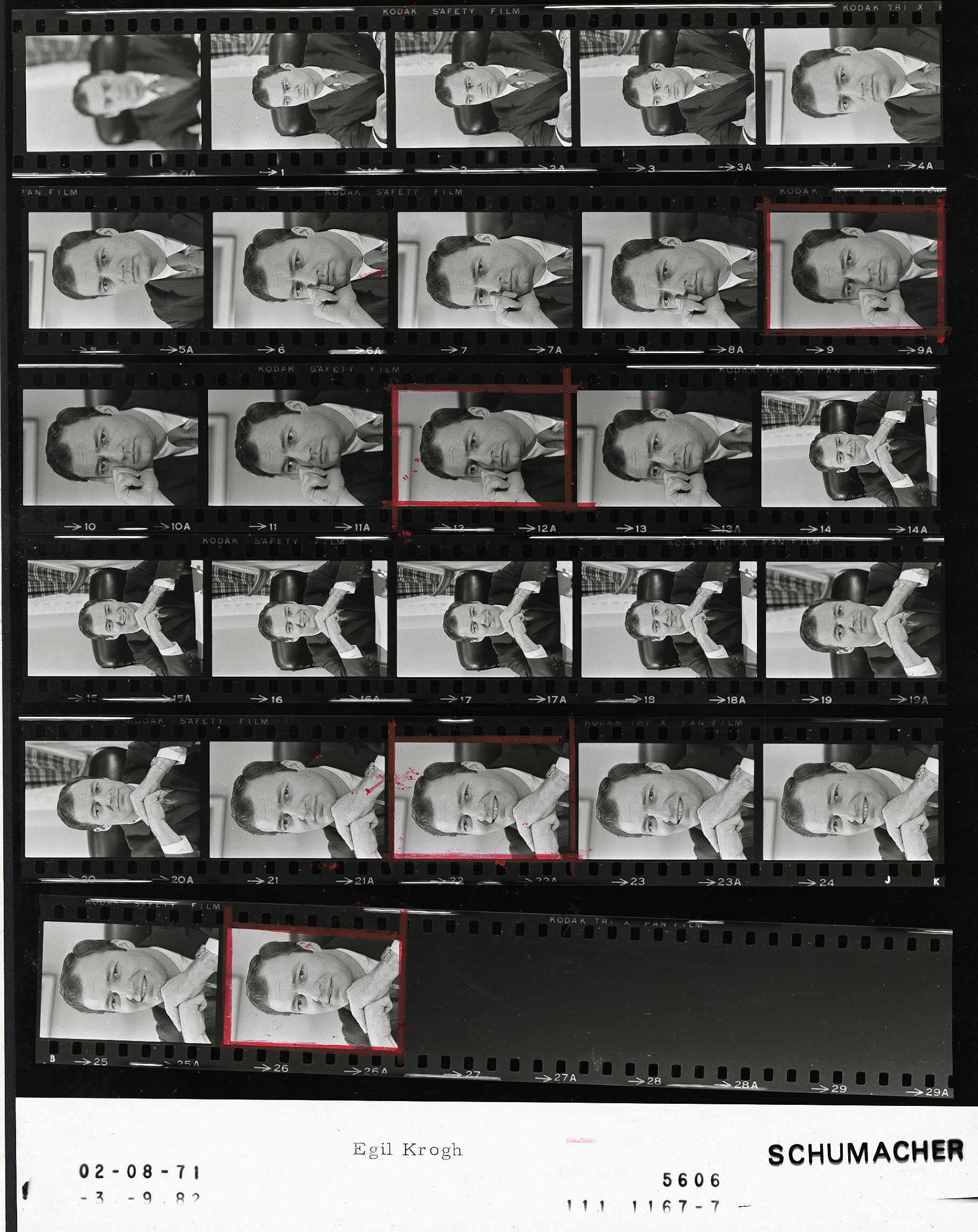
- Frame(s): WHPO-5606-, Egil Krogh portraits. 2/8/1971, Washington, D.C. unknown. Egil Krogh.
Roll WHPO-5607 Photographer: Atkins, Oliver | Color or B&W: B&W
- Frame(s): WHPO-5607-03A-05A, President Nixon accepting diplomatic credentials from Antonio Sanchez de Lozada, Ambassador of Bolivia. 2/8/1971, Washington, D.C. White House, Oval Office. President Nixon, Antonio Sanchez de Lozada, Jose Juan de Olloqui, the Earl of Cromer.
- Frame(s): WHPO-5607-07A-09A, President Nixon accepting diplomatic credentials from Jose Juan de Olloqui, Ambassador of Mexico. 2/8/1971, Washington, D.C. White House, Oval Office. President Nixon, Antonio Sanchez de Lozada, Jose Juan de Olloqui, the Earl of Cromer.
- Frame(s): WHPO-5607-11A-12A, President Nixon accepting the diplomatic credentials from the Earl of Cromer, Ambassador of Great Britain. 2/8/1971, Washington, D.C. White House, Oval Office. President Nixon, Antonio Sanchez de Lozada, Jose Juan de Olloqui, the Earl of Cromer.
Roll WHPO-5608 Photographer: Kightlinger, Jack | Color or B&W: B&W
- Frame(s): WHPO-5608-, President Nixon with Ray Price and Noel Koch. 2/8/1971, Washington, D.C. White House, Oval Office. President Nixon, Ray Price, Noel Koch.
Roll WHPO-5609 Photographer: Knudsen, Robert L. | Color or B&W: B&W
- Frame(s): WHPO-5609-, President Nixon during the filming of a statement on the environment. 2/8/1971, Washington, D.C. Theatre, White House. President Nixon.
- Frame(s): WHPO-5609-02A, President Nixon seated during the filming of a statement on the environment. 2/8/1971, Washington, D.C. Theatre, White House. President Nixon.
Roll WHPO-5610 Photographer: Kightlinger, Jack | Color or B&W: Color
- Frame(s): WHPO-5610-, Reception for the Diplomatic Corps with President Nixon and Pat Nixon in attendance. 2/8/1971, Washington, D.C. White House. President Nixon, Pat Nixon, guests.
Roll WHPO-5611 Photographer: Kightlinger, Jack | Color or B&W: Color
- Frame(s): WHPO-5611-, President Nixon and Pat Nixon greeting guests during a reception for the Diplomatic Corps. 2/8/1971, Washington, D.C. Blue Room, White House. President Nixon, Pat Nixon, guests.
The White House Communications Agency Sound Recordings Collection contains public statements that took place between 1969 and 1974. Visit the finding aid to learn more.
D - First Family
- WHCA-SR-D-013
Mrs. Judy Agnew on "The David Frost Show". (2/8/1971, none listed)
Runtime: none listed
Production credits: No feed information listed; No WHCA engineer initials listed
Original Format: 1/4-inch reel-to-reel audiotape. Original source type: Original.
G - Cabinet Officer Briefings
- WHCA-SR-G-078
Briefing to news media by Secretary of the Interior Rogers Morton, with Russell Train and William Ruckelshaus. (2/8/1971, Press Lobby)
Production credits: Audio feed supplied by WHCA; Recorded by JAD (initials of WHCA engineer)
Original Format: 1/4-inch reel-to-reel audiotape. Original source type: Original.
P - Formal Presidential Remarks
- WHCA-SR-P-710206
Taped statement on Environmental Message. (2/8/1971)
Runtime: 0:00:54
Original Format: 1/4-inch reel-to-reel audiotape. Original source type: Original. - WHCA-SR-P-710207
Remarks by President Nixon in a diplomatic reception. (2/8/1971)
Runtime: 5:24
Original Format: 1/4-inch reel-to-reel audiotape. Original source type: Original.
The White House Communications Agency Videotape Collection contains “off-the-air” recordings of televised programs produced between 1968 and 1974. Visit the finding aid to learn more.
- WHCA-4162
President Nixon's Speech at the University of Nebraska Coliseum: "The President Meets #1". Walter Hickel, former Secretary of the Interior, actress Rachel Roberts (AKA Mrs. Rex Harrison to 2/21/71).
Group W Productions
Runtime: 01:06:07 - WHCA-4163
"George Washington's Mt. Vernon".
NBC
Runtime: 00:53:04 - WHCA-4164
"The David Frost Show" with guest Mrs. Judy Agnew (wife of Vice President Agnew) and singer Loretta Lynn.
NBC
Runtime: 01:00:44 - WHCA-4174
Weekly News Summary, Tape I.
ALL NETWORKS
Runtime: 1:30
5. Reasoner/Bell/Koppel: Indochina War including the Laos situation. Time Code Start: 10:36. Keywords: Laos, Cambodia, Vietnam War. Network: ABC.
6. Reasoner/Scali/Clark: Indochina War including the Laos situation (McCloskey of the State Dept., Senators Muskie, Fulbright and Scott). Time Code Start: 16:59. Keywords: Laos, Cambodia, Vietnam War. Network: ABC.
7. Reasoner: Commentary on President Nixon sending package of various environment bills to Congress. Time Code Start: 21:50. Keywords: bills, laws, environment, pollution, anti-pollution, smog, ecology, environment, mountains, lakes, rivers, clean air, Environmental Protection Agency, EPA. Network: ABC.
8. Brinkley/Bennett/Goralski/Kaplow: Indochina War in Laos; 5,000 South Vietnamese attack into Laos to disrupt Ho Chi Minh trail supply shipments; U.S. air support, artillery, medical aid; Senator Mansfield says deepening of tragedy. Time Code Start: 23:10. Keywords: Laos, Cambodia, Vietnam War. Network: NBC.
9. Chancellor: Opinion on poll on Indochina War. Time Code Start: 28:50. Keywords: Laos, Cambodia, Vietnam War, public opinions, polls, approval ratings, Gallup poll, Harris poll. Network: NBC.
10. Cronkite/Williams: Indochina War including the Laos situation. Time Code Start: 30:35. Keywords: Laos, Cambodia, Vietnam War. Network: CBS.
11. Cronkite/Kalb: The Laos situation and White House and Congress reactions (McCloskey of State Dept., Senators Fulbright, Muskie, Gerald Ford House Minority Leader). Time Code Start: 33:00. Keywords: Vietnam War, House of Representatives, Congressmen, leaders, Senate. Network: CBS.
12. Cronkite/Sevareid: Commentary on Hawks and Doves. Time Code Start: 36:15. Keywords: Vietnam War, anti-war, pro-war, politics, political ideology. Network: CBS.
13. Cronkite/Schorr: President Nixon signs environment bills and John Connally affirmed as Treasurer. Time Code Start: 39:55. Keywords: bills, laws, signings, ecology, environment, mountains, lakes, rivers, clean air, Environmental Protection Agency, EPA, pollution, anti-pollution, smog, officials, Department of the Treasury. Network: CBS. - WHCA-4211
Excerpts From the "NBC Nightly News" Indochina War Coverage, Tape I (Weekly News Summary).
NBC
20. Brinkley: U.S. air power supports Laos invasion. Time Code Start: 19:39. Keywords: Laos, Vietnam War, invasions. Network: NBC.
21. Bennett: At Quang Tri; helicopters at Keyh Sanh. Time Code Start: 20:40. Keywords: killed in action, KIA, fatalities, aircraft. Network: NBC.
22. Goralsky: Invasion strategy. Time Code Start: 22:30. Keywords: Vietnam War. Network: NBC.
23. Kaplow: White House reaction to invasion; U.S. troop withdrawal program. Time Code Start: 23:44. Keywords: Vietnam War, troops, withdrawals, Presidents, statements, reactions. Network: NBC.
24. Brinkley: College campus reaction; Senate reaction to invasion. Time Code Start: 24:30. Keywords: Vietnam War, public opinions, polls, approval ratings, Gallup poll, Harris poll. Network: NBC.
25. Chancellor: Statistics of a poll on the Vietnam war. Time Code Start: 25:18. Keywords: Laos, Cambodia, Vietnam War, public opinions, polls, approval ratings, Gallup poll, Harris poll. Network: NBC.
Context (External Sources)
The Vanderbilt Television News Archive is the world's most extensive and complete archive of television news. They have been recording, preserving and providing access to television news broadcasts of the national networks since August 5, 1968.
Wikipedia is a free encyclopedia that anyone can edit.