
Introduction
This almanac page for Friday, February 5, 1971, pulls together various records created by the federal government and links to additional resources which can provide context about the events of the day.
Previous Date: Thursday, February 4, 1971
Next Date: Saturday, February 6, 1971
Schedule and Public Documents
The Daily Diary files represent a consolidated record of the President's activities. Visit the finding aid to learn more.
The President's day began at The White House - Washington, D. C.
The Weekly Compilation of Presidential Documents made available transcripts of the President's news conferences; messages to Congress; public speeches, remarks, and statements; and other Presidential materials released by the White House.
Digitized versions can be found at HathiTrust.
Each Public Papers of the Presidents volume contains the papers and speeches of the President of the United States that were issued by the White House Office of the Press Secretary during the time period specified by the volume. The material is presented in chronological order, and the dates shown in the headings are the dates of the documents or events. In instances when the release date differs from the date of the document itself, that fact is shown in the text note.
To ensure accuracy, remarks have been checked against audio recordings (when available) and signed documents have been checked against the original, unless otherwise noted. Editors have provided text notes and cross references for purposes of identification or clarity.
The Federal Register is the official daily publication for rules, proposed rules, and notices of federal agencies and organizations, as well as executive orders and other Presidential documents.
The Congressional Record is the official daily record of the debates and proceedings of the U.S. Congress.
Archival Holdings
Any selection of archival documents will necessarily be partial. You should use the documents and folders identified below as a starting place, but consult the linked collection finding aids and folder title lists and the collections themselves for context. Many documents to be found this way do not lend themselves to association with specific dates, but are essential to a complete understanding of the material.
Selective document listing
President's Office Files
The President's Office Files consists of materials drawn together by the Special Files Unit from several administrative subdivisions within the White House Office. It is the handwriting and sensitive papers sent to the Staff Secretary that now comprise much of the President's Office Files. Visit the finding aid to learn more.
- Annotated News Summaries, Box 30, News Summaries - February 1971 [1 of 2]
- Annotated News Summaries, Box 30, News Summaries - February 1971 [2 of 2] [During this period, the Staff Secretary only removed pages from the News Summaries which contained President Nixon's handwriting, often leaving the document with no date. Although there are no specific documents with this date, you should also consult the full folder for the month.]
- President's Daily Schedule, Box 101, [President's Daily Schedule, Jan.-Feb. 1971] [2 of 3]
- The President's Schedule, Friday - February 5, 1971
The H. R. Haldeman Diaries consists of seven handwritten diaries, 36 dictated diaries recorded as sound recordings, and two handwritten audio cassette tape subject logs. The diaries and logs reflect H. R. Haldeman’s candid personal record and reflections on events, issues, and people encountered during his service in the Nixon White House. As administrative assistant to the President and Chief of Staff, Haldeman attended and participated in public events and private meetings covering the entire scope of issues in which the Nixon White House engaged in during the years 1969-1973. Visit the finding aid to learn more.
- Transcript of diary entry (PDF)
Friday, February 5.
The President didn't come in until late because of his sessions with Mansfield and Albert. Apparently, he made no headway with Mansfield and, of course, didn't expect to; but Albert came along all the way, and the President was very impressed with his attitude.
He got into a long discussion this morning of general PR again; dash-- that's a result of his having another day with nothing scheduled. We had originally planned a press conference and had cleared everything for it, and then didn't fill it because of Laos; so he didn't have much to do. He did cover a lot of odds and ends. A meeting with Ambassador Bunker; a farewell session with Lyn Nofziger, which turned into quite a long chat, and he dropped into the Domestic Council meeting just to pep them up a little.
Anyway on the PR thing, he got going again on the fact that we've done so much and gotten so little credit. And wants me to have Connally come in right away after he's confirmed, to unload on our top staff; just say he's shocked and horrified and really hit them on the basis that they're not getting across the "Nixon the Man" idea. Then he wants Connally also to do the Cabinet a couple of weeks later. Praise Romney and Richardson for their magazine article follow-up, but hit them on the need to keep going on this. He thinks the reason for our "thin support" is that people forget what you do; they only think of the man, and we're not getting that side of the story over. He also obviously having a problem with Mrs. Nixon, who isn't getting any of the wire stories or other coverage of her activities. She was disturbed about no TV coverage of the Jackie Onassis dinner the other night, which was a real coup; and also she had the whole Peruvian relief crowd in and didn't, apparently, get any coverage on that. Connie just doesn't keep her posted, which is the real problem. So we'll set up a plan to handle that.
He wants to have a big dinner for the astronauts when they come back, having ground crews, suppliers, and all that sort of thing, rather than just the little family dinner that we've had for the other crews.
He had some other ideas on Finch following up on the whole youth thing. And he called Colson in for a brief chat on that general area since Finch was out of town.
Laos continues on a pretty even keel today. There were a few flurries here and there, but the embargo's lifted and the news is out, and it doesn't seem to be creating nearly the stir that people were afraid of. I think we'll come out extremely well on it.
Everything went very well at the WSAG meeting today. There were no particular problems. Henry was afraid we were getting stuck still with Rogers and Laird doing their Committee briefings on Monday, this time in executive session, but I joined with him to shoot that down, and it turned out that there was no problem. Rogers immediately agreed to it. We have another meeting at 10:30 tomorrow morning.
The President was planning on going to Camp David tonight, but the icy rain made the weather conditions bad so he couldn't fly, and he decided he didn't want to try to drive. He will probably go up tomorrow instead.
He ended up the day with a-- an EOB session with Weinberger and Ehrlichman, on the need for Weinberger to get more into the political side of things. We just sat around and talked for quite a while, and out of it came an idea first to have Ehrlichman and Shultz do briefings of the Democratic conference and caucus in the same way that they've done the Republicans, which would be a real coup. The President then stepped in and said why didn't he have breakfast for the Democrats like he did for the Republicans last week; so we're going to go ahead and set up two much larger breakfasts to bring all the Democratic members down and do the same kind of thing. It’ll be an enormously effective step, I think, because it’ll catch them completely off-base, and it will be especially desirable right after the Laotian operation. That should finish up next week pretty well, so that he can take off for Florida on Thursday with no problem.
The only trouble now is the scheduling of a press conference, and we keep putting it off week by week. His inclination now is to pass on it next week also and probably do it the early part of the following week. This may be okay, but we're getting pretty touchy in putting it off much longer.
End of February 5. - Original audio recording (MP3)
The National Archives Catalog is the online portal to the records held at the National Archives, and information about those records. It is the main way of describing our holdings and also provides access to electronic records and digitized versions of our holdings.
The Catalog searches across multiple National Archives resources at once, including archival descriptions, digitized and electronic records, authority records, and web pages from Archives.gov and the Presidential Libraries. The Catalog also allows users to contribute to digitized historical records through tagging and transcription.
Nixon Library Holdings
All National Archives Units
National Security Documents
The President's Daily Brief is the primary vehicle for summarizing the day-to-day sensitive intelligence and analysis, as well as late-breaking reports, for the White House on current and future national security issues. Read "The President's Daily Brief: Delivering Intelligence to Nixon and Ford" to learn more.
The Foreign Relations of the United States series presents the official documentary historical record of major U.S. foreign policy decisions and significant diplomatic activity. Visit the State Department website for more information.
Vol. II, Organization and Management of U.S. Foreign Policy, 1969-1972
The NSC System
139. Memorandum From the President’s Assistant for National Security Affairs (Kissinger) to Secretary of State Rogers, Washington, February 5, 1971
Source: National Archives, Nixon Presidential Materials, NSC Files, Kissinger Office Files, Box 148, State/WH Relationship, Vol. 5. Secret; Exclusively Eyes Only. A handwritten note at the top of page 1 reads: “Dispatched by hand to Ted Eliot, 2–5–71.”
Vol. VII, Vietnam, July 1970-January 1972
Planning and Decisions for Operations in Cambodia and Laos, October 9, 1970-February 7, 1971
121. Minutes of a Meeting of the Senior Washington Special Actions Group, Washington, February 5, 1971, 2:50 p.m.
Source: National Archives, Nixon Presidential Materials, NSC Files, NSC Institutional Files (H-Files), Box H–115, WSAG Meetings Minutes, Originals, 1971. Top Secret; Sensitive. The meeting took place in the Situation Room of the White House. According to a chronology attached to a memorandum from Howe to Haig, February 9, the meeting ended at 4:45 p.m. (Ibid., NSC Files, Box 84, Vietnam Subject Files, Special Operations File, Vol. IV) All brackets except those that indicate omission of unrelated material are in the original.
Vol. XIX, Part 1, Korea, 1969-1972
U.S. Troop Reductions and Related Defense Issues, November 1969-February 1971
88. Memorandum From John H. Holdridge of the National Security Council Staff to the President’s Assistant for National Security Affairs (Kissinger), Washington, February 5, 1971
Source: National Archives, Nixon Presidential Materials, NSC Files, Box 542, Country Files, Far East, Korea, Vol. IV, 1 Jan–31 Dec 1971. Secret. Sent for information. Lord also initialed the memorandum.
The Kissinger telephone conversation transcripts consist of approximately 20,000 pages of transcripts of Kissinger’s telephone conversations during his tenure as Assistant to the President for National Security Affairs (1969-1974) and Secretary of State (1973-1974) during the administration of President Richard Nixon. Visit the finding aid for more information.
Digitized versions can be found in the National Archives Catalog.
Audiovisual Holdings
The White House Photo Office collection consists of photographic coverage of President Richard Nixon meeting with prominent social, political, and cultural personalities; speaking engagements and news conferences of the President and various high-ranking members of the White House staff and Cabinet; Presidential domestic and foreign travel, including Presidential vacations; social events and entertainment involving the First Family, including entertainers present; official portraits of the President, First Family, and high-ranking members of the Nixon administration; the 1969 and 1973 Inaugurals; the President’s 1972 Presidential election campaign appearances (including speeches) and other official activities of the White House staff and the President’s Cabinet from January 20, 1969 until August 9, 1974 at the White House and the Old Executive Office Building; other locations in Washington, DC, such as The Mall; and the Presidential retreats in Camp David, Maryland, Key Biscayne, Florida, and San Clemente, California. Visit the finding aid to learn more.
Roll WHPO-5595 Photographer: Knudsen, Robert L. | Color or B&W: B&W
- Frame(s): WHPO-5595-, President Nixon seated at his desk during a meeting with Senator John Tower. 2/5/1971, Washington, D.C. White House, Oval Office. President Nixon, John Tower.
- Frame(s): WHPO-5595-03, President Nixon seated at his Oval Office desk during a meeting with Senator John Tower. 2/5/1971, Washington, D.C. White House, Oval Office. President Nixon, John Tower.
Roll WHPO-5596 Photographer: Kightlinger, Jack | Color or B&W: Color
- Frame(s): WHPO-5596-, Pat Nixon discusses art objects with White House art curator Clement Conger. 2/5/1971, Washington, D.C. White House. Pat Nixon, Clement E. Conger.
- Frame(s): WHPO-5596-16, Pat Nixon discusses the acquisition of a Mrs. John Quincy Adams portrait with White House art curator Clement Conger. The portrait sits on an easel in the background. 2/5/1971, Washington, D.C. White House. Pat Nixon, Clement E. Conger.
Roll WHPO-5597 Photographer: Kightlinger, Jack | Color or B&W: Color
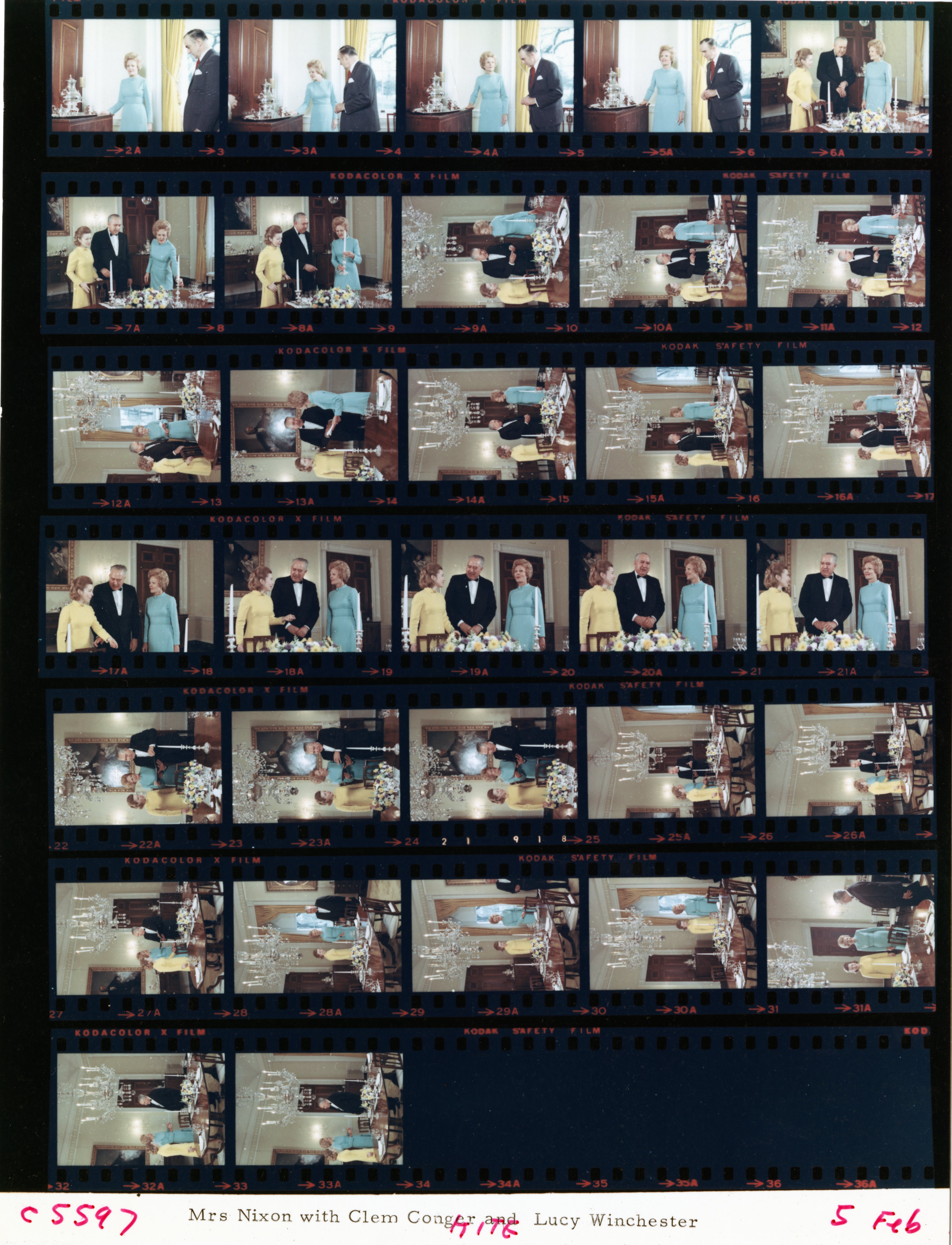
- Frame(s): WHPO-5597-, Pat Nixon admiring art objects with art curator Clement Conger and Lucy Winchester. 2/5/1971, Washington, D.C. White House, Family Dining Room. Pat Nixon, Clement E. Conger, Lucy Winchester.
Roll WHPO-5598 Photographer: Kightlinger, Jack | Color or B&W: Color
- Frame(s): WHPO-5598-, Pat Nixon admiring art objects with art curator Clement Conger. 2/5/1971, Washington, D.C. White House room. Pat Nixon, Clement E. Conger.
Roll WHPO-5599 Photographer: Kightlinger, Jack | Color or B&W: Color
- Frame(s): WHPO-5599-, Pat Nixon admiring a historic portrait with art curator Clement Conger. 2/5/1971, Washington, D.C. White House, Red Room. Pat Nixon, Clement E. Conger.
Roll WHPO-5600 Photographer: Schumacher, Karl | Color or B&W: B&W
- Frame(s): WHPO-5600-, John Davies accepting a gift from three gentlemen. 2/5/1971, Washington, D.C. unknown. John Davies, unidentified men.
Roll WHPO-5601 Photographer: Knudsen, Robert L. | Color or B&W: B&W
- Frame(s): WHPO-5601-, President Nixon with Lyn Nofziger. 2/5/1971, Washington, D.C. White House, Oval Office. President Nixon, Lyn Nofziger.
Roll WHPO-5666 Photographer: Conant, Howell | Color or B&W: Color
- Frame(s): WHPO-5666-01-02, Formal portrait of Pat Nixon, Julie Eisenhower, and Tricia Nixon in front of an arched window in the East Sitting Hall. 2/5/1971, Washington, D.C. White House, East Sitting Hall. Pat Nixon, Julie Nixon Eisenhower, Tricia Nixon.
- Frame(s): WHPO-5666-02, Formal portrait of Pat Nixon, Julie Eisenhower, and Tricia Nixon in front of an arched window in the East Sitting Hall. 2/5/1971, Washington, D.C. White House, East Sitting Hall. Pat Nixon, Julie Nixon Eisenhower, Tricia Nixon.
The White House Communications Agency Sound Recordings Collection contains public statements that took place between 1969 and 1974. Visit the finding aid to learn more.
G - Cabinet Officer Briefings
- WHCA-SR-G-077
Press briefing by Secretary of Labor James D. Hodgson. (2/5/1971, Press Center)
Runtime: 8:00
Production credits: Audio feed supplied by WHCA; Recorded by SRJ (initials of WHCA engineer)
Original Format: 1/4-inch reel-to-reel audiotape. Original source type: Original.
H - White House Staff Member Recordings
- WHCA-SR-H-337
Press briefing by Ronald Ziegler. (2/5/1971, Press Center, White House)
Runtime: 10:00
Keywords: Press conferences, news conferences, interviews, media, press secretary
Production credits: Audio feed supplied by WHCA; Recorded by JLS (initials of WHCA engineer)
Original Format: 1/4-inch reel-to-reel audiotape. Original source type: Original. - WHCA-SR-H-338
Press briefing by Ronald Ziegler, John D. Ehrlichman, and George Shultz regarding Ash Council. (2/5/1971, Press Center, White House)
Runtime: 31:00:00
Keywords: Press conferences, news conferences, interviews, media, press secretary
Production credits: Audio feed supplied by WHCA; Recorded by JLS (initials of WHCA engineer)
Original Format: 1/4-inch reel-to-reel audiotape. Original source type: Original.
The White House Communications Agency Videotape Collection contains “off-the-air” recordings of televised programs produced between 1968 and 1974. Visit the finding aid to learn more.
- WHCA-4154
Weekly News Summary, Tape II.
ALL NETWORKS
Runtime: 1:00
13. Smith/Donaldson: Unemployment figures. Time Code Start: 49:05. Keywords: jobs, unemployment, statistics. Network: ABC.
14. Reasoner: News embargo. Time Code Start: 51:47. Keywords: media, newspapers, magazines, the press, television, TV , news programs, embargoes. Network: ABC.
15. Smith: Commentary on Presidents, promises and history. Time Code Start: 52:44. Keywords: Presidents, politics. Network: ABC.
16. Newman: Paul McCracken on President Nixon's economic policies. Time Code Start: 54:36. Keywords: economy, economics, budgets, finances, recession, inflation, money, wages, costs, unemployment, prices, reports, speeches. Network: NBC.
17. Cronkite/Kalb: Laos. Time Code Start: 55:04. Keywords: Laos, Vietnam War. Network: CBS.
18. Sevareid: Commentary on the politics of economics. Time Code Start: 56:31. Keywords: economy, economics, budgets, finances, recession, inflation, money, wages, costs, unemployment, prices, reports, speeches. Network: CBS.
Context (External Sources)
The Vanderbilt Television News Archive is the world's most extensive and complete archive of television news. They have been recording, preserving and providing access to television news broadcasts of the national networks since August 5, 1968.
Wikipedia is a free encyclopedia that anyone can edit.