
Introduction
This almanac page for Tuesday, February 29, 1972, pulls together various records created by the federal government and links to additional resources which can provide context about the events of the day.
Previous Date: Monday, February 28, 1972
Next Date: Wednesday, March 1, 1972
Schedule and Public Documents
The Daily Diary files represent a consolidated record of the President's activities. Visit the finding aid to learn more.
The President's day began at The White House - Washington, D. C.
The Weekly Compilation of Presidential Documents made available transcripts of the President's news conferences; messages to Congress; public speeches, remarks, and statements; and other Presidential materials released by the White House.
Digitized versions can be found at HathiTrust.
The Federal Register is the official daily publication for rules, proposed rules, and notices of federal agencies and organizations, as well as executive orders and other Presidential documents.
The Congressional Record is the official daily record of the debates and proceedings of the U.S. Congress.
Archival Holdings
Any selection of archival documents will necessarily be partial. You should use the documents and folders identified below as a starting place, but consult the linked collection finding aids and folder title lists and the collections themselves for context. Many documents to be found this way do not lend themselves to association with specific dates, but are essential to a complete understanding of the material.
Selective document listing
President's Office Files
The President's Office Files consists of materials drawn together by the Special Files Unit from several administrative subdivisions within the White House Office. It is the handwriting and sensitive papers sent to the Staff Secretary that now comprise much of the President's Office Files. Visit the finding aid to learn more.
- News Summaries, Unmarked News Summaries, Box 47, News Summaries - February 1972 [4 of 4] [Note: Due to the way News Summary products were compiled, you should also consult nearby days for potentially relevant materials.]
- News Summary, February 29, 1972, (Monday nets, wires, specials)
- News Summaries, Unmarked News Summaries, Box 48, News Summaries - Mar. 1972 [1 of 4]
- Monday-Tuesday Press Coverage of Communique and Return
- President's Daily Schedule, Box 102, [President's Daily Schedule, Jan.-Mar. 1972] [2 of 3]
- The President's Schedule, Tuesday - February 29, 1972
President's Personal File
The President's Personal File is essentially a President's secretary's file, kept by Rose Mary Woods, personal secretary to the President, for two purposes: (1) preserving for posterity a collection of documents particularly close to the President, whether because he dictated or annotated them, or because of the importance of the correspondent or the event concerned and (2) giving appropriate attention–letters of gratitude, invitations to White House social events, and the like–to members and important friends and supporters of the Nixon administration. This generalization does not describe all the varied materials of a file group which is essentially a miscellany, but it does identify the reason for the existence of the file group's core. Visit the finding aid to learn more.
- President's Speech File
The H. R. Haldeman Diaries consists of seven handwritten diaries, 36 dictated diaries recorded as sound recordings, and two handwritten audio cassette tape subject logs. The diaries and logs reflect H. R. Haldeman’s candid personal record and reflections on events, issues, and people encountered during his service in the Nixon White House. As administrative assistant to the President and Chief of Staff, Haldeman attended and participated in public events and private meetings covering the entire scope of issues in which the Nixon White House engaged in during the years 1969-1973. Visit the finding aid to learn more.
- Transcript of diary entry (PDF)
Tuesday, February 29th. The President started this morning with the leadership meeting, and had me in ahead of time just to talk on general approach to things. He wants to hold off on the news summary and criticism. Keep the President in somewhat different position. He needs to stay in a positive, radiant mood, and also he wants to get the staff away from feeling that they have to criticize, because they'll then think negatively. Instead, they should look at the positives. He's decided maybe he won't go to Camp David tonight, in fact definitely won't, but will stay at the White House for Tricia's birthday party, and maybe go up tomorrow.
He had some more bitches from Rose about the fact that she had to put her phone calls through Chapin, her car was not far enough up in the motorcade, and her room placement was bad on the China trip, which was certainly thoughtful of her to burden him with at this time.
After the leadership meeting, which ran about an hour overtime, he had the Cabinet meeting. Made the point that the more deeply you believe in something, the more softly you can talk about it. He was referring to both himself and to Chou as following the same tactic in meetings based on that above point. He said the most important thing out of the China trip was that there's a profound new relationship between the PRC and the US They've both agreed not to resort to the threat of force or the use of force in international relations and in relations with each other, and they've agreed that no nation should dominate Asia. This is the heart of the communiqué. There is now a new relationship at this time. We support the proposition of peaceful settlement of international disputes and disputes between ourselves. The question is whether we can learn to live with our differences, or whether we'll die for them.
Then he told the story about the children's park in Shanghai. He said that in their evaluation of us, the thing that impresses us is not our wealth, but our power, and more importantly our purpose. They see our material emphasis as a weakness. They look for strength of character, willingness to sacrifice, to fail, to believe. He emphasized the continuity of the China trip as it evolves from the Nixon Doctrine. After the Cabinet meeting, he had Henry and me in to evaluate the, both meetings, and was absolutely horrified by Rogers handling of both the Cabinet meeting and even more so the Leaders' meeting...
-------------------------------------------------------------------------------------------------------------------
DECLASSIFIED - E.O. 13526, Sect. 3.4: by MS, NARA, June 12, 2013
Audio Cassette 19, Side A, Withdrawn Item Number 20 [AC-19(A) Sel 15]
Duration: 35 seconds
...where he referred to being in China as like being in the Bronx Zoo and made a big point of how tough he had been in his meetings with the foreign minister where the President couldn't take that tough a line. Also, made a point that Taiwan and the free Chinese were much better people than the Communist Chinese. This is all stuff that is going to do a pretty bad reaction for us in China if it gets to them, of course. But hopefully, it won't.
-------------------------------------------------------------------------------------------------------------------
This evening he called me at home to say he would go to Key Biscayne tomorrow, and that Henry would come down later on the staff plane. The President would go down at noon. So that's finally set.
End of February 29th. Correction, that's the end of... - Original audio recording (MP3)
The National Archives Catalog is the online portal to the records held at the National Archives, and information about those records. It is the main way of describing our holdings and also provides access to electronic records and digitized versions of our holdings.
The Catalog searches across multiple National Archives resources at once, including archival descriptions, digitized and electronic records, authority records, and web pages from Archives.gov and the Presidential Libraries. The Catalog also allows users to contribute to digitized historical records through tagging and transcription.
Nixon Library Holdings
All National Archives Units
National Security Documents
The President's Daily Brief is the primary vehicle for summarizing the day-to-day sensitive intelligence and analysis, as well as late-breaking reports, for the White House on current and future national security issues. Read "The President's Daily Brief: Delivering Intelligence to Nixon and Ford" to learn more.
The Foreign Relations of the United States series presents the official documentary historical record of major U.S. foreign policy decisions and significant diplomatic activity. Visit the State Department website for more information.
Vol. VIII, Vietnam, January-October 1972
Before the Easter Offensive, January 20-March 29, 1972
30. Memorandum From John D. Negroponte of the National Security Council Staff to the President’s Assistant for National Security Affairs (Kissinger), Washington, February 29, 1972
Source: National Archives, Nixon Presidential Materials, NSC Files, Box 158, Vietnam Country Files, Vietnam, Jan–Feb 1972. Secret. Sent for information. Lord initialed for Negroponte. Kissinger initialed the memorandum.
Vol. XX, Southeast Asia, 1969-1972
Thailand
152. Memorandum From the Executive Secretary of the Department of State (Eliot) to the President’s Assistant for National Security Affairs (Kissinger), Washington, February 29, 1972
Source: National Archives, Nixon Presidential Materials, NSC Files, Box 564, Country Files, Far East, Thailand, Vol. VIII. Secret; Nodis.
Vol. E-4, Documents on Iran and Iraq, 1969-1972
Iran 1972
169. Telegram 1218 From the Embassy in Iran to the Department of State, Tehran, February 29, 1972, 1410Z
In an apparent effort to offset criticism over the trials of dissidents, the Iranian Government staged a “spontaneous demonstration” in Tehran to show popular support.
Source: National Archives, RG 59, Central Files 1970–73, POL 23–8 IRAN. Limited Official Use. Repeated to Dhahran, Jidda, Kuwait, London, Khorramshahr, and Tabriz. In Telegram 1282, March 3, the Embassy reported that as the demonstrations ended, the government announced the executions of six anti-government dissidents. (Ibid.) At this time, the 120 Iranians accused of terrorism were facing military tribunals. Donald Toussaint of the Embassy noted to Jack Miklos on March 28 that “there is undoubtedly ambiguity in the charge that all those tried are ‘terrorists.’ All were, it seems, members of various subversive groups, and some members of each group apparently did engage in acts of terrorism. While, in general, the entire membership of a group is charged with the crimes of any of its members, the individual sentences appear to have been based on the severity of the crime each man personally committee … There are reliable reports that an additional number of people, mostly students, have been arrested for political reasons—but we have no information to indicate they are among those presently on trial.” (NEA/IRN, Office of Iran Affairs, Lot File 75D365, Box 7, POL 29, Political Prisoners, Iran 1972)
Vol. E-5, Part 2, Documents on North Africa, 1969-1972
Tunisia
159. Memorandum of Conversation, Washington, February 29, 1972
Assistant Secretary of State for African Affairs Newsom informed Ambassador El Goulli that the United States would be unable to comply with Tunisia’s request for internal security assistance.
Source: National Archives, RG 59, Central Files 1970–73, POL 23 TUN. Secret. Drafted on March 3 by Michael Connors and cleared by Newsom.
The Kissinger telephone conversation transcripts consist of approximately 20,000 pages of transcripts of Kissinger’s telephone conversations during his tenure as Assistant to the President for National Security Affairs (1969-1974) and Secretary of State (1973-1974) during the administration of President Richard Nixon. Visit the finding aid for more information.
Digitized versions can be found in the National Archives Catalog.
Audiovisual Holdings
Visit the White House Tapes finding aid to learn about the taping system's operation and archival processing.
Cabinet Room
- 92-1; 10:07 a.m. - 11:45 a.m.; Nixon, Richard M. (President); Ellender, Allen J.; Mansfield, Michael J. ("Mike"); Byrd, Robert C.; Fulbright, J. William; Stennis, John C.; McGee, Gale W.; Scott, Hugh; Griffin, Robert P.; Smith, Margaret Chase; Aiken, George D.; Young, Milton R.; Goldwater, Barry M.; Hébert, F. Edward; Morgan, Thomas E. ("Doc") (Dr.); Mahon, George H.; Ford, Gerald R.; Arends, Leslie C.; Mailliard, William S.; Bow, Frank T.; Kissinger, Henry A.; MacGregor, Clark; Cook, Richard K.; Korologos, Thomas C.; Ziegler, Ronald L.; Rogers, William P.; Green, Marshall; White House photographer
- 93-1; 12:02 p.m. - 1:20 p.m.; Nixon, Richard M. (President); Cabinet officers; Rogers, William P.; Connally, John B.; Laird, Melvin R.; Mitchell, John N.; Morton, Rogers C. B.; Campbell, J. Philip; Peterson, Peter G.; Hodgson, James D.; Richardson, Elliot L.; Romney, George W.; Volpe, John A.; Kennedy, David M.; Shultz, George P.; Bush, George H. W.; Haldeman, H. R. ("Bob"); Ehrlichman, John D.; Nixon, Richard M. (President); Cabinet officers; Flanigan, Peter M.; MacGregor, Clark; David, Edward E., Jr. (Dr.); Klein, Herbert G.; Price, Raymond K., Jr.; Ziegler, Ronald L.; Butterfield, Alexander P.; Scali, John A.; Malek, Frederic V.; Safire, William L.; Colson, Charles W.; Haig, Alexander M., Jr.; Brown, Robert J.; Chapin, Dwight L.; Knauer, Virginia H.; Woods, Rose Mary; Hannah, John A. (Dr.); Helms, Richard M.; Shakespeare, Frank J.; Stein, Herbert; Weinberger, Caspar W. ("Cap"); Stans, Maurice H.; Sohmer, Arthur J.; White House photographer
Old Executive Office Building
- 322-1; Unknown between 2:42 p.m. & 2:48 p.m.; Nixon, Richard M. (President); Sanchez, Manolo
- 322-2; Unknown between 2:42 p.m. & 2:48 p.m.; Nixon, Richard M. (President); White House operator
- 322-3; Unknown between 2:42 p.m. & 2:48 p.m.; Nixon, Richard M. (President); Sanchez, Manolo
- 322-4; Unknown between 2:42 p.m. & 2:48 p.m.; Nixon, Richard M. (President); White House operator
- 322-5; 2:48 p.m. - 2:50 p.m.; Nixon, Richard M. (President); MacGregor, Clark
- 322-6; 2:51 p.m. - 2:53 p.m.; Nixon, Richard M. (President); Colson, Charles W.
- 322-7; Unknown between 2:53 p.m. & 2:56 p.m.; Nixon, Richard M. (President); Sanchez, Manolo
- 322-8; Unknown between 2:53 p.m. & 2:56 p.m.; Nixon, Richard M. (President); Sanchez, Manolo; Higby, Lawrence M.
- 322-9; Unknown between 2:53 p.m. & 2:56 p.m.; Nixon, Richard M. (President); White House operator
- 322-10; 2:56 p.m. - 3:16 p.m.; Nixon, Richard M. (President); Colson, Charles W.
- 322-11; 3:17 p.m. - 3:17 p.m.; Nixon, Richard M. (President); Sanchez, Manolo
- 322-12; 3:17 p.m. - 3:18 p.m.; Nixon, Richard M. (President); Haldeman, H. R. ("Bob")
- 322-13; Unknown between 3:18 p.m. & 3:23 p.m.; Nixon, Richard M. (President); Kissinger, Henry A.
- 322-14; 3:23 p.m. - 4:00 p.m.; Nixon, Richard M. (President); Haldeman, H. R. ("Bob"); Ziegler, Ronald L.; Haig, Alexander M., Jr.; Kissinger, Henry A.; Sanchez, Manolo
- 322-15; Unknown between 4:00 p.m. & 6:18 p.m.; Nixon, Richard M. (President); Sanchez, Manolo
- 322-16; Unknown between 4:00 p.m. & 6:18 p.m.; Nixon, Richard M. (President); Sanchez, Manolo
- 322-17; Unknown between 4:00 p.m. & 6:18 p.m.; Nixon, Richard M. (President); Sanchez, Manolo
Oval Office
- 675-1; Unknown between 8:10 a.m. & 8:55 a.m.; Nixon, Richard M. (President); Bull, Stephen B.
- 675-2; Unknown between 8:10 a.m. & 8:55 a.m.; Nixon, Richard M. (President); Bull, Stephen B.
- 675-3; Unknown between 8:10 a.m. & 8:55 a.m.; Nixon, Richard M. (President); Bull, Stephen B.
- 675-4; Unknown between 8:10 a.m. & 8:55 a.m.; Nixon, Richard M. (President); Bull, Stephen B.
- 675-5; Unknown between 8:10 a.m. & 8:55 a.m.; Nixon, Richard M. (President); Bull, Stephen B.
- 675-6; Unknown between 8:10 a.m. & 8:55 a.m.; Nixon, Richard M. (President); Bull, Stephen B.
- 675-7; Unknown between 8:10 a.m. & 8:55 a.m.; Nixon, Richard M. (President); Sanchez, Manolo
- 675-8; Unknown between 8:55 a.m. & 10:06 a.m.; Nixon, Richard M. (President); Kissinger, Henry A.; Haldeman, H. R. ("Bob"); [Unknown person(s)]; Bull, Stephen B.; Mansfield, Michael J. ("Mike"); Scott, Hugh
- 675-9; Unknown between 10:06 a.m. & 11:45 a.m.; Sanchez, Manolo; [Unknown person(s)]
- 675-10; 11:45 a.m. - 11:59 a.m.; Nixon, Richard M. (President); Kissinger, Henry A.
- 675-11; 12:01 p.m. - 12:02 p.m.; Nixon, Richard M. (President); Ziegler, Ronald L.; Bull, Stephen B.
- 675-12; Unknown between 1:20 p.m. & 1:28 p.m.; Nixon, Richard M. (President); Bull, Stephen B.
- 675-13; 1:28 p.m. - 1:37 p.m.; Nixon, Richard M. (President); Bull, Stephen B.; Peterson, Peter G.; Peterson, Jim; Peterson, Holly; Peterson, Michael; Rogers, William P.; Connally, John B.; Laird, Melvin R.; Mitchell, John N.; Morton, Rogers C. B.; Hodgson, James D.; Richardson, Elliot L.; Romney, George W.; Volpe, John A.; Kennedy, David M.; Shultz, George P.; Bush, George H. W.; Lynn, James T.; Lynn, James T. (Mrs.); Sweitzer, Brandon W.; Braden, Jean; Haldeman, H. R. ("Bob"); Walker, Ronald H.; Reilly, Gerald; Atkins, Oliver F. ("Ollie")
- 675-14; 1:38 p.m. - 2:42 p.m.; Nixon, Richard M. (President); Kissinger, Henry A.; Ziegler, Ronald L.; Haldeman, H. R. ("Bob"); [Unknown person(s)]; Sanchez, Manolo
- 675-15; Unknown between 12:02 p.m. & 1:20 p.m.; United States Secret Service agents; Sanchez, Manolo; [Unknown person(s)]
White House Telephone
- 20-118; 2:50 p.m. - 2:53 p.m.; Nixon, Richard M. (President); White House operator; Colson, Charles W.
- 20-119; Unknown between 2:53 p.m. & 2:56 p.m.; Nixon, Richard M. (President); White House operator
- 20-120; 2:56 p.m. - 3:16 p.m.; Nixon, Richard M. (President); Colson, Charles W.
- 20-121; 3:17 p.m. - 3:19 p.m.; Nixon, Richard M. (President); White House operator; Haldeman, H. R. ("Bob")
- 20-122; Unknown between 3:18 p.m. & 8:40 p.m.; Nixon, Richard M. (President); White House operator
- 20-123; 8:40 p.m. - 8:47 p.m.; Nixon, Richard M. (President); Haldeman, H. R. ("Bob")
- 20-124; Unknown between 8:47 p.m. & 8:49 p.m.; Nixon, Richard M. (President); White House operator
- 20-125; 8:49 p.m. - 8:52 p.m.; Nixon, Richard M. (President); Haig, Alexander M., Jr.
- 20-126; Unknown between 8:52 p.m. & 8:57 p.m.; Nixon, Richard M. (President); White House operator; Kissinger, Henry A.
- 20-127; Unknown between 8:57 p.m. & 9:05 p.m.; Nixon, Richard M. (President); White House operator
- 20-128; Unknown between 8:57 p.m. & 9:05 p.m.; Nixon, Richard M. (President); White House operator
- 20-129; 9:05 p.m. - 9:08 p.m.; Nixon, Richard M. (President); Lewis, Hobart D.
- 20-130; Unknown between 9:08 p.m. & 9:13 p.m.; Nixon, Richard M. (President); White House operator
- 20-131; 9:13 p.m. - 9:17 p.m.; Nixon, Richard M. (President); Scott, Hugh
- 20-132; 9:17 p.m. - 9:19 p.m.; Nixon, Richard M. (President); White House operator; Rebozo, Charles G. ("Bebe")
- 20-133; Unknown between 9:19 p.m. & 11:59 p.m.; Nixon, Richard M. (President); White House operator
The White House Photo Office collection consists of photographic coverage of President Richard Nixon meeting with prominent social, political, and cultural personalities; speaking engagements and news conferences of the President and various high-ranking members of the White House staff and Cabinet; Presidential domestic and foreign travel, including Presidential vacations; social events and entertainment involving the First Family, including entertainers present; official portraits of the President, First Family, and high-ranking members of the Nixon administration; the 1969 and 1973 Inaugurals; the President’s 1972 Presidential election campaign appearances (including speeches) and other official activities of the White House staff and the President’s Cabinet from January 20, 1969 until August 9, 1974 at the White House and the Old Executive Office Building; other locations in Washington, DC, such as The Mall; and the Presidential retreats in Camp David, Maryland, Key Biscayne, Florida, and San Clemente, California. Visit the finding aid to learn more.
Roll WHPO-8649 Photographer: People's Daily (Renmin Ribao 人民日报) | Color or B&W: B&W
- Frame(s): WHPO-8649-01, Mao Zedong and President Nixon shaking hands near a doorway. Chinese News Service. 2/29/1972, Peking, China unknown.
- Frame(s): WHPO-8649-01-02, Mao Zedong and President Nixon shaking hands near a doorway. 2/29/1972, Peking, China unknown. President Nixon, Mao Zedong, Chinese and American officials.
- Frame(s): WHPO-8649-03, Chinese and American officials together. 2/29/1972, Peking, China Peking Hall, Great Hall of the People. President Nixon, Mao Zedong, Chinese and American officials.
Roll WHPO-8650 Photographer: Schumacher, Karl | Color or B&W: B&W
- Frame(s): WHPO-8650-, Mike Farrell accepting a presentation from Canadian veterans. 2/29/1972, Washington, D.C. Jacqueline Kennedy Garden. Mike Farrell, Canadian veterans, guests.
Roll WHPO-8651 Photographer: Knudsen, Robert L. | Color or B&W: B&W
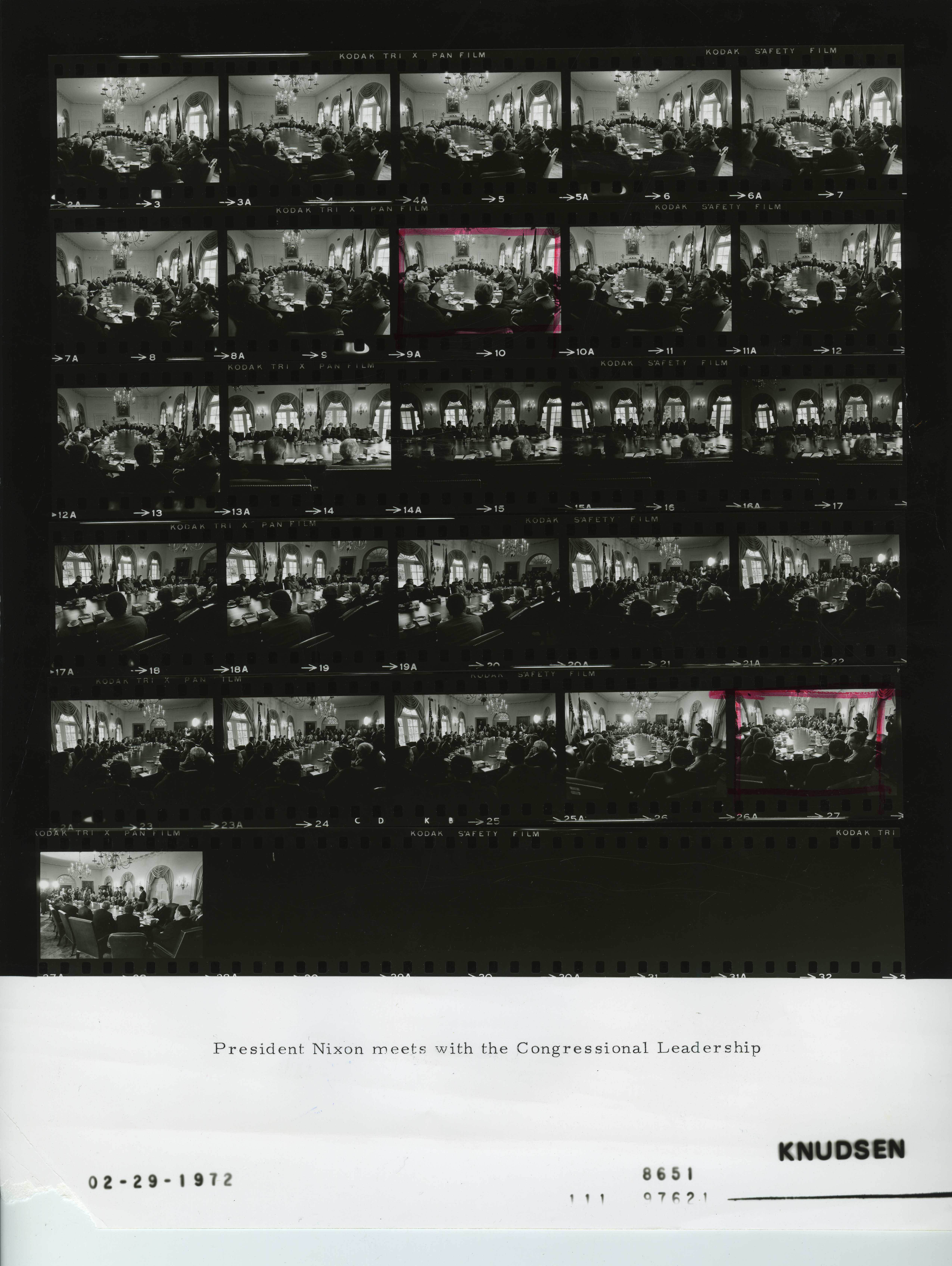
- Frame(s): WHPO-8651-02A-27A, President Nixon describing his China trip to bipartisan Congressional leaders. 2/29/1972, Washington, D.C. White House, Cabinet Room. President Nixon, Congressional leaders, Henry Kissinger.
Roll WHPO-8652 Photographer: Knudsen, Robert L. | Color or B&W: B&W
- Frame(s): WHPO-8652-02A-23A, President Nixon describing his China trip to bipartisan Congressional leaders. 2/29/1972, Washington, D.C. White House, Cabinet Room. President Nixon, Congressional leaders, Henry Kissinger.
Roll WHPO-8654 Photographer: Schumacher, Karl | Color or B&W: Color
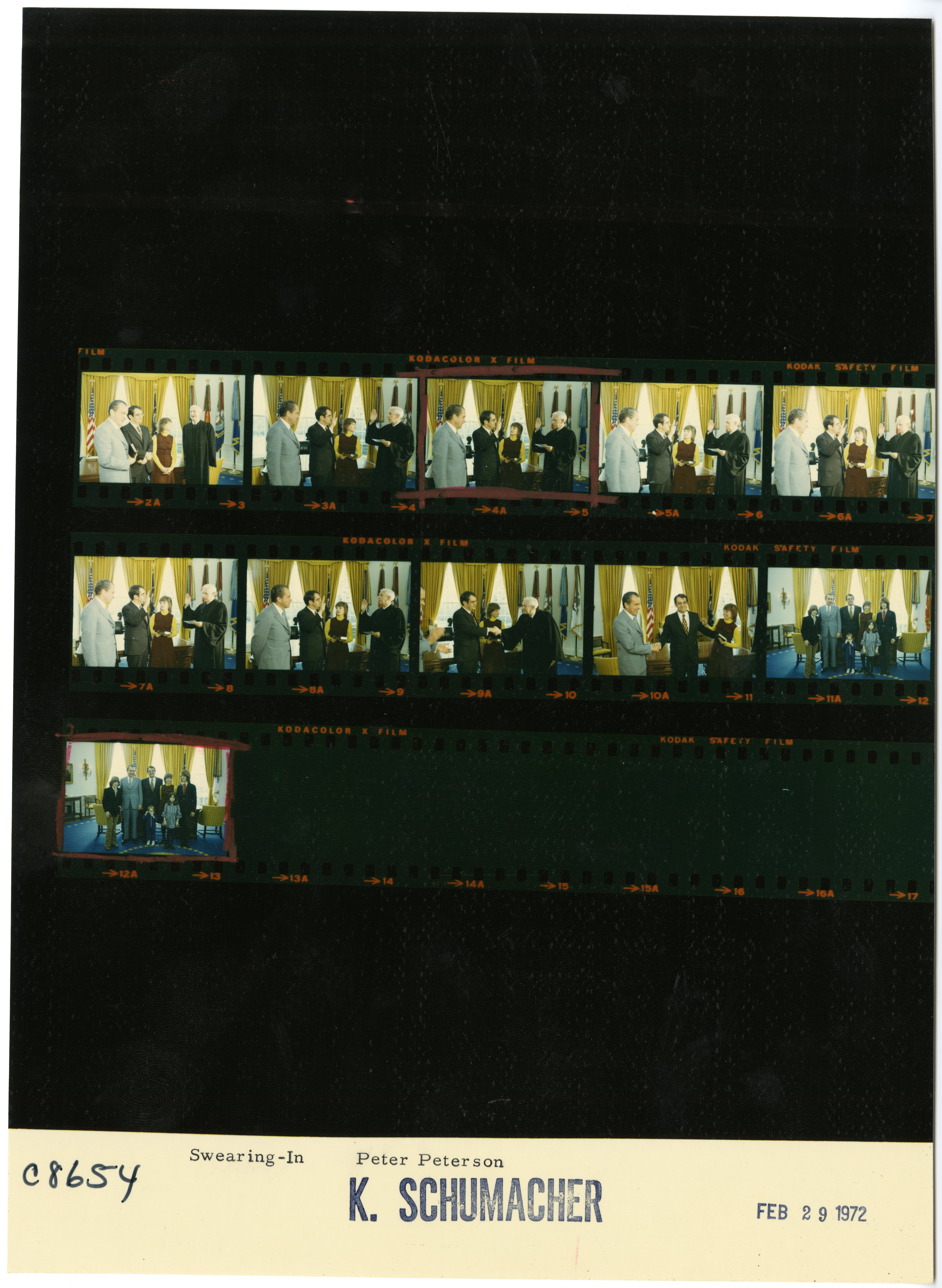
- Frame(s): WHPO-8654-, the Peter Peterson family, Judge Gerald Reilly, and President Nixon. 2/29/1972, Washington, D.C. White House, Oval Office. President Nixon, Peter Peterson, Sally Hornbogen Peterson, Peterson children, Gerald Reilly.
- Frame(s): WHPO-8654-, The swearing-in ceremony of Peter Peterson as Secretary of Commerce officiated by Judge Gerald Reilly. 2/29/1972, Washington, D.C. White House, Oval Office. President Nixon, Peter Peterson, Sally Hornbogen Peterson, Peterson children, Gerald Reilly.
- Frame(s): WHPO-8654-04A, The swearing-in ceremony of Peter Peterson as Secretary of Commerce officiated by Judge Gerald Reilly. 2/29/1972, Washington, D.C. White House, Oval Office. President Nixon, Peter Peterson, Sally Hornbogen Peterson, Gerald Reilly.
Roll WHPO-8655 Photographer: Atkins, Oliver | Color or B&W: B&W
- Frame(s): WHPO-8655-08A, President Nixon shaking hands with Peter Peterson at his swearing-in ceremony as Secretary of Commerce. 2/29/1972, Washington, D.C. White House, Oval Office. President Nixon, Peter Peterson, Sally Hornbogen Peterson, Peterson children, Gerald Reilly.
- Frame(s): WHPO-8655-10A-12A, Peterson family, Judge Gerald Reilly, and President Nixon. 2/29/1972, Washington, D.C. White House, Oval Office. President Nixon, Peter Peterson, Sally Hornbogen Peterson, Peterson children, Gerald Reilly.
- Frame(s): WHPO-8655-2A-9A, Swearing-in ceremony of Peter Peterson as Secretary of Commerce. 2/29/1972, Washington, D.C. White House, Oval Office. President Nixon, Peter Peterson, Sally Hornbogen Peterson, Peterson children, Gerald Reilly.
Roll WHPO-8656 Photographer: Schumacher, Karl | Color or B&W: B&W
- Frame(s): WHPO-8656-07A-08A, Swearing in ceremony of Peter Peterson officiated by Judge Gerald Reilly as President Nixon and Mrs. Peterson stand nearby. 2/29/1972, Washington, D.C. White House, Oval Office. President Nixon, Gerald Reilly, Peter Peterson, Sally Hornbogen Peterson.
- Frame(s): WHPO-8656-08A, Swearing in ceremony of Peter Peterson officiated by Judge Gerald Reilly as President Nixon and Mrs. Peterson stand nearby. 2/29/1972, Washington, D.C. White House, Oval Office. President Nixon, Gerald Reilly, Peter Peterson, Sally Hornbogen Peterson.
- Frame(s): WHPO-8656-09A, 11A, An unidentified stairway. 2/29/1972, Washington, D.C. unknown.
The White House Communications Agency Videotape Collection contains “off-the-air” recordings of televised programs produced between 1968 and 1974. Visit the finding aid to learn more.
- WHCA-5149
"China News Summary", Tape IV.
ALL NETWORKS
Runtime: 1:00
12. Smith/Gill: Visitors to China (Scott). Time Code Start: 24:58. Keywords: People's Republic of China. Network: ABC.
13. Smith: China trip reaction. Time Code Start: 27:15. Keywords: President Nixon, travel, trips, People's Republic of China, Japanese, public opinions. Network: ABC.
14. Reasoner: Commentary on China trip. Time Code Start: 28:02. Keywords: President Nixon, travel, trips, People's Republic of China. Network: ABC.
15. Utley/Valeriani: President Nixon reports on China trip; Senators Mansfield and Scott invited to visit China. Time Code Start: 30:28. Keywords: Presidents, travel, trips, Nixon trips, international, People's Republic of China, speeches. Network: NBC.
16. Cronkite/Pierpoint: Mansfield and Scott invited to visit China; President Nixon reports on trip. Time Code Start: 33:03. Keywords: Presidents, travel, trips, Nixon trips, international, People's Republic of China, Senators. Network: CBS.
17. Cronkite: Commentary on good-old-home. Time Code Start: 34:43. Keywords: lifestyles, reports. Network: CBS. - WHCA-5156
Weekly News Summary, Tape I.
ALL NETWORKS
Runtime: 01:29:55
11. Report on Senate rejection of Griffin Amendment and passing of Mansfield/Scott Amendment/ on camera comments by Senator Griffin and Senator McGovern. Time Code Start: 26:23. Keywords: Presidential elections, campaigns, campaigning, candidates. Network: ABC.
12. Report on Senate rejection of Griffin Amendment and passing of Mansfield/Scott Amendment/ on camera comments by Senator Griffin and Senator McGovern. Time Code Start: 28:56. Keywords: Presidential elections, campaigns, campaigning, candidates. Network: NBC.
13. Report on Amendment to give women equal rights, Equal Rights Amendment (ERA). Time Code Start: 31:03. Keywords: bills, laws, voting, Senators, House Joint Resolution No. 208, Equal Rights For Women, Feminism, Feminist movement, women's rights, Womens Liberation, equality, equal rights, gender, civil rights, activists, women. Network: NBC.
14. Report on trial of Roman Catholic priest Father Philip Berrigan/ on camera comments by Reverend Joseph Wenderoth (Harrisburg 7). Time Code Start: 31:31. Keywords: protests, militants, bombings, violence, sabotage, shootings, kidnappings, courts, trials, investigations, prosecutions. Network: NBC.
15. Report on Senator Ted Kennedy's committee on amnesty for draft dodgers/ film of David Harris and Martin Kelly speaking out. Time Code Start: 34:02. Keywords: military, conscription, evasion, selective service, lottery, laws, Vietnam War, conscientious objectors, political offenses, pardons, draft reform, draft evasion. Network: NBC.
16. Report on Senate rejection of Griffin Amendment and passing of Mansfield/Scott Amendment/ on camera comments by Senator Griffin and Senator McGovern. Time Code Start: 36:42. Keywords: Presidential elections, campaigns, campaigning, candidates. Network: CBS.
17. Report on allegations by Jack Anderson of secret deal between International Telephone & Telegraph (ITT Corporation) and Deputy Attorney General Richard Kleindienst. Time Code Start: 39:02. Keywords: International Telephone & Telegraph, communications, world corporations, conglomerates, campaign funding, investigations, accusations, newspapers, journalists, reporters. Network: CBS.
18. Report on Senator Ted Kennedy's committee on amnesty for draft dodgers/ film of David Harris and Martin Kelly speaking out. Time Code Start: 40:00. Keywords: military, conscription, evasion, selective service, lottery, laws, Vietnam War, conscientious objectors, political offenses, pardons, draft reform, draft evasion. Network: CBS.
Context (External Sources)
The Vanderbilt Television News Archive is the world's most extensive and complete archive of television news. They have been recording, preserving and providing access to television news broadcasts of the national networks since August 5, 1968.
Wikipedia is a free encyclopedia that anyone can edit.