
Introduction
This almanac page for Monday, February 26, 1973, pulls together various records created by the federal government and links to additional resources which can provide context about the events of the day.
Previous Date: Sunday, February 25, 1973
Next Date: Tuesday, February 27, 1973
Schedule and Public Documents
The Daily Diary files represent a consolidated record of the President's activities. Visit the finding aid to learn more.
The President's day began at The White House - Washington, D. C.
The Weekly Compilation of Presidential Documents made available transcripts of the President's news conferences; messages to Congress; public speeches, remarks, and statements; and other Presidential materials released by the White House.
Digitized versions can be found at HathiTrust.
Each Public Papers of the Presidents volume contains the papers and speeches of the President of the United States that were issued by the White House Office of the Press Secretary during the time period specified by the volume. The material is presented in chronological order, and the dates shown in the headings are the dates of the documents or events. In instances when the release date differs from the date of the document itself, that fact is shown in the text note.
To ensure accuracy, remarks have been checked against audio recordings (when available) and signed documents have been checked against the original, unless otherwise noted. Editors have provided text notes and cross references for purposes of identification or clarity.
The Federal Register is the official daily publication for rules, proposed rules, and notices of federal agencies and organizations, as well as executive orders and other Presidential documents.
The Congressional Record is the official daily record of the debates and proceedings of the U.S. Congress.
Archival Holdings
Any selection of archival documents will necessarily be partial. You should use the documents and folders identified below as a starting place, but consult the linked collection finding aids and folder title lists and the collections themselves for context. Many documents to be found this way do not lend themselves to association with specific dates, but are essential to a complete understanding of the material.
Selective document listing
President's Office Files
The President's Office Files consists of materials drawn together by the Special Files Unit from several administrative subdivisions within the White House Office. It is the handwriting and sensitive papers sent to the Staff Secretary that now comprise much of the President's Office Files. Visit the finding aid to learn more.
- News Summaries, Annotated News Summaries, Box 43, Feb. 19-27, 1973 [5 of 6] [Note: Due to the way News Summary products were compiled, you should also consult nearby days for potentially relevant materials.]
- News Summary, February 26, 1973
The H. R. Haldeman Diaries consists of seven handwritten diaries, 36 dictated diaries recorded as sound recordings, and two handwritten audio cassette tape subject logs. The diaries and logs reflect H. R. Haldeman’s candid personal record and reflections on events, issues, and people encountered during his service in the Nixon White House. As administrative assistant to the President and Chief of Staff, Haldeman attended and participated in public events and private meetings covering the entire scope of issues in which the Nixon White House engaged in during the years 1969-1973. Visit the finding aid to learn more.
- Transcript of diary entry (PDF)
Monday, February 26.
The President had Steve and me come over this morning for a meeting on schedule planning. He spent most of the day working at the EOB on preparation for his press conference tomorrow. He had a lot of odds and ends for schedule, nothing very important. Went over the details and general plan of how he wants schedules approached. Reopened the question of his POW party, the State Visit plans, some follow-up on other general odds and ends, use of phone calls and all that.
He then got into Congressional strategy and feels that he's at a loss as to what we can do. That he’s concerned that we have to straighten the Timmons thing. He's a Harlow, without Harlow's gift of mystique. Told me to ask MacGregor about that maybe using Jack Marsh. Maybe keep Timmons on, but have Ehrlichman take responsibility for domestic and Kissinger for defense. So Kissinger and Ehrlichman handle the Congressional BS, and let Timmons be the operator, but not the spokesman. I would then have to program Kissinger, Rogers, and Richardson on the Congressional stuff. Ehrlichman would handle the whole deal on his side.
This merged into some general PR discussion also. He questions whether Ehrlichman is too valuable to make forays out into the country. He can get a better press here and shouldn't go out to Detroit and so on, because he's got too great a substantive and advisory responsibility. On overall PR, he wants Kissinger, Ehrlichman and me to get together and work out goals. Kissinger indicate our goals for the first year and the four years, what is our benchmark, what are we trying to accomplish, Ehrlichman the same for domestic, and me the same for political and PR with Price's help. Then he wants me to form a kitchen Cabinet of MacGregor, Harlow, Bush, Brock, and Mitchell, and he later added John Scali to that. He’s concerned about figuring out what we can accomplish and getting them going. He feels, however, that we are in good shape now versus four years ago, but we have our major weak spot of how to package and sell what we've got. We've come a long way so far because of the big plays, but we now have to go a long way on three yards and a cloud of dust, there won't be any wallbangers from here on. He wants to use Billy Graham also in the kitchen Cabinet.
Then he got into Gannon's memo, says he seems very thoughtful, better as a memo writer than as a speechwriter, and on the next weekend he wants the memo back to read. Also, he wants me to reread it, because he thinks it's quite a perceptive analysis. He says look at Fairley, what the Kennedys did in PR, they had a game plan and they carry it out, and he thinks we can do likewise. Maybe, have Vermont Roister and Price sit in some of the sessions. Also, he wants to talk with Ehrlichman, Price and me for a couple of hours, reviewing goals and thoughts, especially regarding the Gannon memo, which was logical and broken down as to what are the things that people care about: crime, prices, environment, quality of life; not reform, reorganization and so forth, those don't interest people. He feels the major problem now is the desire of a lot of our people to get along with everybody and avoid confrontation. We must recognize that it isn't us that's confronting. He does agree it's a mistake for the President to take on the press, because that just unites them, instead he should do things to get the message through to them.
In terms of vetoes and so on, he wants to be sure the messages are read very carefully and that we get Harlow's judgment on tone. That certain words unnecessarily infuriate Congress, and we shouldn't use them. We should get these messages in further ahead of time so the President can read them. The Kennedys operated on the basis that it's one minute to midnight, which it is somewhere in the world at any point.
He then got into Kissinger and the point of his old line, “that we would sure destroy the libs when the war was over,” and now he isn't doing a thing about it. And his question of whether Scowcroft is strong enough to handle the Kissinger job. He detects signs of weakness and collapse already and feels that we'll probably have to make a change there. Also feels that there's a real question as to how long we can take Kissinger, too.
End of February 26. - Original audio recording (MP3)
The National Archives Catalog is the online portal to the records held at the National Archives, and information about those records. It is the main way of describing our holdings and also provides access to electronic records and digitized versions of our holdings.
The Catalog searches across multiple National Archives resources at once, including archival descriptions, digitized and electronic records, authority records, and web pages from Archives.gov and the Presidential Libraries. The Catalog also allows users to contribute to digitized historical records through tagging and transcription.
Nixon Library Holdings
All National Archives Units
National Security Documents
The President's Daily Brief is the primary vehicle for summarizing the day-to-day sensitive intelligence and analysis, as well as late-breaking reports, for the White House on current and future national security issues. Read "The President's Daily Brief: Delivering Intelligence to Nixon and Ford" to learn more.
The Foreign Relations of the United States series presents the official documentary historical record of major U.S. foreign policy decisions and significant diplomatic activity. Visit the State Department website for more information.
Vol. XXXVIII, Part 2, Organization and Management of Foreign Policy; Public Diplomacy, 1973-1976
The National Security Council System
193. Memorandum From the President’s Special Assistant (Parker) to the President’s Assistant for National Security Affairs (Kissinger), Washington, February 26, 1973
Source: National Archives, Nixon Presidential Materials, NSC Files, Box 1052, Institutional Materials, NSC Institutional Papers—February 1973. No classification marking. Copies were sent to Davis and Scowcroft.
The Kissinger telephone conversation transcripts consist of approximately 20,000 pages of transcripts of Kissinger’s telephone conversations during his tenure as Assistant to the President for National Security Affairs (1969-1974) and Secretary of State (1973-1974) during the administration of President Richard Nixon. Visit the finding aid for more information.
Digitized versions can be found in the National Archives Catalog.
Audiovisual Holdings
Visit the White House Tapes finding aid to learn about the taping system's operation and archival processing.
Old Executive Office Building
- 413-19; Unknown between 10:39 a.m. & 12:23 p.m.; Nixon, Richard M. (President); [Unknown person(s)]
- 413-20; Unknown between 10:39 a.m. & 12:23 p.m.; Nixon, Richard M. (President); Sanchez, Manolo
- 413-21; Unknown between 10:39 a.m. & 12:23 p.m.; Nixon, Richard M. (President); Haldeman, H. R. ("Bob")
- 413-22; 12:23 p.m. - 2:36 p.m.; Nixon, Richard M. (President); Bull, Stephen B.; Haldeman, H. R. ("Bob"); Parker, David N.
- 413-23; Unknown between 2:36 p.m. & 3:30 p.m.; Nixon, Richard M. (President); Sanchez, Manolo
- 413-24; Unknown between 2:36 p.m. & 3:30 p.m.; Nixon, Richard M. (President); Sanchez, Manolo
- 413-25; Unknown between 2:36 p.m. & 3:30 p.m.; Nixon, Richard M. (President); Sanchez, Manolo
- 413-26; Unknown between 2:36 p.m. & 4:50 p.m.; Nixon, Richard M. (President); Sanchez, Manolo
- 413-27; Unknown between 2:36 p.m. & 4:50 p.m.; Nixon, Richard M. (President); Sanchez, Manolo
- 413-28; 4:50 p.m. - 5:15 p.m.; Nixon, Richard M. (President); Ziegler, Ronald L.
- 413-29; 5:21 p.m. - 5:21 p.m.; Nixon, Richard M. (President); White House operator
- 413-30; 5:21 p.m. - 5:22 p.m.; Nixon, Richard M. (President); Bull, Stephen B.
- 413-31; Unknown between 5:22 p.m. & 5:36 p.m.; Nixon, Richard M. (President); Sanchez, Manolo
- 413-32; 5:36 p.m. - 5:37 p.m.; Nixon, Richard M. (President); Nixon, Thelma C. ("Pat") (Ryan)
- 413-33; 5:40 p.m. - 7:15 p.m.; Nixon, Richard M. (President); Haldeman, H. R. ("Bob"); Safire, William L.; Kissinger, Henry A.; Bull, Stephen B.
- 413-34; Unknown between 7:15 p.m. & 7:47 p.m.; Nixon, Richard M. (President); Kissinger, Henry A.
- 413-35; Unknown between 7:15 p.m. & 7:47 p.m.; Nixon, Richard M. (President); Sanchez, Manolo
- 413-36; Unknown between 7:15 p.m. & 7:47 p.m.; Nixon, Richard M. (President); White House operator
- 413-37; 7:47 p.m. - 7:49 p.m.; Nixon, Richard M. (President); Brennan, John V.
- 413-38; Unknown between 7:49 p.m. & 8:50 p.m.; Nixon, Richard M. (President); Sanchez, Manolo
- 413-39; Unknown between 7:49 p.m. & 8:50 p.m.; Nixon, Richard M. (President); Sanchez, Manolo
- 413-40; Unknown between 7:49 p.m. & 8:50 p.m.; Sanchez, Manolo; [Unknown person(s)]
White House Telephone
- 43-197; 5:21 p.m. - 5:21 p.m.; Nixon, Richard M. (President); White House operator
- 43-198; 5:36 p.m. - 5:36 p.m.; Nixon, Richard M. (President); Nixon, Thelma C. ("Pat") (Ryan)
- 43-199; Unknown between 5:36 p.m. & 6:03 p.m.; Nixon, Richard M. (President); White House operator
- 43-200; 6:03 p.m. - 6:07 p.m.; Nixon, Richard M. (President); Safire, William L.
- 43-201; Unknown between 6:07 p.m. & 7:47 p.m.; Nixon, Richard M. (President); White House operator
- 43-220; 7:47 p.m. - 7:49 p.m.; Nixon, Richard M. (President); Brennan, John V.
The White House Photo Office collection consists of photographic coverage of President Richard Nixon meeting with prominent social, political, and cultural personalities; speaking engagements and news conferences of the President and various high-ranking members of the White House staff and Cabinet; Presidential domestic and foreign travel, including Presidential vacations; social events and entertainment involving the First Family, including entertainers present; official portraits of the President, First Family, and high-ranking members of the Nixon administration; the 1969 and 1973 Inaugurals; the President’s 1972 Presidential election campaign appearances (including speeches) and other official activities of the White House staff and the President’s Cabinet from January 20, 1969 until August 9, 1974 at the White House and the Old Executive Office Building; other locations in Washington, DC, such as The Mall; and the Presidential retreats in Camp David, Maryland, Key Biscayne, Florida, and San Clemente, California. Visit the finding aid to learn more.
Roll WHPO-E0343 Photographer: Schumacher, Karl | Color or B&W: Color
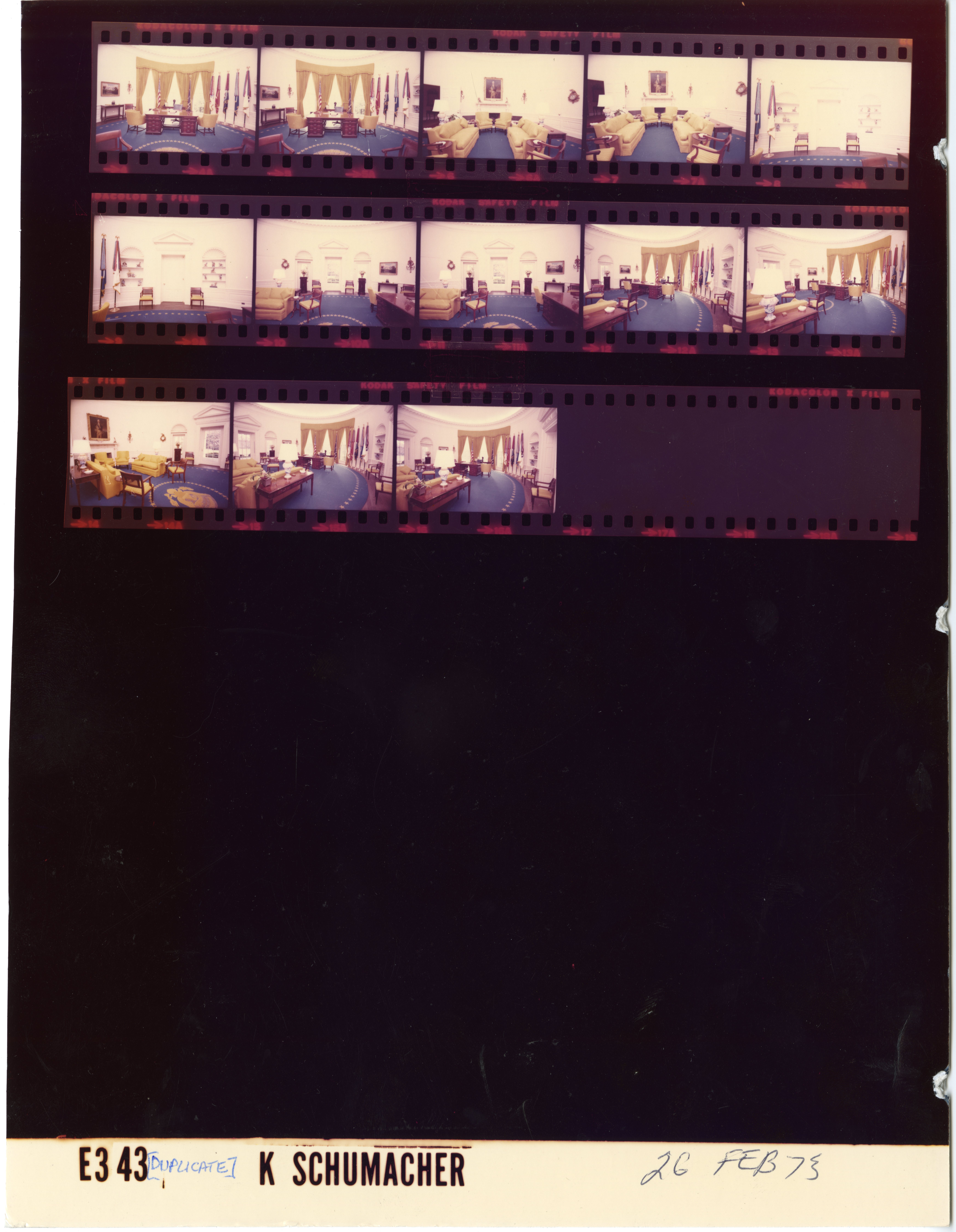
- Frame(s): WHPO-E0343-, The Oval Office. 2/26/1973, Washington, D.C. White House, Oval Office.
The White House Communications Agency Sound Recordings Collection contains public statements that took place between 1969 and 1974. Visit the finding aid to learn more.
G - Cabinet Officer Briefings
- WHCA-SR-G-201
Briefing by Director George Shultz of the Office of Management and Budget (OMB) on Stabilization Program, with John Dunlop. (2/26/1973, [none listed])
Runtime: 46:10:00
Production credits: Audio feed supplied by WHCA; Recorded by GET (initials of WHCA engineer)
Original Format: 1/4-inch reel-to-reel audiotape. Original source type: Original.
L - White House Press Office Briefings
- WHCA-SR-L-142
Press briefing by Ronald Ziegler. (2/26/1973, White House Press Lobby)
Runtime: 25:03:00
Keywords: Press conferences, news conferences, interviews, media, press secretary
Original Format: 1/4-inch reel-to-reel audiotape. Original source type: Original.
The White House Communications Agency Videotape Collection contains “off-the-air” recordings of televised programs produced between 1968 and 1974. Visit the finding aid to learn more.
- WHCA-6133
"Today" Show. Orientation for returning POW's from Vietnam (Vietnam Prisoner of War)
NBC
Runtime: 1:00 - WHCA-6148
"Today" Show excerpt. Kissinger interviewed
NBC
Runtime: 00:24:49 - WHCA-6151
Weekly News Summary, Tape I.
ALL NETWORKS
Runtime: 01:34:02
29. Smith/Jarriel: Wage guidelines of 5.5% still holds. Time Code Start: 72:03. Keywords: economy, economics, budgets, finances, recession, inflation, money, wages, costs, jobs, unemployment, prices. Network: ABC.
30. Smith/Bennett: No word on next POW release; demonstration in Hue. Time Code Start: 73:57. Keywords: Vietnam Prisoner of War, military, troops, releases, demonstrations, rally, protests, protesters, demonstraters, demonstrators, Vietnam War, anti-war. Network: ABC.
31. Smith/Reasoner/Koppel: Ceasefire violations; International Conference on Vietnam in Paris. Time Code Start: 76:30. Keywords: Paris Peace Talks, Vietnam War, ceasefiresr, treaty, treaties, negotiations. Network: ABC.
32. Smith/Clark: Senate attempts to release impounded funds. Time Code Start: 79:10. Keywords: Presidential elections, campaigns, campaigning, candidates, costs, finances, funding. Network: ABC.
33. Smith: Israel's Prime Minister Golda Meir arrives in Washington, D.C.. Time Code Start: 80:46. Keywords: Middle East, Mideast, Prime Ministers, Israeli. Network: ABC.
34. Smith: Commentary on ceasefire in South Vietnam. Time Code Start: 81:50. Keywords: Vietnam War, ceasefires. Network: ABC.
35. Chancellor/Dobyns: The International Conference on Vietnam in Paris with Secretary of State Rogers. Time Code Start: 83:33. Keywords: cabinet, advisors, Paris Peace Talks, Vietnam War, treaty, treaties, negotiations. Network: NBC.
36. Brady: The fighting in Cambodia is continuing. Time Code Start: 87:11. Keywords: Vietnam WarCambodia, Vietnam War, military. Network: NBC.
37. Chancellor/Nessen: Americans who will stay in Vietnam. Time Code Start: 88:46. Keywords: Vietnam War, military, troops. Network: NBC. - WHCA-6152
Weekly News Summary, Tape II.
ALL NETWORKS
Runtime: 01:33:00
1. Chancellor: Israel's Prime Minister Golda Meir in Washington, D.C.. Time Code Start: 00:00. Keywords: Middle East, Mideast, Prime Ministers, Israeli. Network: NBC.
2. Chancellor/Levine: Rules for Phase III with Shultz. Time Code Start: 01:49. Keywords: cabinet, advisors, wage and price controls, freezes, prices, costs, increases, decreases, economy, economics, budgets, finances, recession, inflation, money. Network: NBC.
3. Chancellor: Reports of administration ordered phone taps of reporters and staff members [Watergate]. Time Code Start: 04:14. Keywords: Watergate, Senate committee hearings, investigations, testimony, testify, cover-ups, break-in, burglary, theft, plumbers, scandals. Network: NBC.
4. Bradley: Rioting in South Vietnam against North Vietnamese. Time Code Start: 05:50. Keywords: Vietnam War, riots. Network: CBS.
5. Cronkite/Kalb: The International Conference in Paris, major problems. Time Code Start: 07:50. Keywords: Paris Peace Talks, Vietnam War, treaty, treaties, negotiations. Network: CBS.
6. Cronkite/Pierpoint: Phase III. Time Code Start: 10:29. Keywords: wage and price controls, freezes, prices, costs, increases, decreases, economy, economics, budgets, finances, recession, inflation, money. Network: CBS.
7. Cronkite: Israel's Prime Minister Golda Meir at Dulles Airport near Washington, D. C.. Time Code Start: 13:17. Keywords: Middle East, Mideast, Prime Ministers, Israeli, arrivals, airports. Network: CBS.
8. Sevareid: Commentary on spending confusion on Capitol Hill. Time Code Start: 14:49. Keywords: economy, economics, budgets, finances, recession, inflation, money, wages, costs, unemployment, prices. Network: CBS. - WHCA-W-228
Proceedings of the Senate Watergate Committee Hearings. Testimony of John Ehrlichman
ABC
Runtime: 1:30
Context (External Sources)
The Vanderbilt Television News Archive is the world's most extensive and complete archive of television news. They have been recording, preserving and providing access to television news broadcasts of the national networks since August 5, 1968.
Wikipedia is a free encyclopedia that anyone can edit.