
Introduction
This almanac page for Wednesday, February 26, 1969, pulls together various records created by the federal government and links to additional resources which can provide context about the events of the day.
Previous Date: Tuesday, February 25, 1969
Next Date: Thursday, February 27, 1969
Schedule and Public Documents
The Daily Diary files represent a consolidated record of the President's activities. Visit the finding aid to learn more.
The President's day began at London, England
The Weekly Compilation of Presidential Documents made available transcripts of the President's news conferences; messages to Congress; public speeches, remarks, and statements; and other Presidential materials released by the White House.
European Trip
- London, England (5 Weekly Comp. Pres. Doc. 321, February 26, 1969)
Remarks of President Nixon and Prime Minister Wilson Upon the President's Departure From England. - Bonn, Germany (5 Weekly Comp. Pres. Doc. 322, February 26, 1969)
The President's Remarks Upon His Arrival at Wahn Airport, Cologne, Germany. - Bonn, Germany (5 Weekly Comp. Pres. Doc. 322, February 26, 1969)
The President's Remarks Before the German Bundestag.
Resignations and Retirements
- Resignations of Government Officials (5 Weekly Comp. Pres. Doc. 324, February 26, 1969)
List of Resignations Accepted by the President.
Checklist of White House Press Releases
The releases listed below, made public by the Office of the White House Press Secretary during the period covered by this issue, are not included in the issue.
- Remarks of the President upon departure from London, England (advance text).
- List of German citizens who met with the President.
Each Public Papers of the Presidents volume contains the papers and speeches of the President of the United States that were issued by the White House Office of the Press Secretary during the time period specified by the volume. The material is presented in chronological order, and the dates shown in the headings are the dates of the documents or events. In instances when the release date differs from the date of the document itself, that fact is shown in the text note.
To ensure accuracy, remarks have been checked against audio recordings (when available) and signed documents have been checked against the original, unless otherwise noted. Editors have provided text notes and cross references for purposes of identification or clarity.
The Federal Register is the official daily publication for rules, proposed rules, and notices of federal agencies and organizations, as well as executive orders and other Presidential documents.
The Congressional Record is the official daily record of the debates and proceedings of the U.S. Congress.
Archival Holdings
Any selection of archival documents will necessarily be partial. You should use the documents and folders identified below as a starting place, but consult the linked collection finding aids and folder title lists and the collections themselves for context. Many documents to be found this way do not lend themselves to association with specific dates, but are essential to a complete understanding of the material.
Selective document listing
President's Office Files
The President's Office Files consists of materials drawn together by the Special Files Unit from several administrative subdivisions within the White House Office. It is the handwriting and sensitive papers sent to the Staff Secretary that now comprise much of the President's Office Files. Visit the finding aid to learn more.
- Annotated News Summaries, Box 28, News Summaries - February 1969 [During this period, the Staff Secretary only removed pages from the News Summaries which contained President Nixon's handwriting, often leaving the document with no date. Although there are no specific documents with this date, you should also consult the full folder for the month.]
President's Personal File
The President's Personal File is essentially a President's secretary's file, kept by Rose Mary Woods, personal secretary to the President, for two purposes: (1) preserving for posterity a collection of documents particularly close to the President, whether because he dictated or annotated them, or because of the importance of the correspondent or the event concerned and (2) giving appropriate attention–letters of gratitude, invitations to White House social events, and the like–to members and important friends and supporters of the Nixon administration. This generalization does not describe all the varied materials of a file group which is essentially a miscellany, but it does identify the reason for the existence of the file group's core. Visit the finding aid to learn more.
- President's Speech File
Selective document listing
The White House Press Office during the Presidency of Richard Nixon was responsible for daily communication with the White House press corps. Ronald L. Ziegler was the Press Secretary to the President for Nixon's entire term in office from January 1969 to August 1974 and Gerald Warren served as the Deputy Press Secretary. The office held daily briefings for the press and produced the White House’s press releases. Visit the finding aid to learn more.
- White House Press Conferences, Box 56
- News Conference #68 at the White House (Bonn, Germany) with Ron Ziegler, Press Secretary to the President, and Gunter Diehl, Staatssekretar, February 26, 1969, 1:22 P.M. 6 pgs.
- News Conference #69 at the White House (Bonn, Germany) with Ron Ziegler, Press Secretary to the President, and Gunter Diehl, Staatssekretar, February 26, 1969, 6:40 P.M. 8 pgs.
The H. R. Haldeman Diaries consists of seven handwritten diaries, 36 dictated diaries recorded as sound recordings, and two handwritten audio cassette tape subject logs. The diaries and logs reflect H. R. Haldeman’s candid personal record and reflections on events, issues, and people encountered during his service in the Nixon White House. As administrative assistant to the President and Chief of Staff, Haldeman attended and participated in public events and private meetings covering the entire scope of issues in which the Nixon White House engaged in during the years 1969-1973. Visit the finding aid to learn more.
- Transcript of diary entry (PDF)
Wednesday, February 26.
Bonn
Left London in a cold fog, arrived in Bonn (actually Dusseldorf) in a colder light snow. Great arrival ceremony. Band played both anthems, others had just played ours. German band was terrific, as is Deutschland Uber Alles.
President spent the day on a hectic round of meetings with the Chancellor, other leaders. He added a stop at the Bundestag, gave a brief address, and was apparently a great hit! All the Germans said later it was a real stroke - and apparently he is the first United States President, and perhaps the first Chief of State, to address the Bundestag.
This made him late for the meeting with German intellectual leaders, but it too went very well. All agreed he did an outstanding job, and sold them completely.
We are staying at the Minister's residence in the American sector. Lovely house set way back from the road with front gates and a long driveway. German troops are all over the place as are our Secret Service. It's right on the Rhine. Snow on the ground - very picturesque, but also kind of eerie. Ehrlichman and I spent most of the day shopping and eating, with a little business thrown in.
President blew all his staff time, just barely had a chance to dress for dinner. Small group (22) at the Chancellor's residence. Much more enjoyable than the big State Dinners. President gave outstanding toast - saluting the character of the German people, referring to the strength that is gained from losing, and alluding to the possibility of a defeated VP rising again (reference to Willie Brandt). Chancellor was so impressed he asked Kissinger to stay late to tell him what a great job President had done.
I sat next to Willie Brandt with Schiller, the Minister of Economics, on the other side. Both speak English. Dinner was great - quail soup, trout, steak, sherbet with sliced apples and a red sauce. President spilled his sauce on the front of his tux - waiter instantly appeared with a cup of
hot water to clean it up.
Apparently the whole stop was well worthwhile. I liked the Chancellor - very human, quiet, personable. Brandt seemed cold, opportunistic.
A great white wine at the dinner – Moselle - the President very anxious to stock it at the White House.
Funny incident at dinner. Kiesinger gave his toast in German. Near the end, his Ambassador to the United States broke in and asked if he could translate - had taken notes, no interpreter there. He got about halfway through and Chancellor interrupted him for a correction. General Walters cut in and gave whole toast flawlessly with no notes and astonished everyone there. - Handwritten diary entry (JPG)
The National Archives Catalog is the online portal to the records held at the National Archives, and information about those records. It is the main way of describing our holdings and also provides access to electronic records and digitized versions of our holdings.
The Catalog searches across multiple National Archives resources at once, including archival descriptions, digitized and electronic records, authority records, and web pages from Archives.gov and the Presidential Libraries. The Catalog also allows users to contribute to digitized historical records through tagging and transcription.
Nixon Library Holdings
All National Archives Units
National Security Documents
The President's Daily Brief is the primary vehicle for summarizing the day-to-day sensitive intelligence and analysis, as well as late-breaking reports, for the White House on current and future national security issues. Read "The President's Daily Brief: Delivering Intelligence to Nixon and Ford" to learn more.
- President's Daily Brief of 26 February 1969 [consult link for visuals and extent of redactions]
The President's Daily Brief
26 February 1969
19
Top Secret
[redacted]
I. MAJOR PROBLEMS
MIDDLE EAST
[redacted]
* * *
[redacted]
EUROPE
Luxembourg Foreign Minister Thorn, who has been seeing a lot of the French recently, has his own ideas about the genesis of the "Soames affair." Thorn says both Debre and State Secretary Lipkowski had been trying for months to persuade De Gaulle that unless he made some new initiative, the
British would be in the Common Market "on their own terms" in 1971. The two allegedly urged the General to make a proposition which would be aimed at attaching the British to one of several "trading communities" while preserving their exclusion from the Common Market. Thorn sees De Gaulle's pitch to Soames as a sign that the French President accepted this advice.
This is not necessarily inconsistent with Ambassador Shriver's view that concern about West German resurgence is what motivated De Gaulle. What seems clear is that for a combination of reasons--including recent trends in the European Communities as well as the French decline vis-a-vis West Germany--De Gaulle felt he was losing the initiative and was becoming increasingly isolated.
* * *
A German foreign official tried a new tack last weekend in discussing the nonproliferation treaty with US officials. The conversation apparently reflected a West German effort to develop an interpretation of the treaty which preserves the possibility of a European nuclear force. To-do this the Germans have to get around Article 1, which binds the signatories not to transfer nuclear weapons to other countries.
The official made it clear that the Germans had no intention of proposing a European nuclear defense system, but he observed that Bonn does not consider such a system inconsistent with the treaty, Article 1 notwithstanding. He suggested that Article 10, which recognizes that the signatories may in "extraordinary circumstances affecting their security" take actions otherwise prohibited by the treaty, might be used to justify a collective deterrent even under present circumstances.
The Germans do not expect US approval of this position during President Nixon's visit, but they are certain to bring the subject up.
SOVIET AFFAIRS
West Berlin and. East German authorities have agreed to meet on 26 February in East Berlin to discuss the question of the presidential election. At the same time, East Germany has publicly reiterated its position that it is willing to negotiate an Easter pass agreement only if the West Germans find a new site for their presidential election. A prominent West Berlin Senat official has told the US mission that if the East Germans are not prepared to go beyond the offer of wall passes at Easter, there can be no basis for serious negotiations.
Meanwhile the commander-in-chief of Soviet forces in East Germany has imposed temporary restrictions on the travel of Allied military mission observers during the period 24 February - 10 March. The restrictions apply to the area north, south and west of Berlin extending to the West German border. The Berlin-Helmstedt autobahn normally used by Allied personnel in West Germany when traveling to Berlin is not included in the ban. The restrictions are probably intended to cover the announced Warsaw Pact exercise and to provide an opportunity for harassing tactics if the election is held as scheduled.
* * *
The young man who set himself on fire in Prague's Wenceslaus Square yesterday may have been trying to dramatize the anniversary of the 1948 Communist coup in Czechoslovakia. The suicide, however, is likely neither to generate public disturbances nor to precipitate. a political crisis, as the population has been more or less numbed by over 30 self-immolation attempts since Jan Palach burned himself last month.
VIETNAM
The shape of the enemy's current offensive remains basically unchanged after more than three days of action, although its pace has slackened somewhat. The Communists are continuing to emphasize widespread but generally light rocket and mortar attacks--occasionally accompanied by limited ground probes--against province and district capitals and allied military bases.
Saigon and its environs remained free of enemy activity during 24-25 February; the same was true of Hue. At Da Nang, however, there has been some ground fighting on the outskirts, and the infiltration of weapons and sappers into the city is reported to be continuing.
* * *
Thieu's assessment of Communist plans and capabilities as given to Ambassador Bunker on 24 February was that we can expect more shellings, harassment, and probably some ground attacks in a few areas. He said that the pacification effort in the country had been checked only in a limited way so far. He admitted, however, that with his military commanders preoccupied with the enemy offensive, there would be some loss of momentum in the pacification effort.
In general, Thieu was in a buoyant mood and pleased with the way his forces and the people of South Vietnam were responding to the Communist attacks. He said there has been no rushing back into the urban centers by the people as happened last year. It was Thieu's impression that the Communists are having trouble coordinating their offensive and that our spoiling operations and the uncovering of large caches of material had neutralized the enemy's ability to move large units into action.
Thieu's preliminary assessment may be somewhat optimistic, however. Although it is correct that the enemy has scored few tactical successes so far, he has demonstrated again the continued viability of the Communist military machine throughout South Vietnam. Moreover, the generally limited nature of the offensive to date has left the Communists with a number of options, including the commitment of regular combat forces which have thus far been held in reserve. In addition, the extent of Communist gains in rural areas cannot yet be assessed; in one instance, somewhat at variance with Thieu's statements, continued pressure has forced the relocation of more than 5,000 persons to the provincial capital of Song Be in III Corps.
* * *
Thieu also told Ambassador Bunker that he had instructed Ky to take along Ambassador Lam when Ky meets with President Nixon in Paris. Thieu is under no illusions about Ky's ambitions, and he probably is aware of Ky's current campaign to convince the US that Prime Minister Huong and other cabinet members ought to be replaced with "strong" people, i.e., Ky and his supporters. Thieu probably believes that as long as his appointee, Ambassador Lam, sticks close to Ky, the vice president will be somewhat restrained from broaching the subject of a cabinet change with President Nixon.
II. OTHER MAJOR DEVELOPMENTS
CUBA
[redacted] the Cubans are preparing a "comprehensive" policy to discourage hijackers. Preliminary agreement has been reached with Mexico on a bilateral hijacking treaty, [redacted] the Cubans will soon issue a declaration which might be used as the basis for other bilateral agreements.
[redacted] Havana is still unwilling to work out an agreement with the US except on its own terms.
PANAMA
Colonel Torrijos lost no time in assuring Ambassador Adair that relations between Panama and the US will be much smoother now that Colonel Martinez is out of the way. He also says he plans to release most of th~ political priso~ers now in Panamanian jails--with the possible exception of the Communists.
Martinez and his three associates, meanwhile, arrived in Miami two nights ago. They show no sign so far that tney intend to take up their posts on the Inter-American Defense Board, and we understand they are thinking about chartering a plane back to Panama.
The Foreign Relations of the United States series presents the official documentary historical record of major U.S. foreign policy decisions and significant diplomatic activity. Visit the State Department website for more information.
Vol. XXXIV, National Security Policy, 1969-1972
Parity, Safeguard, and the SS-9 Controversy
11. Memorandum From the Chairman of the Joint Chiefs of Staff (Wheeler) to Secretary of Defense Laird, Washington, February 26, 1969
Source: Washington National Records Center, OSD Files: FRC 330–75–103, 373.24, Safeguard. Top Secret. No drafting information appears on the memorandum. A stamped note, dated February 27, on the first page reads: “Sec Def has seen.”
Vol. XL, Germany and Berlin, 1969-1972
Germany and Berlin, 1969-1972
14. Draft Memorandum of Conversation , Bonn, February 26, 1969, 11:05 a.m.
Source: National Archives, Nixon Presidential Materials, NSC Files, Box 834, Name Files, Sonnenfeldt, Helmut. Secret. No drafting information appears on the memorandum, which is marked “Uncleared—For Embassy Use Only.” The time of the meeting is from the President’s Daily Diary. (Ibid., White House Central Files) In a March 10 letter forwarding the memorandum to Sonnenfeldt, Fessenden explained: “Attached are the draft records of the three meetings we discussed on the phone. The record of the private session between the President and the Chancellor was done by Hans Holzapfel, our interpreter. The other two were prepared by me. We prepared them during the night you were here, and I then gave them to Marty [Hillenbrand] the next morning on our way to Berlin.” (Ibid., NSC Files, Box 834, Name Files, Sonnenfeldt, Helmut) An earlier draft, including handwritten corrections, is ibid., RG 59, Conference Files: Lot 70 D 387, Box 484, CF 338, President Nixon’s Trip to Europe, 2/23–3/2/69, Chronology; Memcons— Vol. I of VIII) For a German record of the meeting, see Akten zur Auswärtigen Politik der Bundesrepublik Deutschland, 1969, Vol. 1, pp. 273–278.
15. Draft Memorandum of Conversation , Bonn, February 26, 1969, noon
Source: National Archives, Nixon Presidential Materials, NSC Files, Box 834, Name Files, Sonnenfeldt, Helmut. Secret. No drafting information appears on the memorandum, which is marked “Uncleared: For Embassy Use Only.” For an explanation, see footnote 1, Document 14. Another, nearly identical, draft is in the National Archives, RG 59, Conference Files: Lot 70 D 387, Box 484, CF 338, President Nixon’s Trip to Europe, 2/23–3/2/69, Chronology; Memcons—Vol. I of VIII. Pedersen also took notes of the conversation. (Department of State, S/S Files: Lot 75 D 229, Pres. Trip to Europe, Feb.–Mar. 1969) For a German record of the meeting, see Akten zur Auswärtigen Politik der Bundesrepublik Deutschland, 1969, Vol. 1, pp. 278–283.
16. Draft Memorandum of Conversation , Bonn, February 26, 1969, 4:15 p.m.
Source: National Archives, Nixon Presidential Materials, NSC Files, Box 834, Name Files, Sonnenfeldt, Helmut. Secret. No drafting information appears on the memorandum, which is marked “Uncleared—For Embassy Use Only.” For an explanation, see footnote 1, Document 14. Another, nearly identical, draft is in the National Archives, RG 59, Conference Files: Lot 70 D 387, Box 484, CF 338, President Nixon’s Trip to Europe, 2/23–3/2/79, Chronology; Memcons—Vol. I of VIII. For a German record of the meeting, see Akten zur Auswärtigen Politik der Bundesrepublik Deutschland, 1969, Vol. 1, pp. 283–291.
Vol. E-2, Documents on Arms Control and Nonproliferation, 1969-1972
Nuclear Non-Proliferation Treaty; Implementation of Safeguard System
12. Memorandum of Conversation Between President Nixon and Chancellor Kiesinger, Bonn, February 26, 1969
In this private conversation between Nixon and Kiesinger, the two leaders discussed the need for an open “line of communication” connecting the two countries so as not to fall into the trap set by the Soviets to break the alliance. The NPT would prove to be a key component to that relationship. At the heart of this discussion was the need to maintain a “firm but not hostile” regarding the NPT and any subsequent Soviet action.
Source: National Archives, Nixon Presidential Materials, NSC Files, Box 834, Name Files, Staff Memos, Sonnenfeldt, Helmut. Secret. No drafting information appears on the memorandum, which is labeled “Uncleared-For Embassy Use Only.” The memorandum was forwarded to National Security Council Operations staff member Sonnenfeldt by Russell Fessenden, Charge d’Affaires at the Embassy in West Germany, under cover of a March 10 letter in which he indicated that the memorandum of this “private session” between Nixon and Kiesinger was drafted by interpreter Hans Holzapfel. (Ibid.) The memorandum of conversation in its entirety is published as Document 14 in Foreign Relations, 1969–1976, volume XL, Germany and Berlin, 1969–1972.
Vol. E-5, Part 1, Documents on Sub-Saharan Africa, 1969-1972
Nigerian Civil War
47. Letter from the Secretary-Treasurer of Joint Church Aid-U.S.A., Inc. (Kinney) to the Special Coordinator on Relief (Ferguson) , New York, February 26, 1969
Kinney expressed hope that one of Fergusonʼs first acts would be to ask the Nigerian Government to cease attacking relief planes making night flights into Uli airstrip.
Source: National Archives, RG 59, Records of the Special Coordinator on Relief to Civilian Victims of the Nigerian Civil War, February 1969 -June 1970, Lot 70 D 336, Box 517, D-13 Voluntary Agencies Joint Church AID. No classification marking. Copies were sent to Bishop Edward E. Swanstrom, James MacCracken, and Rabbi Marc Tanenbaum.
Vol. E-10, Documents on American Republics, 1969-1972
Venezuela
655. Memorandum From Viron P. Vaky of the National Security Council Staff to the Assistant to the President (Ellsworth), Washington, February 26, 1969. , Washington, February 26, 1969
National Security Council staff member Vaky discussed the importance of Venezuelan oil exports to both the U.S. and Venezuelan economies. He stated that if Venezuelan oil exports dropped, extremist movements in the nation would become more powerful.
Source: National Archives, Nixon Presidential Materials, NSC Files, Box 796, Country Files, Latin America, Venezuela, Vol. 1, 1969–1971. Confidential. Drafted by Nachmanoff. Printed from a copy that Vaky did not initial. The attached February 15 letter from Rogers to Hickel was not found. For more information on the President’s decision to review oil import policies, see Foreign Relations, 1969–1976, volume IV, Foreign Assistance, International Development, and Trade Policies, 1969–1972, Document 182.
Audiovisual Holdings
The White House Photo Office collection consists of photographic coverage of President Richard Nixon meeting with prominent social, political, and cultural personalities; speaking engagements and news conferences of the President and various high-ranking members of the White House staff and Cabinet; Presidential domestic and foreign travel, including Presidential vacations; social events and entertainment involving the First Family, including entertainers present; official portraits of the President, First Family, and high-ranking members of the Nixon administration; the 1969 and 1973 Inaugurals; the President’s 1972 Presidential election campaign appearances (including speeches) and other official activities of the White House staff and the President’s Cabinet from January 20, 1969 until August 9, 1974 at the White House and the Old Executive Office Building; other locations in Washington, DC, such as The Mall; and the Presidential retreats in Camp David, Maryland, Key Biscayne, Florida, and San Clemente, California. Visit the finding aid to learn more.
Roll WHPO-0354 Photographer: Schumacher, Karl | Color or B&W: Color
- Frame(s): WHPO-0354-01A-7A, A porcelain lamp base in the shape of a Sevres porcelain pictoral ornamental vase. The Vase pictures shows Chinese or Japanese people in scenes. 2/26/1969, Washington, D.C. White House, Gold Room. none.
- Frame(s): WHPO-0354-08A-10A, A dinner plate with an American Eagle in the center. Possibly Presidential dinnerware from a previous historic administration. 2/26/1969, Washington, D.C. White House, Gold Room. none.
- Frame(s): WHPO-0354-11A-13A, A sugar bowl and creamer dinnerware, featuring floral motifs. 2/26/1969, Washington, D.C. White House, Gold Room. none.
- Frame(s): WHPO-0354-14A-15A, Three sizes of crystal stemware, etched with an American Eagle. A wine or champagne glass, water glass, and liquor glass. 2/26/1969, Washington, D.C. White House, Gold Room. none.
- Frame(s): WHPO-0354-16A-18A, Two sizes of crystal stemware, heavily etched with floral motifs. Wine or champagne glasses. 2/26/1969, Washington, D.C. White House, Gold Room. none.
- Frame(s): WHPO-0354-16A-18A, Two sizes of crystal stemware, heavily etched with floral motifs. Wine or champagne glasses. 2/26/1969, Washington, D.C. White House, Gold Room. none.
- Frame(s): WHPO-0354-19A-20A, A Crystal etched Port or Sherry decanter with three sizes of etched crystal stemware. Liquor or Sherry glasses. 2/26/1969, Washington, D.C. White House, Gold Room. none.
- Frame(s): WHPO-0354-21A-22A, A Crystal cut (not etched) Port or Sherry decanter with two sizes of matching cut (not etched) crystal stemware. Liquor or Sherry glasses. 2/26/1969, Washington, D.C. White House, Gold Room. none.
- Frame(s): WHPO-0354-23A-24A, A Crystal etched flower vase, or bud vase, and two small etched crystal bowls, possibly for small flower table arrangements. 2/26/1969, Washington, D.C. White House, Gold Room. none.
- Frame(s): WHPO-0354-25A-26A, A Crystal cut (not etched) Port or Sherry decanter with two sizes of floral motif etched crystal stemware. Liquor or Sherry glasses. 2/26/1969, Washington, D.C. White House, Gold Room. none.
- Frame(s): WHPO-0354-25A-26A, A Crystal cut (not etched) Port or Sherry decanter with two sizes of floral motif etched crystal stemware. Liquor or Sherry glasses. 2/26/1969, Washington, D.C. White House, Gold Room. none.
- Frame(s): WHPO-0354-27A-26A, Three sizes of crystal stemware, heavily etched with floral motifs; Liquor or Sherry glasses and a tall stemmed wine or champagne glass. 2/26/1969, Washington, D.C. White House, Gold Room. none.
Roll WHPO-0355 Photographer: Schumacher, Karl | Color or B&W: B&W
- Frame(s): WHPO-0355-02A-10A, Deputy Secretary of State for Near Eastern & South Asian Affairs, Rodger Davies accepting rose bushes from two unidentified ladies. Note: Rodger Davies was later shot and killed by a sniper during the 1974 Anti-American Government riots in Cyprus. 2/26/1969, Washington, D.C. White House Grounds. Rodger Davies, unidentified ladies.
Roll WHPO-0357 Photographer: Atkins, Oliver | Color or B&W: B&W
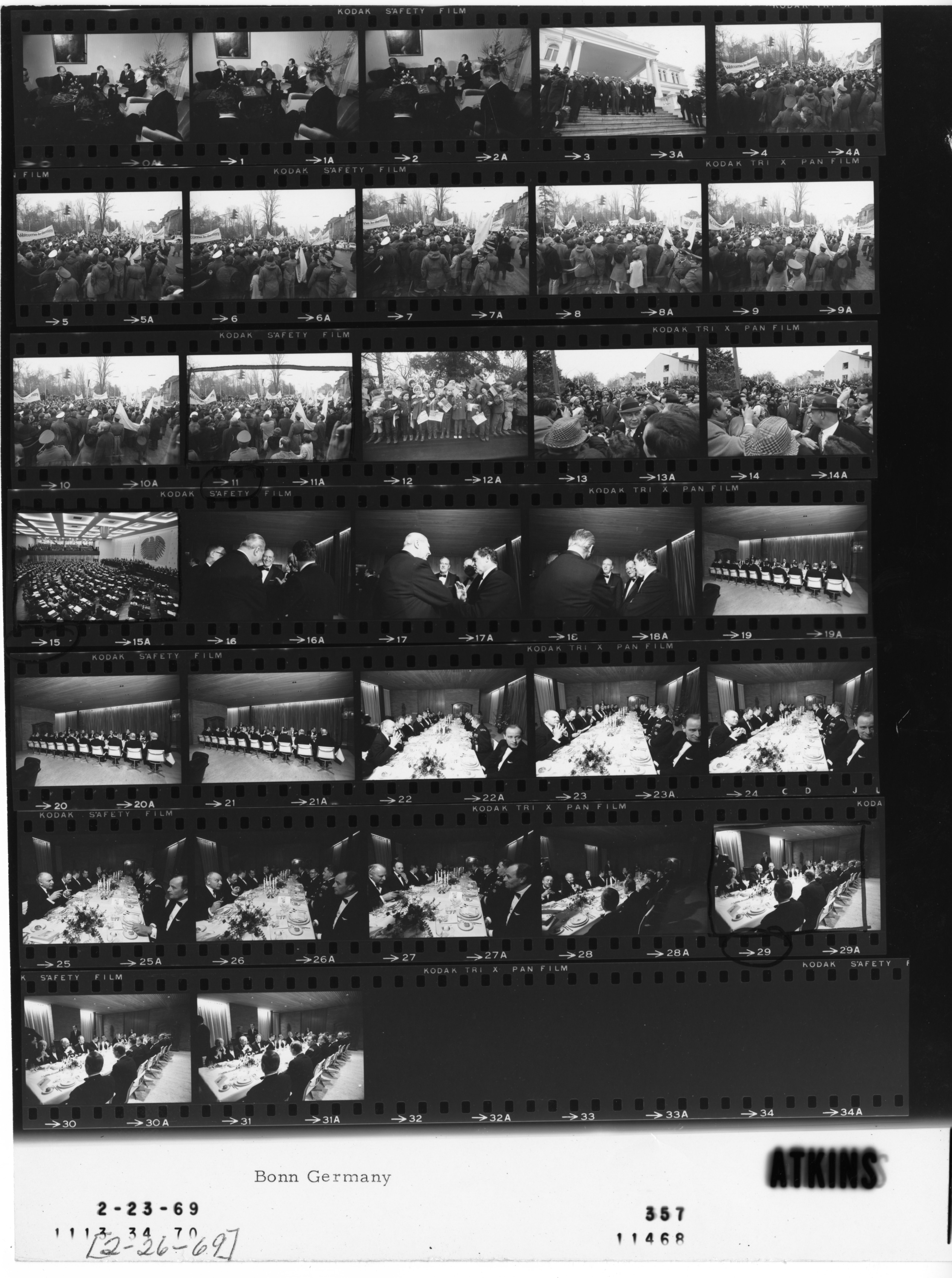
- Frame(s): WHPO-0357-00-02, President Nixon at Villa Hammerschmidt during a casual meeting with President Heinrich Lubke, Secretary of State, William Rogers, Vice Chancellor Willy Brandt and unidentified officials. 2/26/1969, Bonn, West Germany Villa Hammerschmidt. President Nixon, Vice Chancellor Willy Brandt, President Heinrich Lubke, William Rogers, unidentified officials.
- Frame(s): WHPO-0357-03, A group portrait of President Nixon with NATO leaders standing at a Villa Hammerschmidt outdoor entrance stairway. 2/26/1969, Bonn, West Germany Villa Hammerschmidt. President Nixon, Vice Chancellor Willy Brandt, President Heinrich Lubke, William Rogers, Henry Kissinger, unidentified leaders and officials.
- Frame(s): WHPO-0357-04-14, President Nixon mingling with a large crowd of German well wishers, and speaking to individuals. Adult and children are seend holding welcome signs or American flags. 2/26/1969, Bonn, West Germany Unidentified street. President Nixon, unidentified German citizens.
- Frame(s): WHPO-0357-15, The German Bundestag parliament, while in session seen from an upper gallery. large Eagle motif is mounted on of front wall. 2/26/1969, Bonn, West Germany Parliament Building. Unidentified legislators.
- Frame(s): WHPO-0357-16-18, President Nixon, Secretary of State William Rogers, and Vice Chandellor Willy Brandt speaking in a group, before a black tie dinner, hosted by German Chancellor Kurt Kiesinger. 2/26/1969, Bonn, West Germany Palace Schaumburg. President Nixon, Willy Brandt, Kurt Kiesinger, William Rogers, unidentified others.
- Frame(s): WHPO-0357-19-31, President Nixon, Secretary of State William Rogers, and Vice Chandellor Willy Brandt, Chancellor Kurt Kiesinger, military officials and leaders seated attable during a black tie dinner hosted by German Chancellor Kurt Kiesinger. 2/26/1969, Bonn, West Germany Palace Schaumburg. President Nixon, Willy Brandt, Kurt Kiesinger, Henry Kissinger, William Rogers, Martin J. Hillenbrand, U.S. Minister Russel Fessenden, Richard F. Pedersen, H. R. Haldeman, unidentified others.
Roll WHPO-0365 Photographer: Atkins, Oliver | Color or B&W: B&W
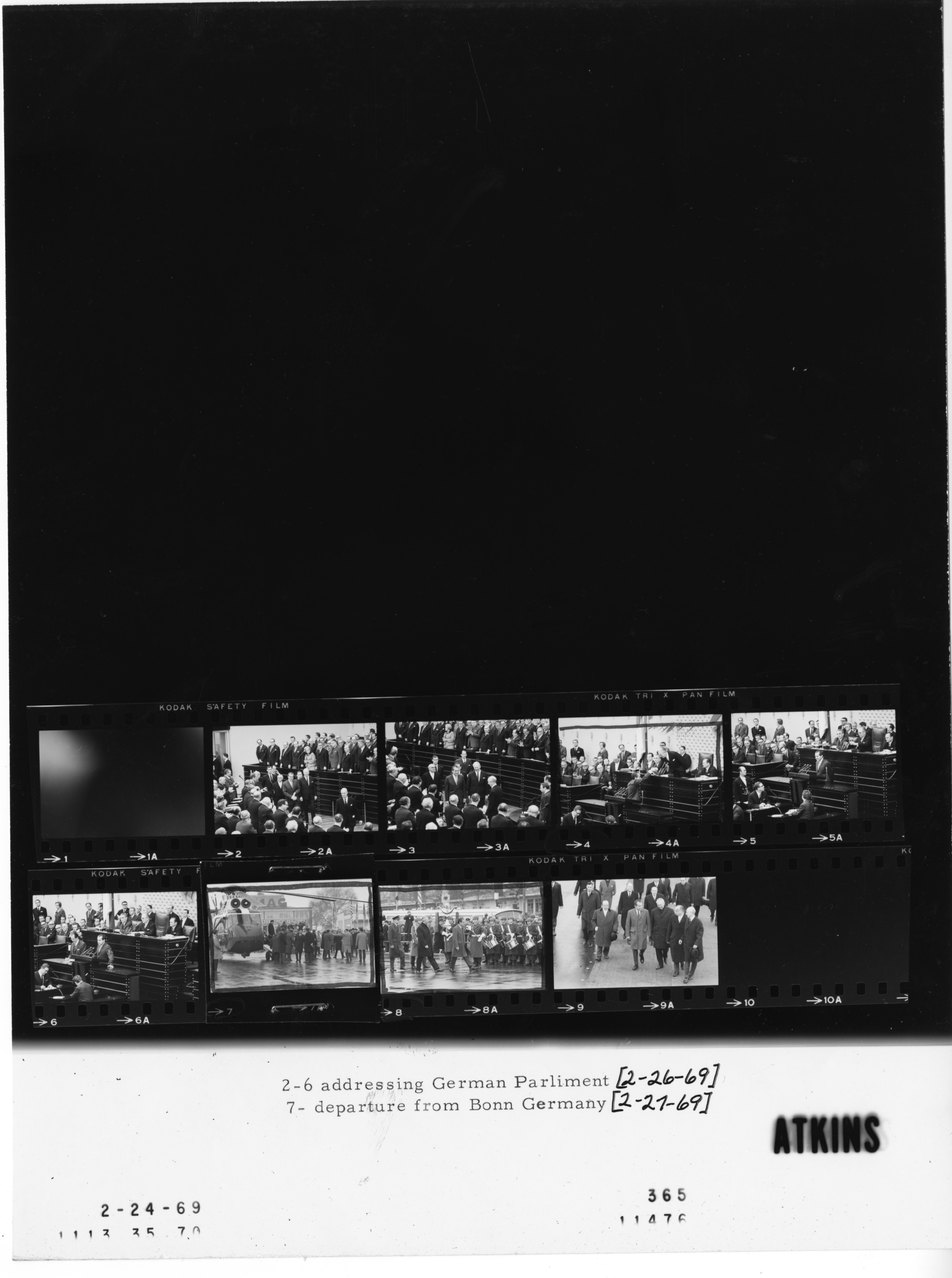
- Frame(s): WHPO-0365-02-06, President Nixon arriving to speak at Bundestag, the German Parliament. 2/26/1969, Bonn, West Germany Parliament Building. President Nixon, unidentified German Parliament members.
Roll WHPO-0383 Photographer: Knudsen, Robert L. | Color or B&W: B&W
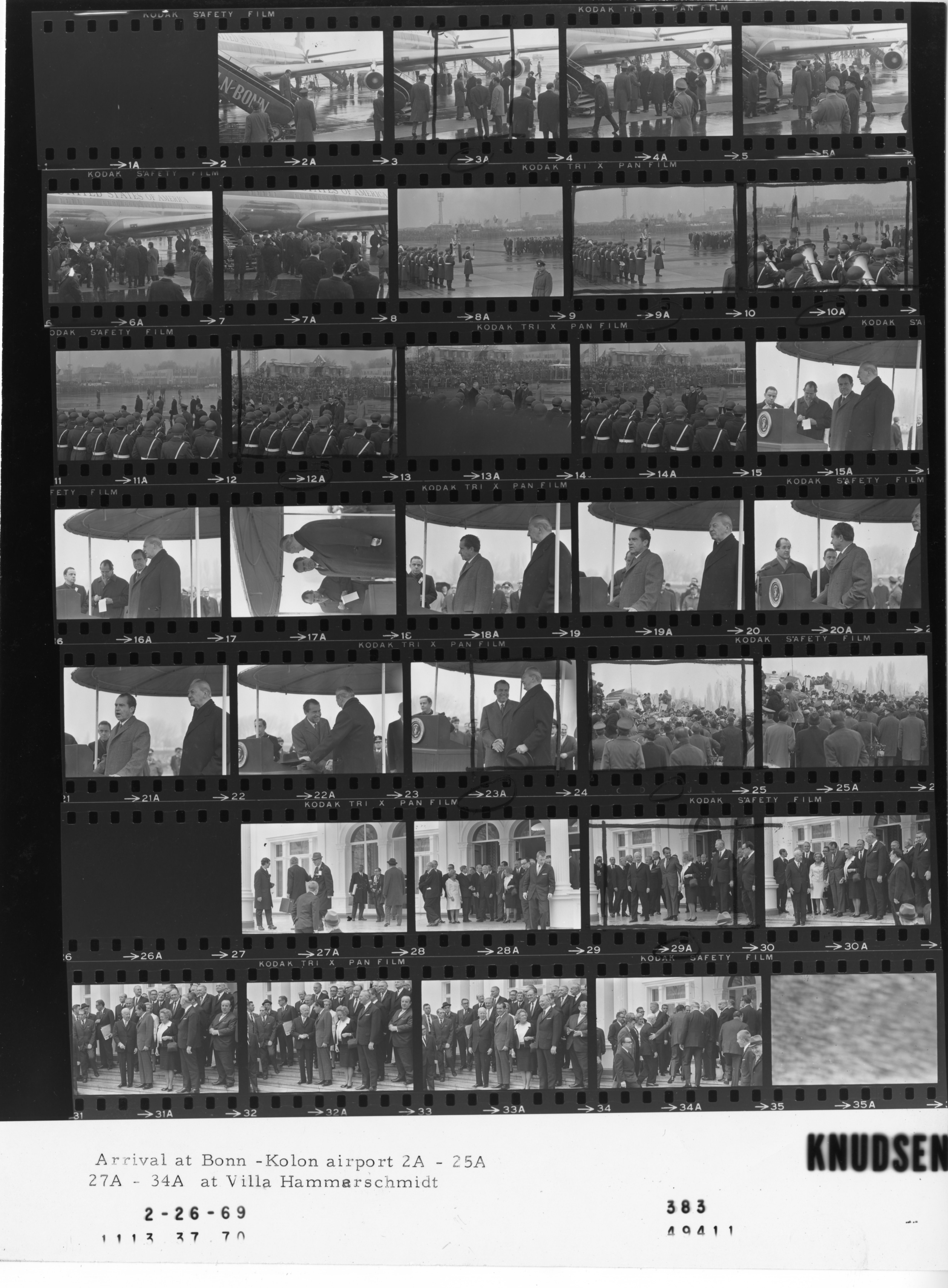
- Frame(s): WHPO-0383-02A-14A, President Nixon arriving at Wahn Airport and greeting well-wishers. 2/26/1969, Bonn, West Germany Wahn Airport. President Nixon, Kurt Kiesinger, honor guard, unidentified officials.
- Frame(s): WHPO-0383-15A-23A, President Nixon standing on a podium with German Chancellor Kurt Kiesinger. 2/26/1969, Bonn, West Germany Wahn Airport. President Nixon, Kurt Kiesinger, honor guard, unidentified officials.
- Frame(s): WHPO-0383-24A-25A, Crowd waiting at the airport surrounds President Nixon. 2/26/1969, Bonn, West Germany Wahn Airport. President Nixon, Kurt Kiesinger, honor guard, unidentified officials.
- Frame(s): WHPO-0383-27A-34A, President Nixon and officials standing outside of Villa Hammerschmidt. 2/26/1969, Bonn, West Germany Villa Hammerschmidt. President Nixon, Chancellor Kurt Kiesinger, President Heinrich Lubke, Kissinger, William Rogers, unidentified officials.
- Frame(s): WHPO-0383-29A, President Nixon and officials standing outside of Villa Hammerschmidt. 2/26/1969, Bonn, West Germany Villa Hammerschmidt. President Nixon, Chancellor Kurt Kiesinger, President Heinrich Lubke, unidentified officials.
Roll WHPO-0384 Photographer: Knudsen, Robert L. | Color or B&W: B&W
- Frame(s): WHPO-0384-02A-09A, President Nixon arriving at Wahn Airport. 2/26/1969, Bonn, West Germany Wahn Airport. President Nixon, Kurt Kiesinger, honor guard, unidentified officials.
- Frame(s): WHPO-0384-10A-13A, President Nixon standing on a podium with German Chancellor Kurt Kiesinger. 2/26/1969, Bonn, West Germany Wahn Airport. President Nixon, Kurt Kiesinger, honor guard, unidentified officials.
- Frame(s): WHPO-0384-14A-27A, President Nixon and officials standing outside of Villa Hammerschmidt in a group. 2/26/1969, Bonn, West Germany Villa Hammerschmidt. President Nixon, Chancellor Kurt Kiesinger, President Heinrich Lubke, Kissinger, William Rogers, Willy Brandt, unidentified officials.
Roll WHPO-0385 Photographer: Atkins, Oliver | Color or B&W: B&W
- Frame(s): WHPO-0385-00-04, President Nixon departing from Heathrow Airport, saying goodbye to Prime Minister Harold Wilson and unidentified officials. 2/26/1969, London, England Heathrow Airport. President Nixon, Harold Wilson, unidentified officials.
- Frame(s): WHPO-0385-05-07, President Nixon arriving at Wahn Airport. 2/26/1969, Bonn, West Germany Wahn Airport. President Nixon, Harold Wilson, unidentified officials.
- Frame(s): WHPO-0385-08, President Nixon on a podium from behind. 2/26/1969, Bonn, West Germany Wahn Airport. President Nixon, Chancellor Kurt Kiesinger, unidentified press corps members.
- Frame(s): WHPO-0385-09-11, Press corps members. 2/26/1969, Bonn, West Germany Wahn Airport. President Nixon, Chancellor Kurt Kiesinger, unidentified press corps members.
- Frame(s): WHPO-0385-12, President Nixon walking with Chancellor Kurt Kiesinger. 2/26/1969, Bonn, West Germany German Chancellery. President Nixon, Kurt Kiesinger, William Rogers, Willy Brandt, unidentified persons.
- Frame(s): WHPO-0385-13-16, President Nixon sitting informally with Chancellor Kurt Kiesinger. 2/26/1969, Bonn, West Germany German Chancellery. President Nixon, Kurt Kiesinger, William Rogers, Willy Brandt, unidentified persons.
- Frame(s): WHPO-0385-16, President Nixon sitting informally with Chancellor Kurt Kiesinger. 2/26/1969, Bonn, West Germany German Chancellery. President Nixon, Chancellor Kurt Kiesinger, unidentified officials.
- Frame(s): WHPO-0385-17-21, William Rogers sitting informally with Willy Brandt. 2/26/1969, Bonn, West Germany German Chancellery. President Nixon, Kurt Kiesinger, William Rogers, Willy Brandt, unidentified persons.
- Frame(s): WHPO-0385-22-23, President Nixon attending a meeting around a large table. 2/26/1969, Bonn, West Germany Villa Hammerschmidt. President Nixon, Heinrich Lubke, William Rogers, Willy Brandt, unidentified officials, street crowd.
- Frame(s): WHPO-0385-24-27, President Nixon shaking hands with German President Heinrich Lubke while standing with a group outside the villa. 2/26/1969, Bonn, West Germany Villa Hammerschmidt. President Nixon, Heinrich Lubke, William Rogers, Willy Brandt, unidentified officials, street crowd.
- Frame(s): WHPO-0385-28-31, President Nixon's motorcade leaving the villa. 2/26/1969, Bonn, West Germany Villa Hammerschmidt. President Nixon, Heinrich Lubke, William Rogers, Willy Brandt, unidentified officials, street crowd.
Roll WHPO-0386 Photographer: Atkins, Oliver | Color or B&W: B&W
- Frame(s): WHPO-0386-00, President Nixon being greeted at Wahn Airport by Kurt Kiesinger, West German Chancellor Willy Brandt, and others. 2/26/1969, Bonn, West Germany Wahn Airport. President Nixon, Kurt Kiesinger, Willy Brandt, unidentified officials, crowd.
- Frame(s): WHPO-0386-01-03, President Nixon at a podium making arrival address. 2/26/1969, Bonn, West Germany Wahn Airport. President Nixon, Kurt Kiesinger, Willy Brandt, unidentified officials, crowd.
- Frame(s): WHPO-0386-04-07, President Nixon signing the Golden Book. 2/26/1969, Bonn, West Germany German Chancellery. President Nixon, unidentified officials.
- Frame(s): WHPO-0386-08-18, President Nixon walking to the villa, standing on its steps with a group shot, and among a street crowd after leaving the villa. 2/26/1969, Bonn, West Germany Villa Hammerschmidt. President Nixon, German President Heinrich Lubke, unidentified officials, crowd.
- Frame(s): WHPO-0386-19-22, Unidentified person signing guest book before dinner. 2/26/1969, Bonn, West Germany Palace Schaumburg. President Nixon, Kurt Kiesinger, Mrs. Kiesinger, unidentified guests.
- Frame(s): WHPO-0386-23-25, 29-33, President Nixon standing with Kurt Kiesinger and Mrs. Kiesinger. 2/26/1969, Bonn, West Germany Palace Schaumburg. President Nixon, Kurt Kiesinger, Mrs. Kiesinger, unidentified guests.
- Frame(s): WHPO-0386-26-27, Unidentified person signing guest book before dinner. 2/26/1969, Bonn, West Germany Palace Schaumburg. President Nixon, Kurt Kiesinger, Mrs. Kiesinger, unidentified guests.
The White House Communications Agency Sound Recordings Collection contains public statements that took place between 1969 and 1974. Visit the finding aid to learn more.
P - Formal Presidential Remarks
- WHCA-SR-P-690231
Remarks by President Nixon on departing England, with remarks by Prime Minister Harold Wilson. (2/26/1969)
Runtime: 4:05
Keywords: 1969 trip to Europe
Original Format: 1/4-inch reel-to-reel audiotape. Original source type: Original. - WHCA-SR-P-690232
Remarks by President Nixon on Arrival at the Airport in Cologne/Bonn, with German Chancellor Kurt Kiesinger. (2/26/1969, Wahn Airport, Cologne, Germany)
Runtime: 2:53
Keywords: 1969 trip to Europe
Original Format: 1/4-inch reel-to-reel audiotape. Original source type: Original. - WHCA-SR-P-690233
Remarks by President Nixon in Bonn Before the German Bundestag (West German Parliament) in Bonn. (2/26/1969)
Runtime: 5:57
Keywords: 1969 trip to Europe
Original Format: 1/4-inch reel-to-reel audiotape. Original source type: Original.
The White House Communications Agency Videotape Collection contains “off-the-air” recordings of televised programs produced between 1968 and 1974. Visit the finding aid to learn more.
- WHCA-3230
Huntley-Brinkley Coverage of the President's Trip.
NBC, CBS
Runtime: 1:00 - WHCA-3231
"Today" Show: The President in Europe AND The President in Europe.
NBC, NBC
Runtime: 1:00
Context (External Sources)
The Vanderbilt Television News Archive is the world's most extensive and complete archive of television news. They have been recording, preserving and providing access to television news broadcasts of the national networks since August 5, 1968.
Wikipedia is a free encyclopedia that anyone can edit.