
Introduction
This almanac page for Wednesday, February 2, 1972, pulls together various records created by the federal government and links to additional resources which can provide context about the events of the day.
Previous Date: Tuesday, February 1, 1972
Next Date: Thursday, February 3, 1972
Schedule and Public Documents
The Daily Diary files represent a consolidated record of the President's activities. Visit the finding aid to learn more.
The President's day began at The White House - Washington, D. C.
The Weekly Compilation of Presidential Documents made available transcripts of the President's news conferences; messages to Congress; public speeches, remarks, and statements; and other Presidential materials released by the White House.
Digitized versions can be found at HathiTrust.
Each Public Papers of the Presidents volume contains the papers and speeches of the President of the United States that were issued by the White House Office of the Press Secretary during the time period specified by the volume. The material is presented in chronological order, and the dates shown in the headings are the dates of the documents or events. In instances when the release date differs from the date of the document itself, that fact is shown in the text note.
To ensure accuracy, remarks have been checked against audio recordings (when available) and signed documents have been checked against the original, unless otherwise noted. Editors have provided text notes and cross references for purposes of identification or clarity.
- Special Message to the Congress Urging Passage of the West Coast Dock Strike Resolution and the Crippling Strikes Prevention Act
- Message to the Senate Transmitting Convention on the Illicit Movement of Cultural Property.
- Remarks on Presenting the Heart-of-the-Year Award to Pearl Bailey
- Proclamation 4104—American Heart Month, 1972
The Federal Register is the official daily publication for rules, proposed rules, and notices of federal agencies and organizations, as well as executive orders and other Presidential documents.
The Congressional Record is the official daily record of the debates and proceedings of the U.S. Congress.
Archival Holdings
Any selection of archival documents will necessarily be partial. You should use the documents and folders identified below as a starting place, but consult the linked collection finding aids and folder title lists and the collections themselves for context. Many documents to be found this way do not lend themselves to association with specific dates, but are essential to a complete understanding of the material.
Selective document listing
President's Office Files
The President's Office Files consists of materials drawn together by the Special Files Unit from several administrative subdivisions within the White House Office. It is the handwriting and sensitive papers sent to the Staff Secretary that now comprise much of the President's Office Files. Visit the finding aid to learn more.
- News Summaries, Annotated News Summaries, Box 33, [Feb. 1-7, 1972] [1 of 2] [Note: Due to the way News Summary products were compiled, you should also consult nearby days for potentially relevant materials.]
- Wednesday, February 2, 1972
- News Summary, February 2, 1972, (Tuesday nets, wires)
- President's Daily Schedule, Box 102, [President's Daily Schedule, Jan.-Mar. 1972] [3 of 3]
- The President's Schedule, Wednesday - February 2, 1972
The H. R. Haldeman Diaries consists of seven handwritten diaries, 36 dictated diaries recorded as sound recordings, and two handwritten audio cassette tape subject logs. The diaries and logs reflect H. R. Haldeman’s candid personal record and reflections on events, issues, and people encountered during his service in the Nixon White House. As administrative assistant to the President and Chief of Staff, Haldeman attended and participated in public events and private meetings covering the entire scope of issues in which the Nixon White House engaged in during the years 1969-1973. Visit the finding aid to learn more.
- Transcript of diary entry (PDF)
Wednesday, February 2nd. We got into a discussion at staff meeting this morning about approval or the textile agreement memo for approval, that's waiting from Peterson for the President's signature. The problem here is that the President has told Flanigan to pick up on this and follow-up with Connally to get the thing worked out Connally's way rather than Peterson's. The President talked to Flanigan a couple times today on this, then late this afternoon Peterson came in to tell me that he wanted to review several problems. First, that Flanigan can't handle the textile industry because Milliken and the others have said that they won't work with him. Second, the problem, there's a problem with Connally, with Kennedy's assumed role in Europe on the economy, and Peterson used that as a springboard to expand on the Connally problem, saying that he's very difficult to deal with, that he overreacted to the Vorst column, and kept Peterson out of the meeting, that there's a risk of tilting everyone else out of joint. State has been putting out a line to try and sink Connally or split Connally and Peterson. So Peterson's pitching that Kennedy be the textile man instead of Flanigan, and with the clear understanding that it's all cleared through Connally.
Flanigan came in a little later and said that Kennedy, he is the real problem bugging Connally and he thinks maybe the President should order that Peterson head the council thing on textile rather than Kennedy, but then he decided that really wasn't feasible, so we left it the way it was.
The President was somewhat disturbed with the Bob Semple piece in the New York Times on describing his day yesterday, because it concentrates on his seeing Boy Scouts, football players, and Republican governors. Makes it appear that he does nothing of substance, and he thinks we've overreacted in trying to get out the personal interest stuff. I think basically he's right.
The big thing today was Muskie's speech. He was supposed to give an environment speech to a church women's group, and at the last minute changed it to what he billed as a major foreign policy address, and then used it as a platform to blast the President on Vietnam. We spent considerable time working on the approach to answering him, the feeling that we need to take him on pretty hard. The President wrote a memo covering some of the points he thought ought to be covered. We ended up having some Senators hit him today, and then Rogers is going to go at him hard tomorrow, if Scali's successful in getting him to do so. This will be a good chance to smoke Rogers out also on whether he really will do this. Before the NSC meeting this morning I got into a thing with the President and Henry about the latest Kissinger-Rogers flap...
-------------------------------------------------------------------------------------------------------------------
DECLASSIFIED - E.O. 13526, Sect. 3.4: by MS, NARA, June 12, 2013
Audio Cassette 18, Side B, Withdrawn Item Number 13 [AC-18(B) Sel 6]
Duration: 27 seconds
...regarding Rogers's plan to meet with Dobrynin. As a result of this, we made our point to the President and he's agreed to write a memorandum of instructions to Rogers regarding the meeting as a way to try to keep him in line and handling the thing the way we want him to.
-------------------------------------------------------------------------------------------------------------------
Late this afternoon we had a long talk at the EOB about the polls, particularly in the primary states, and about schedule planning for the year, and most particularly for March and April. The President's ranging back and forth on basic schedule approach. Had the idea today that we ought to go out to the country some, but not be concerned with the national television play. That we should just try to move the movers and shakers, work live audiences, on the basis that people are sick of so much stuff on television, and that we should do things live. Cahill got to him at the Governor's dinner last night, obviously, and made this pitch, suggesting that he come to New Jersey and meet with 100 of the top fellows at the Governor's residence, like the six top bishops of the church, etcetera. This probably would be a pretty good idea, and we're going to work up a plan on it, but the President then started to extend it to doing some political type rallies and all, which I strongly objected to, and I think he backed off of it. It was agreed that there shouldn't be that sort of thing, at least at this time. We left the meeting on the basis that he wouldn't get into anymore polls or that kind of planning until after China, but that we should be getting some plans developed for review when we get back. Then he wants to move quickly into some overt activity using that two month period for that purpose.
End of February 2nd. - Original audio recording (MP3)
The National Archives Catalog is the online portal to the records held at the National Archives, and information about those records. It is the main way of describing our holdings and also provides access to electronic records and digitized versions of our holdings.
The Catalog searches across multiple National Archives resources at once, including archival descriptions, digitized and electronic records, authority records, and web pages from Archives.gov and the Presidential Libraries. The Catalog also allows users to contribute to digitized historical records through tagging and transcription.
Nixon Library Holdings
All National Archives Units
National Security Documents
The President's Daily Brief is the primary vehicle for summarizing the day-to-day sensitive intelligence and analysis, as well as late-breaking reports, for the White House on current and future national security issues. Read "The President's Daily Brief: Delivering Intelligence to Nixon and Ford" to learn more.
The Foreign Relations of the United States series presents the official documentary historical record of major U.S. foreign policy decisions and significant diplomatic activity. Visit the State Department website for more information.
Vol. VIII, Vietnam, January-October 1972
Before the Easter Offensive, January 20-March 29, 1972
13. National Security Council Meeting, Washington, February 2, 1972
Source: National Archives, Nixon Presidential Materials, White House Tapes, Cabinet Room, Conversation 89–1. No classification marking. The editors transcribed the portions of the tape recording printed here specifically for this volume. The transcript is part of a larger conversation, 10:05 a.m.–12:16 p.m. Kissinger noted in a 9:05 a.m., February 2, telephone conversation with Secretary of the Treasury John B. Connally that Nixon had changed the date of the meeting from January 29 to February 2 so that Connally could attend. (Ibid., Kissinger Telephone Conversations, Box 13, Chronological File, February 1–4, 1972) No other written record of this meeting has been found. In his memoirs, Kissinger noted, “I cannot find a record of the meeting.” (White House Years, p. 1100)
According to the President’s Daily Diary, the following attended the meeting: Nixon, Vice President Agnew, Rogers, Laird, Connally, Mitchell, Helms, Moorer, Bunker, Kissinger, Haig, Director of the Office of Emergency Planning Lincoln, and White House Press Secretary Ziegler. (National Archives, Nixon Presidential Materials, White House Central Files)
Vol. E-4, Documents on Iran and Iraq, 1969-1972
Iraq 1972
297. Airgram A-38 From the Embassy in Lebanon to the Department of State, Beirut, February 2, 1972
The Embassy amplified its analysis of the current situation in Iraq in response to the conclusions of a Lebanese journalist whose articles the previous November had come to the Department’s attention.
Source: National Archives, RG 59, Central Files 1970–73, POL 2 IRAQ. Secret. Repeated to Amman, Ankara, Cairo, Kuwait, London, Moscow, Paris, and Tehran. Drafted by Thomas J. Carolan, Jr. Cleared by Robert B. Oakley, Norman K. Pratt, and Robert B. Houghton. Approved by William B. Buffum. The enclosures are attached but not published. In airgram A-125, May 3, the Embassy assessed the Iraqi government’s future prospects. (Ibid.)
Vol. E-7, Documents on South Asia, 1969-1972
Bangladesh, December 1971-December 1972
390. Letter From President Nixon to British Prime Minister Heath, Washington, February 2, 1972
Nixon wrote to Heath to explain that the United States intended to defer a decision on recognition of Bangladesh “until we have a clearer picture of how it will relate to the broader situation in South Asia.”
Source: Library of Congress, Manuscript Division, Kissinger Papers, Box CL 210, Geopolitical File, South Asia, Chronological File, Jan-June 1972. No classification marking. The text of the letter was transmitted to London on February 3 in telegram 19242 for delivery to Heath. (National Archives, RG 59, Central Files 1970–73, POL 16 BANGLA DESH) The United Kingdom was among eight countries that recognized Bangladesh on February 4. (Telegram 429 from Dacca, February 5; ibid.)
The Kissinger telephone conversation transcripts consist of approximately 20,000 pages of transcripts of Kissinger’s telephone conversations during his tenure as Assistant to the President for National Security Affairs (1969-1974) and Secretary of State (1973-1974) during the administration of President Richard Nixon. Visit the finding aid for more information.
Digitized versions can be found in the National Archives Catalog.
Audiovisual Holdings
Visit the White House Tapes finding aid to learn about the taping system's operation and archival processing.
Cabinet Room
Old Executive Office Building
- 318-8; Unknown between 1:40 p.m. & 1:48 p.m.; Nixon, Richard M. (President); Sanchez, Manolo
- 318-9; Unknown between 1:40 p.m. & 1:48 p.m.; Nixon, Richard M. (President); White House operator
- 318-10; Unknown between 1:40 p.m. & 1:48 p.m.; Nixon, Richard M. (President); Sanchez, Manolo
- 318-11; 1:48 p.m. - 1:48 p.m.; Nixon, Richard M. (President); White House operator
- 318-12; 1:50 p.m. - 1:50 p.m.; Nixon, Richard M. (President); White House operator
- 318-13; Unknown between 1:50 p.m. & 1:56 p.m.; Nixon, Richard M. (President); Haldeman, H. R. ("Bob"); Butterfield, Alexander P.
- 318-14; 1:56 p.m. - 2:00 p.m.; Nixon, Richard M. (President); Eisenhower, Julie Nixon
- 318-15; Unknown between 2:00 p.m. & 2:04 p.m.; Nixon, Richard M. (President); White House operator
- 318-16; Unknown between 2:00 p.m. & 2:04 p.m.; Nixon, Richard M. (President); White House operator
- 318-17; 2:04 p.m. - 2:06 p.m.; Nixon, Richard M. (President); Ziegler, Ronald L.
- 318-18; Unknown between 2:06 p.m. & 2:09 p.m.; Nixon, Richard M. (President); White House operator
- 318-19; 2:09 p.m. - 2:09 p.m.; Nixon, Richard M. (President); [Unknown person(s)]
- 318-20; 2:09 p.m. - 2:13 p.m.; Nixon, Richard M. (President); Cox, Tricia Nixon
- 318-21; Unknown between 2:13 p.m. & 2:14 p.m.; Nixon, Richard M. (President); White House operator
- 318-22; 2:14 p.m. - 2:20 p.m.; Nixon, Richard M. (President); Dent, Harry S.
- 318-23; 2:21 p.m. - 2:50 p.m.; Nixon, Richard M. (President); Kissinger, Henry A.
- 318-24; Unknown between 2:50 p.m. & 3:03 p.m.; Nixon, Richard M. (President); Haldeman, H. R. ("Bob")
- 318-25; 3:03 p.m. - 3:06 p.m.; Nixon, Richard M. (President); Haldeman, H. R. ("Bob")
- 318-26; Unknown between 3:06 p.m. & 3:17 p.m.; Nixon, Richard M. (President); [Unknown person(s)]
- 318-27; Unknown between 3:06 p.m. & 3:17 p.m.; Nixon, Richard M. (President); Haldeman, H. R. ("Bob")
- 318-28; Unknown between 3:06 p.m. & 3:17 p.m.; Nixon, Richard M. (President); Sanchez, Manolo
- 318-29; Unknown between 3:06 p.m. & 3:17 p.m.; Nixon, Richard M. (President); Woods, Rose Mary
- 318-30; Unknown between 3:06 p.m. & 3:17 p.m.; Nixon, Richard M. (President); White House operator
- 318-31; Unknown between 3:06 p.m. & 3:17 p.m.; Nixon, Richard M. (President); Lewis, Hobart D.
- 318-32; 3:17 p.m. - 3:25 p.m.; Nixon, Richard M. (President); Ehrlichman, John D.
- 318-33; Unknown between 3:25 p.m. & 3:30 p.m.; Nixon, Richard M. (President); Lewis, Hobart D.
- 318-34; Unknown between 3:25 p.m. & 3:30 p.m.; Nixon, Richard M. (President); White House operator
- 318-35; 3:30 p.m. - 3:31 p.m.; Nixon, Richard M. (President); Bull, Stephen B.
- 318-36; Unknown between 3:31 p.m. & 4:12 p.m.; Nixon, Richard M. (President); Rockefeller, Nelson A.; Reagan, Ronald W.; Milliken, William G.; Holton, Linwood
- 318-37; Unknown between 3:31 p.m. & 4:12 p.m.; Nixon, Richard M. (President); Sanchez, Manolo; [Unknown person(s)]
- 318-38; Unknown between 3:31 p.m. & 4:12 p.m.; Nixon, Richard M. (President); Haldeman, H. R. ("Bob")
- 318-39; 4:12 p.m. - 5:30 p.m.; Nixon, Richard M. (President); Ziegler, Ronald L.; Haldeman, H. R. ("Bob"); Flanigan, Peter M.
Oval Office
- 664-1; Unknown between 8:51 a.m. & 9:10 a.m.; Nixon, Richard M. (President); White House operator
- 664-2; 9:10 a.m. - 9:13 a.m.; Nixon, Richard M. (President); Gubser, Charles S.
- 664-3; Unknown between 9:13 a.m. & 9:14 a.m.; Nixon, Richard M. (President); White House operator
- 664-4; Unknown between 9:13 a.m. & 9:14 a.m.; Nixon, Richard M. (President); Bull, Stephen B.
- 664-5; 9:14 a.m. - 9:15 a.m.; Nixon, Richard M. (President); Downing, Thomas N.
- 664-6; 9:15 a.m. - 10:05 a.m.; Nixon, Richard M. (President); Haldeman, H. R. ("Bob"); Ziegler, Ronald L.; Kissinger, Henry A.; [Unknown person(s)]
- 664-7; Unknown between 12:16 p.m. & 12:18 p.m.; Nixon, Richard M. (President); Bull, Stephen B.
- 664-8; 12:18 p.m. - 12:34 p.m.; Nixon, Richard M. (President); Ehrlichman, John D.; Bull, Stephen B.; Bailey, Pearl M.; Hurst, J. Willis; Reid, Ross; Hundley, James M. (Dr.); Moses, Campbell; Arkus, M. Frederisk; Cornell, Herbert; Cole, Kenneth R., Jr.; Cavanaugh, James H.; White House photographer
- 664-9; 12:35 p.m. - 12:35 p.m.; Nixon, Richard M. (President); Haldeman, H. R. ("Bob")
- 664-10; 12:35 p.m. - 12:41 p.m.; Nixon, Richard M. (President); Mallary, Richard W.; Cook, Richard K.; White House photographer
- 664-11; Unknown between 12:41 p.m. & 12:43 p.m.; Nixon, Richard M. (President); Bull, Stephen B.; Butterfield, Alexander P.
- 664-12; Unknown between 12:41 p.m. & 12:43 p.m.; Nixon, Richard M. (President); Bull, Stephen B.
- 664-13; Unknown between 12:41 p.m. & 12:43 p.m.; Nixon, Richard M. (President); [Unknown person(s)]; McCormack, John W.; White House photographer; Bull, Stephen B.
- 664-14; Unknown between 1:00 p.m. & 1:03 p.m.; Nixon, Richard M. (President); Sanchez, Manolo
- 664-15; 1:03 p.m. - 1:36 p.m.; Nixon, Richard M. (President); Haldeman, H. R. ("Bob"); Ziegler, Ronald L.; Bull, Stephen B.
- 664-16; Unknown between 10:05 a.m. & 12:16 p.m.; United States Secret Service agents
White House Telephone
- 20-16; Unknown between 8:51 a.m. & 9:10 a.m.; Nixon, Richard M. (President); White House operator
- 20-17; 9:10 a.m. - 9:13 a.m.; Nixon, Richard M. (President); Gubser, Charles S.
- 20-18; Unknown between 9:13 a.m. & 9:14 a.m.; Nixon, Richard M. (President); White House operator
- 20-19; 9:14 a.m. - 9:15 a.m.; Nixon, Richard M. (President); Downing, Thomas N.
- 20-20; Unknown between 1:40 p.m. & 1:48 p.m.; Nixon, Richard M. (President); White House operator
- 20-21; 1:48 p.m. - 1:48 p.m.; Nixon, Richard M. (President); White House operator
- 20-22; 1:50 p.m. - 1:50 p.m.; Nixon, Richard M. (President); White House operator
- 20-23; 1:56 p.m. - 2:00 p.m.; Nixon, Richard M. (President); Eisenhower, Julie Nixon
- 20-24; Unknown between 2:00 p.m. & 2:04 p.m.; Nixon, Richard M. (President); White House operator
- 20-25; 2:04 p.m. - 2:06 p.m.; Nixon, Richard M. (President); Ziegler, Ronald L.
- 20-26; Unknown between 12:06 p.m. & 2:09 p.m.; Nixon, Richard M. (President); White House operator
- 20-27; 2:09 p.m. - 2:13 p.m.; Nixon, Richard M. (President); Cox, Tricia Nixon
- 20-28; Unknown between 2:13 p.m. & 2:14 p.m.; Nixon, Richard M. (President); White House operator
- 20-29; 2:14 p.m. - 2:20 p.m.; Nixon, Richard M. (President); Dent, Harry S.
- 20-30; 3:03 p.m. - 3:06 p.m.; Nixon, Richard M. (President); Haldeman, H. R. ("Bob")
- 20-31; Unknown between 3:06 p.m. & 3:17 p.m.; Nixon, Richard M. (President); White House operator
- 20-32; 3:17 p.m. - 3:25 p.m.; Nixon, Richard M. (President); Ehrlichman, John D.
- 20-33; Unknown between 3:25 p.m. & 3:30 p.m.; Nixon, Richard M. (President); White House operator
- 20-34; 3:30 p.m. - 3:31 p.m.; Nixon, Richard M. (President); Bull, Stephen B.
- 20-35; 4:29 p.m. - 4:31 p.m.; Nixon, Richard M. (President); Flanigan, Peter M.
- 20-36; Unknown between 4:31 p.m. & 7:43 p.m.; Nixon, Richard M. (President); White House operator
- 20-37; 7:43 p.m. - 7:52 p.m.; Nixon, Richard M. (President); Kissinger, Henry A.
- 20-38; 8:09 p.m. - 8:09 p.m.; Nixon, Richard M. (President); White House operator
- 20-39; 8:09 p.m. - 8:09 p.m.; Nixon, Richard M. (President); White House operator
- 20-40; 8:09 p.m. - 8:09 p.m.; Nixon, Richard M. (President); White House operator
- 20-41; 8:00 p.m. - 8:09 p.m.; Nixon, Richard M. (President); White House operator; Rogers, William P.
The White House Photo Office collection consists of photographic coverage of President Richard Nixon meeting with prominent social, political, and cultural personalities; speaking engagements and news conferences of the President and various high-ranking members of the White House staff and Cabinet; Presidential domestic and foreign travel, including Presidential vacations; social events and entertainment involving the First Family, including entertainers present; official portraits of the President, First Family, and high-ranking members of the Nixon administration; the 1969 and 1973 Inaugurals; the President’s 1972 Presidential election campaign appearances (including speeches) and other official activities of the White House staff and the President’s Cabinet from January 20, 1969 until August 9, 1974 at the White House and the Old Executive Office Building; other locations in Washington, DC, such as The Mall; and the Presidential retreats in Camp David, Maryland, Key Biscayne, Florida, and San Clemente, California. Visit the finding aid to learn more.
Roll WHPO-8365 Photographer: Atkins, Oliver | Color or B&W: Color
- Frame(s): WHPO-8365-, The White House grounds and Rose Garden covered in winter snow. 2/2/1972, Washington, D.C. White House, Rose Garden.
- Frame(s): WHPO-8365-06, The White House grounds and Rose Garden covered in winter snow. 2/2/1972, Washington, D.C. White House, Rose Garden.
- Frame(s): WHPO-8365-25, The White House grounds and Rose Garden covered in winter snow. 2/2/1972, Washington, D.C. White House, Rose Garden.
Roll WHPO-8366 Photographer: Atkins, Oliver | Color or B&W: Color
- Frame(s): WHPO-8366-, The White House Rose Garden covered in winter snow, viewed out an interior window. 2/2/1972, Washington, D.C. White House, Rose Garden.
- Frame(s): WHPO-8366-, The White House Rose Garden covered in winter snow. 2/2/1972, Washington, D.C. White House, Rose Garden.
- Frame(s): WHPO-8366-09, The White House Rose Garden covered in winter snow. 2/2/1972, Washington, D.C. White House, Rose Garden.
Roll WHPO-8368 Photographer: Atkins, Oliver | Color or B&W: B&W
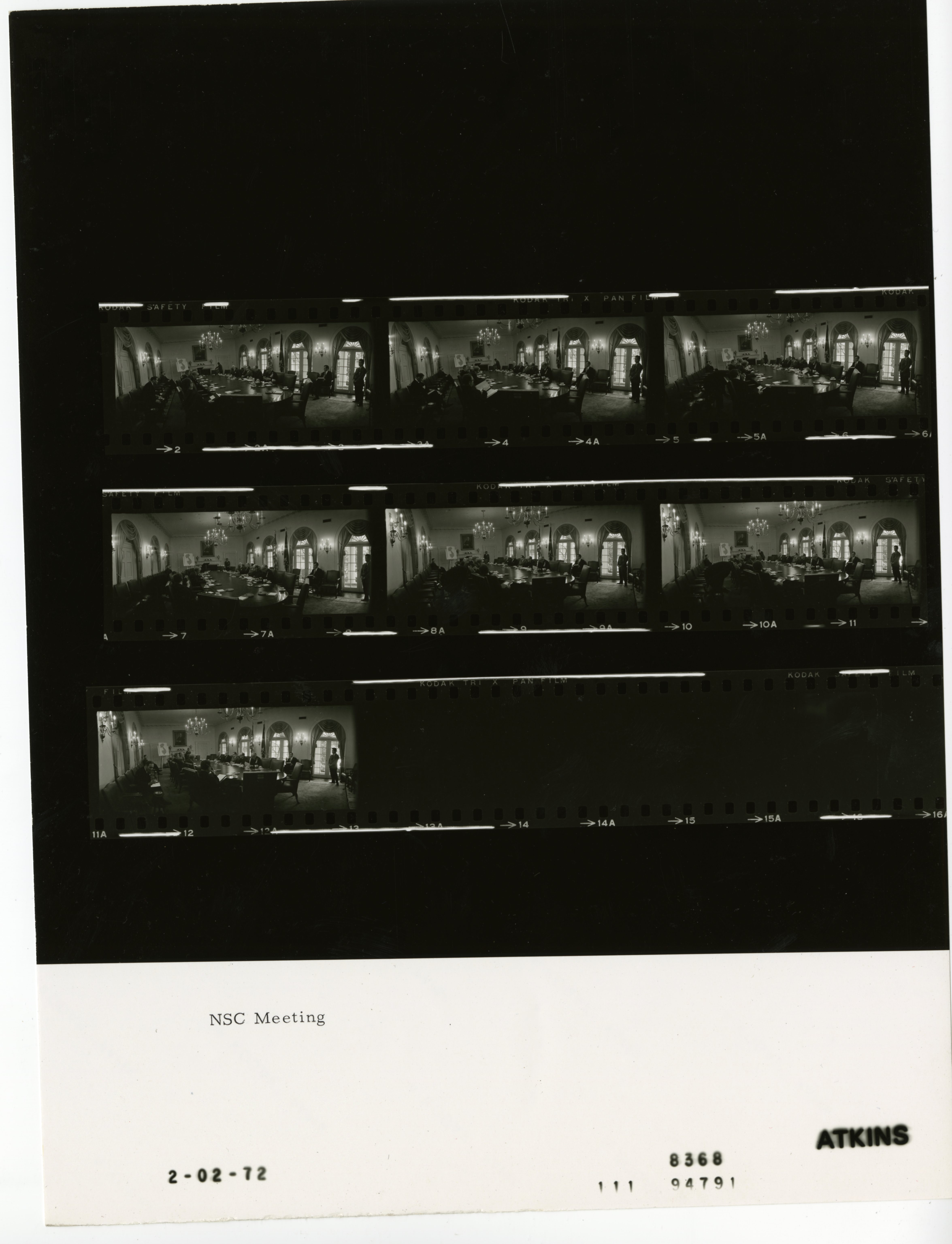
- Frame(s): WHPO-8368-, President Nixon at a meeting of the National Security Council (NSC). 2/2/1972, Washington, D.C. White House, Cabinet Room. Clockwise: President Nixon, Melvin Laird, Thomas Moorer, Henry Kissinger, [possibly Alexander Haig], George A. Lincoln, Spiro Agnew, John Connally, John Mitchell, Alexander Haig, Richard Helms, Ellsworth Bunker, William Rogers.
- Frame(s): WHPO-8368-04, National Security Council (NSC) meeting with President Nixon and other attendees. 2/2/1972, Washington, D.C. White House, Cabinet Room. Clockwise from the President: President Nixon, Melvin Laird, Thomas Moorer, Henry Kissinger, [possibly Alexander Haig], George A. Lincoln, Spiro Agnew, John Connally, John Mitchell, [unidentified man], Richard Helms, Ellsworth Bunker, William Rogers. Ronald Ziegler also pictured.
Roll WHPO-8369 Photographer: Atkins, Oliver | Color or B&W: B&W
- Frame(s): WHPO-8369-, President Nixon seated at his desk signing the proclamation designating American Heart Month while jazz singer Pearl Bailey, Dr. Hurst, and an unidentified man stand nearby. 2/2/1972, Washington, D.C. White House, Oval Office. President Nixon, Pearl Bailey, J. Willis Hurst, unidentified man.
- Frame(s): WHPO-8369-08, President Nixon seated at his desk signing the proclamation designating American Heart Month while jazz singer Pearl Bailey, Dr. Hurst, and an unidentified man stand nearby. 2/2/1972, Washington, D.C. White House, Oval Office. President Nixon, Pearl Bailey, J. Willis Hurst, unidentified man.
Roll WHPO-8370 Photographer: Atkins, Oliver | Color or B&W: B&W
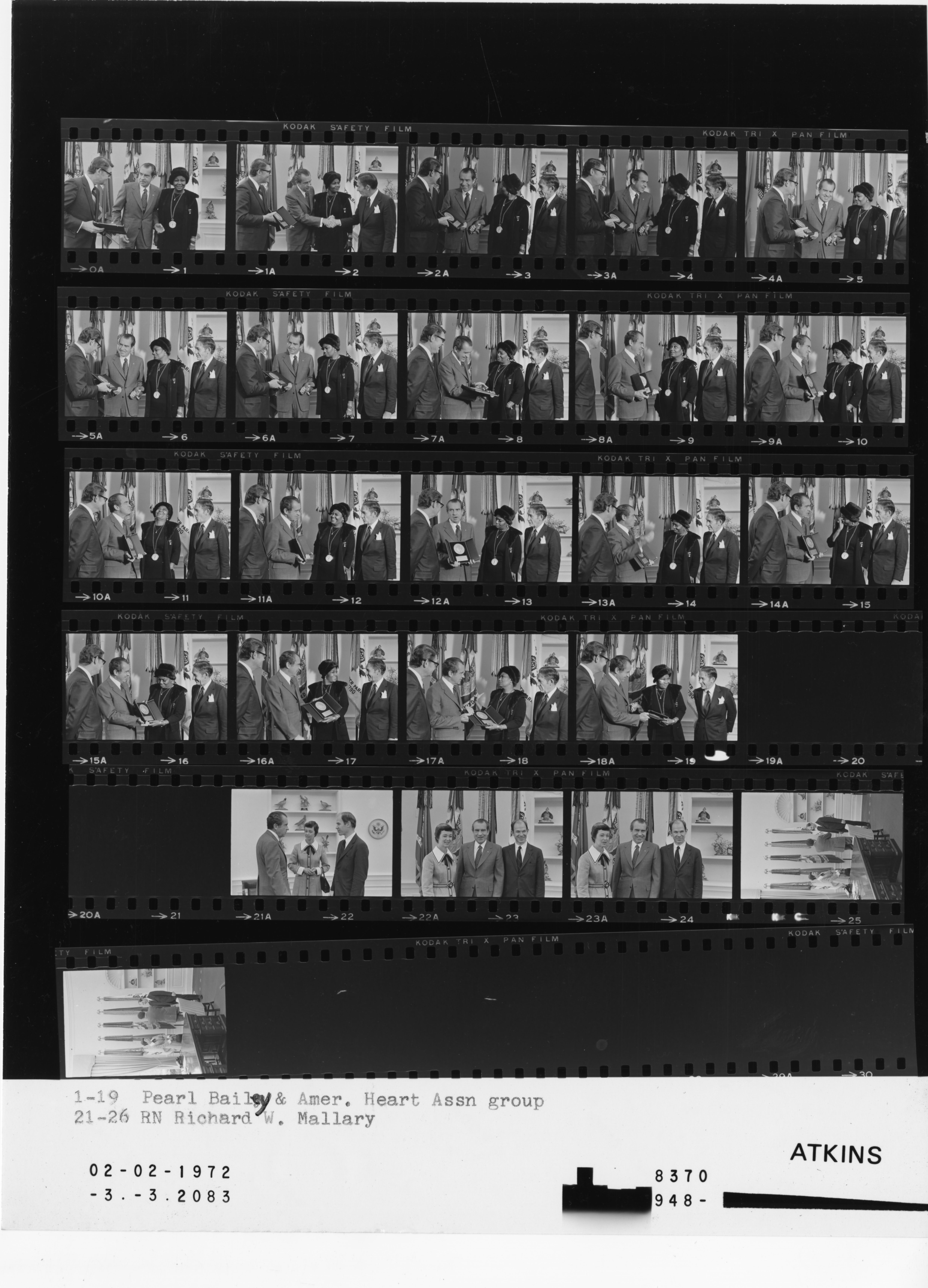
- Frame(s): WHPO-8370-01-19, Singer Pearl Bailey receiving the Heart of the Year Award from President Nixon on the day he signed a Presidential Proclamation designating February 1972, as American Heart Month. 2/2/1972, Washington, D.C. White House, Oval Office. President Nixon, Pearl Bailey, J. Willis Hurst, unidentified man, Rep. Richard Mallary, Mrs. Richard Mallary.
- Frame(s): WHPO-8370-17, Singer Pearl Bailey receiving the Heart of the Year Award from President Nixon on the day he signed a Presidential Proclamation designating February 1972 as American Heart Month. Dr. J. Willis Hurst (President of the American Heart Association) stands nearby. 2/2/1972, Washington, D.C. White House, Oval Office. President Nixon, Pearl Bailey, Dr. J. Willis Hurst, President of the American Heart Association, unidentified man.
- Frame(s): WHPO-8370-22-26, President Nixon with Congressman Richard Mallary and his wife. 2/2/1972, Washington, D.C. White House, Oval Office. President Nixon, Pearl Bailey, J. Willis Hurst, unidentified man, Rep. Richard Mallary, Mrs. Richard Mallary.
Roll WHPO-8371 Photographer: Kightlinger, Jack | Color or B&W: B&W
- Frame(s): WHPO-8371-, President Nixon standing with former Speaker of the House John McCormack. 2/2/1972, Washington, D.C. White House, Oval Office. President Nixon, John McCormack.
Roll WHPO-8372 Photographer: Kightlinger, Jack | Color or B&W: B&W
- Frame(s): WHPO-8372-, Closeup portrait study of Sallyanne Payton. 2/2/1972, Washington, D.C. unknown. Sallyanne Payton.
Roll WHPO-8373 Photographer: Knudsen, Robert L. | Color or B&W: B&W
- Frame(s): WHPO-8373-, Nidecker receiving Swedish gifts. 2/2/1972, Washington, D.C. unknown. Nidecker, unidentified men.
The White House Communications Agency Sound Recordings Collection contains public statements that took place between 1969 and 1974. Visit the finding aid to learn more.
H - White House Staff Member Recordings
- WHCA-SR-H-508
Press briefing by Clark MacGregor and Larry Silberman. (2/2/1972, Press Center, White House)
Runtime: 30:00:00
Keywords: Presidential campaigns, Presidential elections, 1972 Presidential campaign, 1972 Presidential election, Press conferences, news conferences, interviews, media
Production credits: Audio feed supplied by WHCA; Recorded by LRR (initials of WHCA engineer)
Original Format: 1/4-inch reel-to-reel audiotape. Original source type: Original.
H - White House Staff Member Recordings
- WHCA-SR-H-509
Clark MacGregor briefing to a women's group. (2/2/1972, Indian Treaty Room, Executive Office Building)
Runtime: 40:00:00
Keywords: Presidential campaigns, Presidential elections, 1972 Presidential campaign, 1972 Presidential election, Briefings, private briefings
Production credits: Audio feed supplied by WHCA; Recorded by RWF (initials of WHCA engineer)
Original Format: 1/4-inch reel-to-reel audiotape. Original source type: Original.
The White House Communications Agency Videotape Collection contains “off-the-air” recordings of televised programs produced between 1968 and 1974. Visit the finding aid to learn more.
- WHCA-5024
"Dinah's Place".
WTOP-TV
Runtime: 00:29:26 - WHCA-5025
"Great Decisions 1972" AND "A Public Affair: Election '72". Jack Anderson, syndicated newspaper columnist.
Metromedia
Runtime: 1:00 - WHCA-5026
"This Week".
Miami Tele Productions
Runtime: 00:29:46 - WHCA-5027
"Martin Agronsky: Evening Edition". Sam Yorty, Mayor of Los Angeles.
NBC
Runtime: 00:29:38 - WHCA-5030
Weekly News Summary, Tape II.
ALL NETWORKS
Runtime: 01:08:00
12. Report on the dock strike and President Nixon's attempt to get Congress to act quickly/ on camera comments by Senator Alan Cranston and Representative Gerald Ford. Time Code Start: 21:33. Keywords: harbors, Stevedores, dock workers, longshoremen, strikes, recession, inflation, wages, unemployment, trade, negotiations, trade, negotiations. Network: ABC.
13. Film report on Senator Muskie's attack of President Nixon's Peace Plan and Senator McGovern's campaign in New Hampshire. Time Code Start: 23:46. Keywords: Presidential elections, campaigns, campaigning, candidates. Network: ABC.
14. Harry Reasoner commentary on special commission for New York to legislate gambling. Time Code Start: 28:12. Keywords: laws, legislations, gaming control, wagering, bookmakers, bookies, illegal betting, crimes. Network: ABC.
15. Film report on expected Tet offensive and South Vietnam. Time Code Start: 30:05. Keywords: Vietnam War, holidays. Network: NBC.
16. Davind Brinkley commentary on new tax considerations by President Nixon's Administration. Time Code Start: 31:57. Keywords: Presidents, taxes, taxation, revenue. Network: NBC.
17. Report on the dock strike and President Nixon's attempt to get Congress to act quickly/ on camera comments by Senator Alan Cranston, Representative Gerald Ford, and Secretary of Labor James Hodgson. Time Code Start: 34:34. Keywords: harbors, Stevedores, dock workers, longshoremen, strikes, recession, inflation, wages, unemployment, trade, negotiations, trade, negotiations. Network: CBS.
18. Report on Fred Speaker's resignation from the Anti-Poverty League Service/ attack on New York welfare reform. Time Code Start: 36:39. Keywords: organizations, leaders, resignations, anti-poverty, destitution, lifestyles, bills, laws, Family Assistance Programs, government aid, financial aid, health and welfare assistance, financial aid. Network: CBS.
19. Sevareid: commentary on welfare problems and social programs. Time Code Start: 37:41. Keywords: Family Assistance Programs, government aid, financial aid, health and welfare assistance, financial aid. Network: CBS.
Context (External Sources)
The Vanderbilt Television News Archive is the world's most extensive and complete archive of television news. They have been recording, preserving and providing access to television news broadcasts of the national networks since August 5, 1968.
Wikipedia is a free encyclopedia that anyone can edit.