
Introduction
This almanac page for Friday, February 19, 1971, pulls together various records created by the federal government and links to additional resources which can provide context about the events of the day.
Previous Date: Thursday, February 18, 1971
Next Date: Saturday, February 20, 1971
Schedule and Public Documents
The Daily Diary files represent a consolidated record of the President's activities. Visit the finding aid to learn more.
The President's day began at The White House - Washington, D. C.
The Weekly Compilation of Presidential Documents made available transcripts of the President's news conferences; messages to Congress; public speeches, remarks, and statements; and other Presidential materials released by the White House.
Digitized versions can be found at HathiTrust.
Each Public Papers of the Presidents volume contains the papers and speeches of the President of the United States that were issued by the White House Office of the Press Secretary during the time period specified by the volume. The material is presented in chronological order, and the dates shown in the headings are the dates of the documents or events. In instances when the release date differs from the date of the document itself, that fact is shown in the text note.
To ensure accuracy, remarks have been checked against audio recordings (when available) and signed documents have been checked against the original, unless otherwise noted. Editors have provided text notes and cross references for purposes of identification or clarity.
The Federal Register is the official daily publication for rules, proposed rules, and notices of federal agencies and organizations, as well as executive orders and other Presidential documents.
The Congressional Record is the official daily record of the debates and proceedings of the U.S. Congress.
Archival Holdings
Any selection of archival documents will necessarily be partial. You should use the documents and folders identified below as a starting place, but consult the linked collection finding aids and folder title lists and the collections themselves for context. Many documents to be found this way do not lend themselves to association with specific dates, but are essential to a complete understanding of the material.
Selective document listing
President's Office Files
The President's Office Files consists of materials drawn together by the Special Files Unit from several administrative subdivisions within the White House Office. It is the handwriting and sensitive papers sent to the Staff Secretary that now comprise much of the President's Office Files. Visit the finding aid to learn more.
- Annotated News Summaries, Box 30, News Summaries - February 1971 [1 of 2] [During this period, the Staff Secretary only removed pages from the News Summaries which contained President Nixon's handwriting, often leaving the document with no date. In addition to the individual document(s) listed below, you should also consult the full folder for the month.]
- [2/19/71]
- Annotated News Summaries, Box 30, News Summaries - February 1971 [2 of 2]
- President's Daily Schedule, Box 101, [President's Daily Schedule, Jan.-Feb. 1971] [3 of 3]
- The President's Schedule, Friday - February 19, 1971
President's Personal File
The President's Personal File is essentially a President's secretary's file, kept by Rose Mary Woods, personal secretary to the President, for two purposes: (1) preserving for posterity a collection of documents particularly close to the President, whether because he dictated or annotated them, or because of the importance of the correspondent or the event concerned and (2) giving appropriate attention–letters of gratitude, invitations to White House social events, and the like–to members and important friends and supporters of the Nixon administration. This generalization does not describe all the varied materials of a file group which is essentially a miscellany, but it does identify the reason for the existence of the file group's core. Visit the finding aid to learn more.
- President's Speech File
The H. R. Haldeman Diaries consists of seven handwritten diaries, 36 dictated diaries recorded as sound recordings, and two handwritten audio cassette tape subject logs. The diaries and logs reflect H. R. Haldeman’s candid personal record and reflections on events, issues, and people encountered during his service in the Nixon White House. As administrative assistant to the President and Chief of Staff, Haldeman attended and participated in public events and private meetings covering the entire scope of issues in which the Nixon White House engaged in during the years 1969-1973. Visit the finding aid to learn more.
- Transcript of diary entry (PDF)
Friday, February 19.
The big flap this morning was a story in the paper that Fred Russell had been fired, which had the President very much distressed and thoroughly disgusted. This came out of a semi-ambiguous statement by Rog Morton and some pretty clear-cut efforts on the part of Interior Department staff to chop Russell up. He was also concerned that there wasn't any real coverage of the Woodrow Wilson speech last night, but that was basically inevitable. We'll follow-up with mailings and that sort of thing, and that probably will get us at least some mileage.
He told Ziegler to make a point of stating in his briefing that it was absolutely not true that Russell was fired and to really build him up as the type of man that's badly needed in government, etcetera.
He raised the point again of his concern about Kissinger's staff, the fact that the news today reports that one more has turned left––this time Mort Halperin going to the Common Cause staff. He wants me to work with Haig and make sure that Henry examines his staff very closely and is really set to kick out any potential traitors and not to let any others in.
We had a session with the Physical Fitness Council this morning, which I did not attend, but apparently the President was superb in a very light way in his remarks. He was somewhat concerned that we didn't have as good a turnout as we should have for it.
This afternoon he did the YR Leadership Conference gathering and apparently got a spectacular reception, and again did an excellent job, culminating by sitting at the piano and playing God Bless America while they all sang. He was furious to learn that the Vice President had not been scheduled to talk with them and that nobody was on their agenda to discuss revenue sharing; so he booked Ehrlichman in for tomorrow afternoon. He's somewhat distressed by this whole-- the evidence that this shows of the ineffective follow-up that must be going on in our domestic programs. Ehrlichman and I had a long session with Ed Morgan in the morning-- with eac-- just the two of us in the morning and then with Ed Morgan this afternoon, trying to work out a better way of approaching this. We've suggested that Morgan use Fred Malek as a management consultant and try to get some backup help on how to structure his operation and get more going on it.
End of February 19. - Original audio recording (MP3)
The National Archives Catalog is the online portal to the records held at the National Archives, and information about those records. It is the main way of describing our holdings and also provides access to electronic records and digitized versions of our holdings.
The Catalog searches across multiple National Archives resources at once, including archival descriptions, digitized and electronic records, authority records, and web pages from Archives.gov and the Presidential Libraries. The Catalog also allows users to contribute to digitized historical records through tagging and transcription.
Nixon Library Holdings
All National Archives Units
National Security Documents
The President's Daily Brief is the primary vehicle for summarizing the day-to-day sensitive intelligence and analysis, as well as late-breaking reports, for the White House on current and future national security issues. Read "The President's Daily Brief: Delivering Intelligence to Nixon and Ford" to learn more.
The Foreign Relations of the United States series presents the official documentary historical record of major U.S. foreign policy decisions and significant diplomatic activity. Visit the State Department website for more information.
Vol. IV, Foreign Assistance, International Development, Trade Policies, 1969-1972
Foreign Assistance Policy, 1969-1972
49. Memorandum From Secretary of State Rogers to President Nixon, Washington, February 19, 1971
Source: National Archives, RG 59, Central Files 1970-73, AID (US) 1. Secret. Drafted by Ronald I. Spiers (PM) on February 18 and forwarded to Rogers under cover of a February 19 memorandum from Under Secretary Irwin indicating that the memorandum had been prepared at Rogers’ suggestion. (Ibid.)
Vol. XIII, Soviet Union, October 1970-October 1971
"A Key Point in Our Relationship": Backchannel Talks on SALT, Berlin, and the Summit
119. Memorandum From Harold Saunders of the National Security Council Staff to the President’s Assistant for National Security Affairs (Kissinger), Washington, February 19, 1971
Source: National Archives, Nixon Presidential Materials, NSC Files, Box 647, Country Files, Middle East, Middle East (General), Vol. 8, 1971 [2 of 3]. Secret; Nodis. Sent for information. A note on the memorandum indicates that Kissinger saw it. In a separate memorandum to Kissinger on February 19, Saunders commented that this memorandum was “in response to your question for a review of where we stand. I assume that what you are concerned about principally is whether we are too much leaving the Soviets out of the current peacemaking effort and will regret this later. This memorandum is written with that specific question in mind and is designed to give you a chance to review our present posture from that angle. It suggests requesting a memo on strategy toward the USSR at the next SRG.” (Ibid.)
Vol. XXI, Chile, 1969-1973
Cool and Correct: The U.S. Response to the Allende Administration, November 5, 1970-December 31, 1972
207. Notes of a Meeting, Valparaiso, February 19, 1971, 12:05-1:15 p.m.
Source: National Archives, RG 59, Central Files 1970–73, POL CHILE–US. Secret. The meeting took place in the President’s Office Rotunda. A handwritten notation on the first page reads: “Reconstructed from rough notes—not verbatim.”
Vol. XXIX, Eastern Mediterranean, 1969-1972
Greece
303. Telegram From the Embassy in Greece to the Department of State, Athens, February 19, 1971, 1101Z
Source: National Archives, Nixon Presidential Materials, NSC Files, Box 594, Country Files—Middle East, Greece, Vol. II 1 Nov 1970–31 Dec 1971. Secret; Priority; Exdis. Repeated to US NATO.
Vol. XLI, Western Europe; NATO, 1969-1972
Italy
207. Intelligence Information Cable, Washington, February 19, 1971
Source: National Archives, Nixon Presidential Materials, NSC Files, Box 695, Country Files—Europe, Italy, Vol. III. Secret; [handling restriction not declassified]; Controlled Dissem; [handling restriction not declassified]; Background Use Only.
Vol. E-2, Documents on Arms Control and Nonproliferation, 1969-1972
Chemical and Biological Warfare; Geneva Protocol; Biological Weapons Convention
215. Memorandum From Secretary of Defense Laird to President Nixon, Washington, February 19, 1971
Given the recent restrictions on the use of chemical herbicides in Vietnam and the possible compromise of U.S. military authority, Laird did not concur with Secretary of State Rogers’ request for an immediate phase out, Instead, Laird recommended leaving further action to accelerate the phase out imposed by the Geneva Protocol to those military authorities directly effected by the decision.
Source: National Archives, Nixon Presidential Materials, NSC Files, Box 312, Subject Files, Chemical, Biological Warfare (Toxins, etc.), Vol. III. Secret.
The Kissinger telephone conversation transcripts consist of approximately 20,000 pages of transcripts of Kissinger’s telephone conversations during his tenure as Assistant to the President for National Security Affairs (1969-1974) and Secretary of State (1973-1974) during the administration of President Richard Nixon. Visit the finding aid for more information.
Digitized versions can be found in the National Archives Catalog.
Audiovisual Holdings
The White House Tapes are sound recordings of President Richard Nixon's telephone conversations and of meetings held in the Oval Office and the Cabinet Room in the White House, the President's office in the Old Executive Office Building (OEOB), the Lincoln Sitting Room in the residence section of the White House, and several locations at the Presidential retreat at Camp David, Maryland. These recordings document many of the major events and decisions of the Nixon Administration from February 16, 1971 to July 18, 1973. Visit the White House Tapes finding aid to learn about the taping system's operation and archival processing.
Oval Office
- 452-1; Unknown between 9:03 a.m. & 9:05 a.m.; Nixon, Richard M. (President); Butterfield, Alexander P.
- 452-2; 9:05 a.m. - 9:06 a.m.; Nixon, Richard M. (President); Nixon, Thelma C. ("Pat") (Ryan)
- 452-3; 9:30 a.m. - 10:06 a.m.; Nixon, Richard M. (President); Haldeman, H. R. ("Bob"); Ziegler, Ronald L.; Bull, Stephen B.
- 452-4; 10:07 a.m. - 10:48 a.m.; Nixon, Richard M. (President); Shultz, George P.; McCracken, Paul W.; Peterson, Peter G.; Donovan, Hedley W.; Lubar, Robert; Seligman, Daniel; Bowen, William; Burck, Gilbert; Mayer, Lawrence; Banks, Louis; White House photographer; Bull, Stephen B.
- 452-5; Unknown between 12:41 p.m. & 12:44 p.m.; Nixon, Richard M. (President); Bull, Stephen B.
- 452-6; Unknown between 12:41 p.m. & 12:44 p.m.; Nixon, Richard M. (President); Butterfield, Alexander P.
- 452-7; Unknown between 12:44 p.m. & 1:02 p.m.; Nixon, Richard M. (President); McReynolds, Leah; Casselman, William E., II; Parker, David N.; White House photographer
- 452-8; Unknown between 12:44 p.m. & 1:02 p.m.; Nixon, Richard M. (President); Brown, John R., III; Brown, John R., III (Mrs.); Butterfield, Alexander P.; Parker, David N.; White House photographer
- 452-9; Unknown between 12:44 p.m. & 1:02 p.m.; Nixon, Richard M. (President); Elam, Harriet; Elam, Harriet; Elam, Harry; Elam, Clarence; Chapin, Dwight L.; Parker, David N.; White House photographer
- 452-10; Unknown between 12:44 p.m. & 1:02 p.m.; Nixon, Richard M. (President); Black, George, Jr.; Abrams, Evelyn; McGee, Delores; Smith, Lawrence; Brown, Robert J.; Hannah, John A. (Dr.); Witherell, Harvey J.; Parker, David N.; White House photographer
- 452-11; Unknown between 1:02 p.m. & 1:04 p.m.; Nixon, Richard M. (President); Bull, Stephen B.
- 452-12; 1:04 p.m. - 1:08 p.m.; Nixon, Richard M. (President); Hampton, Lionel; Yeates, Harry; Tipone, William; Cashen, Henry C., II; Richardson, John, Jr.; White House photographer
- 452-13; Unknown between 1:08 p.m. & 1:09 p.m.; Nixon, Richard M. (President); Bull, Stephen B.
- 452-14; Unknown between 1:09 p.m. & 1:39 p.m.; Nixon, Richard M. (President); Holt, Cooper; Rainwater, Herbert R. (Chief); Johnson, Donald E.; Colson, Charles W.; Haig, Alexander M., Jr.
- 452-15; Unknown between 1:38 p.m. & 1:39 p.m.; Nixon, Richard M. (President); Bull, Stephen B.
- 452-16; Unknown between 1:38 p.m. & 1:39 p.m.; Nixon, Richard M. (President); White House operator
- 452-17; Unknown between 1:39 p.m. & 2:25 p.m.; Nixon, Richard M. (President); Haldeman, H. R. ("Bob"); White House operator; King, Gerturde
- 452-18; Unknown between 12:41 p.m. & 12:44 p.m.; Nixon, Richard M. (President); Bull, Stephen B.
- 452-19; Unknown between 1:38 p.m. & 1:39 p.m.; Nixon, Richard M. (President); Bull, Stephen B.
- 453-1; Unknown between 3:15 p.m. & 3:59 p.m.; Nixon, Richard M. (President); Ehrlichman, John D.; Shultz, George P.; Whitaker, John C.; Bull, Stephen B.; Bull, Stephen B.
- 453-2; Unknown between 3:59 p.m. & 4:00 p.m.; Nixon, Richard M. (President); Bull, Stephen B.
- 453-3; 4:00 p.m. - 4:05 p.m.; Nixon, Richard M. (President); Black, Melia; Southall, Pamela; Black, Orville; Black, Hilary; Manarin, Rosemary; Fountain, Betty; White House photographer
- 453-4; 4:06 p.m. - 4:11 p.m.; Nixon, Richard M. (President); Romas, Ronald C.; McQuaig, Linda; Wilson, Glenn; Morris, Jay; Abate, Joseph; Odle, Robert C., Jr.; White House photographer
- 453-5; Unknown between 4:11 p.m. & 4:52 p.m.; United States Secret Service agents
- 454-1; Unknown between 4:11 p.m. & 4:59 p.m.; Nixon, Richard M. (President); Butterfield, Alexander P.; Sanchez, Manolo; Ziegler, Ronald L.; White House operator; Woods, Rose Mary; Ehrlichman, John D.
- 454-2; Unknown between 4:54 p.m. & 4:59 p.m.; Nixon, Richard M. (President); Bull, Stephen B.
- 454-3; 4:59 p.m. - 5:08 p.m.; Nixon, Richard M. (President); Haldeman, H. R. ("Bob"); Ehrlichman, John D.; Bull, Stephen B.
- 454-4; 5:08 p.m. - 6:34 p.m.; Nixon, Richard M. (President); Shultz, George P.; McCracken, Paul W.; Burns, Arthur F.; Connally, John B.; Ziegler, Ronald L.; Woods, Rose Mary; White House photographer
- 454-5; Unknown between 6:34 p.m. & 6:46 p.m.; Nixon, Richard M. (President); Bull, Stephen B.
- 454-6; Unknown between 6:46 p.m. & 11:59 p.m.; Bull, Stephen B.; [Unknown person(s)]
The White House Photo Office collection consists of photographic coverage of President Richard Nixon meeting with prominent social, political, and cultural personalities; speaking engagements and news conferences of the President and various high-ranking members of the White House staff and Cabinet; Presidential domestic and foreign travel, including Presidential vacations; social events and entertainment involving the First Family, including entertainers present; official portraits of the President, First Family, and high-ranking members of the Nixon administration; the 1969 and 1973 Inaugurals; the President’s 1972 Presidential election campaign appearances (including speeches) and other official activities of the White House staff and the President’s Cabinet from January 20, 1969 until August 9, 1974 at the White House and the Old Executive Office Building; other locations in Washington, DC, such as The Mall; and the Presidential retreats in Camp David, Maryland, Key Biscayne, Florida, and San Clemente, California. Visit the finding aid to learn more.
Roll WHPO-5704 Photographer: Atkins, Oliver | Color or B&W: B&W
- Frame(s): WHPO-5704-03A-07A, President Nixon seated informally during a meeting in the Oval Office with advisors and top management of Fortune Magazine and Time, Inc. 2/19/1971, Washington, D.C. White House, Oval Office. President Nixon, George Shultz, Paul McCracken, Peter Peterson, Hedley Donovan, Robert Lubar, Daniel Seligman, William Bowen, Gilbert Burck, Lawrence Mayer, Louis Banks.
Roll WHPO-5705 Photographer: Atkins, Oliver | Color or B&W: B&W
- Frame(s): WHPO-5705-02A-10A, President Nixon and Pat Nixon greeting members of the President's Council on Physical Fitness and Sports Advisory Conference. 2/19/1971, Washington, D.C. White House, East Room. President Nixon, Pat Nixon, unidentified men.
Roll WHPO-5706 Photographer: Atkins, Oliver | Color or B&W: B&W
- Frame(s): WHPO-5706-01-30, President Nixon and Pat Nixon addressing and greeting members of the President's Council on Physical Fitness and Sports Advisory Conference. 2/19/1971, Washington, D.C. White House, East Room. President Nixon, Pat Nixon, unidentified persons.
Roll WHPO-5707 Photographer: Knudsen, Robert L. | Color or B&W: B&W
- Frame(s): WHPO-5707-01A-09A, President Nixon and Pat Nixon addressing and greeting members of the President's Council on Physical Fitness and Sports Advisory Conference. 2/19/1971, Washington, D.C. White House, East Room. President Nixon, Pat Nixon, unidentified persons.
Roll WHPO-5708 Photographer: Knudsen, Robert L. | Color or B&W: B&W
- Frame(s): WHPO-5708-01A-22A, President Nixon and Pat Nixon addressing and greeting members of the President's Council on Physical Fitness and Sports Advisory Conference. 2/19/1971, Washington, D.C. White House, East Room. President Nixon, Pat Nixon, unidentified persons.
Roll WHPO-5709 Photographer: Atkins, Oliver | Color or B&W: B&W
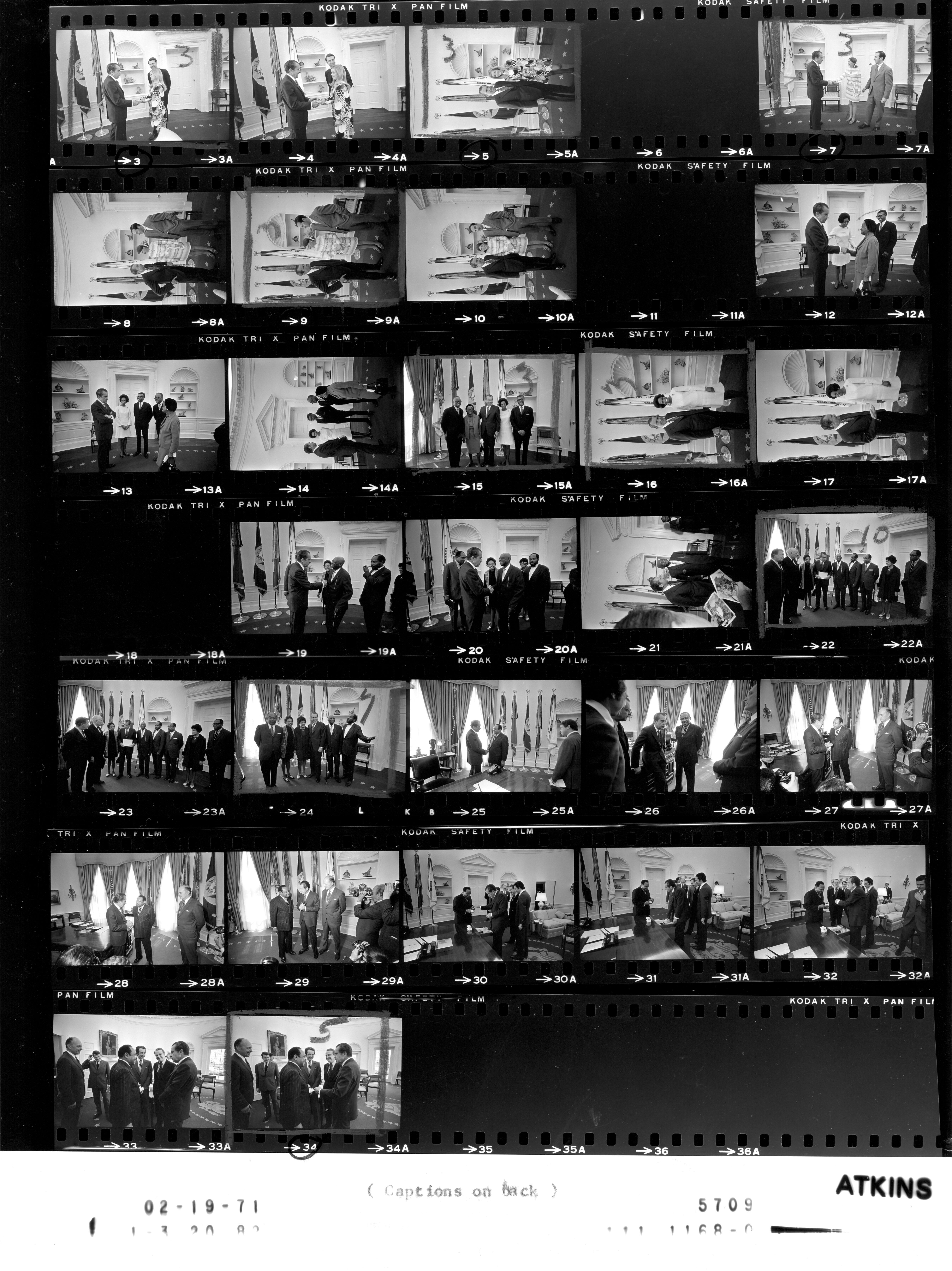
- Frame(s): WHPO-5709-03-05, President Nixon greeting David Parker and Leah McReynolds. 2/19/1971, Washington, D.C. White House, Oval Office. President Nixon, David Parker, Leah McReynolds, Mr. & Mrs. John R. Brown, III, Harriet Elam, Mrs. Robert Elam, Harry Elam, Clarence Elam.
- Frame(s): WHPO-5709-07-10, President Nixon greeting David Parker, Leah McReynolds, Mr. & Mrs. John R. Brown, III. 2/19/1971, Washington, D.C. White House, Oval Office. President Nixon, David Parker, Leah McReynolds, Mr. & Mrs. John R. Brown, III, Harriet Elam, Mrs. Robert Elam, Harry Elam, Clarence Elam.
- Frame(s): WHPO-5709-12-17, President Nixon greeting David Parker, Leah McReynolds, Mr. & Mrs. John R. Brown, III, Harriet Elam, Mrs. Robert Elam, Harry Elam, Clarence Elam. 2/19/1971, Washington, D.C. White House, Oval Office. President Nixon, David Parker, Leah McReynolds, Mr. & Mrs. John R. Brown, III, Harriet Elam, Mrs. Robert Elam, Harry Elam, Clarence Elam.
- Frame(s): WHPO-5709-19-24, President Nixon greeting George Black, Evelyn Abrams, Delores McGee, Lawrence Smith, Robert Brown, Admiral John Hannah, Harvey Witherell, and others. 2/19/1971, Washington, D.C. White House, Oval Office. President Nixon, George Black, Evelyn Abrams, Delores McGee, Lawrence Smith, Robert Brown, John Hannah, Harvey Witherell, Lionel Hampton, Harry Yeates, William Tipone, Henry Cashen,II, John Richardson, unidentified persons.
- Frame(s): WHPO-5709-25-34, President Nixon greeting jazz musician Lionel Hampton, Harry Yeates, William Tipone, Henry Cashen, II, John Richardson. 2/19/1971, Washington, D.C. White House, Oval Office. President Nixon, George Black, Evelyn Abrams, Delores McGee, Lawrence Smith, Robert Brown, John Hannah, Harvey Witherell, Lionel Hampton, Harry Yeates, William Tipone, Henry Cashen,II, John Richardson, unidentified persons.
Roll WHPO-5710 Photographer: Knudsen, Robert L. | Color or B&W: B&W
- Frame(s): WHPO-5710-02-13, President Nixon standing with George Black, John Hannah, and a George Black family member. 2/19/1971, Washington, D.C. White House, Oval Office. President Nixon, George Black, Black family member, John Hannah, Lionel Hampton, Charles W. Colson, H.R. "Chief" Rainwater, unidentified others.
- Frame(s): WHPO-5710-14-27, President Nixon standing with jazz musician Lionel Hampton and an unidentified man, Veterans of Foreign Wars (VFW) National Commander H.R. "Chief" Rainwater. 2/19/1971, Washington, D.C. White House, Oval Office. President Nixon, George Black, Black family member, John Hannah, Lionel Hampton, Charles W. Colson, H.R. "Chief" Rainwater, unidentified others.
- Frame(s): WHPO-5710-28-29, President Nixon in the Oval office with George Black, a Black family member, John Hannah, jazz musician Lionel Hampton, Charles Colson, H.R. "Chief" Rainwater, and others. 2/19/1971, Washington, D.C. White House, Oval Office. President Nixon, George Black, Black family member, John Hannah, Lionel Hampton, Charles W. Colson, H.R. "Chief" Rainwater, unidentified others.
Roll WHPO-5711 Photographer: Knudsen, Robert L. | Color or B&W: Color
- Frame(s): WHPO-5711-02A-08A, President Nixon greeting Harriet Elam, Mrs. Robert Elam, Harry Elam, and Clarence Elam. Dwight Chapin with the Elams prior to seeing President Nixon. 2/19/1971, Washington, D.C. White House, Oval Office. President Nixon, Harriet Elam, Mrs. Robert Elam, Harry Elam, Clarence Elam, Dwight Chapin.
Roll WHPO-5712 Photographer: Knudsen, Robert L. | Color or B&W: B&W
- Frame(s): WHPO-5712-01A-03A, President Nixon greeting participants during a reception for the Young Republican National Federation. 2/19/1971, Washington, D.C. White House, East Room. President Nixon, Pat Nixon, members of the Young Republican National Federation.
- Frame(s): WHPO-5712-04A-15A, President Nixon playing piano during a reception for the Young Republican National Federation. 2/19/1971, Washington, D.C. White House, East Room. President Nixon, Pat Nixon, members of the Young Republican National Federation.
- Frame(s): WHPO-5712-09, President Nixon playing piano during a reception for the Young Republican National Federation. 2/19/1971, Washington, D.C. White House, East Room. President Nixon, members of the Young Republican National Federation.
Roll WHPO-5713 Photographer: Knudsen, Robert L. | Color or B&W: B&W
- Frame(s): WHPO-5713-02A-36A, President Nixon attending a reception for Young Republicans. 2/19/1971, Washington, D.C. White House, East Room. President Nixon, Young Republicans.
Roll WHPO-5714 Photographer: Schumacher, Karl | Color or B&W: B&W
- Frame(s): WHPO-5714-02-22, President Nixon sitting informally with the QUADRIAD, George Shultz, Paul McCracken, John Connally, and Arthur Burns. 2/19/1971, Washington, D.C. White House, Oval Office. President Nixon, George P. Shultz, Paul W. McCracken, John Connally, Arthur Burns.
- Frame(s): WHPO-5714-05, President Nixon sitting informally with the QUADRIAD, George Shultz, Paul McCracken, John Connally, and Arthur Burns. 2/19/1971, Washington, D.C. White House, Oval Office. President Nixon, George P. Shultz, Paul W. McCracken, John Connally, Arthur Burns.
Roll WHPO-5715 Photographer: Atkins, Oliver | Color or B&W: B&W
- Frame(s): WHPO-5715-01-07, President Nixon meeting the grandchildren of George Black. 2/19/1971, Washington, D.C. White House, Oval Office. President Nixon, Black family members.
- Frame(s): WHPO-5715-09-22, President Nixon with Young Republican leaders individually and in groupings. 2/19/1971, Washington, D.C. White House, Oval Office. President Nixon, Ronald Romas, Linda McQuaig, Glenn Wilson, Jay Morris, Joseph Abate.
Roll WHPO-5716 Photographer: Schumacher, Karl | Color or B&W: B&W
- Frame(s): WHPO-5716-02-03, Unidentified men gretting each other. 2/19/1971, Washington, D.C. unknown. unidentified men.
- Frame(s): WHPO-5716-04-16, Vice President Agnew sitting with Italian P.M. Emilio Colombo, Aldo Moro, Graham Martin, and others. 2/19/1971, Washington, D.C. unknown. Spiro Agnew, Emilio Colombo, Aldo Moro, Graham Martin, officials.
The White House Communications Agency Sound Recordings Collection contains public statements that took place between 1969 and 1974. Visit the finding aid to learn more.
B - Vice-Presidential (Agnew and Ford)
- WHCA-SR-B-203
Remarks in an interview with Howard K. Smith-Wash., DC. (2/19/1971)
Runtime: 25:00:00
Original Format: 1/4-inch reel-to-reel audiotape. Original source type: Original.
H - White House Staff Member Recordings
- WHCA-SR-H-341
Press briefing by Ronald Ziegler and Paul McCracken. (2/19/1971, Press Center, White House)
Runtime: 20:00
Keywords: Press conferences, news conferences, interviews, media, press secretary
Production credits: Audio feed supplied by WHCA; Recorded by RRS (Bob Schroder, WHCA engineer)
Original Format: 1/4-inch reel-to-reel audiotape. Original source type: Original.
P - Formal Presidential Remarks
- WHCA-SR-P-710226
Remarks by President Nixon at reception for Council on Physical Fitness. (2/19/1971)
Runtime: 9:01
Original Format: 1/4-inch reel-to-reel audiotape. Original source type: Original. - WHCA-SR-P-710227
Remarks by President Nixon at reception for Young Republicans. (2/19/1971)
Runtime: 21:55
Original Format: 1/4-inch reel-to-reel audiotape. Original source type: Original.
The White House Communications Agency Videotape Collection contains “off-the-air” recordings of televised programs produced between 1968 and 1974. Visit the finding aid to learn more.
- WHCA-4185
Weekly News Summary, Tape II.
ALL NETWORKS
Runtime: 1:00
4. Smith/Scali: White House report of actions in Laos. Time Code Start: 11:45. Keywords: Laos, Vietnam War. Network: ABC.
5. Reasoner/Tuckner: Laos report. Time Code Start: 13:40. Keywords: Laos, Vietnam War. Network: ABC.
6. Smith/Donaldson: Economic report. Time Code Start: 15:45. Keywords: economy, economics, budgets, finances, recession, inflation, money, wages, costs, unemployment, prices, reports, speeches. Network: ABC.
7. Jarriel: Jogger President Nixon. Time Code Start: 18:50. Keywords: Presidents, health, exercise, jogging. Network: ABC.
8. Newman/Bennent: Indochina. Time Code Start: 20:50. Keywords: Laos, Cambodia, Vietnam War. Network: NBC.
9. Levine: Secretary Hodson with construction workers union leaders. Time Code Start: 22:46. Keywords: cabinet, advisors, union, organizations, jobs, unemployment, labor, buildings, housing, wages, costs. Network: NBC.
10. Brinkley: Economic report; Cost of living up only .1% for January. Time Code Start: 25:33. Keywords: economy, economics, budgets, finances, recession, inflation, money, wages, costs, unemployment, prices, reports, speeches. Network: NBC.
11. Cronkite/Dean: Indochina. Time Code Start: 26:20. Keywords: Laos, Cambodia, Vietnam War. Network: CBS.
12. Cronkite/Benton: Economic report. Time Code Start: 31:39. Keywords: economy, economics, budgets, finances, recession, inflation, money, wages, costs, unemployment, prices, reports, speeches. Network: CBS.
13. Cronkite/Pierpoint: White House visitors. Time Code Start: 34:23. Keywords: tourism, travel, trips. Network: CBS.
14. End of Tape II. Time Code Start: 37:05. Keywords: program finishing time reminder. Network: CBS. - WHCA-4211
Excerpts From the "NBC Nightly News" Indochina War Coverage, Tape I (Weekly News Summary).
NBC
47. Newman: First major battle in Laos at South Vietnamese base. Time Code Start: 52:21. Keywords: Laos, Vietnam War, Armed Forces, military, air bases, airfields, airports. Network: NBC.
48. Bennett: U.S. fire base (FSB) Charlie 2, just south of the Demilitarized Zone (DMZ). Time Code Start: 53:00. Keywords: Vietnam War, Armed Forces, military, air bases, airfields, airports, fire support base, firebases, temporary military encampments, artillery air strike coordination center. Network: NBC.
Context (External Sources)
The Vanderbilt Television News Archive is the world's most extensive and complete archive of television news. They have been recording, preserving and providing access to television news broadcasts of the national networks since August 5, 1968.
Wikipedia is a free encyclopedia that anyone can edit.