
Introduction
This almanac page for Wednesday, February 19, 1969, pulls together various records created by the federal government and links to additional resources which can provide context about the events of the day.
Previous Date: Tuesday, February 18, 1969
Next Date: Thursday, February 20, 1969
Schedule and Public Documents
The Daily Diary files represent a consolidated record of the President's activities. Visit the finding aid to learn more.
The President's day began at The White House - Washington, D. C.
The Weekly Compilation of Presidential Documents made available transcripts of the President's news conferences; messages to Congress; public speeches, remarks, and statements; and other Presidential materials released by the White House.
Addresses and Remarks
- Department of the Interior (5 Weekly Comp. Pres. Doc. 288, February 19, 1969)
The President's Remarks to Employees at the Department.
Congress, Communications to
- The Nation's Antipoverty Programs (5 Weekly Comp. Pres. Doc. 282, February 19, 1969)
The President's Message to the Congress, With Recommendations on the Office of Economic Opportunity and Its Programs. - Head Start Program (5 Weekly Comp. Pres. Doc. 287, February 19, 1969)
The President's Message to the Congress Transmitting Report Recommending Delegation of the Program to the Department of Health, Education, and Welfare.
Checklist of White House Press Releases
The releases listed below, made public by the Office of the White House Press Secretary during the period covered by this issue, are not included in the issue.
- Biography of Donald L. Jackson.
Digest of Other White House Announcements
Following is a listing of items of general interest which were announced in the press but not made public as formal White House press releases during the period covered by this issue. Appointments requiring Senate approval are not included since they appear in the list of nominations submitted to the Senate, below.
- The President met with the bipartisan leadership of the House and Senate at the White House.
- The President announced his intention to nominate Donald H. Jackson as a member of the Interstate Commerce Commission.
Nominations Submitted to the Senate
Does not include promotions of members of the Uniformed Services, nominations to the Service Academies, or nominations of Foreign Service Officers.
- GRANT HANSEN, of California, to be an Assistant Secretary of the Air Force.
- G. WARREN NUTTER, of Virginia, to be an Assistant Secretary of Defense.
- JOHN L. McLUCAS, of Massachusetts, to be Under Secretary of the Air Force.
- CURTIS W. TARE, of California, to be an Assistant Secretary of the Air Force.
- THADDEUS R. BEAL, of Massachusetts, to be Under Secretary of the Army.
- EUGENE M. BECKER, of Illinois, to be an Assistant Secretary of the Army.
- WILLIAM K. BREHM, of Michigan, to be an Assistant Secretary of the Army.
- JAMES D. HITTLE, of Virginia, to be an Assistant Secretary of the Navy.
- JOHN G. VENEMAN, of California, to be Under Secretary of Health, Education, and Welfare.
- JAMES E. ALLEN, JR., of New York, to be an Assistant Secretary of Health, Education, and Welfare.
- JAMES E. ALLEN, JR., of New York, to be Commissioner of Education.
- GILBERT HAHN, JR., of the District of Columbia, to be Chairman of the District of Columbia Council for the term expiring February 1, 1972.
- STERLING TUCKER, of the District of Columbia, to be Vice Chairman of the District of Columbia Council for the term expiring February 1, 1972.
- JERRY A. MOORE, of the District of Columbia, to be a member of the District of Columbia Council for the term expiring February 1, 1972.
Each Public Papers of the Presidents volume contains the papers and speeches of the President of the United States that were issued by the White House Office of the Press Secretary during the time period specified by the volume. The material is presented in chronological order, and the dates shown in the headings are the dates of the documents or events. In instances when the release date differs from the date of the document itself, that fact is shown in the text note.
To ensure accuracy, remarks have been checked against audio recordings (when available) and signed documents have been checked against the original, unless otherwise noted. Editors have provided text notes and cross references for purposes of identification or clarity.
The Federal Register is the official daily publication for rules, proposed rules, and notices of federal agencies and organizations, as well as executive orders and other Presidential documents.
The Congressional Record is the official daily record of the debates and proceedings of the U.S. Congress.
Archival Holdings
Any selection of archival documents will necessarily be partial. You should use the documents and folders identified below as a starting place, but consult the linked collection finding aids and folder title lists and the collections themselves for context. Many documents to be found this way do not lend themselves to association with specific dates, but are essential to a complete understanding of the material.
Selective document listing
President's Office Files
The President's Office Files consists of materials drawn together by the Special Files Unit from several administrative subdivisions within the White House Office. It is the handwriting and sensitive papers sent to the Staff Secretary that now comprise much of the President's Office Files. Visit the finding aid to learn more.
- Annotated News Summaries, Box 28, News Summaries - February 1969 [During this period, the Staff Secretary only removed pages from the News Summaries which contained President Nixon's handwriting, often leaving the document with no date. Although there are no specific documents with this date, you should also consult the full folder for the month.]
- President's Meetings File, Box 73, Memoranda for the President--Beginning February 16, 1969
President's Personal File
The President's Personal File is essentially a President's secretary's file, kept by Rose Mary Woods, personal secretary to the President, for two purposes: (1) preserving for posterity a collection of documents particularly close to the President, whether because he dictated or annotated them, or because of the importance of the correspondent or the event concerned and (2) giving appropriate attention–letters of gratitude, invitations to White House social events, and the like–to members and important friends and supporters of the Nixon administration. This generalization does not describe all the varied materials of a file group which is essentially a miscellany, but it does identify the reason for the existence of the file group's core. Visit the finding aid to learn more.
- President's Speech File
Selective document listing
The White House Press Office during the Presidency of Richard Nixon was responsible for daily communication with the White House press corps. Ronald L. Ziegler was the Press Secretary to the President for Nixon's entire term in office from January 1969 to August 1974 and Gerald Warren served as the Deputy Press Secretary. The office held daily briefings for the press and produced the White House’s press releases. Visit the finding aid to learn more.
- White House Press Conferences, Box 56
- News Conference #55 at the White House with Ron Ziegler, February 19, 1969, 10:16 A.M. EST. 2 pgs.
- News Conference #56 at the White House with Ron Ziegler, February 19, 1969, 4:08 P.M. EST. 5 pgs.
The National Archives Catalog is the online portal to the records held at the National Archives, and information about those records. It is the main way of describing our holdings and also provides access to electronic records and digitized versions of our holdings.
The Catalog searches across multiple National Archives resources at once, including archival descriptions, digitized and electronic records, authority records, and web pages from Archives.gov and the Presidential Libraries. The Catalog also allows users to contribute to digitized historical records through tagging and transcription.
Nixon Library Holdings
All National Archives Units
National Security Documents
The President's Daily Brief is the primary vehicle for summarizing the day-to-day sensitive intelligence and analysis, as well as late-breaking reports, for the White House on current and future national security issues. Read "The President's Daily Brief: Delivering Intelligence to Nixon and Ford" to learn more.
- President's Daily Brief of 19 February 1969 [consult link for visuals and extent of redactions]
The President's Daily Brief
19 February 1969
19
Top Secret
20 February 1969
LATE NOTES FOR THE PRESIDENT'S DAILY BRIEF OF
19 FEBRUARY 1969
I. MAJOR PROBLEMS
MIDDLE EAST
Cairo's semi-official newspaper Al Ahram declared in an editorial today that Arab commandos would mount attacks on Israeli targets anywhere regardless of reprisal raids. It asserted that Palestinian Arab resistance would not lessen despite any countermoves by Israel. (Reuters, 20 Feb 69)
* * *
Iraq today executed seven more men accused of spying for Israel. None apparently was Jewish. (Reuters, 20 Feb 69)
EUROPE
The US Embassy in Bonn reports that there were in fact two West German statements on the WEU controversy Tuesday. The first, presumably issued shortly after French Ambassador Seydoux met with Kiesinger, stated that Bonn believed that except in "exceptional cases," meetings of the WEU Council "may only be convened by unanimous vote." The German Foreign Ministry took umbrage at this, however, and succeeded in forcing the issuance of a "corrective statement" which asserted that Council meetings which take place by turns "do not need prior unanimous consent." Last Friday's meeting, the statement said, was such a meeting. [redacted]
SOVIET AFFAIRS
There is nothing significant to report.
VIETNAM
We share the US delegation's view that the French, by telling us of their tete-a-tete with Le Due Tho before he left Paris, are trying to convey an impression that they have a special relationship with the North Vietnamese. This also may be part of a buildupup for De Gaulle to approach President Nixon with some ideas on the war which the French can pass off as coming directly from the North Vietnamese. The French have not been at all forthcoming concerning their contacts with the Cornmunists in the past few months. We cannot becertain, but we strongly suspect that Hanoi would not put much trust in France as a channel to the US at the moment, especially when out contacts through the Soviets are so well established. Regardless of what case the French try to make, the Communists probably regard their talks with the French as just one more way to put pressure on the US to adopt such ideas as the need for a "peace cabinet" in Saigon. [redacted]
II. OTHER IMPORTANT DEVELOPMENTS
There is nothing significant to report.
I. MAJOR PROBLEMS
MIDDLE EAST
Eshkol today convened his ministerial committee for security affairs to ponder the attack on the El Al plane at Zurich. Israeli spokesmen have dropped contradictory hints as to the possible target (or targets) of any retaliatory strike. Transport Minister Carmel pointed a finger at Lebanon, but he widened the range of possibilities when he told the press, "the responsibility for such acts is not only with the perpetrators, but with the Arab states in which these acts are being planned and where the terrorists are being equipped."
[redacted]
* * *
The French, who earlier had been anxious to get started right away on four-power discussions, now want to delay them until De Gaulle has met with President Nixon. Paris also seems at this point to have rejected the US bid to convene the four powers for the limited purpose of giving Jarring a new lease on life. The decision appears to have been made by De Gaulle, who is said to be "not at all pleased" at what he considers American hesitancy to enter substantive discussions.
The spectre of a peace "imposed" by the great powers has, however, stimulated a more forthcoming Israeli attitude toward the Jarring mission. They have hinted that they are now willing to offer concessions to him if he renews contacts with the Middle East parties free of great power influence.
EUROPE
The only surprise about the French statement issued today on the WEU crisis was that it did not do more than threaten a boycott of WEU meetings. Several of the other WEU members, including Britain, had not excluded the possibility of some threats from Paris against the European Communities. France may realize there is not much it can do publicly in the present crisis. It may be concentrating instead on diplomatic arm twisting. The French ambassador in Paris was scheduled to see Kiesinger today, and Debré summoned the Luxembourg foreign minister to Paris.
Embassy reporting from The Hague suggests that the British, Dutch, and Italians still have the bit in their teeth. The Dutch reportedly have suggested that another WEU Council be called to discuss Greece's membership in the Council of Europe, and the British are said to have suggested a whole list of initiatives, including the transfer of WEU headquarters to Brussels and the appointment of full-time representatives. One Dutch official, however, said he expected Brussels and Bonn to make propitiating gestures toward Paris soon.
Bonn's position seems ambiguous at the moment. Kiesinger's office issued a statement last night which according to the press lends support to France's argument that last week's WEU meeting on the Middle East was "illegal." (The text of the statement itself is not yet available, however.) On the other hand, a ranking foreign office official in Bonn today told the US Embassy that Kiesinger himself had approved the German decision to attend the meeting on the Middle East. The official reiterated that Germany strongly supports the use of WEU for political consultation between the British and the Five (as long as WEU rules are not broken), even if the French do not want to attend. In fact, he said, it has been France's own actions in the past which have weakened the WEU structure and regulations.
* * *
Following the sharp increase in the Paris price of gold on Monday, reports from Paris now suggest that the French--in anticipation of the President's visit--are working overtime to get De Gaulle's views on monetary questions into the best light. Their line, as stated particularly by the influential financial writer of Le Monde, is that the new US administration is basically in sympathy with De Gaulle's international monetary views. He and other writers claim to see the new Nixon administration progressively excluding from consideration all monetary reform proposals except the well-known French ones--an increase in the official price of gold and a movement toward an international monetary system based on a pure gold standard. A corollary of this is that the US and France must share the same leaky boat, the repair of which involves joint devaluation through an increase in the price of gold.
SOVIET AFFAIRS
There have been no further harassments of Berlin traffic since the two-hour tie-up early this morning.
VIETNAM
We are unable to make very much of the private conversations Mr. Jorden and Ambassador Vance recently held with their North Vietnamese counterparts. With Jorden, Nguyen Thanh Le used the familiar technique of promising good (but unspecified) results if the US would agree to withdraw its forces from Vietnam. His statement that the Communists have "rejected" the Manila formulation on troop withdrawals is the usual hyperbole and should not be taken at face value.
Ha Van Lau's remarks to Vance constitute the most direct invitation yet to the US to open substantive discussions on specific issues. His suggestion that we take up the Front's standard "five points" as a beginning is undoubtedly the way the Communists would like to proceed. His request for a statement of the Nixon administration's objectives in Vietnam is a much more straightforward approach than the North Vietnamese usually employ, but it has long been clear that Hanoi wants to get a clearer idea how the us views the shape of a final settlement.
Despite Hanoi's emphasis on the importance of settling political matters in Paris, the Communists probably are willing to tackle withdrawal of forces as one of the first issues. As on other substantive matters, the Communists have not tipped their hand to any significant extent on this issue. Nonetheless, there is considerable evidence of Communist thinking about withdrawal of forces. Based on a review of this evidence, we see the present Communist position roughly as follows:
--The Communists want a clear US commitment to the principle of complete withdrawal of all US military forces from Vietnam within a specified time. They will be seeking such a commitment early on in private talks, but they eventually will want it made public in negotiated agreements.
--They clearly are interested in the withdrawal formulations used in the 1966 Manila Declaration, as given to them repeatedly by Ambassadors Harriman and Vance. They doubtless wonder at present if the substance of the Manila formulations remains US policy.
--The Communists are not likely to accept, much less carry out, any agreements resolving this military problem or any others without some parallel understandings on broader political questions.
--Their demands for "unconditional" withdrawal of us forces are propaganda and clearly intended for openers only. They expect to bargain on-this issue, and they know that they will eventually have to pull out substantial forces of their own. They are unlikely to agree to any kind of solid inspection and verification arrangements to monitor withdrawals, however.
--The Communists anticipate that the withdrawal of US forces will be gradual, perhaps requiring several years. There have been hints that they expect the US to maintain military bases in Vietnam for some time after a settlement.
* * *
[redacted]
* * *
There is new evidence which adds to persistent indications that the Communists are planning attacks in Saigon soon. [redacted] Several recently captured Communist soldiers have mentioned plans for early action against selected targets in and around the capital.
General Kerwin of II Field force believes an attack in the III Corps area will come this weekend. [redacted]
II. OTHER IMPORTANT DEVELOPMENTS
CAMBODIA
[redacted] a sharp rise in insurgent ambushes, harassments of villages, and propaganda activities. Armed clashes have been almost as frequent as last year; much of the fighting this time, however, has apparently been at the government's initiative.
Most of the action is centered in the northeast, where army units have destroyed several tribal insurgent camps and large rice caches, and in the western provinces, where the dissidence first appeared two years ago. Smaller scale rebel activities continue, however; in almost every other province.
[redacted]
PERU
[redacted]
FRANCE
At Annex is the discussion of internal problems affecting the French Government.
ANNEX
INTERNAL PRESSURES ON THE FRENCH GOVERNMENT
SIGNIFICANCE: The setbacks of 1968 bruised France somewhat but did not weaken De Gaulle's grip on the country and the people. He remains firmly in the saddle. Underlying his present strong position is the continued support of a majority of the French population, a massive Gaullist majority in the National Assembly, and the loyal support of his Prime Minister and cabinet. Nevertheless, his government faces a constellation of interrelated domestic political problems arising from continued student and labor unrest and pressure on the franc.
* * *
The government is not now, and is not likely to be over the next few months, under significant pressure from organized and traditional political forces in France. Last June's elections reduced to less than 25% the parliamentary representation of all the opposition parties combined. In addition, there is considerable--and continuing--antagonism within the Opposition. De Gaulle's own party now holds such a massive majority in the Assembly that it no longer requires support from its allies, the Independent Republicans. Although the Gaullist party is heterogeneous and often restive, it is unlikely to oppose De Gaulle on- any major issue, much less attempt to replace him. Parliamentary elections are not due for five years, and De Gaulle's presidential term runs until 1972. Thus, any serious challenge to the Gaullist regime in the near future will come from outside the established electoral and parliamentary system.
Potential sources of such a challenge reside in the two groups which precipitated last May's crisis--students and workers. Student unrest continues to be one of France's major political problems, despite a full-scale government effort to deal with the defects in the educational establishment
after last May's crisis. Minister of Education Edgar Faure, with the full backing of the general, is trying to sap the strength of the minority left wing of the student movement by inducing the student majority to give academic reforms a fair test. De Gaulle is hedging bets, however, and has also encouraged the Minister of Interior to beef up security forces for use in the event that the radicals get out of hand.
To date Faure's efforts have failed to win widespread support in the student milieu~ Radicals remain in control of the student movement--in part because of the failure of moderate elements to organize effectively--and can still stir up minor campus disorders such as have occurred over the past two months. Nevertheless, radical student leaders are acutely aware of their political isolation, and are urging their followers to avoid the "trap" of another major confrontation with police. More importantly, the radicals have had no luck in enlisting workers to their cause; an isolated student rebellion without mass worker support would pose no serious threat to the regime. Such support is unlikely unless workers are made gravely dissatisfied by the outcome of scheduled wage negotiations this March.
The enactment of the landmark trade union rights law in December 1968 put the unions in a much stronger bargaining position than a year ago. As a consequence, union leaders are anxious to avoid a recurrence of the May disorders. They calculate that they can gain more by moderate approaches to their goals than by militant tactics which risk plunging the economy into turmoil once again~ The mood of the rank and file is more difficult to determine, but the slim worker response to last week's "day of action" suggests that, if something close to their salary goals is achieved in March negotiations with management, labor unrest is not likely to reach crisis proportions.
Even if, as we expect, serious labor unrest is avoided in March, the government still faces difficult problems. Mainly because of restrictive monetary policies adopted to shore up the franc, there will probably be an economic slowdown in late spring which could cause- at least a temporary rise in unemployment. While these policies also have the beneficial effect of reducing the trade deficit, the French international financial position nevertheless remains precarious. Factors not subject to government control such as major strikes, student disturbances, monetary crises in other major countries, or even a temporary increase in the trade gap, could increase already shaky confidence in the franc and trigger another wave of speculation. Present exchange controls, although relatively effective to date, would probably not hold up in a crisis situation.
If in that case external financial aid or other limited measures failed to reduce pressure on the franc, De Gaulle would be confronted with the choice of imposing further austerity measures or devaluation. Given his desire to avoid domestic unrest, he would probably opt for devaluation, thus attempting to export his problems--with all the implications this could have for the international monetary community.
The outlook for France, then, is for various degrees of social and economic instability ranging from sporadic labor unrest and student disturbances to a renewed attack on the franc and possibly its devaluation. It is unlikely, however, that unrest will reach a level of intensity comparable to that of last May or great enough to overthrow De Gaulle.
Neither last May's crisis nor the November franc crisis forced a change in De Gaulle's foreign policy and defense views. Nor are the problems which he will face over the next few months likely to prompt him to alter significantly French policy on NATO, nuclear strategy, the enlargement of the European community, East-West relations, the reform of the international monetary system, or France's mission to chart a separate course in world politics. On such matters, he remains convinced of the rightness of his conceptions and impervious to any contrary advice from his colleagues.
The Foreign Relations of the United States series presents the official documentary historical record of major U.S. foreign policy decisions and significant diplomatic activity. Visit the State Department website for more information.
Vol. I, Foundations of Foreign Policy, 1969-1972
Foundations of Foreign Policy, 1969-1972
12. Memorandum From the President’s Special Assistant (Buchanan) to President Nixon, Washington, February 19, 1969
Source: National Archives, Nixon Presidential Materials, White House Special Files, President’s Office Files, Box 77, Memoranda for the President, Jan 21-Apr 6, 1969. Confidential.
Vol. III, Foreign Economic Policy; International Monetary Policy, 1969-1972
International Monetary Policy, 1969-1972
116. Talking Paper Prepared in the Department of the Treasury , Washington, February 19, 1969
Source: Washington National Records Center, Department of the Treasury, Volcker Group Masters: FRC 56 86 30, VG/LIM/1-VG/LIM/30. Confidential; Limdis. Presidents Nixon and De Gaulle met in Paris on February 28, March 1, and March 2. International monetary issues reportedly were discussed in an expanded meeting on March 1, but no record of that meeting was found. Regarding their final meeting on March 2, see Document 7.
117. Telegram From the Department of State to the Mission to the OECD , Washington, February 19, 1969, 0222Z
Source: National Archives, RG 59, Central Files 1967-69, FN 17. Unclassified. Drafted by Enders (E/IMA), cleared by Rogers (EUR/RPE) and Widman (Treasury), and approved by Enders. Repeated to Bonn, Brussels, The Hague, London, and Luxembourg.
Vol. VI, Vietnam, January 1969-July 1970
Vietnam, January 1969-July 1970
22. Memorandum From the President’s Assistant for National Security Affairs (Kissinger) to President Nixon, Washington, February 19, 1969
Source: Library of Congress, Manuscript Division, Kissinger Papers, Box TS 12, Geopolitical File, Cambodia Bombings, 1969. Top Secret; Sensitive.
Vol. XII, Soviet Union, January 1969-October 1970
Initial Contacts, January-April 22, 1969
19. Talking Points Prepared by the National Security Council Staff for Nixon, Washington, February 19, 1969
Source: Library of Congress, Manuscript Division, Kissinger Papers, CL 312, Meetings, National Security Council, February–March, 1969. Confidential. Similar talking points were also prepared for Kissinger. (Ibid.) Time did not permit discussion of East-West relations at the NSC meeting on February 19.
Vol. XXVIII, Southern Africa
Regional Issues
4. Telegram From the Embassy in South Africa to the Department of State, Cape Town, February 19, 1969, 1543Z
Source: National Archives, RG 59, Central Files 1967–69, POL 19 SW AFR. Confidential. Repeated to Pretoria, London, Paris, USUN, Maseru, Gaborone, Mbabane, Stockholm, Bonn, Helsinki, Madrid, Lusaka, Taipei, Dakar, Dar es Salaam, Addis Ababa, Nairobi, Tokyo, Durban, and Johannesburg.
Vol. XXXII, SALT I, 1969-1972
Preparations for SALT, January 27-November 12, 1969
5. Minutes of a National Security Council Meeting , Washington, February 19, 1969
Source: National Archives, Nixon Presidential Materials, NSC Files, NSC Institutional Files (H-Files), Box H–109, NSC Minutes Originals 1969. Top Secret; Sensitive. According to the President’s Daily Diary, the meeting was held in the Cabinet Room of the White House from 10:26 a.m. to 12:26 p.m. and was attended by: President Nixon, Kissinger, Agnew, Rogers, Laird, David Kennedy, Lincoln, Wheeler, Helms, Packard, Gerard Smith, and Ellis H. Veatch, Director of the Bureau of the Budget’s National Security Programs Division. (Ibid., White House Central Files) The participants were continuing the discussion of strategic policy issues initiated during the February 14 NSC meeting; see Document 4. The full text of the minutes of this meeting is printed in Foreign Relations, 1969–1976, volume XXXIV, National Security Policy, 1969–1972, Document 8.
Vol. XXXIV, National Security Policy, 1969-1972
Parity, Safeguard, and the SS-9 Controversy
8. Minutes of National Security Council Meeting , Washington, February 19, 1969
Source: National Archives, Nixon Presidential Materials, NSC Files, NSC Institutional Files (H-Files), Box H–109, NSC Meeting Minutes, Originals, 1969. Top Secret; Sensitive. No drafting information appears in the minutes. The participants continued the discussion of strategic policy issues begun during the NSC meeting of February 14. According to the President’s Daily Diary, the following attended the meeting, held in the Cabinet Room of the White House from 10:26 a.m. to 12:26 p.m.: the President, Kissinger, Agnew, Rogers, Laird, David Kennedy, Lincoln, General Earle Wheeler, Helms, Packard, Gerard Smith, and Veatch. (Ibid., White House Central Files, President’s Daily Diary)
Vol. E-1, Documents on Global Issues, 1969-1972
U.S. Policy Towards Terrorism, Hijacking of Aircraft, and Attacks on Civil Aviation: Israeli Attack on Beirut Airport and Hijacking of TWA Flight 840, January-December 1969
6. Memorandum from Acting Secretary of State Richardson to President Nixon, Washington, February 19, 1969
Richardson reported that the Department of State had taken action in response to the Zurich El Al attack, and that a discussion had taken place between Israeli Minister Argov and Assistant Secretary of State Sisco. Sisco informed Argov that the U.S. was sending a letter of protest to the UN Security Council and urged France and the UK to do the same. The matter would also be placed on the ICAO Council agenda.
Source: National Archives, RG 59, Lot File: 74D 164. Secret.
Vol. E-7, Documents on South Asia, 1969-1972
India and Pakistan: Pre-Crisis, January 1969-February 1971
8. Telegram 2308 From the Embassy in India to the Department of State and the White House , New Delhi, February 19, 1969, 1114Z
Ambassador Bowles took sharp exception to Ambassador Oehlert’s proposal to expedite military assistance to Pakistan.
Source: National Archives, RG 59, Central Files 1967–69, DEF 12–5 PAK. Secret; Priority; Exdis
The Kissinger telephone conversation transcripts consist of approximately 20,000 pages of transcripts of Kissinger’s telephone conversations during his tenure as Assistant to the President for National Security Affairs (1969-1974) and Secretary of State (1973-1974) during the administration of President Richard Nixon. Visit the finding aid for more information.
Chronological File, Box 1, Folder February 12-22, 1969
- 1:00, Secy Rogers; Mr. Kissinger
Secy Rogers
Mr. Kissinger
2-19-69 1:00
K said this was probably unnecessary call but President is very anxious that there be no leaks of any sort about trend of the discussion today. R said he would say nothing.
Discussed Finney piece in the Times.
K said Fulbright had caught him after meeting and he had a few minutes with him - both agreed if presented to Fulbright in the right way, there will be no problem.
jm - 1:05 PM, Governor Harriman; Mr. Kissinger
Governor Harriman
Mr. Kissinger
2-19-69 1:05 PM
K said after trip he wants to make sure that H is kept well-informed and will see that Eagleburger comes by to brief him once a week. K said he understands H is seeing Dobrynin - K. said he will be having some dealings with him and anything H can say to validate him will be of tremendous help. K said he agreeds with H's general approach on how we can get things lined up over there. K said for H's own information what might be done in Southeast Asia with the Russians help on total basis - this is very agreeable here. K said Brezinski theory is not accepted here but Harriman theory is.
jm - 6:00 PM, Mr. Kissinger; Archbishop Terrence Cooke
Mr. Kissinger
Archbishop Terrence Cooke
2-19-69 6:00 PM
K said he was calling on behalf of the President with a delicate question . K said we have had great deal of advice that President should have a personal representative at the Vatican - there are many foreign policy reasons for doing this. Our motive would be to have the foreign policy views of the Vatican that they care to share with us. K said we have also received a great deal of advice that Roman Catholic Hierarchy in US would resent this being done. C said he did not think that was true - a personal representative would not change the present situation - did not know where that information was coming from. K said he had had it from a priest and a layman but rather than to take gossip had thought it best to talk with the Archbishop. C said this matter had not been discussed for the past ten years - discussions have not been going on. K asked whether he could mention this to the President and C said yes. C said if President decides to do something in this area he thinks it would be very pleasing to the Hierarchy. Reaction would be far from negative - it would be positive. K said our intention would be strictly foreign policy and we would set it up in any way that would make that clear. C said last time it had been a personal representative and K said that is way we would propose to set it up now. C said he would like to speak to the Apostolic Delegate about this - asked whether he had seen President. K said no but that he had seen the Apostolic Delegate but the matter was not brought up. C said it would be helpful to talk with him but it would be kept very quiet. C said he was convinced it would not in any way be unfavorable if set forth in terms of foreign policy aspect. C asked K to give him a little time and he would call K after he had had a chance to speak to the Apostolic Delegate. C said he did know that this subject was on the mind of the President as the President had mentioned it to him at the Inaugural luncheon. K said the President feels very warmly toward the Archbishop. C said he would quietly check out reaction at the present time as well as reaction to last time there was a representative there. He will call back tomorrow. C asked that President be given his prayerful good wishes.
jm - 7:10 PM, Mr. Wohlstetter; Mr. Kissinger
Mr. Wohlstetter
Mr. Kissinger
2-19-69 7:10 PM
W talked about his Okinawa paper - also has something on the Middle East. K asked how to proceed pratically from here and asked if W could come down for a day every other week. W said yes. K said the way to be really helpful to him would be to comment on something currently happening. It was agreed that W would come down after the European trip. K told him to call Col Haig toward the end of the week of his return.
jm - 7:25 PM, Mr. Ehrlichman; Mr. Kissinger
Mr. Ehrlichman
Mr. Kissinger
2/19/69 7:25 pm
HAK told Ehrlichman that SecState complained to the Pres. that State has not been given any schedules of what is going on. HAK reassured the Pres that all our communications went thru State and they know everything we know. (Actually it was Leddy who complained, and he got backed up. )
HAK and Ehrlichman will have breakfast tomorrow, Thurs., at 7 :30 a. m., to go thru the whole schedule, with names and everything.
Audiovisual Holdings
The White House Photo Office collection consists of photographic coverage of President Richard Nixon meeting with prominent social, political, and cultural personalities; speaking engagements and news conferences of the President and various high-ranking members of the White House staff and Cabinet; Presidential domestic and foreign travel, including Presidential vacations; social events and entertainment involving the First Family, including entertainers present; official portraits of the President, First Family, and high-ranking members of the Nixon administration; the 1969 and 1973 Inaugurals; the President’s 1972 Presidential election campaign appearances (including speeches) and other official activities of the White House staff and the President’s Cabinet from January 20, 1969 until August 9, 1974 at the White House and the Old Executive Office Building; other locations in Washington, DC, such as The Mall; and the Presidential retreats in Camp David, Maryland, Key Biscayne, Florida, and San Clemente, California. Visit the finding aid to learn more.
Roll WHPO-0319 Photographer: Atkins, Oliver | Color or B&W: Color
- Frame(s): WHPO-0319-03-09, President Nixon and Secretary of State William Rogers seated at a conference table. 2/19/1969, Washington, D.C. White House, Cabinet Room. President Nixon, William Rogers.
Roll WHPO-0321 Photographer: Kightlinger, Jack | Color or B&W: Color
- Frame(s): WHPO-0321-03-12, Unoccupied dining table set for eight in the Roosevelt Room or "Fish Room." Franklin Roosevelt named this room the Fish Room, where he displayed an aquarium and fishing mementos. President Nixon named this room Roosevelt Room, honoring Theodore Roosevelt, builder of the West Wing, and Franklin for rennovations within it. 2/19/1969, Washington, D.C. White House, West Wing, Roosevelt Room (Fish Room).
- Frame(s): WHPO-0321-13-20, Unoccupied Cabinet Room and conference table set with ashtrays and notepads. 2/19/1969, Washington, D.C. White House, West Wing. unidentified staff members.
- Frame(s): WHPO-0321-21, 25-36, Various offices with unidentified staff members. 2/19/1969, Washington, D.C. White House, West Wing. unidentified staff members.
- Frame(s): WHPO-0321-22-24, Office scene, Dwight Chapin speaking on the phone at a desk, an unidentified secretary sits at her desk, typing at a typewriter behind him. 2/19/1969, Washington, D.C. White House, West Wing. unidentified staff members.
Roll WHPO-0322 Photographer: Kightlinger, Jack | Color or B&W: Color
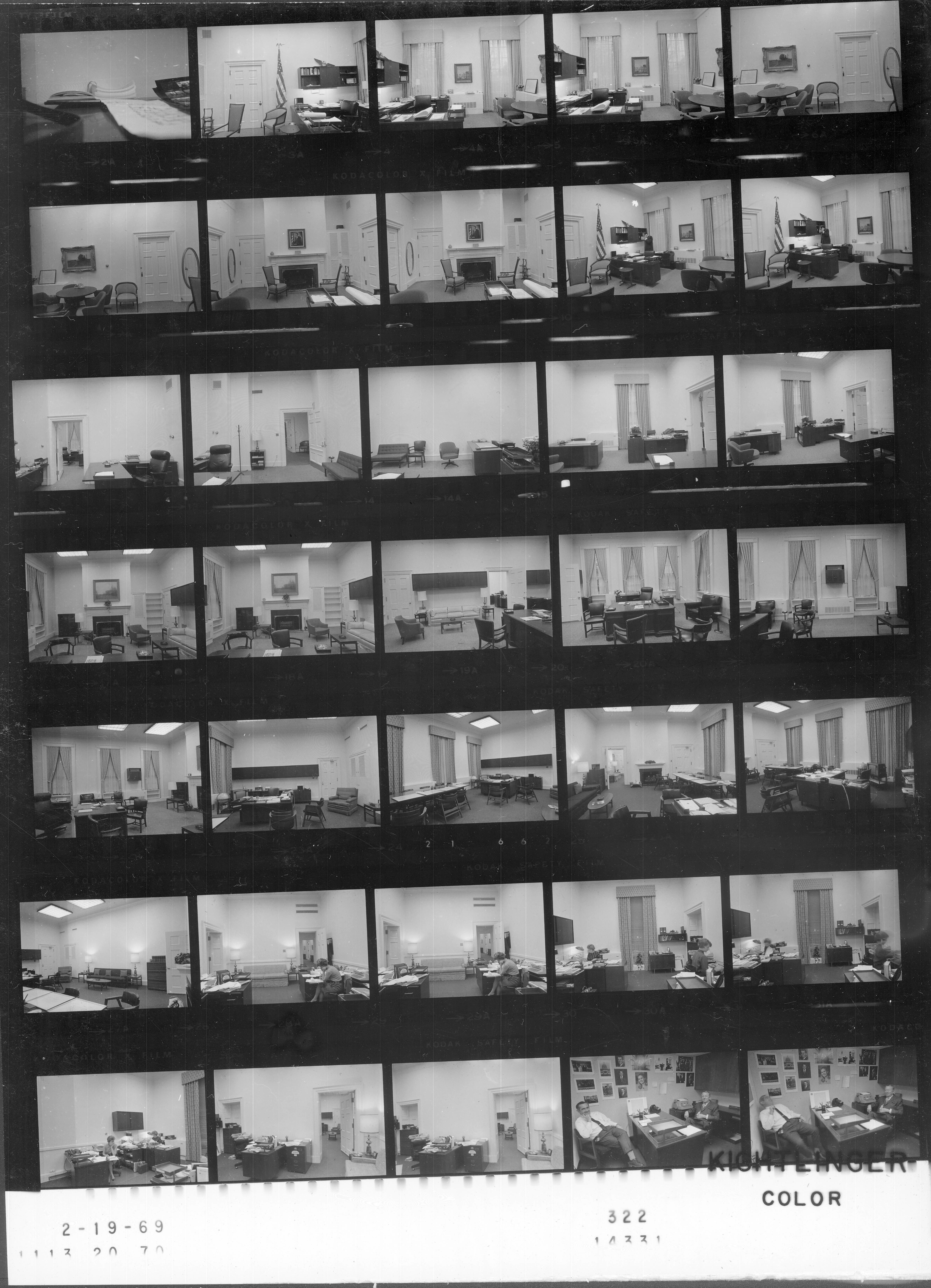
- Frame(s): WHPO-0322-02A, Photo contact sheets and a log book on on shelf in the White House Photo office. 2/19/1969, Washington, D.C. White House, West Wing.
- Frame(s): WHPO-0322-03A-09A, H.R. Haldeman's original office, located next door to the Oval Office, showing the closet that contained Lyndon B. Johnson's electronic recording equipment. Box located in the upper right hand area is the Presidential Locator board. 2/19/1969, Washington, D.C. White House, West Wing.
- Frame(s): WHPO-0322-10A-11A, A male staff member standing talking on the phone at the desk located near a door of H.R. Haldeman's original office, located next door to the Oval Office. 2/19/1969, Washington, D.C. White House, West Wing. unidentified staff member.
- Frame(s): WHPO-0322-12A-28A, 33A-34A, A furnished unoccupied West Wing office. 2/19/1969, Washington, D.C. White House, West Wing.
- Frame(s): WHPO-0322-29A-32A, An unidentified secretary leaning over a folded letter or document making written notations in a West Wing office. 2/19/1969, Washington, D.C. White House, West Wing. unidentified staff secretary.
- Frame(s): WHPO-0322-35A-36A, WHPO staff Photographer Bob Knudsen sits in the White House Photo office talking with office manager Buck May at his desk. Photo prints hang on the wall behind them. 2/19/1969, Washington, D.C. White House, West Wing. Robert L. Knudsen, Buck May.
Roll WHPO-0323 Photographer: Kightlinger, Jack | Color or B&W: Color
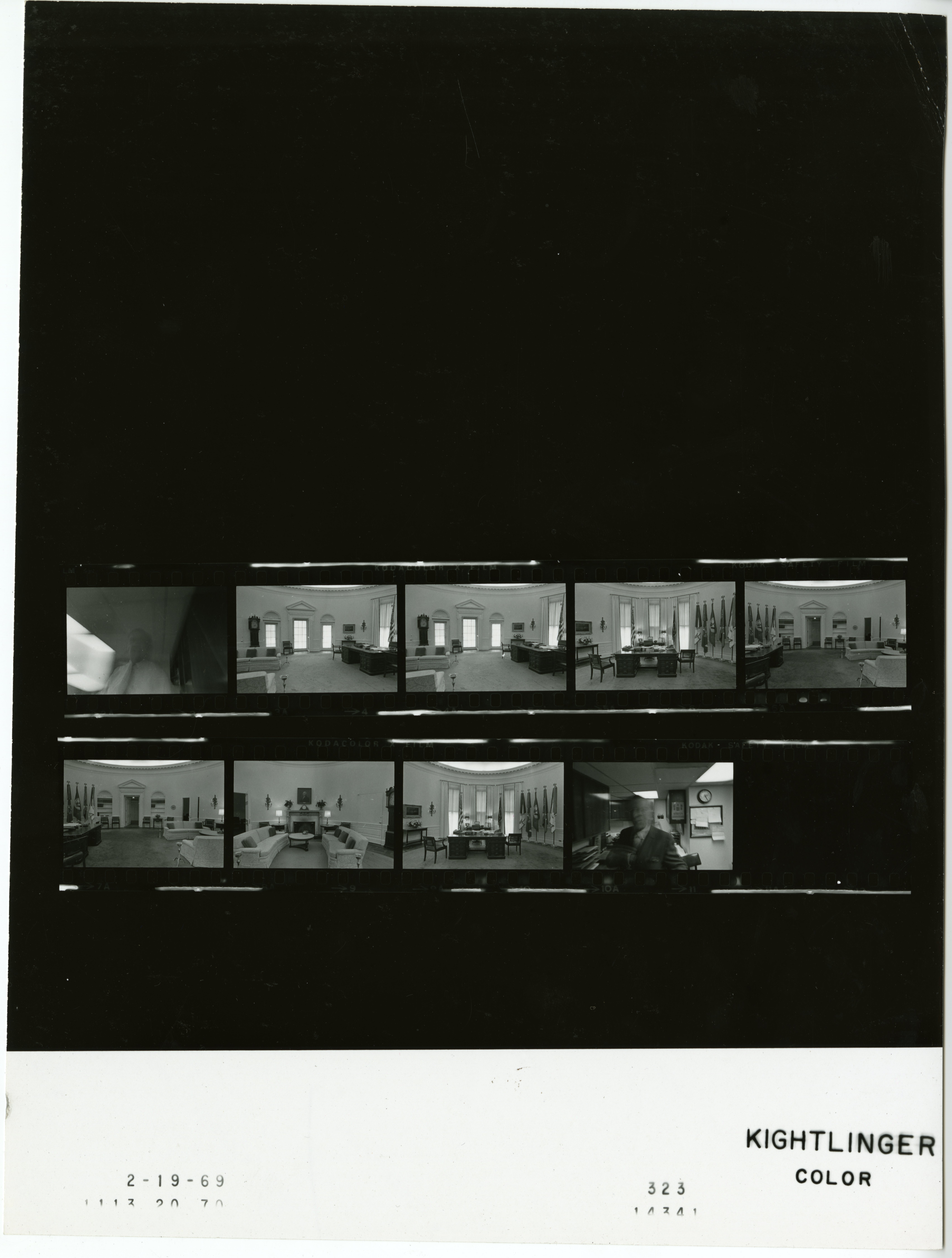
- Frame(s): WHPO-0323-03A-09A, Furnishing in the unoccupied Oval Office: President's Desk, Sofa seating area with standing ashtrays at end of couches, entry doors, three door style windows and alcoves, the wall of flags. 2/19/1969, Washington, D.C. White House, West Wing. none.
Roll WHPO-0324 Photographer: Kightlinger, Jack | Color or B&W: Color
- Frame(s): WHPO-0324-04-07, President Nixon's personal secretary Rose Mary Woods working at her office desk. 2/19/1969, Washington, D.C. White House, West Wing. unidentified staff member.
- Frame(s): WHPO-0324-08-11, President Nixon's personal secretary Rose Mary Woods' office furnishings; sofa and small table or conference area. 2/19/1969, Washington, D.C. White House, West Wing.
Roll WHPO-0325 Photographer: Atkins, Oliver | Color or B&W: B&W
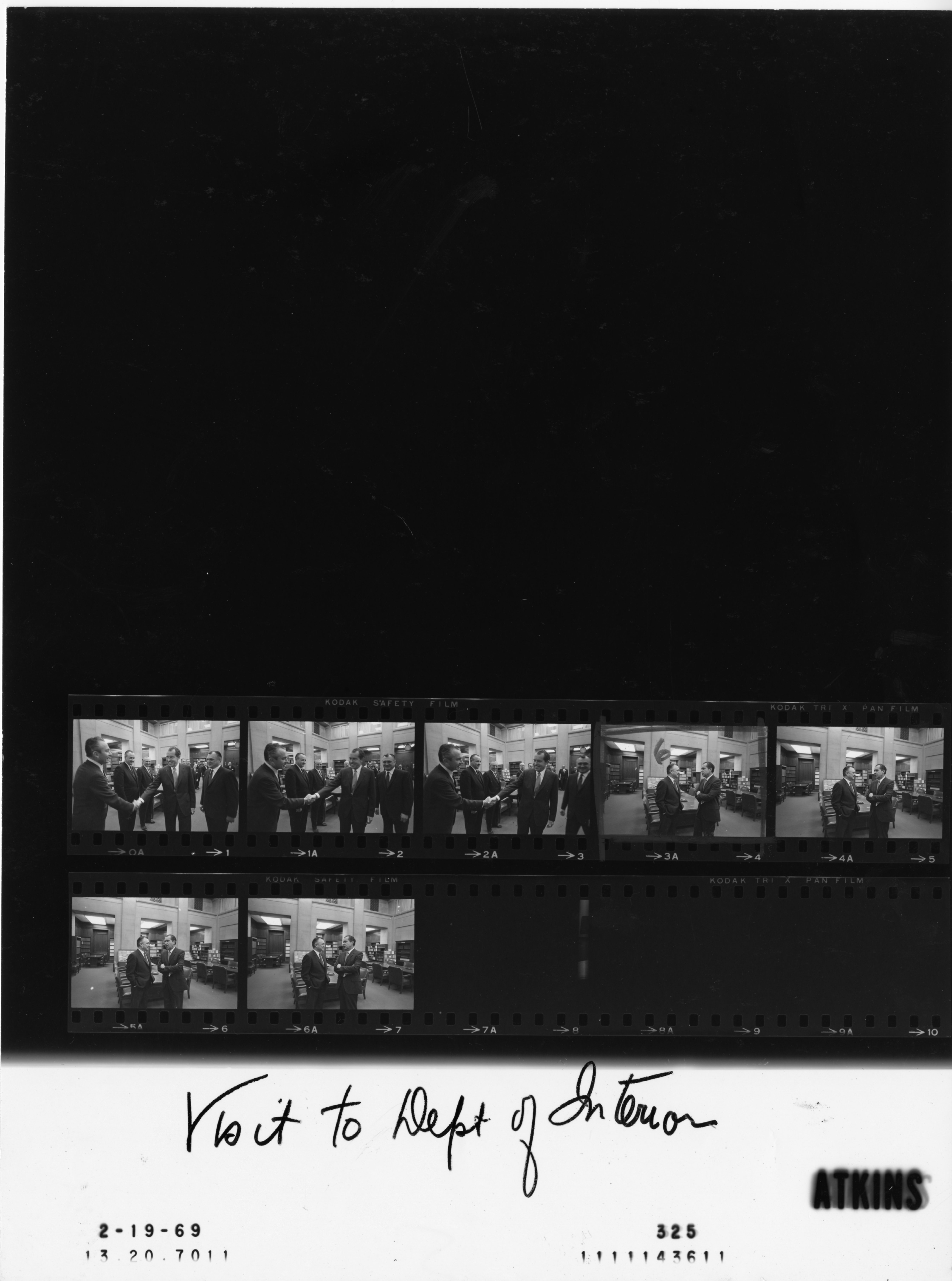
- Frame(s): WHPO-0325-00A-02A, Secretary of the Interior Walter Hickel stands next to President Nixon as he greets officials inside the Department of the Interior building. 2/19/1969, Washington, D.C. Department of the Interior. President Nixon, Walter Hickel, Russell Train, Dr. Carl McMurray, Tom Holley, Josef Holbert, Edgar Kaiser. Jr., and other officials.
- Frame(s): WHPO-0325-03A-06A, Secretary of the Interior Walter Hickel speaking with President Nixon inside the Department of the Interior building. 2/19/1969, Washington, D.C. Department of the Interior. President Nixon, Walter Hickel.
Roll WHPO-0326 Photographer: Atkins, Oliver | Color or B&W: B&W
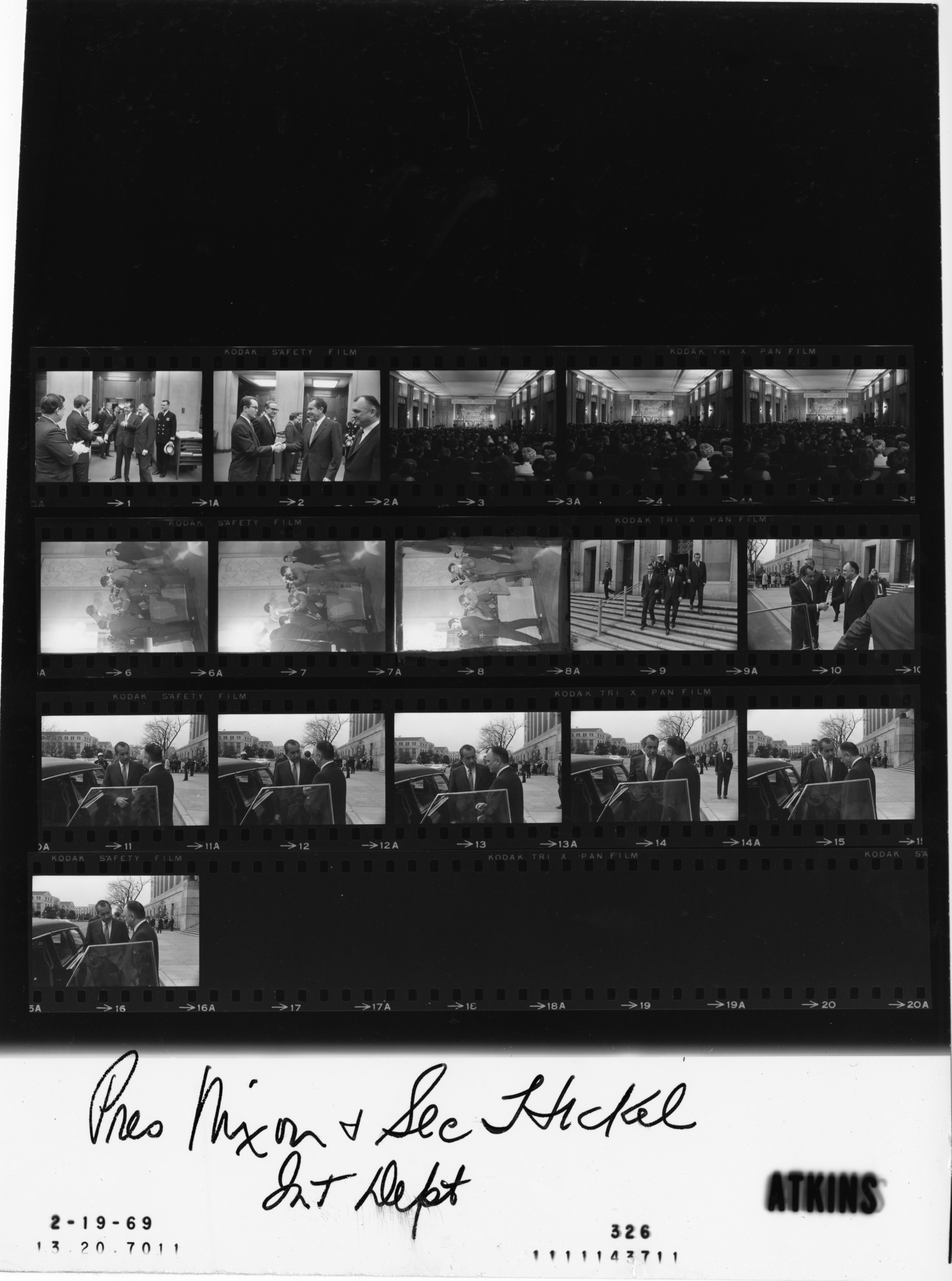
- Frame(s): WHPO-0326-01-02, Secretary of the Interior Walter Hickel stands next to President Nixon as he greets officials inside the Department of the Interior building. 2/19/1969, Washington, D.C. Department of the Interior. President Nixon, Walter Hickel, Russell Train, Dr. Carl McMurray, Tom Holley, Josef Holbert, Edgar Kaiser. Jr., and other officials.
- Frame(s): WHPO-0326-03-05, President Nixon addressing a large auditorium audience in Department of the Interior building, seen from behind the seated audience. 2/19/1969, Washington, D.C. Department of the Interior. President Nixon, Walter Hickel, Interior Department staff members, press photographers.
- Frame(s): WHPO-0326-06-08, Press Corps News photographers with cameras up, taking photos during President Nixon's (unseen) visit to the Department of the Interior building. 2/19/1969, Washington, D.C. Department of the Interior. President Nixon, Walter Hickel, Interior Department staff members, press photographers.
- Frame(s): WHPO-0326-09-16, Secretary of the Interior Walter Hickel escorts President Nixon away from the Department of the Interior building. 2/19/1969, Washington, D.C. Department of the Interior. President Nixon, Walter Hickel.
The White House Communications Agency Sound Recordings Collection contains public statements that took place between 1969 and 1974. Visit the finding aid to learn more.
H - White House Staff Member Recordings
- WHCA-SR-H-007
Remarks by John D. Ehrlichman and Ronald Ziegler to the press concerning the President's European trip. (2/19/1969, Indian Treaty Room, Executive Office Building)
Runtime: 72:00:00
Keywords: Press conferences, news conferences, interviews, media, press secretary
Production credits: Audio feed supplied by WHCA; Recorded by JFB (initials of WHCA engineer)
Original Format: 1/4-inch reel-to-reel audiotape. Original source type: Original.
P - Formal Presidential Remarks
- WHCA-SR-P-690221
Remarks by President Nixon to Employees at the Department of the Interior. (2/19/1969, Department of the Interior.)
Runtime: 0:14:30
Keywords: Environment, clean air
Original Format: 1/4-inch reel-to-reel audiotape. Original source type: Original.
Context (External Sources)
The Vanderbilt Television News Archive is the world's most extensive and complete archive of television news. They have been recording, preserving and providing access to television news broadcasts of the national networks since August 5, 1968.
Wikipedia is a free encyclopedia that anyone can edit.