

Introduction
This almanac page for Wednesday, February 17, 1971, pulls together various records created by the federal government and links to additional resources which can provide context about the events of the day.
Previous Date: Tuesday, February 16, 1971
Next Date: Thursday, February 18, 1971
Schedule and Public Documents
The Daily Diary files represent a consolidated record of the President's activities. Visit the finding aid to learn more.
The President's day began at The White House - Washington, D. C.
The Weekly Compilation of Presidential Documents made available transcripts of the President's news conferences; messages to Congress; public speeches, remarks, and statements; and other Presidential materials released by the White House.
Digitized versions can be found at HathiTrust.
Each Public Papers of the Presidents volume contains the papers and speeches of the President of the United States that were issued by the White House Office of the Press Secretary during the time period specified by the volume. The material is presented in chronological order, and the dates shown in the headings are the dates of the documents or events. In instances when the release date differs from the date of the document itself, that fact is shown in the text note.
To ensure accuracy, remarks have been checked against audio recordings (when available) and signed documents have been checked against the original, unless otherwise noted. Editors have provided text notes and cross references for purposes of identification or clarity.
The Federal Register is the official daily publication for rules, proposed rules, and notices of federal agencies and organizations, as well as executive orders and other Presidential documents.
The Congressional Record is the official daily record of the debates and proceedings of the U.S. Congress.
Archival Holdings
Any selection of archival documents will necessarily be partial. You should use the documents and folders identified below as a starting place, but consult the linked collection finding aids and folder title lists and the collections themselves for context. Many documents to be found this way do not lend themselves to association with specific dates, but are essential to a complete understanding of the material.
Selective document listing
President's Office Files
The President's Office Files consists of materials drawn together by the Special Files Unit from several administrative subdivisions within the White House Office. It is the handwriting and sensitive papers sent to the Staff Secretary that now comprise much of the President's Office Files. Visit the finding aid to learn more.
- Annotated News Summaries, Box 30, News Summaries - February 1971 [1 of 2] [During this period, the Staff Secretary only removed pages from the News Summaries which contained President Nixon's handwriting, often leaving the document with no date. In addition to the individual document(s) listed below, you should also consult the full folder for the month.]
- [2/17/71]
- Annotated News Summaries, Box 30, News Summaries - February 1971 [2 of 2]
- News Summary, February 17, 1971, Television Report (Tuesday Night Telecasts)
- President's Daily Schedule, Box 101, [President's Daily Schedule, Jan.-Feb. 1971] [3 of 3]
- The President's Schedule, Wednesday - February 17, 1971
President's Personal File
The President's Personal File is essentially a President's secretary's file, kept by Rose Mary Woods, personal secretary to the President, for two purposes: (1) preserving for posterity a collection of documents particularly close to the President, whether because he dictated or annotated them, or because of the importance of the correspondent or the event concerned and (2) giving appropriate attention–letters of gratitude, invitations to White House social events, and the like–to members and important friends and supporters of the Nixon administration. This generalization does not describe all the varied materials of a file group which is essentially a miscellany, but it does identify the reason for the existence of the file group's core. Visit the finding aid to learn more.
- President's Speech File
The H. R. Haldeman Diaries consists of seven handwritten diaries, 36 dictated diaries recorded as sound recordings, and two handwritten audio cassette tape subject logs. The diaries and logs reflect H. R. Haldeman’s candid personal record and reflections on events, issues, and people encountered during his service in the Nixon White House. As administrative assistant to the President and Chief of Staff, Haldeman attended and participated in public events and private meetings covering the entire scope of issues in which the Nixon White House engaged in during the years 1969-1973. Visit the finding aid to learn more.
- Transcript of diary entry (PDF)
Wednesday, February 17.
The President was holed up at the EOB all day, getting ready for his press conference, and had hardly any interruptions. He did call once and was particularly interested in talking about the results of a youth poll reported in the news summary today. He was intrigued that it showed that youth want stronger leadership, more fam-- close family ties, and they recognize the need for hard work to achieve success. He feels there's a real problem for us in it, in that their most admired men are JFK, Martin Luther King, and Bobby Kennedy, with Nixon coming in a poor fourth at 9 percent. He felt it was interesting that Teddy was not in this list, however. He thinks this whole study shows that youth is a very vulnerable target for us, and that we ought to be concentrating on our opportunities to reach youth. He also wants us to get going on our poll covering these areas, as well as a thorough analysis of this Gallup Poll.
The press conference was very successful, ran for about 45 minutes in the office. There were about 50 press there. The President did a superb job of taking the questions and encouraging follow-up questions. Practically the whole thing was on Laos and Vietnam, certainly for the full first half. The only domestic questions were on meeting with the black Congressmen, where the President said he hoped it would be worked out; on the integrated housing question, where he said he'd have a recommendation on the Blackjack issue in 30 days. And that then he tried to explain the difference between human rights and economic integration, making the point that we will enforce the law requiring that any human has the right to buy or rent a house where he wants to, if he's able to do it; but we will not use economic force to bring about racial or economic balance within a neighborhood, or to upset the zoning planning for an area. On the economy, he was asked about the construction unions, and made the point that Hodgson is meeting with them over the weekend and will recommend it to him-- recommend action to him on Monday, and that there will be some action. He said the construction business is a sick industry because it has too rich a diet, and made the point that the federal government has $14 billion in expenditures in construction each year and, therefore, we must get into the question.
On Vietnam, regarding the negotiations in Paris, he said they've got to recognize that time is running out if they expect to do any negotiating with the US, because we are about to be out of the war. And he said there would be no more concessions from us at the bargaining table. He covered all the usual questions with the usual answers. There was one question as to whether he was disappointed regarding Congressional reaction to revenue sharing. He said he wasn't disappointed at all, that all reforms have tough sledding, that all institutions and establishments are reluctant to give up their power; but the people are for revenue sharing, so it will eventually be approved by Washington. He said he was surprised at the favorable reaction at the grass roots; it was much greater than he had expected it would be. He let the press conference go on even after they tried to close it off, and it ended, I think, with a very good feeling.
I had a session this afternoon with Mitchell and Finch on political structure, trying to get Finch's role pinned down. I had had a long meeting with Finch this morning on the same subject. It's very tough to get him down to specifics, but Mitchell laid out the basic format very clearly, and I think we at least made some progress.
Henry was in, agonizing over his TV problem. It appears that Klein wants somebody on for a special full hour of Face the Nation after the State of the World next week, and Henry, of course, wants to go on himself but professes to believe, as I do, that he can't. He's obviously violently opposed to Laird and/or Rogers going on, not for any valid reason, but because he's afraid they'll louse up his report and/or take credit for it. Unfortunately, there's no way of talking him out of this line of thinking, and the net result probably will be that we won't have anybody go on. We'll try to use the time for domestic policy.
End of February 17. - Original audio recording (MP3)
The National Archives Catalog is the online portal to the records held at the National Archives, and information about those records. It is the main way of describing our holdings and also provides access to electronic records and digitized versions of our holdings.
The Catalog searches across multiple National Archives resources at once, including archival descriptions, digitized and electronic records, authority records, and web pages from Archives.gov and the Presidential Libraries. The Catalog also allows users to contribute to digitized historical records through tagging and transcription.
Nixon Library Holdings
All National Archives Units
National Security Documents
The President's Daily Brief is the primary vehicle for summarizing the day-to-day sensitive intelligence and analysis, as well as late-breaking reports, for the White House on current and future national security issues. Read "The President's Daily Brief: Delivering Intelligence to Nixon and Ford" to learn more.
The Foreign Relations of the United States series presents the official documentary historical record of major U.S. foreign policy decisions and significant diplomatic activity. Visit the State Department website for more information.
Vol. V, United Nations, 1969-1972
Chinese Representation in the United Nations
330. Telegram From the Department of State to Certain Posts, Washington, February 17, 1971, 2157Z
Source: National Archives, RG 59, Central Files 1970–73, UN 6 CHICOM. Secret. Drafted by Feldman; cleared by Armitage, John A. Froebe, Jr., and Shoesmith; and approved by Deputy Assistant Secretary Herz. Sent to Canberra, Tokyo, and Wellington and repeated to USUN, Taipei, and Hong Kong.
Vol. XIII, Soviet Union, October 1970-October 1971
"A Key Point in Our Relationship": Backchannel Talks on SALT, Berlin, and the Summit
116. Transcript of a Telephone Conversation Between President Nixon and the President’s Assistant for National Security Affairs (Kissinger), Washington, February 17, 1971, 9:20 a.m.
Source: National Archives, Nixon Presidential Materials, Henry Kissinger Telephone Conversation Transcripts, Box 8, Chronological File. No classification marking.
Vol. XXI, Chile, 1969-1973
Cool and Correct: The U.S. Response to the Allende Administration, November 5, 1970-December 31, 1972
206. Minutes of a Meeting of the Senior Review Group, Washington, February 17, 1971, 3:30-3:58 p.m.
Source: National Archives, Nixon Presidential Materials, NSC Files, NSC Institutional Files (H-Files), Box H–52, SRG Meeting, Chile, 2/17/71. Secret; Nodis. The meeting took place in the White House Situation Room. A copy was sent to Nachmanoff, Kennedy, and Bergsten. All brackets are in the original.
Vol. XXVIII, Southern Africa
Regional Issues
45. Memorandum From the Assistant Secretary of State for African Affairs (Newsom) and the Department of State Legal Adviser (Stevenson) to Secretary of State Rogers, Washington, February 17, 1971
Source: National Archives, RG 59, Central Files 1970–73, LAB 10 S AFR. Limited Official Use. Drafted by Keiter on February 13 and cleared in AF/S, L/AF, and AF.
Vol. XXIX, Eastern Europe, 1969-1972
Yugoslavia
223. Telegram From the Embassy in Yugoslavia to the Department of State, Belgrade, February 17, 1971, 1207Z
Source: National Archives, Nixon Presidential Materials, NSC Files, Box 733, Country Files—Europe, Yugoslavia, Vol. II Aug 70–Aug 71. Secret; Priority; Exdis.
Vol. XL, Germany and Berlin, 1969-1972
Germany and Berlin, 1969-1972
184. Memorandum From Helmut Sonnenfeldt of the National Security Council Staff to the President’s Assistant for National Security Affairs (Kissinger), Washington, February 17, 1971
Source: National Archives, Nixon Presidential Materials, NSC Files, Kissinger Office Files, Box 58, Country Files, Europe, Berlin, Vol. 1. Secret. Sent for information. Kissinger initialed the memorandum indicating that he had seen it.
Vol. E-5, Part 1, Documents on Sub-Saharan Africa, 1969-1972
Uganda
244. Telegram 641 From the Embassy in Uganda to the Department of State, Kampala, February 17, 1971, 1105Z
Ambassador Ferguson reported that all contacts had been reduced following the coup; he recommended developing contacts at the ministerial level to begin new business relations.
Source: National Archives, RG 59, Central Files 1970–73, POL Uganda-US. Confidential; Priority.245. Telegram 27102 From the Department of State to the Embassy in Uganda, Washington, February 17, 1971, 0126Z
The Department agreed with the Embassyʼs view, but wanted to delay formal public actions that might prejudice African acceptance of the new Ugandan Government or in any way add to problems threatening the future of the East African community.
Source: National Archives, RG 59, Central Files 1970–73, POL Uganda-US. Confidential. Drafted by Kinter (AF/E); cleared in AF/C, L/AF, AF/E, AID/AFR/ESA, AID/AFR/GC, A/OS, and by Moore; and approved by Newsom.
Vol. E-7, Documents on South Asia, 1969-1972
India and Pakistan: Pre-Crisis, January 1969-February 1971
116. Letter From President Nixon to Pakistani President Yahya, Washington, February 17, 1971
Nixon responded to Yahya’s request for U.S. mediation in Pakistan’s dispute with India over a hijacking incident. He noted that the U.S. Government had discussed the incident with the Indian and Pakistani Governments but suggested that a multilateral approach to mediation through the International Civil Aviation Organization might prove more fruitful.
Source: National Archives, Nixon Presidential Materials, NSC Files, Box 759, Presidential Correspondence File, Pakistan (1971). No classification marking. On February 23 Yahya wrote to Nixonagain and, citing the effects of the prohibition of overflights of Indian territory on contacts between the two wings of Pakistan, reiterated his request that Nixon take a personal interest in the dispute. (Ibid.)
Vol. E-10, Documents on American Republics, 1969-1972
Guatemala
349. Telegram 634 From the Embassy in Guatemala to the Department of State, February 17, 1971, 0020Z., February 17, 1971, 0020Z
Ambassador Davis reported his encounters with President Arana and Foreign Minister Herrera at a diplomatic dinner the day after he had conveyed the Department of State’s concerns regarding Guatemala’s counterinsurgency activities. President Arana appealed for help, while Herrera responded by alluding somewhat unflatteringly to State Department.
Source: National Archives, Nixon Presidential Materials, NSC Files, Box 785, Country Files, Latin America, Guatemala, Vol. I. Secret; Exdis. A stamped notation on the telegram indicates it was received in the White House Situation Room on February 17 at 8:21 a.m. In telegram 809 from Guatemala City, February 26, Davis reported the arrival of two U.S. journalists on the wake of his meetings with Arana and Herrera and suggested, “GOG may get idea—which they will of course deeply resent—that we issued private warning, they responded, and we disregarded response and socked them.” (Ibid.) In telegram 035575 to Guatemala City, March 3, the Department noted its main motive was to try to help anticipate such critical press interest and avoid damage to Guatemala’s image and prestige. (Ibid.)
Guyana
372. Telegram 207 From the Embassy in Guyana to the Department of State, February 17, 1971, 2150Z., February 17, 1971, 2150Z
According to Ambassador King, former Supreme Court Justice Arthur Goldberg discussed with Prime Minister Burnham the negative economic effects of the nationalization of the bauxite industry for Guyana’s economy. Goldberg raised the possibility that Reynolds might construct processing facilities in Guyana, and Burnham showed interest.
Source: National Archives, Nixon Presidential Materials, NSC Files, Box 785, Country Files, Latin America, Guyana, Vol. 1. Secret; Exdis; Priority. Justice Goldberg requested that this message be give no foreign dissemination. After Burnham’s conversation with Goldberg, Burnham decided not to nationalize Reynolds, but would nationalized DEMBA. (Telegram 204 from Georgetown, February 17, ibid.)
Panama
544. Memorandum From Arnold Nachmanoff of the National Security Council Staff to the President’s Assistant for National Security Affairs (Kissinger), Washington, February 17, 1971., Washington, February 17, 1971
National Security Council staff member Nachmanoff recommended that President’s Assistant for National Security Affairs Kissinger approve for President Nixon the text of Special Representative for U.S.-Panama Relations Anderson’s reply to Ambassador de la Ossa. The letter states that for the United States the defense and efficient operation of the Canal are very important, and suggests further discussions be held.
Source: National Archives, Nixon Presidential Materials, NSC Files, Box 792, Country Files, Latin America, Panama, Atlantic-Pacific International Ocean Canal Study Commission, Vol. 1, 1971. Secret. Sent for action. Haig initialed for Kissinger and initialed his approval for Kissinger. Attached but not published are Tabs A and B. Tab A is the draft letter to de la Ossa and Tab B is a February 10 letter from Anderson to Nixon. The final version of Anderson’s letter to de la Ossa was not found.
The Kissinger telephone conversation transcripts consist of approximately 20,000 pages of transcripts of Kissinger’s telephone conversations during his tenure as Assistant to the President for National Security Affairs (1969-1974) and Secretary of State (1973-1974) during the administration of President Richard Nixon. Visit the finding aid for more information.
Digitized versions can be found in the National Archives Catalog.
Audiovisual Holdings
The White House Tapes are sound recordings of President Richard Nixon's telephone conversations and of meetings held in the Oval Office and the Cabinet Room in the White House, the President's office in the Old Executive Office Building (OEOB), the Lincoln Sitting Room in the residence section of the White House, and several locations at the Presidential retreat at Camp David, Maryland. These recordings document many of the major events and decisions of the Nixon Administration from February 16, 1971 to July 18, 1973. Visit the White House Tapes finding aid to learn about the taping system's operation and archival processing.
Oval Office
- 450-19; Unknown between 12:00 a.m. & 4:04 p.m.; Nixon, Richard M. (President); Ziegler, Ronald L.
- 450-20; 4:04 p.m. - 4:51 p.m.; Nixon, Richard M. (President); White House photographer
- 450-21; 4:52 p.m. - 5:24 p.m.; Nixon, Richard M. (President); Scheel, Walter; Rogers, William P.; Kissinger, Henry A.; White House photographer
- 450-22; 5:25 p.m. - 5:26 p.m.; Nixon, Richard M. (President); Ziegler, Ronald L.
- 450-23; 5:26 p.m. - 5:53 p.m.; Nixon, Richard M. (President); Ehrlichman, John D.; Evans, Daniel J.; White House photographer; Bull, Stephen B.
- 450-24; 5:53 p.m. - 5:59 p.m.; Nixon, Richard M. (President); Chapin, Dwight L.
- 450-25; 6:20 p.m. - 6:32 p.m.; Nixon, Richard M. (President); Haldeman, H. R. ("Bob"); Ziegler, Ronald L.
The White House Photo Office collection consists of photographic coverage of President Richard Nixon meeting with prominent social, political, and cultural personalities; speaking engagements and news conferences of the President and various high-ranking members of the White House staff and Cabinet; Presidential domestic and foreign travel, including Presidential vacations; social events and entertainment involving the First Family, including entertainers present; official portraits of the President, First Family, and high-ranking members of the Nixon administration; the 1969 and 1973 Inaugurals; the President’s 1972 Presidential election campaign appearances (including speeches) and other official activities of the White House staff and the President’s Cabinet from January 20, 1969 until August 9, 1974 at the White House and the Old Executive Office Building; other locations in Washington, DC, such as The Mall; and the Presidential retreats in Camp David, Maryland, Key Biscayne, Florida, and San Clemente, California. Visit the finding aid to learn more.
Roll WHPO-5678 Photographer: Atkins, Oliver | Color or B&W: B&W
- Frame(s): WHPO-5678-02-19, Pat Nixon sitting for a coin sculpture by the Philadelphia Mint. 2/17/1971, Washington, D.C. White House, Yellow Oval Room. Pat Nixon, sculptor, unidentified men.
Roll WHPO-5679 Photographer: Atkins, Oliver | Color or B&W: Color
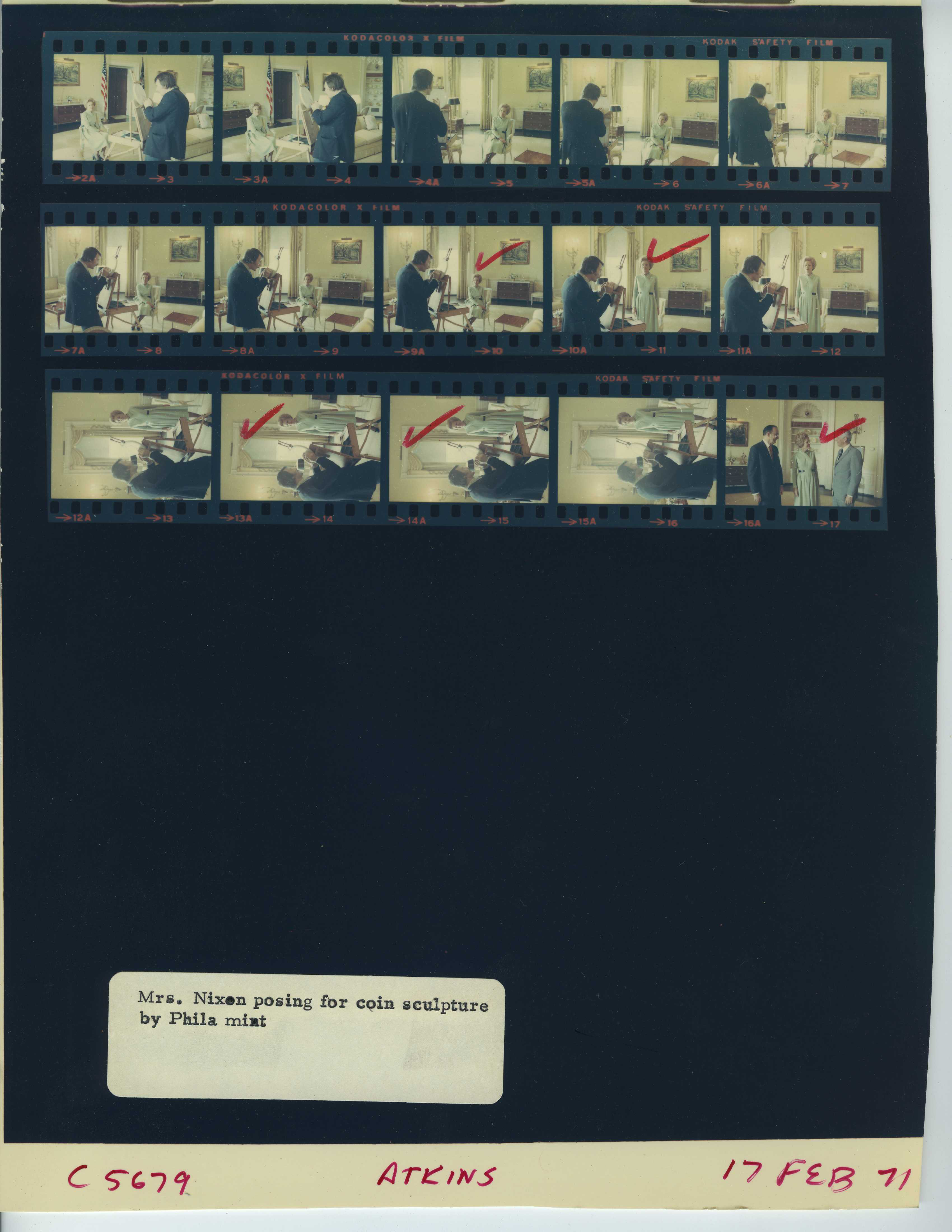
- Frame(s): WHPO-5679-02A-16A, Pat Nixon sitting for a coin sculpture by the Philadelphia Mint. 2/17/1971, Washington, D.C. White House, Yellow Oval Room. Pat Nixon, sculptor, unidentified men.
Roll WHPO-5680 Photographer: Kightlinger, Jack | Color or B&W: B&W
- Frame(s): WHPO-5680-03A-10A, President Nixon seated informally in the Oval Office during a meeting with German Foreign Minister Walter Scheel and Secretary of State William Rogers. 2/17/1971, Washington, D.C. White House, Oval Office. President Nixon, William Rogers, Walter Scheel, Daniel Evans.
- Frame(s): WHPO-5680-10A, President Nixon seated informally in the Oval Office during a meeting with German Foreign Minister Walter Scheel and Secretary of State William Rogers. 2/17/1971, Washington, D.C. White House, Oval Office. President Nixon, William Rogers, Walter Scheel, Daniel Evans.
- Frame(s): WHPO-5680-11A-15A, President Nixon sitting with State of Washington Governor Daniel Evans. 2/17/1971, Washington, D.C. White House, Oval Office. President Nixon, William Rogers, Walter Scheel, Daniel Evans.
Roll WHPO-5681 Photographer: Kightlinger, Jack | Color or B&W: B&W
- Frame(s): WHPO-5681-03-07, President Nixon sitting with William Rogers, Walter Scheel, Henry Kissinger, and another man. 2/17/1971, Washington, D.C. White House, Oval Office. President Nixon, William Rogers, Walter Scheel, Henry Kissinger, unidentified man.
- Frame(s): WHPO-5681-08-09, President Nixon talking with photographers. 2/17/1971, Washington, D.C. White House, Oval Office. President Nixon, photographers.
Roll WHPO-5682 Photographer: Kightlinger, Jack | Color or B&W: Color
- Frame(s): WHPO-5682-03-09, President Nixon and Pat Nixon greeting singing groups from the four service academies, entertainment for a Military Reception. 2/17/1971, Washington, D.C. White House, East Room. President Nixon, Pat Nixon, service academy singers.
- Frame(s): WHPO-5682-10-17, President Nixon with singing groups from the four service academies, entertainment for a Military Reception. 2/17/1971, Washington, D.C. White House, East Room. President Nixon, Pat Nixon, service academy singers.
Roll WHPO-5692 Photographer: Schumacher, Karl | Color or B&W: B&W
- Frame(s): WHPO-5692-03-09, President Nixon sitting informally with German Foreign Minister Walter Scheel, William Rogers, and an unidentified man. 2/17/1971, Washington, D.C. White House, Oval Office. President Nixon, Walter Scheel, William Rogers, unidentified man, press corps members.
The White House Communications Agency Sound Recordings Collection contains public statements that took place between 1969 and 1974. Visit the finding aid to learn more.
J - Entertainment at the White House
- WHCA-SR-J-144
Entertainment at a military reception [see P-710218]. (2/17/1971)
Runtime: 39:45:00
Keywords: Musician, musicians, music, celebrities, performance
Original Format: 1/4-inch reel-to-reel audiotape. Original source type: Original.
P - Formal Presidential Remarks
- WHCA-SR-P-710218
Remarks by President Nixon at military reception [see J-144]. (2/17/1971)
Runtime: 9:07
Original Format: 1/4-inch reel-to-reel audiotape. Original source type: Original.
The White House Communications Agency Videotape Collection contains “off-the-air” recordings of televised programs produced between 1968 and 1974. Visit the finding aid to learn more.
- WHCA-4181
"The Mike Douglas Show" with guest Sen. Hubert Humphrey.
Runtime: 00:59:52 - WHCA-4182
"Claire". Pearl Bailey.
Undetermined
Runtime: 01:01:19 - WHCA-4184
Weekly News Summary, Tape I.
ALL NETWORKS
Runtime: 1:30
26. Sm/Jarriel/Reasoner: White House comment on Laos with Vietnam report. Time Code Start: 61:09. Keywords: Laos, Vietnam War. Network: ABC.
27. Tuckner: Helicopter pilots in Laos. Time Code Start: 62:49. Keywords: Laos, Vietnam War. Network: ABC.
28. Smith: Secretary Connelly asks Congress for new ceiling on the National Debt and the economy and construction prices. Time Code Start: 66:02. Keywords: cabinet, advisors, speeches, economic, budgets, jobs, unemployment, labor, buildings, housing, wages, costs, debt, ceilings. Network: ABC.
29. Smith: Commentary on the Laos push. Time Code Start: 67:23. Keywords: Laos, Vietnam War. Network: ABC.
30. Chancellor: President Nixon's comments on Laos. Time Code Start: 69:07. Keywords: Presidents, speeches, Laos, Vietnam War. Network: NBC.
31. Lewis: Indochina. Time Code Start: 69:52. Keywords: Laos, Cambodia, Vietnam War. Network: NBC.
32. Chancellor: President Nixon and construction wages and prices. Time Code Start: 72:48. Keywords: Presidents, speeches, jobs, unemployment, labor, buildings, housing, wages, costs. Network: NBC.
33. Cronkite/Rather: President Nixon's statement on Indochina. Time Code Start: 73:51. Keywords: Presidents, speeches, Laos, Cambodia, Vietnam War. Network: CBS.
34. Cronkite: Construction wages and prices. Time Code Start: 76:36. Keywords: jobs, unemployment, labor, buildings, housing, wages, costs. Network: CBS. - WHCA-4211
Excerpts From the "NBC Nightly News" Indochina War Coverage, Tape I (Weekly News Summary).
NBC
42. Newman: President Nixon at press conference takes strong stand on peace negotiations. Time Code Start: 46:30. Keywords: Presidents, speeches, statements, media, press conferences, news conferences, interviews. Network: NBC.
43. Lewis: U.S. helicopters meet heavy anti-aircraft fire. Time Code Start: 47:25. Keywords: Vietnam war, helicopters, aircraft,. Network: NBC.
Context (External Sources)
The Vanderbilt Television News Archive is the world's most extensive and complete archive of television news. They have been recording, preserving and providing access to television news broadcasts of the national networks since August 5, 1968.
Wikipedia is a free encyclopedia that anyone can edit.