

Introduction
This almanac page for Friday, February 16, 1973, pulls together various records created by the federal government and links to additional resources which can provide context about the events of the day.
Previous Date: Thursday, February 15, 1973
Next Date: Saturday, February 17, 1973
Schedule and Public Documents
The Daily Diary files represent a consolidated record of the President's activities. Visit the finding aid to learn more.
The President's day began at The White House - Washington, D. C.
The Weekly Compilation of Presidential Documents made available transcripts of the President's news conferences; messages to Congress; public speeches, remarks, and statements; and other Presidential materials released by the White House.
Digitized versions can be found at HathiTrust.
Each Public Papers of the Presidents volume contains the papers and speeches of the President of the United States that were issued by the White House Office of the Press Secretary during the time period specified by the volume. The material is presented in chronological order, and the dates shown in the headings are the dates of the documents or events. In instances when the release date differs from the date of the document itself, that fact is shown in the text note.
To ensure accuracy, remarks have been checked against audio recordings (when available) and signed documents have been checked against the original, unless otherwise noted. Editors have provided text notes and cross references for purposes of identification or clarity.
The Federal Register is the official daily publication for rules, proposed rules, and notices of federal agencies and organizations, as well as executive orders and other Presidential documents.
Archival Holdings
Any selection of archival documents will necessarily be partial. You should use the documents and folders identified below as a starting place, but consult the linked collection finding aids and folder title lists and the collections themselves for context. Many documents to be found this way do not lend themselves to association with specific dates, but are essential to a complete understanding of the material.
Selective document listing
President's Office Files
The President's Office Files consists of materials drawn together by the Special Files Unit from several administrative subdivisions within the White House Office. It is the handwriting and sensitive papers sent to the Staff Secretary that now comprise much of the President's Office Files. Visit the finding aid to learn more.
- News Summaries, Annotated News Summaries, Box 42, Feb. 8-17, 1973 [7 of 7] [Note: Due to the way News Summary products were compiled, you should also consult nearby days for potentially relevant materials.]
- News Summary, February 16, 1973, (Thursday nets, wires & columns)
The H. R. Haldeman Diaries consists of seven handwritten diaries, 36 dictated diaries recorded as sound recordings, and two handwritten audio cassette tape subject logs. The diaries and logs reflect H. R. Haldeman’s candid personal record and reflections on events, issues, and people encountered during his service in the Nixon White House. As administrative assistant to the President and Chief of Staff, Haldeman attended and participated in public events and private meetings covering the entire scope of issues in which the Nixon White House engaged in during the years 1969-1973. Visit the finding aid to learn more.
- Transcript of diary entry (PDF)
Friday, February 16th. The President had a Cabinet meeting today. He opened the meeting, referring to the VP's trip and then left to meet with Sir Christopher Soames while the VP gave the report on his trip. He did a pretty good job, taking about a half hour to paint the overall picture. Regarding Thieu, he said he's in good shape, positive, would win with an 85 percent vote on an election held today. A much better position than his image in the United States shows. And the VP urged him to try and improve his image in the US Told him he ought to consider addressing the American people when he comes over here, and he ought to talk to people, thank the American people, lay a wreath at Arlington, and so on.
-------------------------------------------------------------------------------------------------------------------
DECLASSIFIED - E.O. 13526, Sect. 3.4: by MS, NARA, June 12, 2013
Audio Cassette 31, Side A, Withdrawn Item Number 3 [AC-31(A) Sel 2-1]
Duration: 1 minute 35 seconds
Cambodia, he says, is the most discouraging of the countries. Lon Nol has serious physical and political problems. Insurgency there has grown greatly; it's diverse and fragmentary, but the government only controls one-third of the country. They have a bad army and there's a lot of corruption. In Laos, Phouma was optimistic regarding the Pathet Lao and the cease-fire. Thailand were cagey neutrals, but pro-US, at least in the form of Thanom, the Prime Minister. Thanom is afraid the US doesn't have the resolution to carry out the Nixon Doctrine, so he's reluctant to openly support us. They're all afraid that we're withdrawing from the area.
In Singapore, Lee Kuan Yew said the ballgame was over in Indochina if Nixon hadn't responded to the May invasion; May 8th is what held Indochina together. Indonesian, not too strong of the US Suharto is in constant battle with Malik. Our total aid to them is $500 million or, I think, the total foreign aid they're getting is $500 million and the US provides one-third of this. They can't develop their assets; their population is located badly. Malaysia, he was very impressed. There's a good structure there. They're neutralist, but, they understand the US presence and want it. The Philippines there's great political instability in spite of Marcos moves; the religious problem with the Muslim insurrection. They're worried about continued US assistance; they're in a good position now. And he got a very cordial reception there.
-------------------------------------------------------------------------------------------------------------------
He summarized by saying there's great fear that the US won't carry out the Nixon Doctrine, because Congress will cut off the aid money. They’re afraid we'll withdraw completely and militarily. If we get out, the Communists will build and they'll fall. They want more aid than we're giving.
-------------------------------------------------------------------------------------------------------------------
DECLASSIFIED - E.O. 13526, Sect. 3.4: by MS, NARA, June 12, 2013
Audio Cassette 31, Side A, Withdrawn Item Number 3 [AC-31(A) Sel 2-2]
Duration: 21 seconds
But, they won't give up China-Soviet trade. Lee Kuan Yew is concerned about Australia and New Zealand softening and going socialist, but he thinks they'll live-up, they’ll line-up, when the going gets tough…
-------------------------------------------------------------------------------------------------------------------
...and they are making economic progress in the area, and stability is building. If they can get help, they can take over for themselves. If we help enough, the Communists can't take over. If we do cut back, it could stir insurrection; it will depend on the Nixon Doctrine. They need a lot of money, but that's cheaper than military involvement.
Rogers then made the point that, of what would have happened if the President had not done what he did, their problems, and that their problems aren't as great as they indicate. Then there was some discussion about aid to North Vietnam.
-------------------------------------------------------------------------------------------------------------------
DECLASSIFIED - E.O. 13526, Sect. 3.4: by MS, NARA, June 12, 2013
Audio Cassette 31, Side A, Withdrawn Item Number 3 [AC-31(A) Sel 2-3]
Duration: 57 seconds
At that point, the President came in and brought Christopher Soames in with him and let him speak for a moment. Soames emphasized that the European Community must come out politically right. And then explained that the UK got out of their adverse trade balanced by getting off their behinds and selling and doing better in the world markets. And the US, it all came too easy to you. Then he talked about how the Japs have moved into Europe. They take sections of the market in different countries. For example, they killed Zeiss in eighteen months. In Denmark, they moved in on heavy earth-moving equipment. Now they're moving in on autos in Britain. So we should move into the Japanese market and force them to enable us to do so. He hopes our attitude towards the trade bill is as a trade liberalization bill even though we have to have safeguards. Regarding Europe, we should think about the doors that are openable rather than those that have to be locked.
-------------------------------------------------------------------------------------------------------------------
The President then said we have to recognize that political leaders have strengthened, have strong isolationist feelings to deal with; that we must not pander to that. Nothing would be more harmful than to allow an economic confrontation to become so violent as to deteriorate the political and military situation.
-------------------------------------------------------------------------------------------------------------------
DECLASSIFIED - E.O. 13526, Sect. 3.4: by MS, NARA, June 12, 2013
Audio Cassette 31, Side A, Withdrawn Item Number 3 [AC-31(A) Sel 2-4]
Duration: 31 seconds
Shultz made the point regarding the international economy that in answering Soames' pitch that they have to unlock some of the doors—this was after Soames had left. The President said the fundamental problem is our companies, with, with a vigorous program of trade on a competitive basis, Japan, that's what we need to develop. Japan today is not being a good partner, and Tanaka is not being a good ally.
-------------------------------------------------------------------------------------------------------------------
If we become the fortress America, economically, we would again become a fortress America, militarily and politically, and that would destroy us. There was considerable discussion then on the international economic situation. The President made an aside to Richardson as it was going on, “Isn't this a fascinating discussion?”
The President explained the importance of trade and said there's, we only have 4 percent exports, but those are the cream, and we need them. There was then some joke about haircuts and the fact that American barbers are in real economic trouble.
The President made a pitch about the need for less sophisticated planes and so forth for the smaller countries to fight their limited wars, not just what we need to fight the Soviet Union. The President directed all this to the CIEP, that the highest priority and the whole question of how US companies can be encouraged to develop foreign trade. We're the only nation in the free world now that looks outward, while two major nations in the Communist world do this. The President made the point that our desire is not to build a protectionist wall, it's a freer flow of trade of investment, but we must not jeopardize American jobs and business, so we need the right of the President to go in and bargain, so that we get a fair shake abroad for American products and American labor.
The President then talked about aid to North Vietnam and amnesty, and told Rogers to circulate what he had said on the Hill. On aid, the President will probably have a press conference and cover that. The press says that it's a difficult sale to make, but there's no need to wring hands. Remember 27 years ago with the Marshall Plan, the conservatives opposed aid, and liberals supported it, now it's just the opposite. But the aid worked with the Japanese and the Germans. Now look at North Vietnam. The problem is 45,000 Americans killed, POW's mistreated, and so forth, so now the liberals are against aid for the same reason that the conservatives opposed it in '47. No foreign aid until we solve the problems in this country, no aid for North or South Vietnam unless we restore the budget cuts for the ghettos, and so on. The old Internationalists have become the new Isolationists; those who damned the US being in the war and supported North Vietnam in the war, are now opposing aid to North Vietnam, a curious switch. The only dollars we can justify abroad are where they serve the interests of the United States. An assistance program for Vietnam will be to serve US interests, to create a peace that can last awhile. It’s not a question of reparations or humanitarian interests. The motivation is the same as after World War II; help our enemies, because it's better to do that then to leave them as Communist targets. We should help North Vietnam because the US is in a position to draw them inward and have influence on them in the future. If we have no leverage, we have no influence. The Russians and the Chinese can help, but we, they can't get caught at it. We'll have to tell them now not to make up their minds; they don't know what, or why we're asking for it—that is the Congress and the opponents. The Republican line is that we won't do it alone; we'll get the Japanese and so forth into it. The President asked all the Cabinet to take Rogers's line. Don't try to win them, because we hate North Vietnam, just sell our interest which is for peace.
-------------------------------------------------------------------------------------------------------------------
DECLASSIFIED - E.O. 13526, Sect. 3.4: by MS, NARA, June 12, 2013
Audio Cassette 31, Side A, Withdrawn Item Number 3 [AC-31(A) Sel 2-5]
Duration: 38 seconds
The Vice President questioned whether the Soviets could do aid for South Vietnam on a multilateral basis. Several countries will participate. But multilateral aid doesn't give the US the stroke which is our objective. We need the ability to influence North Vietnam. This is in the interest of the United States bilaterally and we don’t want Soviets to help to South Vietnam, because there would, although there will be a lot of interest of other nations to help. We should think in terms of Indochina for all nations, but we need the stroke of North Vietnam ourselves. The President then said that we're dealing with a maniacal introverted bunch of people up there in North Vietnam.
-------------------------------------------------------------------------------------------------------------------
LBJ and Rusk stated that the policy was we would assist, and Nixon did too. On where the money's coming from, we don't know the plan yet, but we have to say that the money for this is not going to shortchange American domestic programs in the United States. We can handle this in the national security complex.
The Cabinet meeting adjourned at that point.
Roy Ash, earlier in the staff meeting, had raised some ideas on the whole budget thing. He says we can bring a group of factors together to put together a package. We have the problem of base closings, which are required by the Defense budget cuts; number two, the money for North Vietnam; number three, the problem is we can't make our budget; number four, that we've conceded on such things as veterans' emergency loans, and so on; and number five, we could get some help on the Hill if we go at things right. So we should package up the second round on the budget, bring in a few good Congressmen and Senators, and try to put the whole thing together. We had a Brennan problem stirring today, as he is getting more and more frustrated on his personnel situation, and the President agreed to take him to Florida with him on his plane, so that helped. The President left right after the Cabinet meeting for Florida and stopped in Jacksonville to pick up Julie and David and get some public acclaim there.
End of February 16th. - Original audio recording (MP3)
The National Archives Catalog is the online portal to the records held at the National Archives, and information about those records. It is the main way of describing our holdings and also provides access to electronic records and digitized versions of our holdings.
The Catalog searches across multiple National Archives resources at once, including archival descriptions, digitized and electronic records, authority records, and web pages from Archives.gov and the Presidential Libraries. The Catalog also allows users to contribute to digitized historical records through tagging and transcription.
Nixon Library Holdings
All National Archives Units
National Security Documents
The President's Daily Brief is the primary vehicle for summarizing the day-to-day sensitive intelligence and analysis, as well as late-breaking reports, for the White House on current and future national security issues. Read "The President's Daily Brief: Delivering Intelligence to Nixon and Ford" to learn more.
The Foreign Relations of the United States series presents the official documentary historical record of major U.S. foreign policy decisions and significant diplomatic activity. Visit the State Department website for more information.
Vol. XVIII, China, 1973-1976
Kissinger's Visits to Beijing and the Establishment of the Liaison Offices, January 1973-May 1973
9. Memorandum of Conversation, Beijing, February 16, 1973, 2:15-6:00 p.m.
Source: National Archives, Nixon Presidential Materials, NSC Files, Kissinger Office Files, Box 98, Country Files, Far East, HAK China Trip, Memcons & Reports (originals), February 1973. Top Secret; Sensitive; Exclusively Eyes Only. The meeting was held at Villa 3. All brackets are in the original.
Vol. XXXVI, Energy Crisis, 1969-1974
March 16, 1972-March 6, 1973
165. Paper Prepared by the National Security Council Staff, Washington, February 16, 1973
Source: National Archives, Nixon Presidential Materials, NSC Files, Kissinger Office Files, Box 137, Country Files, Middle East, Iran–Oil, 5 Feb 1973–7 Sep 1974. Secret. Transmitted to Scowcroft under a February 16 covering memorandum from Saunders.
Vol. E-8, Documents on South Asia, 1973-1976
Afghanistan
2. Telegram 1121 From the Embassy in Afghanistan to the Department of State, Kabul, February 16, 1973, 0740Z
The Embassy reported on Afghanistan’s approach to Afghan-Pakistani relations, especially Pakistan’s policies in Baluchistan and the Northwest Frontier Province (NWFP) and the related issue of “Pushtunistan.” The Embassy noted the threat these issues posed to Prime Minister Shafiq’s “reform” government, which hoped the United States would help “keep the situation in hand.”
Source: National Archives, RG 59, Central Files 1970–73, POL AFG–PAK. Confidential; Priority; Limdis. It was drafted by Neumann and repeated to Islamabad, Tehran, New Delhi, Moscow, Lahore, and Karachi. In telegram 1118 from Kabul, February 15, the Embassy summarized the Ambassador’s discussion with Shafiq regarding developments in Baluchistan and the NWFP. Shafiq asked that the United States use its influence to contain the Pakistani crisis because the “course of action now being followed by Bhutto might lead to events which would not be confined to the borders of Pakistan.” (Ibid.)
India-Pakistan 1
108. Telegram 1389 From the Embassy in Pakistan to the Department of State, Islamabad, February 16, 1973, 1139Z
The Embassy reported that Prime Minister Bhutto apparently had used the Iraqi arms smuggling controversy as an opportunity to purge opposition governments in Baluchistan and on the frontier through constitutional means; however, the Embassy also speculated that the move may signal the “end of his government’s experiment with democracy.”
Source: National Archives, RG 59, Central Files 1970–73, Political & Defense, POL 23–8 PAK. Confidential; Priority. It was repeated pPriority to Kabul, Karachi, and Lahore, and to New Delhi and Tehran. On February 14, Bhutto sent a letter to Nixon requesting U.S. aid to combat what he believed to be Soviet attempts to subvert Pakistan. (Ibid., POL PAK–US)
The Kissinger telephone conversation transcripts consist of approximately 20,000 pages of transcripts of Kissinger’s telephone conversations during his tenure as Assistant to the President for National Security Affairs (1969-1974) and Secretary of State (1973-1974) during the administration of President Richard Nixon. Visit the finding aid for more information.
Digitized versions can be found in the National Archives Catalog.
Audiovisual Holdings
Visit the White House Tapes finding aid to learn about the taping system's operation and archival processing.
Cabinet Room
- 114-1; 9:39 a.m. - 11:59 a.m.; Nixon, Richard M. (President); Agnew, Spiro T. (Vice President); Cabinet officers; Rogers, William P.; Shultz, George P.; Richardson, Elliot L.; Kleindienst, Richard G.; Morton, Rogers C. B.; Campbell, J. Philip; Dent, Frederick B.; Brennan, Peter J.; Weinberger, Caspar W. ("Cap"); Lynn, James T.; Brinegar, Claude S.; Ash, Roy L.; Scali, John A.; Haldeman, H. R. ("Bob"); Ehrlichman, John D.; Flanigan, Peter M.; Timmons, William E.; Ziegler, Ronald L.; Price, Raymond K., Jr.; Scowcroft, Brent G. (Gen.); Bush, George H. W.; Harlow, Bryce N.; Sohmer, Arthur J.
- 115-1; Unknown between 11:59 a.m., 2/16 & 10:00 a.m., 8/16; [Unknown person(s)]
- 115-2; Unknown between 11:59 a.m., 2/16 & 10:00 a.m., 8/17; White House tour group
- 115-3; Unknown between 11:59 a.m., 2/16 & 10:00 a.m., 8/17; White House tour group
- 115-4; Unknown between 11:59 a.m., 2/16 & 10:00 a.m., 9/7; [Unknown person(s)]
Oval Office
- 858-1; Unknown between 8:50 a.m. & 11:59 p.m.; Nixon, Richard M. (President); Bull, Stephen B.
- 858-2; 8:50 a.m. - 9:08 a.m.; Nixon, Richard M. (President); Haldeman, H. R. ("Bob"); [Unknown person(s)]; Bull, Stephen B.
- 858-3; 9:08 a.m. - 9:36 a.m.; Nixon, Richard M. (President); Ehrlichman, John D.; Gray, L[ouis] Patrick, III
- 858-4; 9:46 a.m. - 10:32 a.m.; Nixon, Richard M. (President); Flanigan, Peter M.; Sonnenfeldt, Helmut ("Hal"); Soames, Christopher (Sir); White House photographer
- 858-5; Unknown between 11:59 a.m. & 12:07 p.m.; Nixon, Richard M. (President); Ehrlichman, John D.; Shultz, George P.
The White House Photo Office collection consists of photographic coverage of President Richard Nixon meeting with prominent social, political, and cultural personalities; speaking engagements and news conferences of the President and various high-ranking members of the White House staff and Cabinet; Presidential domestic and foreign travel, including Presidential vacations; social events and entertainment involving the First Family, including entertainers present; official portraits of the President, First Family, and high-ranking members of the Nixon administration; the 1969 and 1973 Inaugurals; the President’s 1972 Presidential election campaign appearances (including speeches) and other official activities of the White House staff and the President’s Cabinet from January 20, 1969 until August 9, 1974 at the White House and the Old Executive Office Building; other locations in Washington, DC, such as The Mall; and the Presidential retreats in Camp David, Maryland, Key Biscayne, Florida, and San Clemente, California. Visit the finding aid to learn more.
Roll WHPO-E0265 Photographer: Atkins, Oliver | Color or B&W: B&W
- Frame(s): WHPO-E0265-, President Nixon meeting in the Oval office with Sir Christopher Soames, Flanigan, and Helmut Sonnenfeldt. 2/16/1973, Washington, D.C. White House, Oval Office. President Nixon, Sir Christopher Soames, Helmut Sonenfeldt, Flanigan.
Roll WHPO-E0266 Photographer: Parish | Color or B&W: B&W
- Frame(s): WHPO-E0266-, Stan Scott with Miss Teenager of D.C. September Swann, and mother. Gaylord Tissueboo. 2/16/1973, Washington, D.C. unknown. Stan Scott, September Swann & her mother, Gaylord Tissueboo.
Roll WHPO-E0276 Photographer: Kightlinger, Jack | Color or B&W: Color
- Frame(s): WHPO-E0276-, President Nixon saying farewell to Major William Shaw, retiring co-pilot of Presidential helicopter Army One. 2/16/1973, Key Biscayne, Florida Key Biscayne Compound helipad. President Nixon, William Shaw.
- Frame(s): WHPO-E0276-09, President Nixon saying farewell to Major William Shaw, retiring co-pilot of Presidential helicopter Army One. 2/16/1973, Key Biscayne, Florida Key Biscayne Compound helipad. President Nixon, William Shaw.
Roll WHPO-E0282 Photographer: Kightlinger, Jack | Color or B&W: B&W
- Frame(s): WHPO-E0282-04, The Nixons are greeted upon arrival at Mayport Naval Air Station. 2/16/1973, Mayport NAS, Jacksonville Beach, Florida tarmac, USS Albany, apartment balcony. President Nixon, Pat Nixon, Julie Eisenhower, David Eisenhower, Capt. J.D. Elliot, Ziegler, Adm. Frederick H. Michaelis, Commander of Naval Air Forces, Atlantic Fleet. Capt. Paul Anderson, Commander of the Mayport NAS, military personnel, policemen, officials, crowds.
- Frame(s): WHPO-E0282-05-09, The Nixons and Eisenhowers on the USS Albany. 2/16/1973, Mayport NAS, Jacksonville Beach, Florida tarmac, USS Albany, apartment balcony. President Nixon, Pat Nixon, Julie Eisenhower, David Eisenhower, Capt. J.D. Elliot, Ziegler, military personnel, policemen, officials,, Adm. Frederick H. Michaelis, Commander of Naval Air Forces, Atlantic Fleet. Capt. Paul Anderson, Commander of the Mayport NAS.
- Frame(s): WHPO-E0282-06, President Nixon waves while walking aboard the USS Albany ship with Navy officials. 2/16/1973, Mayport NAS, Jacksonville Beach, Florida tarmac, USS Albany, apartment balcony. President Nixon, Pat Nixon, Adm. Frederick H. Michaelis, Commander of Naval Air Forces, Atlantic Fleet. Capt. Paul Anderson, Commander of the Mayport NAS.
- Frame(s): WHPO-E0282-10-12, 18, President Nixon greeting people in the crowd waiting at Mayport Naval Air Station, Florida. 2/16/1973, Mayport NAS, Jacksonville Beach, Florida tarmac, USS Albany, apartment balcony. President Nixon, Pat Nixon, Julie Eisenhower, David Eisenhower, Capt. J.D. Elliot, Ron Ziegler, military personnel, policemen, officials, crowds.
- Frame(s): WHPO-E0282-13-17, The Nixons and Eisenhowers on the balcony of the Eisenhower's apartment. 2/16/1973, Mayport NAS, Jacksonville Beach, Florida tarmac, USS Albany, apartment balcony. President Nixon, Pat Nixon, Julie Eisenhower, David Eisenhower, Capt. J.D. Elliot, Ziegler, military personnel, policemen, officials, crowds.
- Frame(s): WHPO-E0282-19-22, President Nixon shaking hands before departure. 2/16/1973, Mayport NAS, Jacksonville Beach, Florida tarmac, USS Albany, apartment balcony. President Nixon, Pat Nixon, Julie Eisenhower, David Eisenhower, Capt. J.D. Elliot, Ziegler, military personnel, policemen, officials, crowds.
Roll WHPO-E0283 Photographer: Kightlinger, Jack | Color or B&W: Color
- Frame(s): WHPO-E0283-03-27, President Nixon and the presidential party touring the USS Albany with Capt. Elliot. 2/16/1973, Mayport NAS, Jacksonville Beach, Florida USS Albany. President Nixon, Pat Nixon, Julie Eisenhower, David Eisenhower, Capt. J.D. Elliot, military personnel, Dr. & Mrs. David Cheshire & children, crowd.
- Frame(s): WHPO-E0283-24A, President Nixon, Pat Nixon and David Eisenhower descend the gangplank stairway departing from the USS Albany. 2/16/1973, Mayport NAS, Jacksonville Beach, Florida USS Albany. President Nixon, Pat Nixon, David Eisenhower, military personnel.
- Frame(s): WHPO-E0283-28-37, The Nixons and Eisenhowers at the Eisenhower's apartment. The Chesire family is present. 2/16/1973, Jacksonville Beach, Florida apartment house exterior. President Nixon, Pat Nixon, Julie Eisenhower, David Eisenhower, Capt. J.D. Elliot, military personnel, Dr. & Mrs. David Cheshire & children, crowd.
Roll WHPO-E0284 Photographer: Kightlinger, Jack | Color or B&W: Color
- Frame(s): WHPO-E0284-03-05, President Nixon seated near Labor Secretary Brennan aboard the "Spirit of '76.". 2/16/1973, enroute "Spirit of '76," interior. President Nixon, Pat Nixon, Peter Brennan, Ronald Ziegler, Julie Eisenhower, Capt. & Mrs. Paul Anderson, Admiral Frederick Michaelis, Mrs. Frederick Wright, Mayor Hans Tanzler, Jr., Bull, crowd, unidentified men.
- Frame(s): WHPO-E0284-06-07, Ron Ziegler aboard the "Spirit of '76.". 2/16/1973, enroute "Spirit of '76," interior. President Nixon, Pat Nixon, Peter Brennan, Ziegler, Julie Eisenhower, Capt. & Mrs. Paul Anderson, Adm. Frederick Michaelis, Mrs. Frederick Wright, Mayor Hans Tanzler, Jr., Bull, crowd, unidentified men.
- Frame(s): WHPO-E0284-08-17, President Nixon and Pat Nixon are greeted by supporters in the crowd upon arrival at Mayport Naval Air Station, Florida. 2/16/1973, Mayport NAS, Florida tarmac. President Nixon, Pat Nixon, Peter Brennan, Ziegler, Julie Eisenhower, Capt. & Mrs. Paul Anderson, Adm. Frederick Michaelis, Mrs. Frederick Wright, Mayor Hans Tanzler, Jr., Bull, crowd, unidentified men.
- Frame(s): WHPO-E0284-18-30, President Nixon greeting people in the crowd waiting at Mayport Naval Air Station, Florida. 2/16/1973, Mayport NAS, Florida tarmac. President Nixon, Pat Nixon, Peter Brennan, Ziegler, Julie Eisenhower, Capt. & Mrs. Paul Anderson, Adm. Frederick Michaelis, Mrs. Frederick Wright, Mayor Hans Tanzler, Jr., Bull, crowd, unidentified men.
Roll WHPO-E0285 Photographer: Kightlinger, Jack | Color or B&W: B&W
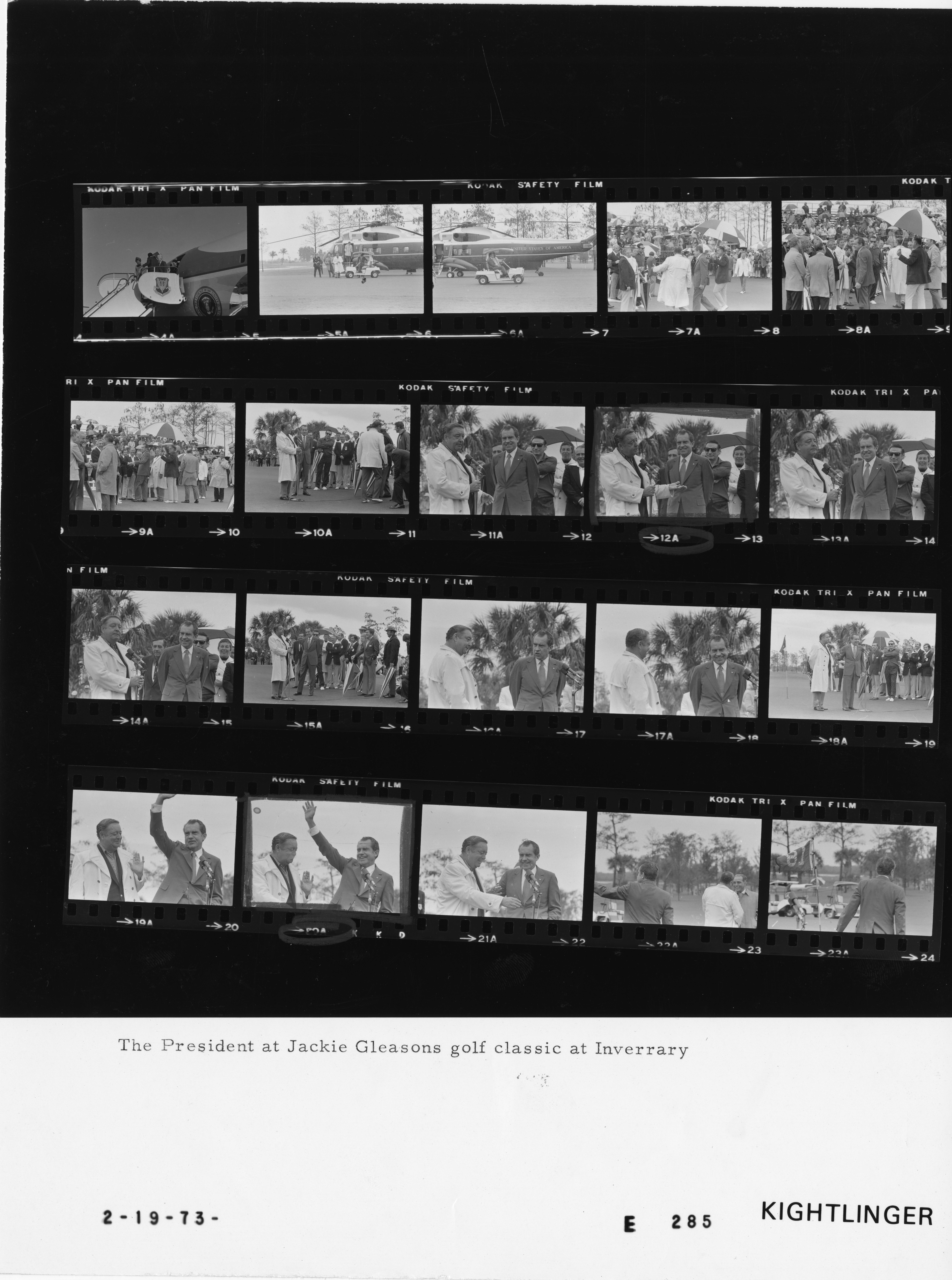
- Frame(s): WHPO-E0285-04A, Nixon, Pat Nixon, and Secretary Peter Brennan leaving their plane. 2/16/1973, Homestead AFB, Florida tarmac. President Nixon, Pat Nixon, Peter Brennan.
Roll WHPO-E0292 Photographer: Knudsen, Robert L. | Color or B&W: Color
- Frame(s): WHPO-E0292-, Far East Tour. Kissinger and Chinese officials visiting the Museum of Arts. 2/16/1973, Peking, China rooms, Museum of Art. Kissinger, Chinese officials.
Roll WHPO-E0293 Photographer: Knudsen, Robert L. | Color or B&W: Color
- Frame(s): WHPO-E0293-, Far East Tour. Kissinger at a dinner, shaking hands with Premier Chou En-Lai, toasting him and other officials, giving a speech, and leaving. 2/16/1973, Peking, China unidentified room, Hall of the People. Kissinger, Chou En-Lai, Chinese and American officials.
Roll WHPO-E0294 Photographer: Knudsen, Robert L. | Color or B&W: Color
- Frame(s): WHPO-E0294-, Far East Tour. Kissinger being greeted upon arrival and viewing exhibits, accompanied by officials. 2/16/1973, Peking, China Art Museum. Kissinger, Chinese officials, American officials.
Roll WHPO-E0295 Photographer: Knudsen, Robert L. | Color or B&W: Color
- Frame(s): WHPO-E0295-, Far East Tour. Premier Chou En-Lai greeting American officials, greeting Kissinger, and eating dinner with him and other officials. 2/16/1973, Peking, China inidentified room, Hall of the People. Kissinger, Chou En-Lai, Chinese & American officials.
Roll WHPO-E0296 Photographer: Knudsen, Robert L. | Color or B&W: Color
- Frame(s): WHPO-E0296-, Far East Tour. Misc. 2/16/1973, Peking, China Summer Palace. Chinese soldiers, citizens.
Roll WHPO-E0297 Photographer: Knudsen, Robert L. | Color or B&W: B&W
- Frame(s): WHPO-E0297-, Far East Tour. National Security Advisor Henry Kissinger and Premier Chou En-Lai seated with officials around a conference table. 2/16/1973, Peking, China unknown. Henry Kissinger, Chou En-Lai, Chinese & American officials.
- Frame(s): WHPO-E0297-06, Far East Tour. National Security Advisor Henry Kissinger and his staff seated at a conference table across from People's Republic of China Premier Zhou Enlai, his interpreter and staff officials. 2/16/1973, Peking, China Conference table. Henry Kissinger, Zhou Enlai, Chinese & American officials, Winston Lord.
Roll WHPO-E0316 Photographer: Atkins, Oliver | Color or B&W: B&W
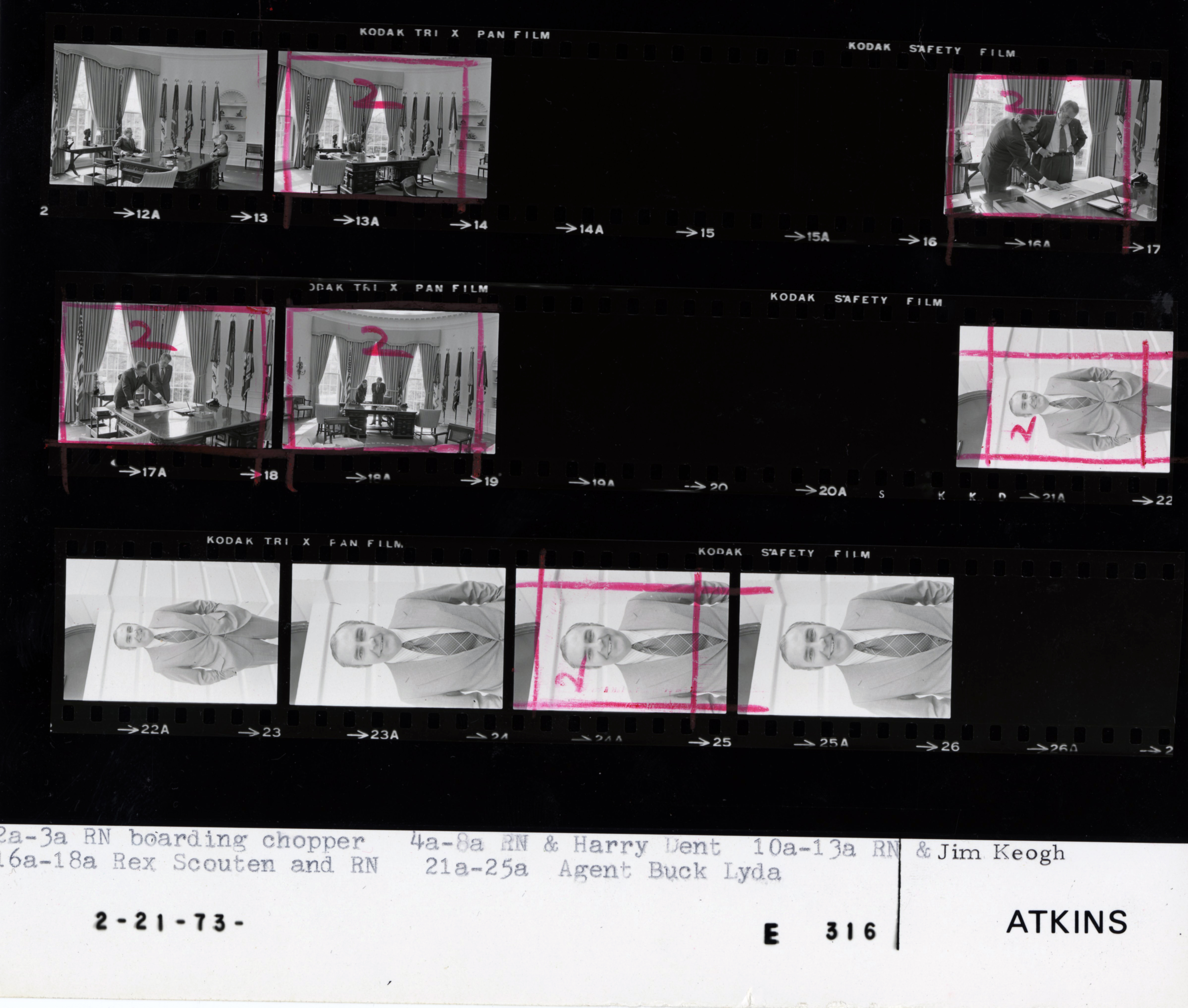
- Frame(s): WHPO-E0316-02A-03A, President Nixon seen at a distance, walking to the AF1 helicopter parked on the White House Lawn. The Washington Monument is visible in the background. 2/16/1973, Washington, D.C. White House, helipad. President Nixon, military personnel.
The White House Communications Agency Sound Recordings Collection contains public statements that took place between 1969 and 1974. Visit the finding aid to learn more.
K - Informal Presidential Remarks
- WHCA-SR-K-037
Julie Eisenhower house-Jacksonville, FL. (2/16/1973)
Runtime: 7:34
Original Format: 1/4-inch reel-to-reel audiotape. Original source type: Original.
L - White House Press Office Briefings
- WHCA-SR-L-136
Press briefing by Ronald Ziegler. (2/16/1973, White House Press Lobby)
Runtime: 4:30
Keywords: Press conferences, news conferences, interviews, media, press secretary
Original Format: 1/4-inch reel-to-reel audiotape. Original source type: Original.
P - Formal Presidential Remarks
- WHCA-SR-P-730218
Remarks by President Nixon on arrival at Mayport, Fla. NAS and aboard the USS Albany. (2/16/1973)
Runtime: 2:04
Original Format: 1/4-inch reel-to-reel audiotape. Original source type: Original.
The White House Communications Agency Videotape Collection contains “off-the-air” recordings of televised programs produced between 1968 and 1974. Visit the finding aid to learn more.
- WHCA-6136
Weekly News Summary, Tape I.
ALL NETWORKS
Runtime: 1:00
1. Reasoner/Peterson/Sherwood: POWs; POW wives against President Nixon. Time Code Start: 00:00. Keywords: Vietnam War, Vietnam Prisoner of War, releases, families, reactions. Network: ABC.
2. Smith/Snell: Office of Economic Opportunity (OEO) disbanded. Time Code Start: 05:03. Keywords: Office of Economic Opportunity, war on poverty, VISTA, Job Corps, Community Action Program, Head Start , welfare, closings. Network: ABC.
3. Reasoner/Bell: President Nixon goes to Key Biscayne, Florida. Time Code Start: 08:43. Keywords: Presidents, travel, trips, Nixon trips, domestic, residences, homes. Network: ABC.
4. Smith: The U.S. dollar. Time Code Start: 11:30. Keywords: economy, economics, budgets, finances, recession, inflation, money, currency, monetary values, exchange rates, decreases, wages, costs, increases. Network: ABC.
5. Chancellor/Anderson: President Nixon visits Naval base in Florida. Time Code Start: 13:14. Keywords: Presidents, travel, trips, Nixon trips, domestic, Armed Forces, military, air bases, airfields, airports, Navy. Network: NBC.
6. Chancellor/Nessen: Helicopter shot down in South Vietnam; camera shy Viet Cong officials. Time Code Start: 15:30. Keywords: Vietnam War, aircraft, crashes, People's Liberation Armed Forces (PLAF), National Liberation Front (NLF), VC. Network: NBC.
7. Chancellor/Biondi: More POWs at Travis Air Force Base near Fairfield, California. Time Code Start: 18:00. Keywords: Vietnam War, Vietnam Prisoner of War, releases, arrivals, Armed Forces, military, air bases, airfields, airports, hospitals. Network: NBC.
8. Chancellor/Bell: Vietnam veteran watching POW returns. Time Code Start: 20:05. Keywords: Vietnam War, Vietnam Prisoner of War, releases, military air bases, airports. Network: NBC.
9. Chancellor/Stern: L. Patrick Gray nominated as Director of FBI. Time Code Start: 23:00. Keywords: Federal Bureau of Investigations, leaders, nominees. Network: NBC.
10. Brinkley: Reduction in size and weight and automobiles. Time Code Start: 25:05. Keywords: automobiles, cars, manufacturing, sizes, decreases. Network: NBC.
11. Cronkite/Drinkwater: POWs at Travis Air Force Base. Time Code Start: 27:34. Keywords: Vietnam War, Vietnam Prisoner of War, releases, arrivals, Armed Forces, military, air bases, airfields, airports, hospitals. Network: CBS.
12. Cronkite: President Nixon at Naval base in Florida. Time Code Start: 29:25. Keywords: Presidents, travel, trips, Nixon trips, domestic, Armed Forces, military, air bases, airfields, airports, Navy. Network: CBS.
13. Cronkite: Hanoi film of POWs. Time Code Start: 32:23. Keywords: Vietnam War, Vietnam Prisoner of War. Network: CBS.
14. Cronkite/Morton: Calley conviction upheld by Court of Appeals (Lt. Calley and My Lai Massacre trial). Time Code Start: 34:24. Keywords: Vietnam War, Lt. Calley, My Lai Massacre, military trials, massacres, war crimes, atrocities, mass murders, civilians deaths, shootings. Network: CBS.
15. Cronkite: American helicopter shot down in South Vietnam. Time Code Start: 37:25. Keywords: Vietnam War, aircraft, crashes. Network: CBS.
Context (External Sources)
The Vanderbilt Television News Archive is the world's most extensive and complete archive of television news. They have been recording, preserving and providing access to television news broadcasts of the national networks since August 5, 1968.
Wikipedia is a free encyclopedia that anyone can edit.