
Introduction
This almanac page for Saturday, February 10, 1973, pulls together various records created by the federal government and links to additional resources which can provide context about the events of the day.
Previous Date: Friday, February 9, 1973
Next Date: Sunday, February 11, 1973
Schedule and Public Documents
The Daily Diary files represent a consolidated record of the President's activities. Visit the finding aid to learn more.
The President's day began at San Clemente, California
The Weekly Compilation of Presidential Documents made available transcripts of the President's news conferences; messages to Congress; public speeches, remarks, and statements; and other Presidential materials released by the White House.
Digitized versions can be found at HathiTrust.
The Federal Register is the official daily publication for rules, proposed rules, and notices of federal agencies and organizations, as well as executive orders and other Presidential documents.
No Federal Register published on this date
Archival Holdings
Any selection of archival documents will necessarily be partial. You should use the documents and folders identified below as a starting place, but consult the linked collection finding aids and folder title lists and the collections themselves for context. Many documents to be found this way do not lend themselves to association with specific dates, but are essential to a complete understanding of the material.
Selective document listing
President's Office Files
The President's Office Files consists of materials drawn together by the Special Files Unit from several administrative subdivisions within the White House Office. It is the handwriting and sensitive papers sent to the Staff Secretary that now comprise much of the President's Office Files. Visit the finding aid to learn more.
- News Summaries, Annotated News Summaries, Box 42, Feb. 8-17, 1973 [2 of 7] [Note: Due to the way News Summary products were compiled, you should also consult nearby days for potentially relevant materials.]
- News Summary, February 10, 1973, (Friday nets, wires)
The H. R. Haldeman Diaries consists of seven handwritten diaries, 36 dictated diaries recorded as sound recordings, and two handwritten audio cassette tape subject logs. The diaries and logs reflect H. R. Haldeman’s candid personal record and reflections on events, issues, and people encountered during his service in the Nixon White House. As administrative assistant to the President and Chief of Staff, Haldeman attended and participated in public events and private meetings covering the entire scope of issues in which the Nixon White House engaged in during the years 1969-1973. Visit the finding aid to learn more.
- Transcript of diary entry (PDF)
Saturday, February 10.
The President had his meeting this morning with the Vice President on his return and then left the office for the day. He did have me in for a little while on some miscellaneous things. He doesn't want to get into the international monetary thing with Shultz who keeps calling to report. He agreed that the VP should do a Cabinet meeting next week without the President, to report on his trip. He decided Jim Reynolds can't do Mexico; we should see if we can get out of that. He wants to make Brennan the Military Assistant. Had some ideas on State Dinners.
On the Nobel Prize, he wants to send a letter to the committee saying that he feels that the President of the United States-- that his practice as President not to accept an award for doing his duty. And therefore, requests he not be considered and notify them that he would not be able to accept the award. He wants Price to do a draft on this.
He says he may do a press conference here in California in March when he's out here with Thieu. That that would be a good time to have it here and better than now. He may still do one in the press room on his return, or even out here after Kissinger returns.
We had Dean and Moore out for an extended session on the whole Watergate strategy question and made a little progress in laying out an operating plan there. Decided that it would be a good idea to put Stans into a confirmable post and let him clear himself by-- in the confirmation process. Use Buchanan as an observer/spokesman on the whole Ervin hearings business. Consider Fred Buzhardt or Ruckelshaus as minority counsel, Wally Johnson as our full-time staff man on it. The main concern was the need to knock Kleindienst into the case and to keep him in the post through the duration of the hearings and to be a buffer and to take the heat, where necessary, in the Department there for things the President needs done. We're regrouping again tomorrow on the same subject.
End of February 10. - Original audio recording (MP3)
The National Archives Catalog is the online portal to the records held at the National Archives, and information about those records. It is the main way of describing our holdings and also provides access to electronic records and digitized versions of our holdings.
The Catalog searches across multiple National Archives resources at once, including archival descriptions, digitized and electronic records, authority records, and web pages from Archives.gov and the Presidential Libraries. The Catalog also allows users to contribute to digitized historical records through tagging and transcription.
Nixon Library Holdings
All National Archives Units
National Security Documents
The President's Daily Brief is the primary vehicle for summarizing the day-to-day sensitive intelligence and analysis, as well as late-breaking reports, for the White House on current and future national security issues. Read "The President's Daily Brief: Delivering Intelligence to Nixon and Ford" to learn more.
The Foreign Relations of the United States series presents the official documentary historical record of major U.S. foreign policy decisions and significant diplomatic activity. Visit the State Department website for more information.
Vol. X, Vietnam, January 1973-July 1975
Neither War nor Peace, January 27-June 15, 1973
11. Memorandum of Conversation, Hanoi, February 10, 1973, 3-6:22 p.m.
Source: National Archives, Nixon Presidential Materials, NSC Files, Kissinger Office Files, Box 113, Country Files, Far East, Vietnam Negotiations, Hanoi Memcons, February 10–13, 1973. Top Secret; Sensitive; Exclusively Eyes Only. The meeting was held at the DRV President’s House. Brackets are in the original. Kissinger’s party arrived at Noi Bai airfield at 10:30 a.m. Le Duc Tho then escorted Kissinger to the Government Guest House in Hanoi, where the two men discussed procedural matters. A memorandum of that conversation, February 10, 11:10 a.m.–12 p.m., is ibid.
Vol. XXVII, Iran; Iraq, 1973-1976
Iraq, January 1973-December 1974
203. Telegram From the Department of State to Selected Diplomatic Posts, Washington, February 10, 1973, 0055Z
Source: National Archives, RG 59, Central Files 1970–73, SOC 14 IRAQ. Confidential. Drafted by Cochran (NEA) and cleared by Korn (NEA/ARN). Sent to Vienna, London, Geneva, Stockholm, Helsinki, Oslo, Ottawa, Brasilia, Buenos Aires, Mexico City, Caracas, Santiago, Montevideo, Bonn, Canberra, Tel Aviv, Baghdad, USUN, and Beirut.
Vol. XXXI, Foreign Economic Policy, 1973-1976
The End of Fixed Exchange Rates, January-March 1973
7. Notes of a Telephone Conversation Between Secretary of the Treasury Shultz and the Under Secretary of the Treasury for Monetary Affairs (Volcker), February 10, 1973, 7:30 a.m.
Source: National Archives, RG 56, Office of the Under Secretary of the Treasury, Files of Under Secretary Volcker, 1969–1974, Accession 56–79–15, Box 1, 1973 Devaluation. No classification marking. Shultz, who was in Washington, drafted these notes on his conversation with Volcker, who was in Bonn.
8. Notes of a Telephone Conversation Between Secretary of the Treasury Shultz and the Under Secretary of the Treasury for Monetary Affairs (Volcker), February 10, 1973, 9:10 a.m.
Source: National Archives, RG 56, Office of the Under Secretary of the Treasury, Files of Under Secretary Volcker, 1969–1974, Accession 56–79–15, Box 1, 1973 Devaluation. No classification marking. Shultz, who was in Washington, drafted these notes on his conversation with Volcker, who was in Bonn.
9. Telegram From the Department of State to the Embassy in the Federal Republic of Germany, Washington, February 10, 1973, 2358Z
Source: National Archives, Nixon Presidential Materials, NSC Files, Box 754, Presidential Correspondence 1969–1974, Germany Willy Brandt, 1972. Secret; Immediate; Nodis. Drafted by Bennett and Scowcroft and approved by Wright and Eliot (S/S). Drafts of this telegram that are substantively the same as the version that was sent (with the exception of the two instances noted below) were cleared by Shultz, Haldeman, Ehrlich-man, and Burns. (Ibid.) A March 2 note indicates that Brandt’s February 9 letter to Nixon “was sent out to HAK by wire on Feb. 9, and never went through the system. Shultz did the reply and it was transmitted by General Scowcroft (LDX to State) on Feb. 10.” (Ibid.) Brandt’s letter is in Document 6.
Vol. XLII, Vietnam: The Kissinger-Le Duc Tho Negotiations
Attempting To Implement the Accords, February 1973-December 1973
49. Memorandum of Conversation, Hanoi, February 10, 1973, 11:10 a.m.-noon
Source: National Archives, Nixon Presidential Materials, NSC Files, Kissinger Office Files, Box 113, Country Files, Far East, Vietnam Negotiations, Hanoi Memcons, February 10–13, 1973. Top Secret; Sensitive; Exclusively Eyes Only. The meeting was held in the Reception Room of the Government Guest House. All brackets are in the original. The tabs are attached but not printed.
Kissinger’s long-planned visit to Hanoi, beginning on February 10 with this meeting and continuing until February 13, included consultations with Le Duc Tho and senior members of the Government of the Democratic Republic of (North) Vietnam and the Lao Dong (Communist) Party. Kissinger’s later reflections on this round of meetings noted:
“We had wrung [in the Paris Peace Accords] a tenuous compromise from these ideologues, but it took a greater act of faith than I was capable of to believe that they would abide willingly by an inconclusive outcome. The purpose of my journey to Hanoi in February 1973 was to encourage any tendencies that existed to favor peaceful reconstruction over continued warfare, to stabilize the peace insofar as prospects of American goodwill could do so, and to warn of the serious consequences should these hopes be disappointed.” (Kissinger, Ending the Vietnam War, p. 435)
After the last meeting on February 13, Kissinger wrote: “I left Hanoi with determination [to make the agreement work] rather than optimism [that it would].” (Ibid., p. 451)
Regarding the fate of the Peace Accords, now primarily in the hands of the North Vietnamese and their Southern allies, Kissinger reported to the President:
“They [the North Vietnamese] have two basic choices which I frankly pointed out to them [on February 11]. They can use the Vietnam Agreement as an offensive weapon, nibbling at its edges, pressuring Saigon, confronting us with some hard choices. In this case they would carry out the release of our prisoners and wait till our withdrawals were completed before showing their real colors unambiguously; they would keep their forces in Laos and Cambodia through procrastination of negotiations or straight-forward violations; and launch a big new attack soon. They would calculate that we would not have the domestic base or will to respond.
“Their other option is to basically honor the Agreement and seek their objectives through gradual evolution. They would welcome a more constructive relationship with us, seek our economic assistance and concentrate on reconstruction and building socialism in the north. Their Indochina allies would be told to pursue their objectives by political and psychological means. They would, in short, adhere to a more peaceful course and let the forces of history work their will, at least for a few years.
“The North Vietnamese naturally proclaim the second option as their settled course, but this means nothing. I could not judge from my talks whether their enormous losses, isolation from their allies, and the prospect of [American] aid mean they are ready for a breather. For them the ideal course would be to follow both options at once: violating the Agreement to pursue their objectives and improving relations with us so as to get economic aid. Our essential task is to convince them that they must make a choice between the two.” (Kissinger’s report quoted ibid., pp. 451–452)50. Memorandum of Conversation, Hanoi, February 10, 1973, 3-6:22 p.m.
Source: National Archives, Nixon Presidential Materials, NSC Files, Kissinger Office Files, Box 113, Country Files, Far East, Vietnam Negotiations, Hanoi Memcons, February 10–13, 1973. Top Secret; Sensitive; Exclusively Eyes Only. The meeting was held at the DRV President’s House. All brackets are in the original. The tabs and a map are attached but not printed.
Vol. E-3, Documents on Global Issues, 1973-1976
Drug Control, 1973-1976
145. Telegram 644 From the United States Mission to the United Nations at Geneva to the Department of State, New York, February 10, 1973, 1100Z
The telegram summarized negotiations at the 25th Session of the UN Commission on Narcotic Drugs.
Source: National Archives, RG 59, Central Files 1970–73, SOC 11–5. Limited Official Use. Repeated for information to Buenos Aires, London, and the United States Mission to the United Nations in New York. “Division” refers to the Division on Narcotic Drugs, the section of the UN secretariat that provided support for UN drug control functions.
Vol. E-12, Documents on East and Southeast Asia, 1973-1976
East Asia and Pacific Regional, SEATO, ASEAN
1. Memorandum of Conversation, San Clemente, February 10, 1973, 10:05–11:30 a.m., San Clemente, February 10, 1973, 10:05-11:30 a.m.
Agnew briefed the President on his recently completed trip to Southeast Asia.
Source: National Archives, Nixon Presidential Materials, NSC Files, Box 1026, Presidential/HAK Memcons, January–March 1973. Secret. A transcript version of this conversation is ibid. Nixon’s talking points for the meeting, which he received under a February 9 memorandum from Scowcroft, are ibid., Box 952, VIP Visits, Vice-President’s SEA Visit, 1/28–2/10/73 [3 of 3]. Nixon saw a memorandum, February 9, from Agnew, which is the written report of the trip. (Ibid., [2 of 3])
The Kissinger telephone conversation transcripts consist of approximately 20,000 pages of transcripts of Kissinger’s telephone conversations during his tenure as Assistant to the President for National Security Affairs (1969-1974) and Secretary of State (1973-1974) during the administration of President Richard Nixon. Visit the finding aid for more information.
Digitized versions can be found in the National Archives Catalog.
Audiovisual Holdings
The White House Photo Office collection consists of photographic coverage of President Richard Nixon meeting with prominent social, political, and cultural personalities; speaking engagements and news conferences of the President and various high-ranking members of the White House staff and Cabinet; Presidential domestic and foreign travel, including Presidential vacations; social events and entertainment involving the First Family, including entertainers present; official portraits of the President, First Family, and high-ranking members of the Nixon administration; the 1969 and 1973 Inaugurals; the President’s 1972 Presidential election campaign appearances (including speeches) and other official activities of the White House staff and the President’s Cabinet from January 20, 1969 until August 9, 1974 at the White House and the Old Executive Office Building; other locations in Washington, DC, such as The Mall; and the Presidential retreats in Camp David, Maryland, Key Biscayne, Florida, and San Clemente, California. Visit the finding aid to learn more.
Roll WHPO-E0204 Photographer: Kightlinger, Jack | Color or B&W: B&W
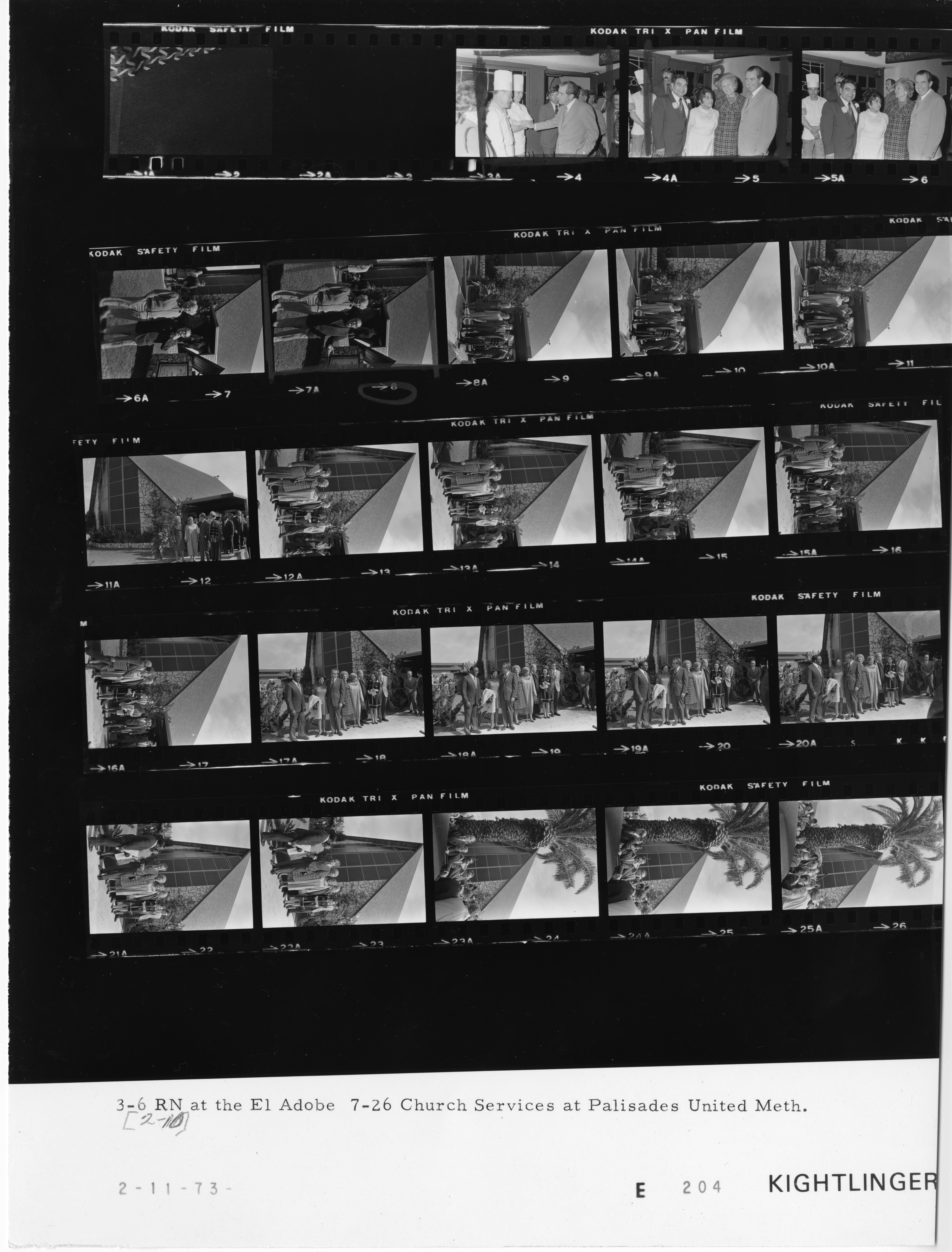
- Frame(s): WHPO-E0204-04-06, President Nixon and Pat Nixon. President Nixon greeting chefs and standing at the El Adobe Mexican Restaurant with Roy O'Campo and wife. 2/10/1973, San Juan Capistrano, California El Adobe Restaurant. President Nixon, Pat Nixon Mr. & Mrs. Roy O'Campo.
Roll WHPO-E0223 Photographer: Knudsen, Robert L. | Color or B&W: B&W
- Frame(s): WHPO-E0223-, Far East Tour. Henry Kissinger arriving at the airport, attending meetings, speaking to the press, and reviewing troops before boarding a plane. 2/10/1973, Laos airport tarmac, unidentified room. Henry Kissinger, unidentified officials, press corps members, troops.
- Frame(s): WHPO-E0223-26, Far East Tour. Henry Kissinger arriving at the airport, attending meetings, speaking to the press, and reviewing troops before boarding a plane. 2/10/1973, Laos airport tarmac, unidentified room.
Roll WHPO-E0225 Photographer: Knudsen, Robert L. | Color or B&W: Color
- Frame(s): WHPO-E0225-19-27, Far East Tour. Kissinger in a meeting with Laotian officials and others. 2/10/1973, Laos unidentified room. Kissinger, Laotian officials, Americans, press corps members.
- Frame(s): WHPO-E0225-28-36, Far East Tour. Kissinger speaking to the press prior to departure. 2/10/1973, Laos airport tarmac. Kissinger, Laotian officials, Americans, press corps members.
Roll WHPO-E0226 Photographer: Knudsen, Robert L. | Color or B&W: B&W
- Frame(s): WHPO-E0226-02-05, Henry Kissinger on his Far East Tour. Kissinger seated with the Vietnamese Prime Minister Pham Van Dong during a meeting with many officials seated listening. 2/10/1973, Hanoi, Vietnam unidentified sites. Henry Kissinger, Pham Van Dong, unidentified officials, press corps reporters and photographers.
- Frame(s): WHPO-E0226-03A, Henry Kissinger on his Far East Tour. Kissinger seated with the Vietnamese Prime Minister Pham Van Dong during a meeting with many officials seated listening. 2/10/1973, Hanoi, Vietnam large ballroom area. Henry Kissinger, Pham Van Dong, unidentified officials, press corps reporters and photographers.
- Frame(s): WHPO-E0226-06-07, Henry Kissinger on his Far East Tour. A building in Hanoi, Vietnam. 2/10/1973, Hanoi, Vietnam unidentified sites. Henry Kissinger, unidentified officials, press corps members.
- Frame(s): WHPO-E0226-08-16, Henry Kissinger on his Far East Tour. Officials seated at a conference table. 2/10/1973, Hanoi, Vietnam unidentified sites. Henry Kissinger, unidentified officials, press corps members.
Roll WHPO-E0227 Photographer: Knudsen, Robert L. | Color or B&W: B&W
- Frame(s): WHPO-E0227-, Henry Kissinger on his Far East Tour. Henry Kissinger during various activities in Bangkok, Thailand. 2/10/1973, Bangkok, Thailand airports, building, road. Kissinger, Vietnamese or Thai officials, unidentified persons.
Roll WHPO-E0228 Photographer: Knudsen, Robert L. | Color or B&W: B&W
- Frame(s): WHPO-E0228-, Henry Kissinger on his Far East Tour. Kissinger seated with an unidentified Vietnamese official during a meeting. Reporters or assistants seated around periphery of room taking notes. Seated Photographer holding camera up. 2/10/1973, Hanoi, Vietnam large conference room or ballroom. Henry Kissinger, Pham Van Dong, unidentified officials, press corps reporters and photographers.
- Frame(s): WHPO-E0228-16, Henry Kissinger on his Far East Tour. Kissinger seated with an unidentified Vietnamese official during a meeting with many officials seated listening. 2/10/1973, Hanoi, Vietnam large conference room or ballroom. Henry Kissinger, unidentified officials, press corps reporters and photographers.
- Frame(s): WHPO-E0228-31, Henry Kissinger on his Far East Tour. Kissinger seated with the Vietnamese Prime Minister Pham Van Dong during a meeting. Unidentified Vietnamese man seated nearby to Van Dong writing on a notepad. Possibly an interpreter. 2/10/1973, Hanoi, Vietnam large conference room or ballroom. Henry Kissinger, Pham Van Dong, unidentified official.
Roll WHPO-E0229 Photographer: Knudsen, Robert L. | Color or B&W: Color
- Frame(s): WHPO-E0229-02-04, Henry Kissinger on his Far East Tour. Kissinger seated with the Vietnamese Prime Minister Pham Van Dong during a meeting. Unidentified Vietnamese man seated nearby to Van Dong holding a notepad. Possibly an interpreter. 2/10/1973, Hanoi, Vietnam large conference or ballroom. Henry Kissinger, Pham Van Dong, unidentified official.
- Frame(s): WHPO-E0229-03, Henry Kissinger on his Far East Tour. Kissinger seated with the Vietnamese Prime Minister Pham Van Dong during a meeting. Unidentified Vietnamese man seated nearby to Van Dong holding a notepad. Possibly an interpreter. 2/10/1973, Hanoi, Vietnam large conference or ballroom. Henry Kissinger, Pham Van Dong, unidentified official.
- Frame(s): WHPO-E0229-05-26, Henry Kissinger on his Far East Tour. Kissinger seated with the Vietnamese Prime Minister Pham Van Dong and others in the American and Vietnamese delegations. 2/10/1973, Hanoi, Vietnam large conference or ballroom. Henry Kissinger, Pham Van Dong, unidentified official.
- Frame(s): WHPO-E0229-27-29, Presidential Palace exterior. 2/10/1973, Hanoi, Vietnam Henry Kissinger, Pham Van Dong, unidentified official.
- Frame(s): WHPO-E0229-30-36, Henry Kissinger on his Far East Tour sitting with the American and Vietnamese delegations at a large table. 2/10/1973, Hanoi, Vietnam large conference or ballroom. Henry Kissinger, Pham Van Dong, unidentified official.
Roll WHPO-E0230 Photographer: Knudsen, Robert L. | Color or B&W: Color
- Frame(s): WHPO-E0230-02A-14A, Henry Kissinger's Far East Tour. Arrival in Hanoi. Kissinger greeting Vietnamese officials and walking away from the plane with diplomats. 2/10/1973, Hanoi, Vietnam airports, road, Hanoi building. Kissinger, Vietnamese prime minister, unidentified officials.
- Frame(s): WHPO-E0230-15A-35A, Henry Kissinger on his Far East Tour. Kissinger seated with the Vietnamese Prime Minister Pham Van Dong during a meeting. 2/10/1973, Hanoi, Vietnam large conference room or ballroom. Henry Kissinger, Vietnamese prime minister, officials, unidentified persons.
Roll WHPO-E0244 Photographer: Smith | Color or B&W: B&W

- Frame(s): WHPO-E0244-, President Nixon approaching the helipad to greet Vice President Agnew. 2/10/1973, San Clemente, California helipad, Western White House. President Nixon, Spiro Agnew, military personnel.
- Frame(s): WHPO-E0244-12A, Vice President Agnew stepping off the Marine 2 helicopter and shaking hands with President Nixon at the Western White House helipad. 2/10/1973, San Clemente, California helipad, Western White House. President Nixon, Spiro Agnew, military personnel.
Roll WHPO-E0245 Photographer: Wilcoxen | Color or B&W: B&W
- Frame(s): WHPO-E0245-, President Nixon approaching a helipad to greet Vice President Agnew. 2/10/1973, San Clemente, California helipad, Western White House. President Nixon, Spiro Agnew, military personnel.
The White House Communications Agency Sound Recordings Collection contains public statements that took place between 1969 and 1974. Visit the finding aid to learn more.
L - White House Press Office Briefings
- WHCA-SR-L-130
Press briefing by Ronald Ziegler with press pool report. (2/10/1973, President's Compound, San Clemente, California)
Runtime: 0:17:30
Keywords: Press conference, news conference, interviews, media, press secretary, briefings, Paris Peace Talks, Vietnam War, Indochina War, treaty, treaties, negotiations, Vice Presidents, travel, trips, Asia, Southeast Asia, Philippines, China, Thailand, Nepal, Mal
Production credits: Audio feed supplied by WHCA; Recorded by GLG (initials of WHCA engineer)
Original Format: 1/4-inch reel-to-reel audiotape. Original source type: Original. Technical notes: 31 minutes and 37 seconds of silence at end of recording removed from access copies.
The White House Communications Agency Videotape Collection contains “off-the-air” recordings of televised programs produced between 1968 and 1974. Visit the finding aid to learn more.
- WHCA-6102
J Hobson Special AND "McCaffery at Large".
NBC
Runtime: 01:00:29 - WHCA-6103
"Agronsky & Company".
NBC; Post-Newsweek Stations, Inc.
Runtime: 00:33:14 - WHCA-6119
Weekly News Summary, Tape I.
ALL NETWORKS
Runtime: 1:30
15. Utley: POWs coming home. Time Code Start: 37:05. Keywords: Vietnam War, Vietnam Prisoner of War, releases. Network: NBC.
16. Utley: Peace still not at hand in Vietnam. Time Code Start: 38:04. Keywords: Paris Peace Talks, Vietnam War, treaty, treaties, negotiations. Network: NBC.
17. Utley/Rich: Kissinger in Cambodia. Time Code Start: 39:00. Keywords: officials, travel, trips, Cambodia, Vietnam War. Network: NBC.
18. Utley/Brady: Ceasefire. Time Code Start: 42:05. Keywords: Vietnam War, ceasefires. Network: NBC.
19. Mudd/Schieffer: POWs. Time Code Start: 44:17. Keywords: Vietnam War, Vietnam Prisoner of War, releases. Network: CBS.
20. Mudd/Quint: Vice President Agnew in California; Henry Kissinger in Vietnam. Time Code Start: 45:50. Keywords: Vice Presidents, travel, trips, cabinet, advisors, Vietnam War. Network: CBS.
21. Mudd/Wagner: Demonstration in Hue. Time Code Start: 48:10. Keywords: demonstrations, rally, protests, protesters, demonstraters, demonstrators, Vietnam War, anti-war. Network: CBS.
Context (External Sources)
The Vanderbilt Television News Archive is the world's most extensive and complete archive of television news. They have been recording, preserving and providing access to television news broadcasts of the national networks since August 5, 1968.
Wikipedia is a free encyclopedia that anyone can edit.