
Introduction
This almanac page for Wednesday, December 20, 1972, pulls together various records created by the federal government and links to additional resources which can provide context about the events of the day.
Previous Date: Tuesday, December 19, 1972
Next Date: Thursday, December 21, 1972
Schedule and Public Documents
The Daily Diary files represent a consolidated record of the President's activities. Visit the finding aid to learn more.
The President's day began at The White House - Washington, D. C.
The Weekly Compilation of Presidential Documents made available transcripts of the President's news conferences; messages to Congress; public speeches, remarks, and statements; and other Presidential materials released by the White House.
Digitized versions can be found at HathiTrust.
The Federal Register is the official daily publication for rules, proposed rules, and notices of federal agencies and organizations, as well as executive orders and other Presidential documents.
Archival Holdings
Any selection of archival documents will necessarily be partial. You should use the documents and folders identified below as a starting place, but consult the linked collection finding aids and folder title lists and the collections themselves for context. Many documents to be found this way do not lend themselves to association with specific dates, but are essential to a complete understanding of the material.
Selective document listing
President's Office Files
The President's Office Files consists of materials drawn together by the Special Files Unit from several administrative subdivisions within the White House Office. It is the handwriting and sensitive papers sent to the Staff Secretary that now comprise much of the President's Office Files. Visit the finding aid to learn more.
- News Summaries, Unmarked News Summaries, Box 52, News Summaries - December 1972 [6 of 6] [Note: Due to the way News Summary products were compiled, you should also consult nearby days for potentially relevant materials.]
- News Summary, December 20, 1972, (Tuesday nets, wires, columns)
- President's Daily Schedule, Box 102, [President's Daily Schedule, Oct.-Dec. 1972] [2 of 2]
- The President's Schedule, Wednesday - December 20, 1972
The H. R. Haldeman Diaries consists of seven handwritten diaries, 36 dictated diaries recorded as sound recordings, and two handwritten audio cassette tape subject logs. The diaries and logs reflect H. R. Haldeman’s candid personal record and reflections on events, issues, and people encountered during his service in the Nixon White House. As administrative assistant to the President and Chief of Staff, Haldeman attended and participated in public events and private meetings covering the entire scope of issues in which the Nixon White House engaged in during the years 1969-1973. Visit the finding aid to learn more.
- Transcript of diary entry (PDF)
Wednesday, December 20th. The President had his physical this morning. Apparently everything went well, except that they did confirm that he had splintered a bone in his foot, and, so he was right on that problem.
He got into the Kissinger problem; he's worrying that Henry is trying to have it both ways. That the real problem is peace at hand statement, from which the President drew back, but other than that there is no difference between the two of them. He did feel Sullivan should have the briefing at State today, and he gave Ziegler the line to cover with Rogers and Sullivan. And after Ziegler went out, made the point that we can't allow Kissinger's judgment to be overriding on these things, that he can't be both close to the President and away from him. A little later he had Henry in. He said with some glee, that Haig has now joined the club. That he got kicked in the teeth by Thieu, was kept waiting five hours, and that Thieu demands total withdrawal of all North Vietnamese troops. So we have to go out on January 3rd for a separate deal, if we can get it. We lost three more B-52s today...
-------------------------------------------------------------------------------------------------------------------
DECLASSIFIED - E.O. 13526, Sect. 3.4: by MS, NARA, June 12, 2013
Audio Cassette 29, Side A, Withdrawn Item Number 3 [AC 29(A) Sel 2-1]
Duration: 7 seconds
…and hit a Russian ship in the Haiphong Harbor.
-------------------------------------------------------------------------------------------------------------------
The President is obviously very concerned about the reaction on the B-52s. The military apparently anticipated three losses for every 100 planes in raids, but we’re running somewhat higher than that. He says, however, that we must not knock it off, and Kissinger agrees.
-------------------------------------------------------------------------------------------------------------------
DECLASSIFIED - E.O. 13526, Sect. 3.4: by MS, NARA, June 12, 2013
Audio Cassette 29, Side A, Withdrawn Item Number 3 [AC 29(A) Sel 2-2]
Duration: 18 seconds
The conclusion now is that we have 2 choices: one, to scrap the peace plan, and go to a bilateral agreement, which we could move on at the requested meeting January 3rd; or two, conclude a deal with North Vietnam, and if Thieu doesn't buy it, then go bilateral. I argued for the latter; the President felt we should do the former.
-------------------------------------------------------------------------------------------------------------------
The President kept coming back to the B-52 loss problem, but saying we can't back off. But can we? Will we get three losses every time? If so, it's going to be very tough to take. Thieu has ended up ignoring the President's letters, and stating his own demands, such as getting the troops out. The President says that in effect what he said is he wants us to go out alone, so we have to figure how we can without sinking South Vietnam. The real question is whether Hanoi will settle bilaterally without cutting aid to Sou--, without forcing us to cut aid to South Vietnam. They can gamble that Congress will cut off aid anyway. If we go bilateral, there will be no cease-fire, but we would argue that South Vietnam is now in a position where they can stand on their own feet. Kissinger, over and over in the meeting, really blasted Thieu as a complete SOB, says that he still may be just doing this to make a record, and then planning to cave at the end, but the main thing now is to finish the thing as best we can. The President says it's better not to get a negative agreement, and that we should go for a separate deal, which I argued against.
He's concerned about Dole popping off, says that we may have to take this whole thing out, regarding the thing that Congress may have to take it out of the President's hands. He shouldn't indicate any doubt he's being used by the Kennedy's and so on. Kissinger said we could have had an agreement on November 20th. If we knew Thieu wouldn't go along anyway then we could have settled. He then said though I want it clear that I'm in total agreement with what we've done and what we've decided.
The President then went back to the lost B-52s and was really bothered about it, wondering if there's anything he should do. Kissinger says no, that this is the last of the extensive raids in Hanoi, and we should start reducing our losses. Kissinger keeps coming back to referring to the South Vietnamese as SOBs, maniacs, and so on. Both agreed that we can't let the word out that Haig's been rebuffed. We have to continue bombing the North, but on a less massive basis, and we should cut back on hitting Hanoi and avoid excessive losses. The President says that he doesn't think that the American public is opposed to what we're doing, but Kennedy and the commentators, and so on, can mobilize them over a period of time. If North Vietnam will agree to talk now, we'll be in good shape. The question still is whether to go bilateral, or negotiate it. If Hanoi accepts the January 3rd meeting, we should meet, settle, and put it to Thieu: in other words, the President is now shifting to my view. We should now treat Thieu with total silence, not give him another chance. The President then sort of summed it up, that gloomy as it looks at this point, something still may happen.
Truman's death is still imminent and may affect the President's travel plans, although nothing specific was said on that.
The President had a meeting with Shultz this afternoon just before departing; the helicopter came in the middle of it to turn it off. He covered Dr. David, who doesn't want to take the AEC. The President told George to try to talk him into taking the operational job, even though we have to leave open the question of where the Energy responsibility goes. Shultz is supposed to try and sell him anyway.
On price controls, Shultz reported that, the, because we've said that we' re continuing controls, the commentators, etcetera, are now moving the other way, saying that we should go against them, which is good, because it will put pressure on us from that side now, and maybe enable us to lift them. He thinks that labor will endorse the 5.5 percent wage standard. The President agreed to a bipartisan Congressional meeting on January 5th on economic matters and then we’ll announce our decision shortly after that. On trade, the President said he'd like to see Shultz's approach on it that defends the American interest, but he won't go for reducing trade barriers at this time. We should make a very close Congressional check, and remember that it's a political problem, not just an economic problem; this he keeps reminding Shultz on these things. On tax policy, Shultz says he's ready with a mem--, some memorandum for the President to study, but there's a real question of whether the President wants any tax proposals in.
The President then left for Key Biscayne for Christmas.
End of December 20th. - Original audio recording (MP3)
The National Archives Catalog is the online portal to the records held at the National Archives, and information about those records. It is the main way of describing our holdings and also provides access to electronic records and digitized versions of our holdings.
The Catalog searches across multiple National Archives resources at once, including archival descriptions, digitized and electronic records, authority records, and web pages from Archives.gov and the Presidential Libraries. The Catalog also allows users to contribute to digitized historical records through tagging and transcription.
Nixon Library Holdings
All National Archives Units
National Security Documents
The President's Daily Brief is the primary vehicle for summarizing the day-to-day sensitive intelligence and analysis, as well as late-breaking reports, for the White House on current and future national security issues. Read "The President's Daily Brief: Delivering Intelligence to Nixon and Ford" to learn more.
The Foreign Relations of the United States series presents the official documentary historical record of major U.S. foreign policy decisions and significant diplomatic activity. Visit the State Department website for more information.
Vol. IV, Foreign Assistance, International Development, Trade Policies, 1969-1972
Coordinating Committee on Export Controls, 1969-1972
385. Letter From the Under Secretary of Commerce (Lynn) to the Acting Staff Director of the National Security Council Under Secretaries Committee (Weiss), Washington, December 20, 1972
Source: National Archives, RG 59, S/S Files: Lot 83 D 305, NSDM 159. Secret. The letter is Tab C to a December 30 memorandum from Armstrong to Irwin; see footnote 1, Document 387.
Vol. V, United Nations, 1969-1972
U.S. Position Papers and Assessments of General Assembly Sessions
108. Telegram From the Mission to the United Nations to the Department of State, New York, December 20, 1972, 0143Z
Source: National Archives, RG 59, Central Files 1970–73, UN 8–3. Limited Official Use.
Vol. IX, Vietnam, October 1972-January 1973
The Christmas Bombings, December 14-29, 1972
203. Backchannel Message From Richard T. Kennedy of the National Security Council Staff to the President’s Deputy Assistant for National Security Affairs (Haig) in Saigon, Washington, December 20, 1972, 0207Z
Source: National Archives, Nixon Presidential Materials, NSC Files, Box 1019, Alexander M. Haig Special File, Gen. Haig’s Vietnam Trip, Tohaig/Haigto & Misc., December 17–22, 1972 [1 of 3]. Top Secret; Sensitive.
204. Backchannel Message From the President’s Deputy Assistant for National Security Affairs (Haig) to the President’s Assistant for National Security Affairs (Kissinger), Saigon, December 20, 1972, 0353Z
Source: National Archives, Nixon Presidential Materials, NSC Files, Box 859, For the President’s Files (Winston Lord)—China Trip/Vietnam, Sensitive Camp David, Vol. XXIII. Top Secret; Sensitive; Exclusively Eyes Only.
205. Backchannel Message From the President’s Deputy Assistant for National Security Affairs (Haig) to the President’s Assistant for National Security Affairs (Kissinger), Saigon, December 20, 1972, 0410Z
Source: National Archives, Nixon Presidential Materials, NSC Files, Box 859, For the President’s Files (Winston Lord)—China Trip/Vietnam, Sensitive Camp David, Vol. XXIII. Top Secret; Immediate; Sensitive; Exclusively Eyes Only.
206. Backchannel Message From the President’s Deputy Assistant for National Security Affairs (Haig) to the President’s Assistant for National Security Affairs (Kissinger), Saigon, December 20, 1972, 1020Z
Source: National Archives, Nixon Presidential Materials, NSC Files, Box 1020, Alexander M. Haig Special File, Gen. Haig’s Vietnam Trip, Tohaig/Haigto & Misc., December 17–22, 1972 [2 of 3]. Top Secret; Sensitive; Exclusively Eyes Only.
207. Backchannel Message From Richard T. Kennedy of the National Security Council Staff to the President’s Deputy Assistant for National Security Affairs (Haig) in Saigon, Washington, December 20, 1972
Source: National Archives, Nixon Presidential Materials, NSC Files, Box 1020, Alexander M. Haig Special File, Gen. Haig’s Vietnam Trip, Tohaig/Haigto & Misc., December 17–22, 1972 [3 of 3]. Top Secret; Sensitive; Exclusively Eyes Only. Printed from a copy that was approved for transmission as WHS 29929.
208. Memorandum From the President’s Assistant for National Security Affairs (Kissinger) to President Nixon, Washington, December 20, 1972
Source: National Archives, Nixon Presidential Materials, NSC Files, Box 859, For the President’s Files (Winston Lord)—China Trip/Vietnam, Sensitive Camp David, Vol. XXIII. Top Secret; Sensitive; Exclusively Eyes Only. A stamped notation on the first page reads: “The President has seen.”
209. Conversation Among President Nixon, the President’s Assistant for National Security Affairs (Kissinger), and the Assistant to the President (Haldeman), Washington, December 20, 1972
Source: National Archives, Nixon Presidential Materials, White House Tapes, Conversation 827–10. No classification marking. According to the President’s Daily Diary, Nixon met with Haldeman beginning at 11:32 a.m. and Kissinger beginning at 11:33 until 12:16 p.m. in the Oval Office. (Ibid., White House Central Files) The editors transcribed the portions of the conversation printed here specifically for this volume.
210. Backchannel Message From the President’s Deputy Assistant for National Security Affairs (Haig) to the President’s Assistant for National Security Affairs (Kissinger), December 20, 1972, 1653Z
Source: National Archives, Nixon Presidential Materials, NSC Files, Box 1020, Alexander M. Haig Special File, Gen. Haig’s Vietnam Trip, Tohaig/Haigto & Misc., December 17–22, 1972 [2 of 3]. Top Secret; Operational Immediate; Sensitive; Exclusively Eyes Only.
211. Message From the Chairman of the Joint Chiefs of Staff (Moorer) to the Commander in Chief, Pacific (Gayler) and the Pacific Command Senior Commanders, Washington, December 20, 1972, 2106Z
Source: National Archives, RG 218, Records of the Chairman, Records of Thomas Moorer, Box 71, Linebacker II Messages, December 1972. Top Secret; Immediate; Specat; Exclusive.
Vol. XXXIII, SALT II, 1972-1980
SALT II, 1972-1980
10. Backchannel Message From the Chief of the Delegation to the Strategic Arms Limitation Talks (Smith) to President Nixon, Geneva, December 20, 1972, 1503Z
Source: National Archives, Nixon Presidential Materials, NSC Files, Box 427, Backchannel Files, Backchannel Messages–1972–SALT. Top Secret; Immediate; Exclusive Eyes Only.
Vol. XXXIX, European Security
Opening Negotiations, December 1972-July 1973
122. Memorandum From Secretary of State Rogers to President Nixon, Washington, December 20, 1972
Source: National Archives, Nixon Presidential Materials, NSC Files, Box 248, Agency Files, CSCE and MBFR. Confidential. Hyland wrote on an attached correspondence profile: “No action necessary.”
Vol. XL, Germany and Berlin, 1969-1972
Germany and Berlin, 1969-1972
388. Memorandum From the President’s Assistant for National Security Affairs (Kissinger) to President Nixon, Washington, December 20, 1972
Source: National Archives, Nixon Presidential Materials, NSC Files, Box 689, Country Files, Europe, East Germany, Vol. I. Confidential. Sent for information. Butterfield stamped the memorandum to indicate that the President had seen it; according to a typewritten note attached to a copy, Nixon still had the memorandum as of December 26. (Ibid.) In a memorandum forwarding a draft to Kissinger on December 19, Sonnenfeldt wrote: “We have now reached the stage where the State Department is about to initiate contacts with the GDR. Steps in this direction so far have been made without overall guidance from us, except on the Four-Power Declaration, and indeed without the President having been fully informed. The contact with the GDR now proposed by State will put us on the path to diplomatic relations. I think the time has therefore come to give Secretary Rogers Presidential guidance for the steps which he proposes to take.” (Ibid.)
Vol. E-2, Documents on Arms Control and Nonproliferation, 1969-1972
Chemical and Biological Warfare; Geneva Protocol; Biological Weapons Convention
274. Memorandum From Michael Guhin of the National Security Council Staff to the President’s Assistant for National Security Affairs (Kissinger), Washington, December 20, 1972
Guhin recommended updating three aspects of the NSSM 157 study to allow for analyses of ensuing Soviet proposals, possible shelf-life restrictions, and recent developments in the U.S. binary weapons program.
Source: National Archives, Nixon Presidential Materials, NSC Files, NSC Institutional Files (H-Files), Boxes H–192 and H–193, NSSM 157. Secret. Sent for action. The memorandum was sent through Elliot. A handwritten notation that was crossed out indicates it was also sent through Scowcroft. At Tab A is Document 275.
Vol. E-5, Part 1, Documents on Sub-Saharan Africa, 1969-1972
The Horn
333. Research Study Prepared in the Bureau of Intelligence and Research, Department of State, Washington, December 20, 1972
This study of “Somalia: The Soviet Presence” assessed the USSRʼs position in Somalia, Soviet interests and objectives in the Horn, and prospects for Somali-Soviet relations.
Source: National Archives, RG 59, Central Files 1970–73, POL Somali-USSR. Secret; No Foreign Dissem; Controlled Dissem. Only the abstract is published.
The Kissinger telephone conversation transcripts consist of approximately 20,000 pages of transcripts of Kissinger’s telephone conversations during his tenure as Assistant to the President for National Security Affairs (1969-1974) and Secretary of State (1973-1974) during the administration of President Richard Nixon. Visit the finding aid for more information.
Digitized versions can be found in the National Archives Catalog.
Audiovisual Holdings
Visit the White House Tapes finding aid to learn about the taping system's operation and archival processing.
Cabinet Room
- 110-11; Unknown between 12:00 a.m. & 11:24 a.m.; Stein, Herbert; Meany, George; Lyons, John H. ("Jack"); Dennis, C. L.; Hall, Paul; Abel, I[lorwith] W.; Fitzsimmons, Frank E.; Greathouse, Pat; Brennan, Peter J.; Rumsfeld, Donald H.; Shultz, George P.
- 111-1; Unknown between 11:24 a.m. & 11:32 a.m.; Nixon, Richard M. (President); National Commission on Productivity; Meany, George; Lyons, John H. ("Jack"); Dennis, C. L.; Hall, Paul; Abel, I[lorwith] W.; Fitzsimmons, Frank E.; Greathouse, Pat; Brennan, Peter J.; Shultz, George P.; Stein, Herbert; Rumsfeld, Donald H.
Old Executive Office Building
- 392-3; Unknown between 12:18 p.m. & 12:29 p.m.; Nixon, Richard M. (President); [Unknown person(s)]
- 392-4; Unknown between 12:18 p.m. & 12:29 p.m.; Nixon, Richard M. (President); Monzon, Zosimo T.
- 392-5; Unknown between 12:18 p.m. & 12:29 p.m.; Nixon, Richard M. (President); Bull, Stephen B.
- 392-6; 12:29 p.m. - 12:29 p.m.; Nixon, Richard M. (President); White House operator
- 392-7; 12:32 p.m. - 12:32 p.m.; Nixon, Richard M. (President); [Unknown person(s)]
- 392-8; 12:32 p.m. - 12:33 p.m.; Nixon, Richard M. (President); Haldeman, H. R. ("Bob")
- 392-9; 12:33 p.m. - 1:30 p.m.; Nixon, Richard M. (President); Colson, Charles W.; Bull, Stephen B.; White House operator; Nixon, Thelma C. ("Pat") (Ryan)
Oval Office
- 827-1; Unknown between 10:16 a.m. & 10:20 a.m.; Nixon, Richard M. (President); Bull, Stephen B.
- 827-2; Unknown between 10:16 a.m. & 10:20 a.m.; Nixon, Richard M. (President); Monzon, Zosimo T.
- 827-3; Unknown between 10:16 a.m. & 10:20 a.m.; Nixon, Richard M. (President); Haldeman, H. R. ("Bob"); Ziegler, Ronald L.; Monzon, Zosimo T.
- 827-4; Unknown between 10:16 a.m. & 10:20 a.m.; Nixon, Richard M. (President); Bull, Stephen B.
- 827-5; Unknown between 10:16 a.m. & 10:20 a.m.; Nixon, Richard M. (President); Bull, Stephen B.
- 827-6; Unknown between 10:16 a.m. & 10:20 a.m.; Nixon, Richard M. (President); Bull, Stephen B.
- 827-7; Unknown between 10:20 a.m. & 11:20 a.m.; Nixon, Richard M. (President); Haldeman, H. R. ("Bob"); Ziegler, Ronald L.; Monzon, Zosimo T.
- 827-8; Unknown between 11:05 a.m. & 11:20 a.m.; Nixon, Richard M. (President); Haldeman, H. R. ("Bob"); Bull, Stephen B.
- 827-9; Unknown between 11:24 a.m. & 11:32 a.m.; Bull, Stephen B.; United States Secret Service agents
- 827-10; Unknown between 11:32 a.m. & 12:16 p.m.; Nixon, Richard M. (President); Haldeman, H. R. ("Bob"); Kissinger, Henry A.
- 827-11; Unknown between 1:51 p.m. & 1:53 p.m.; Nixon, Richard M. (President); Bull, Stephen B.
- 827-12; 1:53 p.m. - 2:20 p.m.; Nixon, Richard M. (President); Haldeman, H. R. ("Bob"); Woods, Rose Mary; Bull, Stephen B.
- 827-13; 2:20 p.m. - 2:25 p.m.; Nixon, Richard M. (President); Bull, Stephen B.; Nixon, Thelma C. ("Pat") (Ryan); Jones, Edward V.; Jones, Edward V. (Mrs.); Balling, James, Jr.; Balling, James, Jr. (Mrs.); Balling, Nella; Balling, Maria; White House photographer
- 827-14; Unknown between 2:25 p.m. & 2:35 p.m.; Nixon, Richard M. (President)
- 827-15; 2:36 p.m. - 2:40 p.m.; Nixon, Richard M. (President); Woods, Rose Mary
- 827-16; Unknown between 2:40 p.m. & 2:45 p.m.; Nixon, Richard M. (President)
- 827-17; Unknown between 2:40 p.m. & 2:45 p.m.; Nixon, Richard M. (President); Bull, Stephen B.
- 827-18; 2:45 p.m. - 2:46 p.m.; Nixon, Richard M. (President); Woods, Rose Mary
- 827-19; 2:47 p.m. - 2:55 p.m.; Nixon, Richard M. (President); Ziegler, Ronald L.
- 827-20; 2:56 p.m. - 3:05 p.m.; Nixon, Richard M. (President); Haldeman, H. R. ("Bob"); Ziegler, Ronald L.
- 827-21; 3:05 p.m. - 3:49 p.m.; Nixon, Richard M. (President); Ziegler, Ronald L.; Pett, Saul; Burroughs, Henry; White House photographer; Monzon, Zosimo T.
- 827-22; 3:51 p.m. - 4:24 p.m.; Nixon, Richard M. (President); Ziegler, Ronald L.; Haldeman, H. R. ("Bob"); [Unknown person(s)]; Bull, Stephen B.; Shultz, George P.
- 827-23; 4:25 p.m. - 4:32 p.m.; Nixon, Richard M. (President); Chotiner, Murray M.
- 827-24; Unknown between 11:24 a.m. & 11:32 a.m.; United States Secret Service agents; [Unknown person(s)]; Haldeman, H. R. ("Bob")
- 827-25; Unknown between 10:16 a.m. & 10:20 a.m.; [Unknown person(s)]
- 827-26; Unknown between 4:32 p.m. & 4:37 p.m.; [Unknown person(s)]
White House Telephone
- 34-139; 12:29 p.m. - 12:29 p.m.; Nixon, Richard M. (President); White House operator
- 34-140; 12:32 p.m. - 12:33 p.m.; Nixon, Richard M. (President); Haldeman, H. R. ("Bob"); Bull, Stephen B.
- 34-141; Unknown between 12:33 p.m. & 12:47 p.m.; Nixon, Richard M. (President); White House operator
- 34-142; 12:47 p.m. - 12:48 p.m.; Nixon, Richard M. (President); Nixon, Thelma C. ("Pat") (Ryan)
- 34-143; Unknown between 12:48 p.m. & 12:49 p.m.; Nixon, Richard M. (President); White House operator
- 34-144; 12:49 p.m. - 12:50 p.m.; Nixon, Richard M. (President); Bull, Stephen B.
The White House Photo Office collection consists of photographic coverage of President Richard Nixon meeting with prominent social, political, and cultural personalities; speaking engagements and news conferences of the President and various high-ranking members of the White House staff and Cabinet; Presidential domestic and foreign travel, including Presidential vacations; social events and entertainment involving the First Family, including entertainers present; official portraits of the President, First Family, and high-ranking members of the Nixon administration; the 1969 and 1973 Inaugurals; the President’s 1972 Presidential election campaign appearances (including speeches) and other official activities of the White House staff and the President’s Cabinet from January 20, 1969 until August 9, 1974 at the White House and the Old Executive Office Building; other locations in Washington, DC, such as The Mall; and the Presidential retreats in Camp David, Maryland, Key Biscayne, Florida, and San Clemente, California. Visit the finding aid to learn more.
Roll WHPO-D1145 Photographer: Royer | Color or B&W: B&W
- Frame(s): WHPO-D1145-, Vice President Agnew standing with Tom Winter and Alan Ryskind. 12/20/1972, Washington, D.C. Vice Presidential Office, Executive Office Building. Spiro Agnew, Tom Winter, Alan Ryskind.
Roll WHPO-D1146 Photographer: Knudsen, Robert L. | Color or B&W: B&W
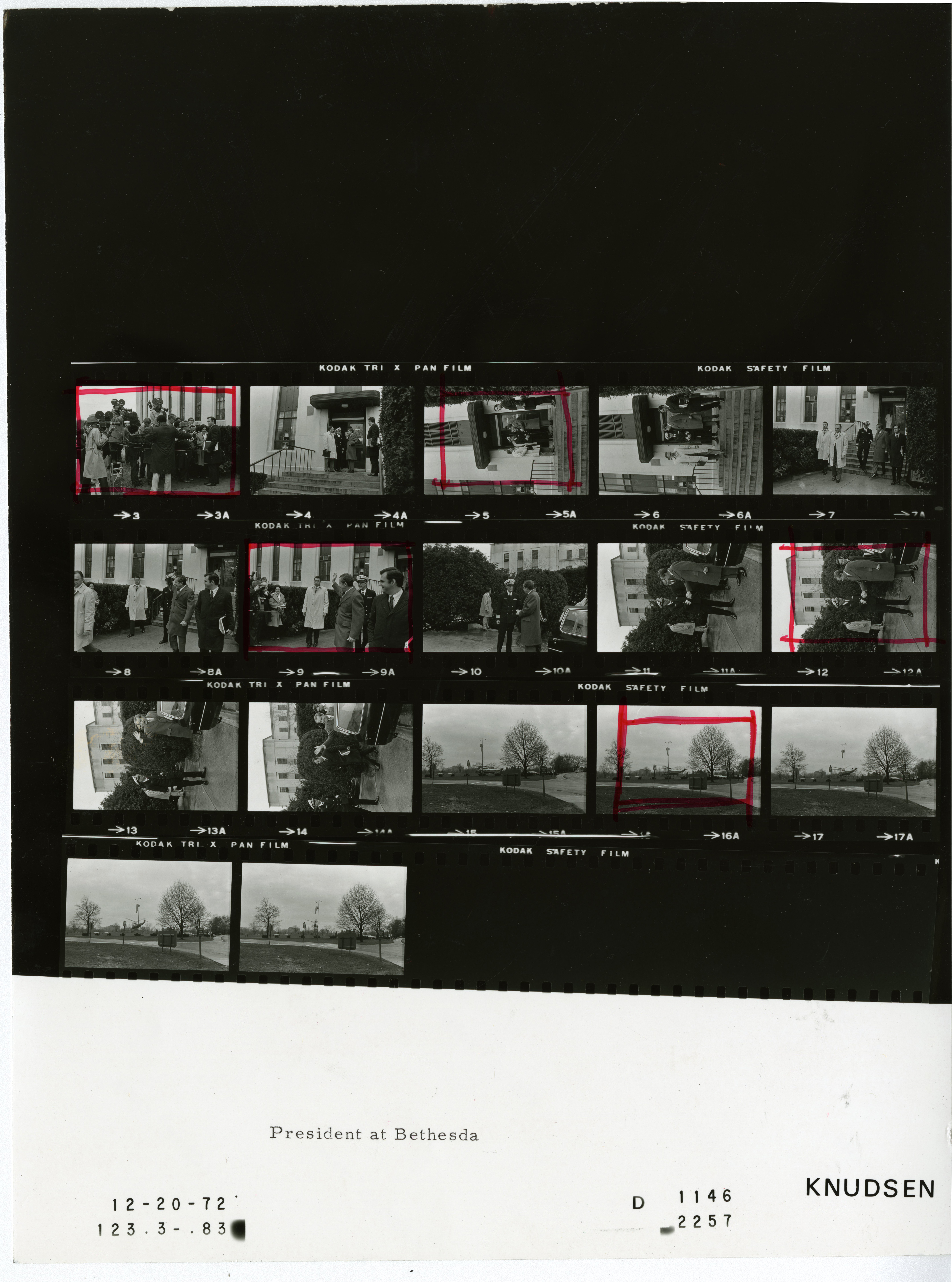
- Frame(s): WHPO-D1146-03-11, 12-14, President Nixon leaving Bethesda Naval Hospital accompanied by Ron Ziegler, and Rear Admiral Felix Ballenger, and Major General Dr. Walter Tkach, and a secret service agent (probably Bob Taylor in the trenchcoat) after having his annual physical exam. 12/20/1972, Bethesda, Maryland helipad, Bethesda Naval Hospital. President Nixon, Maj. Gen. Dr. Walter R. Tkach, Rear Adm. Felix Ballenger, Ron Ziegler, Reporter Helen Thomas, members of the press, aides.
- Frame(s): WHPO-D1146-12, President Nixon after leaving Bethesda Naval Hospital accompanied by Press Secreatary Ron Ziegler, shakes hands with Rear Admiral Felix Ballenger, while an unidentified secret service agent looks down a hedge lined stairway. 12/20/1972, Bethesda, Maryland helipad, Bethesda Naval Hospital. President Nixon, Maj. Gen. Dr. Walter R. Tkach, Rear Adm. Felix Ballenger, Ron Ziegler, Reporter Helen Thomas, members of the press, aides.
- Frame(s): WHPO-D1146-15-19, Marine One helicopter taking off from the heliport field at Bethesda Naval Hospital. 12/20/1972, Bethesda, Maryland helipad, Bethesda Naval Hospital. President Nixon, Maj. Gen. Dr. Walter R. Tkach, Rear Adm. Felix Ballenger, Ziegler, Helen Thomas, members of the press, aides.
Roll WHPO-D1147 Photographer: Knudsen, Robert L. | Color or B&W: B&W
- Frame(s): WHPO-D1147-01A-02A, 05A, George Shultz, Donald Rumsfeld and Ben Stein seated with labor leaders around the conference table. 12/20/1972, Washington, D.C. Cabinet Room, room, White House. George Shultz, labor leaders, Donald Rumsfeld, Henry Kissinger, Ben Stein, unidentified men.
- Frame(s): WHPO-D1147-03A, 06A-12A, Henry Kissinger standing individually with an unidentified man in an unidentified White house office. 12/20/1972, Washington, D.C. office room, White House. Henry Kissinger, unidentified staff members.
Roll WHPO-D1148 Photographer: Kightlinger, Jack | Color or B&W: Color
- Frame(s): WHPO-D1148-03A-14A, Pat Nixon with White House secretaries and staff members during a Christmas reception for them. 12/20/1972, Washington, D.C. White House, Grand Hallway. President Nixon, Pat Nixon, Mr. & Mrs. Edward Jones, Mr. & Mrs. James Balling, Jr., Balling daughters, staff members, unidentified men.
- Frame(s): WHPO-D1148-15A-17A, Staff members. Unidentified men standing at the front entrance. 12/20/1972, Washington, D.C. White House, North Portico Entrance. President Nixon, Pat Nixon, Mr. & Mrs. Edward Jones, Mr. & Mrs. James Balling, Jr., Balling daughters, staff members, unidentified men.
- Frame(s): WHPO-D1148-18A-26A, President Nixon and Pat Nixon with Edward Jones and family. 12/20/1972, Washington, D.C. White House, Oval Office. President Nixon, Pat Nixon, Mr. & Mrs. Edward Jones, Mr. & Mrs. James Balling, Jr., Balling daughters, staff members, unidentified men.
Roll WHPO-D1149 Photographer: Knudsen, Robert L. | Color or B&W: Color
- Frame(s): WHPO-D1149-01-09, President Nixon and Pat Nixon visit with Edward Jones and family. 12/20/1972, Washington, D.C. White House, Oval Office. President Nixon, Pat Nixon, Mr. & Mrs. Edward Jones, Mr. & Mrs. James Balling, Jr., Balling daughters.
The White House Communications Agency Sound Recordings Collection contains public statements that took place between 1969 and 1974. Visit the finding aid to learn more.
H - White House Staff Member Recordings
- WHCA-SR-H-676
Press briefing by Ronald Ziegler and Dr. Walter Tkach. (12/20/1972, Press Lobby, White House)
Runtime: 32:35:00
Keywords: Press conferences, news conferences, interviews, media, press secretary
Production credits: Audio feed supplied by WHCA; Recorded by GET (initials of WHCA engineer)
Original Format: 1/4-inch reel-to-reel audiotape. Original source type: Original.
The White House Communications Agency Videotape Collection contains “off-the-air” recordings of televised programs produced between 1968 and 1974. Visit the finding aid to learn more.
- WHCA-5955
Weekly News Summary, Tape II.
ALL NETWORKS
Runtime: 1:00
6. Reasoner/Smith/Koppel/Clark: Vietnam; J. Riedhaim; peace talks stalled; Congressional comment. Time Code Start: 17:46. Keywords: Paris Peace Talks, Vietnam War, treaty, treaties, negotiations, cancellations. Network: ABC.
7. Reasoner: POWs interviewed in Hanoi; President Nixon physical checkup OK. Time Code Start: 24:03. Keywords: Vietnam War, Vietnam Prisoner of War, Presidents, health, fitness, examinations, media, press conferences, news conferences, interviews. Network: ABC.
8. Smith/Donaldson: White House Director of Communications Herb Klein interview. Time Code Start: 28:51. Keywords: advisors, media, press conferences, news conferences, interviews, newspapers, magazines, publications, radio, television, TV, the press. Network: ABC.
9. Smith: Commentary on First Amendment Rights, the press and TV. Time Code Start: 31:13. Keywords: Freedom of the Press, media, newspapers, magazines, publications, television, constitutional rights. Network: ABC.
10. Chancellor/Brady: More bombing in North Vietnam. Time Code Start: 32:57. Keywords: Vietnam War, bombs, bombings. Network: NBC.
11. Chancellor/Duke/Rosenfeld: Paris peace talks may be cancelled; Congress may cut war fund in next session with Scott, Mansfield; world reaction to bombing. Time Code Start: 35:31. Keywords: Paris Peace Talks, Vietnam War, treaty, treaties, negotiations, endings, military, aircraft, bombing, reactions. Network: NBC.
12. Chancellor: POWs shown in Hanoi, Vietnam. Time Code Start: 41:44. Keywords: Vietnam War, Vietnam Prisoner of War, treatment. Network: NBC.
13. Cronkite/Schieffer/Kalb: Intense bombing in North Vietnam; Pentagon comment with Reidhaim; Hanoi, Vietnam may have been pre-warned about bombing resumption. Time Code Start: 45:16. Keywords: United States Department of Defense headquarters, Armed Forces, Vietnam War, bombings. Network: CBS.
14. Cronkite/Wagner: Wagner leaves Saigon, Vietnam. Time Code Start: 50:35. Keywords: Vietnam War. Network: CBS.
15. Cronkite: POWs shown off in Hanoi, Vietnam. Time Code Start: 53:48. Keywords: Vietnam War, Vietnam Prisoner of War, treatment. Network: CBS.
16. Cronkite/Mudd: President Nixon wants National Football League (NFL) to lift TV blackout on pro football play-offs; Attorney General Kleindienst asks NFL Commissioner Rozelle to lift blackout. Time Code Start: 56:00. Keywords: Presidents, sports, football, games, television, programs, broadcasting, requests, Washington Redskins, Greenbay Packers. Network: CBS.
17. Sevareid: Government spending. Time Code Start: 57:45. Keywords: economy, economics, budgets, finances, recession, inflation, money, wages, costs, unemployment, prices. Network: CBS.
Context (External Sources)
The Vanderbilt Television News Archive is the world's most extensive and complete archive of television news. They have been recording, preserving and providing access to television news broadcasts of the national networks since August 5, 1968.
Wikipedia is a free encyclopedia that anyone can edit.