

Introduction
This almanac page for Thursday, December 2, 1971, pulls together various records created by the federal government and links to additional resources which can provide context about the events of the day.
Previous Date: Wednesday, December 1, 1971
Next Date: Friday, December 3, 1971
Schedule and Public Documents
The Daily Diary files represent a consolidated record of the President's activities. Visit the finding aid to learn more.
The President's day began at The White House - Washington, D. C.
The Weekly Compilation of Presidential Documents made available transcripts of the President's news conferences; messages to Congress; public speeches, remarks, and statements; and other Presidential materials released by the White House.
Digitized versions can be found at HathiTrust.
Each Public Papers of the Presidents volume contains the papers and speeches of the President of the United States that were issued by the White House Office of the Press Secretary during the time period specified by the volume. The material is presented in chronological order, and the dates shown in the headings are the dates of the documents or events. In instances when the release date differs from the date of the document itself, that fact is shown in the text note.
To ensure accuracy, remarks have been checked against audio recordings (when available) and signed documents have been checked against the original, unless otherwise noted. Editors have provided text notes and cross references for purposes of identification or clarity.
The Federal Register is the official daily publication for rules, proposed rules, and notices of federal agencies and organizations, as well as executive orders and other Presidential documents.
The Congressional Record is the official daily record of the debates and proceedings of the U.S. Congress.
Archival Holdings
Any selection of archival documents will necessarily be partial. You should use the documents and folders identified below as a starting place, but consult the linked collection finding aids and folder title lists and the collections themselves for context. Many documents to be found this way do not lend themselves to association with specific dates, but are essential to a complete understanding of the material.
Selective document listing
President's Office Files
The President's Office Files consists of materials drawn together by the Special Files Unit from several administrative subdivisions within the White House Office. It is the handwriting and sensitive papers sent to the Staff Secretary that now comprise much of the President's Office Files. Visit the finding aid to learn more.
- News Summaries, Annotated News Summaries, Box 32, [Dec. 2-7, 1971] [1 of 3] [Note: Due to the way News Summary products were compiled, you should also consult nearby days for potentially relevant materials.]
- Thursday, December 2
- News Summary, December 2, 1971, (Wednesday networks, wires, mags)
President's Personal File
The President's Personal File is essentially a President's secretary's file, kept by Rose Mary Woods, personal secretary to the President, for two purposes: (1) preserving for posterity a collection of documents particularly close to the President, whether because he dictated or annotated them, or because of the importance of the correspondent or the event concerned and (2) giving appropriate attention–letters of gratitude, invitations to White House social events, and the like–to members and important friends and supporters of the Nixon administration. This generalization does not describe all the varied materials of a file group which is essentially a miscellany, but it does identify the reason for the existence of the file group's core. Visit the finding aid to learn more.
- President's Speech File
The H. R. Haldeman Diaries consists of seven handwritten diaries, 36 dictated diaries recorded as sound recordings, and two handwritten audio cassette tape subject logs. The diaries and logs reflect H. R. Haldeman’s candid personal record and reflections on events, issues, and people encountered during his service in the Nixon White House. As administrative assistant to the President and Chief of Staff, Haldeman attended and participated in public events and private meetings covering the entire scope of issues in which the Nixon White House engaged in during the years 1969-1973. Visit the finding aid to learn more.
- Transcript of diary entry (PDF)
Wednesday-- Thursday, December 2.
The President made his old folks speech this morning, and it came out better than he had expected it to. He raised the question, by phone with me before he went over, as to whether it would be useful for him to take a swipe at the tax check-off thing and decided to do it, on the basis of talking about a $100 million program for the aged and saying this was a much better use of that money than for political campaign funds, as the Senate was trying to put through. He got a big hand for that. A lot of interruption for applause as he tossed out various little programs of $10, $15, $20 million apiece. He was glad it came off as well as it did, but pretty disgusted with the process by which he had to get the reaction. Later in the day, on the tax check-off thing, MacGregor got his maneuvering going and ended up with a deal worked out by Wilbur Mills, who decided to move to change it from an appropriation to an authorization and then to postpone it until after the '72 elections. And then Burns was going to move to eliminate the check-off altogether and authorize an appropriation not to exceed the limits applied for broadcasting in the Campaign Spending Bill. All this got jiggled around during the day and came up with a-- with basically the Mills Bill, as the President and MacGregor agreed that Burns should not go along with it that our position should be to oppose the whole thing right on through, but to hope that Mills won out, which is exactly what happened. So we came out the best we could have on it.
He had a long talk with me during the day on speechwriter problems. He wanted me to talk to Price and really shake up the staff on the need for a whole different approach, on the basis that, in a speech to a live audience, you've got to say something of interest to the audience. He felt the aging speech, while it was okay because it was a programmatic problem, it still looked like writing by committee. There was no flavor and it was not for the ear and it was not in tune with the people. He's saying that he may go very hard the other way and just do all the speeches himself and let the writing unit do the statements and messages and that sort of thing. He feels that the problem is their obsession with being Presidential, that there's no fire in the belly except what the President puts in, and that he may have spoiled them by just using their stuff as the starting point, when they should give him a finished product. He's concerned that their stuff is sounding more and more like Eisenhower's––that is, consensus writing––and feels that maybe the problem is that it's bicycled around too much and there are too many ideas that take all the steam out of it. And he thinks they should cut down on the consultations.
He left for Key Biscayne after the Golda Meir meeting and a swearing-in ceremony for Butz, who was confirmed today. The President blew the swearing-in a bit, in that the reason for rushing it was so that Butz could announce a big corn purchase deal tomorrow, but the President kept alluding to it during the ceremony, which takes the steam off of it , especially when MacGregor came in afterwards and told me he had learned that Ralston Purina had brought-- bought two million bushels of corn yesterday afternoon––or this afternoon, I guess––which creates a monumental problem, since Butz has just come off the Ralston Purina board and Hardin has just gone on it. Hopefully that won't get out. Anyway, he went on to Key Biscayne tonight, and presumably he'll stay there for the weekend.
End of December 2. - Original audio recording (MP3)
The National Archives Catalog is the online portal to the records held at the National Archives, and information about those records. It is the main way of describing our holdings and also provides access to electronic records and digitized versions of our holdings.
The Catalog searches across multiple National Archives resources at once, including archival descriptions, digitized and electronic records, authority records, and web pages from Archives.gov and the Presidential Libraries. The Catalog also allows users to contribute to digitized historical records through tagging and transcription.
Nixon Library Holdings
All National Archives Units
National Security Documents
The President's Daily Brief is the primary vehicle for summarizing the day-to-day sensitive intelligence and analysis, as well as late-breaking reports, for the White House on current and future national security issues. Read "The President's Daily Brief: Delivering Intelligence to Nixon and Ford" to learn more.
The Foreign Relations of the United States series presents the official documentary historical record of major U.S. foreign policy decisions and significant diplomatic activity. Visit the State Department website for more information.
Vol. III, Foreign Economic Policy; International Monetary Policy, 1969-1972
Foreign Economic Policy
83. Memorandum From Secretary of State Rogers to President Nixon, Washington, December 2, 1971
Source: National Archives, Nixon Presidential Materials, NSC Files, Agency Files, Box 285, State Volume 13. Secret.
Vol. V, United Nations, 1969-1972
UN Finances and Reduction of the U.S. Assessment
174. Telegram From the Department of State to the Mission to the United Nations, Washington, December 2, 1971, 0953Z
Source: National Archives, RG 59, Central Files 1970–73, UN 10. Limited Official Use. Drafted by Hennes and Assistant Secretary De Palma; cleared by Southworth, Kathleen Bell, Nielson, Kathryn N. Folger, and von Peterffy; and approved by De Palma.
Secretary-General Succession
236. Telegram From the Mission to the United Nations to the Department of State, New York, December 2, 1971, 0111Z
Source: National Archives, Nixon Presidential Materials, NSC Files, Box 303, Agency Files, USUN, Vol. IX. Secret; Nodis; Noforn.
Vol. XI, South Asia Crisis, 1971
South Asia Crisis, 1971
214. Memorandum From the Presidentʼs Assistant for National Security Affairs (Kissinger) to President Nixon, Washington, December 2, 1971
Source: National Archives, Nixon Presidential Materials, NSC Files, Box 37, Presidentʼs Daily Briefs, Dec 1–Dec 16, 1971. Top Secret; Sensitive; Codeword. A stamp on the memorandum indicates that the President saw it.
Vol. XIX, Part 1, Korea, 1969-1972
Republic of Korea Troops in Vietnam and Force Modernization, April 1971-December 1972
116. Telegram From the Department of State to the Embassy in Korea, Washington, December 2, 1971, 2300Z
Source: National Archives, RG 59, Central Files 1970–73, POL KOR N–KOR S. Secret; Noforn; Exdis. Drafted by Ranard and Robert Dorr (EA/K) on December 1, cleared by Miller (S/S), and approved by Brown. Repeated to CINCPAC for POLAD and to COMUSK.
117. Telegram From the Embassy in Korea to the Department of State, Seoul, December 2, 1971, 0952Z
Source: National Archives, RG 59, Central Files 1970–73, POL 15–1 KOR S. Secret; Priority; Exdis. Repeated to Tokyo and CINCPAC for POLAD.
Vol. XXIX, Eastern Mediterranean, 1969-1972
Turkey
451. National Intelligence Estimate, Washington, December 2, 1971
Source: Central Intelligence Agency, NIC Files, Job 79–R1012A, NIEs and SNIEs. Secret. The CIA and the intelligence organizations of the Departments of State and Defense and the National Security Agency participated in the preparation of this estimate. The Director of Central Intelligence submitted it with the concurrence of all members of the USIB, except the representatives of FBI and AEC who abstained on the grounds it was outside their jurisdiction. A note on the cover sheet indicates that this estimate superseded NIE 29.2–70, Document 428.
Vol. XXXVI, Energy Crisis, 1969-1974
April 15, 1971-March 11, 1972
96. Memorandum of Conversation, Washington, December 2, 1971
Source: National Archives, RG 59, Central Files 1970–73, PET 3 OPEC. Confidential. Drafted by Brown (E/ORF/FSE) on December 7 and approved in U on January 10, 1972.
Vol. XXXIX, European Security
MBFR and the Conference on European Security, December 1970-December 1971
81. National Security Decision Memorandum 142, Washington, December 2, 1971
Source: National Archives, Nixon Presidential Materials, NSC Files, Box 364, Subject Files, National Security Decision Memoranda (NSDM’s), Nos. 97–144. Top Secret.
Vol. XLI, Western Europe; NATO, 1969-1972
Western Europe Region and NATO
76. National Security Decision Memorandum 142, Washington, December 2, 1971
Source: National Archives, Nixon Presidential Materials, NSC Files, Box 364, Subject Files, National Security Decision Memoranda (NSDM’s) Nos. 97–. Top Secret.
Vol. E-2, Documents on Arms Control and Nonproliferation, 1969-1972
Nuclear Test Ban Issues; Peaceful Nuclear Explosions
306. Memorandum From the Director of the Program Analysis Staff, National Security Council (Odeen), to the President’s Assistant for National Security Affairs (Kissinger), Washington, December 2, 1971
Odeen reviewed and evaluated three resolutions before the UN General Assembly urging all nuclear powers to halt nuclear weapons testing.
Source: National Archives, Nixon Presidential Materials, NSC Files, Box 1328, NSC Unfiled, 1971. Confidential. Sent for urgent action. The attachments are not published. None of the options on page 5 are marked. Haig forwarded Odeen’s memorandum to Kissinger under cover of a note in which he observed that State and ACDA wanted the U.S. to agree with the Canadian resolution while Odeen and Merrit thought the U.S. should abstain. Haig recommended voting no on the Mexican and Saudi resolutions but abstaining on the Canadian resolution “to reflect a degree of difference in our attitude.” Kissinger wrote “Agree” at the bottom of Haig’s note. (Ibid.)
Vol. E-5, Part 2, Documents on North Africa, 1969-1972
Libya
79. Memorandum From Secretary Laird to Secretary Rogers, Washington, December 2, 1971
Laird recommended to Rogers that the United States allow a Spanish firm to sell F–5Bs to Libya.
Source: National Archives, RG 59, Central Files 1970–73, DEF 12–5 LIBYA. Secret.
The Kissinger telephone conversation transcripts consist of approximately 20,000 pages of transcripts of Kissinger’s telephone conversations during his tenure as Assistant to the President for National Security Affairs (1969-1974) and Secretary of State (1973-1974) during the administration of President Richard Nixon. Visit the finding aid for more information.
Digitized versions can be found in the National Archives Catalog.
Audiovisual Holdings
Visit the White House Tapes finding aid to learn about the taping system's operation and archival processing.
Oval Office
- 628-1; Unknown between 11:31 a.m. & 11:35 a.m.; Nixon, Richard M. (President); [Unknown person(s)]; Bull, Stephen B.; Sanchez, Manolo
- 628-2; 11:35 a.m. - 12:13 p.m.; Nixon, Richard M. (President); Ziegler, Ronald L.; Kissinger, Henry A.; Haldeman, H. R. ("Bob")
- 628-3; 12:13 p.m. - 12:13 p.m.; Nixon, Richard M. (President); White House operator
- 628-4; 12:15 p.m. - 12:17 p.m.; Nixon, Richard M. (President); Bennett, Frances (Grant)
- 628-5; Unknown between 12:17 p.m. & 12:21 p.m.; Nixon, Richard M. (President); Woods, Rose Mary; Bull, Stephen B.
- 628-6; 12:21 p.m. - 12:43 p.m.; Nixon, Richard M. (President); MacGregor, Clark
- 628-7; Unknown between 12:43 p.m. & 12:45 p.m.; Nixon, Richard M. (President); Bull, Stephen B.
- 628-8; 12:45 p.m. - 2:03 p.m.; Nixon, Richard M. (President); Haldeman, H. R. ("Bob"); Bull, Stephen B.; MacGregor, Clark; Woods, Rose Mary; White House operator
- 628-9; Unknown between 2:03 p.m. & 2:07 p.m.; Nixon, Richard M. (President); White House operator
- 628-10; Unknown between 2:03 p.m. & 2:07 p.m.; Nixon, Richard M. (President); Ziegler, Ronald L.
- 628-11; 2:07 p.m. - 2:19 p.m.; Nixon, Richard M. (President); Colson, Charles W.
- 628-12; 2:19 p.m. - 2:19 p.m.; Nixon, Richard M. (President); Bull, Stephen B.
- 628-13; 2:19 p.m. - 2:50 p.m.; Nixon, Richard M. (President); Metcalf, Gordon M.; Batten, William M.; Shultz, George P.; Moore, Richard A.; Ziegler, Ronald L.; White House photographer; Bull, Stephen B.
- 628-14; 2:50 p.m. - 3:04 p.m.; Nixon, Richard M. (President); Fletcher, Arthur A.; Cole, Kenneth R., Jr.; White House photographer; Kissinger, Henry A.
- 628-15; 3:04 p.m. - 3:05 p.m.; Nixon, Richard M. (President); Bull, Stephen B.
- 628-16; 3:05 p.m. - 4:53 p.m.; Nixon, Richard M. (President); Meir, Golda; White House photographer; Sanchez, Manolo; Kissinger, Henry A.; Rabin, Yitzhak
- 628-17; Unknown between 4:53 p.m. & 4:55 p.m.; Nixon, Richard M. (President); [Unknown person(s)]
- 628-18; 4:55 p.m. - 5:15 p.m.; Nixon, Richard M. (President); Kissinger, Henry A.; Woods, Rose Mary; Bull, Stephen B.
- 628-19; 5:15 p.m. - 5:35 p.m.; Nixon, Richard M. (President); Butz, Earl L.; Blackmun, Harry A.; Rogers, William P.; Aiken, George D.; Chiles, Lawton M., Jr.; Dole, Robert J.; Eastland, James O.; Griffin, Robert P.; Miller, Jack R.; Mayne, Wiley; Purcell, Graham; Sorkin, Martin; Campbell, J. Philip; Palmby, Clarence D.; Lyng, Richard E.; Cowden, Thomas K.; Bayley, Ned; Elliott, Frank; Gifford, Claude W.; Behren, Fritz; Smith, James E.; Hamil, David A.; Peterson, Ervin; Brock, Don; Bloom, Sally; Lord, Martha; Malek, Frederic V.; Haldeman, H. R. ("Bob"); MacGregor, Clark; Nidecker, John E.; Timmons, William E.; Whitaker, John C.; Butterfield, Alexander P.; White House photographer
White House Telephone
- 15-188; Unknown between 7:40 a.m. & 8:33 a.m.; Nixon, Richard M. (President); White House operator
- 15-189; 8:33 a.m. - 8:34 a.m.; Nixon, Richard M. (President); White House operator; Rebozo, Charles G. ("Bebe")
- 15-190; Unknown between 8:34 a.m. & 8:53 a.m.; Nixon, Richard M. (President); White House operator
- 15-191; 8:53 a.m. - 8:59 a.m.; Nixon, Richard M. (President); White House operator; Ehrlichman, John D.
- 15-192; 9:09 a.m. - 9:10 a.m.; Nixon, Richard M. (President); White House operator; Rebozo, Charles G. ("Bebe")
- 15-193; 9:25 a.m. - 9:31 a.m.; Nixon, Richard M. (President); White House operator; Ehrlichman, John D.
- 15-194; Unknown between 9:31 a.m. & 9:32 a.m.; Nixon, Richard M. (President); White House operator
- 15-195; 9:32 a.m. - 9:38 a.m.; Nixon, Richard M. (President); White House operator; Haldeman, H. R. ("Bob")
- 15-196; 9:45 a.m. - 9:59 a.m.; Nixon, Richard M. (President); White House operator; Haldeman, H. R. ("Bob")
- 15-197; Unknown between 11:31 a.m. & 12:15 p.m.; Nixon, Richard M. (President); White House operator
- 15-198; 12:15 p.m. - 12:17 p.m.; Nixon, Richard M. (President); White House operator; Bennett, Frances (Grant)
- 15-199; Unknown between 1:50 p.m. & 2:07 p.m.; Nixon, Richard M. (President); White House operator
- 15-200; Unknown between 1:50 p.m. & 2:07 p.m.; Nixon, Richard M. (President); White House operator
- 15-201; Unknown between 1:50 p.m. & 2:07 p.m.; Nixon, Richard M. (President); White House operator
- 15-202; 2:07 p.m. - 2:19 p.m.; Nixon, Richard M. (President); Colson, Charles W.
The White House Photo Office collection consists of photographic coverage of President Richard Nixon meeting with prominent social, political, and cultural personalities; speaking engagements and news conferences of the President and various high-ranking members of the White House staff and Cabinet; Presidential domestic and foreign travel, including Presidential vacations; social events and entertainment involving the First Family, including entertainers present; official portraits of the President, First Family, and high-ranking members of the Nixon administration; the 1969 and 1973 Inaugurals; the President’s 1972 Presidential election campaign appearances (including speeches) and other official activities of the White House staff and the President’s Cabinet from January 20, 1969 until August 9, 1974 at the White House and the Old Executive Office Building; other locations in Washington, DC, such as The Mall; and the Presidential retreats in Camp David, Maryland, Key Biscayne, Florida, and San Clemente, California. Visit the finding aid to learn more.
Roll WHPO-7897 Photographer: Kightlinger, Jack | Color or B&W: B&W
- Frame(s): WHPO-7897-01-07, George Bell receiving an Operation Identification poster. 12/2/1971, Washington, D.C. unknown. George Bell, unidentified woman and men.
Roll WHPO-7898 Photographer: Kightlinger, Jack | Color or B&W: Color
- Frame(s): WHPO-7898-05-17, Pat Nixon receiving a quilt from senior citizens of Jones County, Miss. 12/2/1971, Washington, D.C. White House, Map Room. Pat Nixon, Charles Williams, Mississippi citizens group.
Roll WHPO-7899 Photographer: Knudsen, Robert L. | Color or B&W: Color
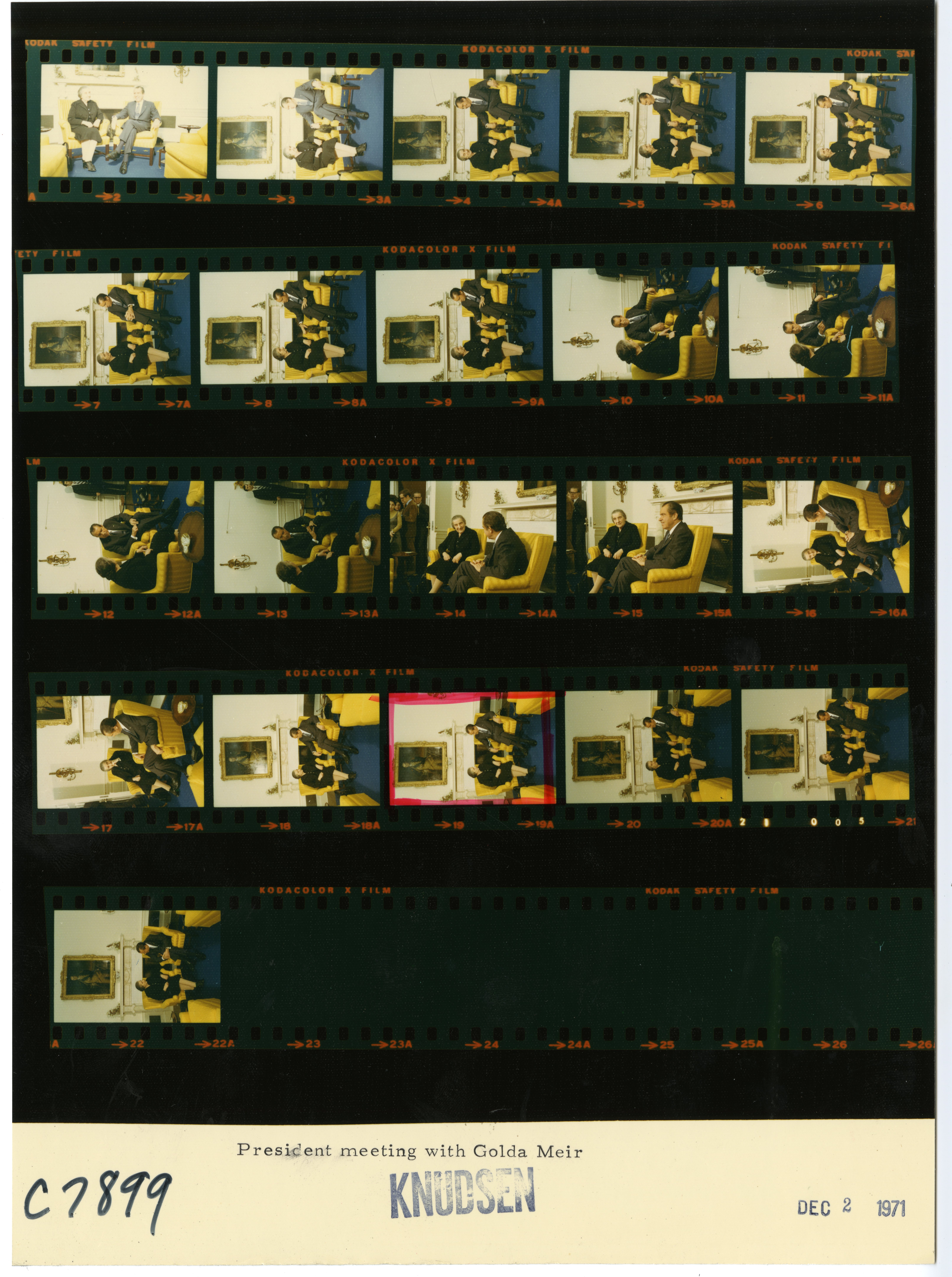
- Frame(s): WHPO-7899-02-22, President Nixon seated informally in the Oval Office armchairs during a meeting with Israeli Prime Minister Golda Meir. 12/2/1971, Washington, D.C. White House, Oval Office. President Nixon, Golda Meir.
- Frame(s): WHPO-7899-09, President Nixon seated informally in the Oval Office armchairs during a meeting with Israeli Prime Minister Golda Meir. 12/2/1971, Washington, D.C. White House, Oval Office. President Nixon, Golda Meir.
- Frame(s): WHPO-7899-19, President Nixon seated informally in the Oval Office armchairs during a meeting with Israeli Prime Minister Golda Meir. 12/2/1971, Washington, D.C. White House, Oval Office. President Nixon, Golda Meir.
Roll WHPO-7900 Photographer: Knudsen, Robert L. | Color or B&W: B&W
- Frame(s): WHPO-7900-03-11, Closeup portrait study of Maj. Jack Brennan. 12/2/1971, Washington, D.C. unknown. Maj. John V. Brennan (AKA) Jack Brennan.
Roll WHPO-7901 Photographer: Atkins, Oliver | Color or B&W: B&W

- Frame(s): WHPO-7901-03, President Nixon shaking hands with Arthur Fletcher, Alternate Representative for Ambassador George H. W. Bush, from the U.S. Delegation to the United Nations (U.N.). 12/2/1971, Washington, D.C. White House, Oval Office. President Nixon, Arthur A. Fletcher.
- Frame(s): WHPO-7901-03-05, President Nixon shaking hands with Arthur Fletcher, Alternate Representative for Ambassador George H. W. Bush, from the U.S. Delegation to the United Nations (U.N.). 12/2/1971, Washington, D.C. White House, Oval Office. President Nixon, Arthur A. Fletcher, Kenneth Cole.
- Frame(s): WHPO-7901-06-14, President Nixon standing with Arthur Fletcher, Alternate Representative for Ambassador George H. W. Bush, from the U.S. Delegation to the United Nations (U.N.). 12/2/1971, Washington, D.C. White House, Oval Office. President Nixon, Arthur A. Fletcher, Kenneth Cole.
Roll WHPO-7902 Photographer: Kightlinger, Jack | Color or B&W: B&W
- Frame(s): WHPO-7902-01A-08A, Robert Finch, on behalf of President Nixon, receiving a carved story board from Micronesian leaders. 12/2/1971, Washington, D.C. unknown. Robert Finch, Olympio Borja, Alper domsin, Redali Lomisang, Ibedul Ngoriakl, Andrew Roboman, Francisco Luktun, Micronesian Leaders.
Roll WHPO-7903 Photographer: Atkins, Oliver | Color or B&W: B&W
- Frame(s): WHPO-7903-02-21, President Nixon seated informally in the Oval Office armchairs during a meeting with Israeli Prime Minister Golda Meir. 12/2/1971, Washington, D.C. White House, Oval Office. President Nixon, Golda Meir.
- Frame(s): WHPO-7903-11A, President Nixon seated informally in the Oval Office armchairs during a meeting with Israeli Prime Minister Golda Meir. 12/2/1971, Washington, D.C. White House, Oval Office. President Nixon, Golda Meir.
Roll WHPO-7904 Photographer: Knudsen, Robert L. | Color or B&W: B&W
- Frame(s): WHPO-7904-02A, President Nixon greeting crowd outside the Washington Hilton Hotel. 12/2/1971, Washington, D.C. Washington Hilton Hotel. President Nixon, press corps members.
- Frame(s): WHPO-7904-04A-18A, President Nixon meeting with Chairman of the Board and Chief Executive Officer of J. C. Penny Co. William Batten, Chairman of the Board and Chief Executive Officer of Sears Roebuck Co. Gordan Metcalf , and Director of the OMB George Shultz. 12/2/1971, Washington, D.C. White House, Oval Office. President Nixon, George P. Shultz, William M. Batten, Gordan M. Metcalf.
Roll WHPO-7905 Photographer: Atkins, Oliver | Color or B&W: B&W
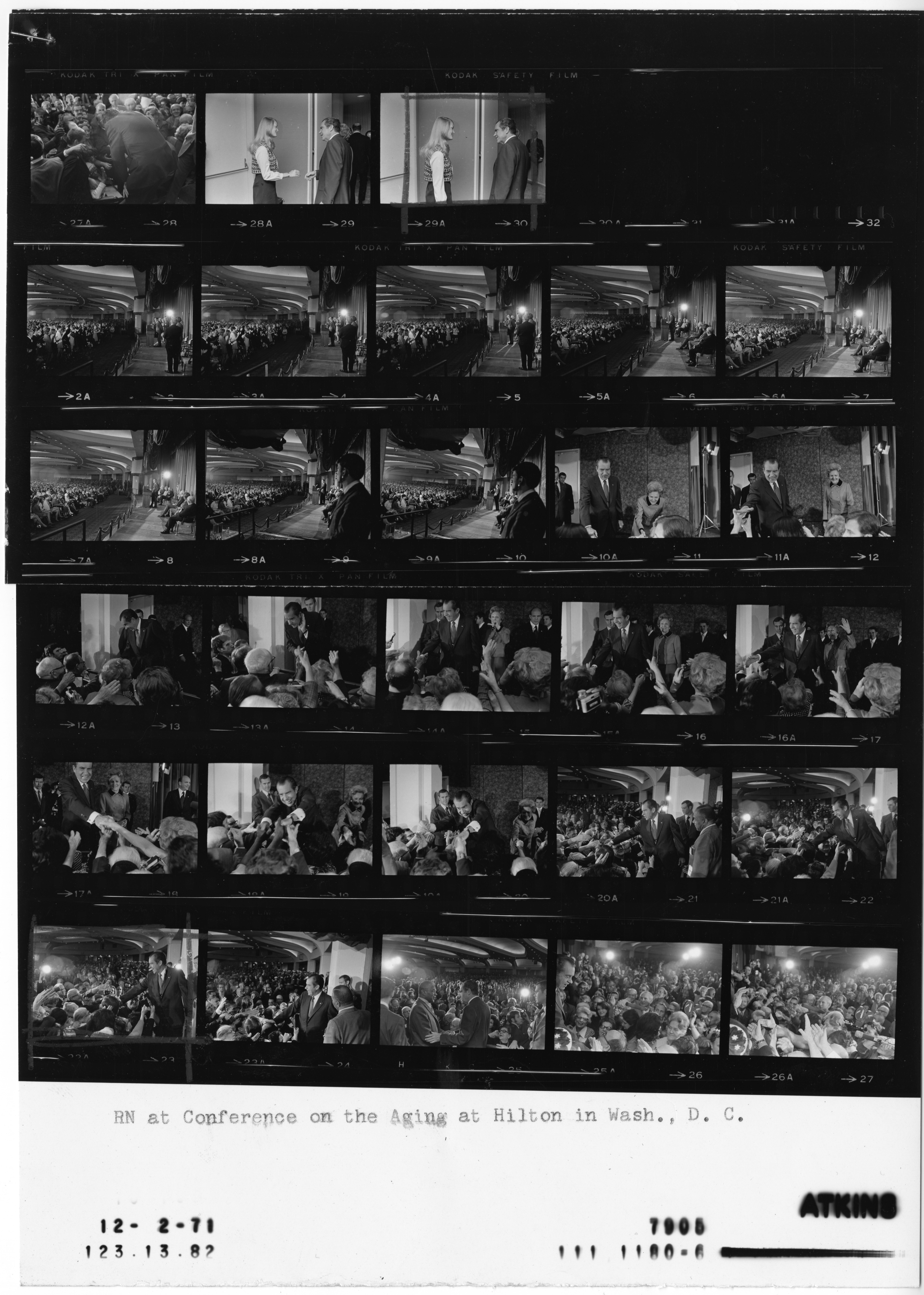
- Frame(s): WHPO-7905-02A-09A, President Nixon addressing the delegates to the 1971 White House Conference on Aging. 12/2/1971, Washington, D.C. Washington Hilton Hotel. President Nixon, Pat Nixon, Also attending on stage: Former Chief Justice Earl Warren. Arthur S. Flemming, Chairman of the White House Conference on Aging. Rabbi Abraham Feldman,Congregation Beth Israel, Hartford, Conn. Bishop Raymond Gallagher, Diocese of Lafayette, Indiana. John Martin, Commissioner of the illVd's Administration on Aging. Inabel B. Lindsay, Member of the Advisory Committee for the White House Conference on Aging. Berthe Adkins, Member of the Advisory Cormnittee for the White House Conference on Aging.
- Frame(s): WHPO-7905-10A-27A, President Nixon greeting the crowd as he leaves the 1971 White House Conference on Aging. 12/2/1971, Washington, D.C. Washington Hilton Hotel. President Nixon, Pat Nixon, Also attending on stage: Former Chief Justice Earl Warren. Arthur S. Flemming, Chairman of the White House Conference on Aging. Rabbi Abraham Feldman,Congregation Beth Israel, Hartford, Conn. Bishop Raymond Gallagher, Diocese of Lafayette, Indiana. John Martin, Commissioner of the illVd's Administration on Aging. Inabel B. Lindsay, Member of the Advisory Committee for the White House Conference on Aging. Berthe Adkins, Member of the Advisory Cormnittee for the White House Conference on Aging.
- Frame(s): WHPO-7905-28A-29A, President Nixon talking with a young woman as he leaves the 1971 White House Conference on Aging. 12/2/1971, Washington, D.C. Washington Hilton Hotel. President Nixon, Pat Nixon, Also attending on stage: Former Chief Justice Earl Warren. Arthur S. Flemming, Chairman of the White House Conference on Aging. Rabbi Abraham Feldman,Congregation Beth Israel, Hartford, Conn. Bishop Raymond Gallagher, Diocese of Lafayette, Indiana. John Martin, Commissioner of the illVd's Administration on Aging. Inabel B. Lindsay, Member of the Advisory Committee for the White House Conference on Aging. Berthe Adkins, Member of the Advisory Cormnittee for the White House Conference on Aging.
Roll WHPO-7906 Photographer: Atkins, Oliver | Color or B&W: B&W
- Frame(s): WHPO-7906-02A-05A, President Nixon attending the swearing-in ceremony for Secretary of Agriculture, Earl Butz, presided over by US Supreme Court Justice Harry Blackmun. 12/2/1971, Washington, D.C. White House, Oval Office. President Nixon, Pat Nixon, Earl L. Butz, Mary Emma (Powell) Butz, Harry A. Blackmun, Melvin R. Laird, George Aiken.
- Frame(s): WHPO-7906-06, President Nixon attending the swearing-in ceremony for Secretary of Agriculture, Earl Butz, presided over by US Supreme Court Justice Harry Blackmun. 12/2/1971, Washington, D.C. White House, Oval Office. President Nixon, Pat Nixon, Earl L. Butz, Mary Emma (Powell) Butz, Harry A. Blackmun, Melvin R. Laird, George Aiken.
- Frame(s): WHPO-7906-06A-10A, 19A, President Nixon shaking hands with Secretary of Agriculture Earl Butz. 12/2/1971, Washington, D.C. White House, Oval Office. President Nixon, Pat Nixon, Earl L. Butz, Mary Emma (Powell) Butz, Harry A. Blackmun, Melvin R. Laird, George Aiken.
- Frame(s): WHPO-7906-11A, 13A-14A, 18A, 20A-21A, President Nixon with Secretary of Agriculture Earl Butz, with Mrs. Earl Butz, Pat Nixon and US Supreme Court Justice Harry Blackmun. 12/2/1971, Washington, D.C. White House, Oval Office. President Nixon, Pat Nixon, Earl L. Butz, Mary Emma (Powell) Butz, Harry A. Blackmun, Melvin R. Laird, George Aiken.
- Frame(s): WHPO-7906-12A, Secretary of Agriculture, Earl Butz kissing his wife, Mary Emma (Powell) Butz. 12/2/1971, Washington, D.C. White House, Oval Office. President Nixon, Pat Nixon, Earl L. Butz, Mary Emma (Powell) Butz, Harry A. Blackmun, Melvin R. Laird, George Aiken.
- Frame(s): WHPO-7906-16, President Nixon shaking hands with Earl Butz at his swearing-in ceremony as the Secretary of Agriculture, presided over by Justice Harry Blackmun. Pat Nixon and Melvin Laird stand behind them. 12/2/1971, Washington, D.C. White House, Oval Office. President Nixon, Pat Nixon, Earl L. Butz, Mary Emma (Powell) Butz, Harry A. Blackmun, Melvin R. Laird, George Aiken.
Roll WHPO-7907 Photographer: Schumaker, Byron | Color or B&W: Color
- Frame(s): WHPO-7907-01A-08A, President Nixon attending the swearing-in ceremony for Secretary of Agriculture Earl Butz, presided over by Supreme Court Justice Harry Blackmun. 12/2/1971, Washington, D.C. Oval Office, White House. President Nixon, Pat Nixon, Earl L. Butz, Mary Emma (Powell) Butz, Harry A. Blackmun, Melvin R. Laird, George Aiken.
- Frame(s): WHPO-7907-07, President Nixon attending the swearing-in ceremony for Secretary of Agriculture Earl Butz, presided over by Supreme Court Justice Harry Blackmun. 12/2/1971, Washington, D.C. Oval Office, White House. President Nixon, Pat Nixon, Earl L. Butz, Mary Emma (Powell) Butz, Harry A. Blackmun, Melvin R. Laird, George Aiken.
- Frame(s): WHPO-7907-09A-13A, President Nixon standing with Secretary of Agriculture Earl Butz, with Mrs. Earl Butz, Pat Nixon and Supreme Court Justice Harry Blackmun. 12/2/1971, Washington, D.C. Oval Office, White House. President Nixon, Pat Nixon, Earl L. Butz, Mary Emma (Powell) Butz, Harry A. Blackmun, Melvin R. Laird, George Aiken.
- Frame(s): WHPO-7907-14A-18A, President Nixon shaking hands with with Secretary of Agriculture Earl Butz and with Mary (Powell) Butz. 12/2/1971, Washington, D.C. Oval Office, White House. President Nixon, Pat Nixon, Earl L. Butz, Mary Emma (Powell) Butz, Harry A. Blackmun, Melvin R. Laird, George Aiken.
- Frame(s): WHPO-7907-18, President Nixon shaking hands with with Secretary of Agriculture Earl Butz after his swearing-in ceremony. 12/2/1971, Washington, D.C. Oval Office, White House. President Nixon, Pat Nixon, Earl L. Butz, Mary Emma (Powell) Butz, Harry A. Blackmun, Melvin R. Laird, George Aiken.
Roll WHPO-7908 Photographer: | Color or B&W:
- Frame(s): WHPO-7908-01-20, Doctors and surgeons working during a surgery procedure taking place in the operating room of a Chinese hospital. 12/2/1971, China hospital, operating room.
The White House Communications Agency Sound Recordings Collection contains public statements that took place between 1969 and 1974. Visit the finding aid to learn more.
P - Formal Presidential Remarks
- WHCA-SR-P-711204
Remarks by President Nixon to White House Conference on Aging at Wash. Hilton. (12/2/1971)
Runtime: 36:13:00
Original Format: 1/4-inch reel-to-reel audiotape. Original source type: Original. - WHCA-SR-P-711205
Swearing-in ceremony for Earl Butz with Butz, Secretary Rogers, Senator George Aiken. (12/2/1971)
Runtime: 4:16
Original Format: 1/4-inch reel-to-reel audiotape. Original source type: Original.
The White House Communications Agency Videotape Collection contains “off-the-air” recordings of televised programs produced between 1968 and 1974. Visit the finding aid to learn more.
- WHCA-4850
Weekly News Summary , Tape II.
ALL NETWORKS
Runtime: 1:00
15. Reasoner/Donaldson: Senate puts off tax/political finance bill (Muskie). Time Code Start: 30:11. Keywords: bills, laws, taxes, taxation, revenue, reforms. Network: ABC.
16. Gill: President Nixon will veto campaign bill if necessary. Time Code Start: 32:55. Keywords: Presidents, bills, laws, vetoes, elections, campaigns, funding, limitations. Network: ABC.
17. Lawrence: President Nixon 9 years ago recommended public funds for political campaigning. Time Code Start: 34:25. Keywords: Presidents, vetoes, bills, laws, elections, campaigns, funding, limitations. Network: ABC.
18. Reasoner/Clark: Secretary of Agriculture Butz approved by Senate and sworn in by President Nixon. Time Code Start: 35:48. Keywords: Senate, cabinet, advisors, appointments, nominations, investigations, confirmations, swearings in, sworn in, swearing in ceremony. Network: ABC.
19. Reasoner/Koppel: Israel's Prime Minister Golda Meir meets with Secretary of State Rogers and President Nixon. Time Code Start: 37:18. Keywords: Presidents, Middle East, Mideast, Israeli, Prime Ministers, cabinet, advisors, leaders, meetings. Network: ABC.
20. Reasoner: Commentary on men's pantyhose…again. Time Code Start: 39:25. Keywords: fashion, products, clothing, underwear. Network: ABC.
21. Chancellor/Kiker: Senator Jackson won't enter New Hampshire primary; tax cut bill debated (Senators Hubert H. Humphrey, O'Brien). Time Code Start: 41:27. Keywords: Senators, Presidential elections, campaigns, primaries, candidates, primaries, debates, bills, laws, bills, laws, taxes, taxation, revenue, reforms, reductions, decreases. Network: NBC.
22. Chancellor: Different campaign spending plans. Time Code Start: 45:55. Keywords: Presidential elections, campaigns, campaigning, candidates, costs, finances, funding. Network: NBC.
23. Chancellor/Stern: National Convention sites get money for defense. Time Code Start: 46:50. Keywords: Presidential elections, campaigns, campaigning, candidates, voting. Network: NBC.
24. Chancellor/Oliver: Registering young voters. Time Code Start: 48:30. Keywords: Vote, voters, voting, Presidential elections, campaigns, campaigning, candidates, primaries, voting, registrations. Network: NBC.
25. Chancellor/Rosenfeld: President Nixon speaks to the elderly. Time Code Start: 52:10. Keywords: Presidents, speeches, senior citizens, aging issues. Network: NBC.
26. Cronkite/Morton: Tax bill/Campaign spending compromise; Democrats respond (Senator Hubert H. Humphrey). Time Code Start: 53:55. Keywords: political parties, Democrats, Democratic Party, bills, laws, taxes, taxation, revenue, reforms, taxes, taxation, revenue, Presidential elections, campaigns, campaigning, funding, finances, debates. Network: CBS.
27. Cronkite/Rather: President Nixon speaks to elderly. Time Code Start: 55:45. Keywords: Presidents, speeches, senior citizens, aging issues. Network: CBS.
28. Cronkite/Benton: Earl Butz approved for Secretary of Agriculture, President Nixon swears in. Time Code Start: 57:55. Keywords: Senate, cabinet, advisors, appointments, nominations, investigations, confirmations, swearings in, sworn in, swearing in ceremony. Network: CBS.
29. Cronkite: President Nixon assures Israel's Prime Minister Golda Meir of help to Israel; U.S. to spend [?] on the United Nations (U.N.); Cambodians take a beating. Time Code Start: 59:40. Keywords: Presidents, Middle East, Mideast, Israeli, Prime Ministers, war, meetings, weapons, aid, Cambodia, Vietnam War, organization of nations, intergovernmental alliance. Network: CBS.
30. Cronkite/Schieffer: The Pentagon's solicited war films. Time Code Start: 60:57. Keywords: United States Department of Defense headquarters, Armed Forces. Network: CBS. - WHCA-4851
Weekly News Summary , Tape III.
ALL NETWORKS
Runtime: 0:12
1. Sevareid: World Trade. Time Code Start: 00:00. Keywords: foreign relations, business, exchanges, agreements, contracts, profits, finance, sales, buying, selling, imports, exports. Network: CBS.
Context (External Sources)
The Vanderbilt Television News Archive is the world's most extensive and complete archive of television news. They have been recording, preserving and providing access to television news broadcasts of the national networks since August 5, 1968.
Wikipedia is a free encyclopedia that anyone can edit.