
Introduction
This almanac page for Saturday, December 16, 1972, pulls together various records created by the federal government and links to additional resources which can provide context about the events of the day.
Previous Date: Friday, December 15, 1972
Next Date: Sunday, December 17, 1972
Schedule and Public Documents
The Daily Diary files represent a consolidated record of the President's activities. Visit the finding aid to learn more.
The President's day began at The White House - Washington, D. C.
The Weekly Compilation of Presidential Documents made available transcripts of the President's news conferences; messages to Congress; public speeches, remarks, and statements; and other Presidential materials released by the White House.
Digitized versions can be found at HathiTrust.
Each Public Papers of the Presidents volume contains the papers and speeches of the President of the United States that were issued by the White House Office of the Press Secretary during the time period specified by the volume. The material is presented in chronological order, and the dates shown in the headings are the dates of the documents or events. In instances when the release date differs from the date of the document itself, that fact is shown in the text note.
To ensure accuracy, remarks have been checked against audio recordings (when available) and signed documents have been checked against the original, unless otherwise noted. Editors have provided text notes and cross references for purposes of identification or clarity.
The Federal Register is the official daily publication for rules, proposed rules, and notices of federal agencies and organizations, as well as executive orders and other Presidential documents.
Archival Holdings
Any selection of archival documents will necessarily be partial. You should use the documents and folders identified below as a starting place, but consult the linked collection finding aids and folder title lists and the collections themselves for context. Many documents to be found this way do not lend themselves to association with specific dates, but are essential to a complete understanding of the material.
Selective document listing
President's Office Files
The President's Office Files consists of materials drawn together by the Special Files Unit from several administrative subdivisions within the White House Office. It is the handwriting and sensitive papers sent to the Staff Secretary that now comprise much of the President's Office Files. Visit the finding aid to learn more.
- News Summaries, Annotated News Summaries, Box 41, Dec. 1972 [4 of 5] [Note: Due to the way News Summary products were compiled, you should also consult nearby days for potentially relevant materials.]
- News Summary, December 16, 1972, (Friday nets, wires)
- President's Daily Schedule, Box 102, [President's Daily Schedule, Oct.-Dec. 1972] [2 of 2]
- The President's Schedule, Saturday - December 16, 1972
President's Personal File
The President's Personal File is essentially a President's secretary's file, kept by Rose Mary Woods, personal secretary to the President, for two purposes: (1) preserving for posterity a collection of documents particularly close to the President, whether because he dictated or annotated them, or because of the importance of the correspondent or the event concerned and (2) giving appropriate attention–letters of gratitude, invitations to White House social events, and the like–to members and important friends and supporters of the Nixon administration. This generalization does not describe all the varied materials of a file group which is essentially a miscellany, but it does identify the reason for the existence of the file group's core. Visit the finding aid to learn more.
- President's Speech File
The H. R. Haldeman Diaries consists of seven handwritten diaries, 36 dictated diaries recorded as sound recordings, and two handwritten audio cassette tape subject logs. The diaries and logs reflect H. R. Haldeman’s candid personal record and reflections on events, issues, and people encountered during his service in the Nixon White House. As administrative assistant to the President and Chief of Staff, Haldeman attended and participated in public events and private meetings covering the entire scope of issues in which the Nixon White House engaged in during the years 1969-1973. Visit the finding aid to learn more.
- Transcript of diary entry (PDF)
Saturday, December 16.
I spent all morning in a personnel meeting, keeping the President stalled. Didn't get in to see him till later in the afternoon. I raised the point of Anne Armstrong as counselor and the President bought it. We worked up a way to go at it, and I tried to reach Anne to tell her; she wasn't available by phone. We decided we wanted to leak it to the press for the Sunday papers, to the Star, and called Ziegler to tell him to do that. I still couldn't get Anne and the time got to 4:30, which is the latest Ron could leak it, so we went ahead and leaked it without telling Anne. Then I did get her on the phone, told her. She was a little flabbergasted. I didn't get her till 5:30, and by that time, I told her that she'd have to be at the Cabinet dinner tonight, and that really threw her, too, because she only had two hours to notify her family, get organized and get to the dinner but she went ahead and did it. The President decided he wanted her on his right and wanted her to give a toast at the dinner, which he did do.
The Cabinet dinner went off very well. A little bit rambling, as the President got up and gave a little talk about the importance of Cabinet people. Then he gave a toast to the Vice President and considered him as symbolic of the entire Cabinet. Then had Bill Rogers toast Mamie Eisenhower and Pat Nixon, the First Ladies. Bill very graciously also toasted Julie as the symbol of the coming together of those two families. Then he announced Anne Armstrong's appointment; told them it was a big secret until Monday and had Anne respond with a toast to the President. She did a very good job, working in the idea that this is the period when we salute the Prince of Peace and it’s fitting that those of us who are closest to, and work most directly with the President, have a chance to gather with him at this time and to drink a toast to the man who has done the most for peace in our history. A potential awkwardness didn't seem to develop, at least there were no real problems at the dinner, although it wasn't any great smashing success, I don't think.
End of December 16. - Original audio recording (MP3)
The National Archives Catalog is the online portal to the records held at the National Archives, and information about those records. It is the main way of describing our holdings and also provides access to electronic records and digitized versions of our holdings.
The Catalog searches across multiple National Archives resources at once, including archival descriptions, digitized and electronic records, authority records, and web pages from Archives.gov and the Presidential Libraries. The Catalog also allows users to contribute to digitized historical records through tagging and transcription.
Nixon Library Holdings
All National Archives Units
National Security Documents
The President's Daily Brief is the primary vehicle for summarizing the day-to-day sensitive intelligence and analysis, as well as late-breaking reports, for the White House on current and future national security issues. Read "The President's Daily Brief: Delivering Intelligence to Nixon and Ford" to learn more.
The Foreign Relations of the United States series presents the official documentary historical record of major U.S. foreign policy decisions and significant diplomatic activity. Visit the State Department website for more information.
Vol. IX, Vietnam, October 1972-January 1973
The Christmas Bombings, December 14-29, 1972
181. Conversation Among President Nixon, Vice President Agnew, and the President’s Assistant for National Security Affairs (Kissinger), Washington, December 16, 1972
Source: National Archives, Nixon Presidential Materials, White House Tapes, Oval Office, Conversation 825–6. No classification marking. According to the President’s Daily Diary, Agnew and Kissinger met with Nixon in the Oval Office from 10:01 to 10:35 a.m. (Ibid., White House Central Files) The editors transcribed the portions of the conversation printed here specifically for this volume.
183. Message From the Chief of the U.S. Delegation to the Paris Peace Talks (Porter) to the President’s Assistant for National Security Affairs (Kissinger), Paris, December 16, 1972, 1830Z
Source: National Archives, Nixon Presidential Materials, NSC Files, Box 865, For the President’s Files (Winston Lord)—China Trip/Vietnam, Camp David Memcons, December 1972 [1 of 3]. Top Secret; Sensitive; Eyes Only. Sent via Guay and Haig. Kissinger had directed Porter to remain in Paris and meet with Xuan Thuy to discuss the protocols and understandings after he and Le Duc Tho had departed.
Vol. XVII, China, 1969-1972
China, March-December 1972
270. Memorandum of Conversation, New York, December 16, 1972, 6-7 p.m.
Source: National Archives, Nixon Presidential Materials, NSC Files, Box 850, President’s File—China Trip, China Exchanges. Top Secret; Sensitive; Exclusively Eyes Only. The meeting was held at the PRC Mission to the UN.
Vol. XIX, Part 1, Korea, 1969-1972
Republic of Korea Troops in Vietnam and Force Modernization, April 1971-December 1972
171. Telegram From the Embassy in Korea to the Department of State, Seoul, December 16, 1972, 0047Z
Source: National Archives, RG 59, Central Files 1970–73, DEF 6 KOR S. Secret; Exdis. Repeated to Saigon, CINCPAC for POLAD, and Secretary Laird.
Vol. XX, Southeast Asia, 1969-1972
Thailand
185. Letter From President Nixon to Thai National Executive Council Chairman Field Marshal Thanom Kittikachorn, Washington, December 16, 1972
Source: National Archives, RG 59, Central Files 1970–73, POL THAI–US. Secret; Nodis. It was delivered by General Haig on his late December–January trip to Southeast Asia.
Vol. XXIII, Arab-Israeli Dispute, 1969-1972
Proximity Talks and the Backchannel: Separate Department of State and White House Negotiating Tricks
322. Telegram From the Department of State to the Embassy in Israel, Washington, December 16, 1972, 0145Z
Source: National Archives, Nixon Presidential Materials, NSC Files, Box 610, Country Files, Middle East, Israel, Vol. XI. Secret; Exdis. Drafted by Stackhouse and approved in draft by Sisco, and by Atherton. Repeated to Amman, Beirut, Cairo, Jerusalem, London, Paris, Moscow, Jidda, and USUN. All brackets are in the original except those indicating text omitted by the editors.
Vol. XL, Germany and Berlin, 1969-1972
Germany and Berlin, 1969-1972
387. Memorandum From the President’s Assistant for National Security Affairs (Kissinger) to President Nixon, Washington, December 16, 1972
Source: National Archives, Nixon Presidential Materials, NSC Files, Box 687, Country Files, Europe, Germany (Bonn), Vol. XII. Secret; Sensitive; Eyes Only. Sent for information. Butterfield stamped the memorandum to indicate that the President had seen it. No drafting information appears on the memorandum. Sonnenfeldt forwarded a draft to Kissinger on December 14. (Ibid.)
Vol. E-1, Documents on Global Issues, 1969-1972
U.S. Policy Towards Terrorism, Hijacking of Aircraft, and Attacks on Civil Aviation: The Olympic Attack and the Anti-Terrorism Initiatives, September−December 1972
121. Telegram 227601 From the Department of State to the Mission to the United Nations, Washington, December 16, 1972, 1825Z
The Department agreed with reluctance that the U.S. delegation should participate on the terrorism committee required by the UNGA terrorism resolution.
Source: National Archives, RG 59, Central Files 1970-73, POL 23-8. Confidential; Routine. Repeated to London, Paris, Rome, and NATO. Drafted by Armitage and cleared by De Palma.
Vol. E-10, Documents on American Republics, 1969-1972
Mexico
485. Telegram 7204 From the Embassy in Mexico to the Department of State, December 16, 1972, 0026Z., December 16, 1972, 0026Z
Ambassador McBride reported that President Echeverría indicated optimism that 1973 would see the settlement of the long-standing salinity problem.
Source: National Archives, RG 59, Central Files 1970–73, POL 33–1 MEX–US. Confidential. In telegram 7363 from Mexico City, December 28, the Embassy reported an exchange of notes with Rabasa that extended the temporary salinity agreement until April 30, 1973. (Ibid.) In a memorandum to Nixon, December 29, Johnson forwarded a copy of Herbert Brownell’s report and recommendations for a permanent resolution to the Colorado River salinity issue. Neither is published. (Ibid., Nixon Presidential Materials, NSC Files, Box 789, Country Files, Latin America, Brownell Report on Salinity Problem with Mexico)
The Kissinger telephone conversation transcripts consist of approximately 20,000 pages of transcripts of Kissinger’s telephone conversations during his tenure as Assistant to the President for National Security Affairs (1969-1974) and Secretary of State (1973-1974) during the administration of President Richard Nixon. Visit the finding aid for more information.
Digitized versions can be found in the National Archives Catalog.
Audiovisual Holdings
Visit the White House Tapes finding aid to learn about the taping system's operation and archival processing.
Old Executive Office Building
- 382-1; Unknown between 11:25 a.m. & 11:30 a.m.; Nixon, Richard M. (President); Sanchez, Manolo
- 382-2; 11:30 a.m. - 12:45 p.m.; Nixon, Richard M. (President); Colson, Charles W.; Bull, Stephen B.; White House operator; Butterfield, Alexander P.
- 382-3; 12:45 p.m. - 1:25 p.m.; Nixon, Richard M. (President); Ziegler, Ronald L.; Kissinger, Henry A.; Haig, Alexander M., Jr.; [Unknown person(s)]
- 382-4; Unknown between 1:26 p.m. & 1:35 p.m.; Nixon, Richard M. (President); Sanchez, Manolo
- 382-5; 1:26 p.m. - 1:35 p.m.; Nixon, Richard M. (President); Butterfield, Alexander P.
- 382-6; Unknown between 1:35 p.m. & 3:25 p.m.; Nixon, Richard M. (President); [Unknown person(s)]
- 382-7; Unknown between 1:35 p.m. & 3:25 p.m.; Nixon, Richard M. (President); Sanchez, Manolo
- 382-8; Unknown between 1:35 p.m. & 3:25 p.m.; Nixon, Richard M. (President); White House operator
- 382-9; 3:25 p.m. - 3:28 p.m.; Nixon, Richard M. (President); Ziegler, Ronald L.
- 382-10; Unknown between 3:28 p.m. & 3:45 p.m.; Nixon, Richard M. (President); Ehrlichman, John D.
- 382-11; Unknown between 3:28 p.m. & 3:45 p.m.; Nixon, Richard M. (President); [Unknown person(s)]
- 382-12; Unknown between 3:28 p.m. & 3:45 p.m.; Nixon, Richard M. (President); Sanchez, Manolo
- 382-13; 3:45 p.m. - 5:25 p.m.; Nixon, Richard M. (President); Haldeman, H. R. ("Bob"); White House operator; Ziegler, Ronald L.; Sanchez, Manolo; [Unknown person(s)]; Armstrong, Anne L.; Higby, Lawrence M.
Oval Office
- 825-1; Unknown between 9:15 a.m. & 9:37 a.m.; Nixon, Richard M. (President); Monzon, Zosimo T.
- 825-2; Unknown between 9:15 a.m. & 9:37 a.m.; Nixon, Richard M. (President); Monzon, Zosimo T.; Bull, Stephen B.
- 825-3; Unknown between 9:15 a.m. & 9:37 a.m.; Nixon, Richard M. (President); Bull, Stephen B.
- 825-4; 9:37 a.m. - 9:50 a.m.; Nixon, Richard M. (President); Haig, Alexander M., Jr.; Bull, Stephen B.
- 825-5; Unknown between 9:50 a.m. & 9:58 a.m.; Nixon, Richard M. (President); Bull, Stephen B.
- 825-6; 9:58 a.m. - 10:46 a.m.; Nixon, Richard M. (President); Kissinger, Henry A.; Bull, Stephen B.; Agnew, Spiro T. (Vice President)
- 825-7; Unknown between 10:46 a.m. & 10:50 a.m.; Nixon, Richard M. (President); Bull, Stephen B.
- 825-8; Unknown between 10:46 a.m. & 10:50 a.m.; Nixon, Richard M. (President); Sanchez, Manolo
- 825-9; Unknown between 10:46 a.m. & 10:50 a.m.; Nixon, Richard M. (President); Bull, Stephen B.
- 825-10; 10:50 a.m. - 11:08 a.m.; Nixon, Richard M. (President); Butterfield, Alexander P.; Ziegler, Ronald L.; White House operator
- 825-11; 11:08 a.m. - 11:09 a.m.; Nixon, Richard M. (President); Dunn, Thomas G.
- 825-12; Unknown between 11:09 a.m. & 11:25 a.m.; Nixon, Richard M. (President); Sanchez, Manolo; Bull, Stephen B.
- 825-13; Unknown between 11:09 a.m. & 11:25 a.m.; Nixon, Richard M. (President); Bull, Stephen B.
- 825-14; Unknown between 11:09 a.m. & 11:25 a.m.; Nixon, Richard M. (President); Butterfield, Alexander P.
- 825-15; Unknown between 11:09 a.m. & 11:25 a.m.; Nixon, Richard M. (President); Butterfield, Alexander P.
- 825-16; Unknown between 11:09 a.m. & 11:25 a.m.; Nixon, Richard M. (President); Bull, Stephen B.
- 825-17; Unknown between 11:09 a.m. & 11:25 a.m.; Nixon, Richard M. (President); Bull, Stephen B.
White House Telephone
- 34-94; Unknown between 10:50 a.m. & 11:08 a.m.; Nixon, Richard M. (President); White House operator
- 34-95; 11:08 a.m. - 11:09 a.m.; Nixon, Richard M. (President); Dunn, Thomas G.
- 34-96; Unknown between 11:30 a.m. & 12:11 p.m.; Nixon, Richard M. (President); White House operator
- 34-97; 12:11 p.m. - 12:12 p.m.; Nixon, Richard M. (President); Butterfield, Alexander P.
- 34-98; Unknown between 1:35 p.m. & 3:25 p.m.; Nixon, Richard M. (President); White House operator
- 34-99; 3:25 p.m. - 3:28 p.m.; Nixon, Richard M. (President); Ziegler, Ronald L.
- 34-100; Unknown between 3:45 p.m. & 4:27 p.m.; Haldeman, H. R. ("Bob"); White House operator; Ziegler, Ronald L.
- 34-101; Unknown between 3:45 p.m. & 4:27 p.m.; Haldeman, H. R. ("Bob"); White House operator
- 34-102; Unknown between 3:45 p.m. & 4:27 p.m.; Haldeman, H. R. ("Bob"); White House operator
- 34-103; Unknown between 4:27 p.m. & 5:25 p.m.; Haldeman, H. R. ("Bob"); White House operator
- 34-104; Unknown between 4:27 p.m. & 5:25 p.m.; Haldeman, H. R. ("Bob"); Armstrong, Anne L.
The White House Photo Office collection consists of photographic coverage of President Richard Nixon meeting with prominent social, political, and cultural personalities; speaking engagements and news conferences of the President and various high-ranking members of the White House staff and Cabinet; Presidential domestic and foreign travel, including Presidential vacations; social events and entertainment involving the First Family, including entertainers present; official portraits of the President, First Family, and high-ranking members of the Nixon administration; the 1969 and 1973 Inaugurals; the President’s 1972 Presidential election campaign appearances (including speeches) and other official activities of the White House staff and the President’s Cabinet from January 20, 1969 until August 9, 1974 at the White House and the Old Executive Office Building; other locations in Washington, DC, such as The Mall; and the Presidential retreats in Camp David, Maryland, Key Biscayne, Florida, and San Clemente, California. Visit the finding aid to learn more.
Roll WHPO-D1114 Photographer: Atkins, Oliver | Color or B&W: Color
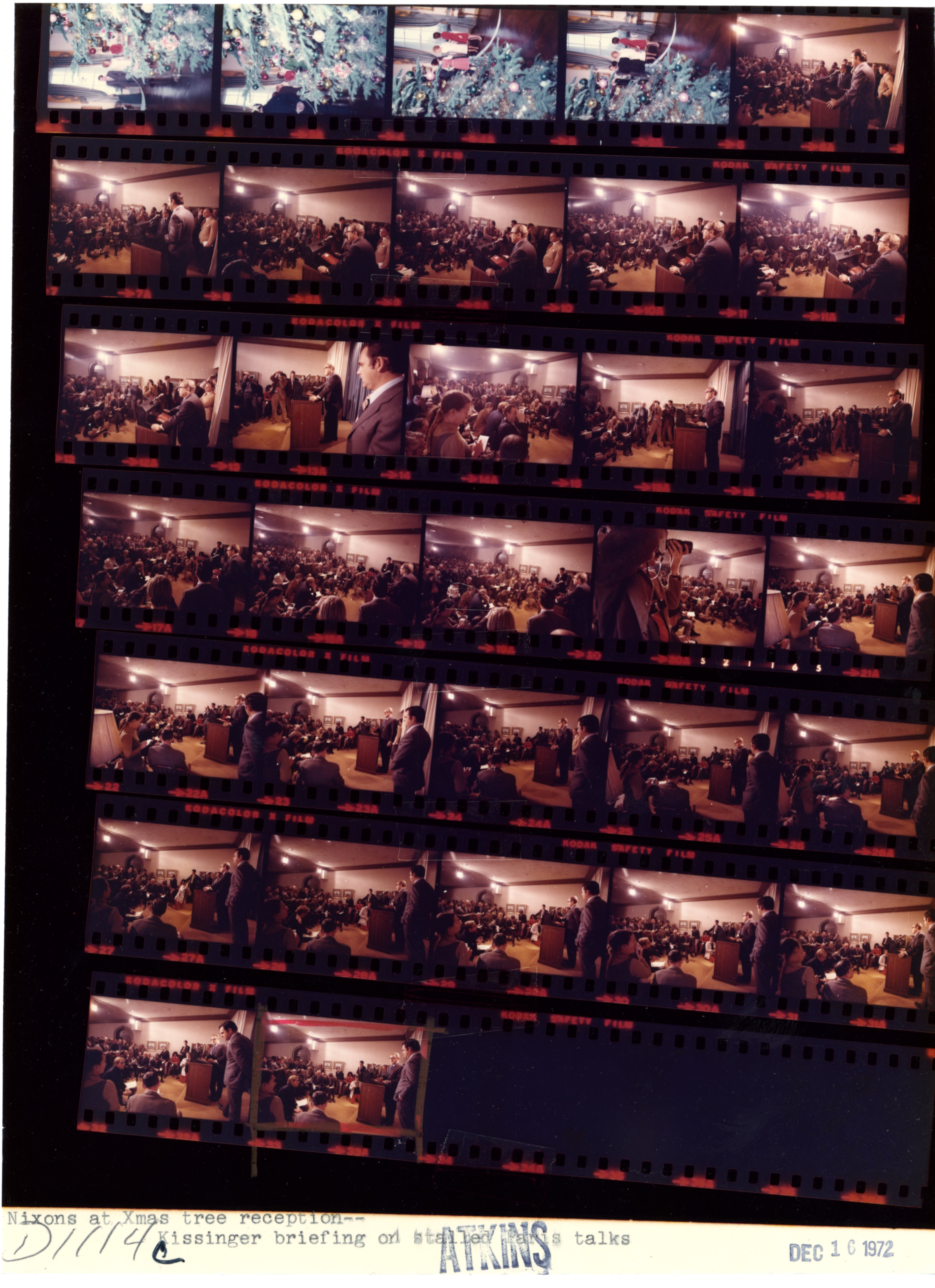
- Frame(s): WHPO-D1114-02A-05A, President Nixon, Pat Nixon and Julie Eisenhower greet guests in a receiving line near a White House Christmas tree. 12/16/1972, Washington, D.C. White House, Blue Room. President Nixon, Pat Nixon, Julie Eisenhower, guests.
- Frame(s): WHPO-D1114-06A-08A, Ron Ziegler speaking during a press conference about the stalled Paris Peace talks. 12/16/1972, Washington, D.C. White House, room. Henry Kissinger, Ronald Ziegler, press corps reporters, photographers.
- Frame(s): WHPO-D1114-08A-33A, Henry Kissinger speaking during a press conference about the stalled Paris Peace talks. 12/16/1972, Washington, D.C. White House, room. Henry Kissinger, Ronald Ziegler, press corps reporters, photographers.
- Frame(s): WHPO-D1114-33A, Henry Kissinger speaking during a press conference about the stalled Paris Peace talks. 12/16/1972, Washington, D.C. White House, room. Henry Kissinger, Ronald Ziegler.
Roll WHPO-D1120 Photographer: Kightlinger, Jack | Color or B&W: Color
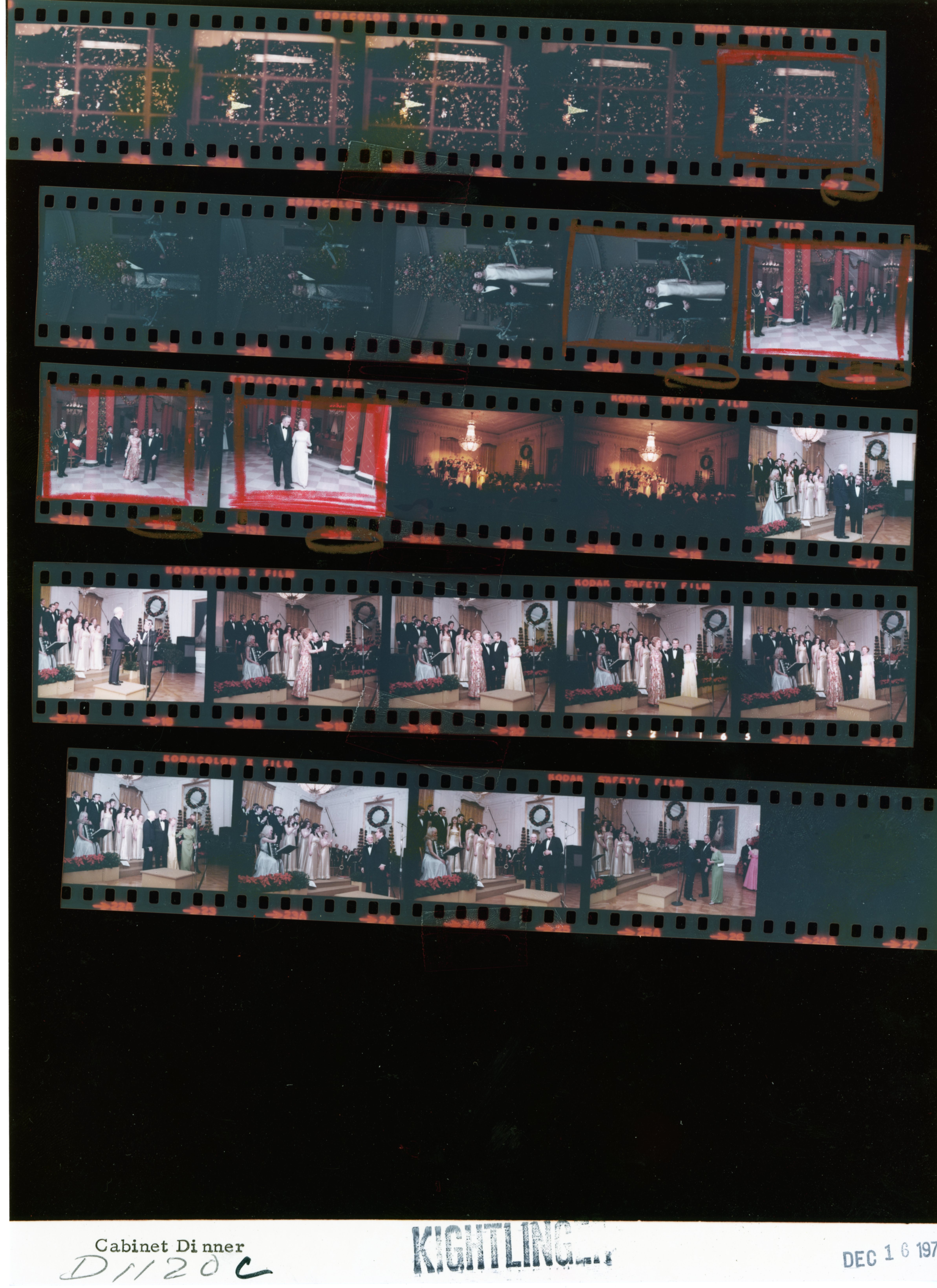
- Frame(s): WHPO-D1120-03-07, The National Christmas tree seen through a White House room window. 12/16/1972, Washington, D.C. room, Blue Room, Grand Hallway, White House, East Room.
- Frame(s): WHPO-D1120-08-09, Christmas dinner guest couple, Ron Ziegler and wife Mrs. Ziegler, by a White House Christmas tree. 12/16/1972, Washington, D.C. room, Blue Room, Grand Hallway, White House, East Room. Mr. & Mrs. Ron Ziegler.
- Frame(s): WHPO-D1120-10-11, A Cabinet member Christmas dinner guest couple, Caspar Weinberger and wife Mrs. Weinberger, by a White House Christmas tree. 12/16/1972, Washington, D.C. room, Blue Room, Grand Hallway, White House, East Room. Mr. & Mrs. Caspar Weinberger.
- Frame(s): WHPO-D1120-12-14, President Nixon and Pat Nixon and officials walk to Cabinet Christmas dinner honoring past, present, and newly designated Cabinet members. 12/16/1972, Washington, D.C. room, Blue Room, Grand Hallway, White House, East Room. President Nixon, Pat Nixon, Spiro Agnew, Judy Agnew, Mr. & Mrs. George Romney.
- Frame(s): WHPO-D1120-15-26, President Nixon and Pat Nixon and Mamie Eisenhower speak with band leader Fred Waring and the Pennsylvania Choir, The Pennsylvanians. 12/16/1972, Washington, D.C. room, Blue Room, Grand Hallway, White House, East Room. President Nixon, Pat Nixon, Mamie Eisenhower, Fred Waring, The Pennsylvanians choir members.
The White House Communications Agency Sound Recordings Collection contains public statements that took place between 1969 and 1974. Visit the finding aid to learn more.
H - White House Staff Member Recordings
- WHCA-SR-H-675
Press briefing by Henry Kissinger. (12/16/1972, Press Lobby, White House)
Runtime: 53:00:00
Keywords: Press conferences, news conferences, interviews, media
Production credits: Audio feed supplied by WHCA; Recorded by GLG (initials of WHCA engineer)
Original Format: 1/4-inch reel-to-reel audiotape. Original source type: Original.
L - White House Press Office Briefings
- WHCA-SR-L-091
Press briefing by Ronald Ziegler. (12/16/1972, White House Press Lobby)
Runtime: 5:00
Keywords: Press conferences, news conferences, interviews, media, press secretary
Original Format: 1/4-inch reel-to-reel audiotape. Original source type: Original.
P - Formal Presidential Remarks
- WHCA-SR-P-721202
Remarks by President Nixon in toast for old and new Cabinet members with AA, Secretary William Rogers. (12/16/1972)
Runtime: 26:12:00
Original Format: 1/4-inch reel-to-reel audiotape. Original source type: Original. - WHCA-SR-P-721203
Remarks by President Nixon introducing Fred Waring and the Pennsylvanians with Waring. (12/16/1972)
Runtime: 4:33
Original Format: 1/4-inch reel-to-reel audiotape. Original source type: Original.
The White House Communications Agency Videotape Collection contains “off-the-air” recordings of televised programs produced between 1968 and 1974. Visit the finding aid to learn more.
- WHCA-5949
Kissinger Press Briefing.
Undetermined
Runtime: 01:39:29 - WHCA-5950
Kissinger Press Briefing.
ALL NETWORKS
Runtime: 01:29:02 - WHCA-5951
"The Advocates".
ALL NETWORKS
Runtime: 01:01:18 - WHCA-5952
"Agronsky & Company".
ALL NETWORKS
Runtime: 00:30:24 - WHCA-5954
Weekly News Summary, Tape I.
ALL NETWORKS
Runtime: 01:35:07
9. Utley/Valeriani: Kissinger press conference. Time Code Start: 15:08. Keywords: media, press conferences, news conferences, interviews. Network: NBC.
10. Utley/Hunt: McGovern's reaction to press conference; Vietnam. Time Code Start: 22:17. Keywords: Vietnam War, Presidents, Vice Presidents, speeches, statements, press conferences, news conferences, interviews, news. Network: NBC.
Context (External Sources)
The Vanderbilt Television News Archive is the world's most extensive and complete archive of television news. They have been recording, preserving and providing access to television news broadcasts of the national networks since August 5, 1968.
Wikipedia is a free encyclopedia that anyone can edit.