
Introduction
This almanac page for Friday, April 9, 1971, pulls together various records created by the federal government and links to additional resources which can provide context about the events of the day.
Previous Date: Thursday, April 8, 1971
Next Date: Saturday, April 10, 1971
Schedule and Public Documents
The Daily Diary files represent a consolidated record of the President's activities. Visit the finding aid to learn more.
The President's day began at The White House - Washington, D. C.
The Weekly Compilation of Presidential Documents made available transcripts of the President's news conferences; messages to Congress; public speeches, remarks, and statements; and other Presidential materials released by the White House.
Digitized versions can be found at HathiTrust.
Each Public Papers of the Presidents volume contains the papers and speeches of the President of the United States that were issued by the White House Office of the Press Secretary during the time period specified by the volume. The material is presented in chronological order, and the dates shown in the headings are the dates of the documents or events. In instances when the release date differs from the date of the document itself, that fact is shown in the text note.
To ensure accuracy, remarks have been checked against audio recordings (when available) and signed documents have been checked against the original, unless otherwise noted. Editors have provided text notes and cross references for purposes of identification or clarity.
The Federal Register is the official daily publication for rules, proposed rules, and notices of federal agencies and organizations, as well as executive orders and other Presidential documents.
Archival Holdings
Any selection of archival documents will necessarily be partial. You should use the documents and folders identified below as a starting place, but consult the linked collection finding aids and folder title lists and the collections themselves for context. Many documents to be found this way do not lend themselves to association with specific dates, but are essential to a complete understanding of the material.
Selective document listing
President's Office Files
The President's Office Files consists of materials drawn together by the Special Files Unit from several administrative subdivisions within the White House Office. It is the handwriting and sensitive papers sent to the Staff Secretary that now comprise much of the President's Office Files. Visit the finding aid to learn more.
- Annotated News Summaries, Box 30, News Summaries - April 1971 [During this period, the Staff Secretary only removed pages from the News Summaries which contained President Nixon's handwriting, often leaving the document with no date. Although there are no specific documents with this date, you should also consult the full folder for the month.]
The H. R. Haldeman Diaries consists of seven handwritten diaries, 36 dictated diaries recorded as sound recordings, and two handwritten audio cassette tape subject logs. The diaries and logs reflect H. R. Haldeman’s candid personal record and reflections on events, issues, and people encountered during his service in the Nixon White House. As administrative assistant to the President and Chief of Staff, Haldeman attended and participated in public events and private meetings covering the entire scope of issues in which the Nixon White House engaged in during the years 1969-1973. Visit the finding aid to learn more.
- Transcript of diary entry (PDF)
Friday, April 9.
We got into quite a discussion with Ziegler this morning on several PR items, particularly the Calley question, as a result of the problem of the letter from the prosecutor, Daniel. The President now feels that Ehrlichman should not have answered the questions regarding the Calley case when he announced the President's decision to review it. He feels we have to educate our people, not to be responsive and to recognize that a briefing is not for the benefit of the press.
He also got into the Scott flap on the withdrawal dates. Scott is now saying that the President does have a definite date in mind, and the President spent considerable time briefing Ziegler on how to handle that, to shoot it down by making the point that he was present at the briefing, and that we have a plan for total American withdrawal, but the President said he would not discuss the matter of a final date, because that would jeopardize our three goals. He said the date depends on what happens, and therefore, he can't discuss it. He further went on to say that while he has a plan, it would be destructive to that plan to have any discussion of a fixed date. You can be certain of total withdrawal, but there is no date set for it, and that would greatly weaken the chances to end the war sooner. Scott then should say that the President did not tell him there was a fixed date, that the issue is total withdrawal, not the date of it. And Ziegler should say he talked to Scott, and they're incorrectly interpreting you, and make the point that an integral part of the plan is that there is no straitjacket of a fixed date. When Ron went out, the President made the point that Ron does an excellent job in these briefings, and he was particularly pleased with that.
He hit me on making sure that we don't appoint any more establishment people to any commissions, etcetera. He wants to go for Midwest, Southern and Western people, and not pick up any more Eastern establishment types.
Later this morning, he had a meeting with Nancy Hanks and Len Garment on the whole culture thing. The President was in great spirits and joking with them on a lot of the culture items. He made the point on the Hershorn that we can't let it go modern, which is a bit of a problem since that's all it is. So he urged Nancy to do the best we can to change it. Then he talked about the need to take Easterners off the Board and put some Midwest and Westerners on. He agreed to do a talk to the Arts Foundation. He got into quite a discussion on the movies, and the need to reverse the antitrust divestiture order and let the producers get a piece of the action.
He later decided to do the ASNE without television, so as to let the war issue move off of the TV screen for a couple of weeks. He feels he can't avoid a large number of questions on the war, and that the way to solve the problem is just not to put the thing on television. He did agree to permit film. All of this turning out to be basically what Scali was recommending.
In the afternoon, we went to Good Friday church services at St. John's across from Lafayette Park. All was worked out on the basis of a last minute run, but somehow someone got the word, and when we arrived there were a half a dozen minister-types standing out in front, shouting "Peace Now." The President went in and remained for the twenty minute service, and then as he went out a different door, the demonstrators had gathered there and were chanting again, this time something about Christ died to save men's lives, or something. The President's reaction was, of course, that he would not go to Gettysburg for Easter services, since it had been announced he was going and that would just set-up more demonstrations. So we had to work out a plan for canceling that and setting up an unannounced trip to Thurmont for Easter services. I left for Williamsburg at 4:00. The President left for Camp David at 5:30 to join his family there for the Easter weekend.
End of April 9. - Original audio recording (MP3)
The National Archives Catalog is the online portal to the records held at the National Archives, and information about those records. It is the main way of describing our holdings and also provides access to electronic records and digitized versions of our holdings.
The Catalog searches across multiple National Archives resources at once, including archival descriptions, digitized and electronic records, authority records, and web pages from Archives.gov and the Presidential Libraries. The Catalog also allows users to contribute to digitized historical records through tagging and transcription.
Nixon Library Holdings
All National Archives Units
National Security Documents
The President's Daily Brief is the primary vehicle for summarizing the day-to-day sensitive intelligence and analysis, as well as late-breaking reports, for the White House on current and future national security issues. Read "The President's Daily Brief: Delivering Intelligence to Nixon and Ford" to learn more.
The Foreign Relations of the United States series presents the official documentary historical record of major U.S. foreign policy decisions and significant diplomatic activity. Visit the State Department website for more information.
Vol. IV, Foreign Assistance, International Development, Trade Policies, 1969-1972
Foreign Assistance Policy, 1969-1972
59. Memorandum From Secretary of Defense Laird to President Nixon, Washington, April 9, 1971
Source: National Archives, Nixon Presidential Materials, NSC Files, Subject Files, Box 402, Trade, Volume III 12/70-6/71. Secret. A stamped notation reads: “The President has seen.” Attached to a May 4 memorandum from Kissinger to the President summarizing Laird’s points and noting that Kissinger had sent a brief reply to Laird that indicated that the President’s interest in Laird’s study that would be used as the basis for re-examining military sales policy. On Kissinger’s memorandum to the President, Nixon wrote: “K—I agree totally with Laird’s concern—The foreign service types will of course disagree—I don’t want a leisurely study of this made. I want action—soonest possible to reverse this trend. Inform Connally of my concern. He shares it.” A May 6 memorandum from Haig to Bergsten informed him of the President’s reaction to Laird’s memorandum and asked Bergsten to monitor closely the progress on Laird’s study. (Ibid.) In a May 15 memorandum, Haig also asked Bergsten to provide a memorandum from Kissinger to Connally. (Ibid., Box 226, Department of Defense, Volume XI 2/24/71-5/15/71)
Trade and Commerce, 1969-1972
253. Memorandum From Secretary of State Rogers to President Nixon, Washington, April 9, 1971
Source: National Archives, Nixon Presidential Materials, NSC Files, Subject Files, Box 402, Trade, Volume III 12/70-6/71. Confidential.
Vol. V, United Nations, 1969-1972
Chinese Representation in the United Nations
344. Memorandum From the President’s Assistant for National Security Affairs (Kissinger) to President Nixon, Washington, April 9, 1971
Source: National Archives, Nixon Presidential Materials, NSC Files, Box 1025, Nixon/HAK Memoranda, The President, Kissinger, and Ambassador Chow, April 12, 1971. Secret. Sent for action. The memorandum is stamped “The President has seen.” A covering note in the files suggests that it was drafted by Wright, with the concurrence of Holdridge. (Ibid.) Another copy of the memorandum contains a covering note that reads: “April 12, HAK—Pres. didn’t act on this. Do you want to A. ask him, B. send back?” Kissinger initialed option “A” and wrote “Let me take in to [unreadable] to get signed. HK” (Ibid., NSC Files, Box 300, Agency Files, USUN, 1 January 1971–May 1971, Vol. VI, Part 2)
Vol. VII, Vietnam, July 1970-January 1972
The Consequences of Operation Lan Som 719 and the Search for a Settlement, April 8-October 6, 1971
175. Memorandum From the President’s Assistant for National Security Affairs (Kissinger) to President Nixon, Washington, April 9, 1971
Source: National Archives, Nixon Presidential Materials, NSC Files, Box 121, Vietnam Subject Files, Viet (POW) Jan-Jun 71, Vol. II. Confidential. Sent for action. Astamped notation on the memorandum reads, “The President has seen.” Holdridge forwarded the memorandum to Kissinger under an April 9 covering memorandum, recommending that he sign it. He noted that the Department of State had prepared the draft statement at his request.
Vol. XI, South Asia Crisis, 1971
South Asia Crisis, 1971
23. Minutes of Senior Review Group Meeting, Washington, April 9, 1971, 11:15 a.m.-12:15 p.m.
Source: National Archives, Nixon Presidential Materials, NSC Files, NSC Institutional Files (H-Files), Box H–112, SRG Minutes, Originals, 1971. Secret. No drafting information is provided on the minutes. The meeting was held in the White House Situation Room. According to Kissingerʼs appointment book, the meeting took place from 11:12 a.m. to 12:24 p.m. (Library of Congress, Manuscript Division, Kissinger Papers, Box 438, Miscellany, 1968–1976, Record of Schedule)
24. Memorandum for the Record, Wea, April 9, 1971
Source: National Security Council Files, 40 Committee, Minutes—1971. Secret; Sensitive.
Vol. XVII, China, 1969-1972
China,January-September 1971
112. Memorandum From John H. Holdridge of the National Security Council Staff to the President’s Assistant for National Security Affairs (Kissinger), Washington, April 9, 1971
Source: National Archives, Nixon Presidential Materials, NSC Files, Box 521, Country Files, Far East, China, Vol. VI. Secret. Sent for information. The attached NSC Correspondence Profile indicates that the memorandum was “Noted by HAK.”
Vol. XXI, Chile, 1969-1973
Cool and Correct: The U.S. Response to the Allende Administration, November 5, 1970-December 31, 1972
220. Memorandum From the President’s Assistant for National Security Affairs (Kissinger) to President Nixon, Washington, April 9, 1971
Source: National Archives, Nixon Presidential Materials, NSC Files, Box 774, Country Files, Latin America, Chile, Vol. IV. Confidential. Sent for information. A stamped notation on the memorandum indicates the President saw it.
Vol. XXXII, SALT I, 1969-1972
From Stalemate to Breakthrough, August 24, 1970-May 20, 1971
146. Conversation Between President Nixon and the Director of the Office of Management and Budget (Shultz), Washington, April 9, 1971
Source: National Archives, Nixon Presidential Materials, White House Tapes, Oval Office, Conversation No. 476–8. No classification marking. Haig was also present during the meeting, which, according to the President’s Daily Diary, was held from 10:03 to 10:27 a.m. (Ibid., White House Central Files) The editor transcribed the portion of the conversation printed here specifically for this volume.
147. Memorandum From K. Wayne Smith of the National Security Council Staff to the President’s Assistant for National Security Affairs (Kissinger), Washington, April 9, 1971
Source: National Archives, Nixon Presidential Materials, NSC Files, NSC Institutional Files (H-Files), Box H–007, Verification Panel Meeting SALT 4/9/71. Top Secret.
Vol. E-1, Documents on Global Issues, 1969-1972
Oceans Policy
388. Transcript of Telephone Conversation Between Secretary of Defense Laird and the President’s Assistant for National Security Affairs (Kissinger), Washington, April 9, 1971, 10:57 a.m.
Laird and Kissinger discussed the influence of private interests in Law of the Sea negotiations and Laird’s concerns about national security. “Bill” refers to Secretary of State Rogers, who attended an Organization of American States meeting in San Jose, Costa Rica, from Tuesday, April 13 through Friday, April 16. Brigadier General Robert Pursley was Military Assistant to the Secretary, Department of Defense.
Source: National Archives, Nixon Presidential Materials, Kissinger Transcripts, Chronological File, Box 9, April 8-14, 1971. No classification.
Vol. E-10, Documents on American Republics, 1969-1972
Guatemala
351. Telegram 60510 From the Department of State to the Embassy in Guatemala, April 9, 1971, 2152Z., April 9, 1971, 2152Z
In a meeting with Assistant Secretary of State Meyer, Guatemalan Ambassador Asensio expressed “his chagrin at unpleasant image of Guatemala being cast these days by American press and, indeed, by U.S. officials.”
Source: National Archives, RG 59, Central Files 1970–73, POL GUAT. Limited Official Use. Drafted on April 9 by Bell; cleared by Breen, Wiggins, and Hurwitch; and approved by Meyer. In Airgram A–73 from Guatemala City, April 23, the Embassy reported that President Arana faced a dilemma regarding a November 1970 state of siege: “To end the State of Siege without being able to announce a decisive victory against the insurgent Left is politically difficult; to continue under Siege powers for an indefinite period is equally perilous.” (Ibid., POL 15–1 GUAT)
The Kissinger telephone conversation transcripts consist of approximately 20,000 pages of transcripts of Kissinger’s telephone conversations during his tenure as Assistant to the President for National Security Affairs (1969-1974) and Secretary of State (1973-1974) during the administration of President Richard Nixon. Visit the finding aid for more information.
Digitized versions can be found in the National Archives Catalog.
Audiovisual Holdings
The White House Tapes are sound recordings of President Richard Nixon's telephone conversations and of meetings held in the Oval Office and the Cabinet Room in the White House, the President's office in the Old Executive Office Building (OEOB), the Lincoln Sitting Room in the residence section of the White House, and several locations at the Presidential retreat at Camp David, Maryland. These recordings document many of the major events and decisions of the Nixon Administration from February 16, 1971 to July 18, 1973. Visit the White House Tapes finding aid to learn about the taping system's operation and archival processing.
Oval Office
- 476-3; Unknown between 8:40 a.m. & 8:52 a.m.; Nixon, Richard M. (President); [Unknown person(s)]
- 476-4; Unknown between 8:40 a.m. & 8:52 a.m.; Nixon, Richard M. (President); Bull, Stephen B.
- 476-5; Unknown between 8:40 a.m. & 8:52 a.m.; Nixon, Richard M. (President); Bull, Stephen B.
- 476-6; Unknown between 8:40 a.m. & 8:52 a.m.; Nixon, Richard M. (President); Bull, Stephen B.
- 476-7; 8:52 a.m. - 9:58 a.m.; Nixon, Richard M. (President); Haldeman, H. R. ("Bob"); Ziegler, Ronald L.
- 476-8; 10:03 a.m. - 10:27 a.m.; Nixon, Richard M. (President); Shultz, George P.; Haig, Alexander M., Jr.
- 476-9; Unknown between 10:27 a.m. & 10:28 a.m.; Nixon, Richard M. (President); [Unknown person(s)]; White House operator
- 476-10; 10:28 a.m. - 10:31 a.m.; Nixon, Richard M. (President); Colson, Charles W.
- 476-11; 10:33 a.m. - 11:05 a.m.; Nixon, Richard M. (President); McCracken, Paul W.; White House operator; Ziegler, Ronald L.
- 476-12; 11:05 a.m. - 11:05 a.m.; Nixon, Richard M. (President); [Unknown person(s)]
- 476-13; 11:05 a.m. - 11:38 a.m.; Nixon, Richard M. (President); Bull, Stephen B.; Kennedy, David M.; White House photographer; Haig, Alexander M., Jr.
- 476-14; 11:40 a.m. - 1:30 p.m.; Nixon, Richard M. (President); Haldeman, H. R. ("Bob"); Garment, Leonard; Finch, Robert H.; Hanks, Nancy; [Unknown person(s)]; Bull, Stephen B.; Rumsfeld, Donald H.; Rumsfeld, Joyce (Pierson); Rumsfeld, Jeannette (Husted); Rumsfeld, George D.
- 476-15; Unknown between 1:30 p.m. & 1:33 p.m.; Kissinger, Henry A.; Sanchez, Manolo
- 476-16; 1:33 p.m. - 1:33 p.m.; Nixon, Richard M. (President); Kissinger, Henry A.
- 476-17; Unknown between 1:35 p.m. & 1:47 p.m.; Nixon, Richard M. (President); Sanchez, Manolo
- 476-18; Unknown between 1:35 p.m. & 1:47 p.m.; Nixon, Richard M. (President); White House operator
- 476-19; Unknown between 1:35 p.m. & 1:47 p.m.; Nixon, Richard M. (President); Bull, Stephen B.
- 476-20; Unknown between 1:35 p.m. & 1:47 p.m.; Nixon, Richard M. (President); Bull, Stephen B.
- 476-21; Unknown between 1:35 p.m. & 1:47 p.m.; Nixon, Richard M. (President); White House operator
- 476-22; Unknown between 1:35 p.m. & 1:47 p.m.; Nixon, Richard M. (President); White House operator
- 476-23; Unknown between 1:35 p.m. & 1:47 p.m.; Nixon, Richard M. (President); [Unknown person(s)]
- 476-24; Unknown between 1:35 p.m. & 1:47 p.m.; Nixon, Richard M. (President); Bull, Stephen B.
- 476-25; 1:47 p.m. - 2:37 p.m.; Nixon, Richard M. (President); Burns, Arthur F.; Kissinger, Henry A.; Peterson, Peter G.; Bull, Stephen B.; Watts, Phil
- 476-26; 3:16 p.m. - 3:33 p.m.; Nixon, Richard M. (President); Haldeman, H. R. ("Bob"); Bull, Stephen B.; Murphy, Thomas F.; Ziegler, Ronald L.
- 476-27; 3:34 p.m. - 3:34 p.m.; Nixon, Richard M. (President); Bull, Stephen B.
- 476-28; 3:34 p.m. - 3:37 p.m.; Nixon, Richard M. (President); Piazza, Marguerite; Bergtholdt, F. Harry; Condon, William J.; Condon, Anna B.; Pollard, Herman Marvin (Dr.); Pollard, Herman Marvin (Mrs.); Rimer, Irving I.; Cole, Kenneth R., Jr.; White House photographer
- 476-29; Unknown between 3:40 p.m. & 3:50 p.m.; Nixon, Richard M. (President); Kuhn, Bowie K.; Cronus, Joseph E.; Feeney, Charles S.; Short, Robert E.; Williams, Theodore S. ("Ted"); Cashen, Henry C., II
White House Telephone
- 1-54; Unknown between 8:40 a.m. & 10:02 a.m.; Nixon, Richard M. (President); White House operator
- 1-55; 10:03 a.m. - 10:27 a.m.; Nixon, Richard M. (President); Haig, Alexander M., Jr.
- 1-56; 10:27 a.m. - 10:28 a.m.; Nixon, Richard M. (President); White House operator
- 1-57; 10:28 a.m. - 10:31 a.m.; Nixon, Richard M. (President); Colson, Charles W.
- 1-58; Unknown between 10:31 a.m. & 11:01 a.m.; Nixon, Richard M. (President); White House operator
- 1-59; 11:01 a.m. - 11:02 a.m.; Nixon, Richard M. (President); Ziegler, Ronald L.
- 1-60; Unknown between 1:35 p.m. & 1:47 p.m.; Nixon, Richard M. (President); White House operator
- 1-61; Unknown between 1:35 p.m. & 1:47 p.m.; Nixon, Richard M. (President); White House operator
- 1-62; Unknown between 1:35 p.m. & 1:47 p.m.; Nixon, Richard M. (President); White House operator
- 1-63; 1:47 p.m. - 1:54 p.m.; Nixon, Richard M. (President); Burns, Arthur F.; Peterson, Peter G.
- 1-64; 3:20 p.m. - 3:21 p.m.; Nixon, Richard M. (President); Murphy, Thomas F.
The White House Photo Office collection consists of photographic coverage of President Richard Nixon meeting with prominent social, political, and cultural personalities; speaking engagements and news conferences of the President and various high-ranking members of the White House staff and Cabinet; Presidential domestic and foreign travel, including Presidential vacations; social events and entertainment involving the First Family, including entertainers present; official portraits of the President, First Family, and high-ranking members of the Nixon administration; the 1969 and 1973 Inaugurals; the President’s 1972 Presidential election campaign appearances (including speeches) and other official activities of the White House staff and the President’s Cabinet from January 20, 1969 until August 9, 1974 at the White House and the Old Executive Office Building; other locations in Washington, DC, such as The Mall; and the Presidential retreats in Camp David, Maryland, Key Biscayne, Florida, and San Clemente, California. Visit the finding aid to learn more.
Roll WHPO-6012 Photographer: Knudsen, Robert L. | Color or B&W: B&W
- Frame(s): WHPO-6012-02A-07A, President Nixon receiving a Yap Island money stone from Ambassador-at-Large David Kennedy. Yap Stones known as Rai are large round doughnut-shaped carved calcite disks. 4/9/1971, Washington, D.C. White House, Oval Office. President Nixon, David Kennedy.
- Frame(s): WHPO-6012-06A, President Nixon receiving a Yap Island money stone from Ambassador-at-Large David Kennedy. Yap Stones known as Rai are large round doughnut-shaped carved calcite disks. 4/9/1971, Washington, D.C. White House, Oval Office. President Nixon, David Kennedy.
Roll WHPO-6013 Photographer: Knudsen, Robert L. | Color or B&W: B&W
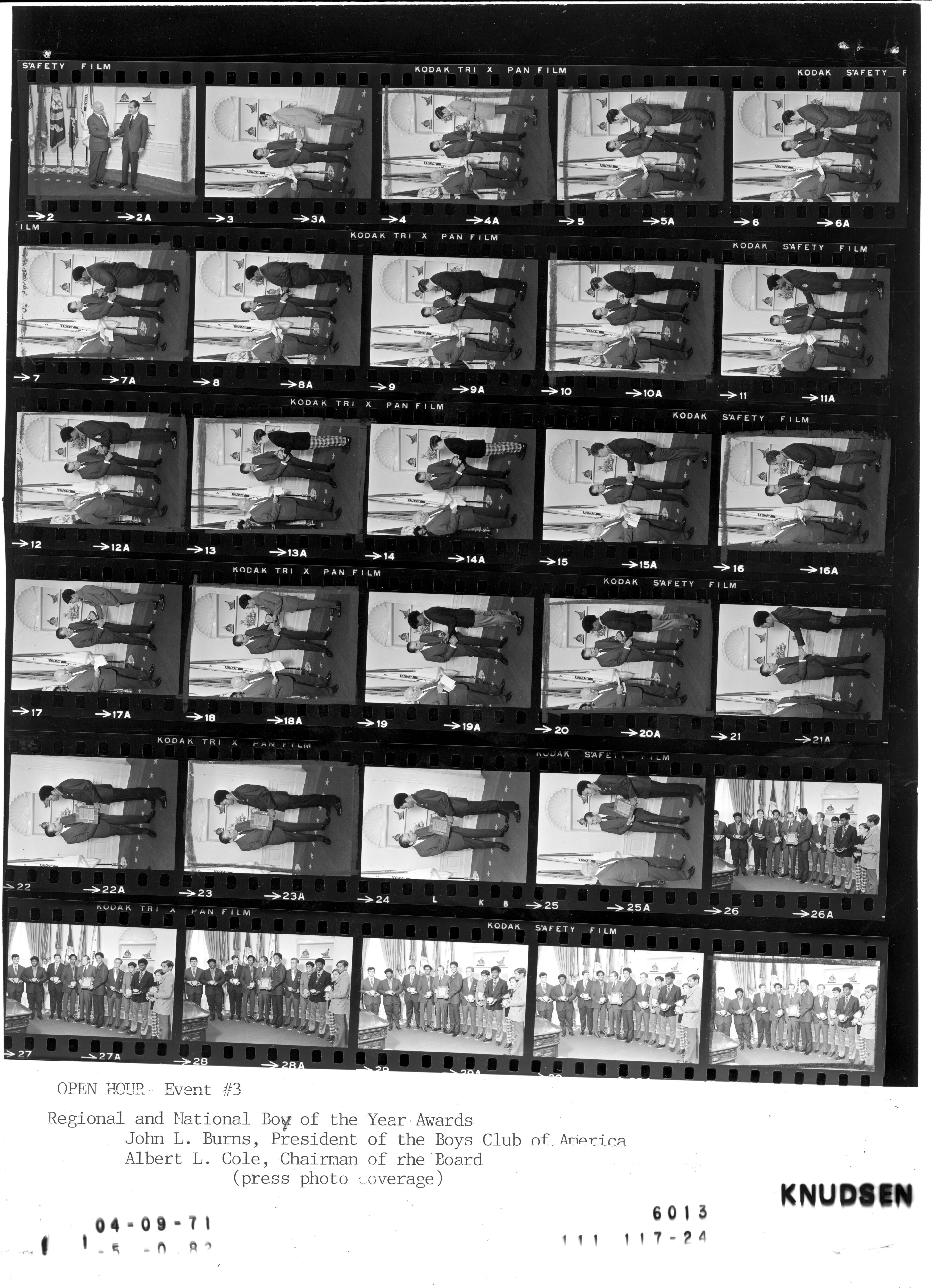
- Frame(s): WHPO-6013-02-25, President Nixon presenting awards to Pelton Stewart, the Boys Club of America National Boy of the Year, and the regional finalists. 4/9/1971, Washington, D.C. White House, Oval Office. President Nixon, Horacio Cardozo, James Mendell, Threadwell Goodson, Jeff Koneck, Raymond Barnett, Donald Reidy, Jr., Paul Spataro, Alfredo Amaya, Frederick Hannah, Pelton Stewart.
- Frame(s): WHPO-6013-26-31, President Nixon with Pelton Stewart, the Boys Club of America National Boy of the Year, and the regional finalists. 4/9/1971, Washington, D.C. White House, Oval Office. President Nixon, Horacio Cardozo, James Mendell, Threadwell Goodson, Jeff Koneck, Raymond Barnett, Donald Reidy, Jr., Paul Spataro, Alfredo Amaya, Frederick Hannah, Pelton Stewart.
Roll WHPO-6014 Photographer: Knudsen, Robert L. | Color or B&W: B&W
- Frame(s): WHPO-6014-01A-04A, President Nixon shaking hands with Robert H. Taylor. 4/9/1971, Washington, D.C. White House, Oval Office. President Nixon, Robert H. Taylor.
- Frame(s): WHPO-6014-07A-10A, President Nixon shaking hands with T. Kong Lee. 4/9/1971, Washington, D.C. White House, Oval Office. President Nixon, T. Kong Lee.
Roll WHPO-6015 Photographer: Knudsen, Robert L. | Color or B&W: B&W
- Frame(s): WHPO-6015-02A-12A, President Nixon standing with Cancer Crusade Chairman Marguerite Piazza and her family. 4/9/1971, Washington, D.C. White House, Oval Office. President Nixon, Marguerite Piazza, Harry Bergtholdt, Shirley Condon, Billy Condon, Ann Condon.
- Frame(s): WHPO-6015-15A-25A, President Nixon standing with Commissioner of Baseball Bowie Kuhn, Ted Williams, and other baseball celebrities. 4/9/1971, Washington, D.C. White House, Oval Office. President Nixon, Bowie Kuhn, Ted Williams, Joe Cronin, Charles "Chub" Feeney, Robert Short, Joe Burke.
- Frame(s): WHPO-6015-29, President Nixon standing with Commissioner of Baseball Bowie Kuhn, Ted Williams, and other baseball celebrities in the Oval Office. 4/9/1971, Washington, D.C. White House, Oval Office. President Nixon, Bowie Kuhn, Ted Williams, Joe Cronin, Charles "Chub" Feeney, Robert Short, Joe Burke.
Roll WHPO-6016 Photographer: Schumacher, Karl | Color or B&W: B&W
- Frame(s): WHPO-6016-02-15, Furniture in the Map Room. 4/9/1971, Washington, D.C. White House, Map Room.
Roll WHPO-6017 Photographer: Knudsen, Robert L. | Color or B&W: B&W
- Frame(s): WHPO-6017-02-08, President Nixon standing in the Oval office with Donald Rumsfeld, his wife and parents. 4/9/1971, Washington, D.C. White House, Oval Office. President Nixon, Donald Rumsfeld, Mrs. Donald Rumsfeld, George Rumsfeld, Mrs. George Rumsfeld.
The White House Communications Agency Sound Recordings Collection contains public statements that took place between 1969 and 1974. Visit the finding aid to learn more.
G - Cabinet Officer Briefings
- WHCA-SR-G-102
Press briefing by Secretary of Labor James D. Hodgson and Mr. Lovell, with Ronald Ziegler; press pool report by Robert Pierpoint. (4/9/1971, Press Center)
Runtime: 28:00:00
Production credits: Audio feed supplied by NBC; Recorded by KAP (initials of WHCA engineer)
Original Format: 1/4-inch reel-to-reel audiotape. Original source type: Original.
The White House Communications Agency Videotape Collection contains “off-the-air” recordings of televised programs produced between 1968 and 1974. Visit the finding aid to learn more.
- WHCA-4267
Weekly News Summary, Tape II.
ALL NETWORKS
Runtime: 00:27:42
27. Smith/Giggans: War casualties; other war news. Time Code Start: 59:20. Keywords: Vietnam War, killed in action, KIA, death tolls, fatalities, casualty, casualties, military, troops. Network: ABC.
28. Smith/Farmer: Bombing of night club in Saigon, Vietnam. Time Code Start: 62:20. Keywords: Vietnam War, bombs, bombings. Network: ABC.
29. Gill: Possible softening of Red China policy toward U.S. (People's Republic of China). Time Code Start: 63:29. Keywords: People's Republic of China, diplomacy, changes. Network: ABC.
30. Smith/Jarriel: Air Force One (AF1). Time Code Start: 65:14. Keywords: Presidents, aircraft, planes, transportation, Boeing 707 SAM 27000, Boeing 707 SAM 26000. Network: ABC.
31. Smith/Geer: Springtime in Washington, D.C. (President Nixon leaving church). Time Code Start: 68:00. Keywords: President Nixon, religion, religious services, cities, tourism, seasons, weather. Network: ABC.
32. Smith: Commentary on Pentagon decision on punishment for former-G.I.s. Time Code Start: 69:36. Keywords: United States Department of Defense headquarters, Armed Forces. Network: ABC.
33. McGee: Bombing in Vietnam; Calley case; war news (Lt. Calley and My Lai Massacre trial). Time Code Start: 72:28. Keywords: Vietnam War, Lt. Calley, My Lai Massacre, military trials, massacres, war crimes, atrocities, mass murders, civilians deaths, shootings. Network: NBC.
34. McGee: President Nixon approves of jobs for youth. Time Code Start: 73:30. Keywords: Presidents, speeches, stsatements, approvals, jobs, unemployment, young people, teenagers, teens. Network: NBC.
35. Chancellor/Duke: Changing politics in the South. Time Code Start: 74:11. Keywords: Southern states, politics. Network: NBC.
36. Cronkite/Scheiffer: War casualties; helicopters lost. Time Code Start: 77:47. Keywords: Vietnam War, killed in action, KIA, death tolls, fatalities, casualty, casualties, military, troops, aircraft, losses, crashes. Network: CBS.
37. Duvall: G.I.s who extend service tours in South Vietnam. Time Code Start: 79:44. Keywords: Vietnam War, military, troops. Network: CBS.
38. Cronkite: War action, Calley case (Lt. Calley and My Lai Massacre trial). Time Code Start: 85:40. Keywords: Vietnam War, Lt. Calley, My Lai Massacre, military trials, massacres, war crimes, atrocities, mass murders, civilians deaths, shootings. Network: CBS.
39. Cronkite/Sevareid: Commentary on Washington D.C. in Springtime. Time Code Start: 86:45. Keywords: cities, tourism, weather. Network: CBS.
Context (External Sources)
The Vanderbilt Television News Archive is the world's most extensive and complete archive of television news. They have been recording, preserving and providing access to television news broadcasts of the national networks since August 5, 1968.
Wikipedia is a free encyclopedia that anyone can edit.