
Introduction
This almanac page for Saturday, April 3, 1971, pulls together various records created by the federal government and links to additional resources which can provide context about the events of the day.
Previous Date: Friday, April 2, 1971
Next Date: Sunday, April 4, 1971
Schedule and Public Documents
The Daily Diary files represent a consolidated record of the President's activities. Visit the finding aid to learn more.
The President's day began at San Clemente, California
The Weekly Compilation of Presidential Documents made available transcripts of the President's news conferences; messages to Congress; public speeches, remarks, and statements; and other Presidential materials released by the White House.
Digitized versions can be found at HathiTrust.
Each Public Papers of the Presidents volume contains the papers and speeches of the President of the United States that were issued by the White House Office of the Press Secretary during the time period specified by the volume. The material is presented in chronological order, and the dates shown in the headings are the dates of the documents or events. In instances when the release date differs from the date of the document itself, that fact is shown in the text note.
To ensure accuracy, remarks have been checked against audio recordings (when available) and signed documents have been checked against the original, unless otherwise noted. Editors have provided text notes and cross references for purposes of identification or clarity.
The Federal Register is the official daily publication for rules, proposed rules, and notices of federal agencies and organizations, as well as executive orders and other Presidential documents.
Archival Holdings
Any selection of archival documents will necessarily be partial. You should use the documents and folders identified below as a starting place, but consult the linked collection finding aids and folder title lists and the collections themselves for context. Many documents to be found this way do not lend themselves to association with specific dates, but are essential to a complete understanding of the material.
Selective document listing
President's Office Files
The President's Office Files consists of materials drawn together by the Special Files Unit from several administrative subdivisions within the White House Office. It is the handwriting and sensitive papers sent to the Staff Secretary that now comprise much of the President's Office Files. Visit the finding aid to learn more.
- Annotated News Summaries, Box 30, News Summaries - April 1971 [During this period, the Staff Secretary only removed pages from the News Summaries which contained President Nixon's handwriting, often leaving the document with no date. Although there are no specific documents with this date, you should also consult the full folder for the month.]
President's Personal File
The President's Personal File is essentially a President's secretary's file, kept by Rose Mary Woods, personal secretary to the President, for two purposes: (1) preserving for posterity a collection of documents particularly close to the President, whether because he dictated or annotated them, or because of the importance of the correspondent or the event concerned and (2) giving appropriate attention–letters of gratitude, invitations to White House social events, and the like–to members and important friends and supporters of the Nixon administration. This generalization does not describe all the varied materials of a file group which is essentially a miscellany, but it does identify the reason for the existence of the file group's core. Visit the finding aid to learn more.
- President's Speech File
The H. R. Haldeman Diaries consists of seven handwritten diaries, 36 dictated diaries recorded as sound recordings, and two handwritten audio cassette tape subject logs. The diaries and logs reflect H. R. Haldeman’s candid personal record and reflections on events, issues, and people encountered during his service in the Nixon White House. As administrative assistant to the President and Chief of Staff, Haldeman attended and participated in public events and private meetings covering the entire scope of issues in which the Nixon White House engaged in during the years 1969-1973. Visit the finding aid to learn more.
- Transcript of diary entry (PDF)
Saturday, April 3.
The President got to working on the speech this morning and has changed substantially the approach that Henry was originally taking. He's going to go fairly quickly through the basic detail stuff he has to cover regarding Vietnam, Laos, and the troop withdrawal and then get more into a general approach to the situation that we now find ourselves in regarding the war, the need for national defense, and the general public attitude towards all of this. Everybody, including even Henry, seems to agree with this basic change of direction.
Then he got into quite a discussion on the general thesis of tactics on how to approach all of the events that affect the polls. For instance, his announcements regarding the war at various times. That after each of them we've had a substantial improvement in public opinion, but Laos, where we had no announcements and no television appearance by the President, the public opinion dropped radically and has stayed down. He feels that this indicates some need to change our schedule planning, to drop the trivia and to make more effective use of TV. We've got to get through the symbolism of contact with a lot of people by working out a schedule which shows a lot of contact, but doesn't have so many actual meetings. In other words, one a day makes the point; there's no point in adding a lot of others.
He feels we've spent too much time on therapy with the Cabinet, the staff, and the Congress, and that it doesn't do any good and that we should, from now on, concentrate only on our hardcore enthusiasts, where we can get some mileage out of them. In the same context, he wants to cut down on open hours, and so forth. His main point is that we have to dominate the dialogue, so we should go back to looking at ways to do this. He sees that as one prime time press conference a month, plus one other major prime time television appearance, a speech or something else, and that we should get rid of all the nickel and dime stuff, except for one such thing a day. Use the rest of the time to make the big plays and to prepare for the television appearances. He does feel we need more visible indications of Presidential leadership, and that we've got to get away from the little stuff in order to get to that appearance of leadership.
We got into some discussion of Congressional things, but MacGregor says we've got a new problem about to crop up because Goldwater and Hatfield have united in the Senate to oppose any extension of the draft, on the grounds that we can now move to a volunteer army. This will pose a whole new problem. Even though it was Saturday and a sensationally beautiful day, the President stayed in the office all day, going over these things with me plus reviewing periodic speech drafts with Buchanan. This should get him in shape to take tomorrow off, and we'll see what happens.
End of April 3. - Original audio recording (MP3)
The National Archives Catalog is the online portal to the records held at the National Archives, and information about those records. It is the main way of describing our holdings and also provides access to electronic records and digitized versions of our holdings.
The Catalog searches across multiple National Archives resources at once, including archival descriptions, digitized and electronic records, authority records, and web pages from Archives.gov and the Presidential Libraries. The Catalog also allows users to contribute to digitized historical records through tagging and transcription.
Nixon Library Holdings
All National Archives Units
National Security Documents
The President's Daily Brief is the primary vehicle for summarizing the day-to-day sensitive intelligence and analysis, as well as late-breaking reports, for the White House on current and future national security issues. Read "The President's Daily Brief: Delivering Intelligence to Nixon and Ford" to learn more.
The Foreign Relations of the United States series presents the official documentary historical record of major U.S. foreign policy decisions and significant diplomatic activity. Visit the State Department website for more information.
Vol. XI, South Asia Crisis, 1971
South Asia Crisis, 1971
18. Memorandum From Secretary of State Rogers to President Nixon, Washington, April 3, 1971
Source: National Archives, RG 59, Central Files 1970–73, POL 23–9 PAK. Secret. Drafted by Van Hollen and Anthony C.E. Quainton (NEA/INC) on April 2, and cleared by Sisco, and by Spengler in draft.
Vol. XXXII, SALT I, 1969-1972
From Stalemate to Breakthrough, August 24, 1970-May 20, 1971
145. Letter From the Permanent Representative to the North Atlantic Treaty Organization (Ellsworth) to President Nixon, Brussels, April 3, 1971
Source: National Archives, Nixon Presidential Materials, NSC Files, NSC Institutional Files (H-Files), Box H–007, Verification Panel Meeting SALT 4/9/71. Secret; Sensitive.
Vol. XLI, Western Europe; NATO, 1969-1972
Spain
303. Memorandum From the President’s Assistant for National Security Affairs (Kissinger) to President Nixon, Washington, April 3, 1971
Source: National Archives, Nixon Presidential Materials, NSC Files, Box 705, Country Files—Europe, Spain, Vol. III. Secret. Sent for information. A stamped notation on the memorandum reads: “The President has seen.” The President wrote at the top: “Helms, Excellent analysis.” An attached note to the NSC Secretariat reads: “Per Dr. K’s office, Dr. K has already called Mr. Helms and passed on the President’s remark ‘excellent analysis.’”
The Kissinger telephone conversation transcripts consist of approximately 20,000 pages of transcripts of Kissinger’s telephone conversations during his tenure as Assistant to the President for National Security Affairs (1969-1974) and Secretary of State (1973-1974) during the administration of President Richard Nixon. Visit the finding aid for more information.
Digitized versions can be found in the National Archives Catalog.
Audiovisual Holdings
The White House Photo Office collection consists of photographic coverage of President Richard Nixon meeting with prominent social, political, and cultural personalities; speaking engagements and news conferences of the President and various high-ranking members of the White House staff and Cabinet; Presidential domestic and foreign travel, including Presidential vacations; social events and entertainment involving the First Family, including entertainers present; official portraits of the President, First Family, and high-ranking members of the Nixon administration; the 1969 and 1973 Inaugurals; the President’s 1972 Presidential election campaign appearances (including speeches) and other official activities of the White House staff and the President’s Cabinet from January 20, 1969 until August 9, 1974 at the White House and the Old Executive Office Building; other locations in Washington, DC, such as The Mall; and the Presidential retreats in Camp David, Maryland, Key Biscayne, Florida, and San Clemente, California. Visit the finding aid to learn more.
Roll WHPO-5971 Photographer: Atkins, Oliver | Color or B&W: Color
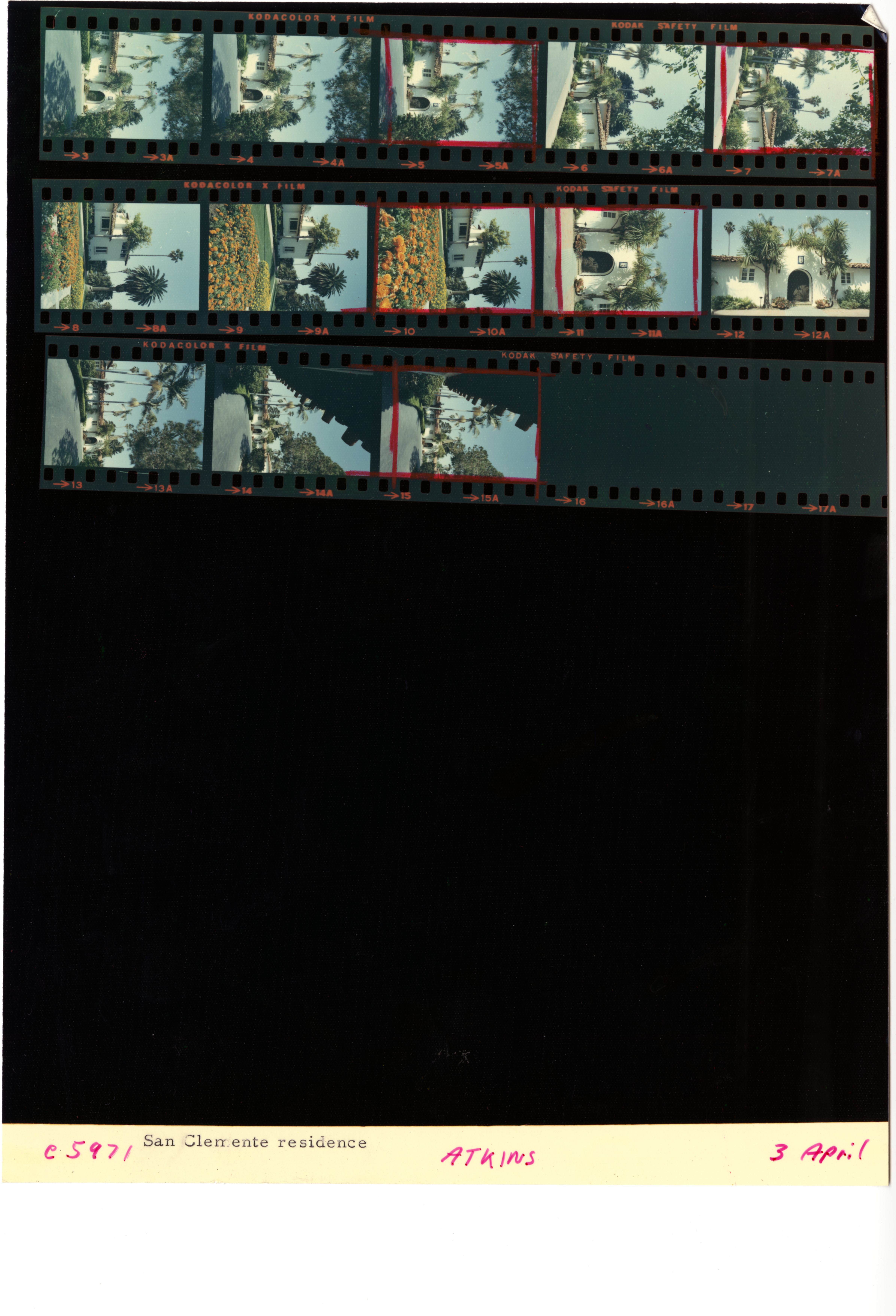
- Frame(s): WHPO-5971-03-15, La Casa Pacifica residence building exteriors. 4/3/1971, San Clemente, California Western White House, residence.
- Frame(s): WHPO-5971-10, La Casa Pacifica residence exterior, second floor corner room. Flowers blooming in foreground. 4/3/1971, San Clemente, California Western White House, La Casa Pacifica, residence, exterior.
- Frame(s): WHPO-5971-14, Driveway and arch front door entrance to La Casa Pacifica. An overhanging roof from nearby building frames the shot. 4/3/1971, San Clemente, California Western White House, La Casa Pacifica, residence exterior.
Roll WHPO-5982 Photographer: Kightlinger, Jack | Color or B&W: B&W
- Frame(s): WHPO-5982-07A-13A, Ronald Ziegler and John Ehrlichman at a press briefing concerning Lt. Calley. 4/3/1971, Laguna Beach, California unknown. Ronald Ziegler, John Ehrlichman, press corps members.
The White House Communications Agency Sound Recordings Collection contains public statements that took place between 1969 and 1974. Visit the finding aid to learn more.
H - White House Staff Member Recordings
- WHCA-SR-H-364
Press briefing by John D. Ehrlichman and Ronald Ziegler. (4/3/1971, Surf and Sand Hotel, Laguna Beach, California)
Runtime: 1:10:00
Keywords: Press conferences, news conferences, interviews, media, press secretary
Production credits: Audio feed supplied by WHCA; Recorded by BAC (initials of WHCA engineer)
Original Format: 1/4-inch reel-to-reel audiotape. Original source type: Original.
The White House Communications Agency Videotape Collection contains “off-the-air” recordings of televised programs produced between 1968 and 1974. Visit the finding aid to learn more.
- WHCA-4257
"Agronsky & Company". The panelists discuss the Calley trial verdict decision - Lt. William Laws Calley trial concerning his involvement in the My Lai masacre in Vietnam Herbert Klein, Director of White House Communications.
WETA
Runtime: 00:29:24 - WHCA-4266
Weekly News Summary, Tape I.
ALL NETWORKS
Runtime: 1:30
1. Chancellor: President Nixon will review Calley case (Lt. Calley and My Lai Massacre trial). Time Code Start: 00:00. Keywords: Vietnam War, Lt. Calley, My Lai Massacre, military trials, massacres, war crimes, atrocities, mass murders, civilians deaths, shootings. Network: NBC.
2. Chancellor: Senator McGovern agrees with President Nixon's decision. Time Code Start: 03:36. Keywords: Presidential elections, campaigns, campaigning, candidates. Network: NBC.
3. Trotta: Calley rally in Georgia (Lt. Calley and My Lai Massacre trial). Time Code Start: 05:00. Keywords: Vietnam War, Lt. Calley, My Lai Massacre, military trials, massacres, war crimes, atrocities, mass murders, civilians deaths, shootings. Network: NBC.
4. Chancellor: Three views on Calley case - Westmoreland, Redenhoud (letter writer), & Bierraum (juror) (Lt. Calley and My Lai Massacre trial). Time Code Start: 06:38. Keywords: Vietnam War, Lt. Calley, My Lai Massacre, military trials, massacres, war crimes, atrocities, mass murders, civilians deaths, shootings. Network: NBC.
5. Mudd/Rather: President Nixon intervenes in Calley case (Lt. Calley and My Lai Massacre trial). Time Code Start: 13:08. Keywords: Presidents, intervention, Vietnam War, Lt. Calley, My Lai Massacre, military trials, massacres, war crimes, atrocities, mass murders, civilians deaths, shootings. Network: CBS.
6. Mudd/Williams: Laos report. Time Code Start: 16:36. Keywords: Laos, Vietnam War. Network: CBS.
7. Mudd: Presidential appointment of Scali to be public information liaison from the White House. Time Code Start: 20:09. Keywords: Presidents, appointments, confirmations, cabinet, advisors, agencies, nominees, media, public relations, PR, journalists, reporters. Network: CBS.
8. Mudd/Schieffer: Advertising to unsell the war in Vietnam. Time Code Start: 20:33. Keywords: Vietnam War, advertisements, ads, TV spots, television, commercials, billboards, propaganda. Network: CBS.
Context (External Sources)
The Vanderbilt Television News Archive is the world's most extensive and complete archive of television news. They have been recording, preserving and providing access to television news broadcasts of the national networks since August 5, 1968.
Wikipedia is a free encyclopedia that anyone can edit.