

Introduction
This almanac page for Thursday, April 22, 1971, pulls together various records created by the federal government and links to additional resources which can provide context about the events of the day.
Previous Date: Wednesday, April 21, 1971
Next Date: Friday, April 23, 1971
Schedule and Public Documents
The Daily Diary files represent a consolidated record of the President's activities. Visit the finding aid to learn more.
The President's day began at The White House - Washington, D. C.
The Weekly Compilation of Presidential Documents made available transcripts of the President's news conferences; messages to Congress; public speeches, remarks, and statements; and other Presidential materials released by the White House.
Digitized versions can be found at HathiTrust.
The Federal Register is the official daily publication for rules, proposed rules, and notices of federal agencies and organizations, as well as executive orders and other Presidential documents.
The Congressional Record is the official daily record of the debates and proceedings of the U.S. Congress.
Archival Holdings
Any selection of archival documents will necessarily be partial. You should use the documents and folders identified below as a starting place, but consult the linked collection finding aids and folder title lists and the collections themselves for context. Many documents to be found this way do not lend themselves to association with specific dates, but are essential to a complete understanding of the material.
Selective document listing
President's Office Files
The President's Office Files consists of materials drawn together by the Special Files Unit from several administrative subdivisions within the White House Office. It is the handwriting and sensitive papers sent to the Staff Secretary that now comprise much of the President's Office Files. Visit the finding aid to learn more.
- Annotated News Summaries, Box 30, News Summaries - April 1971 [During this period, the Staff Secretary only removed pages from the News Summaries which contained President Nixon's handwriting, often leaving the document with no date. Although there are no specific documents with this date, you should also consult the full folder for the month.]
The H. R. Haldeman Diaries consists of seven handwritten diaries, 36 dictated diaries recorded as sound recordings, and two handwritten audio cassette tape subject logs. The diaries and logs reflect H. R. Haldeman’s candid personal record and reflections on events, issues, and people encountered during his service in the Nixon White House. As administrative assistant to the President and Chief of Staff, Haldeman attended and participated in public events and private meetings covering the entire scope of issues in which the Nixon White House engaged in during the years 1969-1973. Visit the finding aid to learn more.
- Transcript of diary entry (PDF)
Thursday, April 22.
The President had three major meetings today and had me sit in on each of them. One with Dole and Anne Armstrong, one with John Connally, and one with Bill Rogers. In addition to that, he had a breakfast with Laird, a long session with John Burns on the Health Program, a posthumous Medal of Honor presentation and a long session with the pro-Nixon Congressional enthusiasts.
In the Dole meeting, other than a general political discussion, Anne Armstrong asked the President how he answers the question of how to deal with youth, and how we should approach this problem. He made some very interesting points. We've got to give them a challenge; we can't let them escape responsibility for themselves and blame their problems on external factors. We can't let them think solely of self, any more than a nation can think solely of itself. They've got to explore the unknown. They have to do something. He diverted for a minute to say that the United States should be first in the world, because we will use that position to help others and to maintain the peace, to do good, rather than to do evil, to help rather than to harm others. Back to the dealing with youth, he said we should be understanding of upper and middle-class parents, because they really do have great problems with their kids because they've been given so much. It's a mistake to think that the way to greatness is to make it easy to get there. For instance, the two greatest nations in the world today––other than the US––are Japan and Germany, and they became so because they were defeated nations that had to rise up by their own bootstraps. He said we must not destroy the character of children by permissiveness, permissiveness that denies a child the opportunity to look in a mirror and finally realize that the problem is me, not my teachers, not the war, not the environment, but me. It was a fascinating insight. He got quite absorbed in it and made these points very strongly.
He also told Anne the story as he had Henry earlier, of how his mother had to support his older brother while they were in Prescott, Arizona, and he was recovering––or actually, he died––from tuberculosis; and in order to finance living over there, his mother took in three other tuberculosis patients, all of whom were also terminal cases, and nursed all of them to their deaths, with Mrs. Nixon providing the full care. The two together made quite an impression, I think, on Anne Armstrong, and she's going to use the points in her appearances.
In the Connally meeting, he got into quite a discussion of the Cabinet and his plans for making changes there. He made the point that he was moving Stans to Finance Chairman, and we needed a really strong salesman as Commerce Secretary. Connally suggested Pete Peterson, which is really a pretty good idea. He also suggested we look into B. K. Johnson as Secretary of the Army or some other post in Defense. He's apparently Kleberg's son-in-- son or nephew and would be outstandingly good. Then the President told him that we'd be encouraging Hardin to go take the Purdue post, and Connally suggested we go to past presidents of the Cattlemen’s Association as good agriculture candidates. He feels strongly we should go to a Midwest or Mountain states man, and he had some specific names in mind. He thinks we should avoid the Farm Bureau. The President last night had come up with Hower as a candidate for this one, but he didn't raise that as a possibility with Connally. Then the President made the point that we were going to change General Lincoln at OEP and were thinking of Rush, or perhaps Chapman of the Marine Corps, as a possibility there. Connally suggested Admiral Anderson for that one, and the more the President got to thinking about that as the day went on, the more intrigued he became with the idea.
The meeting with Rogers this afternoon was to cover the points that needed to be covered before he took off on his trip. It went very well, and there was nothing of any great substance; I’ve written a memo for the President's file on the specifics. In general, Rogers made the point that he doesn't think there's going to be a war in the Middle East, because there's nothing in it for Israel, no reason for Israel to start a war, and obviously no reason for the Egyptians to start one because they'd lose it. Israel's got all she wants anyway, although she keeps moving to escalate her demands and probably will continue to. He's going to try to talk the Israelis into considering a settlement on the grounds that they can get a better settlement now than they'll be able to later. He realizes he can't get into the middle of negotiating on this; he'll urge, not dictate. He'll stay out of the mediator role. He'll handle Israel and Egypt on a very evenly-balanced basis. He'll keep settlement as a long-range goal but urge something now, such as Suez arrangements. The President told him to talk to the Pope regarding POW's, told him that Scali would handle the Ping-Pong visit when the Chinese come over, rather than the State Department. Asked him to try and get some dope discussions going in Turkey and get some publicity on it, and asked him to give a brief report to the President each day on how the trip was going while he is gone.
As he was thinking about the Chamber of Commerce speech and looking back on his-- the success of the welfare speech to the Governors, he came up with some ideas on the points that he wants to make in the welfare area. Principally, that we should hit it again on emphasizing that he's not in favor of a guaranteed annual income because it may destroy character, that we should guarantee the right to earn an income, but not to guarantee the because it may destroy character, that we should guarantee the right to earn an income, but not to guarantee the income regardless of the willingness to go out and work for it. He wants Buchanan to revise some of the things he used in the earlier speeches, even back in '66, on this subject. He feels strongly you don't help someone by giving him unnecessary assistance, because that destroys his ability to help himself.
Harry Dent made the point that people want to be for the President, and they want reasons. They need to get a total picture of the man, and he thinks we ought to have a school for the sub-Cabinet, and so on, to sell this point. In telling me this, the President got to pondering this idea and sort of came up with the conclusion that our problem is that the Democrats always personalize, while the Republicans deal with process, and that the Democrats don't govern well, but they're much better politicians. Pretty good points.
The other big item today was the continuation of the veterans demonstration problem. We had a long session this morning to try to determine what to do in face of the fact that the veterans are in violation of the Supreme Court order by staying on the mall; and it's really our job to enforce that order, but the President has ordered the Attorney General not to use police and not to evict the veterans. Our decision ended up to be that we just continue negotiating and try to and negotiate the issue to death. Later this afternoon, the Attorney General, under pressure from the Supre-- Burger and the Court, went back to the District Court and asked them to vacate the order-- or dissolve the order on the grounds that there was only one more night left and it wasn't worth pursuing. Apparently, the circuit court judge blasted us on this move and said that the court had been put in a very bad position––which actually it has, since we asked for the order to begin with and then didn't enforce it after we got it––which put the veterans in the position of violating the law and us in the position of not enforcing it. Fortunately, I don't think this point has come through very clearly, and it probably won't. We did move a little too fast on getting the order to begin with, though.
End of April 22. - Original audio recording (MP3)
The National Archives Catalog is the online portal to the records held at the National Archives, and information about those records. It is the main way of describing our holdings and also provides access to electronic records and digitized versions of our holdings.
The Catalog searches across multiple National Archives resources at once, including archival descriptions, digitized and electronic records, authority records, and web pages from Archives.gov and the Presidential Libraries. The Catalog also allows users to contribute to digitized historical records through tagging and transcription.
Nixon Library Holdings
All National Archives Units
National Security Documents
The President's Daily Brief is the primary vehicle for summarizing the day-to-day sensitive intelligence and analysis, as well as late-breaking reports, for the White House on current and future national security issues. Read "The President's Daily Brief: Delivering Intelligence to Nixon and Ford" to learn more.
The Foreign Relations of the United States series presents the official documentary historical record of major U.S. foreign policy decisions and significant diplomatic activity. Visit the State Department website for more information.
Vol. V, United Nations, 1969-1972
Chinese Representation in the United Nations
348. Memorandum of Conversation, Washington, April 22, 1971, 11:40 a.m.-12:15 p.m.
Source: National Archives, RG 59, Central Files 1970–73, UN 6 CHICOM. Secret; Exdis. Drafted by Martin and approved by Assistant Secretary Green and in S as amended on May 12. The memorandum of conversation is identified as part three of seven parts.
Vol. XX, Southeast Asia, 1969-1972
Thailand
117. Memorandum From Richard T. Kennedy and John H. Holdridge of the National Security Council Staff to the President’s Assistant for National Security Affairs (Kissinger), Washington, April 22, 1971
[Source: National Archives, Nixon Presidential Materials, NSC Files, Box 563, Country Files, Far East, Thailand, Vol. VI. Secret; Sensitive. 1 page of source text not declassified.]
Vol. XXIII, Arab-Israeli Dispute, 1969-1972
224. Telegram From the Department of State to the Embassy in Israel, Washington, April 22, 1971, 0237Z
Source: National Archives, Nixon Presidential Materials, NSC Files, Box 1162, Saunders Files, Middle East Negotiations Files, Middle East—Jarring Talks, April 21–30, 1971. Secret; Priority; Nodis; Cedar Plus. Drafted by Sisco and Atherton, cleared by Haig, and approved by Rogers. Repeated Priority to Cairo and to USUN.
225. Memorandum for the President’s File by the President’s Assistant (Haldeman), Washington, April 22, 1971
Source: National Archives, Nixon Presidential Materials, NSC Files, Kissinger Office Files, Box 129, Country Files, Middle East. No classification marking. “Top Secret” is handwritten in the upper right-hand corner. All brackets are in the original except those indicating text omitted by the editors.
Vol. XXIV, Middle East Region and Arabian Peninsula, 1969-1972; Jordan, September 1970
Indian Ocean
58. Minutes of a Senior Review Group Meeting, Washington, April 22, 1971, 3:42-4:05 p.m.
Source: National Archives, Nixon Presidential Materials, NSC Files, NSC Institutional Files (H-Files), Box H–112, Senior Review Group, SRG Minutes (Originals) 1971. Secret. The meeting took place in the White House Situation Room. Saunders and Kennedy prepared an April 17 briefing memorandum for Kissinger that included talking papers. (Library of Congress, Manuscript Division, Kissinger Papers, Box CL 304, National Security Council, Feb–Aug 1971) An April 22 memorandum from Saunders and Hoskinson to Kissinger discussed Soviet and Chinese policies toward Ceylon within the wider context of access to the Indian Ocean. (National Archives, Nixon Presidential Materials, NSC Files, NSC Institutional Files (H-Files), Box H–054, Senior Review Group Meetings, SRG Meetings Indian Ocean (NSSM 110) 4/22/71) Nutter prepared a memorandum for the record of this meeting on April 26. (Ibid., RG 218, Records of the Joint Chiefs of Staff, Records of Admiral Moorer, Box 113, Work File (Indian Ocean))
Vol. XXVIII, Southern Africa
Portuguese Africa
95. Memorandum From the Chief of the Africa Division, Directorate of Operations, Central Intelligence Agency (Roosevelt) to Director of Central Intelligence Helms, Washington, April 22, 1971
[Source: Central Intelligence Agency, NIC Files, Job 79–01229A, AA–1, AF Division 1971. Secret. 2 pages not declassified.]
Vol. XXXIX, European Security
MBFR and the Conference on European Security, December 1970-December 1971
46. Memorandum From Helmut Sonnenfeldt of the National Security Council Staff to the President’s Assistant for National Security Affairs (Kissinger), Washington, April 22, 1971
Source: National Archives, Nixon Presidential Materials, NSC Institutional Files (H-Files), Box H–008, Verification Panel Meeting, MBFR, 4/23/71. Secret. Sent for information.
Vol. XL, Germany and Berlin, 1969-1972
Germany and Berlin, 1969-1972
224. Memorandum of Conversation, Washington, April 22, 1971, 11:45 a.m.
Source: National Archives, RG 59, Central Files 1970–73, POL 38–6. Secret. Drafted by Sutterlin. In an attached May 7 memorandum to Eliot, Jeanne W. Davis, NSC Staff Secretary, reported that the memorandum had been approved for limited distribution within the Department of State. The meeting was held in the White House. The memorandum is part I of II. Part II, a brief discussion of the recent visit to China by Klaus Mehnert, a German professor, is ibid., Nixon Presidential Materials, NSC Files, Box 685, Country Files, Europe, Germany (Bonn), Vol. IX.
225. National Security Decision Memorandum 106, Washington, April 22, 1971
Source: National Archives, Nixon Presidential Materials, NSC Files, NSC Institutional Files (H-Files), Boxes H–221-229, NSDMs 97-144. Secret; Limdis. Copies were sent to the Chairman of the Joint Chiefs of Staff and the Director of Central Intelligence. No drafting information appears on the memorandum. Sonnenfeldt forwarded a draft to Kissinger on March 29 (see Document 216). At a breakfast meeting on April 16, Irwin asked Kissinger about the status of the NSDM, which had been pending at the White House since March 20. According to a record of the meeting: “HAK said that he thought he had signed the reply to JNI[rwin]; at any rate he will check on this.” (Memorandum for the Record, April 20; National Archives, RG 59, S/S Files: Lot 74 D 164, Irwin/Kissinger Lunches, 1970–1971) In telegram 70827 to Bonn, April 26, the Department forwarded the text of NSDM 106. (Ibid., Central Files 1970–73, POL 28 GER B)
Vol. E-10, Documents on American Republics, 1969-1972
Haiti
400. Memorandum From the President’s Assistant for National Security Affairs (Kissinger) to President Nixon, Washington, April 22, 1971., Washington, April 22, 1971
President’s Assistant for National Security Affairs Kissinger reported that President Duvalier had died and informed President Nixon he was calling a Washington Special Actions Group (WSAG) meeting to assess the situation.
Source: National Archives, Nixon Presidential Materials, NSC Files, Box 785, Country Files, Latin America, Haiti, Vol. I. Secret. The minutes from the April 22 WSAG meeting are printed as Document 401.401. Minutes of Washington Special Actions Group Meeting, Washington, April 22 1971, 11:15–11:46 a.m., Washington, April 22, 1971, 11:15-11:46 a.m.
[9 pages not declassified in time for publication]
Source: National Archives, Nixon Presidential Materials, NSC Files, NSC Institutional Files (H-Files), Box H–115, Washington Special Actions Group. Secret; Nodis.
Venezuela
674. Memorandum From the President’s Assistant for National Security Affairs (Kissinger) to President Nixon, Washington, April 22, 1971., Washington, April 22, 1971
After summarizing a Department of State memorandum on U.S. efforts to aid Venezuela in developing its southern region, President’s Assistant for National Security Affairs Kissinger informed President Nixon that Secretary State Rogers had instructed the U.S. Ambassador in Venezuela to enter into conversations with the Venezuelans to implement Washington’s blueprint in this area.
Source: National Archives, Nixon Presidential Materials, NSC Files, Box 796, Country Files, Latin America, Venezuela, Vol. 1, 1969–1971. Confidential. Sent for information. Attached but not published at Tab A is a February 23 memorandum from Rogers to the President.
The Kissinger telephone conversation transcripts consist of approximately 20,000 pages of transcripts of Kissinger’s telephone conversations during his tenure as Assistant to the President for National Security Affairs (1969-1974) and Secretary of State (1973-1974) during the administration of President Richard Nixon. Visit the finding aid for more information.
Digitized versions can be found in the National Archives Catalog.
Audiovisual Holdings
The White House Tapes are sound recordings of President Richard Nixon's telephone conversations and of meetings held in the Oval Office and the Cabinet Room in the White House, the President's office in the Old Executive Office Building (OEOB), the Lincoln Sitting Room in the residence section of the White House, and several locations at the Presidential retreat at Camp David, Maryland. These recordings document many of the major events and decisions of the Nixon Administration from February 16, 1971 to July 18, 1973. Visit the White House Tapes finding aid to learn about the taping system's operation and archival processing.
Cabinet Room
Oval Office
- 486-1; 9:41 a.m. - 10:41 a.m.; Nixon, Richard M. (President); Kissinger, Henry A.; Haldeman, H. R. ("Bob"); Dole, Robert J.; Armstrong, Anne L.; Bull, Stephen B.
- 486-2; 10:41 a.m. - 12:01 p.m.; Nixon, Richard M. (President); Ford, Gerald R.; Byrnes, John W.; Richardson, Elliot L.; MacGregor, Clark; Cole, Kenneth R., Jr.; Price, John R., Jr.; Bull, Stephen B.; Sanchez, Manolo; Connally, John B.; Ziegler, Ronald L.; Maroon, Fred; Wayman, Stan
- 486-3; 12:01 p.m. - 1:43 p.m.; Nixon, Richard M. (President); Connally, John B.; Haldeman, H. R. ("Bob"); Sanchez, Manolo
- 486-4; Unknown between 1:43 p.m. & 2:38 p.m.; United States Secret Service agents
- 486-5; 2:40 p.m. - 3:35 p.m.; Nixon, Richard M. (President); Haldeman, H. R. ("Bob"); Bull, Stephen B.; Ziegler, Ronald L.; Rogers, William P.; Maroon, Fred; Wayman, Stan
- 486-6; Unknown between 3:35 p.m. & 3:41 p.m.; Sanchez, Manolo; [Unknown person(s)]
- 486-7; 3:41 p.m. - 4:35 p.m.; Nixon, Richard M. (President); Rogers, William P.; Haldeman, H. R. ("Bob"); Sanchez, Manolo; Bull, Stephen B.
- 486-8; Unknown between 4:35 p.m. & 4:52 p.m.; United States Secret Service agents
White House Telephone
- 2-27; Unknown between 6:41 p.m. & 6:47 p.m.; Nixon, Richard M. (President); White House operator
- 2-28; 6:47 p.m. - 6:56 p.m.; Nixon, Richard M. (President); Haldeman, H. R. ("Bob")
- 2-29; Unknown between 6:56 p.m. & 8:10 p.m.; Nixon, Richard M. (President); White House operator
- 2-30; 8:10 p.m. - 8:23 p.m.; Nixon, Richard M. (President); Colson, Charles W.
- 2-31; 8:23 p.m. - 8:25 p.m.; Nixon, Richard M. (President); Connally, John B.
The White House Photo Office collection consists of photographic coverage of President Richard Nixon meeting with prominent social, political, and cultural personalities; speaking engagements and news conferences of the President and various high-ranking members of the White House staff and Cabinet; Presidential domestic and foreign travel, including Presidential vacations; social events and entertainment involving the First Family, including entertainers present; official portraits of the President, First Family, and high-ranking members of the Nixon administration; the 1969 and 1973 Inaugurals; the President’s 1972 Presidential election campaign appearances (including speeches) and other official activities of the White House staff and the President’s Cabinet from January 20, 1969 until August 9, 1974 at the White House and the Old Executive Office Building; other locations in Washington, DC, such as The Mall; and the Presidential retreats in Camp David, Maryland, Key Biscayne, Florida, and San Clemente, California. Visit the finding aid to learn more.
Roll WHPO-6123 Photographer: Atkins, Oliver | Color or B&W: B&W
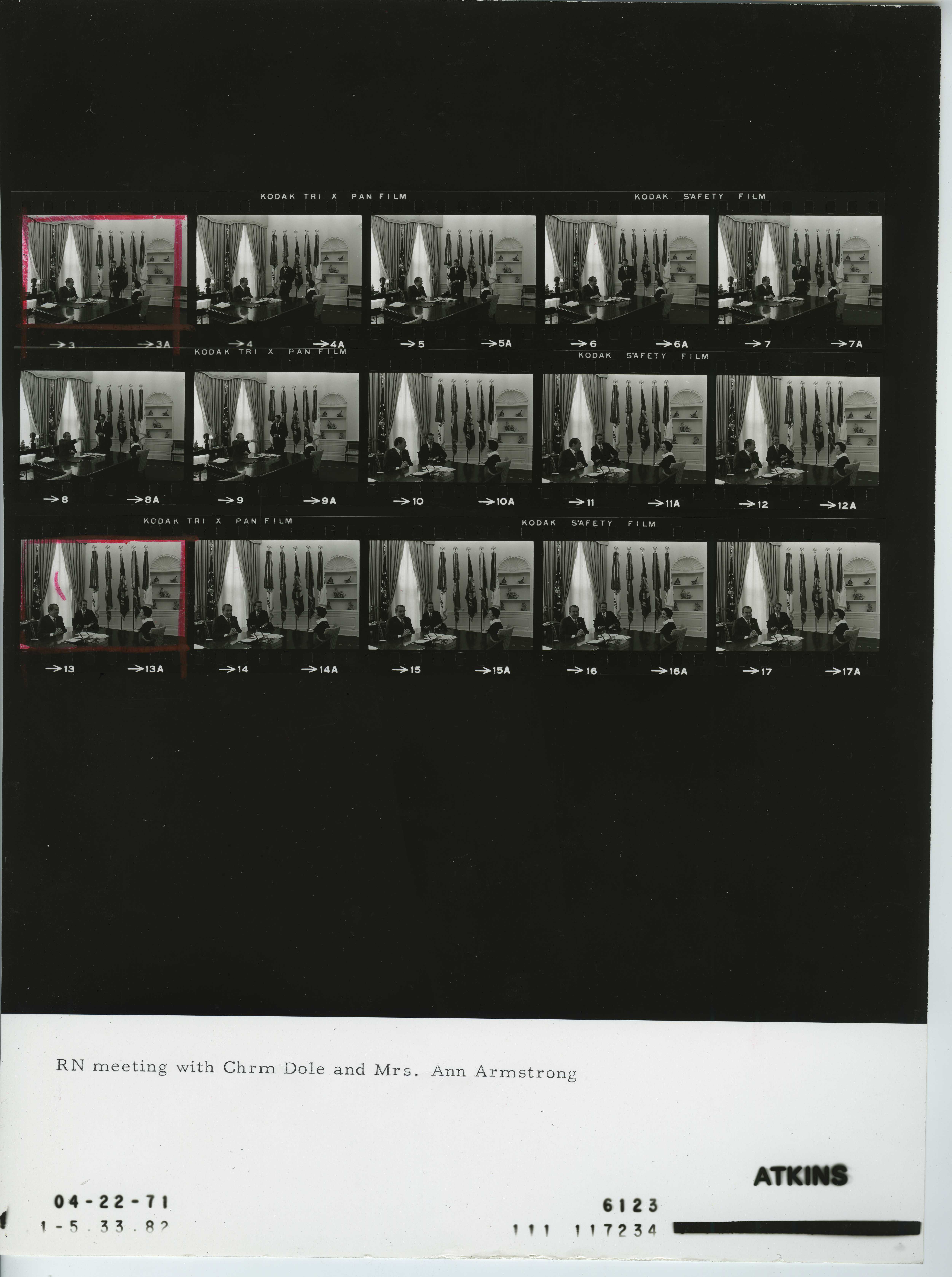
- Frame(s): WHPO-6123-03-17, President Nixon seated at his Oval office desk during a meeting with Senator Bob Dole and Anne Armstrong, Co-chairman of the Republican National Committee. 4/22/1971, Washington, D.C. White House, Oval Office. President Nixon, Robert Dole, Anne Armstrong.
- Frame(s): WHPO-6123-05, President Nixon seated at his Oval office desk during a meeting with Senator Bob Dole and Anne Armstrong, Co-chairman of the Republican National Committee. 4/22/1971, Washington, D.C. White House, Oval Office. President Nixon, Robert Dole, Anne Armstrong.
Roll WHPO-6124 Photographer: Atkins, Oliver | Color or B&W: B&W
- Frame(s): WHPO-6124-03-05, President Nixon having breakfast with Secretary of Defense Melvin R. Laird and Henry Kissinger. 4/22/1971, Washington, D.C. White House, Family Dining Room. President Nixon, Melvin Laird, Henry Kissinger.
Roll WHPO-6125 Photographer: Atkins, Oliver | Color or B&W: Color
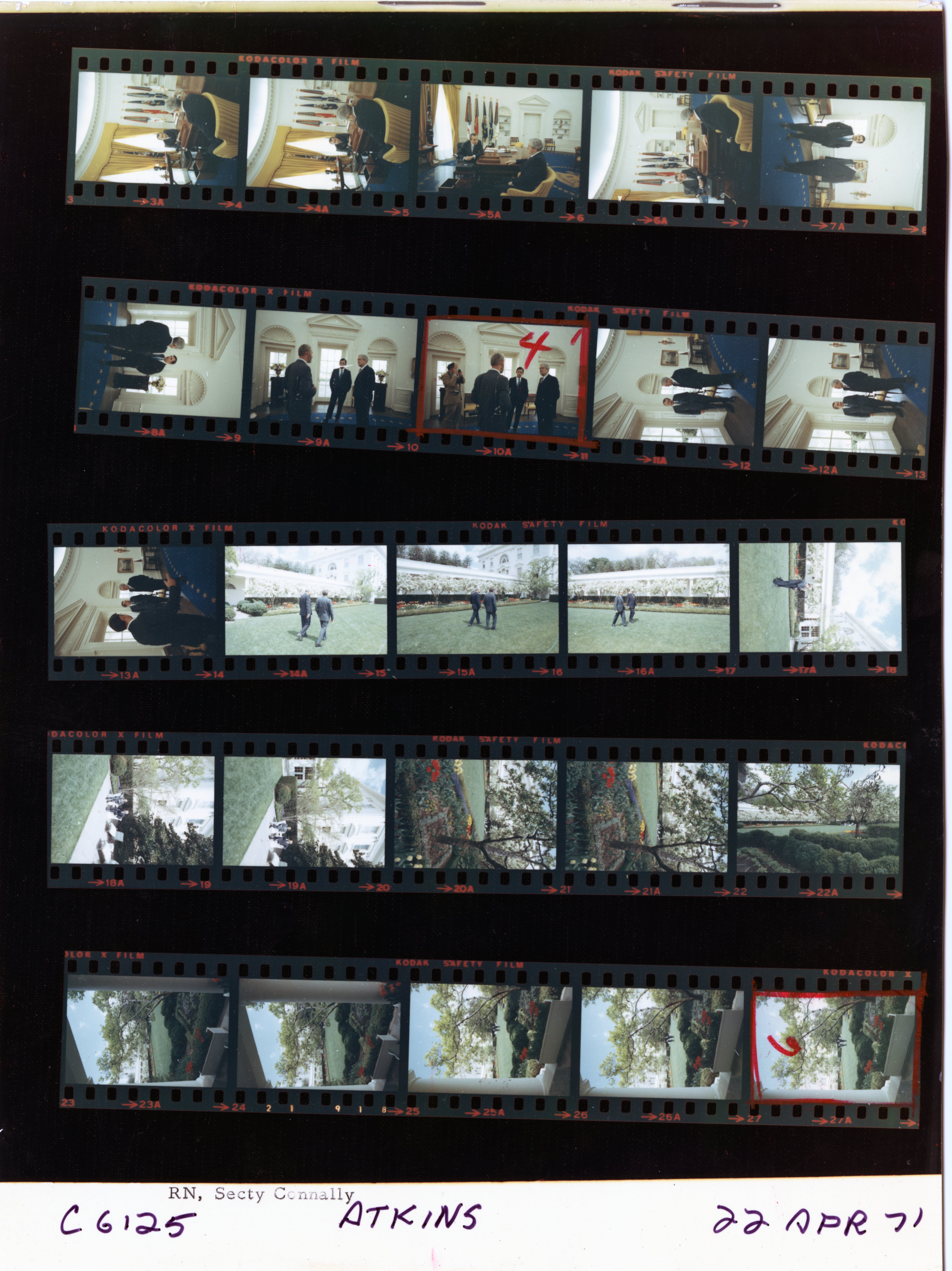
- Frame(s): WHPO-6125-03A-13A, President Nixon meeting with John Connally. 4/22/1971, Washington, D.C. White House, Oval Office. President Nixon, John Connally, unidentified men.
- Frame(s): WHPO-6125-14A-27A, President Nixon walking in the Rose Garden with John Connally. 4/22/1971, Washington, D.C. White House, Oval Office, Rose Garden. President Nixon, John Connally, unidentified men.
Roll WHPO-6126 Photographer: Atkins, Oliver | Color or B&W: Color
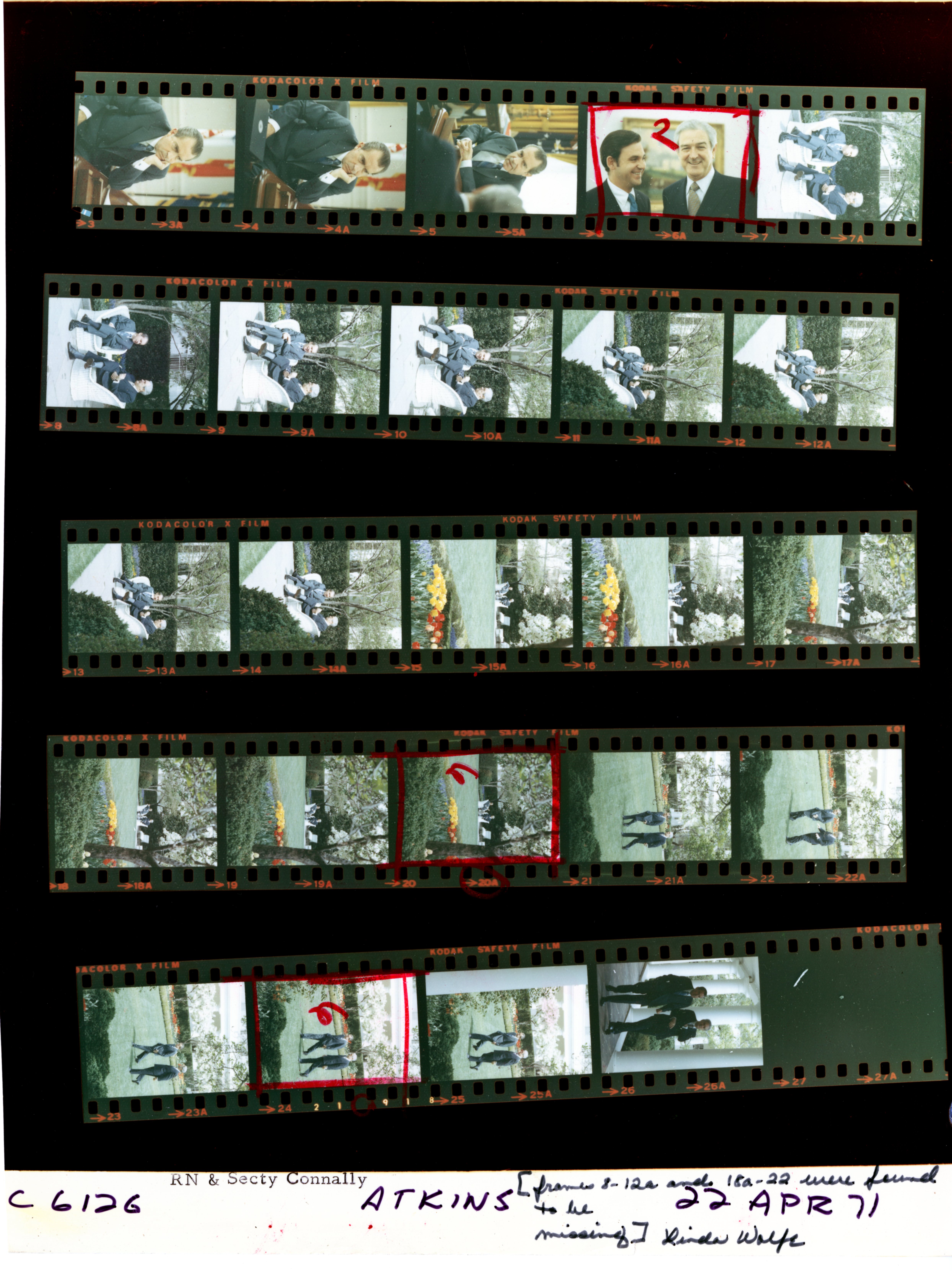
- Frame(s): WHPO-6126-03-05, President Nixon seated at his Oval Office desk during a meeting with John Connally. 4/22/1971, Washington, D.C. White House, Oval Office. President Nixon, John Connally.
- Frame(s): WHPO-6126-06, John Connally standing with an unidentified man. 4/22/1971, Washington, D.C. White House, Oval Office. President Nixon, John Connally, unidentified man.
- Frame(s): WHPO-6126-07-26, President Nixon and John Connally during a meeting outdoors in the Rose Garden. Red and yellow tulips in bloom. 4/22/1971, Washington, D.C. White House, Rose Garden. President Nixon, John Connally, unidentified man.
- Frame(s): WHPO-6126-15A, President Nixon and John Connally seated in wicker chairs during a meeting outdoors in the Rose Garden. Red and yellow tulips in bloom. 4/22/1971, Washington, D.C. White House, Rose Garden. President Nixon, John Connally.
- Frame(s): WHPO-6126-24A, President Nixon and John Connally walking during a meeting outdoors in the Rose Garden. White blooming trees with red and yellow tulips in bloom. 4/22/1971, Washington, D.C. White House, Rose Garden. President Nixon, John Connally.
- Frame(s): WHPO-6126-8a-12a and 18a-22a, No negatives - contact sheet only., President Nixon and John Connally during a meeting outdoors in the Rose Garden. 4/22/1971, Washington, D.C. White House, Rose Garden. President Nixon, John Connally.
Roll WHPO-6127 Photographer: Atkins, Oliver | Color or B&W: B&W
- Frame(s): WHPO-6127-02A-04A, President Nixon sitting with Gerald Ford, Elliot Richardson, John Byrnes, Clark MacGregor, Ken Cole, and John Price, Jr. 4/22/1971, Washington, D.C. White House, Oval Office. President Nixon, Clark MacGregor, Ken Cole, John Byrnes, Elliot Richardson, John Price, Jr., Gerald Ford.
Roll WHPO-6128 Photographer: Atkins, Oliver | Color or B&W: B&W
- Frame(s): WHPO-6128-04-09, President Nixon meeting with Republican Congressmen. 4/22/1971, Washington, D.C. White House, Cabinet Room. President Nixon, Clark MacGregor, Republican Congressmen.
Roll WHPO-6129 Photographer: Atkins, Oliver | Color or B&W: B&W
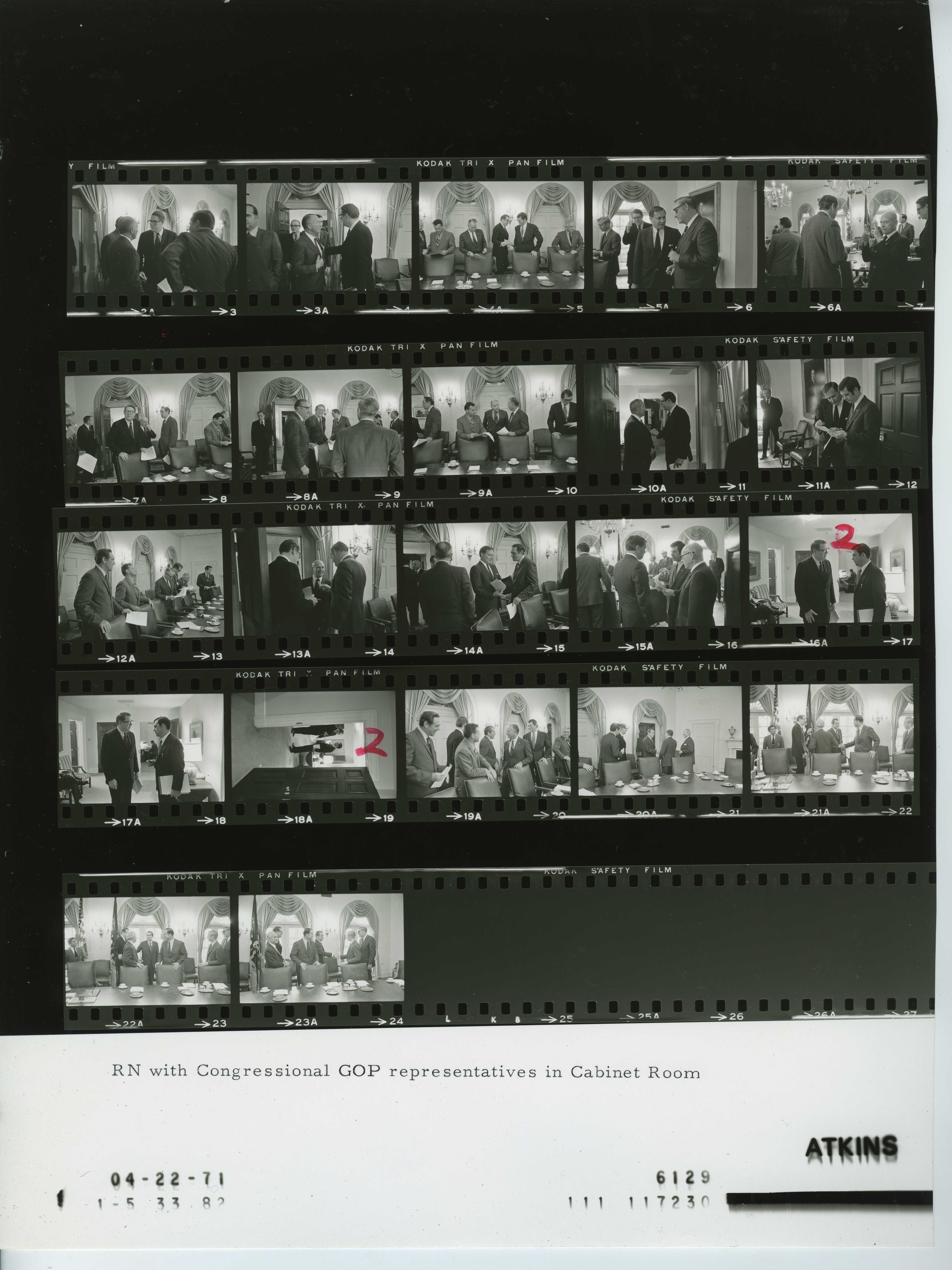
- Frame(s): WHPO-6129-02A-23A, President Nixon greeting Republican Congressmen. 4/22/1971, Washington, D.C. White House, Cabinet Room. President Nixon, Clark MacGregor, Republican Congressmen.
Roll WHPO-6130 Photographer: Atkins, Oliver | Color or B&W: B&W
- Frame(s): WHPO-6130-02-16, President Nixon with the families of posthumous Medals of Honor awardees Staff Sgt. Robert J. Pruden, Sgt. Rodney J. Evans, and Specialist Four Michael R. Blanchfield. 4/22/1971, Washington, D.C. White House, Oval Office. President Nixon, families of Robert J. Pruden, Rodney J. Evans, and Michael R. Blanchfield.
Roll WHPO-6131 Photographer: Kightlinger, Jack | Color or B&W: B&W
- Frame(s): WHPO-6131-03-16, President Nixon and Secretary of State William Rogers seated in wicker chairs during a meeting outdoors in the Rose Garden. 4/22/1971, Washington, D.C. White House, Rose Garden. President Nixon, William Rogers.
- Frame(s): WHPO-6131-06, President Nixon and Secretary of State William Rogers seated in wicker chairs during a meeting outdoors in the Rose Garden. 4/22/1971, Washington, D.C. White House, Rose Garden. President Nixon, William Rogers.
- Frame(s): WHPO-6131-07, President Nixon and Secretary of State William Rogers seated in wicker chairs during a meeting outdoors in the Rose Garden. 4/22/1971, Washington, D.C. White House, Rose Garden. President Nixon, William Rogers.
- Frame(s): WHPO-6131-13, President Nixon and Secretary of State William Rogers seated in wicker chairs during a meeting outdoors in the Rose Garden. 4/22/1971, Washington, D.C. White House, Rose Garden. President Nixon, William Rogers.
Roll WHPO-6132 Photographer: Kightlinger, Jack | Color or B&W: Color
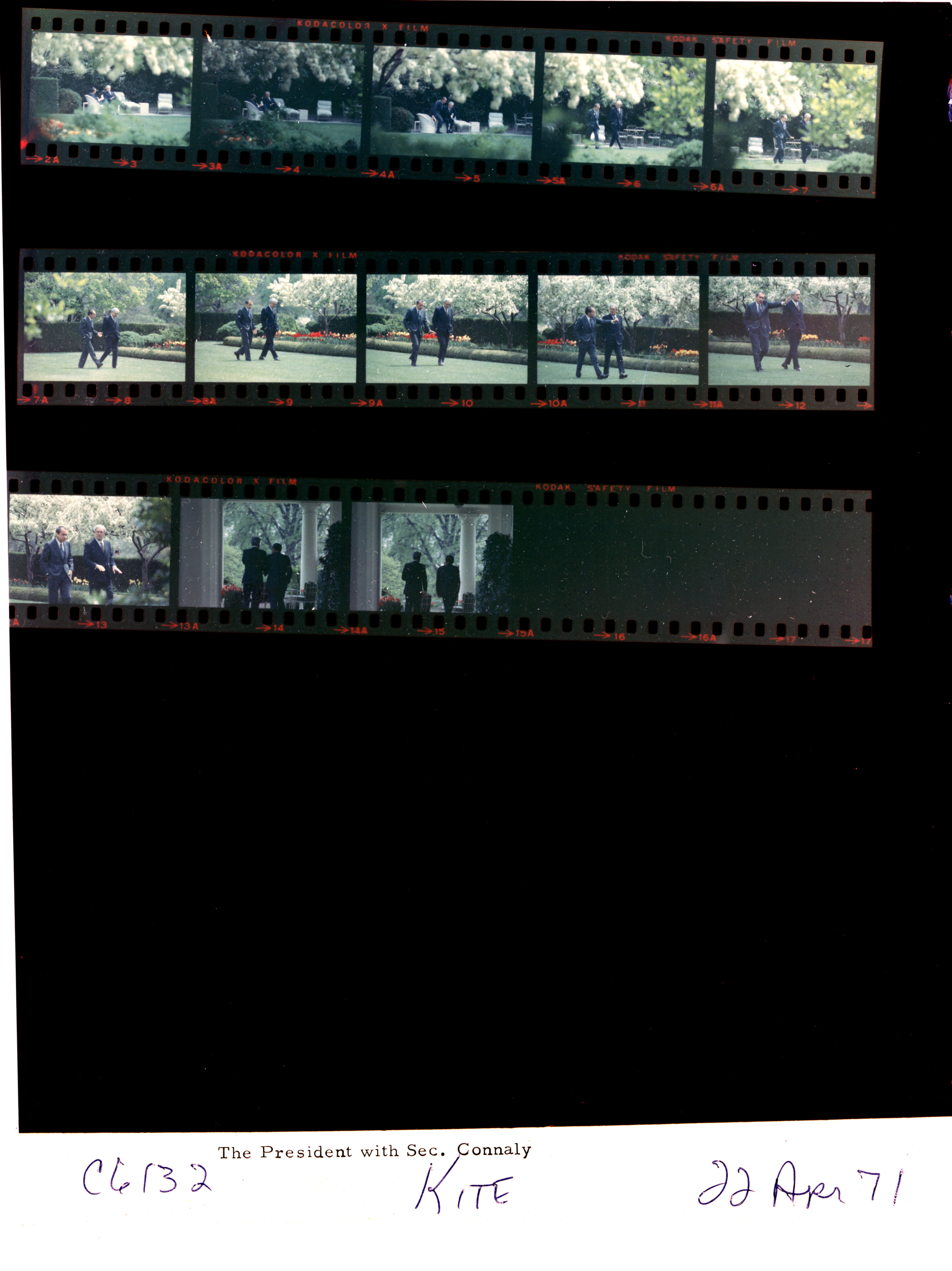
- Frame(s): WHPO-6132-02A-14A, President Nixon and William Rogers meeting outside. 4/22/1971, Washington, D.C. White House, Rose Garden. President Nixon, William Rogers.
The White House Communications Agency Sound Recordings Collection contains public statements that took place between 1969 and 1974. Visit the finding aid to learn more.
H - White House Staff Member Recordings
- WHCA-SR-H-377
Introduction to a group of women reporters by Barbara Franklin, Fred Malek, and Margvita White. (4/22/1971, Roosevelt Room, White House)
Runtime: 43:00:00
Keywords: Briefings, public briefings, statements to the press (see also Press conferences, news conferences, interviews, media)
Production credits: Audio feed supplied by WHCA; Recorded by JGB (initials of WHCA engineer)
Original Format: 1/4-inch reel-to-reel audiotape. Original source type: Original.
P - Formal Presidential Remarks
- WHCA-SR-P-710414
Posthumous Medal of Honor presentation ceremony with remarks by President Nixon. (4/22/1971, East Room, the White House)
Runtime: 0:10:48
Production credits: Audio feed supplied by WHCA; Recorded by RRS (initials of WHCA engineer)
Original Format: 1/4-inch reel-to-reel audiotape. Original source type: Original. Technical notes: 2 minutes and 58 seconds of noise at beginning of recording and 1 minutes and 50 seconds of silence at end of recording removed from access copies.
The White House Communications Agency Videotape Collection contains “off-the-air” recordings of televised programs produced between 1968 and 1974. Visit the finding aid to learn more.
- WHCA-4296
"Black Perspective". Tom Wicker (newspaper columnist), Phyllis Newman, Alec McGowan.
Daphne Productions and Roland & Jaffee Productions
Runtime: 00:29:32 - WHCA-4297
"Indochina: Another View".
PBS
Runtime: 0:30 - WHCA-4301
Weekly News Summary, Tape II. John Kerry, Walter Cronkite, John Chancellor, Eric Severeid, Gill.
ALL NETWORKS
Runtime: 01:36:58
19. Gill: Appeal from Haiti (President Nixon on film). Time Code Start: 47:38. Keywords: Caribbean, aid, poverty, refugees, political opression, terrorism, militants. Network: ABC.
20. Smith/Windsor/Gill: Vietnam veterans protest outside Foreign Relations Committee; footage of veterans sleeping, singing, protesting, being arrested; Foreign Relations Committee report includes John Kerry's testimony (1 min, 45 sec) and audience applauding. Time Code Start: 48:58. Keywords: Vietnam War, veterans, Veterans of Foreign Wars, Vietnam Vets Against the war, demonstrations, rallys, protests, testimony. Network: ABC.
21. Smith/Geer: Veteran of Foreign war, Herbert Rainwater (Commander in Chief, V.F.W.) rebute Vietnam vets. Time Code Start: 52:55. Keywords: Vietnam War, veterans. Network: ABC.
22. Smith/Bergman: White House Youth Conference, topics include: legalization of Marijuana, cessation of War in Vietnam. Time Code Start: 55:26. Keywords: Presidents, young people, issues, voting age, registrations, conferences, meetings, jobs, employment, drugs, drug abuse, teenagers, teens. Network: ABC.
23. Smith: Commentary on Haiti. Time Code Start: 57:41. Keywords: Caribbean, aid, poverty, refugees, political opression, terrorism, militants. Network: ABC.
24. McGee/Duke: Vietnam; Paris talks; refugees. Time Code Start: 59:27. Keywords: Paris Peace Talks, Vietnam War, treaty, treaties, negotiations. Network: NBC.
25. Brinkley/Trotta: Vietnam Vets Against the war, footage of veterans sleeping, singing, protesting, being arrested outside Supreme Court; John Kerry testifies Senate Foreign Relations Committee hearing (3 minute long clip of Kerry testifying) (head. Time Code Start: 63:04. Keywords: Vietnam War, veterans, demonstrations, rallys, protests, protesters, demonstraters, demonstrators, anti-war, testimony, Veterans of Foreign Wars, Vietnam Vets Against the war, demonstrations, rallys, protests, testimony. Network: NBC.
26. McGee/Briggs: White House Youth Conference. Time Code Start: 67:43. Keywords: Presidents, young people, issues, voting age, registrations, conferences, meetings, jobs, employment, drugs, drug abuse, teenagers, teens. Network: NBC.
27. McGee: Films of South Vietnam. Time Code Start: 71:13. Keywords: Vietnam War. Network: NBC.
28. Cronkite: Veterans protest outside Supreme Court; footage of veterans sleeping, singing, protesting, being arrested; John Kerry's testimony at Foreign Relations Committee (1 min 30 sec); Rainwater (of VFW) rebukes Kerry; Paris talks; casualties. Time Code Start: 73:55. Keywords: Paris Peace Talks, Vietnam War, treaty, treaties, negotiations, killed in action, KIA, death tolls, fatalities, casualty, casualties, military, troops, Veterans of Foreign Wars, Vietnam Vets Against the war, demonstrations, rallys, protests, testimony. Network: CBS.
29. Cronkite/Mudd: Representative Boggs vs the FBI. Time Code Start: 78:27. Keywords: Congressmen, bugging, wiretapping, wire tap, surveillance, Federal Bureau of Investigations. Network: CBS.
30. Sevareid: Commentary on Representative Boggs and the FBI. Time Code Start: 79:50. Keywords: Congressmen, bugging, wiretapping, wire tap, surveillance, Federal Bureau of Investigations. Network: CBS.
Context (External Sources)
The Vanderbilt Television News Archive is the world's most extensive and complete archive of television news. They have been recording, preserving and providing access to television news broadcasts of the national networks since August 5, 1968.
Wikipedia is a free encyclopedia that anyone can edit.