

Introduction
This almanac page for Tuesday, April 20, 1971, pulls together various records created by the federal government and links to additional resources which can provide context about the events of the day.
Previous Date: Monday, April 19, 1971
Next Date: Wednesday, April 21, 1971
Schedule and Public Documents
The Daily Diary files represent a consolidated record of the President's activities. Visit the finding aid to learn more.
The President's day began at The White House - Washington, D. C.
The Weekly Compilation of Presidential Documents made available transcripts of the President's news conferences; messages to Congress; public speeches, remarks, and statements; and other Presidential materials released by the White House.
Digitized versions can be found at HathiTrust.
Each Public Papers of the Presidents volume contains the papers and speeches of the President of the United States that were issued by the White House Office of the Press Secretary during the time period specified by the volume. The material is presented in chronological order, and the dates shown in the headings are the dates of the documents or events. In instances when the release date differs from the date of the document itself, that fact is shown in the text note.
To ensure accuracy, remarks have been checked against audio recordings (when available) and signed documents have been checked against the original, unless otherwise noted. Editors have provided text notes and cross references for purposes of identification or clarity.
The Federal Register is the official daily publication for rules, proposed rules, and notices of federal agencies and organizations, as well as executive orders and other Presidential documents.
The Congressional Record is the official daily record of the debates and proceedings of the U.S. Congress.
Archival Holdings
Any selection of archival documents will necessarily be partial. You should use the documents and folders identified below as a starting place, but consult the linked collection finding aids and folder title lists and the collections themselves for context. Many documents to be found this way do not lend themselves to association with specific dates, but are essential to a complete understanding of the material.
Selective document listing
President's Office Files
The President's Office Files consists of materials drawn together by the Special Files Unit from several administrative subdivisions within the White House Office. It is the handwriting and sensitive papers sent to the Staff Secretary that now comprise much of the President's Office Files. Visit the finding aid to learn more.
- Annotated News Summaries, Box 30, News Summaries - April 1971 [During this period, the Staff Secretary only removed pages from the News Summaries which contained President Nixon's handwriting, often leaving the document with no date. In addition to the individual document(s) listed below, you should also consult the full folder for the month.]
- [4/20/71]
The H. R. Haldeman Diaries consists of seven handwritten diaries, 36 dictated diaries recorded as sound recordings, and two handwritten audio cassette tape subject logs. The diaries and logs reflect H. R. Haldeman’s candid personal record and reflections on events, issues, and people encountered during his service in the Nixon White House. As administrative assistant to the President and Chief of Staff, Haldeman attended and participated in public events and private meetings covering the entire scope of issues in which the Nixon White House engaged in during the years 1969-1973. Visit the finding aid to learn more.
- Transcript of diary entry (PDF)
Tuesday April 20.
The President had a pretty busy day. Starting with the leaders at 8:00; then agricultural editors; the Jaycee leadership, the President of the International Red Cross; a session with Shultz; session with Hardin and Lincoln on the Texas drought; meeting with the Attorney General; and a meeting with our pro-Nixon Senators in the Cabinet Room. In between these, he had me in five or six times for fairly extensive sessions, adding up to 14 pages of notes.
One item of concern was Bill Rogers' plans for extending his trip next week to include Israel and Egypt and a couple of other Middle East stops. This, of course, has Henry going right up the wall. He's opposed to the whole idea of Rogers getting into the Middle East, as always, and particularly doesn't think he should go there, but the President confirmed that he had told him he could. Henry then raised the specter of Rogers probably coming up with a proposal for going to the Soviet Union, and the President said absolutely no on that without any equivocation at all.
He got into personnel changes several times during the day. He wants to replace General Lincoln at OEP and put a politician in there who will really exploit the opportunities for us in the disaster declarations, and use that post as a base for becoming a major spokesman. He also wants to get a list of all the holdovers that are still in, that the President has appointed, such as Resor and Shillito, and then clean house unless any of them were with us before the election. He bases this on the way Yost has stabbed us. He especially wants George Bush to clean out the UN office. Then he got into wanting to make some Cabinet replacements and comes to the conclusion that it really might be possible to make some changes this year, which is what he would really like to do in order to get some strong salesman/spokesman types in the Cabinet. He thinks I should talk to Bill Rogers and have him try to encourage Cliff Hardin to take the Purdue presidency and open that one up; and that we should go ahead on moving Stans back into the Finance Chairman role, so we can open Commerce up.
The next big item of the day was a monumental flap arising from a rather weird, off-the-record press deal that the Vice President had Sunday night in Williamsburg. Apparently, after midnight he called nine press people to his suite and spent three hours in an off-the-record backgrounder with them, during which he expressed his disagreement with the idea of letting down the barriers with China and his extreme dissatisfaction with the press reporting of the Chinese Ping-Pong tour. This, of course, has created exactly the kind of flap that should have been expected.
The President made the point that his first mistake was to have drinks with reporters. Kissinger said that he had sent Haig to brief the Vice President Friday on China. The President wants him now to get off this wicket and say he was completely misunderstood. Kissinger had recommended that Ziegler say that the Vice President's expressing his personal view. But the President disagreed with that and agreed with Ron's recommendation that he say that the Vice President's authorized him to say that there is no difference with the Vice President-- on the part of the Vice President with the President's policy on China: the Vice President completely agrees with the initiatives the President has taken. The President's particular concern was to be sure Ron did not create the impression that the President supports the Vice President's views on this, and he made the point that the Vice President should realize that they'll just use those to destroy the Vice President. He says it's clear that he doesn't understand the big picture in this whole Chinese operation, which is of course, the Russian game. We're using the Chinese thaw to get the Russians shook. Dobrynin will be back later this week, and Henry will get a reading on how it's working.
Henry also raised the point of the need now to get a direct channel to deal with the Chinese and is thinking of the idea of sending Walters to Warsaw to set up the communications. The President got again to the point that Agnew shows qualities here that are very damaging. He wants me to talk privately to Connally and to move very, very slowly, but to start getting him with it, in this area as a possible Vice Presidential candidate. He makes the point that the Vice President shouldn't say anything once a decision is made. His job is to support the President.
The next thing to come along was the Supreme Court's unanimous ruling on school desegregation, which is apparently quite a milestone decision, and knocks down the President's neighborhood school idea and upholds busing for the purpose of desegregation. The President spent considerable time with Ron, and later with the Attorney General, working out the precise
wording of how Ron should handle it. He obviously was very much concerned about the decision and feels that we’ve got to be careful very careful in what we say. After a lot of discussion, they all agreed that we would make the point that now that the Court has acted, it's the law of the land; and therefore, it's the obligation of the local school authorities and the district courts, which have jurisdiction in these matters, to carry out the mandate of the Court. He doesn't want Ron to go any further than that.
He then made the point that he wanted Ehrlichman to get Richardson in and ordered him that HEW is not to do anything, except what is specifically required by the law. They are not to take the initiative; they are not to get out in front and charge. He wants to be sure that there's an absolute order to them on this, that they don't screw us on the Court decision. He wants to get Ed Morgan back in to help the follow-up on it and nip it in the bud with Elliot Richardson, program him on no initiatives. He wants to kill the idea of any philosophy of our getting credit for the decision or getting out in front of the Court on it. We go straight down the line and not one step beyond the law. He decided to have a meeting with the Attorney General and Richardson and Ehrlichman in the morning to lay the law down on this.
The session with the Senators apparently didn't go very well. The President called several times afterwards to complain that they didn't have our polls, didn't know how well things were going and that Baker had taken it upon himself to deliver a 20 minute dissertation to the President on how he should try to get us out of the war.
End of April 20. - Original audio recording (MP3)
The National Archives Catalog is the online portal to the records held at the National Archives, and information about those records. It is the main way of describing our holdings and also provides access to electronic records and digitized versions of our holdings.
The Catalog searches across multiple National Archives resources at once, including archival descriptions, digitized and electronic records, authority records, and web pages from Archives.gov and the Presidential Libraries. The Catalog also allows users to contribute to digitized historical records through tagging and transcription.
Nixon Library Holdings
All National Archives Units
National Security Documents
The President's Daily Brief is the primary vehicle for summarizing the day-to-day sensitive intelligence and analysis, as well as late-breaking reports, for the White House on current and future national security issues. Read "The President's Daily Brief: Delivering Intelligence to Nixon and Ford" to learn more.
The Foreign Relations of the United States series presents the official documentary historical record of major U.S. foreign policy decisions and significant diplomatic activity. Visit the State Department website for more information.
Vol. V, United Nations, 1969-1972
Secretary-General Succession
212. Telegram From the Mission to the United Nations to the Department of State, New York, April 20, 1971, 0030Z
Source: National Archives, Nixon Presidential Materials, NSC Files, Box 300, Agency Files, USUN, Vol. VI. Secret; Exdis. Repeated to Djakarta, Helsinki, London, and Moscow.
Vol. XIII, Soviet Union, October 1970-October 1971
"A Key Point in Our Relationship": Backchannel Talks on SALT, Berlin, and the Summit
187. Conversation Between President Nixon and the President’s Assistant for National Security Affairs (Kissinger), Washington, April 20, 1971
Source: National Archives, Nixon Presidential Materials, White House Tapes, Oval Office, Conversation 483–13. No classification marking. The editors transcribed the portion of the tape recording printed here specifically for this volume. According to the President’s Daily Diary, Nixon met Kissinger in the Oval Office from 1:12 to 1:25 p.m. (Ibid., White House Central Files)
Vol. XX, Southeast Asia, 1969-1972
Thailand
116. Memorandum From John H. Holdridge of the National Security Council Staff to the President’s Assistant for National Security Affairs (Kissinger), Washington, April 20, 1971
Source: National Archives, Nixon Presidential Materials, NSC Files, Box 563, Country Files, Far East, Thailand, Vol. VI. Secret. Sent for information. Kissinger initialed the memorandum, indicating that he had seen it.
Vol. XXIII, Arab-Israeli Dispute, 1969-1972
222. Conversation Between President Nixon and the President’s Assistant for National Security Affairs (Kissinger), Washington, April 20, 1971, 10:13-10:25 a.m.
Source: National Archives, Nixon Presidential Materials, White House Tapes, Oval Office, Conversation No. 483–4. No classification marking. Haldeman was also present during the conversation. The editors transcribed the tape recording printed here specifically for this volume. Brackets indicate unclear portions of the original recording or those that remain classified, except “[Rogers]”, added for clarity.
Vol. E-2, Documents on Arms Control and Nonproliferation, 1969-1972
Nuclear Non-Proliferation Treaty; Implementation of Safeguard System
52. Document Adopted by the Board of Governors, International Atomic Energy Agency, Vienna, April 20, 1971
This document entitled “The Structure and Contents of IAEA Safeguards Agreements Under the Nonproliferation Treaty,” outlined the objectives and applications of the agreement, including policies on cooperation, implementation, accountability, and finance.
Source: Documents on Disarmament, 1971, pp. 218–244.
The Kissinger telephone conversation transcripts consist of approximately 20,000 pages of transcripts of Kissinger’s telephone conversations during his tenure as Assistant to the President for National Security Affairs (1969-1974) and Secretary of State (1973-1974) during the administration of President Richard Nixon. Visit the finding aid for more information.
Digitized versions can be found in the National Archives Catalog.
Audiovisual Holdings
The White House Tapes are sound recordings of President Richard Nixon's telephone conversations and of meetings held in the Oval Office and the Cabinet Room in the White House, the President's office in the Old Executive Office Building (OEOB), the Lincoln Sitting Room in the residence section of the White House, and several locations at the Presidential retreat at Camp David, Maryland. These recordings document many of the major events and decisions of the Nixon Administration from February 16, 1971 to July 18, 1973. Visit the White House Tapes finding aid to learn about the taping system's operation and archival processing.
Cabinet Room
- 54-2; Unknown between 7:55 a.m. & 8:06 a.m.; Peterson, Peter G.; Harlow, Bryce N.; Poff, Richard H.; [Unknown person(s)]
- 54-3; Unknown between 8:06 a.m. & 9:44 a.m.; Nixon, Richard M. (President); Agnew, Spiro T. (Vice President); Griffin, Robert P.; Smith, Margaret Chase; Cotton, Norris; Allott, Gordon L.; Dominick, Peter H.; Ford, Gerald R.; Arends, Leslie C.; Conable, Barber B., Jr.; Poff, Richard H.; Wilson, Robert C. ("Bob"); Stafford, Robert T.; Dole, Robert J.; Shultz, George P.; Peterson, Peter G.; Flanigan, Peter M.; Schlesinger, James R. (Dr.); MacGregor, Clark; Timmons, William E.; BeLieu, Kenneth E.; Buchanan, Patrick J.; Bergsten, C. Fred; Rose, Jonathan C.; Harlow, Bryce N.; Klein, Herbert G.; Ziegler, Ronald L.; White House photographer
- 55-1; 5:17 p.m. - 6:21 p.m.; Nixon, Richard M. (President); Goldwater, Barry M.; Bellmon, Henry L.; Tower, John G.; Baker, Howard H., Jr.; Dole, Robert J.; Gurney, Edward J.; Boggs, J. Caleb; Curtis, Carl T.; Hansen, Clifford P.; Miller, Jack R.; MacGregor, Clark; Timmons, William E.; BeLieu, Kenneth E.; Cowen, Eugene S.; Dent, Harry S.; Kissinger, Henry A.
Old Executive Office Building
- 251-1; Unknown between 1:26 p.m. & 2:38 p.m.; Nixon, Richard M. (President); [Unknown person(s)]
- 251-2; Unknown between 1:26 p.m. & 2:38 p.m.; Nixon, Richard M. (President); Sanchez, Manolo
- 251-3; 2:38 p.m. - 2:38 p.m.; Nixon, Richard M. (President); White House operator
- 251-4; Unknown between 2:38 p.m. & 2:39 p.m.; Nixon, Richard M. (President); Sanchez, Manolo
- 251-5; Unknown between 2:38 p.m. & 2:39 p.m.; Nixon, Richard M. (President); Sanchez, Manolo
- 251-6; 2:39 p.m. - 2:44 p.m.; Nixon, Richard M. (President); Cox, Tricia Nixon
- 251-7; 2:45 p.m. - 2:46 p.m.; Nixon, Richard M. (President); Arends, Leslie C.
- 251-8; Unknown between 2:46 p.m. & 2:55 p.m.; Nixon, Richard M. (President); Haldeman, H. R. ("Bob")
- 251-9; 2:55 p.m. - 3:00 p.m.; Nixon, Richard M. (President); Ziegler, Ronald L.
- 251-10; Unknown between 3:00 p.m. & 3:04 p.m.; Nixon, Richard M. (President); Haldeman, H. R. ("Bob")
- 251-52; Unknown between 2:38 p.m. & 2:39 p.m.; Nixon, Richard M. (President); White House operator
Oval Office
- 483-1; Unknown between 7:55 a.m. & 7:57 a.m.; Nixon, Richard M. (President); Bull, Stephen B.
- 483-2; Unknown between 7:55 a.m. & 8:06 a.m.; Nixon, Richard M. (President); Bull, Stephen B.; Haldeman, H. R. ("Bob")
- 483-3; Unknown between 8:06 a.m. & 9:46 a.m.; United States Secret Service agents
- 483-4; 9:46 a.m. - 11:15 a.m.; Nixon, Richard M. (President); Haldeman, H. R. ("Bob"); Kissinger, Henry A.; Bull, Stephen B.; Ziegler, Ronald L.
- 483-5; Unknown between 11:15 a.m. & 11:20 a.m.; Nixon, Richard M. (President); Bull, Stephen B.
- 483-6; Unknown between 11:20 a.m. & 11:50 a.m.; United States Secret Service agents
- 483-7; 11:50 a.m. - 12:15 p.m.; Nixon, Richard M. (President); Haldeman, H. R. ("Bob"); Bull, Stephen B.
- 483-8; Unknown between 12:15 p.m. & 12:37 p.m.; United States Secret Service agents
- 483-9; 12:37 p.m. - 12:40 p.m.; Nixon, Richard M. (President); Haldeman, H. R. ("Bob"); Bull, Stephen B.
- 483-10; 12:40 p.m. - 1:10 p.m.; Nixon, Richard M. (President); Kissinger, Henry A.; Naville, Marcel A.; Borsinger, Melchoir; [Unknown person(s)]
- 483-11; 1:11 p.m. - 1:11 p.m.; Nixon, Richard M. (President); [Unknown person(s)]
- 483-12; 1:11 p.m. - 1:11 p.m.; Nixon, Richard M. (President); Sanchez, Manolo
- 483-13; 1:12 p.m. - 1:25 p.m.; Nixon, Richard M. (President); Kissinger, Henry A.
- 483-14; Unknown between 1:25 p.m. & 3:04 p.m.; United States Secret Service agents
- 483-15; Unknown between 1:25 p.m. & 3:04 p.m.; United States Secret Service agents
- 483-16; 3:06 p.m. - 3:34 p.m.; Nixon, Richard M. (President); Shultz, George P.; Bull, Stephen B.
- 483-17; 3:35 p.m. - 4:10 p.m.; Nixon, Richard M. (President); Hardin, Clifford M.; Lincoln, George A. (Gen.); Flanigan, Peter M.; White House photographer; White House operator; Connally, John B.; Hughes, James D. ("Don"); Mahon, George H.; MacGregor, Clark
- 483-18; 4:10 p.m. - 4:19 p.m.; Nixon, Richard M. (President); Woods, Rose Mary; Ziegler, Ronald L.; Maroon, Fred; Sanchez, Manolo; [Unknown person(s)]; Haldeman, H. R. ("Bob")
- 483-19; 4:20 p.m. - 5:14 p.m.; Nixon, Richard M. (President); Haldeman, H. R. ("Bob"); Mitchell, John N.; Dean, John W., III; White House photographer; Ziegler, Ronald L.; [Unknown person(s)]; White House operator; Morrison, Sue
- 483-20; Unknown between 5:14 p.m. & 5:17 p.m.; Butterfield, Alexander P.; [Unknown person(s)]
- 483-21; Unknown between 5:14 p.m. & 5:17 p.m.; Nixon, Richard M. (President); Butterfield, Alexander P.; Mitchell, John N.; Haldeman, H. R. ("Bob")
- 483-22; 6:22 p.m. - 6:44 p.m.; Nixon, Richard M. (President); Kissinger, Henry A.; Haldeman, H. R. ("Bob")
- 483-23; Unknown between 6:44 p.m. & 7:00 p.m.; United States Secret Service agents
White House Telephone
- 2-7; Unknown between 3:35 p.m. & 3:47 p.m.; Nixon, Richard M. (President); White House operator
- 2-8; 3:47 p.m. - 3:48 p.m.; Nixon, Richard M. (President); Connally, John B.
- 2-9; Unknown between 3:48 p.m. & 3:54 p.m.; Nixon, Richard M. (President); White House operator
- 2-10; 3:54 p.m. - 3:55 p.m.; Nixon, Richard M. (President); Hughes, James D. ("Don")
- 2-11; Unknown between 3:55 p.m. & 4:04 p.m.; Nixon, Richard M. (President); White House operator
- 2-12; 4:04 p.m. - 4:07 p.m.; Nixon, Richard M. (President); Mahon, George H.
- 2-13; Unknown between 4:42 p.m. & 4:59 p.m.; Nixon, Richard M. (President); White House operator
- 2-14; 4:59 p.m. - 5:01 p.m.; Nixon, Richard M. (President); Mitchell, John N.; Morrison, Sue
- 2-15; Unknown between 6:44 p.m. & 7:30 p.m.; Nixon, Richard M. (President); White House operator
- 2-16; 7:30 p.m. - 7:33 p.m.; Nixon, Richard M. (President); Haldeman, H. R. ("Bob")
- 2-17; Unknown between 7:33 p.m. & 7:34 p.m.; Nixon, Richard M. (President); White House operator
- 2-18; 7:34 p.m. - 7:34 p.m.; Nixon, Richard M. (President); White House operator
- 2-19; 7:40 p.m. - 7:43 p.m.; Nixon, Richard M. (President); Kissinger, Henry A.
- 2-20; Unknown between 7:43 p.m. & 7:45 p.m.; Nixon, Richard M. (President); White House operator
- 2-21; 7:45 p.m. - 7:57 p.m.; Nixon, Richard M. (President); Colson, Charles W.
- 42-58; 2:38 p.m. - 2:38 p.m.; Nixon, Richard M. (President); White House operator
- 42-59; Unknown between 2:38 p.m. & 2:39 p.m.; Nixon, Richard M. (President); White House operator
- 42-60; 2:39 p.m. - 2:44 p.m.; Nixon, Richard M. (President); Cox, Tricia Nixon
- 42-61; 2:45 p.m. - 2:46 p.m.; Nixon, Richard M. (President); Arends, Leslie C.
The White House Photo Office collection consists of photographic coverage of President Richard Nixon meeting with prominent social, political, and cultural personalities; speaking engagements and news conferences of the President and various high-ranking members of the White House staff and Cabinet; Presidential domestic and foreign travel, including Presidential vacations; social events and entertainment involving the First Family, including entertainers present; official portraits of the President, First Family, and high-ranking members of the Nixon administration; the 1969 and 1973 Inaugurals; the President’s 1972 Presidential election campaign appearances (including speeches) and other official activities of the White House staff and the President’s Cabinet from January 20, 1969 until August 9, 1974 at the White House and the Old Executive Office Building; other locations in Washington, DC, such as The Mall; and the Presidential retreats in Camp David, Maryland, Key Biscayne, Florida, and San Clemente, California. Visit the finding aid to learn more.
Roll WHPO-6091 Photographer: Knudsen, Robert L. | Color or B&W: Color
- Frame(s): WHPO-6091-03-10, Gerald Ford and Hugh Scott in the Rose Garden. 4/20/1971, Washington, D.C. White House, Rose Garden. Gerald Ford, Hugh Scott.
- Frame(s): WHPO-6091-11-21, Gardener in the Rose Garden. 4/20/1971, Washington, D.C. White House, Rose Garden. gardener.
Roll WHPO-6092 Photographer: Knudsen, Robert L. | Color or B&W: B&W
- Frame(s): WHPO-6092-02A-04A, President Nixon attending a Republican Congressional Leadership meeting. 4/20/1971, Washington, D.C. White House, Cabinet Room. President Nixon, Spiro Agnew, Republican Congressional leaders.
Roll WHPO-6093 Photographer: Schumaker, Byron | Color or B&W: Color
- Frame(s): WHPO-6093-01-12, Rose Garden during in bloom. 4/20/1971, Washington, D.C. White House, Rose Garden.
Roll WHPO-6095 Photographer: Atkins, Oliver | Color or B&W: B&W
- Frame(s): WHPO-6095-02A-05A, President Nixon standing at a microphone during a meeting with officials of the U.S. Junior Chamber of Commerce. 4/20/1971, Washington, D.C. White House, State Dining Room. President Nixon, unidentified Jaycee officials.
- Frame(s): WHPO-6095-06A-07A, President Nixon receiving a plaque during a meeting with officials of the U.S. Junior Chamber of Commerce. 4/20/1971, Washington, D.C. White House, State Dining Room. President Nixon, unidentified Jaycee officials.
Roll WHPO-6096 Photographer: Atkins, Oliver | Color or B&W: B&W
- Frame(s): WHPO-6096-01A-11A, President Nixon sitting with International Red Cross President Marcel Naville, Red Cross General Delegate for Europe Melchior Borsinger, and Henry Kissinger. 4/20/1971, Washington, D.C. White House, Oval Office. President Nixon, Henry Kissinger, Marcel Naville, Melchior Borsinger.
Roll WHPO-6097 Photographer: Atkins, Oliver | Color or B&W: B&W
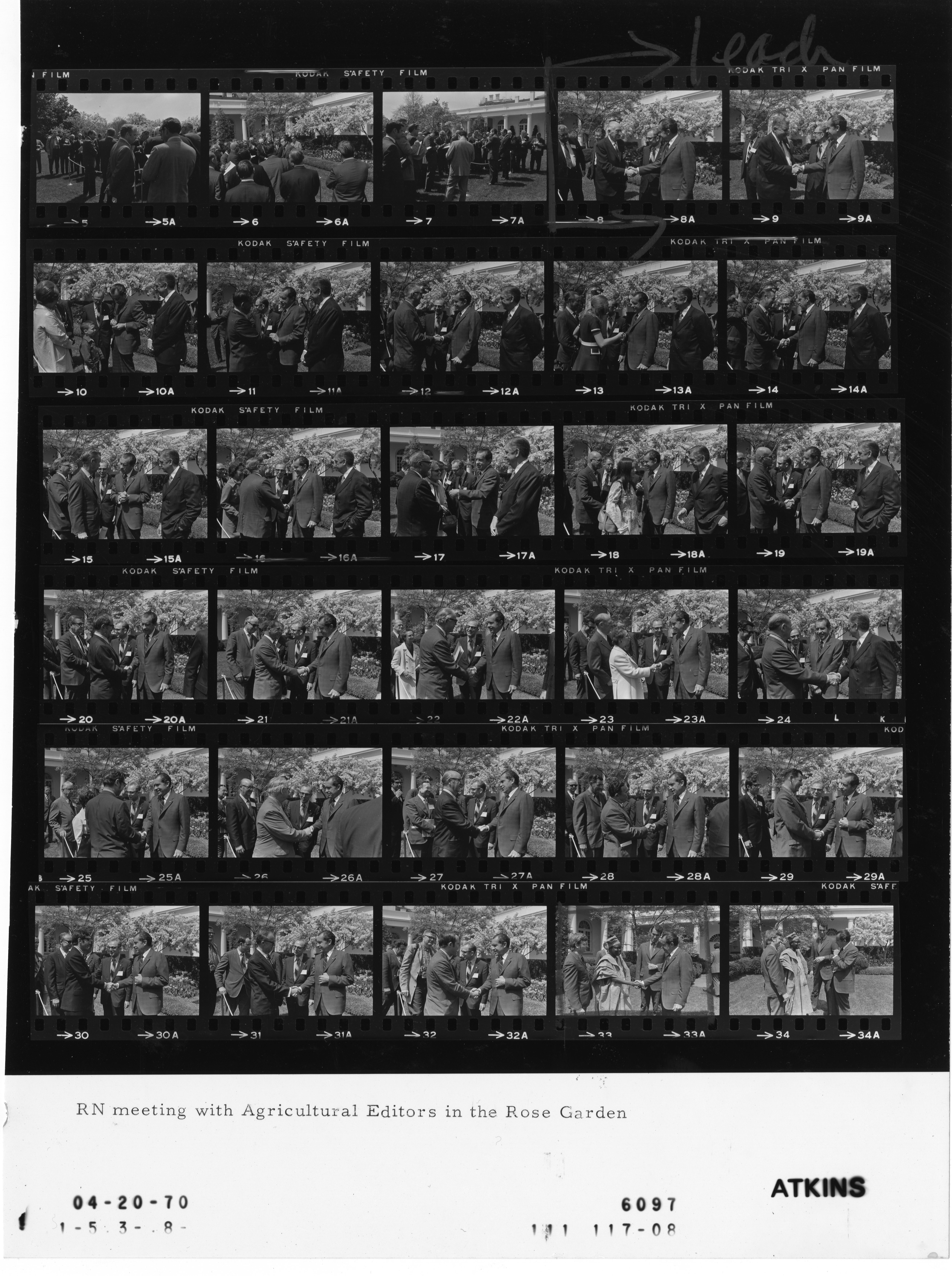
- Frame(s): WHPO-6097-05-07, President Nixon addressing Newspaper Farm Editors of America members. 4/20/1971, Washington, D.C. White House, Rose Garden. President Nixon, editors.
- Frame(s): WHPO-6097-08-34, President Nixon speaking to, and shaking hands with Newspaper Farm Editors of America members. 4/20/1971, Washington, D.C. White House, Rose Garden. President Nixon, editors.
Roll WHPO-6098 Photographer: Knudsen, Robert L. | Color or B&W: B&W
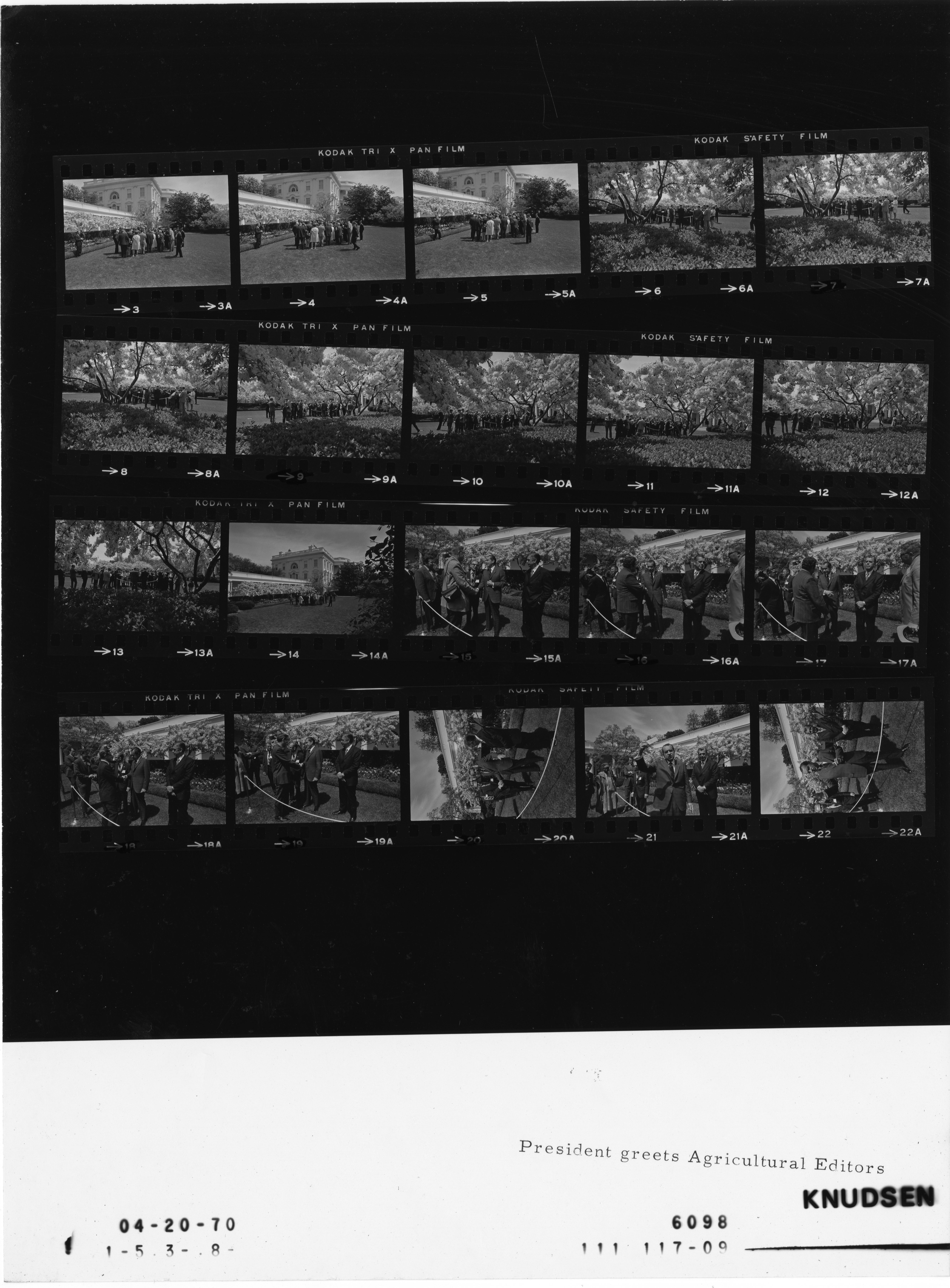
- Frame(s): WHPO-6098-03-22, President Nixon attending meeting with Newspaper Farm Editors of America members. 4/20/1971, Washington, D.C. White House, Rose Garden. President Nixon, editors.
Roll WHPO-6099 Photographer: Atkins, Oliver | Color or B&W: Color
- Frame(s): WHPO-6099-01-02, Copies of photographs of President Nixon and Pat Nixon. 4/20/1971, San Clemente, California Western White House, beach grounds. President Nixon, Pat Nixon.
Roll WHPO-6100 Photographer: Schumacher, Karl | Color or B&W: B&W
- Frame(s): WHPO-6100-04A-19A, Vice Presidential staff members meeting with students. 4/20/1971, Washington, D.C. unknown. staff members, students.
Roll WHPO-6101 Photographer: Schumacher, Karl | Color or B&W: B&W
- Frame(s): WHPO-6101-02-15, Vice Presidential staff members meeting with students. 4/20/1971, Washington, D.C. unknown. staff members, students.
Roll WHPO-6102 Photographer: Kightlinger, Jack | Color or B&W: B&W
- Frame(s): WHPO-6102-02A-17A, President Nixon sitting at his desk with Secretary Hardin and General George Lincoln, Director of OEP. 4/20/1971, Washington, D.C. White House, Oval Office. President Nixon, Clifford Hardin, General George Lincoln, aides.
- Frame(s): WHPO-6102-18A-31A, White House staff meeting with Republican Senators. 4/20/1971, Washington, D.C. White House, Cabinet Room. Clark MacGregor, Barry Goldwater, Bob Dole, White House staff.
Roll WHPO-6103 Photographer: Kightlinger, Jack | Color or B&W: B&W
- Frame(s): WHPO-6103-02A-36A, White House staff meeting with Republican Senators. 4/20/1971, Washington, D.C. White House, Cabinet Room. Clark MacGregor, Barry Goldwater, Bob Dole, White House staff.
Roll WHPO-6104 Photographer: Kightlinger, Jack | Color or B&W: B&W
- Frame(s): WHPO-6104-03A-34A, White House staff meeting with Republican Senators. 4/20/1971, Washington, D.C. White House, Cabinet Room. Clark MacGregor, Barry Goldwater, Bob Dole, White House staff.
The White House Communications Agency Sound Recordings Collection contains public statements that took place between 1969 and 1974. Visit the finding aid to learn more.
P - Formal Presidential Remarks
- WHCA-SR-P-710412
Remarks by President Nixon to US Junior Chamber of Commerce. (4/20/1971)
Runtime: 16:28
Original Format: 1/4-inch reel-to-reel audiotape. Original source type: Original.
The White House Communications Agency Videotape Collection contains “off-the-air” recordings of televised programs produced between 1968 and 1974. Visit the finding aid to learn more.
- WHCA-4289
"The Mike Douglas Show".
ALL NETWORKS
Runtime: 00:59:18 - WHCA-4290
"Thirty Minutes". FTN: Herbert Klein, Director of White House Communications; "MTP": McNerney, President of Blue Cross.
CBS, NBC
Runtime: 00:29:27 - WHCA-4291
"The Advocates". Civil Demonstrations, Right or Wrong? former Presidential Press Secretaries and Herb Klein.
NBC
Runtime: 1:00 - WHCA-4292
"Justice In America," Part I. author Joe Gelmis, actors Richard Hayes and Anthony Quayle, pop singer Paul Anka.
Daphne Productions and Roland & Jaffee Productions
Runtime: 00:59:52 - WHCA-4293
"The David Frost Show" with Luci Johnson Nugent and Chuck Connors. Jazz Month in New York City, Chief Red Fox's Career & Memoirs, Participation in Buffalo Bill's Wild West Show, 1890s New York, Luci Johnson's book on LBJ, Vietnam Protests, Burgess' Book on Shakespeare; Italian Stereotypes in Society and the Godfather fil Joseph Blatchford, Director of the Peace Corps.
WETA
Runtime: 01:35:00 - WHCA-4294
"The Dick Cavett Show" : Alan Shepard, Jane Asher, Stanley Myron Handleman.
WCET, Los Angeles
Runtime: 01:29:16 - WHCA-4300
Weekly News Summary, Tape I. John Kerry.
ALL NETWORKS
Runtime: 01:34:02
36. Smith/Geer: Supreme Court. Time Code Start: 65:45. Keywords: law officials, judges, justices, courts, trials, investigations, rulings. Network: ABC.
37. Reasoner/Donaldson: Vietnam report. Time Code Start: 69:28. Keywords: Vietnam War. Network: ABC.
38. Smith/Clark: Vietnam vets. Time Code Start: 71:58. Keywords: Vietnam War, veterans. Network: ABC.
39. Smith/Jarriel: Ping Pong diplomats (table tennis). Time Code Start: 75:00. Keywords: American, People's Republic of China, sports, games, ping pong, table tennis, organizations, groups, travel, trips. Network: ABC.
40. Smith: President Nixon and Daughters of the American Revolution (DAR). Time Code Start: 77:00. Keywords: Presidents, women, organizations, historic, military, families. Network: ABC.
41. Reasoner: Commentary on White House scheme. Time Code Start: 77:23. Keywords: Presidents, issues. Network: ABC.
42. Brinkley/Rich: U.S. Table Tennis Assoc. President Steenhoven announces visit invitation to Chinese Ping Pong team accepted; China export commodities fair in Canton, film shows Chinese agriculture machinery displayed,. Time Code Start: 79:14. Keywords: People's Republic of China, sports, ping pong, table tennis, games, teams, travel, trips, organizations, leaders, officials, agricultural products, technology fairs, conventions. Network: NBC.
43. Brinkley/Godsey: Busing for segregation; Supreme Court rules busing of children O.K. to achieve school racial balance; spokespersons interviews NAACP Julius Chambers, William BOOE of Charlotte, North Carolina Board of Education. Time Code Start: 84:44. Keywords: desegregation, racism, racial profiling, racial discrimination, civil rights, African Americans, schools, students, National Association for the Advancement of Colored People. Network: NBC.
44. Brinkley/Duke: Vietnam Vets Against the War attend Senate Foreign Relations Committee hearings on bills to force end to Vietnam war. Time Code Start: 87:23. Keywords: Vietnam War, veterans. Network: NBC.
45. Brinkley: Senator Mansfield on murder of officers in Vietnam; discusses problems of "fragging" in Vietnam; tells of Lieutenant killed by other Gis. Time Code Start: 89:28. Keywords: Vietnam War, military, troops, leaders, officers, assassinations, killings, deaths, crimes, violence, homicides, murders, shootings, statistics. Network: NBC.
46. Chancellor: War in Vietnam; North Vietnam films; Cambodia. Time Code Start: 90:12. Keywords: Cambodia, Vietnam War. Network: NBC. - WHCA-4301
Weekly News Summary, Tape II. John Kerry, Walter Cronkite, John Chancellor, Eric Severeid, Gill.
ALL NETWORKS
Runtime: 01:36:58
1. Chancellor: White House Youth Conference. Time Code Start: 00:00. Keywords: Presidents, young people, issues, voting age, registrations, conferences, meetings, jobs, employment, drugs, drug abuse, teenagers, teens. Network: NBC.
2. Cronkite: Desegregation. Time Code Start: 03:05. Keywords: desegregation, racism, racial profiling, racial discrimination, civil rights, African Americans, schools, students. Network: CBS.
3. Cronkite: Vietnam vets; Mansfield on officer murders in Vietnam: Cambodia. Time Code Start: 05:15. Keywords: Cambodia, Vietnam War, veterans, military, troops, leaders, officers, assassinations, killings, deaths, crimes, violence, homicides, murders, shootings, statistics. Network: CBS.
4. Kalb: Middle East; Secretary of State Rogers with Deputy Prime Minister of Israel. Time Code Start: 08:50. Keywords: Middle East, Mideast, Israeli, war, leaders, meetings, cabinet, advisors. Network: CBS.
5. Cronkite/Herman: "Sell…Pentagon" controversy. Time Code Start: 10:34. Keywords: United States Department of Defense headquarters, Armed Forces. Network: CBS.
Context (External Sources)
The Vanderbilt Television News Archive is the world's most extensive and complete archive of television news. They have been recording, preserving and providing access to television news broadcasts of the national networks since August 5, 1968.
Wikipedia is a free encyclopedia that anyone can edit.