
Introduction
This almanac page for Friday, September 24, 1971, pulls together various records created by the federal government and links to additional resources which can provide context about the events of the day.
Previous Date: Thursday, September 23, 1971
Next Date: Saturday, September 25, 1971
Schedule and Public Documents
The Daily Diary files represent a consolidated record of the President's activities. Visit the finding aid to learn more.
The President's day began at The White House - Washington, D. C.
The Weekly Compilation of Presidential Documents made available transcripts of the President's news conferences; messages to Congress; public speeches, remarks, and statements; and other Presidential materials released by the White House.
Digitized versions can be found at HathiTrust.
Each Public Papers of the Presidents volume contains the papers and speeches of the President of the United States that were issued by the White House Office of the Press Secretary during the time period specified by the volume. The material is presented in chronological order, and the dates shown in the headings are the dates of the documents or events. In instances when the release date differs from the date of the document itself, that fact is shown in the text note.
To ensure accuracy, remarks have been checked against audio recordings (when available) and signed documents have been checked against the original, unless otherwise noted. Editors have provided text notes and cross references for purposes of identification or clarity.
The Federal Register is the official daily publication for rules, proposed rules, and notices of federal agencies and organizations, as well as executive orders and other Presidential documents.
The Congressional Record is the official daily record of the debates and proceedings of the U.S. Congress.
Archival Holdings
Any selection of archival documents will necessarily be partial. You should use the documents and folders identified below as a starting place, but consult the linked collection finding aids and folder title lists and the collections themselves for context. Many documents to be found this way do not lend themselves to association with specific dates, but are essential to a complete understanding of the material.
Selective document listing
President's Office Files
The President's Office Files consists of materials drawn together by the Special Files Unit from several administrative subdivisions within the White House Office. It is the handwriting and sensitive papers sent to the Staff Secretary that now comprise much of the President's Office Files. Visit the finding aid to learn more.
- News Summaries, Annotated News Summaries, Box 30, News Summaries - September 1971 [2 of 2]
- [9/24/71]
- News Summaries, Unmarked News Summaries, Box 46, News Summaries - September 1971 [7 of 9] [Note: Due to the way News Summary products were compiled, you should also consult nearby days for potentially relevant materials.]
- News Summary, September 24, 1971, (Thursday newscasts, wires, mags, columns)
- President's Daily Schedule, Box 102, [President's Daily Schedule, Sept.-Dec. 1971] [1 of 3]
- The President's Schedule, Friday - September 24, 1971
The H. R. Haldeman Diaries consists of seven handwritten diaries, 36 dictated diaries recorded as sound recordings, and two handwritten audio cassette tape subject logs. The diaries and logs reflect H. R. Haldeman’s candid personal record and reflections on events, issues, and people encountered during his service in the Nixon White House. As administrative assistant to the President and Chief of Staff, Haldeman attended and participated in public events and private meetings covering the entire scope of issues in which the Nixon White House engaged in during the years 1969-1973. Visit the finding aid to learn more.
- Transcript of diary entry (PDF)
Friday, September 24th. We got into some more evaluation of the Detroit trip last night, his feeling that he needs a better director of his television. For instance, there was nobody before he went on the air, or while he was on the air, that explained to the audience the way the questions were set up, and so on. He also had a lot of thoughts on Buchanan's briefing books and the speech writing, the need to go back and get his good lines and bring them in, and that sort of thing.
At 9:00, they had a Cabinet meeting on international economic policy. The President opened it, making the point of the need for a united front and that we have to take real care of what we say to the foreigners who are here for the IMF meetings, at social events, etcetera, because they will look for ways to point up the differences within the Administration. He explained the need for us to be tough in our economic policy and completely backed Connally's line in Europe, making the point that Connally has been accused by the press of having failed there, as Dulles always was, because he didn't give away the store and come away with the foreigners happy with us.
Connally further explained the need for a tough position and pointed out why our trading partners are opposed to us, because they want to go back to fixed exchange rates. He said there were four basic points that the others raised: first, they insist on the removal of the surcharge immediately; second, they question the extent of the realignment that we want; third, they say the US must revalue the dollar by changing the price of gold; and fourth, they are concerned about how much realignment, and who gives. He says we're now holding bilateral meetings with our trading partners to work these things out.
The President made the point that we shouldn't be concerned about all the criticism. He hit George Ball for criticizing us, making the point that...
-------------------------------------------------------------------------------------------------------------------
DECLASSIFIED - E.O. 13526, Sect. 3.4: by MS, NARA, June 12, 2013
Audio Cassette 14, Side A, Withdrawn Item Number 7 [AC-14(A) Sel 5]
Duration: 3 seconds
...of course he did, he represents the Japs...
-------------------------------------------------------------------------------------------------------------------
...also, the New York bankers who want it back the old way. He said, don't forget that the system we found produced an annual major crisis and the quarterly mini-crises in international economics; made the point that the US is the only country left in the free world with the capacity to lead. It's essential not to allow economic difficulties and differences to shatter the free world alliance, and he doesn't think they will. We must exercise leadership, because none of them will. We can't be as irresponsible as they have been and are. We can only lead if we are strong and sound economically, otherwise, the American people will turn inward. Said these steps we are taking, although traumatic at the time, are essential. We have to strengthen our own economic situation. Only then can an American President lead the American people towards free world trade, etcetera.
He said that beneath the surface in the US there's frustration on Vietnam, the campus problems, economic problems, the fact that we've dropped to second place in air transportation, and steel, etcetera, and as a result there is a dangerous incipient economic and political isolationism growing. We can't just preach about it, we have to get at the heart of the problem, and that's the economic problem, not just in the business community. The labor unions have now become anti-free trade, in a 180 degree turn, because they don't want to compete with foreign labor. So our position now is being taken because of the long-range view. We have to cure the patient in order to support our leadership position.
Dave Packard emphasized that time is a big lever for us. That we should take our time, let the pressures build up. We don't need to be in a hurry to settle. Others are more dependent on international trade than we are, so they'll have to come around to our point of view. Uncertainty will be an important factor, and we should use it.
The President said we have to remember that everybody wants to get into the US market. Connally said we'll take everyone's export; they have to have this market. We can't have a trade war, because they can't afford it. We're dealing from strength, and we're in a position to get a lot of the things we want. The President said it's popular in other countries to kick the US, even though probably the majority of people in those countries don't feel that way. It's not.
-------------------------------------------------------------------------------------------------------------------
DECLASSIFIED - E.O. 13526, Sect. 3.4: by MS, NARA, June 12, 2013
Audio Cassette 14, Side A, Withdrawn Item Number 8 [AC-14(A) Sel 6]
Duration: 5 seconds
He said we now could appeal to Americans to kick the foreigners, especially the Japs and Europeans.
-------------------------------------------------------------------------------------------------------------------
It's not easy to be responsible and to satisfy our constituency. Again, the point that no other nation currently can lead, so we just want to make a fair deal. He said there's a significant political factor that within this country there's an ominous change in the attitude of Americans; there, a growing sentiment for trade barriers, and to reduce our commitments abroad, and to call on other nations to carry the burden. A demagogue could make real headway with this to call for the US to turn inward, but the US, in terms of the interest of the interest of the world order, both military and economic, must lead. The President does not want to withdraw from his commitments; he wants to keep the American people interested in the world, and continue our military strength and our foreign assistance, work toward reducing trade barriers. That's the position we're fighting for. The key to it is for us to make progress on reducing the unfairness now of international trade.
-------------------------------------------------------------------------------------------------------------------
DECLASSIFIED - E.O. 13526, Sect. 3.4: by MS, NARA, June 12, 2013
Audio Cassette 14, Side A, Withdrawn Item Number 9 [AC-14(A) Sel 7]
Duration: 25 seconds
And he told the story regarding anti-Americanism. Magsaysay, who was talking with a, regarding a bitter enemy of his who was a Philippine Senator, and Nixon said, how does that Senator always win his elections? He's always kicking the United States. And Magsaysay said the sure way to success is to give the Americans hell but don't drive them away.
-------------------------------------------------------------------------------------------------------------------
The President closed on the note that we should remember that a smile costs nothing, and that's all we'll give them.
There was some further discussion on the Supreme Court question today, now that he has a second seat, which was announced, the Harlan resignation was announced yesterday. The President had a talk with Mitchell on the phone at midday, reviewed the Court situation, wants to send up his nominations next week before he gets into his series of international announcements. Agreed with the Attorney General we should do the two together. He's figuring on Poff as the first one, was very intrigued with the AG's recommendation of Mulligan of New York for the second man. As an Irish Catholic, former dean of the Fordham Law School, very conservative, etcetera.
He then went out for a golf game with the AG this afternoon. And there’s been no contact this evening, as he's getting ready, I'm sure, for the weekend trip.
End of September 24th. - Original audio recording (MP3)
The National Archives Catalog is the online portal to the records held at the National Archives, and information about those records. It is the main way of describing our holdings and also provides access to electronic records and digitized versions of our holdings.
The Catalog searches across multiple National Archives resources at once, including archival descriptions, digitized and electronic records, authority records, and web pages from Archives.gov and the Presidential Libraries. The Catalog also allows users to contribute to digitized historical records through tagging and transcription.
Nixon Library Holdings
All National Archives Units
National Security Documents
The President's Daily Brief is the primary vehicle for summarizing the day-to-day sensitive intelligence and analysis, as well as late-breaking reports, for the White House on current and future national security issues. Read "The President's Daily Brief: Delivering Intelligence to Nixon and Ford" to learn more.
The Foreign Relations of the United States series presents the official documentary historical record of major U.S. foreign policy decisions and significant diplomatic activity. Visit the State Department website for more information.
Vol. II, Organization and Management of U.S. Foreign Policy, 1969-1972
The Intelligence Community and the White House
238. Memorandum From the President’s Deputy Assistant for National Security Affairs (Haig) to the President’s Assistant for National Security Affairs (Kissinger), Washington, September 24, 1971
Source: National Archives, Nixon Presidential Materials, NSC Files, Subject Files, Box 332, Intelligence Reorganization, Vol. I. Top Secret; Byeman. Sent for action. The enclosures are attached but not printed.
Vol. III, Foreign Economic Policy; International Monetary Policy, 1969-1972
International Monetary Policy, 1969-1972
178. Memorandum From the Executive Secretary of the Department of State (Eliot) to the President’s Assistant for National Security Affairs (Kissinger), Washington, September 24, 1971
Source: National Archives, RG 59, Central Files 1970-73, E 1 US. Confidential. Drafted by R.J. Smith and L.J. Kennon (E/IFD/OMA) and cleared by S. Weintraub (E/IFD) and Katz (E).
179. Memorandum From the President’s Assistant for International Economic Affairs (Peterson) to the President’s Assistant for National Security Affairs (Kissinger), Washington, September 24, 1971
Source: National Archives, Nixon Presidential Materials, NSC Files, Agency Files, Box 218, Council on International Economic Policy. Confidential.
180. Memorandum From Lawrence H. Berlin of the Program and Policy Coordination Staff, Agency for International Development, to the Assistant Administrator for Program and Policy Coordination (Stern), Washington, September 24, 1971
Source: Washington National Records Center, Agency for International Development, Office of the Administrator: FRC 286 75 13, Box 10, PRM 7-2 July 1971-October 1971 FY72. Confidential.
Vol. XXVIII, Southern Africa
Regional Issues
55. Telegram From the Mission to the United Nations to the Department of State, New York, September 24, 1971, 2138Z
Source: National Archives, RG 59, Central Files 1970–73, INCO–CHROME 17 US–RHOD. Unclassified.
Vol. XLI, Western Europe; NATO, 1969-1972
Western Europe Region and NATO
72. Letter From Acting Secretary of State Irwin to the President’s Assistant for National Security Affairs (Kissinger), Washington, September 24, 1971
Source: National Archives, RG 59, Central Files 1970–73, DEF 6 NATO. Secret. A handwritten note indicates the letter was signed by the Under Secretary and that the drafting office was omitted.
Vol. E-1, Documents on Global Issues, 1969-1972
U.S. Policy Towards International Production and Trafficking in Illegal Drugs
210. Memorandum From Director of Central Intelligence Helms to the President’s Assistant for National Security Affairs (Kissinger), Washington, September 24, 1971
Source: National Archives, Nixon Presidential Materials, NSC Files, Box 358, Subject Files, Narcotics IV. Secret; Sensitive.
Vol. E-13, Documents on China, 1969-1972
26. Memorandum From the Military Attaché at the Embassy in France (Walters) to the President’s Assistant for National Security Affairs (Kissinger), Washington, September 24, 1971, Washington, September 24, 1971
Walters raised the possibility that the Chinese were truly world revolutionaries who would turn on President Nixon after his visit.
Source: National Archives, Nixon Presidential Materials, NSC Files, Box 849, President’s File-China Trip, China Exchanges, July 1971-Oct 20, 1971. Secret; Eyes Only. Ellipsis in the source text. Walters was in Washington, September 24-September 28.
The Kissinger telephone conversation transcripts consist of approximately 20,000 pages of transcripts of Kissinger’s telephone conversations during his tenure as Assistant to the President for National Security Affairs (1969-1974) and Secretary of State (1973-1974) during the administration of President Richard Nixon. Visit the finding aid for more information.
Digitized versions can be found in the National Archives Catalog.
Audiovisual Holdings
The White House Tapes are sound recordings of President Richard Nixon's telephone conversations and of meetings held in the Oval Office and the Cabinet Room in the White House, the President's office in the Old Executive Office Building (OEOB), the Lincoln Sitting Room in the residence section of the White House, and several locations at the Presidential retreat at Camp David, Maryland. These recordings document many of the major events and decisions of the Nixon Administration from February 16, 1971 to July 18, 1973. Visit the White House Tapes finding aid to learn about the taping system's operation and archival processing.
Cabinet Room
- 77-2; Unknown between 8:13 a.m. & 11:03 a.m.; Nixon, Richard M. (President); Agnew, Spiro T. (Vice President); Rogers, William P.; Cabinet officers; Connally, John B.; Packard, David; Mitchell, John N.; Morton, Rogers C. B.; Hardin, Clifford M.; Stans, Maurice H.; Silberman, Laurence H.; Richardson, Elliot L.; Romney, George W.; Beggs, James M.; Kennedy, David M.; Shultz, George P.; Finch, Robert H.; Bush, George H. W.; Haldeman, H. R. ("Bob"); Ehrlichman, John D.; Flanigan, Peter M.; Peterson, Peter G.; Klein, Herbert G.; Weber, Arnold R.; Price, Raymond K., Jr.; Warren, Gerald L.; Butterfield, Alexander P.; Kennedy, Richard T. (Col.); Irwin, John N., II; Johnson, U. Alexis; Samuels, Nathanial; Agnew, Spiro T. (Vice President); Burns, Arthur F.; McCracken, Paul W.; Solomon, Ezra; Weinberger, Caspar W. ("Cap"); [Unknown person(s)]
- 77-3; Unknown between 9:53 a.m. & 11:03 a.m.; Shultz, George P.; Friedman, Milton; [Unknown person(s)]
- 77-5; Unknown between 11:03 a.m. & 9:29 p.m.; Bull, Stephen B.; [Unknown person(s)]
- 77-6; Unknown between 9:53 a.m. & 3:15 p.m.; Sanchez, Manolo; [Unknown person(s)]
Oval Office
- 578-1; Unknown between 8:13 a.m. & 9:05 a.m.; Nixon, Richard M. (President); Bull, Stephen B.
- 578-2; Unknown between 8:13 a.m. & 9:05 a.m.; Nixon, Richard M. (President); Haldeman, H. R. ("Bob"); [Unknown person(s)]
- 578-3; Unknown between 9:05 a.m. & 9:52 a.m.; Sanchez, Manolo; [Unknown person(s)]
- 578-4; 9:52 a.m. - 10:29 a.m.; Nixon, Richard M. (President); Haldeman, H. R. ("Bob"); Connally, John B.; Burns, Arthur F.
- 578-5; 10:33 a.m. - 11:44 a.m.; Nixon, Richard M. (President); Haldeman, H. R. ("Bob"); Bull, Stephen B.; Friedman, Milton; Shultz, George P.; Atkins, Oliver F. ("Ollie"); Sanchez, Manolo
- 578-6; 11:44 a.m. - 12:05 p.m.; Nixon, Richard M. (President); Ehrlichman, John D.; Magruder, William M.
- 578-7; Unknown between 12:05 p.m. & 12:07 p.m.; Nixon, Richard M. (President); Butterfield, Alexander P.
- 578-8; 12:07 p.m. - 12:23 p.m.; Nixon, Richard M. (President); Laird, Melvin R.; Bryant, Cunningham C. (Brig. Gen.); Hunton, Benjamin L. (Brig.); Gravely, Samuel (Rear Adm.); White House photographer
- 578-9; 12:23 p.m. - 12:32 p.m.; Nixon, Richard M. (President); Bull, Stephen B.; Naranjo, Michael ("White Antelope"); Underwood, Larry (Mrs.); Johnson, Donald E.
- 578-10; 12:32 p.m. - 12:32 p.m.; Nixon, Richard M. (President); Bull, Stephen B.
- 578-11; Unknown between 12:46 p.m. & 1:32 p.m.; Nixon, Richard M. (President); Haldeman, H. R. ("Bob"); White House operator; Mitchell, John N.; Sanchez, Manolo
- 578-12; Unknown between 9:05 a.m. & 9:52 a.m.; United States Secret Service agents; [Unknown person(s)]
- 578-13; Unknown between 12:32 p.m. & 12:44 p.m.; United States Secret Service agents
White House Telephone
- 10-1; Unknown between 12:59 p.m. & 1:11 p.m.; Nixon, Richard M. (President); White House operator
- 10-2; 1:11 p.m. - 1:13 p.m.; Nixon, Richard M. (President); Mitchell, John N.
- 10-3; Unknown between 1:13 p.m. & 1:52 p.m.; Nixon, Richard M. (President); White House operator
- 10-4; 1:52 p.m. - 2:02 p.m.; Nixon, Richard M. (President); Colson, Charles W.
- 10-5; 7:12 p.m. - 7:12 p.m.; Nixon, Richard M. (President); White House operator
- 10-6; Unknown between 7:12 p.m. & 7:15 p.m.; Nixon, Richard M. (President); White House operator
- 10-7; Unknown between 7:12 p.m. & 7:15 p.m.; Nixon, Richard M. (President); White House operator
- 10-8; Unknown between 7:12 p.m. & 7:15 p.m.; Nixon, Richard M. (President); White House operator
- 10-9; 7:15 p.m. - 7:24 p.m.; Nixon, Richard M. (President); Connally, John B.
- 10-10; Unknown between 7:24 p.m. & 7:35 p.m.; Nixon, Richard M. (President); White House operator
The White House Photo Office collection consists of photographic coverage of President Richard Nixon meeting with prominent social, political, and cultural personalities; speaking engagements and news conferences of the President and various high-ranking members of the White House staff and Cabinet; Presidential domestic and foreign travel, including Presidential vacations; social events and entertainment involving the First Family, including entertainers present; official portraits of the President, First Family, and high-ranking members of the Nixon administration; the 1969 and 1973 Inaugurals; the President’s 1972 Presidential election campaign appearances (including speeches) and other official activities of the White House staff and the President’s Cabinet from January 20, 1969 until August 9, 1974 at the White House and the Old Executive Office Building; other locations in Washington, DC, such as The Mall; and the Presidential retreats in Camp David, Maryland, Key Biscayne, Florida, and San Clemente, California. Visit the finding aid to learn more.
Roll WHPO-7048 Photographer: unknown | Color or B&W: Color
- Frame(s): WHPO-7048-, Childhood photos of David Eisenhower. 9/24/1971, unknown unknown. David Eisenhower.
Roll WHPO-7049 Photographer: unknown | Color or B&W: Color
- Frame(s): WHPO-7049-, Childhood photos of David Eisenhower. 9/24/1971, unknown unknown. David Eisenhower, unidentified man, unidentified boy.
Roll WHPO-7050 Photographer: unknown | Color or B&W: Color
- Frame(s): WHPO-7050-, Childhood photos of David Eisenhower. 9/24/1971, unknown unknown. David Eisenhower, unidentified man, unidentified boys.
Roll WHPO-7051 Photographer: unknown | Color or B&W: Color
- Frame(s): WHPO-7051-, Childhood photos of David Eisenhower. 9/24/1971, unknown unknown. David Eisenhower, unidentified boys.
Roll WHPO-7052 Photographer: unknown | Color or B&W: Color
- Frame(s): WHPO-7052-, Childhood photos of David Eisenhower. 9/24/1971, unknown unknown. David Eisenhower, unidentified young girl, unidentified man.
Roll WHPO-7053 Photographer: unknown | Color or B&W: Color
- Frame(s): WHPO-7053-, Childhood photos of David Eisenhower. 9/24/1971, unknown unknown. David Eisenhower, unidentified boys, unidentified man.
Roll WHPO-7054 Photographer: unknown | Color or B&W: Color
- Frame(s): WHPO-7054-, Childhood photos of David Eisenhower. 9/24/1971, unknown unknown. David Eisenhower, unidentified man.
Roll WHPO-7055 Photographer: unknown | Color or B&W: Color
- Frame(s): WHPO-7055-, Childhood photos of David Eisenhower. 9/24/1971, unknown unknown. David Eisenhower, unidentified man.
Roll WHPO-7056 Photographer: unknown | Color or B&W: Color
- Frame(s): WHPO-7056-01,03-04, Childhood photos of David Eisenhower. 9/24/1971, unknown unknown. David Eisenhower.
- Frame(s): WHPO-7056-02, Mamie Eisenhower standing in an archway. 9/24/1971, unknown unknown. Mamie Eisenhower.
Roll WHPO-7057 Photographer: unknown | Color or B&W: Color
- Frame(s): WHPO-7057-, Childhood photos of David Eisenhower. 9/24/1971, unknown unknown. David Eisenhower.
Roll WHPO-7058 Photographer: unknown | Color or B&W: Color
- Frame(s): WHPO-7058-, Childhood photos of David Eisenhower. 9/24/1971, unknown unknown. David Eisenhower, Indian man, children.
Roll WHPO-7059 Photographer: unknown | Color or B&W: Color
- Frame(s): WHPO-7059-, Childhood photos of David Eisenhower. 9/24/1971, unknown unknown. David Eisenhower.
Roll WHPO-7060 Photographer: unknown | Color or B&W: Color
- Frame(s): WHPO-7060-, Childhood photos of David Eisenhower. 9/24/1971, Colorado and unknown Pikes Peak, unknown. David Eisenhower.
Roll WHPO-7342 Photographer: Knudsen, Robert L. | Color or B&W: B&W
- Frame(s): WHPO-7342-03-07, Unidentified menin front of a box of oysters from St. Mary's County, Maryland. 9/24/1971, Washington, D.C. unknown. unidentified men.
Roll WHPO-7345 Photographer: Schumacher, Karl | Color or B&W: B&W
- Frame(s): WHPO-7345-04A-30A, Vice President Agnew addressing the National Security Industrial Association meeting. 9/24/1971, Washington, D.C. Sheraton Park Hotel. Spiro Agnew, unidentified officials, audience.
Roll WHPO-7346 Photographer: Schumacher, Karl | Color or B&W: B&W
- Frame(s): WHPO-7346-00-12, Vice President Agnew addressing the National Security Industrial Association meeting. 9/24/1971, Washington, D.C. Sheraton Park Hotel. Spiro Agnew, unidentified officials, audience.
Roll WHPO-7347 Photographer: Schumacher, Karl | Color or B&W: B&W
- Frame(s): WHPO-7347-05-14, Vice President Agnew standing with Lt. Gov. Schultz and other officials. 9/24/1971, Washington, D.C. Executive Office Building, (EOB), Vice Presidential Office. Spiro Agnew, Lt. Gov. Schultz, unidentified men.
- Frame(s): WHPO-7347-15-26, Vice President Agnew being presented with a gift from the Order of Police. 9/24/1971, Washington, D.C. Executive Office Building, (EOB), Vice Presidential Office. Spiro Agnew, Lt. Gov. Schultz, unidentified police officials.
Roll WHPO-7348 Photographer: Schumacher, Karl | Color or B&W: B&W
- Frame(s): WHPO-7348-09-17, Eagle decoration on a wall. 9/24/1971, Washington, D.C. unknown.
Roll WHPO-7349 Photographer: Atkins, Oliver | Color or B&W: B&W
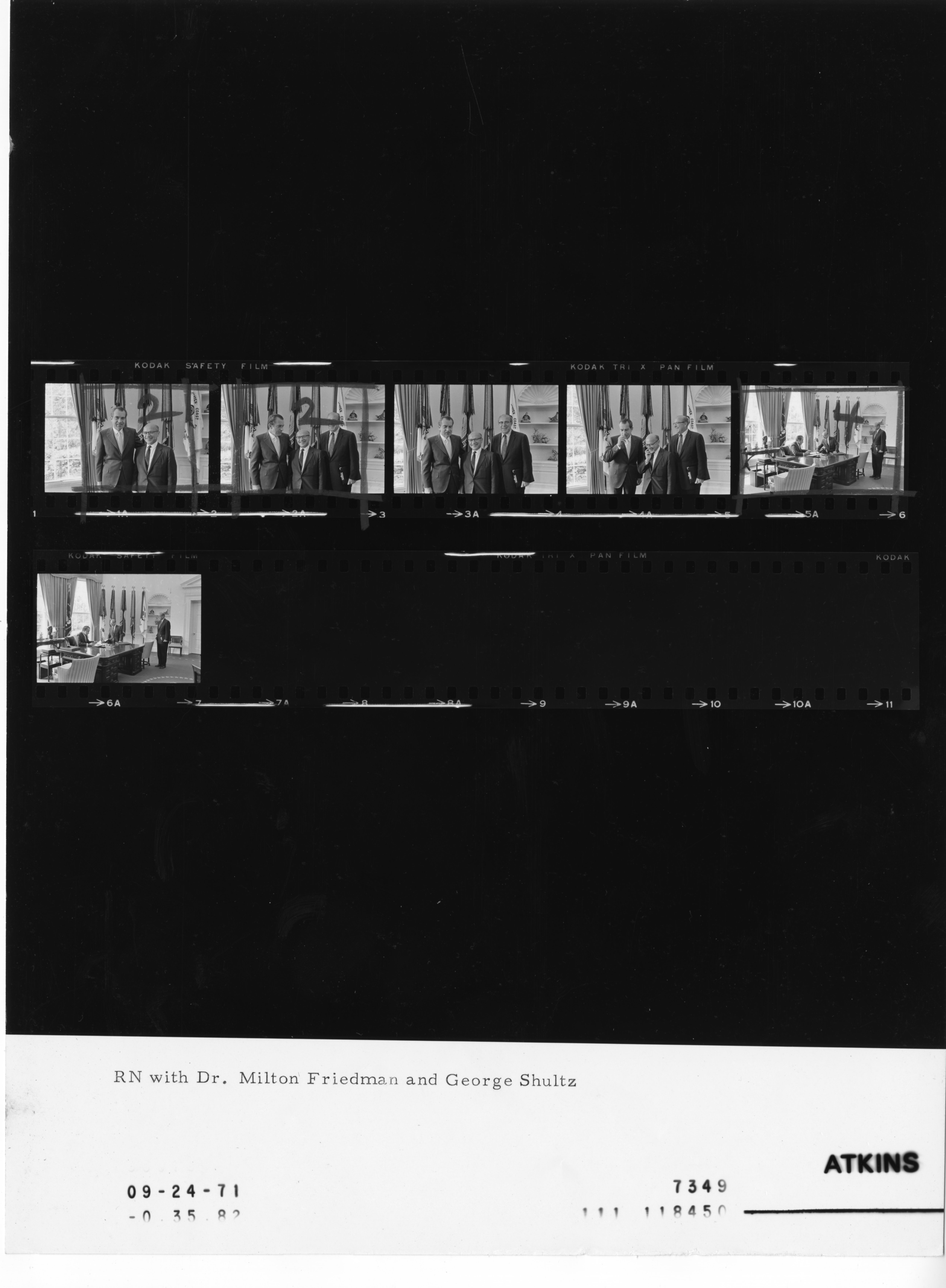
- Frame(s): WHPO-7349-01A-04A, President Nixon standing with George Shultz and Milton Friedman. 9/24/1971, Washington, D.C. White House, Oval Office. President Nixon, George Shultz, Milton Friedman.
- Frame(s): WHPO-7349-05A, President Nixon sitting at his Oval Office desk during a meeting with Shultz and Milton Friedman. 9/24/1971, Washington, D.C. White House, Oval Office. President Nixon, George Shultz, Milton Friedman.
- Frame(s): WHPO-7349-05A-06A, President Nixon sitting at his Oval Office desk during a meeting with Shultz and Milton Friedman. 9/24/1971, Washington, D.C. White House, Oval Office. President Nixon, George Shultz, Milton Friedman.
Roll WHPO-7350 Photographer: Atkins, Oliver | Color or B&W: B&W
- Frame(s): WHPO-7350-01-04, President Nixon with Rear Admiral Samuel Gravely, Secretary of Defense Melvin Laird, Brigadier General Benjamin Hunton, Brig. Gen. Cunningham Bryant. They are not mentioned in the Presidential Daily Diary for Sept. 28, and may possibly have been present with Melvin Laird when President Nixon signed H.R. 6531, a bill amending the Military Service Act of 1967. 9/24/1971, Washington, D.C. White House, Oval Office. President Nixon, Samuel Gravely, Melvin Laird, Benjamin Hunton, Cunningham Bryant.
- Frame(s): WHPO-7350-03, President Nixon standing in the Oval Office with Rear Admiral Samuel Gravely, Secretary of Defense Melvin Laird, Brigadier General Benjamin Hunton, Brig. Gen. Cunningham Bryant. They are not mentioned in the Presidential Daily Diary for Sept. 28, and may possibly have been present with Melvin Laird when President Nixon signed H.R. 6531, a bill amending the Military Service Act of 1967. 9/24/1971, Washington, D.C. White House, Oval Office. President Nixon, Samuel Gravely, Melvin Laird, Benjamin Hunton, Cunningham Bryant.
- Frame(s): WHPO-7350-05, President Nixon standing in the Oval Office with Rear Admiral Samuel Gravely, Secretary of Defense Melvin Laird, Brigadier General Benjamin Hunton, Brig. Gen. Cunningham Bryant. They are not mentioned in the Presidential Daily Diary for Sept. 28, and may possibly have been present with Melvin Laird when President Nixon signed H.R. 6531, a bill amending the Military Service Act of 1967. 9/24/1971, Washington, D.C. White House, Oval Office. President Nixon, Samuel Gravely, Melvin Laird, Benjamin Hunton, Cunningham Bryant.
- Frame(s): WHPO-7350-08-24, President Nixon standing with Mrs. J. Willard Marriott, Inaugural Committee Chairman J. Willard Marriott, Chairman of the Executive Committee for the President's Advisory Commission on the Arts, and J. Willard Marriott, President of the Marriott Corp. 9/24/1971, Washington, D.C. White House, Cabinet Room. President Nixon, Samuel Gravely, Melvin Laird, Benjamin Hunton, Cunningham Bryant, J. Willard Marriott, Mrs. J. Willard Marriott.
Roll WHPO-7351 Photographer: Atkins, Oliver | Color or B&W: Color
- Frame(s): WHPO-7351-02A-10A, President Nixon standing with Mrs. Alice Marriott, Chairman of the Executive Committee for the President's Advisory Commission on the Arts, Inaugural Committee Chairman and President of the Marriott Corp. 9/24/1971, Washington, D.C. White House, Cabinet Room. President Nixon, J. Willard Marriott, Mrs. Alice Marriott.
- Frame(s): WHPO-7351-11, President Nixon standing with Mrs. Alice Marriott and Mr. J. Willard Marriott. 9/24/1971, Washington, D.C. White House, Cabinet Room. President Nixon, J. Willard Marriott, Mrs. Alice Marriott.
Roll WHPO-7352 Photographer: Knudsen, Robert L. | Color or B&W: Color
- Frame(s): WHPO-7352-02-07, Pat Nixon arriving at the Capitol to attend a luncheon honoring Senator Allen Ellender's birthday. 9/24/1971, Washington, D.C. Capitol. Pat Nixon, Allen Ellender, unidentified persons.
- Frame(s): WHPO-7352-07, Pat Nixon arriving at the Capitol to attend a luncheon honoring Senator Allen Ellender's birthday. Ellender and Pat Nixon stand near a doorway holding a large Happy Birthday note. 9/24/1971, Washington, D.C. Capitol. Pat Nixon, Allen Ellender, unidentified persons.
- Frame(s): WHPO-7352-08-31, Pat Nixon attending a luncheon honoring Senator Allen Ellender's birthday. 9/24/1971, Washington, D.C. Capitol. Pat Nixon, Allen Ellender, unidentified persons.
Roll WHPO-7353 Photographer: Kightlinger, Jack | Color or B&W: B&W
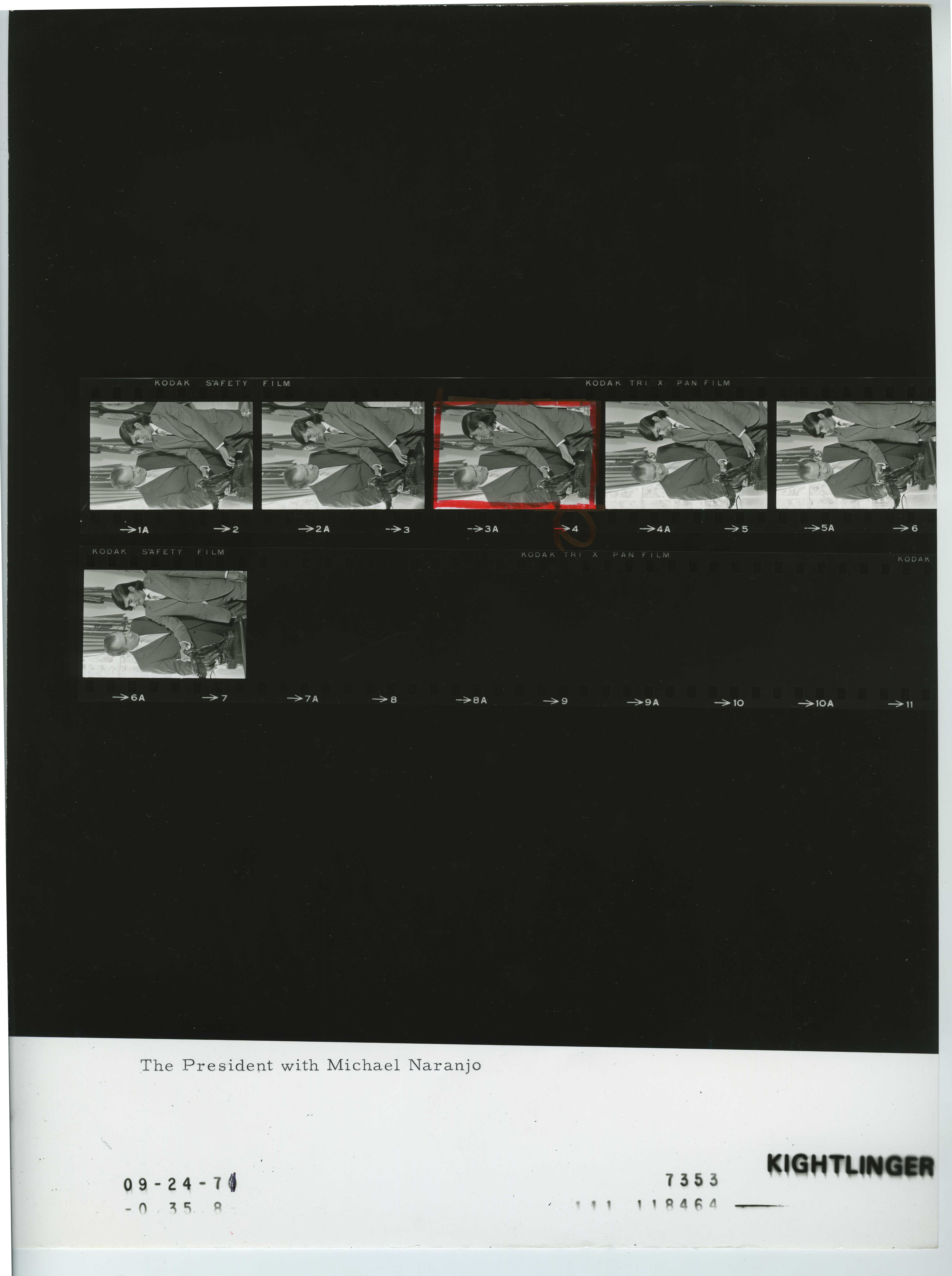
- Frame(s): WHPO-7353-01A-06A, President Nixon receiving a sculpture entitled "Dance of the Eagle" from blind American Indian artist sculptor Michael Naranjo, who was blinded in Vietnam in 1968. 9/24/1971, Washington, D.C. White House, Oval Office. President Nixon, Michael Naranjo.
Roll WHPO-7354 Photographer: Kightlinger, Jack | Color or B&W: B&W
- Frame(s): WHPO-7354-04-10, President Nixon receiving a sculpture entitled "Dance of the Eagle" from blind American Indian artist sculptor Michael Naranjo, who was blinded in Vietnam in 1968. 9/24/1971, Washington, D.C. White House, Oval Office. President Nixon, Michael Naranjo.
The White House Communications Agency Videotape Collection contains “off-the-air” recordings of televised programs produced between 1968 and 1974. Visit the finding aid to learn more.
- WHCA-4681
"President Nixon Speaking at Detroit's Economic Club".
CBS
Runtime: 01:06:32 - WHCA-4682
"Martin Agronsky: Evening Edition". Johnny Carson.
NBC
Runtime: 00:29:57
Context (External Sources)
The Vanderbilt Television News Archive is the world's most extensive and complete archive of television news. They have been recording, preserving and providing access to television news broadcasts of the national networks since August 5, 1968.
Wikipedia is a free encyclopedia that anyone can edit.