

Introduction
This almanac page for Wednesday, October 1, 1969, pulls together various records created by the federal government and links to additional resources which can provide context about the events of the day.
Previous Date: Tuesday, September 30, 1969
Next Date: Thursday, October 2, 1969
Schedule and Public Documents
The Daily Diary files represent a consolidated record of the President's activities. Visit the finding aid to learn more.
The President's day began at The White House - Washington, D. C.
The Weekly Compilation of Presidential Documents made available transcripts of the President's news conferences; messages to Congress; public speeches, remarks, and statements; and other Presidential materials released by the White House.
Announcements
- Draft Postponement for Graduate Students (5 Weekly Comp. Pres. Doc. 1353, October 1, 1969)
Announcement of National Security Council Memorandum Recommending Postponement of Induction to the End of the Academic Year.
Appointments and Nominations
- United States Ambassador to the Federal Republic of Cameroon (5 Weekly Comp. Pres. Doc. 1352, October 1, 1969)
Announcement of Intention To Nominate Lewis Hoffacker of the District of Columbia. - Task Force on Women's Rights and Responsibilities. (5 Weekly Comp. Pres. Doc. 1352, October 1, 1969)
Announcement of Establishment and Membership.
Executive Orders
- National Guard of the District of Columbia (5 Weekly Comp. Pres. Doc. 1353, October 1, 1969)
Executive Order 11485.
Acts Approved by the President
- H.R. 6508 -- Public Law 91-79
Disaster Relief Act of 1969. - H.R. 9526 -- Public Law 91-80
An Act to amend the District of Columbia Unemployment Compensation Act to provide that employer contributions do not have to be made under that Act with respect to service performed in the employ of certain public international organizations.
Nominations Submitted to the Senate
Does not include promotions of members of the Uniformed Services, nominations to the Service Academies, or nominations of Foreign Service Officers.
- ROBERT E. WIECZOROWSKI, of Illinois, to be U.S. Executive Director of the International Bank for Reconstruction and Development for a term of 2 years, vice Covey T. Oliver, resigned.
Each Public Papers of the Presidents volume contains the papers and speeches of the President of the United States that were issued by the White House Office of the Press Secretary during the time period specified by the volume. The material is presented in chronological order, and the dates shown in the headings are the dates of the documents or events. In instances when the release date differs from the date of the document itself, that fact is shown in the text note.
To ensure accuracy, remarks have been checked against audio recordings (when available) and signed documents have been checked against the original, unless otherwise noted. Editors have provided text notes and cross references for purposes of identification or clarity.
The Federal Register is the official daily publication for rules, proposed rules, and notices of federal agencies and organizations, as well as executive orders and other Presidential documents.
The Congressional Record is the official daily record of the debates and proceedings of the U.S. Congress.
Archival Holdings
Any selection of archival documents will necessarily be partial. You should use the documents and folders identified below as a starting place, but consult the linked collection finding aids and folder title lists and the collections themselves for context. Many documents to be found this way do not lend themselves to association with specific dates, but are essential to a complete understanding of the material.
Selective document listing
President's Office Files
The President's Office Files consists of materials drawn together by the Special Files Unit from several administrative subdivisions within the White House Office. It is the handwriting and sensitive papers sent to the Staff Secretary that now comprise much of the President's Office Files. Visit the finding aid to learn more.
- President's Handwriting, Box 3, President's Handwriting, October 1 thru 15, 1969 [1 of 3]
- Telephone Call Recommendation; Herbert G. Klein to The President re: Harvey W. Schwandner - Editor of the Milwaukee Sentinel. October 1, 1969. 2 pgs.
- President's Handwriting, Box 3, President's Handwriting, October 1 thru 15, 1969 [2 of 3]
- Memo; Bill Safire to The President re: Report on visit with Governor Dewey - October 1, 1969. October 1, 1969. 2 pgs.
- Annotated News Summaries, Box 28, News Summaries - October 1969 [During this period, the Staff Secretary only removed pages from the News Summaries which contained President Nixon's handwriting, often leaving the document with no date. In addition to the individual document(s) listed below, you should also consult the full folder for the month.]
- Digest of Recent News Reports, October 1, 1969
- Communist Media Reaction to the President's News Conference (10/1 FBI's Report)
The H. R. Haldeman Diaries consists of seven handwritten diaries, 36 dictated diaries recorded as sound recordings, and two handwritten audio cassette tape subject logs. The diaries and logs reflect H. R. Haldeman’s candid personal record and reflections on events, issues, and people encountered during his service in the Nixon White House. As administrative assistant to the President and Chief of Staff, Haldeman attended and participated in public events and private meetings covering the entire scope of issues in which the Nixon White House engaged in during the years 1969-1973. Visit the finding aid to learn more.
- Transcript of diary entry (PDF)
Wednesday, October 1.
Group meeting with President - 8:30, supposed to be for one hour but lasted until after 11:00. President canceled his planned meeting with Kissinger staff to stay with our session. Covered a lot of ground about his priorities and general needs. Got the line and approach pretty well established and I think gave him a feeling of getting things more under control. Then had several staff sessions with Klein, Mollenhoff. Pushed Herb on need for targeting effort against major objectives and skipping all the fringe stuff. Just listened to Clark's tales of horror regarding his investigations.
In the big meeting in the morning, decided to let October 15 go by without any overt counter effort on our part. Was somewhat annoyed by staff concern that he was following LBJ pattern - especially regarding his Marine speech yesterday. Feels he has to say those things and that his style and approach is so different that it can't be considered an LBJ technique - and refuses to stop just because Johnson did something - if he thinks it is needed. Kissinger and Cliff Miller both felt nothing was right approach. Ehrlichman argued for action, i.e., a day of prayer - but President said no. Did say he had his own idea, but wouldn't tell us now (this is the plan for a press conference which he told me yesterday).
Harlow concerned regarding Haynsworth, as is Ehrlichman, so they were told to work it out with Mitchell. Bryce recommended to President that the nomination be withdrawn. Mitchell later persuaded him otherwise.
Other big issue was problem of testimony at Symington hearings - and President agreed to see Senator Symington this afternoon and tell him we would not permit subordinates to testify, will not disclose contingency plans and will not discuss nuclear storage situation. This he did, apparently with some success, although Stu will probably blast us anyway.
President had several pages of lists on yellow pad that he checked off as we covered the ground. Also has been cleaning out all his old briefcases, etc., because there are piles of stuff in the out box every day - way beyond what goes in - some going clear back to the transition period. Hope it eventually all gets cleaned out. - Handwritten diary entry (JPG)
The National Archives Catalog is the online portal to the records held at the National Archives, and information about those records. It is the main way of describing our holdings and also provides access to electronic records and digitized versions of our holdings.
The Catalog searches across multiple National Archives resources at once, including archival descriptions, digitized and electronic records, authority records, and web pages from Archives.gov and the Presidential Libraries. The Catalog also allows users to contribute to digitized historical records through tagging and transcription.
Nixon Library Holdings
All National Archives Units
National Security Documents
The President's Daily Brief is the primary vehicle for summarizing the day-to-day sensitive intelligence and analysis, as well as late-breaking reports, for the White House on current and future national security issues. Read "The President's Daily Brief: Delivering Intelligence to Nixon and Ford" to learn more.
The Foreign Relations of the United States series presents the official documentary historical record of major U.S. foreign policy decisions and significant diplomatic activity. Visit the State Department website for more information.
Vol. XII, Soviet Union, January 1969-October 1970
Establishment of the Kissinger-Dobrynin Channel; Dialogue on the Middle East; and the Sino-Soviet Dispute, April 23-December 10, 1969
91. Memorandum From Harold Saunders of the National Security Council Staff to the President’s Assistant for National Security Affairs (Kissinger) , Washington, October 1, 1969
Source: National Archives, Nixon Presidential Materials, NSC Files, Box 650, Country Files, Middle East, Middle East Negotiations, July–October 1969. Secret; Nodis. Sent for information. A notation on the memorandum indicates Kissinger saw it. Attached but not printed are telegram 3324 from USUN, October 1, providing an account of the Rogers–Gromyko talk of September 30, and telegram 3322 from USUN, October 1, providing an account of the Sisco–Dobrynin talk of September 30.
Vol. XIX, Part 2, Japan, 1969-1972
January-November 1969: The Decision for Okinawa Reversion
20. Memorandum From Secretary of Commerce Stans to the President’s Assistant for National Security Affairs (Kissinger) , Washington, October 1, 1969
Source: National Archives, Nixon Presidential Materials, NSC Files, Box 213, Agency Files, Dept of Commerce—1970, Vol. I. Secret; Eyes Only. Kissinger initialed this memorandum and wrote, “Note of acknowledgment” in the upper-right hand corner. In an October 16 letter to Stans, Kissinger expressed “thanks for your memorandum of October 1 containing the most helpful suggestions on Japan.” (Ibid.)
Vol. XXIII, Arab-Israeli Dispute, 1969-1972
The Rogers Plan
53. Memorandum From Harold Saunders of the National Security Council Staff to the President’s Assistant for National Security Affairs (Kissinger), Washington, October 1, 1969
Source: National Archives, Nixon Presidential Materials, NSC Files, Box 650, Country Files, Middle East, Middle East Negotiations, July 1–October 1969. Secret; Nodis. Sent for information. A stamped notation on the first page reads: “HAK has seen.” Attached but not printed are telegrams 3324 from USUN, October 1, which reported Rogers’s meeting with Gromyko that day, and telegram 3322 from USUN, October 1, which reported Sisco’s meeting with Dobrynin on September 29.
Vol. XXIV, Middle East Region and Arabian Peninsula, 1969-1972; Jordan, September 1970
The Two Yemens
173. Telegram From Secretary of State Rogers to the Department of State, New York, October 1, 1969, 2308Z
Source: National Archives, Nixon Presidential Materials, NSC Files, Box 1245, Saunders Files, Yemen. Confidential. It was repeated to Jidda and Aden.
Vol. XL, Germany and Berlin, 1969-1972
Germany and Berlin, 1969-1972
29. Memorandum From Helmut Sonnenfeldt of the National Security Council Staff to the President’s Assistant for National Security Affairs (Kissinger) , Washington, October 1, 1969
Source: National Archives, Nixon Presidential Materials, NSC Files, Box 682, Country Files, Europe, Germany, Vol. III. Confidential. Sent for action. According to another copy, Downey drafted the memorandum on October 1. (Library of Congress, Manuscript Division, Kissinger Papers, Box CL 2, Chronological File, 1969–75, 1 July–31 Oct. 1969)
Vol. XLI, Western Europe; NATO, 1969-1972
Italy
184. Memorandum From the President’s Assistant for National Security Affairs (Kissinger) to President Nixon, Washington, October 1, 1969
Source: National Archives, Nixon Presidential Materials, NSC Files, Box 694, Country Files—Europe, Italy, Vol. I. Confidential. Sent for information.
Vol. E-5, Part 2, Documents on North Africa, 1969-1972
Libya
41. Memorandum From the President’s Assistant for National Security Affairs (Kissinger) to President Nixon, Washington, October 1, 1969
Source: National Archives, Nixon Presidential Materials, NSC Files, Box 738, Country Files, Africa, Libya, Vol. I. Secret. Sent for information.
Vol. E-7, Documents on South Asia, 1969-1972
India and Pakistan: Pre-Crisis, January 1969-February 1971
37. Letter From Pakistani President Yahya to President Nixon, Rawalpindi, October 1, 1969
Yahya requested urgent approval of the sale of 1.7 million tons of wheat under PL–480 to offset a serious food shortage in East Pakistan.
Source: National Archives, RG 59, Central Files 1967–69, AID (US) 15–8 PAK. No classification marking. The Consulate General in Dacca underlined the problem of food shortages in East Pakistan on October 10 in telegram 2855 from Dacca. (Ibid., POL 18 PAK )
Vol. E-10, Documents on American Republics, 1969-1972
Soccer War
653. Memorandum From the Executive Secretary (Eliot) to the President’s Assistant for National Security Affairs (Kissinger), Washington, October 1, 1969. , Washington, October 1, 1969
In a report on the status of the Honduran–Salvadoran conflict, the Department of State noted that despite progress with troop withdrawals, prisoner repatriations, and protections for immigrants, tensions remained high and both countries were engaged in large arms purchases, auguring poorly for short-term regional stability.
Source: National Archives, Nixon Presidential Materials, NSC Files, Box 786, Country Files, Latin America, Honduras–Salvador Dispute. Confidential.
The Kissinger telephone conversation transcripts consist of approximately 20,000 pages of transcripts of Kissinger’s telephone conversations during his tenure as Assistant to the President for National Security Affairs (1969-1974) and Secretary of State (1973-1974) during the administration of President Richard Nixon. Visit the finding aid for more information.
Chronological File, Box 2, Folder October 1-13, 1969
- 11:35 AM, Ambassador Lucet - French
- 12:00 PM, Elliot Richardson
- 12:10 PM, Elliot Richardson
- 3:00 PM, Donald Marron
- 3:10 PM, Secretary Laird
Audiovisual Holdings
The White House Photo Office collection consists of photographic coverage of President Richard Nixon meeting with prominent social, political, and cultural personalities; speaking engagements and news conferences of the President and various high-ranking members of the White House staff and Cabinet; Presidential domestic and foreign travel, including Presidential vacations; social events and entertainment involving the First Family, including entertainers present; official portraits of the President, First Family, and high-ranking members of the Nixon administration; the 1969 and 1973 Inaugurals; the President’s 1972 Presidential election campaign appearances (including speeches) and other official activities of the White House staff and the President’s Cabinet from January 20, 1969 until August 9, 1974 at the White House and the Old Executive Office Building; other locations in Washington, DC, such as The Mall; and the Presidential retreats in Camp David, Maryland, Key Biscayne, Florida, and San Clemente, California. Visit the finding aid to learn more.
Roll WHPO-2070 Photographer: Schumacher, Karl | Color or B&W: B&W
- Frame(s): WHPO-2070-05-12, Unidentified man (Head and shoulders). 10/1/1969, Washington, D.C. unknown. unidentified man.
Roll WHPO-2071 Photographer: Schumacher, Karl | Color or B&W: B&W
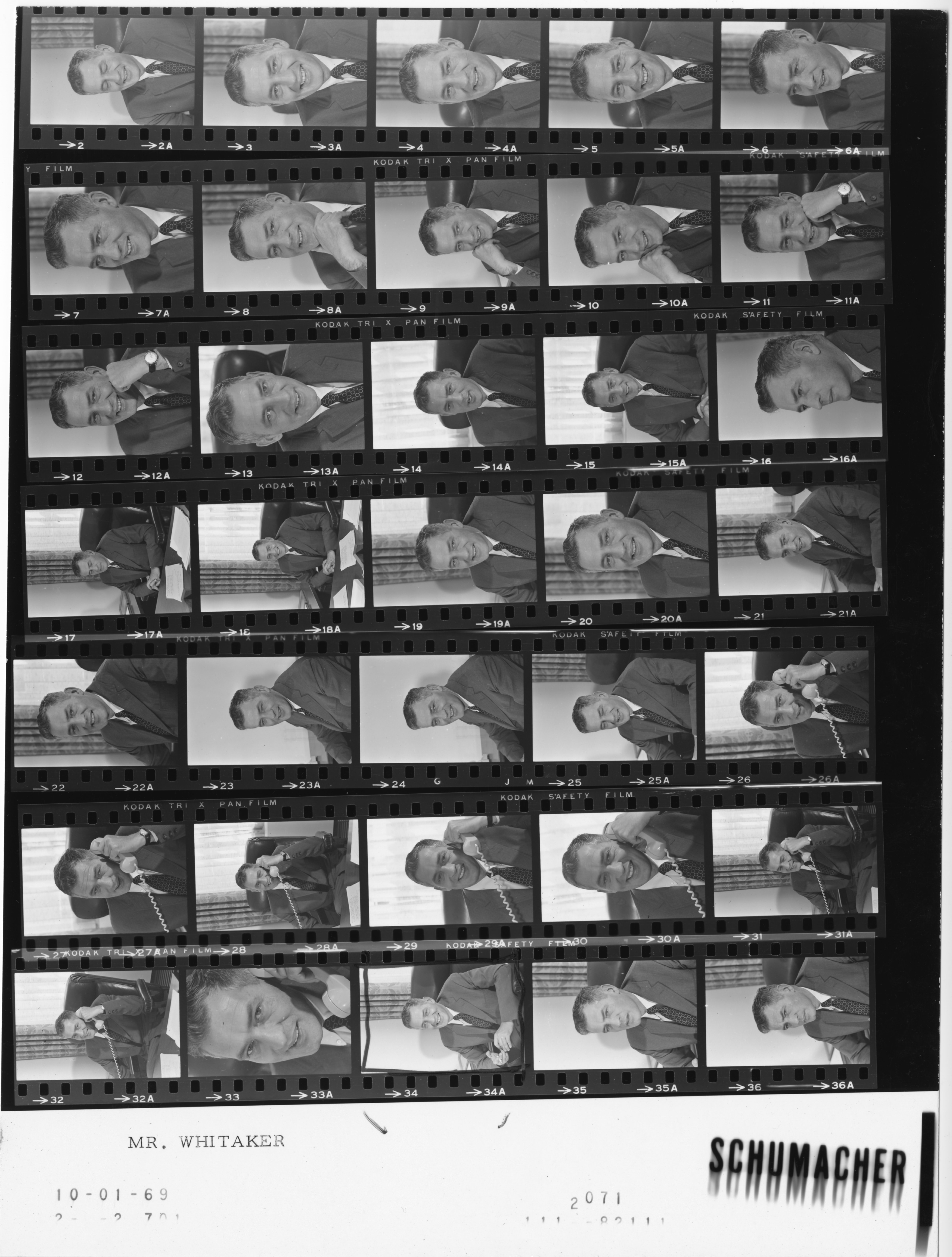
- Frame(s): WHPO-2071-02-36, Portrait study of John Whitaker working at his desk. 10/1/1969, Washington, D.C. Whitaker's office. John Whitaker.
The White House Communications Agency Videotape Collection contains “off-the-air” recordings of televised programs produced between 1968 and 1974. Visit the finding aid to learn more.
- WHCA-3442
"Here's Barbara" with A New Look at the White House (WTTG); Martin Agronsky report on Elliot Richardson and the Vietnam War (WTOP); "Selling of the President," an interview with Joe McGinniss (NBC, WRC). (00:00:00:-00:18:15) "Here's Barbara:" "A New Look at the White House," report on Presidential procedures on hosting guests such as diplomats and heads of state; press access to the White House; living quarters and decorations, Oval Office and bedroom, in
All networks
Runtime: 00:40:00 - WHCA-3443
Weekly News Summary.
All networks
Runtime: 15
6. Cronkite: White House in Green Beret trial, Colonel Robert Rheault denies Vietnam civilian had been murdered. Time Code Start: 01:84. Keywords: Army, Special Forces, military, troops, trials, murders. Network: CBS.
Context (External Sources)
The Vanderbilt Television News Archive is the world's most extensive and complete archive of television news. They have been recording, preserving and providing access to television news broadcasts of the national networks since August 5, 1968.
Wikipedia is a free encyclopedia that anyone can edit.