
Introduction
This almanac page for Tuesday, May 18, 1971, pulls together various records created by the federal government and links to additional resources which can provide context about the events of the day.
Previous Date: Monday, May 17, 1971
Next Date: Wednesday, May 19, 1971
Schedule and Public Documents
The Daily Diary files represent a consolidated record of the President's activities. Visit the finding aid to learn more.
The President's day began at The White House - Washington, D. C.
The Weekly Compilation of Presidential Documents made available transcripts of the President's news conferences; messages to Congress; public speeches, remarks, and statements; and other Presidential materials released by the White House.
Digitized versions can be found at HathiTrust.
Each Public Papers of the Presidents volume contains the papers and speeches of the President of the United States that were issued by the White House Office of the Press Secretary during the time period specified by the volume. The material is presented in chronological order, and the dates shown in the headings are the dates of the documents or events. In instances when the release date differs from the date of the document itself, that fact is shown in the text note.
To ensure accuracy, remarks have been checked against audio recordings (when available) and signed documents have been checked against the original, unless otherwise noted. Editors have provided text notes and cross references for purposes of identification or clarity.
The Federal Register is the official daily publication for rules, proposed rules, and notices of federal agencies and organizations, as well as executive orders and other Presidential documents.
The Congressional Record is the official daily record of the debates and proceedings of the U.S. Congress.
Archival Holdings
Any selection of archival documents will necessarily be partial. You should use the documents and folders identified below as a starting place, but consult the linked collection finding aids and folder title lists and the collections themselves for context. Many documents to be found this way do not lend themselves to association with specific dates, but are essential to a complete understanding of the material.
Selective document listing
President's Office Files
The President's Office Files consists of materials drawn together by the Special Files Unit from several administrative subdivisions within the White House Office. It is the handwriting and sensitive papers sent to the Staff Secretary that now comprise much of the President's Office Files. Visit the finding aid to learn more.
- Annotated News Summaries, Box 30, News Summaries - May 1971 [1 of 4]
- Annotated News Summaries, Box 30, News Summaries - May 1971 [2 of 4]
- Annotated News Summaries, Box 30, News Summaries - May 1971 [3 of 4]
- Annotated News Summaries, Box 30, News Summaries - May 1971 [4 of 4] [During this period, the Staff Secretary only removed pages from the News Summaries which contained President Nixon's handwriting, often leaving the document with no date. Although there are no specific documents with this date, you should also consult the full folder for the month.]
- President's Daily Schedule, Box 101, [President's Daily Schedule, Mar.-May 1971] [3 of 3]
- The President's Schedule, Tuesday - May 18, 1971
The H. R. Haldeman Diaries consists of seven handwritten diaries, 36 dictated diaries recorded as sound recordings, and two handwritten audio cassette tape subject logs. The diaries and logs reflect H. R. Haldeman’s candid personal record and reflections on events, issues, and people encountered during his service in the Nixon White House. As administrative assistant to the President and Chief of Staff, Haldeman attended and participated in public events and private meetings covering the entire scope of issues in which the Nixon White House engaged in during the years 1969-1973. Visit the finding aid to learn more.
- Transcript of diary entry (PDF)
Tuesday, May 18.
SALT was the big activity today, as our original plans for the Rogers, Laird, and Gerry Smith meetings were one by one dropped and shifted, because Henry didn't have the final okay from Dobrynin on the wording of the agreement and the final decision to confirm announcement on Thursday. As the day went on, Henry became more and more nervous, as did the President, because it looked as if maybe there was a snag we weren't going to get through. That all proved to be unfounded, as at 3:45, Henry burst into a meeting the President and I were having with Colson, to say that everything was all set. We talked in some double-talk so Colson wouldn't understand what we were saying for a while, and then finally Chuck left and we went into the plans for how to handle it. We'll go ahead with briefings tomorrow of Rogers, etcetera. The President is still extremely worried about how to tell Rogers and went back and forth on that, frequently, on and off during the rest of the afternoon, but we locked him in for a 9:00 appointment in the morning, and he's going to have to face up to it now.
There was, of course, considerable discussion as the day went on of looking back on how the whole thing had come together, of the tremendous role Henry's played in this, implementing the President's decisions in his many secret meetings with Dobrynin, which have finally brought us to the point of something that we can actually take to the people. This puts us in a marvelous position because of the general feeling on the part of many of the doves in Congress that SALT had broken down and Muskie's plan to start holding hearings, etcetera. This, of course, shoots all the ground out from under them. The problem now is how to handle the announcement and follow-up on it in such a way as to tread the very fine line between making sure that the enormous significance of the step is clearly understood, but that we don't oversell it or appear to have arrived at any final decision.
There was a lot of back and forth discussion between Henry and the President as to who deserved the credit, etcetera, Henry making very clear the point that it was the President's courage in the decisions that had made it all possible, but obviously Henry feels he played a monumental role also, and I guess he really did. As we discussed planning on the announcement, the President overruled the original decision to notify the Congressional leaders at 3:00 this afternoon-- 3:00 Wednesday afternoon––that there would be a leaders' meeting on Thursday morning––the idea being to get them on guard before the Mansfield amendment votes at 5:00. The President felt that would be a cheap shot and it would be better from our viewpoint to let the vote go on whatever grounds it does, and then notify the leaders right afterwards of the Thursday morning meeting. This is one that someday we've got to be sure it gets out because he deserves a lot of credit, since it now appears that we'll probably lose on one of the amendments to the Mansfield amendment. We can defeat Mansfield, but we can't defeat all of the other options, or at least probably not.
As the afternoon went on, the President became more and more pleased about the whole thing falling together, the more he thought about it. He decided to have Henry and me join him on the Sequoia for dinner. At the last minute, he also added Ehrlichman and Colson, so we had a pretty good group and there was a lot of basically light conversation, and the President, as we sat up on the upper deck before dinner, had Henry read the announcement to the group. Ehrlichman and Colson were astonished by the scope, because nobody on the inside thought we had any possibility of getting the thing this far down the road. The President was in very good spirits and very jovial through dinner, making a lot of wisecracks, having some fun with Henry, discussing some of the plans for announcement, etcetera.
Ehrlichman reported that the SST revival was dead, since Boeing had decided to fold their hand and not attempt to go for renewal, on the basis that they can't win in the negotiation of-- renegotiation of the contract. This came as something of a blow to the President. He's especially concerned because it's obviously a slur on us, in that the House revived the thing and we weren't able to carry it through with the supplier. He's furious with Boeing and has made it clear they'll get nothing more from this Administration as long as he is in office.
He also got into quite a long thing on the lack of leadership in the Congress, particularly in the Senate, making the point that Gerry Ford really is the only leader we've got on either side in either house. And that led into some reminiscing about the old time greats in the Congress.
Ehrlichman reported that in his meeting with the president of Boeing, T. Wilson, this afternoon, Wilson got into a pitch on their new hydrofoil and John cut him off, saying that he really didn't think this Administration was going to be very interested in a new contract with the Boeing Company, at least at this time, at which Wilson got up hastily and departed.
We had a little flap with the Director of the National Institutes of Mental Health, who apparently said the other day that he thought marijuana offenses should be handled like traffic violations. This sent the President right up the wall, and he's told Ehrlichman to get the guy fired, which it turns out we're glad to do because he's been causing some other problems and shows some clear disloyalty. So John's moving ahead on that.
End of May 18. - Original audio recording (MP3)
The National Archives Catalog is the online portal to the records held at the National Archives, and information about those records. It is the main way of describing our holdings and also provides access to electronic records and digitized versions of our holdings.
The Catalog searches across multiple National Archives resources at once, including archival descriptions, digitized and electronic records, authority records, and web pages from Archives.gov and the Presidential Libraries. The Catalog also allows users to contribute to digitized historical records through tagging and transcription.
Nixon Library Holdings
All National Archives Units
National Security Documents
The President's Daily Brief is the primary vehicle for summarizing the day-to-day sensitive intelligence and analysis, as well as late-breaking reports, for the White House on current and future national security issues. Read "The President's Daily Brief: Delivering Intelligence to Nixon and Ford" to learn more.
The Foreign Relations of the United States series presents the official documentary historical record of major U.S. foreign policy decisions and significant diplomatic activity. Visit the State Department website for more information.
Vol. V, United Nations, 1969-1972
High-Level Meetings; Miscellaneous Issues
35. Memorandum From Melvin Levine and Richard Smyser of the National Security Council Staff to the President’s Assistant for National Security Affairs (Kissinger), Washington, May 18, 1971
Source: National Archives, Nixon Presidential Materials, NSC Files, Box 301, Agency Files, USUN, Vol. VII. Secret; Nodis. Sent for urgent information.
Vol. XI, South Asia Crisis, 1971
South Asia Crisis, 1971
51. Information Memorandum From the Assistant Secretary of State for Near Eastern and South Asian Affairs (Sisco) to Secretary of State Rogers, Washington, May 18, 1971
Source: National Archives, RG 59, Central Files 1970–73, POL 27 INDIA–PAK. Confidential. Drafted by Quainton on May 17 and cleared by Spengler, Schneider, and Van Hollen. A copy was sent to Kissinger on May 20 under a covering note from Executive Secretary Eliot. (Ibid., POL 23–9 PAK)
Vol. XIII, Soviet Union, October 1970-October 1971
"One of Two Routes": Soviet-American Relations and Kissinger's Secret Trip to China, April 23-July 18, 1971
223. Conversation Between President Nixon and the President’s Assistant for National Security Affairs (Kissinger), Washington, May 18, 1971
Source: National Archives, Nixon Presidential Materials, White House Tapes, Conversation 500–10. No classification marking. The editors transcribed the portions of the tape recording printed here specifically for this volume. According to the President’s Daily Diary, Nixon met Kissinger in the Oval Office from 9:41 to 10 a.m. (Ibid., White House Central Files)
224. Transcript of a Telephone Conversation Between the President’s Assistant for National Security Affairs (Kissinger) and the Soviet Ambassador (Dobrynin), Washington, May 18, 1971, 4 p.m.
Source: National Archives, Nixon Presidential Materials, Henry Kissinger Telephone Conversation Transcripts, Box 27, Dobrynin File. No classification marking.
Vol. XXIX, Eastern Mediterranean, 1969-1972
Turkey
446. Telegram From the Embassy in Turkey to the Department of State, Ankara, May 18, 1971, 1145Z
Source: National Archives, Nixon Presidential Materials, NSC Files, Box 633, Country Files—Middle East, Turkey, Vol. II 1 Jan 1970–31 Dec 1971. Secret; Priority; Exdis. Repeated to Adana, Izmir, and Istanbul.
Vol. XXXIX, European Security
MBFR and the Conference on European Security, December 1970-December 1971
50. Conversation Among President Nixon, the President’s Assistant for National Security Affairs (Kissinger), Secretary of Defense Laird, Acting Secretary of State Johnson, and the Republican Congressional Leadership, Washington, May 18, 1971, 8:02-9:02 a.m.
Source: National Archives, Nixon Presidential Materials, White House Tapes, Conversation 58–1. No classification marking. The editors transcribed the portions of the tape recording printed here specifically for this volume. Attending the meeting from Congress were Robert Griffin (R–MI), Norris Cotton (R–NH), Peter Dominick (R–CO), Gerald Ford (R–MI), Leslie Arends (R–IL), John Anderson (R–CA), Barber Conable (R–NY), Richard Poff (R–VA), Bob Wilson (R–CA), John Rhodes (R–AZ), Robert Stafford (R–VT), H. Allen Smith (R–CA), and Robert Dole (R–KS). Also attending were Peter Peterson, Shultz, Ehrlichman, MacGregor, Timmons, Dent, Ziegler, Harlow, and LeBieu. The conversation took place in the Cabinet Room.
Vol. E-4, Documents on Iran and Iraq, 1969-1972
Iraq 1969-1971
288. Telegram 1302 From the Mission to Geneva to the Department of State, Geneva, May 18, 1971, 1515Z
The UN High Commissioner for Refugees conveyed his annoyance over the leak of information concerning his intervention in Baghdad, which had resulted in the release of imprisoned Jews.
Source: National Archives, RG 59, Central Files 1970–73, POL 29 IRAQ. Confidential. Repeated to USUN.
Vol. E-10, Documents on American Republics, 1969-1972
Argentina
66. Talking Points Prepared by Arnold Nachmanoff of the National Security Council Staff for the President’s Assistant for National Security Affairs (Kissinger), Washington, May 18, 1971., Washington, May 18, 1971
National Security Council staff member Nachmanoff briefed President’s Assistant for National Security Affairs Kissinger for his meeting with Ambassador Lodge. Nachmanoff discussed SOUTHCOM, the role of the Ambassador, and the political and economic situation in both Argentina and Chile.
Source: National Archives, Nixon Presidential Materials, NSC Files, Box 768, Country Files, Latin America, Argentina 1969–71. Secret. Sent for information. No record of the meeting appeared in Kissinger’s schedule book. Sent under a covering May 18 memorandum from Nachmanoff to Kissinger.
The Kissinger telephone conversation transcripts consist of approximately 20,000 pages of transcripts of Kissinger’s telephone conversations during his tenure as Assistant to the President for National Security Affairs (1969-1974) and Secretary of State (1973-1974) during the administration of President Richard Nixon. Visit the finding aid for more information.
Digitized versions can be found in the National Archives Catalog.
Audiovisual Holdings
The White House Tapes are sound recordings of President Richard Nixon's telephone conversations and of meetings held in the Oval Office and the Cabinet Room in the White House, the President's office in the Old Executive Office Building (OEOB), the Lincoln Sitting Room in the residence section of the White House, and several locations at the Presidential retreat at Camp David, Maryland. These recordings document many of the major events and decisions of the Nixon Administration from February 16, 1971 to July 18, 1973. Visit the White House Tapes finding aid to learn about the taping system's operation and archival processing.
Cabinet Room
- 58-1; 8:02 a.m. - 9:33 a.m.; Nixon, Richard M. (President); Kissinger, Henry A.; Laird, Melvin R.; Johnson, U. Alexis; Griffin, Robert P.; Cotton, Norris; Dominick, Peter H.; Ford, Gerald R.; Arends, Leslie C.; Anderson, John B.; Conable, Barber B., Jr.; Poff, Richard H.; Wilson, Robert C. ("Bob"); Rhodes, John J.; Stafford, Robert T.; Smith, H. Allen; Dole, Robert J.; Peterson, Peter G.; Shultz, George P.; Ehrlichman, John D.; MacGregor, Clark; Timmons, William E.; Dent, Harry S.; Ziegler, Ronald L.; Harlow, Bryce N.; BeLieu, Kenneth E.
- 58-2; Unknown between 9:33 a.m., 5/18 & 9:02 a.m., 2/23; [Unknown person(s)]
- 58-3; Unknown between 9:33 a.m., 5/18 & 9:02 a.m., 2/26; [Unknown person(s)]
Oval Office
- 500-1; Unknown between 7:26 a.m. & 7:55 a.m.; Nixon, Richard M. (President); Butterfield, Alexander P.
- 500-2; Unknown between 7:26 a.m. & 7:55 a.m.; Nixon, Richard M. (President); Haldeman, H. R. ("Bob")
- 500-3; Unknown between 7:26 a.m. & 7:55 a.m.; Nixon, Richard M. (President); Bolling, Landrum
- 500-4; Unknown between 7:26 a.m. & 7:55 a.m.; Nixon, Richard M. (President); Waggonner, Joe D., Jr.
- 500-5; 7:55 a.m. - 7:56 a.m.; Nixon, Richard M. (President); Butterfield, Alexander P.
- 500-6; 7:58 a.m. - 8:02 a.m.; Nixon, Richard M. (President); Kissinger, Henry A.
- 500-7; Unknown between 8:02 a.m. & 9:33 a.m.; Butterfield, Alexander P.; [Unknown person(s)]
- 500-8; 9:34 a.m. - 9:38 a.m.; Nixon, Richard M. (President); Rogers, William P.
- 500-9; 9:38 a.m. - 9:38 a.m.; Nixon, Richard M. (President); Bull, Stephen B.
- 500-10; 9:41 a.m. - 10:00 a.m.; Nixon, Richard M. (President); Kissinger, Henry A.; Bull, Stephen B.
- 500-11; 10:26 a.m. - 11:03 a.m.; Nixon, Richard M. (President); Haldeman, H. R. ("Bob"); Kissinger, Henry A.; Ehrlichman, John D.
- 500-12; Unknown between 11:03 a.m. & 11:06 a.m.; Nixon, Richard M. (President); Bull, Stephen B.
- 500-13; 11:06 a.m. - 11:28 a.m.; Nixon, Richard M. (President); Kissinger, Henry A.
- 500-14; Unknown between 11:28 a.m. & 11:30 a.m.; Nixon, Richard M. (President); Bull, Stephen B.
- 500-15; Unknown between 11:28 a.m. & 11:30 a.m.; Nixon, Richard M. (President); Butterfield, Alexander P.
- 500-16; 11:30 a.m. - 12:16 p.m.; Nixon, Richard M. (President); Ehrlichman, John D.; Shultz, George P.; Butterfield, Alexander P.; Haldeman, H. R. ("Bob"); Frank, Joniece; Kleppe, Thomas S.; Flanigan, Peter M.; Atkins, Oliver F. ("Ollie"); Frank, John N.; Frank, John N. (Mrs.)
- 500-17; 12:16 p.m. - 12:35 p.m.; Linkletter, Arthur F. ("Art"); Shumway, DeVan L.; Atkins, Oliver F. ("Ollie"); Ehrlichman, John D.
- 500-18; Unknown between 2:10 p.m. & 2:14 p.m.; Nixon, Richard M. (President); Butterfield, Alexander P.
- 500-19; Unknown between 2:14 p.m. & 2:30 p.m.; Nixon, Richard M. (President); Acker, Marjorie P.
- 500-20; Unknown between 2:14 p.m. & 2:30 p.m.; Nixon, Richard M. (President); [Unknown person(s)]
- 500-21; Unknown between 2:14 p.m. & 2:30 p.m.; Nixon, Richard M. (President); Ehrlichman, John D.
- 500-22; 2:30 p.m. - 3:04 p.m.; Nixon, Richard M. (President); Haldeman, H. R. ("Bob"); Bull, Stephen B.
- 500-23; Unknown between 3:04 p.m. & 3:06 p.m.; Nixon, Richard M. (President); Bull, Stephen B.
- 500-24; Unknown between 3:04 p.m. & 3:06 p.m.; Nixon, Richard M. (President); Bull, Stephen B.
- 500-25; 3:06 p.m. - 3:40 p.m.; Nixon, Richard M. (President); Kissinger, Henry A.; Bull, Stephen B.; Haldeman, H. R. ("Bob")
- 500-26; 3:42 p.m. - 4:05 p.m.; Nixon, Richard M. (President); Haldeman, H. R. ("Bob"); Colson, Charles W.; Bull, Stephen B.; Kissinger, Henry A.
- 500-27; Unknown between 4:05 p.m. & 4:06 p.m.; Nixon, Richard M. (President); Haldeman, H. R. ("Bob")
- 500-28; Unknown between 4:06 p.m. & 4:41 p.m.; Bull, Stephen B.; [Unknown person(s)]; Butterfield, Alexander P.
- 500-29; 4:42 p.m. - 5:05 p.m.; Nixon, Richard M. (President); Haldeman, H. R. ("Bob"); Scali, John A.; Ziegler, Ronald L.; Kissinger, Henry A.; Ehrlichman, John D.; Bull, Stephen B.
- 500-30; 5:05 p.m. - 6:34 p.m.; Nixon, Richard M. (President); Shultz, George P.; Klein, Herbert G.; Lubar, Robert; Michaels, James W.; Young, Lewis H.; Bleiberg, Robert M.; Evans, Joseph E.; Wooldridge, [Pawhatan] Jack, Jr.; Brady, Raymond J.; Mulloney, Thomas; Fleiger, Howard W.; Loeb, Marshall; Bernstein, Lester; Gemmill, Henry; White House photographer; White House operator
- 500-32; 6:34 p.m. - 6:35 p.m.; Nixon, Richard M. (President); Nixon, Thelma C. ("Pat") (Ryan)
- 500-33; Unknown between 6:35 p.m. & 6:38 p.m.; Nixon, Richard M. (President); Bull, Stephen B.
- 500-34; 6:38 p.m. - 6:49 p.m.; Nixon, Richard M. (President); Haldeman, H. R. ("Bob"); Butterfield, Alexander P.; Bull, Stephen B.; Kissinger, Henry A.; Shultz, George P.
- 500-35; Unknown between 6:49 p.m. & 10:43 p.m.; Butterfield, Alexander P.; [Unknown person(s)]
- 500-36; Unknown between 4:41 p.m. & 4:42 p.m.; Haldeman, H. R. ("Bob"); [Unknown person(s)]
White House Telephone
- 3-58; Unknown between 9:33 a.m. & 9:34 a.m.; Nixon, Richard M. (President); White House operator
- 3-59; 9:34 a.m. - 9:38 a.m.; Nixon, Richard M. (President); Rogers, William P.
- 3-60; 6:34 p.m. - 6:34 p.m.; Nixon, Richard M. (President); White House operator; Klein, Herbert G.
- 3-61; 6:34 p.m. - 6:35 p.m.; Nixon, Richard M. (President); Nixon, Thelma C. ("Pat") (Ryan)
- 3-189; 8:14 p.m. - 8:14 p.m.; Nixon, Richard M. (President); White House operator
The White House Photo Office collection consists of photographic coverage of President Richard Nixon meeting with prominent social, political, and cultural personalities; speaking engagements and news conferences of the President and various high-ranking members of the White House staff and Cabinet; Presidential domestic and foreign travel, including Presidential vacations; social events and entertainment involving the First Family, including entertainers present; official portraits of the President, First Family, and high-ranking members of the Nixon administration; the 1969 and 1973 Inaugurals; the President’s 1972 Presidential election campaign appearances (including speeches) and other official activities of the White House staff and the President’s Cabinet from January 20, 1969 until August 9, 1974 at the White House and the Old Executive Office Building; other locations in Washington, DC, such as The Mall; and the Presidential retreats in Camp David, Maryland, Key Biscayne, Florida, and San Clemente, California. Visit the finding aid to learn more.
Roll WHPO-6318 Photographer: Knudsen, Robert L. | Color or B&W: B&W
- Frame(s): WHPO-6318-03-12, President Nixon's Oval Office desk chair. 5/18/1971, Washington, D.C. White House, Oval Office.
Roll WHPO-6319 Photographer: Atkins, Oliver | Color or B&W: B&W
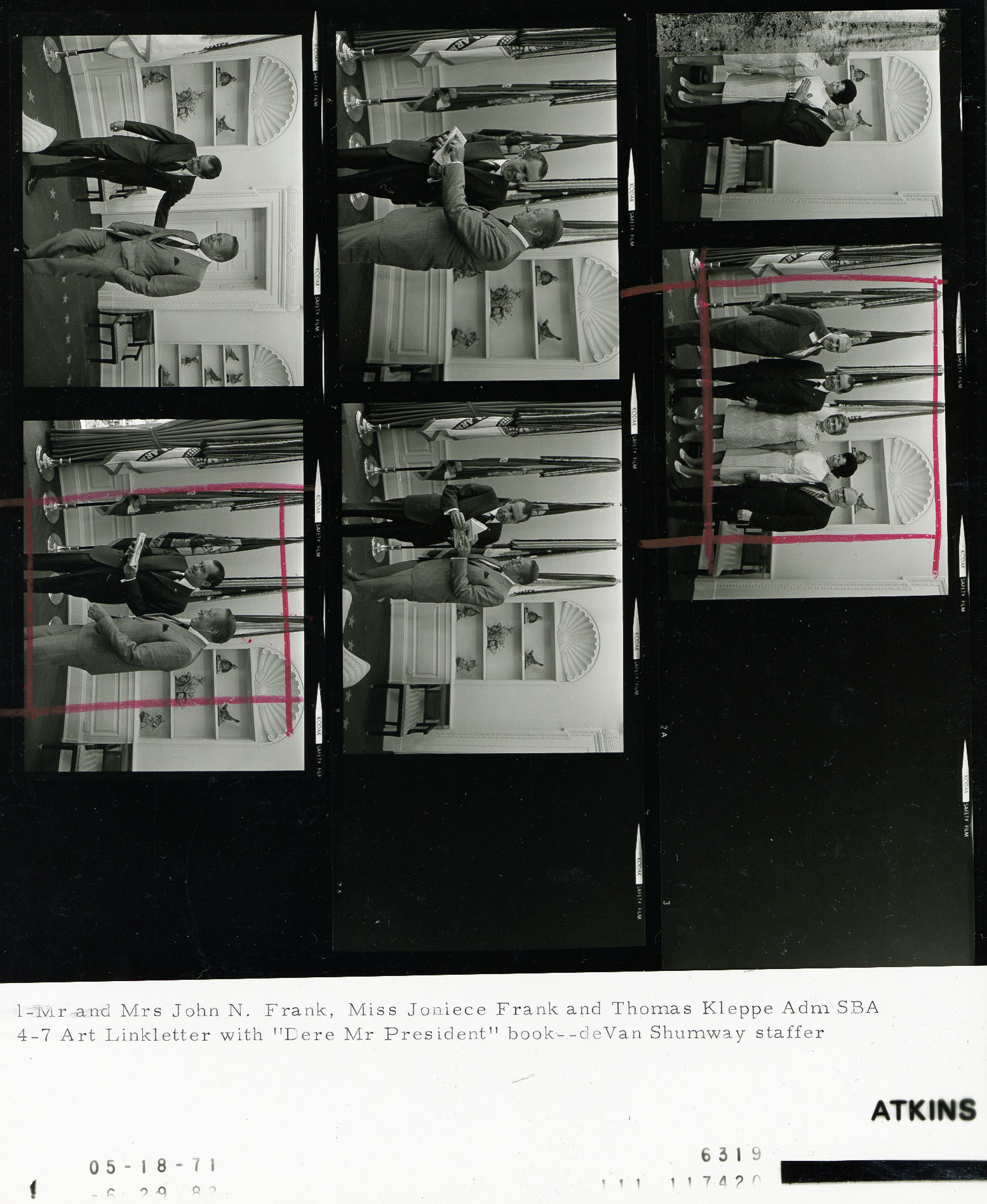
- Frame(s): WHPO-6319-01, President Nixon with John Frank, National Small Businessman of the Year, Manager of the Frankoma Pottery, Inc., Mrs. John Frank, Miss Joniece Frank, and Thomas Kleppe, Administrator of the Small Business Administration. 5/18/1971, Washington, D.C. White House, Oval Office. President Nixon, John Frank, Mrs. John Frank, Joniece Frank, Thomas Kleppe.
- Frame(s): WHPO-6319-04-07, President Nixon standing in the Oval Office with televison celebrity host Art Linkletter, who is presenting the President a gift copy of his book, "Dear Mr. President". 5/18/1971, Washington, D.C. White House, Oval Office. President Nixon, Art Linkletter.
- Frame(s): WHPO-6319-05, President Nixon standing in the Oval Office with televison celebrity host Art Linkletter, who is presenting the President a gift copy of his book, "Dear Mr. President". 5/18/1971, Washington, D.C. White House, Oval Office. President Nixon, Art Linkletter.
Roll WHPO-6320 Photographer: Atkins, Oliver | Color or B&W: B&W
- Frame(s): WHPO-6320-02A-04A, President Nixon addressing attendees of the State Legislative Leaders' Briefing. 5/18/1971, Washington, D.C. White House, East Room. President Nixon, state legislative leaders.
Roll WHPO-6321 Photographer: Kightlinger, Jack | Color or B&W: Color
- Frame(s): WHPO-6321-08-33, Pat Nixon being attending a Cabinet and Sub-Cabinet Wives Luncheon in her honor. 5/18/1971, Washington, D.C. State Department, Benjamin Franklin Room. Pat Nixon, administration wives.
Roll WHPO-6322 Photographer: Kightlinger, Jack | Color or B&W: Color
- Frame(s): WHPO-6322-03-11, Pat Nixon being attending a Cabinet and Sub-Cabinet Wives Luncheon in her honor. 5/18/1971, Washington, D.C. unknown. Pat Nixon, administration wives.
- Frame(s): WHPO-6322-12, Pat Nixon with an unidentified serviceman. 5/18/1971, Washington, D.C. unknown. Pat Nixon, serviceman.
Roll WHPO-6323 Photographer: Atkins, Oliver | Color or B&W: Color
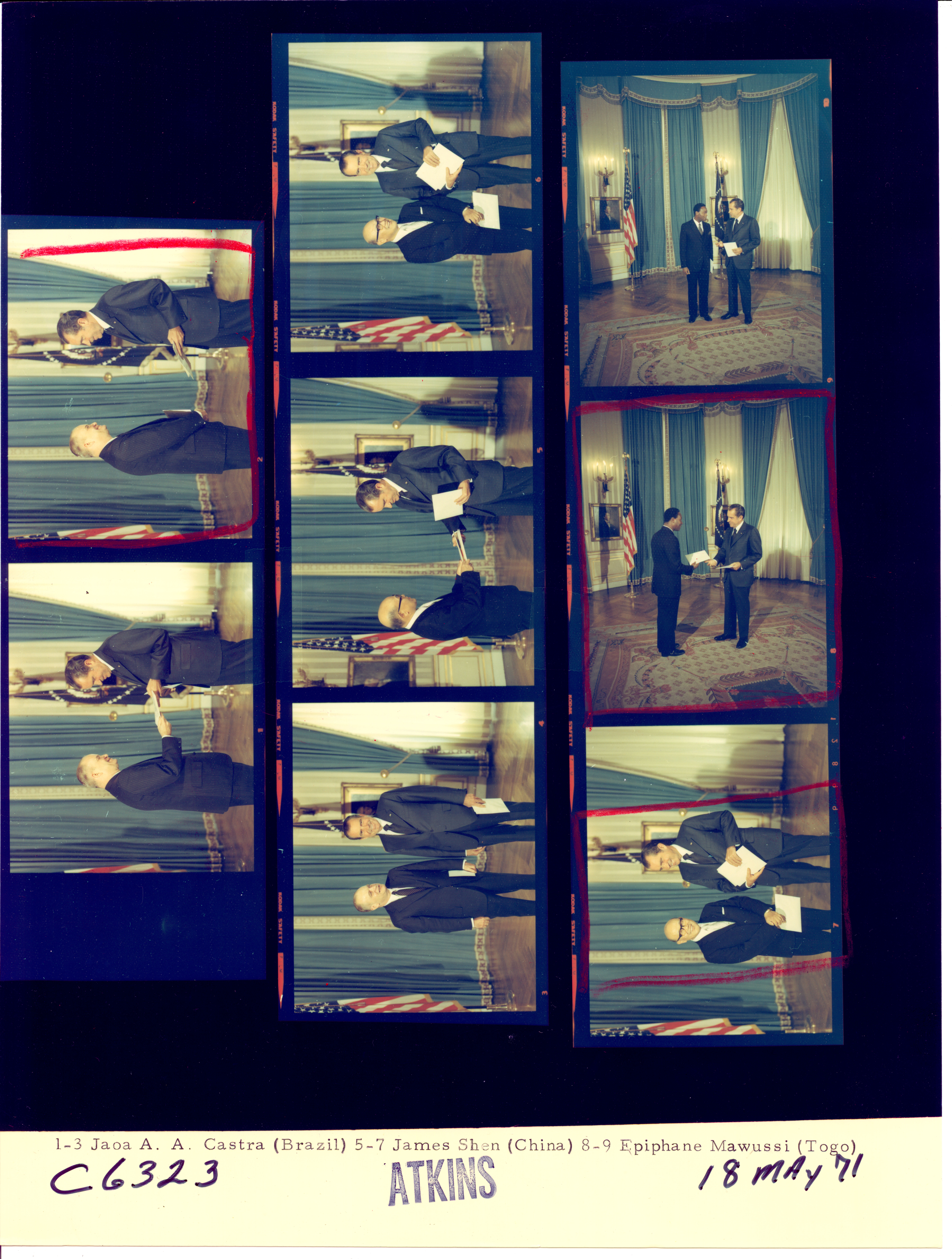
- Frame(s): WHPO-6323-01-03, President Nixon accepting diplomatic credentials from Joao Augusto de Araujo Castro, Ambassador from Brazil to the U.S. 5/18/1971, Washington, D.C. White House, Blue Room. President Nixon, Joao Augusto de Araujo Castro.
- Frame(s): WHPO-6323-05-07, President Nixon accepting diplomatic credentials from James C.H. Shen, Ambassador from the Republic of China to the U.S. 5/18/1971, Washington, D.C. White House, Blue Room. President Nixon, James C.H. Shen.
- Frame(s): WHPO-6323-08-09, President Nixon accepting diplomatic credentials from Epiphane Ayi Mawussi, Ambassador from the Republic of Togo to the U.S. 5/18/1971, Washington, D.C. White House, Blue Room. President Nixon, Epiphane Ayi Mawussi.
Roll WHPO-6324 Photographer: Kightlinger, Jack | Color or B&W: Color
- Frame(s): WHPO-6324-02A-17A, Pat Nixon with Military Wife of the Year finalists and their husbands. 5/18/1971, Washington, D.C. White House, Library. Pat Nixon, Billie Reeves Willett, Mrs. Billie Reeves Willett, James W. Squires, Mrs James W. Squires, Carl W. Selin, Mrs. Carl W. Selin, Thomas L. Sullivan, Mrs. Thomas L. Sullivan, Nephi Berkenpas, Mrs. Nephi Berkenpas.
- Frame(s): WHPO-6324-18A-19A, Pat Nixon with Military Wife of the Year finalists, their husbands, and television celebrity Art Linkletter. 5/18/1971, Washington, D.C. White House, Map Room. Pat Nixon, Billie Reeves Willett, Mrs. Billie Reeves Willett, James W. Squires, Mrs James W. Squires, Carl W. Selin, Mrs. Carl W. Selin, Thomas L. Sullivan, Mrs. Thomas L. Sullivan, Nephi Berkenpas, Mrs. Nephi Berkenpas, Art Linkletter.
Roll WHPO-6325 Photographer: Atkins, Oliver | Color or B&W: B&W
- Frame(s): WHPO-6325-01A-12A, President Nixon shaking hands with attendees of the Business Magazine Editors' meeting. 5/18/1971, Washington, D.C. White House, Oval Office. President Nixon, business magazine editors.
Roll WHPO-6328 Photographer: Schumacher, Karl | Color or B&W: B&W
- Frame(s): WHPO-6328-02-14, Vice President Agnew attending fundraisers in New York City. 5/18/1971, New York, New York unknown. Spiro Agnew, unidentified persons.
- Frame(s): WHPO-6328-17-36, Vice President Agnew attending fundraisers in Jackson, Mississippi. 5/18/1971, Jackson, Mississippi unknown. Spiro Agnew, unidentified persons.
Roll WHPO-6339 Photographer: Schumacher, Karl | Color or B&W: B&W
- Frame(s): WHPO-6339-03A-07, Vice President Agnew leaving a fundraiser event, and on a plane. 5/18/1971, Jackson, Mississippi, air unidentified building, airplane. Spiro Agnew, unidentified persons, aides.
The White House Communications Agency Videotape Collection contains “off-the-air” recordings of televised programs produced between 1968 and 1974. Visit the finding aid to learn more.
- WHCA-4373
"Justice In America: 'Justice Delayed, Justice Denied' ".
Undetermined
Runtime: 00:57:30 - WHCA-4374
"Thirty Minutes".
WTOP
Runtime: 00:29:46 - WHCA-4379
Weekly News Summary, Tape I.
ALL NETWORKS
Runtime: 1:30
33. Reasoner: NATO report from Belgium and troop strength Europe. Time Code Start: 72:00. Keywords: N.A.T.O., North Atlantic Treaty Organization, Europe, international, world, military, war, defence, defense, organizations. Network: ABC.
34. Smith/Sherwood/Watson: Drug committee on Marijuana with President Nixon on film. Time Code Start: 76:10. Keywords: Presidents, advisors, drugs, drug abuse, cannabis, marijuana, pot smoking, addicts, addiction, prevention programs. Network: ABC.
35. Reasoner/Donaldson: Indochina report. Time Code Start: 80:30. Keywords: Laos, Cambodia, Vietnam War. Network: ABC.
36. Reasoner: Commentary on taxpayers. Time Code Start: 82:50. Keywords: taxes, taxation, revenue. Network: ABC.
37. Chancellor: Emission standards for automobiles by the Environmental Protection Agency (EPA). Time Code Start: 84:44. Keywords: laws, rulings, automobiles, cars, trucks, vehicles, emissions, pollutants, air pollution, smog, smoke, Environmental Protection Agency, EPA. Network: NBC.
38. Brinkley: President Nixon's program for cancer research. Time Code Start: 86:30. Keywords: Presidents, programs, health, cancers, diseases, medical research, investigations. Network: NBC.
39. Chancellor/Hager: Voting in Senate for Supersonic Transport (SST) and Senator Mansfield's proposal for withdrawal of 1/2 of U.S. NATO forces. Time Code Start: 90:13. Keywords: Supersonic Transport, SST, aircraft, speed of sound, subsonic airliners, voting. Network: NBC.
40. End of Tape 1. Time Code Start: 93:10. Keywords: program finishing time reminder. Network: NBC. - WHCA-4380
Weekly News Summary, Tape II.
ALL NETWORKS
Runtime: 1:00
1. Cronkite/Plante: Effect of railroad strike on the economy with Secretary of Transportation Volpe. Time Code Start: 00:00. Keywords: railroads, trains, railroad industry, rail cars, mass transit, transportation, strikes, economy, recession, inflation, money, wages, costs, unemployment. Network: CBS.
2. Cronkite: Upcoming Senate votes on Mansfield Amendment and Supersonic Transport (SST). Time Code Start: 01:48. Keywords: Supersonic Transport, SST, aircraft, speed of sound, subsonic airliners, Vietnam War, troops, withdrawals, amendments, voting, losses. Network: CBS.
3. Cronkite/Sevareid: Commentary on stolen FBI files. Time Code Start: 04:14. Keywords: Federal Bureau of Investigations, espionage, spying, investigations, crime, records, theft. Network: CBS.
Context (External Sources)
The Vanderbilt Television News Archive is the world's most extensive and complete archive of television news. They have been recording, preserving and providing access to television news broadcasts of the national networks since August 5, 1968.
Wikipedia is a free encyclopedia that anyone can edit.