
Introduction
This almanac page for Wednesday, July 14, 1971, pulls together various records created by the federal government and links to additional resources which can provide context about the events of the day.
Previous Date: Tuesday, July 13, 1971
Next Date: Thursday, July 15, 1971
Schedule and Public Documents
The Daily Diary files represent a consolidated record of the President's activities. Visit the finding aid to learn more.
The President's day began at San Clemente, California
The Weekly Compilation of Presidential Documents made available transcripts of the President's news conferences; messages to Congress; public speeches, remarks, and statements; and other Presidential materials released by the White House.
Digitized versions can be found at HathiTrust.
The Federal Register is the official daily publication for rules, proposed rules, and notices of federal agencies and organizations, as well as executive orders and other Presidential documents.
The Congressional Record is the official daily record of the debates and proceedings of the U.S. Congress.
Archival Holdings
Any selection of archival documents will necessarily be partial. You should use the documents and folders identified below as a starting place, but consult the linked collection finding aids and folder title lists and the collections themselves for context. Many documents to be found this way do not lend themselves to association with specific dates, but are essential to a complete understanding of the material.
Selective document listing
President's Office Files
The President's Office Files consists of materials drawn together by the Special Files Unit from several administrative subdivisions within the White House Office. It is the handwriting and sensitive papers sent to the Staff Secretary that now comprise much of the President's Office Files. Visit the finding aid to learn more.
- Annotated News Summaries, Box 30, News Summaries - July 1971 [1 of 2]
- Annotated News Summaries, Box 30, News Summaries - July 1971 [2 of 2] [During this period, the Staff Secretary only removed pages from the News Summaries which contained President Nixon's handwriting, often leaving the document with no date. Although there are no specific documents with this date, you should also consult the full folder for the month.]
- President's Daily Schedule, Box 101, [President's Daily Schedule, June-Aug. 1971] [2 of 3]
- The President's Schedule, Wednesday - July 14, 1971
The H. R. Haldeman Diaries consists of seven handwritten diaries, 36 dictated diaries recorded as sound recordings, and two handwritten audio cassette tape subject logs. The diaries and logs reflect H. R. Haldeman’s candid personal record and reflections on events, issues, and people encountered during his service in the Nixon White House. As administrative assistant to the President and Chief of Staff, Haldeman attended and participated in public events and private meetings covering the entire scope of issues in which the Nixon White House engaged in during the years 1969-1973. Visit the finding aid to learn more.
- Transcript of diary entry (PDF)
Wednesday, July 14.
Bob Dole called this morning to say that he was concerned, because at the policy luncheon today, there was a great deal of bitching about the economy game plan amongst the Republican senators. Apparently, Scott is thinking about descending on the President, and Dole urges that we do something before he does, take some kind of initiative. They're all really upset at B, and especially are disturbed with Shultz and McCracken.
President got into few general items this morning on personnel: particularly the question of Flanigan to State, if we can make the right kind of deal; and then finalize Rumsfeld, either at OEP then NATO, or else dump him; and follow up on the question of Stans taking on the finance job; then maybe making Peterson head of OEP, so he could be a spokesman, not just a White House man.
At 9:45, he had Henry in, and we got into a long discussion of the whole international thing: first item being the Bruce problem, because the networks last night all reported that David Bruce was going to be leaving because we were dissatisfied with him, and he with us, which is not the case at all. So, we had Ziegler in to shoot that down, making the point that Bruce has the total confidence of the President and that the only discussion regarding his resignation concerns his personal medical condition, and we expect after the period of recuperation that he'll handle other special missions for the President.
President got to the Taiwan problem a couple of times. He's obviously very concerned about how to handle it and gets to thinking about the question of his being the one to scuttle Taiwan. He also was talking in general about planning for the Peking meeting and made the point that he's got to go into that meeting with complete preparation and no tension; that he's got to handle the things alone, and on a very free kind of basis.
Then we got into quite a discussion of the question of Henry giving a backgrounder on Friday, after the Thursday night announcement. Henry made the point that such a backgrounder is this is not just an accident where Henry happened to jump at the chance at the last minute to zip over to Peking. The press will try to give Kissinger the credit in order to screw the President, and they will try to say that the President had nothing to do with it, and Henry's argument is that he can shoot that down. Second, the text of his backgrounder would be reproduced and distributed to embassies, and so forth, which would provide guidance and a talking paper to them, and we could also send it to Chou En-lai so that he would have a confirmation of how we're handling the thing here. President raised, at this point, the question of an alternative, which would be just a guidance paper that could be issued, but Henry made the point, that made it too formal. Henry's third point is that, at such a backgrounder, they'll certainly ask him about Vietnam and Le Duc Tho, and he can handle that by leaving the impression that something's going on, but not saying anything. He'll go back to what we've always said. He'll give none of the substance, and thus he can build the mystery. President then asked Henry to outline the points that he would make in the backgrounder, and Henry never really got to that. He did say he'd make-- build up the fact that it was carefully planned over a long period of time. On substance, he would build mystery with authority, whereas Ziegler and Scali, and so on, couldn't do it with authority, and he'd give a little of the color of the meeting. President ended up in favor of the backgrounder, making the point that after that, Henry should set an absolute wall and see no one else, except a group of our friendly columnists, and we'll set up a dinner for them hosted by Scali on Monday night in Washington, as an off-the- record social event. President made the point that he must not see, on any basis, The New York Times, Post, CBS, except maybe NBC, except for maybe Chancellor. He is to draw a complete curtain there.
Then we got into the question of Rogers' speech in London, and in the middle of our discussion, Rogers called to say he was going to cancel his speech and instead have a press conference next week in Washington; so that worked out really much better. We agreed, however, that I should call him and get him to hold his press conference off until later in the week, not do it on Tuesday as he had planned. The-- I did this later today, and Rogers bought it completely.
Getting back to the backgrounder, they-- the President made the point that Henry could bring up the Kansas City speech anecdote: that is that Chou En-lai was fully familiar with the content of it while Henry hadn't even received it since he had been on the road, and Chou En-lai loaned him his annotated copy. Then the point of this being the result of the President starting a long time ago, and he could cite the Foreign Affairs article, etc. He can make the point that on four different occasions the President and Kissinger worked on this in the Lincoln sitting room, emphasizing the long preparations that have gone into it, making the point that only the Secretary of State knew about this, plus Kissinger and the President. President specifically said we shouldn't even say that Haldeman knew about it, with which I fully concurred.
The President comes down in favor of the backgrounder, on the basis that we have to establish a framework in which to operate; otherwise, people are going to be running off in all different directions. And it's pretty hard to argue with that. We then got into some notification plans, question of when to tell Ziegler, and the President felt that we should not tell him, so that he can honestly say that he didn’t know, and that after the broadcast he should say only that he will brief at 9:00 in the morning and that he'll have nothing to say until then. We're going to set up a plan to notify all the Washington staff that there's no comment in any way on this, the same with the Cabinet, etcetera. We'll make no calls, however, until after 8:00 tomorrow night. That is, 8:00 Washington time. The President still was worried about Henry's backgrounder as far as Rogers is concerned and ended up deciding not to tell Rogers, but that for me to call him on Friday morning and say Kissinger is going into Ron's briefing to give them some of the information on the thing––the purpose being to take the play away from himself just as he did on the SALT business. Then President decided that he'd like to go on out to dinner after the telecast tomorrow night; so he's going to have Ziegler, Ehrlichman, Kissinger, and me join him, and we'll go to Perino's.
End of July 14. - Original audio recording (MP3)
The National Archives Catalog is the online portal to the records held at the National Archives, and information about those records. It is the main way of describing our holdings and also provides access to electronic records and digitized versions of our holdings.
The Catalog searches across multiple National Archives resources at once, including archival descriptions, digitized and electronic records, authority records, and web pages from Archives.gov and the Presidential Libraries. The Catalog also allows users to contribute to digitized historical records through tagging and transcription.
Nixon Library Holdings
All National Archives Units
National Security Documents
The President's Daily Brief is the primary vehicle for summarizing the day-to-day sensitive intelligence and analysis, as well as late-breaking reports, for the White House on current and future national security issues. Read "The President's Daily Brief: Delivering Intelligence to Nixon and Ford" to learn more.
The Foreign Relations of the United States series presents the official documentary historical record of major U.S. foreign policy decisions and significant diplomatic activity. Visit the State Department website for more information.
Vol. VII, Vietnam, July 1970-January 1972
The Consequences of Operation Lan Som 719 and the Search for a Settlement, April 8-October 6, 1971
233. Memorandum From the President’s Assistant for National Security Affairs (Kissinger) to President Nixon, Washington, July 14, 1971
Source: National Archives, Nixon Presidential Materials, NSC Files, Box 853, For the President’s Files—Lord, Vietnam Negotiations, Sensitive, Camp David, Vol. IX. Top Secret; Sensitive; Exclusively Eyes Only. A stamped notation on the memorandum reads, “The President has seen.”
234. Memorandum From the President’s Assistant for National Security Affairs (Kissinger) to President Nixon, Washington, July 14, 1971
Source: National Archives, Nixon Presidential Materials, NSC Files, Box 1032, Files for the President, China Materials, Polo I, Record. Top Secret; Sensitive; Exclusively Eyes Only. Printed from an unsigned copy. Other portions of the memorandum are printed in Foreign Relations, 1969–1976, volume XVII, China, 1969–1972, Document 144. Kissinger met with Chou En-lai on July 9 and 10. The memoranda of conversation of these meetings are printed in full ibid., Documents 139–141 and 143.
Vol. XVII, China, 1969-1972
China,January-September 1971
144. Memorandum From the President’s Assistant for National Security Affairs (Kissinger) to President Nixon, San Clemente, California, July 14, 1971
Source: National Archives, Nixon Presidential Materials, NSC Files, Box 1032, Files for the President—China Material, Polo I, Record, July 1971 HAK trip to PRC. Top Secret; Sensitive; Exclusively Eyes Only. Printed from an unsigned copy, which is 27 pages long. Nixon and Haig were in San Clemente, California, from July 6 through July 18. A 21-page version of this memorandum, July 17, contains less information on commitments made by the Kissinger or Chou on behalf of their respective nations, for example, information on U.S. officers to inform the PRC leaders of any agreements reached with the Soviet Union is absent from the shorter version. (Ibid., RG 59, Office Files of William P. Rogers, Entry 5439, China) See Foreign Relations, 1969–1976, vol. E–13, Document 9.
Vol. XXIV, Middle East Region and Arabian Peninsula, 1969-1972; Jordan, September 1970
Persian Gulf States
102. Memorandum From the President’s Deputy Assistant for National Security Affairs (Haig) to President Nixon, Washington, July 14, 1971
Source: National Archives, Nixon Presidential Materials, NSC Files, Box 632, Country Files, Middle East, Trucial States. Confidential. Sent for action. A notation on the memorandum indicates that the President saw it.
Vol. XL, Germany and Berlin, 1969-1972
Germany and Berlin, 1969-1972
267. Message From the Ambassador to Germany (Rush) to the President’s Assistant for National Security Affairs (Kissinger), Bonn, July 14, 1971
Source: National Archives, Nixon Presidential Materials, NSC Files, Kissinger Office Files, Box 59, Country Files, Europe, Ambassador Rush, Berlin, Vol. 2. Top Secret; Sensitive; Exclusively Eyes Only. The message was sent through the special Navy channel in Frankfurt. No time of transmission is on the message; a handwritten note indicates that it was received in Washington on July 15 at 0020Z.
Vol. E-2, Documents on Arms Control and Nonproliferation, 1969-1972
Conferences on Nuclear and World Disarmament and Soviet UN Initiative on Non-Use of Force
328. Memorandum From the President’s Assistant for National Security Affairs (Kissinger) to President Nixon, Washington, July 14, 1971
Kissinger briefed the President on his discussion with Chou En-Lai regarding the Soviet proposal for a five-power nuclear disarmament conference.
Source: National Archives, Nixon Presidential Materials, NSC Files, Box 1032, Files for the President, China Materials, Polo I Record, HAK Visit to PRC. Top Secret; Sensitive; Exclusively Eyes Only.
Vol. E-5, Part 1, Documents on Sub-Saharan Africa, 1969-1972
The Horn
319. Telegram 1407 From the Embassy in Somalia to the Department of State, Mogadiscio, July 14, 1971, 1650Z
Ambassador Hadsel reported that during his farewell call he had been assured by President Siad that the vessels would be released very soon, perhaps that weekend, despite the deep feeling of resentment on the part of Somalis over U.S. ships violating Somali laws. The ambassador considered this to be a definitive assurance of action.
Source: National Archives, RG 59, Central Files 1970–73, POL 33–4 Somali-US. Confidential; Priority. Repeated to Addis Ababa, Jidda, Bonn, London, Nairobi, Panama, Paris, Rome, USUN, CINCSTRIKE, and COMIDEASTFOR320. Telegram 127073 From the Department of State to the Embassy in Somalia, Washington, July 14, 1971, 2224Z
While the assurances given were encouraging, the Department wanted Ambassador Hadsel to remain at his post until the amount of the fine was known and all problems had been resolved.
Source: National Archives, RG 59, Central Files 1970–73, POL 33–4 Somali-US. Confidential; Limdis. Drafted by W.B. Coote (AF/E) and approved by Newsom.
Vol. E-10, Documents on American Republics, 1969-1972
Argentina
69. Memorandum From the President’s Deputy Assistant for National Security Affairs (Haig) to President Nixon, Washington, July 14, 1971., Washington, July 14, 1971
President’s Deputy Assistant for National Security Affairs Haig recommended that President Nixon go along with Secretary of State Rogers’ idea that the U.S. Government could not meet his request. However, the U.S. Government would be willing to work with Argentine President Alejandro Lanusse and international agencies to come up with a sound economic program for the South American nation.
Source: National Archives, Nixon Presidential Materials, NSC Files, Box 768, Country Files, Latin America, Argentina 1969–71. Secret; Sensitive. Sent for action. A stamped notation on the memorandum indicates that the President saw it. Nixon approved the recommendation. Attached but not published at Tab A is a July 3 memorandum from Rogers to Nixon. Tab B, a June 30 cable from Lodge to Meyer is printed as Document 67. Attached but not published at Tab C is a June 29 memorandum from Kissinger to Nixon, with a June 24 attachment from Lanusse to Nixon.
Guyana
377. Telegram 996 From the Embassy in Guyana to the Department of State, July 14, 1971, 1458Z., July 14, 1971, 1458Z
Ambassador King credited former Chief Justice Arthur Goldberg’s visit to Guyana as instrumental in the hammering out of an agreement between Burnham and ALCAN.
Source: National Archives, Nixon Presidential Materials, NSC Files, Box 785, Country Files, Latin America, Guyana, Vol. 1. Secret; Exdis. A stamped notation on the telegram indicates that it was received at the White House Situation Room at 4:39 p.m. on July 14.
Vol. E-13, Documents on China, 1969-1972
9. Memorandum From the President’s Assistant for National Security Affairs (Kissinger) to President Nixon, Washington, July 14, 1971, Washington, July 14, 1971
Kissinger summarized his 2-day talks with Chinese Premier Chou En-lai.
Source: National Archives, Nixon Presidential Materials, NSC Files, Box 1032, Files for the President-China Material, Polo I Record, July 1971 HAK Visit to PRC. Top Secret; Sensitive; Exclusively Eyes Only. Tabs A and B were attached but not published.
The Kissinger telephone conversation transcripts consist of approximately 20,000 pages of transcripts of Kissinger’s telephone conversations during his tenure as Assistant to the President for National Security Affairs (1969-1974) and Secretary of State (1973-1974) during the administration of President Richard Nixon. Visit the finding aid for more information.
Digitized versions can be found in the National Archives Catalog.
Audiovisual Holdings
The White House Photo Office collection consists of photographic coverage of President Richard Nixon meeting with prominent social, political, and cultural personalities; speaking engagements and news conferences of the President and various high-ranking members of the White House staff and Cabinet; Presidential domestic and foreign travel, including Presidential vacations; social events and entertainment involving the First Family, including entertainers present; official portraits of the President, First Family, and high-ranking members of the Nixon administration; the 1969 and 1973 Inaugurals; the President’s 1972 Presidential election campaign appearances (including speeches) and other official activities of the White House staff and the President’s Cabinet from January 20, 1969 until August 9, 1974 at the White House and the Old Executive Office Building; other locations in Washington, DC, such as The Mall; and the Presidential retreats in Camp David, Maryland, Key Biscayne, Florida, and San Clemente, California. Visit the finding aid to learn more.
Roll WHPO-6794 Photographer: Knudsen, Robert L. | Color or B&W: B&W
- Frame(s): WHPO-6794-03A-37A, Close-up portrait study of unidentified OMB personnel. 7/14/1971, Washington, D.C. unknown. unidentified OMB personnel.
Roll WHPO-6795 Photographer: Knudsen, Robert L. | Color or B&W: B&W
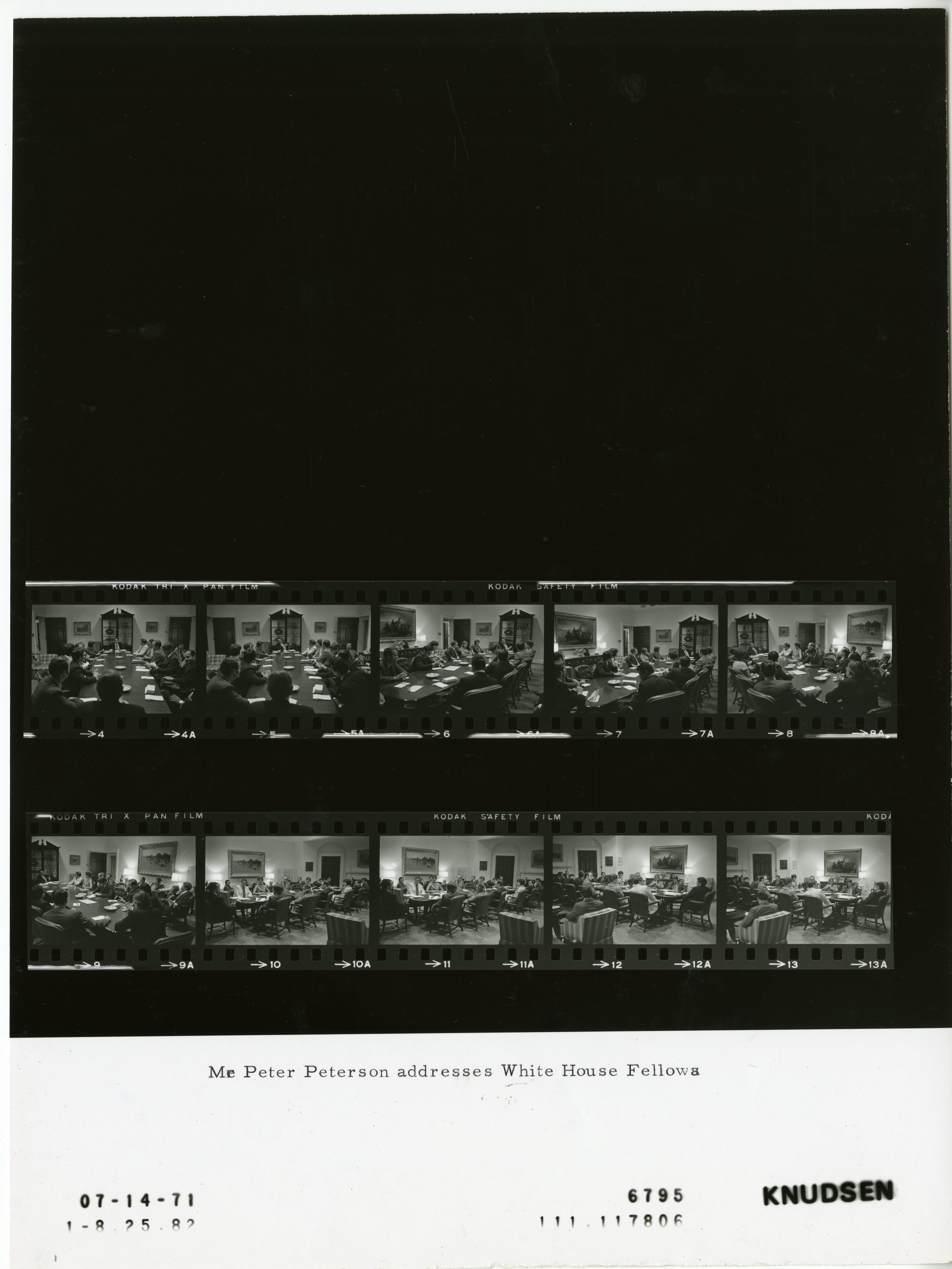
- Frame(s): WHPO-6795-04-13, Peter Peterson addressing White House Fellows around a conference table. 7/14/1971, Washington, D.C. White House, Roosevelt Room. Peter Peterson, unidentified White House Fellows.
Roll WHPO-6796 Photographer: Knudsen, Robert L. | Color or B&W: B&W
- Frame(s): WHPO-6796-01-12, The Washington Monument lit at night, with flags flying. 7/14/1971, Washington, D.C. Washington Monument.
Roll WHPO-6797 Photographer: Knudsen, Robert L. | Color or B&W: B&W
- Frame(s): WHPO-6797-01-12, The Washington Monument lit at night, with flags flying. 7/14/1971, Washington, D.C. Washington Monument.
Roll WHPO-6798 Photographer: Knudsen, Robert L. | Color or B&W: Color
- Frame(s): WHPO-6798-02-12, The Washington Monument lit at night, with flags flying. 7/14/1971, Washington, D.C. Washington Monument.
Roll WHPO-6799 Photographer: Knudsen, Robert L. | Color or B&W: Color
- Frame(s): WHPO-6799-01-11, The Washington Monument lit at night, with flags flying. 7/14/1971, Washington, D.C. Washington Monument.
Roll WHPO-6918 Photographer: Schumacher, Karl | Color or B&W: B&W
- Frame(s): WHPO-6918-06-08, Vice President Agnew greeted by various officials upon arrival in Hawaii. 7/14/1971, Hawaii airport, tarmac. Spiro Agnew, unidentified officials, crowd.
Roll WHPO-6919 Photographer: Schumacher, Karl | Color or B&W: B&W
- Frame(s): WHPO-6919-03-07, Vice President Agnew being greeted upon arrival in Hawaii. 7/14/1971, Hawaii airport, tarmac. Spiro Agnew, unidentified officials, crowd.
Roll WHPO-6920 Photographer: Schumacher, Karl | Color or B&W: B&W
- Frame(s): WHPO-6920-02-19, Vice President Agnew participating in an arrival ceremony in Hawaii, including wearing a lei. 7/14/1971, Hawaii airport. Spiro Agnew, unidentified officials, crowd.
The White House Communications Agency Videotape Collection contains “off-the-air” recordings of televised programs produced between 1968 and 1974. Visit the finding aid to learn more.
- WHCA-4521
"Firing Line".
ALL NETWORKS
Runtime: 01:00:06 - WHCA-4522
"The Dick Cavett Show". U.S. Senator Hugh Scott (R-PA).
CBS, WTOP-TV
Runtime: 01:29:42 - WHCA-4524
Weekly News Summary, Tape I.
ALL NETWORKS
Runtime: 01:30:00
37. Smith/Jarriel: Ambassador Bruce's reasons for retirement. Time Code Start: 79:32. Keywords: cabinet, advisors, travel, trips, Ambassadors, retirement. Network: ABC.
38. Smith/Donaldson: South Vietnamese President Thieu criticized by South Vietnam Vice Preisdent Ky during elections in South Vietnam. Time Code Start: 81:11. Keywords: South Vietnam, Presidential elections, campaigns, campaigning, candidates, speeches. Network: ABC.
39. Smith/Wordham: Western Governors Conference in Wyoming, Governor McCall and Governor Reagan speak on opposing economic views (Governor McCall and Governor Reagan both on film). Time Code Start: 83:45. Keywords: Governors, conferences, meetings, speeches, economy. Network: ABC.
40. Smith/Zimmerman: [Strategic Arms Limitation Talks] SALT, Senator Humphrey speaks on slowing down arms race (Senator Humphrey on film). Time Code Start: 86:03. Keywords: SALT, S.A.L.T., Strategic Arms Limitation Talks, Russia, Soviet Union, USSR, Cold War, détente, summits, meetings. Network: ABC.
41. Smith: Congress votes down CBS citation of contempt, Pentagon Papers and New Haven Black Panthers cases seen as 1st amendment triumphs. Time Code Start: 88:15. Keywords: lawsuits, House of Representatives, hearings, voting, media, radio, television, TV, the press, network broadcasting corporations, Black Panther Party, trials, murder, Alex Rackley, Black Power, African Americans, Revolutionary Socialism. Network: ABC. - WHCA-4525
Weekly News Summary, Tape II.
ALL NETWORKS
Runtime: 1:30
1. Chancellor: American response to Viet Cong and North Vietnamese peace proposal; Draft Extension Bill and Senator Mansfield's End the War Amendment. Time Code Start: 00:00. Keywords: military, conscription, selective service, lottery, laws, Vietnam War, truces, treaties, treaty, draft reform, draft evasion. Network: NBC.
2. Brinkley/Bourgholtzer: Western Governor's Conference in Wyoming, discussion of welfare, support for President Nixon, McCall speaks(Oregon) on Reagan's jeopardizing of President Nixon's political future (McCall and Reagan on film). Time Code Start: 01:01. Keywords: Governors, conferences, meetings. Network: NBC.
3. Kaplow (reporting in San Clemente): President Nixon's welfare differences with Governor Reagan. Time Code Start: 03:59. Keywords: Presidents, Governors, Family Assistance Programs, government aid, financial aid, health and welfare assistance. Network: NBC.
4. Chancellor/Nessen: Senator Ted Kennedy attacks American Medical Association on Healthcare reform. Time Code Start: 04:56. Keywords: health care, health insurance, Senators, speeches, Family Assistance Programs, government aid, financial aid, health and welfare assistance. Network: NBC.
5. Brinkely: Index of industrial production increases slowly. Time Code Start: 06:51. Keywords: labor, manufacturing, reports, increases. Network: NBC.
6. Cronkite/Threlkeld: Western Governor's Conference in Wyoming, leisure activities of Governors involving old west, Governor McCall questions party unity of Congressmen, Governor Reagan with Richard Nixon, (McCall and Reagan on film). Time Code Start: 07:17. Keywords: Governors, conferences, meetings, speeches. Network: CBS.
7. Cronkite/: President Nixon's veto of 5.6% economic development bill; Nixon's bill to create public service jobs signed; stock exchange trends. Time Code Start: 10:59. Keywords: Presidents, vetoes, bills, laws, economy, economics, budgets, finances, recession, inflation, money, wages, costs, unemployment, prices, stocks, stock markets, investments,. Network: CBS.
Context (External Sources)
The Vanderbilt Television News Archive is the world's most extensive and complete archive of television news. They have been recording, preserving and providing access to television news broadcasts of the national networks since August 5, 1968.
Wikipedia is a free encyclopedia that anyone can edit.