
Introduction
This almanac page for Monday, January 12, 1970, pulls together various records created by the federal government and links to additional resources which can provide context about the events of the day.
Previous Date: Sunday, January 11, 1970
Next Date: Tuesday, January 13, 1970
Schedule and Public Documents
The Daily Diary files represent a consolidated record of the President's activities. Visit the finding aid to learn more.
The President's day began at The White House - Washington, D. C.
The Weekly Compilation of Presidential Documents made available transcripts of the President's news conferences; messages to Congress; public speeches, remarks, and statements; and other Presidential materials released by the White House.
Appointments and Nominations
- Commission on Narcotics Drugs of the U.N. Economic and Social Council (6 Weekly Comp. Pres. Doc. 42, January 12, 1970)
Announcement of Designation of John E. Ingersoll as United States Representative to the Commission. - United States Ambassador to Sweden (6 Weekly Comp. Pres. Doc. 42, January 12, 1970)
Announcement of Intention To Nominate Dr. Jerome H. Holland of Virginia. - United States Attorney for Southern District of New York (6 Weekly Comp. Pres. Doc. 42, January 12, 1970)
Announcement of Recess Appointment of Whitney North Seymour, Jr. - Commission on Civil Rights (6 Weekly Comp. Pres. Doc. 43, January 12, 1970)
Announcement of Recess Appointment of Manuel Ruiz, Jr., to the Commission.
Digest of Other White House Announcements
Following is a listing of items of general interest which were announced in the press but not made public as formal White House press releases during the period covered by this issue. Appointments requiring Senate approval are not included since they appear in the list of nominations submitted to the Senate, below.
- The President today announced his intention to nominate the following: LAURENCE C. BEARD of Muskogee, Okla., to be United States Marshal for the Eastern District of Oklahoma for a term of 4 years. JOHN L. BUCK of Orangeville, Pa., to be United States Marshal for the Middle District of Pennsylvania for a term of 4 years. G. THOMAS EISELE of Little Rock, Ark., to be United States District Judge for the Eastern District of Arkansas.
- Representative George Bush of Texas met with the President to discuss his candidacy for the United States Senate.
The Federal Register is the official daily publication for rules, proposed rules, and notices of federal agencies and organizations, as well as executive orders and other Presidential documents.
No Federal Register published on this date
Archival Holdings
Any selection of archival documents will necessarily be partial. You should use the documents and folders identified below as a starting place, but consult the linked collection finding aids and folder title lists and the collections themselves for context. Many documents to be found this way do not lend themselves to association with specific dates, but are essential to a complete understanding of the material.
Selective document listing
President's Office Files
The President's Office Files consists of materials drawn together by the Special Files Unit from several administrative subdivisions within the White House Office. It is the handwriting and sensitive papers sent to the Staff Secretary that now comprise much of the President's Office Files. Visit the finding aid to learn more.
- Annotated News Summaries, Box 29, News Summaries - January 1970 [1 of 2] [During this period, the Staff Secretary only removed pages from the News Summaries which contained President Nixon's handwriting, often leaving the document with no date. In addition to the individual document(s) listed below, you should also consult the full folder for the month.]
- Wall Street Journal, "Assaulting the Aristocracy," 1/12/70
- San Francisco Chronicle, cartoon, "Nonsense, gentlemen, the party is over when I say so!", 1/12/70
- Annotated News Summaries, Box 29, News Summaries - January 1970 [2 of 2]
- President's Daily Schedule, Box 99, [President's Daily Schedule, Jan.-Feb. 1970] [1 of 3]
- The President's Schedule, Monday - January 12, 1970
The H. R. Haldeman Diaries consists of seven handwritten diaries, 36 dictated diaries recorded as sound recordings, and two handwritten audio cassette tape subject logs. The diaries and logs reflect H. R. Haldeman’s candid personal record and reflections on events, issues, and people encountered during his service in the Nixon White House. As administrative assistant to the President and Chief of Staff, Haldeman attended and participated in public events and private meetings covering the entire scope of issues in which the Nixon White House engaged in during the years 1969-1973. Visit the finding aid to learn more.
- Transcript of diary entry (PDF)
Monday, January 12.
Limited schedule to provide time for work on State of the Union - but he didn't use any of it for that. Did have several long sessions with me, and with Ehrlichman and me. Kept Kissinger out all day until after 6:00. Finally let him in for an hour's review before he leaves tomorrow to brief LBJ in Texas. Didn't really have anything specific to get into - just used up the time.
Did decide on a rush Cabinet meeting tomorrow in executive session. Arose from Romney's idea that he could cut his budget another 5 percent, and perhaps all the rest would do likewise - so President is going to try it. Kissinger had originally felt he had to have an NSC on ABM, but was talked out of it pretty easily.
President got into quite a review of general approach to his time this year, i.e., wants to cut councils and committees like UAC, CCEP, etc., to one meeting a month, for one hour. Trying to get less time locked into these meetings, which he doesn't like - and he doesn't feel are productive for him, just therapy for the attendees. Also want to cut down on Congressional meetings and social activities - let the church and evenings at White House suffice.
Spent most of the afternoon sessions reviewing and reverting to the new Derge poll. Was fascinated with the findings and had made a lot of notes on analysis. Especially interested in the strength of the Silent Majority, the weakness of the Moratorium, the decline of the Republican Party. I suggested change in Party name as a start on new realignment and President very seriously took me up on it.
All set to bring Chotiner in as inside White House man for political campaigns. Mixed blessing.
Concluded we can't really stop inflation in this year - the only real solution is controls and that is unpalatable, so you just make the best of it. In this case, form is more important than substance.
Long session with Larry and Chapin about possibility of my taking the OEM job - not that it's being considered, but it might be. My feeling is that it is the wrong move, at least now. Would severely limit my freedom, but I have to get my office set up so I have some freedom now. I think President needs one of us as his personal man and I think this is my best role, although OEM offers great opportunity to branch out and really accomplish something. - Handwritten diary entry (JPG)
The National Archives Catalog is the online portal to the records held at the National Archives, and information about those records. It is the main way of describing our holdings and also provides access to electronic records and digitized versions of our holdings.
The Catalog searches across multiple National Archives resources at once, including archival descriptions, digitized and electronic records, authority records, and web pages from Archives.gov and the Presidential Libraries. The Catalog also allows users to contribute to digitized historical records through tagging and transcription.
Nixon Library Holdings
All National Archives Units
National Security Documents
The President's Daily Brief is the primary vehicle for summarizing the day-to-day sensitive intelligence and analysis, as well as late-breaking reports, for the White House on current and future national security issues. Read "The President's Daily Brief: Delivering Intelligence to Nixon and Ford" to learn more.
The Foreign Relations of the United States series presents the official documentary historical record of major U.S. foreign policy decisions and significant diplomatic activity. Visit the State Department website for more information.
Vol. IV, Foreign Assistance, International Development, Trade Policies, 1969-1972
Foreign Assistance Policy, 1969-1972
21. Memorandum From Secretary of Defense Laird to President Nixon, Washington, January 12, 1970
Source: National Archives, Nixon Presidential Materials, NSC Files, Agency Files, Box 223, Department of Defense, Volume V 12/1/69-1/31/70. Secret.
Vol. XVII, China, 1969-1972
China, 1970
59. Memorandum From the President’s Assistant for National Security Affairs (Kissinger) to President Nixon, Washington, January 12, 1970
Source: National Archives, Nixon Presidential Materials, NSC Files, Box 700, Country Files, Europe, Poland Vol. I Warsaw Talks up to 1/31/70. Secret. Sent for information. Kissinger initialed the memorandum. According to a handwritten notation, it was returned from the President on January 14. An attached covering memorandum indicates that Holdridge forwarded it to Kissinger at the latter’s request on January 9.
Vol. XX, Southeast Asia, 1969-1972
Thailand
44. Telegram From the Vice President’s Party to the Department of State, Bali, January 12, 1970, 0330Z
Source: National Archives, RG 59, Central Files 1970–73, POL 7 US/AGNEW. Secret; Immediate.
Vol. XXIX, Eastern Europe, 1969-1972
General Policy
6. Memorandum From the Presidentʼs Assistant for National Security Affairs (Kissinger) to President Nixon, Washington, January 12, 1970
Source: National Archives, Nixon Presidential Materials, NSC Files, Box 667, Country Files—Europe, General through May 1970. Limited Official Use. A handwritten note from the President reads: “K. I generally support this initiative—(on a practical trade-off basis).” A stamped notation reads: “Jan 16 1970.”
Vol. XXIX, Eastern Mediterranean, 1969-1972
Greece
266. Letter From the Assistant Secretary of Defense for International Security Affairs (Nutter) to the Assistant Secretary of State for Near Eastern and South Asian Affairs (Sisco) , Washington, January 12, 1970
Source: Washington National Records Center, RG 330, OASD/ISA Subject Files: FRC 330 73 A 1971, Greece 000.1, 1970. Secret; Eyes Only.
Vol. XXXIV, National Security Policy, 1969-1972
Chemical and Biological Warfare, Safeguard Phase II, the Draft
117. Memorandum Prepared in the Department of Defense , Washington, January 12, 1970
Source: Ford Library, Laird Papers, Box 27, Safeguard. Top Secret. No drafting information appears on the memorandum. On January 13, Packard sent the memorandum to Kissinger, Richardson, Helms, Wheeler, McCracken, and Mayo under a covering memorandum that reads: “The threat described in this paper represents the combined judgment of the Department of Defense and the Central Intelligence Agency. The document will be the basis of our discussion of Safeguard” at the DPRC meeting to be held two days later. (Ibid.) Kissinger also included the memorandum in President Nixon’s preparatory materials for the January 23 NSC meeting. (National Archives, Nixon Presidential Materials, NSC Files, NSC Institutional Files (H-Files), Box H–26, NSC Meeting, January 23, 1970)
Vol. E-5, Part 1, Documents on Sub-Saharan Africa, 1969-1972
Nigerian Civil War
157. Memorandum From Secretary of State Rogers to President Nixon, Washington, January 12, 1970
Rogers provided an updated status report from the Departmentʼs viewpoint. An early Biafran capitulation or disintegration was likely, presenting problems of relief and security. Rogers noted the Federal Military Governmentʼs (FMG) sensitivity to external meddling and the need for a low-key approach. It was also important for the United States to have a clear record demonstrating its support of an expanded relief effort.
Source: National Archives, Nixon Presidential Materials, NSC Files, Box 281, Agency Files, Department of State, 12/01/69–02/21/70, Vol. V. Confidential.158. Memorandum From the Presidentʼs Assistant for National Security Affairs (Kissinger) to President Nixon, Washington, January 12, 1970
Kissinger recommended announcement of a $10 million emergency donation to Biafra relief and approval of a message to Major General Gowon, Chairman of the Supreme Military Council of Nigeria, offering assistance and recognizing his conciliatory policy.
Source: National Archives, Nixon Presidential Materials, NSC Files, Box 742, Country Files, Africa, Nigeria, Vol. I. Secret. Sent for action. A check mark next to “Approve” and an adjacent handwritten note, “per HAK 1/12,” indicate that the President approved Kissingerʼs recommendations. A January 12 memorandum from Eliot to Rogers indicates that Rogers approved a telegram containing the letter to Gowon as revised by the White House. Eliot noted that the wording of the proposed letter, as drafted by State, had been changed considerably by the White House but there were few substantive changes. (Ibid., RG 59, Central Files 1970–73, POL 27 Biafra-Nigeria)
The Kissinger telephone conversation transcripts consist of approximately 20,000 pages of transcripts of Kissinger’s telephone conversations during his tenure as Assistant to the President for National Security Affairs (1969-1974) and Secretary of State (1973-1974) during the administration of President Richard Nixon. Visit the finding aid for more information.
Chronological File, Box 3, Folder January 3-14, 1970 [1 of 2]
- 9:55 AM, Ambassador Lodge
- 10:20 AM, Marshall Green
- 10:27 AM, Governor Dewey
- 11:20 AM, Secretary Laird
- 11:30 AM, Sonnenfeldt
- 11:50 AM, Katherine Graham
- 4:00 PM, David Rockefeller
- 5:00 PM, Maxinne Cheshire
- PM, Gerard Smith
- 8:45 PM, Rowland Evans
- PM, Ehrlichman
Audiovisual Holdings
The White House Photo Office collection consists of photographic coverage of President Richard Nixon meeting with prominent social, political, and cultural personalities; speaking engagements and news conferences of the President and various high-ranking members of the White House staff and Cabinet; Presidential domestic and foreign travel, including Presidential vacations; social events and entertainment involving the First Family, including entertainers present; official portraits of the President, First Family, and high-ranking members of the Nixon administration; the 1969 and 1973 Inaugurals; the President’s 1972 Presidential election campaign appearances (including speeches) and other official activities of the White House staff and the President’s Cabinet from January 20, 1969 until August 9, 1974 at the White House and the Old Executive Office Building; other locations in Washington, DC, such as The Mall; and the Presidential retreats in Camp David, Maryland, Key Biscayne, Florida, and San Clemente, California. Visit the finding aid to learn more.
Roll WHPO-2734 Photographer: Atkins, Oliver | Color or B&W: B&W
- Frame(s): WHPO-2734-01A-04A, President Nixon sitting informally in the Oval office during a meeting with Ambassador-designate to Sweden Dr. Jerome Holland and Henry Kissinger. 1/12/1970, Washington, D.C. White House. President Nixon, Dr. Jerome Holland, Henry Kissinger.
- Frame(s): WHPO-2734-03, President Nixon sitting informally in the Oval office during a meeting with Ambassador-designate to Sweden Dr. Jerome Holland and Henry Kissinger. 1/12/1970, Washington, D.C. White House. President Nixon, Dr. Jerome Holland, Henry Kissinger.
- Frame(s): WHPO-2734-06A-10A, Congressman George H. W. Bush and Harry Dent. 1/12/1970, Washington, D.C. White House. George Bush, Harry Dent.
- Frame(s): WHPO-2734-11A-17A, President Nixon meeting with Harry Dent and Congressman George H. W. Bush. 1/12/1970, Washington, D.C. White House. President Nixon, Harry Dent, George Bush.
Roll WHPO-2736 Photographer: Kightlinger, Jack | Color or B&W: B&W
- Frame(s): WHPO-2736-, President Nixon in the Oval office during a meeting with Congressman George H. W. Bush. 1/12/1970, Washington, D.C. White House, Oval Office. President Nixon, Congressman George Bush.
- Frame(s): WHPO-2736-10, President Nixon in the Oval office during a meeting with Congressman George H. W. Bush. 1/12/1970, Washington, D.C. White House, Oval Office. President Nixon, Congressman George Bush.
Roll WHPO-2737 Photographer: Kightlinger, Jack | Color or B&W: B&W
- Frame(s): WHPO-2737-, Harry Dent meets with Laotian group. 1/12/1970, Washington, D.C. White House. Harry Dent, unidentified others.
Roll WHPO-2738 Photographer: Kightlinger, Jack | Color or B&W: Color
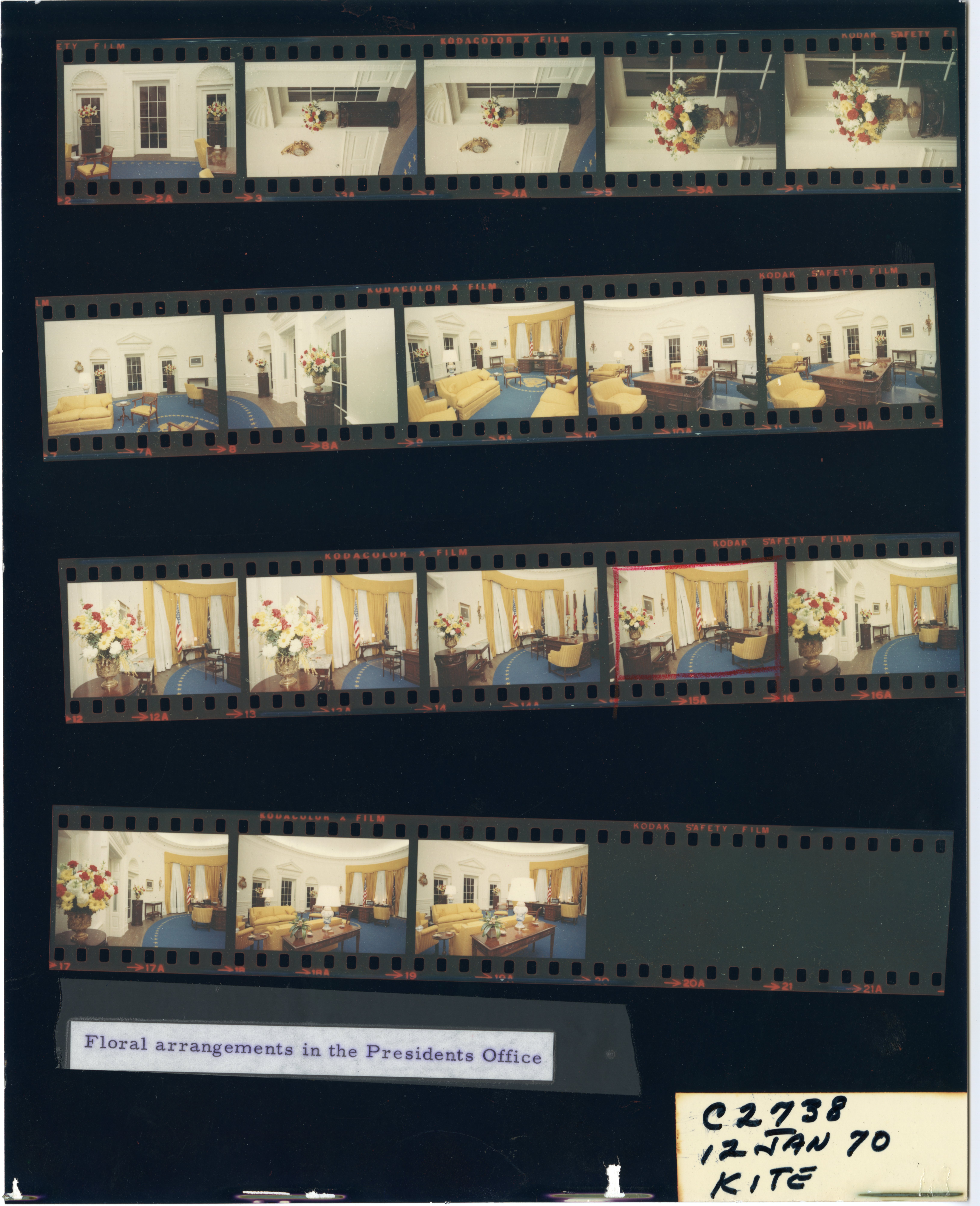
- Frame(s): WHPO-2738-, The Oval Office, and various floral arrangements on walls, or on furniture in it. 1/12/1970, Washington, D.C. White House, oval office. none.
The White House Communications Agency Videotape Collection contains “off-the-air” recordings of televised programs produced between 1968 and 1974. Visit the finding aid to learn more.
- WHCA-3595
"Report From Saigon" with Robert Kaiser and Peter Arnett.
Runtime: 00:59:49 - WHCA-3598
Weekly News Summary - Excerpts. 1/12/1970 to 1/16/1970.
All networks
Runtime: 00:16:37
1. Huntley/Brinkley/Kaplow: Report on Biafra (Nigeria) (Varying net audio); war ends, concern is prevention of a slaughter of Biafrans by advancing Nigerian troops, President Nixon orders $10 million worth of food sent. Time Code Start: 00:08. Keywords: Africa, Nigerian-Biafran War, Nigeria reintegration, famine. Network: NBC.
2. Smith/Jarriel: Report on Biafra (Nigeria); Africa's worst war, between Nigeria and Biafra ends, Major General Philip Effiong left in charge of Biafra when Gen. Odumegwu Ojukwu fled Sunday. Time Code Start: 02:04. Keywords: Africa, Nigerian-Biafran War, Nigeria reintegration, famine. Network: ABC.
3. Interview with White House Director of Communications Herb Klein. Time Code Start: 04:15. Keywords: cabinet, advisors, media, press conferences, news conferences, interviews, newspapers, magazines, publications, radio, television, TV, the press. Network: ABC.
Context (External Sources)
The Vanderbilt Television News Archive is the world's most extensive and complete archive of television news. They have been recording, preserving and providing access to television news broadcasts of the national networks since August 5, 1968.
Wikipedia is a free encyclopedia that anyone can edit.