

Introduction
This almanac page for Wednesday, December 27, 1972, pulls together various records created by the federal government and links to additional resources which can provide context about the events of the day.
Previous Date: Tuesday, December 26, 1972
Next Date: Thursday, December 28, 1972
Schedule and Public Documents
The Daily Diary files represent a consolidated record of the President's activities. Visit the finding aid to learn more.
The President's day began at The White House - Washington, D. C.
The Weekly Compilation of Presidential Documents made available transcripts of the President's news conferences; messages to Congress; public speeches, remarks, and statements; and other Presidential materials released by the White House.
Digitized versions can be found at HathiTrust.
The Federal Register is the official daily publication for rules, proposed rules, and notices of federal agencies and organizations, as well as executive orders and other Presidential documents.
Archival Holdings
Any selection of archival documents will necessarily be partial. You should use the documents and folders identified below as a starting place, but consult the linked collection finding aids and folder title lists and the collections themselves for context. Many documents to be found this way do not lend themselves to association with specific dates, but are essential to a complete understanding of the material.
Selective document listing
President's Office Files
The President's Office Files consists of materials drawn together by the Special Files Unit from several administrative subdivisions within the White House Office. It is the handwriting and sensitive papers sent to the Staff Secretary that now comprise much of the President's Office Files. Visit the finding aid to learn more.
- Annotated and Unmarked News Summaries [Note: Although there was no News Summary on this date, due to the way News Summary products were compiled, you should also consult nearby days for potentially relevant materials.]
- President's Daily Schedule, Box 102, [President's Daily Schedule, Oct.-Dec. 1972] [2 of 2]
- The President's Schedule, Wednesday - December 27, 1972
The H. R. Haldeman Diaries consists of seven handwritten diaries, 36 dictated diaries recorded as sound recordings, and two handwritten audio cassette tape subject logs. The diaries and logs reflect H. R. Haldeman’s candid personal record and reflections on events, issues, and people encountered during his service in the Nixon White House. As administrative assistant to the President and Chief of Staff, Haldeman attended and participated in public events and private meetings covering the entire scope of issues in which the Nixon White House engaged in during the years 1969-1973. Visit the finding aid to learn more.
- Transcript of diary entry (PDF)
Wednesday, December 27th through Tuesday, January 2nd. Again, no contact. The President was in Washington, having come back up on the evening of the 26th from Key Biscayne and spending some time in DC and in--, at Camp David. I left for Palm Springs on the 26th and was there through this entire period; had no contact with the President during that entire time. About the only thing that came up that involved me directly was…
-------------------------------------------------------------------------------------------------------------------
DECLASSIFIED - E.O. 13526, Sect. 3.4: by MS, NARA, June 12, 2013
Audio Cassette 29, Side A, Withdrawn Item Number 6
Duration: 25 seconds
….Steve Bull’s concern with the President's decision to zip off to Nicaragua all of a sudden, to visit the refugee centers and so on. We mobilized Kissinger, Haig, etcetera, and talked him out of it.
------------------------------------------------------------------------------------------------------------------
Other than that the period was relatively uneventful. - Original audio recording (MP3)
The National Archives Catalog is the online portal to the records held at the National Archives, and information about those records. It is the main way of describing our holdings and also provides access to electronic records and digitized versions of our holdings.
The Catalog searches across multiple National Archives resources at once, including archival descriptions, digitized and electronic records, authority records, and web pages from Archives.gov and the Presidential Libraries. The Catalog also allows users to contribute to digitized historical records through tagging and transcription.
Nixon Library Holdings
All National Archives Units
National Security Documents
The President's Daily Brief is the primary vehicle for summarizing the day-to-day sensitive intelligence and analysis, as well as late-breaking reports, for the White House on current and future national security issues. Read "The President's Daily Brief: Delivering Intelligence to Nixon and Ford" to learn more.
The Foreign Relations of the United States series presents the official documentary historical record of major U.S. foreign policy decisions and significant diplomatic activity. Visit the State Department website for more information.
Vol. II, Organization and Management of U.S. Foreign Policy, 1969-1972
The Intelligence Community and the White House
289. Memorandum From the Assistant Secretary of Defense for Intelligence (Hall) to Secretary of Defense Laird, Washington, December 27, 1972
Source: Washington National Records Center, RG 330, OSD Files: FRC 330 77 094, 020 NSA 1972. Secret. A notation on the memorandum indicates Laird saw it.
290. Transcript of a Memorandum to the President’s Assistant (Haldeman) Dictated by President Nixon, Washington, December 27, 1972
Source: National Archives, Nixon Presidential Materials, White House Tapes, Oval Office, Conversation No. 828–6. No classification marking. The President dictated the memorandum in the Oval Office sometime between 10:12 and 10:44 a.m. The editors transcribed the portion of Nixon’s remarks printed here specifically for this volume. A copy of the memorandum has not been found. Nixon’s verbal instructions for punctuation and paragraphing have not been transcribed.
Vol. IV, Foreign Assistance, International Development, Trade Policies, 1969-1972
Foreign Assistance Policy, 1969-1972
105. Action Memorandum From the President’s Assistant for National Security Affairs (Kissinger) to President Nixon, Washington, December 27, 1972
Source: National Archives, Nixon Presidential Materials, NSC Files, Subject Files, Box 324, Foreign Aid, Volume II 1972. Confidential. Forwarded to the President under cover of a December 22 memorandum from Kennedy that summarized the issues.
Vol. V, United Nations, 1969-1972
Special Meetings of the Security Council
146. Telegram From the the Mission to the United Nations to the Department of State, New York, December 27, 1972, 2311Z
Source: National Archives, RG 59, Central Files 1970–73, UN 3 SC. Confidential. Repeated to Panama City.
Vol. IX, Vietnam, October 1972-January 1973
The Christmas Bombings, December 14-29, 1972
226. Message From the Air Attaché at the Embassy in France (Guay) to the President’s Deputy Assistant for National Security Affairs (Haig), Paris, December 27, 1972, 1347Z
Source: National Archives, Nixon Presidential Materials, NSC Files, Box 865, For the President’s Files (Winston Lord)—China Trip/Vietnam, Camp David Memcons, December 1972 [1 of 3]. Top Secret; Sensitive; Exclusively Eyes Only.
227. Conversation Between President Nixon and Richard T. Kennedy of the National Security Council Staff, Washington, December 27, 1972
Source: National Archives, Nixon Presidential Materials, White House Tapes, Oval Office, Conversation 828–5. No classification marking. According to the President’s Daily Diary, Nixon and Kennedy met from 9:20 to 10:12 a.m. (Ibid., White House Central Files) The editors transcribed the portions of the conversation printed here specifically for this volume.
228. Message From Richard T. Kennedy of the National Security Council Staff to the Air Attaché at the Embassy in France (Guay), Washington, December 27, 1972
Source: National Archives, Nixon Presidential Materials, NSC Files, Box 865, For the President’s Files (Winston Lord)—China Trip/Vietnam, Camp David Memcons, December 1972 [1 of 3]. Top Secret; Sensitive; Exclusively Eyes Only.
229. Memorandum for the Record, Washington, December 27, 1972
Source: National Archives, RG 218, Records of the Chairman, Moorer Diary, July 1970–July 1974. Top Secret; Sensitive. A typed notation indicates that this is the “Original and Only Copy.”
Source: National Archives, Nixon Presidential Materials, White House Tapes, Oval Office, Conversation 35–19. No classification marking. According to the President’s Daily Diary, Nixon and Kissinger spoke from 8:39 to 8:45 p.m. (Ibid., White House Central Files) Nixon was in Washington; Kissinger was on vacation in Palm Springs, California. The editors transcribed the portions of the conversation printed here specifically for this volume.
Vol. E-1, Documents on Global Issues, 1969-1972
International Cooperation in Space, 1969-1972
286. Translation of a Letter From the Chairman of the European Space Conference (Lefevre) to Secretary of State Rogers, Brussels, December 27, 1972
Lefevre announced that the Europeans had agreed to develop the space shuttle’s sortie within a common European framework.
Source: National Archives, RG 59, Central Files 1970-73, SP 10 US. No classification marking. A notation on the letter indicates that Lefevre signed the original.
Vol. E-4, Documents on Iran and Iraq, 1969-1972
Iran 1972
241. Telegram 7769 From the Embassy in Iran to the Department of State, Tehran, December 27, 1972, 1318Z
The Embassy reported the local reaction to the appointment of former CIA Director Richard Helms as Ambassador-Designate to Iran.
Source: National Archives, Nixon Presidential Materials, NSC Files, Box 1282, Saunders Files, Middle East Negotiations, Iran 10/1/72–12/31/72. Confidential. Repeated to Islamabad, Jidda, Kuwait, London, and EUCOM.
Iran 1972
242. Telegram 7770 From the Embassy in Iran to the Department of State, Tehran, December 27, 1972, 1338Z
Farland conveyed the Shah’s increasing anxiety for progress on the President’s promise for U.S. technicians to Iran.
Source: National Archives, Nixon Presidential Materials, NSC Files, Box 602, Country Files, Middle East, Iran, Vol. IV, 9/1/71–4/73. Secret; Exdis. Repeated to SECDEF, USCINCEUR, and JCS.
Vol. E-7, Documents on South Asia, 1969-1972
Bangladesh, December 1971-December 1972
435. Telegram 5547 From the Embassy in Bangladesh to the Department of State, Dacca, December 27, 1972, 1034Z
Chargé Newberry met with Foreign Minister Samad to express “serious concern” over a spate of attacks on USIS centers in Bangladesh and to ask for assurances that U.S. facilities in the country would be protected.
Source: National Archives, RG 59, Central Files 1970–73, POL 23–8 BANGLADESH. Limited Official Use; Immediate. Repeated to Islamabad, Calcutta, New Delhi, and USIA. On December 11 the Embassy reported that a group of young men had defaced the USIS center in Dacca with anti-American slogans and Communist Party insignia. On December 22 a group of over 100 students, protesting the U.S. bombing of North Vietnam, attacked the USIS center in Dacca and did serious damage. On December 26 the Embassy reported that a group of leftist youths had virtually destroyed the USIS center in Chittagong, and the following day reported that the same thing had happened in Rajshahi. On December 26 the Department instructed the Embassy to convey “serious concern of USG over spate of destructive attacks against U.S. facilities” and U.S. “distress over the inadequate police protection afforded.” (Telegrams 5310, 5512, 5533, and 5544, December 11, 23, 26, and 27 respectively, all from Dacca; telegram 232100 to Dacca, December 26; all ibid.)
The Kissinger telephone conversation transcripts consist of approximately 20,000 pages of transcripts of Kissinger’s telephone conversations during his tenure as Assistant to the President for National Security Affairs (1969-1974) and Secretary of State (1973-1974) during the administration of President Richard Nixon. Visit the finding aid for more information.
Digitized versions can be found in the National Archives Catalog.
Audiovisual Holdings
Visit the White House Tapes finding aid to learn about the taping system's operation and archival processing.
Oval Office
- 828-1; Unknown between 8:47 a.m. & 9:20 a.m.; Nixon, Richard M. (President); [Unknown person(s)]
- 828-2; Unknown between 8:47 a.m. & 9:20 a.m.; Nixon, Richard M. (President); Bull, Stephen B.
- 828-3; Unknown between 8:47 a.m. & 9:20 a.m.; Nixon, Richard M. (President); [Unknown person(s)]
- 828-4; Unknown between 8:47 a.m. & 9:20 a.m.; Nixon, Richard M. (President); Acker, Marjorie P.
- 828-5; Unknown between 8:47 a.m. & 10:12 a.m.; Nixon, Richard M. (President); Bull, Stephen B.; Kennedy, Richard T. (Col.)
- 828-6; Unknown between 10:12 a.m. & 10:44 a.m.; Nixon, Richard M. (President); Bull, Stephen B.
- 828-7; Unknown between 10:12 a.m. & 10:44 a.m.; Nixon, Richard M. (President); Bull, Stephen B.
- 828-8; 10:44 a.m. - 10:48 a.m.; Nixon, Richard M. (President); Acker, Marjorie P.
- 828-9; Unknown between 10:48 a.m. & 10:53 a.m.; Nixon, Richard M. (President); Sanchez, Manolo
- 828-10; Unknown between 10:48 a.m. & 10:53 a.m.; Nixon, Richard M. (President); White House operator; Acker, Marjorie P.
- 828-11; Unknown between 10:48 a.m. & 10:53 a.m.; Nixon, Richard M. (President); Sanchez, Manolo
- 828-12; 10:53 a.m. - 10:53 a.m.; White House operator; Nixon, Richard M. (President)
- 828-13; 11:01 a.m. - 12:01 p.m.; Nixon, Richard M. (President); Brennan, Peter J.; Sanchez, Manolo; Bull, Stephen B.
- 828-14; Unknown between 12:01 p.m. & 12:03 p.m.; Nixon, Richard M. (President); Sanchez, Manolo
- 828-15; Unknown between 12:01 p.m. & 12:03 p.m.; Nixon, Richard M. (President); Bull, Stephen B.
- 828-16; Unknown between 12:01 p.m. & 12:03 p.m.; Nixon, Richard M. (President); Bull, Stephen B.
- 828-17; Unknown between 8:47 a.m. & 9:20 a.m.; Nixon, Richard M. (President); Bull, Stephen B.
White House Telephone
- 35-10; Unknown between 10:48 a.m. & 10:53 a.m.; Nixon, Richard M. (President); White House operator; Acker, Marjorie P.
- 35-11; 10:53 a.m. - 10:53 a.m.; White House operator; Nixon, Richard M. (President)
- 35-12; Unknown between 7:15 p.m. & 7:41 p.m.; Nixon, Richard M. (President); White House operator
- 35-13; 7:41 p.m. - 7:43 p.m.; Nixon, Richard M. (President); Bull, Stephen B.
- 35-14; Unknown between 7:43 p.m. & 7:52 p.m.; Nixon, Richard M. (President); White House operator
- 35-15; 7:52 p.m. - 7:53 p.m.; Nixon, Richard M. (President); Bull, Stephen B.
- 35-16; Unknown between 7:53 p.m. & 8:14 p.m.; Nixon, Richard M. (President); White House operator
- 35-17; 8:14 p.m. - 8:33 p.m.; Nixon, Richard M. (President); Colson, Charles W.
- 35-18; Unknown between 8:33 p.m. & 8:39 p.m.; Nixon, Richard M. (President); White House operator
- 35-19; 8:39 p.m. - 8:45 p.m.; Nixon, Richard M. (President); Kissinger, Henry A.
- 35-20; Unknown between 8:45 p.m. & 8:49 p.m.; Nixon, Richard M. (President); White House operator
- 35-21; 8:49 p.m. - 8:52 p.m.; Nixon, Richard M. (President); Bull, Stephen B.
The White House Photo Office collection consists of photographic coverage of President Richard Nixon meeting with prominent social, political, and cultural personalities; speaking engagements and news conferences of the President and various high-ranking members of the White House staff and Cabinet; Presidential domestic and foreign travel, including Presidential vacations; social events and entertainment involving the First Family, including entertainers present; official portraits of the President, First Family, and high-ranking members of the Nixon administration; the 1969 and 1973 Inaugurals; the President’s 1972 Presidential election campaign appearances (including speeches) and other official activities of the White House staff and the President’s Cabinet from January 20, 1969 until August 9, 1974 at the White House and the Old Executive Office Building; other locations in Washington, DC, such as The Mall; and the Presidential retreats in Camp David, Maryland, Key Biscayne, Florida, and San Clemente, California. Visit the finding aid to learn more.
Roll WHPO-D1157 Photographer: Atkins, Oliver | Color or B&W: Color
- Frame(s): WHPO-D1157-02-06, President Nixon and Pat Nixon lay a wreath at the funeral bier of former President Harry Truman during his lying in state at the Truman Presidential Library. The Armed Forces military honor guards stand at attention nearby. 12/27/1972, Independence, Missouri Truman Library, street, outside of Truman residence. President Nixon, Pat Nixon, Margaret Truman Daniel, Clifton Daniel, aides, military personnel.
- Frame(s): WHPO-D1157-07, President Nixon and Pat Nixon leaving the Truman Library by limousine. 12/27/1972, Independence, Missouri Truman Library, street, outside of Truman residence. President Nixon, Pat Nixon, Margaret Truman Daniel, Clifton Daniel, aides, military personnel.
- Frame(s): WHPO-D1157-08-17, President Nixon and Pat Nixon standing outside the Truman residence during a sympathy visit to the family. 12/27/1972, Independence, Missouri Truman Library, street, outside of Truman residence. President Nixon, Pat Nixon, Margaret Truman Daniel, Clifton Daniel, aides, military personnel.
Roll WHPO-D1158 Photographer: Atkins, Oliver | Color or B&W: Color
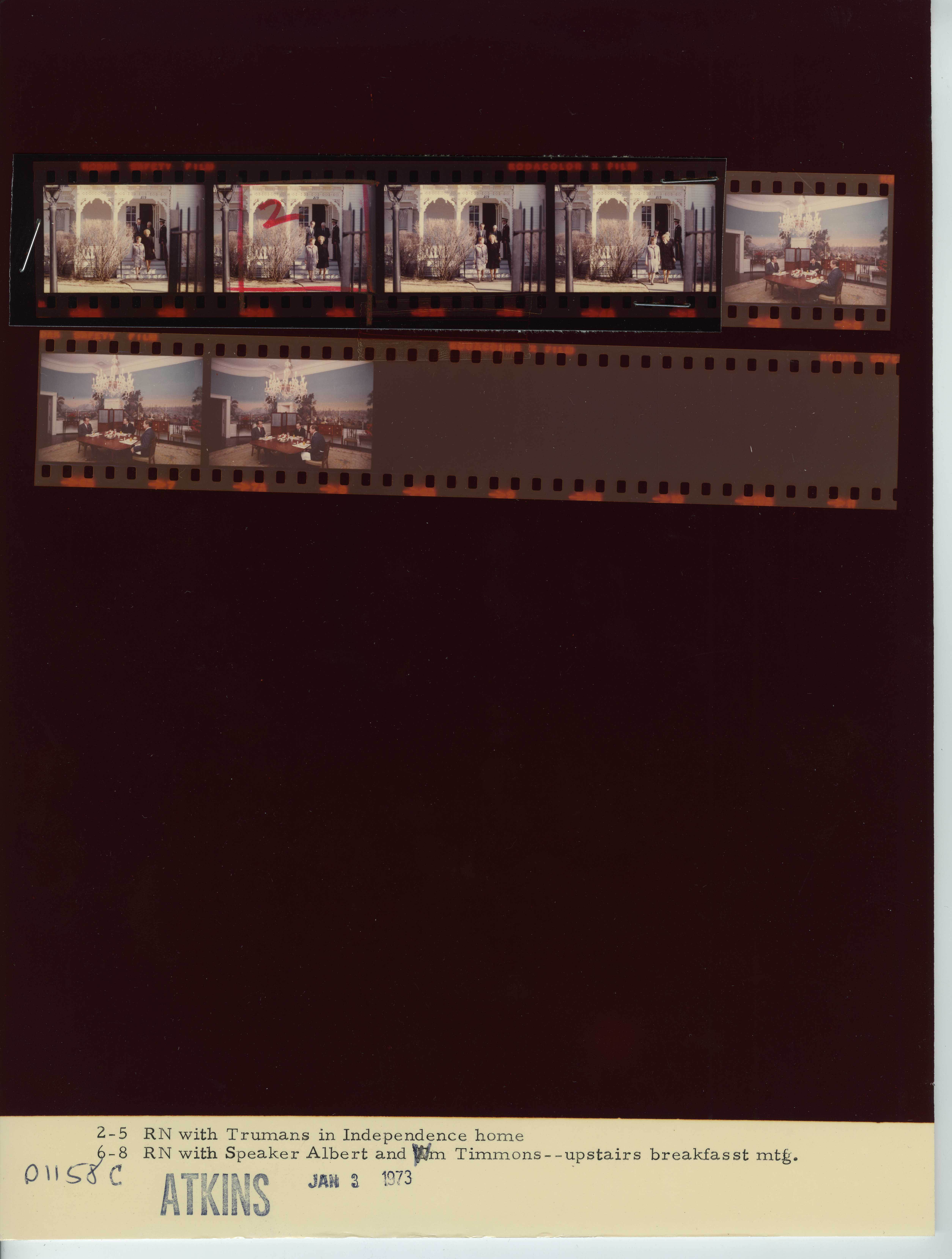
- Frame(s): WHPO-D1158-02A-05A, President Nixon and Pat Nixon, with Margaret Truman Daniel and Clifton Daniel, leaving the Truman residence. 12/27/1972, Independence, Missouri outside of the Truman residence. President Nixon, Pat Nixon, Margaret Truman Daniel, Clifton Daniel.
The White House Communications Agency Videotape Collection contains “off-the-air” recordings of televised programs produced between 1968 and 1974. Visit the finding aid to learn more.
- WHCA-5965
Harry S. Truman at Truman Library.
ALL NETWORKS
Runtime: 01:00:58 - WHCA-5966
Harry S. Truman arrival at Truman Library.
Post-Newsweek Stations, Inc.
Runtime: 01:05:41 - WHCA-5967
Harry S. Truman arrival at Truman Library.
CBS, NBC, ABC
Runtime: 01:00:28 - WHCA-5968
LBJ and Nixon at Truman Library. Tribute to Harry S. Truman at the Truman Library
CBS
Runtime: 00:33:26 - WHCA-5969
CBS Special: Truman.
ALL NETWORKS
Runtime: 01:33:52 - WHCA-5970
Harry S. Truman: A Personal View.
ALL NETWORKS
Runtime: 00:33:56 - WHCA-5977
Weekly News Summary, Tape II.
ALL NETWORKS
Runtime: 1:30
9. Smith/Kincaid: Former President Truman's body lies in state, former President Johnson (LBJ) and President Nixon attending. Time Code Start: 23:17. Keywords: Presidents, death, memorials, ceremony, ceremonies. Network: ABC.
10. Smith/Downs/Tuckner: Bombing of Hanoi, Vietnam, Pentagon report of bombing, Navy bails out GAP Instruments. Time Code Start: 26:52. Keywords: United States Department of Defense headquarters, Armed Forces, Vietnam War, bombings. Network: ABC.
11. Smith: Commentary on Vietnam bombing. Time Code Start: 32:12. Keywords: Vietnam War, bombs, bombings. Network: ABC.
12. Chancellor: Former President Truman funeral service with former President Johnson (LBJ) and President Nixon attending. Time Code Start: 33:20. Keywords: Presidents, death memorials, burials, internments, religious services, funerals. Network: NBC.
13. Chancellor/Rosenfeld: North Vietnam says no talks until the bombing stops; Vietnam war, Freidheim talks about the bombing. Time Code Start: 39:26. Keywords: Vietnam War, bombs, bombings. Network: NBC.
14. Chancellor/Davis: More on former President Truman. Time Code Start: 41:55. Keywords: Presidents, death, documentary, reports. Network: NBC.
15. Cronkite: Former President Truman's funeral service. Time Code Start: 44:50. Keywords: Presidents, death memorials, burials, internments, religious services, funerals. Network: CBS.
16. Cronkite/Schieffer: Vietnam, Freidheim talks about the bombing. Time Code Start: 48:47. Keywords: Vietnam War, bombs, bombings. Network: CBS.
17. Cronkite: Hanoi to boycott Peace Talks. Time Code Start: 52:50. Keywords: Paris Peace Talks, Vietnam War, treaty, treaties, negotiations, boycotts, protests, government officials. Network: CBS.
18. Cronkite/Schorr: Economic council says '72 was a good year, that '73 will be the same with Herb Stein. Time Code Start: 53:12. Keywords: economy, economics, budgets, finances, recession, inflation, money, wages, costs, unemployment, prices, reports. Network: CBS.
Context (External Sources)
The Vanderbilt Television News Archive is the world's most extensive and complete archive of television news. They have been recording, preserving and providing access to television news broadcasts of the national networks since August 5, 1968.
Wikipedia is a free encyclopedia that anyone can edit.