
Introduction
This almanac page for Saturday, August 21, 1971, pulls together various records created by the federal government and links to additional resources which can provide context about the events of the day.
Previous Date: Friday, August 20, 1971
Next Date: Sunday, August 22, 1971
Schedule and Public Documents
The Daily Diary files represent a consolidated record of the President's activities. Visit the finding aid to learn more.
The President's day began at San Clemente, California
The Weekly Compilation of Presidential Documents made available transcripts of the President's news conferences; messages to Congress; public speeches, remarks, and statements; and other Presidential materials released by the White House.
Digitized versions can be found at HathiTrust.
Each Public Papers of the Presidents volume contains the papers and speeches of the President of the United States that were issued by the White House Office of the Press Secretary during the time period specified by the volume. The material is presented in chronological order, and the dates shown in the headings are the dates of the documents or events. In instances when the release date differs from the date of the document itself, that fact is shown in the text note.
To ensure accuracy, remarks have been checked against audio recordings (when available) and signed documents have been checked against the original, unless otherwise noted. Editors have provided text notes and cross references for purposes of identification or clarity.
The Federal Register is the official daily publication for rules, proposed rules, and notices of federal agencies and organizations, as well as executive orders and other Presidential documents.
Archival Holdings
Any selection of archival documents will necessarily be partial. You should use the documents and folders identified below as a starting place, but consult the linked collection finding aids and folder title lists and the collections themselves for context. Many documents to be found this way do not lend themselves to association with specific dates, but are essential to a complete understanding of the material.
Selective document listing
President's Office Files
The President's Office Files consists of materials drawn together by the Special Files Unit from several administrative subdivisions within the White House Office. It is the handwriting and sensitive papers sent to the Staff Secretary that now comprise much of the President's Office Files. Visit the finding aid to learn more.
- Annotated News Summaries, Box 30, News Summaries - August 1971 [1 of 2]
- Annotated News Summaries, Box 30, News Summaries - August 1971 [2 of 2] [During this period, the Staff Secretary only removed pages from the News Summaries which contained President Nixon's handwriting, often leaving the document with no date. Although there are no specific documents with this date, you should also consult the full folder for the month.]
- President's Daily Schedule, Box 101, [President's Daily Schedule, June-Aug. 1971] [3 of 3]
- The President's Schedule, Saturday - August 21, 1971
The H. R. Haldeman Diaries consists of seven handwritten diaries, 36 dictated diaries recorded as sound recordings, and two handwritten audio cassette tape subject logs. The diaries and logs reflect H. R. Haldeman’s candid personal record and reflections on events, issues, and people encountered during his service in the Nixon White House. As administrative assistant to the President and Chief of Staff, Haldeman attended and participated in public events and private meetings covering the entire scope of issues in which the Nixon White House engaged in during the years 1969-1973. Visit the finding aid to learn more.
- Transcript of diary entry (PDF)
Saturday, August 21st. The President called at 9:00 in the morning to ask how everything had played. Unfortunately, I had just gotten up and hadn't even seen the local papers, so I had no answer for him. He mused a bit on the Finch wedding and the crowds there, and also the crowds at Loma Linda, feels that things still look good. Said that a number of people caught him out at the helicopter and said, we sure liked your speech. So that pleased him, too.
I called Connally, following up on Ehrlichman's call with him yesterday, which John discussed with me at the wedding reception last night. Felt that we had a problem and I needed to follow up on it, and it turned out that was right. Connally said he detected a power play going on, that there was a lot of individual politics and gutting underway, and he was disappointed that the President would think that anything would be done without his approval.
-------------------------------------------------------------------------------------------------------------------
DECLASSIFIED - E.O. 13526, Sect. 3.4: by MS, NARA, June 12, 2013
Audio Cassette 13, Side A, Withdrawn Item Number 2 [AC-13 (A) Sel 2-1]
Duration: 16 seconds
He feels we should not rush in on this. The Japs are swamping everybody, trying to lobby their cause. And he detects some weakness on their part. He thinks we should play the hard line; demand basic changes in trade practices; and that it may be months and months before we get this done.
------------------------------------------------------------------------------------------------------------------
He says all this started by Shultz peddling the stuff, that, because he was upset about a Dale story in the New York Times on convertibility of the dollar. The question is whether we want convertibility. Shultz is opposed to setting an exchange rate; he wants all currency to float. Most of the others want some rate established. Connally's plan is to float until we get what we want and then set it, but we have to say to everybody that we're ready to meet; we will talk, but we must have some things first.
-------------------------------------------------------------------------------------------------------------------
DECLASSIFIED - E.O. 13526, Sect. 3.4: by MS, NARA, June 12, 2013
Audio Cassette 13, Side A, Withdrawn Item Number 2 [AC-13 (A) Sel 2-2]
Duration: 5 seconds
His view is that we want to divide the other countries, not unite them against us.
------------------------------------------------------------------------------------------------------------------
So he takes the position that the surcharge and the suspension are temporary, and that you can't talk any other way: that this is the President's line. We have to feel our way in the meantime and see what is possible. The other nations can't agree on what they want, so they don't have a common position either. He does think the Volcker group should consider all those things, and they should not sit with Rogers, Connally, and Burns yet. He's going to use all the former Secretaries of State and Under Secretaries, orchestrating them to develop a major international campaign on this. He's concerned, he says, because he doesn't mind being used, but he resents the petty little moves, such as Sunday night at Camp David, he didn't sit in on the wage-price freeze meeting. The President said he wanted wage prices handled at Treasury, Connally didn't. So they put it at OEP, and the next thing you know, he's designated as the Chairman of the Cost of Living Council. At the Sunday night meeting, they developed an organization chart for the Council, set up an executive policy committee with McCracken as Chairman and didn't even tell Connally. They're immediately making a grab at the White House, Shultz and McCracken, so that they can control it. He thinks this is ridiculous nit-picking. He apparently had written, he apparently wrote a memo to me on this whole thing after the Ehrlichman call, but he says now he won't send it since we've had a chance to talk it over. Says we've got to recognize we are all groping in this thing; that we can't dictate the conclusion at this point, because we don't know where we can arrive at an agreement. Said one question is very disturbing. That's the question of the extent that gold is in the picture. No one wants to go back to a fixed gold price, but we have to tie the currency to something.
-------------------------------------------------------------------------------------------------------------------
DECLASSIFIED - E.O. 13526, Sect. 3.4: by MS, NARA, June 12, 2013
Audio Cassette 13, Side A, Withdrawn Item Number 3 [AC-13 (A) Sel 3]
Duration: 20 seconds
We want to keep the US preeminent. We're developing three blocs; Europe, the Far East, and the US, which is not good, but it's going to evolve. So, first we have to determine how we maintain the strongest position for the US; second, how we reduce trade barriers and quotas; and third, how we revalue to improve our trade position and give us a surplus.
-------------------------------------------------------------------------------------------------------------------
Most of them want some sort of fixed exchange rate with wide margins. Shultz and his group don't agree, they want to float. He then mentioned the Texas Governor and said he's going to get his pants taken off before he's through. When he goes on Face the Nation, the reporters will eat him alive. Connally seemed to view that with considerable relish.
Later in the day I talked with Peterson, who also is upset. His first point was that he was concerned about my memo to him, telling him to fill Mills in on the Japanese textile agreement, and let him take some of the credit. He says he can't do that ahead of time, because Mills will leak it. Instead, he thinks that we should say that with the new situation we can now act unilaterally, but it's still best to get a voluntary deal, and then let Mills try to help us on that. On a somewhat broader point, he said there's a problem with Flanigan in the textile deals, and that it got very embarrassing with Milliken at the meeting last Tuesday, because they dislike and mistrust Flanigan, and Milliken really froze up when Pete came in. If the industry thought that Flanigan was representing the President, this would be very bad. Dent was extremely upset because of Flanigan coming in, and said this aggravated the problem, but it's been worked out. On an even more general basis, he said it's been very difficult for him in the last several weeks to see the President. He has a problem with Connally, because the economic advisors are concerned regarding the lack of a negotiating plan; that Burns, Shultz and McCracken have strong views, they do not respect Volcker. The plan is to try to get him straightened out. But the problem is that Volcker's making statements and hitting in a direction that the President doesn't want to go. Apparently, they're all going to be out here next week for a meeting on the Japan, regarding the Japanese ministerial meeting, so he says he'll talk to us out here then.
I had no further contact with the President during the day.
End of August 21st. - Original audio recording (MP3)
The National Archives Catalog is the online portal to the records held at the National Archives, and information about those records. It is the main way of describing our holdings and also provides access to electronic records and digitized versions of our holdings.
The Catalog searches across multiple National Archives resources at once, including archival descriptions, digitized and electronic records, authority records, and web pages from Archives.gov and the Presidential Libraries. The Catalog also allows users to contribute to digitized historical records through tagging and transcription.
Nixon Library Holdings
All National Archives Units
National Security Documents
The President's Daily Brief is the primary vehicle for summarizing the day-to-day sensitive intelligence and analysis, as well as late-breaking reports, for the White House on current and future national security issues. Read "The President's Daily Brief: Delivering Intelligence to Nixon and Ford" to learn more.
The Foreign Relations of the United States series presents the official documentary historical record of major U.S. foreign policy decisions and significant diplomatic activity. Visit the State Department website for more information.
Vol. XIX, Part 2, Japan, 1969-1972
April-October 1971: Change and Reassessment
90. Memorandum of Conversation, San Clemente, California, August 21, 1971, 10:35-11:35 a.m.
Source: National Archives, Nixon Presidential Materials, NSC Files, Box 536, Country Files, Far East, Japan, Vol. V, 1 Jul–Sep 71. Secret; Sensitive. The meeting took place in Kissinger’s San Clemente office. Lord transmitted the memorandum to Kissinger on September 8, under a memorandum indicating that another Kissinger-Ushiba meeting would take place that day and noting: “I have given a sanitized account of this meeting to Holdridge’s shop to help them prepare your basic talking paper.” (The sanitized version is ibid.) Kissinger’s talking points for the August 21 meeting with Ushiba were contained in an August 19 memorandum from Holdridge and Hormats in which they noted, “Your conversation with Ambassador Ushiba on July 23 was extremely valuable, I am told, in dampening down elements within the Japanese leadership who, as a result of the President’s China initiative, argued for a more independent Japanese foreign policy. However, there are now new complications in US-Japanese relations resulting from the President’s recently-announced economic measures.” For a memorandum of conversation of the July 23 meeting, see Document 83.
Vol. XXI, Chile, 1969-1973
Cool and Correct: The U.S. Response to the Allende Administration, November 5, 1970-December 31, 1972
252. Telegram From the Department of State to the Embassy in Chile, Washington, August 21, 1971, 1924Z
Source: National Archives, RG 59, Central Files 1970–73, INCO 15–2 CHILE. Confidential; Priority; Exdis. Drafted by Meyer and Fisher; cleared by Girdler and Miller; and approved by Meyer.
Vol. XL, Germany and Berlin, 1969-1972
Germany and Berlin, 1969-1972
312. Telegram From the Department of State to the Embassy in Germany, Washington, August 21, 1971, 0111Z
Source: National Archives, RG 59, Central Files 1970–73, POL 28 GER B. Secret; Priority; Nodis. Drafted by Sutterlin; cleared by Brower, Fessenden, Eliot, and Haig; and approved by Rogers.
313. Telegram From the Embassy in Germany to the Department of State, Bonn, August 21, 1971, 1926Z
Source: National Archives, RG 59, Central Files 1970–73, POL 38–6. Secret; Immediate; Exdis. Repeated to the White House.
Vol. XLI, Western Europe; NATO, 1969-1972
Ireland
168. Telegram From the Department of State to the Embassy in Ireland, Washington, August 21, 1971, 0055Z
Source: National Archives, RG 59, Central Files 1970–73, POL 23–9 UK. Limited Official Use; Priority. Drafted by Robert DuBose (EUR/BMI), cleared by Scott George (EUR/BMI), and approved by Fessenden. Repeated to London and Belfast.
The Kissinger telephone conversation transcripts consist of approximately 20,000 pages of transcripts of Kissinger’s telephone conversations during his tenure as Assistant to the President for National Security Affairs (1969-1974) and Secretary of State (1973-1974) during the administration of President Richard Nixon. Visit the finding aid for more information.
Digitized versions can be found in the National Archives Catalog.
Audiovisual Holdings
The White House Photo Office collection consists of photographic coverage of President Richard Nixon meeting with prominent social, political, and cultural personalities; speaking engagements and news conferences of the President and various high-ranking members of the White House staff and Cabinet; Presidential domestic and foreign travel, including Presidential vacations; social events and entertainment involving the First Family, including entertainers present; official portraits of the President, First Family, and high-ranking members of the Nixon administration; the 1969 and 1973 Inaugurals; the President’s 1972 Presidential election campaign appearances (including speeches) and other official activities of the White House staff and the President’s Cabinet from January 20, 1969 until August 9, 1974 at the White House and the Old Executive Office Building; other locations in Washington, DC, such as The Mall; and the Presidential retreats in Camp David, Maryland, Key Biscayne, Florida, and San Clemente, California. Visit the finding aid to learn more.
Roll WHPO-7150 Photographer: Schumaker, Byron | Color or B&W: B&W
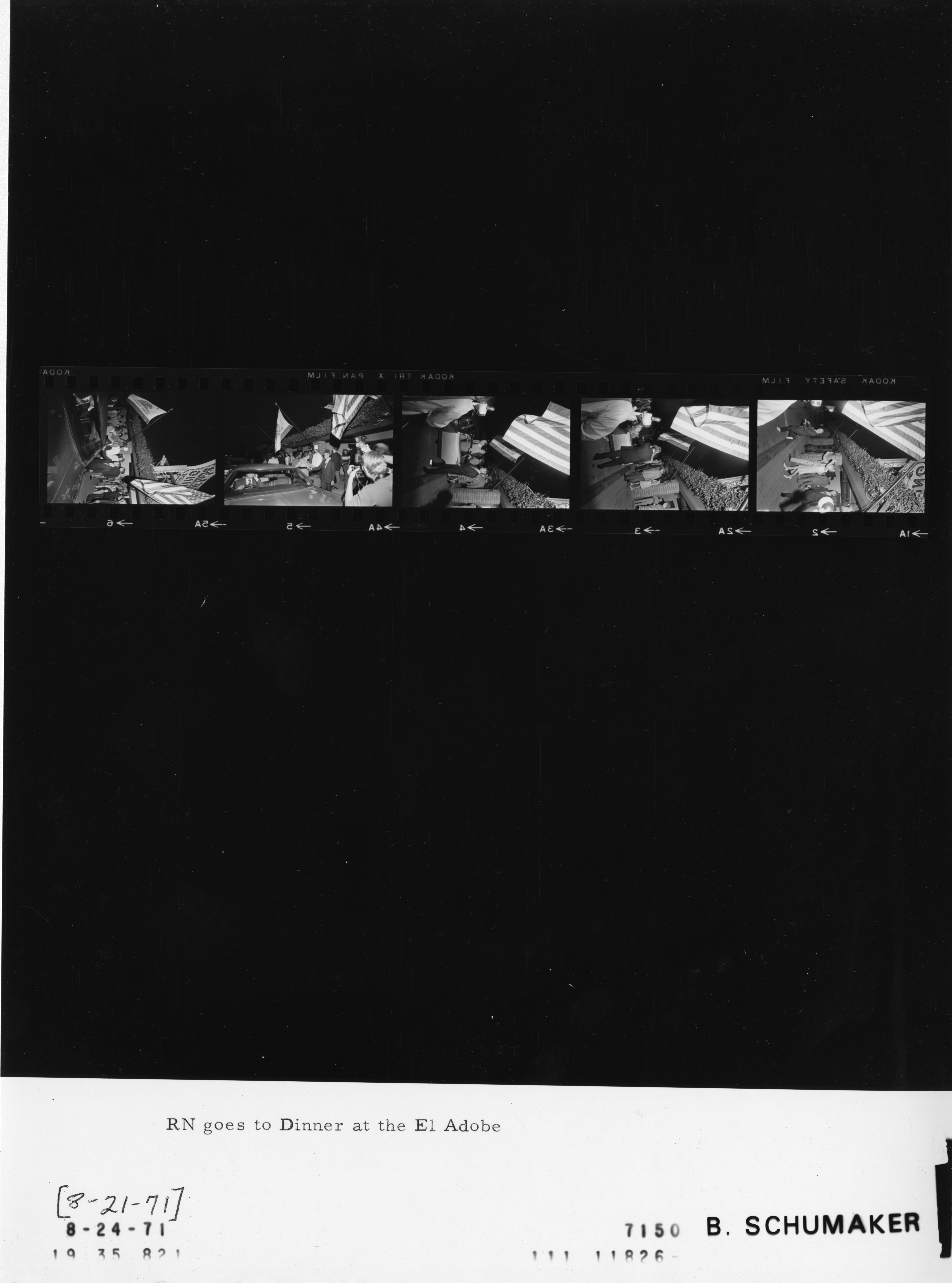
- Frame(s): WHPO-7150-01A-05A, President Nixon leaving the El Adobe Restaurant. 8/21/1971, San Juan Capistrano, California El Adobe Restaurant, exterior. President Nixon, press, chef, unidentified persons.
Context (External Sources)
The Vanderbilt Television News Archive is the world's most extensive and complete archive of television news. They have been recording, preserving and providing access to television news broadcasts of the national networks since August 5, 1968.
Wikipedia is a free encyclopedia that anyone can edit.