
Introduction
This almanac page for Friday, August 13, 1971, pulls together various records created by the federal government and links to additional resources which can provide context about the events of the day.
Previous Date: Thursday, August 12, 1971
Next Date: Saturday, August 14, 1971
Schedule and Public Documents
The Daily Diary files represent a consolidated record of the President's activities. Visit the finding aid to learn more.
The President's day began at The White House - Washington, D. C.
The Weekly Compilation of Presidential Documents made available transcripts of the President's news conferences; messages to Congress; public speeches, remarks, and statements; and other Presidential materials released by the White House.
Digitized versions can be found at HathiTrust.
Each Public Papers of the Presidents volume contains the papers and speeches of the President of the United States that were issued by the White House Office of the Press Secretary during the time period specified by the volume. The material is presented in chronological order, and the dates shown in the headings are the dates of the documents or events. In instances when the release date differs from the date of the document itself, that fact is shown in the text note.
To ensure accuracy, remarks have been checked against audio recordings (when available) and signed documents have been checked against the original, unless otherwise noted. Editors have provided text notes and cross references for purposes of identification or clarity.
The Federal Register is the official daily publication for rules, proposed rules, and notices of federal agencies and organizations, as well as executive orders and other Presidential documents.
Archival Holdings
Any selection of archival documents will necessarily be partial. You should use the documents and folders identified below as a starting place, but consult the linked collection finding aids and folder title lists and the collections themselves for context. Many documents to be found this way do not lend themselves to association with specific dates, but are essential to a complete understanding of the material.
Selective document listing
President's Office Files
The President's Office Files consists of materials drawn together by the Special Files Unit from several administrative subdivisions within the White House Office. It is the handwriting and sensitive papers sent to the Staff Secretary that now comprise much of the President's Office Files. Visit the finding aid to learn more.
- Annotated News Summaries, Box 30, News Summaries - August 1971 [1 of 2]
- Annotated News Summaries, Box 30, News Summaries - August 1971 [2 of 2] [During this period, the Staff Secretary only removed pages from the News Summaries which contained President Nixon's handwriting, often leaving the document with no date. In addition to the individual document(s) listed below, you should also consult the full folder for the month.]
- [8/13/71]
- [8/13/71]
- President's Daily Schedule, Box 101, [President's Daily Schedule, June-Aug. 1971] [3 of 3]
- The President's Schedule, Friday - August 13, 1971
The H. R. Haldeman Diaries consists of seven handwritten diaries, 36 dictated diaries recorded as sound recordings, and two handwritten audio cassette tape subject logs. The diaries and logs reflect H. R. Haldeman’s candid personal record and reflections on events, issues, and people encountered during his service in the Nixon White House. As administrative assistant to the President and Chief of Staff, Haldeman attended and participated in public events and private meetings covering the entire scope of issues in which the Nixon White House engaged in during the years 1969-1973. Visit the finding aid to learn more.
- Transcript of diary entry (PDF)
Friday, August 13.
As a result of last night's decision on the economic move, today's schedule was shifted substantially. The President went ahead with his NSC meeting on Defense budget at 10:00 this morning, and that lasted all morning. Then we set up a 2:30 departure for Camp David, took the Quadriad with the President and announced there'd be a Quadriad meeting up there. Had the other people go up on a separate chopper from Anacostia, so we wouldn't create an undo stir about the attendance. We went round and round on the schedule for the meeting and various arrangements of cabin locations, and all that sort of thing.
Before we left, President did have a session with Shultz on the meeting plan, said he was concerned about the fuzzy thinking when you get down to the nut cutting, and wondered if the Treasury had the specifics ready to discuss. He made the point that, in order to know what to do, we have to have a hard analysis that what's being presented will work, and he commented that this is where intellectuals always fail. Said we need a new name for investment tax credit; he suggested the Employment Tax Act. Said he was inclined to go for the two taxes, the investment credit and the auto excise tax cut, but not go for moving up the exemption increases, even though politically that would be considered the necessary thing to do for the folks. He felt that the exemptions being moved up won't have the effect, because even though the dollars in people's hands might, the problem is not more money in their hands; the political problem is something else, but he wants to let Congress put this on, and blame them for upsetting the budget. He's concerned about the $3.5 billion that this will cost. He's not worried about the politics of the tax cut for business and no tax cut for the folks, and told him to go ahead and work on that basis.
Busing came up again today, as did some speech problems. He wanted Price to go back and start all over again on the VFW and Knights of Columbus speeches; they still didn't hit what the President was after. He had a session with the Attorney General, Ehrlichman, Shultz and Morgan on school busing, and they got a decision from him on how to approach the Columbia, South Carolina, case, which would be another landmark one; we're taking a very moderate busing position which should be effective.
Right after we arrived at Camp David, we started the first meeting at the President's lounge in Aspen. It started at 3:15 and didn't end until 7:00. The President, Connally, Burns, Shultz, McCracken, Peterson, Volcker, Satire and Ehrlichman were in attendance. The President opened the meeting, after a brief updating by Volcker on gold loss problems in the market today. Agreed that we must act on the international money situation. There are many options that are now closed to us, so there's no point in reviewing those.
He made the point then that no calls are to be made out of here, except to get information, and then you're to cover it, so that we don't get any leak out of here as to what's going on; leaks in the past have compromised our position. Between now and Monday, everybody here is to say nothing. If you talk to someone, you assume the responsibility. He referred to China and said we had responsible people, and highly intelligent people, and not naive people, dealing with the China thing, and consequently it didn't leak. There could be no discussion on this situation until the announcement Monday night. He then said he had tentatively decided to make an announcement on Monday night, but the purpose of this meeting was to review that plan.
He said there was general agreement that action is needed: first, on the international monetary situation; secondly, to deal with its causes-- domestic inflation, fiscal problems, tax problems and wage/price problems; third, an import tax that we would send to Congress, but make retroactive. Also an export rebate had been suggested, but he was now sure that there were insurmountable legal barriers to that.
He said it would not be relevant to review how we got here, that analyzing the actions would do no good, instead we have to find solutions and test ideas as to whether they will work. We have to be sure we can limit the consequences. It's easy to take spectacular action; the question is how to get out from under that action later on. He then said he'd like to have Connally present the recommendations that he has proposed, that the timing the President has in mind is an announcement Monday night at 9:00, that nobody is to be briefed on this until 7:00 Monday, that the two most difficult items from a logistical standpoint are the ones Connally should discuss.
He then turned the meeting over to Connally, after the above 15 minute opening. Connally said it's clear that we have to move in the international field, to close the gold window, not change the price of gold, encourage the dollar to float. We need to determine how to ensure economic expansion, more jobs, and so forth, and attack the root cause of the dollar problem. If we close the gold window, we'll need an import tax of 10-15 percent. This will keep foreign products out and be inflationary, so we'll need a further stimulant; so we will reinstate the investment tax credit at something greater than 7 percent, such as 8 or 10 percent. He feels there'd be no problem with Congress, and business will react, of course, very favorably to this. There's a problem in the automobile industry, especially relating to imports: there's no reason for an excise tax on autos. So we'll repeal the excise tax on autos, with the assurance from the industry that they'll pass this through in price reductions. This he feels should affect 10 million people who will be new car buyers this year. We'll go ahead with the disk proposal. We'll move forward the increases in personal income tax exemptions. We'll remove all the financial controls that we've promised to remove. We'll also ask Congress to change the antitrust regulations to exempt United States industries doing business overseas. And we'll impose a wage/price freeze until January 1. Such a program will leave a clear impression that this has been analyzed in depth, not just a reaction to pressure. It will be an act of great awareness, great statesmanship and great courage, and must be presented to the people this way.
The President said he would like to add a couple of points. First, with tax relief, there has to be substantial budget cuts. We can't increase the deficit. Secondly, wage/price freeze only works for a limited period. We can't remove it without putting something in its place, a wage/price board, or something like that. So we must think out now the next step, but we don't need to announce it. We need more education at this meeting on, first, the import tax: can we do it without Congress? Can we do it selectively or across the board? How do we get rid of it afterwards? And secondly, on the wage/price freeze: how do we enforce it? How do we provide for exceptions, hardship cases, and so forth, and what follows?
Shultz then took over on these points, frequently interrupted by questions and exchange of opinion. He said regarding the import tax, the legal situation possibilities are that we can go without Congress under the GATT authority, with some limitations. Also, this might give us some special opportunity to handle the textile problem. The President said he will not use the trading with the enemy act or the national security authority on textiles. He feels that if GATT is broad enough, then we can promise that this is the basis for negotiating stroke, and this would be another step beyond just closing the gold window. Shultz said the GATT approach signal and it's done versus Congress would be good. Arthur Burns says one doesn't preclude the other; also Wilbur Mills says he'll do it anyway. Volcker's opposed to this; he prefers to hold it in our pocket as a threat. Connally disagrees with Volcker; the people reaction would be better to doing it. The President said we don't confront a theory, we confront a fact: if we don't do it, Congress will do it in the wrong way, so we must do it. Burns is definitely for an import duty via GATT, but explicitly make it temporary, like for six months; otherwise it could be interpreted as an aggressive move, which he opposes. Connally agrees, says we should suspend rather than repeal, but he would not put on a six month time limit. The President says the purpose is to set the stage for negotiation. Burns says yes, but also to get a lift for the economy.
The President then stepped in and said to divide up the work. Shultz, Connally and Peterson should explore the GATT provisions, the scope, products, schemes, the revenue-generated price effects, textile effects, etcetera. McCracken asked if we were going to both close the window and impose the border tax; one would counteract the other. Connally admitted that the border tax may counteract the dollar float, but said we should still do it. The President said, now let's turn to the gold window question. Arthur Burns' view is correct, domestically. The argument from the other side is to take the rap now.
This got us up to 4:00, and Arthur Burns then took over for the next 15 minutes with a lecture on the whole subject. He said that Volcker and Connally may be right in their view regarding closing the gold window, but I think they're wrong. If they're right, there's still no rush to close the window. We should analyze the steps we take this weekend. These are dramatic steps: wage/price freeze, border tax, government spending cuts, tax cuts. These will not augment the budget deficit. These will electrify the world, and the flight from the dollar will cease; so we don't need to close the gold window. On the other hand, there are grave risks in closing. First, political: if we do this now, Nixon will get the blame. He'll be responsible for devaluing the dollar, for dropping gold. Pravda will headline this as a sign of the collapse of capitalism. It will be exploited by the politicians, hated by business and financial people. Continued on the next side.
[End of tape reel AC-12(A)]
[Begin tape reel AC-12(B)]
August 14, the meeting with the President at Aspen regarding the new economic news. I was reporting on Arthur Burns’ comments.
The second risk, he felt, was economic, and that would be very hard to evaluate. Question of what will the stock exchanges do? Up or down, you can't predict. Once the dollar floats, the trade basis will change. The risk to world trade would be much greater. The profit margin in world trade, which is already very narrow, will vanish. There'll be retaliation by other countries, and ill will. The bankers feel it would follow quickly. It wouldn't do so with the border tax. Foreign exporters will clamor for action. We release forces that we don't need to release. He recommends, therefore, that we take the other actions and send Volcker abroad to explain them. Then Volcker and the Fed start negotiating on exchange rates, but without closing the window.
The President answered Burns by saying that speculators would start a run on the dollar. Burns said if that happens, you can close the window the next day, but you could try to get by without closing. The President said the argument on the other side is that the gold window action is needed for domestic opinion, and he recited the range of arguments on this. Burns says, so it all works, then how do you know? How do you know that it won't collapse two months before the election? You must realize that you're taking a uniquely powerful action. The President said what is our main problem? The international gold situation, so we must act on it. That's our immediate problem. Why do all the stuff to ourselves domestically and still stay exposed to the mercy of the world by not acting on the gold window? We can't cover our liabilities. We're broke. Anyone can topple us. And he recited the headlines all over the world regarding closing of the gold window; they've already reacted to it. This recital was Connally, not the President. Burns says, well, all you're demonstrating is that this is widely expected, but for the other countries, you've taken unilateral action, contrary to their interests.
Volcker said he agrees with Burns, but this is not the disaster that he paints, except in international banking circles. Others would say it was good, that the United States is biting the bullet, and they should; but Volcker doesn't like putting on the border tax at the same time. What everyone would dislike is closing the window without trying promptly to negotiate.
Connally makes the basic argument again, and Burns keeps rebutting. Why keep worrying about other countries, says Connally, look out for our own interests. McCracken says we must come out with both international and domestic objectives, so we must have a signal that we're making a change in the exchange rate of the dollar. The question is, what is the best route to achieve it? He feels we have to close the window and float.
He's concerned regarding the border tax and its effect on the exchange rate, and says any way we go will cause some uneasiness. His guess is that rates won't gyrate violently. Stein says this raises the question of the United States labor movement, the unions. All of the wage/price freeze depends on their observing the freeze; the need to close the gold window to get them to go along is important, because they will cooperate in an international crisis, but they won’t just on domestic grounds. The President says labor's self-interest is more important than international crises. They'll understand the border tax and the price freeze and the economy stimulants. Among economists, the majority say to close the window and no border tax: that makes good sense, and it's clean. But we deal with the American people. They're deeply concerned regarding closing the window because of the play by the media. They'll try to frighten people. People will applaud the wage/price thing, tax, budget cuts, border tax. Closing the window is an unknown.
Burns then pointed out that the economists in favor of closing the window are only those who are academic economists. The business economists are very much divided on the subject, with the majority opposed to the concept of closing the window. There was an ensuing argument between Volcker and Burns on this. Regarding labor opinion, we got into the question of what about removing foreign investment controls, the antitrust idea. Labor will oppose this because it results in exporting jobs. Problem is you'll make the foreigners mad, and they'll damage us on an overall basis. Connally says that's true, but they're damaging us now. Peterson then said, in referring to the speech coming up Monday night, we need to emphasize sacrifice and statesmanship. He raised the idea of cutting foreign aid. The President said we can't cut it anymore; we've just got to demagogue the question. Also, there's the problem of cutting military aid. On the statesmanship question, he was struck by the fact that we keep having crises, and that maybe we should refer to looking to the future, to the long-term improvement. He questions whether the speech would include the willingness to talk on a long-range basis. This would be a good signal to foreigners. And then, in answer to Arthur Burns, the President says that should come, but later, in the backgrounder, rather than in his speech.
The President said that his plan on his speech is when you have a lot to say, you lose something by saying a lot. Therefore, he's thinking of ten minutes, crisp, strong and confident. In the country, there's a sense of confidence, but it's very delicate and needs to be sparked, and we must understand that the people must understand. Therefore he’s going to announce that no--For example the cut of 5 percent of the government employees is something they'll like, and there will be a lot of things that they'll like, but they will not like what they don't understand, regarding international finance, gold, etcetera. This is going to have to come from the backgrounders rather than from the President's speech.
Peterson said regarding businessmen, you should emphasize looking to the future and getting competitive, in addition to the incentive idea. Also hit technology. Regarding the gold window, this will be good for businessmen because it's bold and definite. Leaving it hazy is not good. With the folks, it'll raise fear, but not with the business people. This gets to the media problem, where the fear has been created with the folks. The President said, this is a real problem. The media's scared the people, and they'll say you've devalued our dollar. Burns referred to the problem of influencing foreign reporting, said the key factor is what happens to the price of gold: if it shoots up, all the backgrounders in the world will be useless. Volcker agrees this is a critical issue, and that we've got to be prepared. The only way to meet it is to have a convincing proposal that shows that we don't think gold is that important. McCracken says that the people reaction will be negative, because they don't understand on the gold thing, but the wage/price reaction will counterbalance this. The President said the opponents and the media will launch a concerted attack on us.
Connally recommends that we talk as if we have alternatives, but we don't have alternatives; we have to recognize the problem and face it. We should say that this will make us more competitive in the world. That's the purpose of doing it now, while we have a cover for it; so we should not wait a day or a week later. We should do it the same time we do wage/price and the other domestic actions. If you wait, then you are in the hands of the money changers. Burns says you must realize you're dealing with the money changers, the central bankers of the world. They won't ask for gold, if you take the other steps, and you'll solve the problem that way without having to take the drastic action. Connally says, look at Schiller, he's driving the dollar own daily. Burns says, I get reports from the central banks the world over, every day. If we take the domestic steps, they'll applaud it, and they won't hit the dollar. Connally says, they may not hit it, they'll just nibble us to death. Peterson argues that this is a bold package, and it's bad to leave gold out and be wrong later, and then look very bad and not look bold enough.
The President then stepped in and said, we've already decided on the import tax, on the GATT basis, and anything to get Japanese leverage. Now we turn to wage/price. But first, before that, the budget cuts. We won't go on disk. We'll push back family assistance because of the symbolic effect. We'll postpone revenue sharing three months; it's necessary to do that anyway because Congress hasn't passed it, and we can't start it anyway. Federal employment we'll freeze with the goal of a 5 percent cut, no new hires, attrition and RIFs if necessary. Then he issued an immortal quote, "The average person thinks the federal employee is unemployed anyway, so it won't hurt unemployment." On space, we'll postpone Apollo and push it ahead a year. We'll push back the federal pay raise. The President expects Shultz, Ehrlichman and Weinberger to work all this out, plus a variety of program changes in OEO, Space, etcetera, so we can cut $5 to $7 billion.
The tax package, however, is $9 billion revenue loss, and the problem is that we can't save enough. We can get $6 billion in cuts, $1 to $2 billion in the import tax. The President takes the view that we can relieve businesses without relieving individuals, and that even if we leave out the acceleration of the exemption, Congress will put it in anyway. So we should not propose it, and that will save us $3.5 billion, and we can blame Congress for adding it on and raising the deficit. He wants a new name for the investment tax credit, a name that means something to people, so that we aren't just doing the same thing. He suggested a jobs tax credit. We'll put in the auto excise tax repeal and the investment tax credit; that'll cost us $6 billion. We'll not put in the personal exemption, which would cost us $3.5 billion. This goes along with his feeling that we cannot cut taxes more than we cut the budget. The point is not what happens, because the Congress will give them the $3.5 billion anyway, but they should be the irresponsible ones on the budget, not the President. So we go with just the two job-creating tax cuts. He's not worried about the charge that this provides no relief for the average guy. If we had the choice, we would do both, but we don't have the dollars. Also, there isn't really a lack of purchasing power in consumer pockets; so it isn't a problem of getting more immediate money to consumers, it's just their willingness to buy.
Burns suggested that we could do something that would be very smart both economically and politically, and that would be to put the investment tax credit high at first, for one year, and then down a little for the next year. For example, do it 10 percent this year, and then go down to 5 percent from then on. Connally says we can still do all three taxes and get them into the ball park of a $7 billion net cut. The President said, if you can do that, let's go ahead with it. Burns says if you cut expenditures, cut taxes a little less, so that you have a little bit of extra surplus. Everyone agreed.
The President then turned to the wage/price freeze, and asked Shultz to cover it, and then Burns to follow up on it. Shultz said: one, the wage/price freeze will have the most immediate and significant impact; two, it works best when related to international crisis; three, whatever device is used, it has a short effective life; four, consider how you stop once you start (the President injected, especially if it's working); five, how to get labor cooperation, it blows up when labor walks out. The plan is for a freeze, not to last too long, but simple, no exceptions, short so that you don't need a bureaucracy. The President expressed his concern that an economy in a straitjacket with the bureaucrats would be a disaster. Shultz said we can't have a serious discussion regarding the freeze, and so forth, without a freeze to cover the discussion. We must show that we'll use this period to develop a plan, that is, how to handle cost of living increases, strikes, etcetera. He suggested a tripartite board, seven members, to set criteria, spin off the problems on the specific areas, maybe create a governmental body to refer cases to the board. The period of effectiveness for the board would also be limited. So his idea is to shift from a freeze to a board, to a freeze, to out. The President said we all agree that we don't want a permanent wage/price control system. Shultz said this structure would be minimal employees, that is, about a thousand, and it should be kept small.
Burns says it could be done with less than a thousand. Burns says, Shultz' ideas are remarkably similar to mine. I think we should set a freeze for only three months. The purpose is shock value and to get time for the machinery. Then set up the machinery. First, the usual tripartite commission, plus Administration and Congressional leaders to report in sixty days with a plan. This insures the political, business and labor support, or work out our own machinery. Shultz says it's important to have some kind of consensus-forming process, but the Administration and the President must maintain control. The President would agree with Burns in January 1973, but we can't get the Democratic leadership to participate now: they'd have us over a barrel; the stakes are too high, they'll do what is in their political interest; they will not help us in this year. Peterson raised the question of whether an announcement of a period of a freeze, in advance, is a good idea. Burns said, don't lose your advantage as the apostle of freedom. McCracken said there's a problem if you announce a freeze without the duration stated, because you throw people off balance if they're caught. Shultz said the shorter the freeze, the less pressure builds up, and thus the better chance to avoid upsetting equilibrium. Burns says the authority expires next May. Shultz says, no, we have two years. Peterson said, what are the President's legal sanctions. Shultz is not sure, thinks fine and jail. Burns says you don't need enforcement; the period will end before enforcement is needed. Stein says don't underestimate the difficulty of transition from the freeze to a board. You'll need more sophisticated rules and more power.
Burns discussed various ways of doing it. The President interrupted, saying you don't have to answer this question yet. He's opposed to this because he doesn't want to get caught. He knows it won't work, so it's a question of timing. So we should work on the length of the freeze and what, if any, exceptions. The President's view is no exceptions, but that should be thought through, such as the problem of interest rates, where bankers stifle purchases. Connally says the Fed can control this. The President says examine this with great care, especially the controls that would stifle the economy. Volcker and others raise the question of how to freeze dividends, and the question of whether this would be desirable. Burns said to think of this as a plan for voluntary compliance. Connally said you don't have the authority to control dividends. Everybody said just ask for a voluntary freeze on dividends.
By this time it was 6:00. The President then said we should leave this point now and make a few assignments. On the budget, Shultz and Connally should take the responsibility and get estimates of what the tax cuts will cost. The President suggested, why not leave out the $3.5 billion acceleration of exemptions and show a surplus of $3.5 billion. Everyone liked that, and then let Congress put it in. Connally and others then argued no, that the President should get credit, and then let the Congress do more. The President said that we could still keep a little bulge on the budget, but not too much. Shultz said we should not accomplish this by putting the economy through the ringer. We want to say that we will keep the economy expanding. They agreed on the investment tax credit of 10 dollars the first year and five dollars from then on. The President said this all is for short-term shock effect; next year we'll have a real tax reform anyway.
The President then made a little speech about prosperity without war: we have to find a way to direct, stimulate, divert, the American energy in peacetime to provide full capacity. McCracken emphasized the importance of positive coloration: don't be defensive. The President then went into his approach to the speech and said the way to kick it off is to start with subject A, which is peace. The United States at long last enters an era of peace. We all welcome this, but it presents enormous challenges. It's a very competitive world. Is the United States going to continue to be a great nation, number one? Don't assume that, unless we're ready to meet the challenge. Of course, we hope to do better. The United States looks at itself, and what do we find? First, the problem of unemployment. We need to take steps to absorb the two million people that we've released from the Defense industries. Second, as the rest of the world becomes more competitive, the international speculators attack our dollars. What can we do about it? There's nothing to be frightened about, but we're not going to allow the dollar to be destroyed, so we'll impose an import tax and tax credits to deal with the problem of jobs and keeping America competitive. Third, we have the inevitable heritages of war and inflation. We've made some progress, but not enough, so we take new actions: freeze wages and prices. This requires that the American people give their total moral support. We talk about, what can you do? The general public can support the freeze. The businessman can invest in America. The consumer can buy products. What can we all do? Get off our butts and get to work. We can't put too much emphasis in this, of a sense of a terrible international crisis. We say, here's a problem, we're going to deal with it, show we're willing to do things differently. Safire will be responsible for being the editor. Stein, especially, should work with him. We'll welcome all ideas, especially Peterson's, but the speech is to be only 1,500 words; we'll lose if we go more. Then obliterate them with paper afterwards. Develop a plan on a man-to-man basis, especially with Arthur Burns' help. For briefings, no word until 7:00p.m. Monday. Burns argues to go for Sunday and prevent bad Monday news. The President argues that Sunday would be more in the nature of a crisis and bad politics.
Shultz raises the question of who needs to be backgrounded, when and by whom? We need a basic background paper for briefers. The President says Haldeman is to handle national TV and national press, business press, business community. For television, Connally should be the big major gun, plus Shultz. For the business types, Burns, McCracken, Stein, Volcker, Peterson. Regarding State, Rogers must know ahead of time to inform people. They recommend that Tresize handle this, Burns, McCracken, Stein, Volcker, Peterson. Regarding State, Rogers must know ahead of time to inform people. They recommend that Trezise handle this. Regarding Congress, a few phone calls to key leaders: Mills, Long, Burns, etcetera. Don't bother with Foreign Relations. Use the White House group to notify business and labor. On timing, we got into a long discussion of the problem of doing this right, not a half-assed rush. Must know that we're doing the right thing. Burns argued for Sunday, not reacting to crisis, speaking from strength. The President says the very fact of doing it Sunday makes it a crisis. Connally argues it's a problem of locating people to brief on Sunday night. There was a general discussion then on problems of timing. The President leaned to Monday for orderly reasons, and Connally agreed. Burns says he'll hold the deal on Monday by becoming inefficient, and that could be worked out. Connally says, what kind of a notice did the Germans give us regarding their float?
The meeting ended at this point, at 7:00, with the agreement that people would go off to do their assignments, and we would regroup tomorrow.
As a side note, Burns stayed afterwards to make a personal pitch against floating the dollar, and asked for a private session with the President later, which the President hedged. He also urged the President to talk to Charlie Coombs in New York to get his view against floating the dollar. Arthur then left, and the President kept me for a few minutes to say, first, that he thinks now we ought to shoot for Sunday night, that's probably the right thing to do, in any event it's good to put the pressure on the working group. Secondly, he wants Ehrlichman and Shultz to know that he leans to Arthur's view about not going ahead with the gold window, but that to do that we'll have to bring Connally along. He wanted Ehrlichman and Shultz to work on Connally this evening and see if they could bring him along on this. I then left the President's residence, and we went over to Laurel and had dinner at 7:30.
The President called me out of dinner at 8:00, by phone, to say that he noticed in the summary that Barryman, the cartoonist, had died, and he wanted to be sure that we got a statement out. The group broke up into their subsections after dinner and went to work. Connally took complete command at the close of dinner, clanked on his glass, made the assignments, told them what rooms to go to, and they divided up into the three working units and used the three rooms of Laurel for their meetings. At 9:45, the President called me and said, in view of the lateness of the hour, why don't you let the work group go on working tonight, and I'll be available any time after 8:30 in the morning to meet with them. Nobody had any intention of meeting with him further tonight, but he seemed to think they might, so he was turning it off.
End of August 13. - Original audio recording (MP3)
The National Archives Catalog is the online portal to the records held at the National Archives, and information about those records. It is the main way of describing our holdings and also provides access to electronic records and digitized versions of our holdings.
The Catalog searches across multiple National Archives resources at once, including archival descriptions, digitized and electronic records, authority records, and web pages from Archives.gov and the Presidential Libraries. The Catalog also allows users to contribute to digitized historical records through tagging and transcription.
Nixon Library Holdings
All National Archives Units
National Security Documents
The President's Daily Brief is the primary vehicle for summarizing the day-to-day sensitive intelligence and analysis, as well as late-breaking reports, for the White House on current and future national security issues. Read "The President's Daily Brief: Delivering Intelligence to Nixon and Ford" to learn more.
The Foreign Relations of the United States series presents the official documentary historical record of major U.S. foreign policy decisions and significant diplomatic activity. Visit the State Department website for more information.
Vol. I, Foundations of Foreign Policy, 1969-1972
Foundations of Foreign Policy, 1969-1972
96. Memorandum of Conversation, Washington, August 13, 1971, 10:05-11:50 a.m.
Source: National Security Council, Nixon NSC Meetings, Minutes—Original, 1971-June 20, 1974. Top Secret. The meeting was held in the Cabinet Room of the White House. (National Archives, Nixon Presidential Materials, White House Central Files, Staff Members and Office Files, Office of Presidential Papers and Archives, Daily Diary)
Vol. III, Foreign Economic Policy; International Monetary Policy, 1969-1972
International Monetary Policy, 1969-1972
166. Memorandum From the Acting Assistant Secretary of State for Economic Affairs (Katz) to Secretary of State Rogers, Washington, August 13, 1971
Source: National Archives, RG 59, Central Files 1970-73, FN 10. Confidential; Nodis. Drafted by Deputy Assistant Secretary Weintraub.
167. Information Memorandum From Robert Hormats of the National Security Council Staff to the President’s Assistant for National Security Affairs (Kissinger), Washington, August 13, 1971
Source: National Archives, Nixon Presidential Materials, NSC Files, Subject Files, Box 376, President’s Economic Program. Confidential. Initialed by Kissinger. A copy was sent to Sonnenfeldt.
Vol. V, United Nations, 1969-1972
Chinese Representation in the United Nations
396. Telegram From the Mission to the United Nations to the Department of State, New York, August 13, 1971, 0200Z
Source: National Archives, RG 59, Central Files 1970–73, UN 6 CHICOM. Confidential. Repeated to Taipei, Tokyo, and Pretoria.
Vol. XI, South Asia Crisis, 1971
South Asia Crisis, 1971
122. Memorandum From Saunders Harold of the National Security Council Staff to the Presidentʼs Assistant for National Security Affairs (Kissinger), Washington, August 13, 1971
Source: National Archives, Nixon Presidential Materials, NSC Files, Box 597, Country Files, Middle East, India, Vol. IV, 1 Jul–30 Nov 71. Secret; Nodis. Sent for action.
Vol. XVII, China, 1969-1972
China,January-September 1971
154. Memorandum From Secretary of Defense Laird to the President’s Assistant for National Security Affairs (Kissinger), Washington, August 13, 1971
Source: National Archives, Nixon Presidential Materials, NSC Files, Box 522, Country Files, Far East, China, Vol. IX. Top Secret; Sensitive. Prepared by Colonel Paul Murray (ISA). An early draft was returned to ISA on July 23, as Laird wanted a more explicit and definitive memorandum. (Memorandum from Pursley to Acting Assistant Secretary of Defense Armistead I. Selden, Jr.; Washington National Records Center, RG 330, ISA Files: FRC 330 74 0115, China, Rep. of, 1971, 000.1) The final draft was forwarded to Laird’s office on August 3. (Memorandum from Selden to Laird; ibid.) According to a memorandum for the record prepared by the NSC staff, Kissinger, at a meeting on July 28, gave a brief overview of his meetings in the PRC to Laird, Pursley, an. Admiral Murphy. (National Archives, Nixon Presidential Materials, NSC Files, Box 1025, Presidential/HAK Memcons, Kissinger, Sec. Laird, Gen. Pursley, Adm. Murphy and Gen. A. Haig, July 28, 1971)
Vol. XXI, Chile, 1969-1973
Cool and Correct: The U.S. Response to the Allende Administration, November 5, 1970-December 31, 1972
247. Memorandum of Telephone Conversation, Washington, August 13, 1971, 5:15 p.m.
Source: National Archives, Nixon Presidential Materials, NSC Files, Box 775, Country Files, Latin America, Chile, Vol. V. Confidential. In an August 26 covering memorandum to Kissinger, Nachmanoff wrote, “the line I took was coordinated with State and Ex-Im.” (Ibid.) A stamped notation at the bottom of Nachmanoff’s memorandum indicates Kissinger saw it.
Vol. XXIX, Eastern Europe, 1969-1972
Poland
151. Memorandum From the Presidentʼs Assistant for National Security Affairs (Kissinger) to President Nixon, Washington, August 13, 1971
Source: National Archives, Nixon Presidential Materials, NSC Files, Box 698, Country Files—Europe, Poland, Vol. I 1969–1971. Secret. Sent for action. A notation on the memorandum indicates the President saw it. Tabs A–C are not printed.
Vol. XXXIV, National Security Policy, 1969-1972
The Defense Budget and U.S. National Security Policy
195. Memorandum of Conversation, Washington, August 13, 1971, 10:05-11:50 a.m.
Source: National Archives, Nixon Presidential Materials, NSC Files, NSC Institutional Files (H-Files), Box H–110, NSC Meetings Minutes, Originals, 1971–6/20/74 [3 of 5]. Top Secret. The meeting was held in the Cabinet Room of the White House. (Ibid., White House Central Files, President’s Daily Diary) All brackets are in the original.
Vol. XL, Germany and Berlin, 1969-1972
Germany and Berlin, 1969-1972
286. Memorandum From Arthur Downey of the National Security Council Staff to the President’s Assistant for National Security Affairs (Kissinger), Washington, August 13, 1971
Source: National Archives, Nixon Presidential Materials, NSC Files, Box 692, Country Files, Europe, Germany (Berlin), Vol. IV. Secret. Sent for information. Kissinger initialed the memorandum, indicating that he had seen it; according to an attached form, the memorandum was “noted by HAK” on August 18.
287. Message From the Ambassador to Germany (Rush) to the President’s Assistant for National Security Affairs (Kissinger), Bonn, August 13, 1971
Source: National Archives, Nixon Presidential Materials, NSC Files, Kissinger Office Files, Box 59, Country Files, Europe, Ambassador Rush, Berlin, Vol. 2. Top Secret; Sensitive; Exclusively Eyes Only. A copy was sent to Haig. The message was sent through the special Navy channel in Frankfurt. No time of transmission is on the message; a handwritten note indicates that it was received in Washington at 2100Z.
288. Telegram From the Department of State to the Embassy in Germany, Washington, August 13, 1971, 2131Z
Source: National Archives, RG 59, Central Files 1970–73, POL 28 GER B. Secret; Priority; Nodis. Drafted by Sutterlin; cleared by Hillenbrand; Miller, Downey; and approved by Rogers.
Vol. XLI, Western Europe; NATO, 1969-1972
United Kingdom
346. Memorandum From the President’s Assistant for National Security Affairs (Kissinger) to President Nixon, Washington, August 13, 1971
Source: National Archives, Nixon Presidential Materials, NSC Files, Box 728, Country Files—Europe, United Kingdom, Vol. VI. Secret; (UK Top Secret Attachment). Sent for information. The first page is stamped: “The President has seen.”
Vol. E-10, Documents on American Republics, 1969-1972
Cuba
241. Memorandum From the Assistant Secretary of State for Inter American Affairs (Meyer) to Under Secretary of State for Political Affairs (Johnson), Washington, August 13, 1971., Washington, August 13, 1971
Assistant Secretary Meyer requested Under Secretary Johnson’s endorsement on a 40 Committee decision to continue radio broadcasts to Cuba.
Source: Department of State, INR/IL Historical Files, Cuba 69–70–71. Secret; Eyes Only. Sent through Wymberley Coerr (INR/DDC). Drafted by Gardner. A handwritten note in the upper right of the first page reads, “Telephonically approved 3 Apr 72.” Attached but not published is the May 24 memorandum for the 40 Committee, titled, “Radio Programming Targeted at Cuban Youth and Its Potential for Attracting Selected Youth Audiences Elsewhere in Latin America.”
Nicaragua
506. Memorandum From the President’s Assistant for National Security Affairs (Kissinger) to President Nixon, Washington, August 13, 1971., Washington, August 13, 1971
The Department of State indicated that, except for textiles, little could be done to respond to President Somoza’s requests, because quota policies were governed by international agreements. The Department of State recommended that the textile quota be doubled. Despite a dissenting view from the Commerce, President’s Assistant for National Security Affairs Kissinger recommended that President Nixon approve the Department of State’s recommendation.
Source: National Archives, Nixon Presidential Materials, NSC Files, Box 790, Country Files, Latin America, Nicaragua Vol. I (1969–1974). Secret. Sent for action. A stamped notation at the top of the memorandum indicates the President saw it. Attached at Tab A is a draft letter to Somoza as signed, it is published as Document 507. Attached but not published at Tabs B and C are a July 15 memorandum from the Department of State to Kissinger and a July 14 memorandum from the Stans to Kissinger, objecting to the Department of State’s recommendations.
The Kissinger telephone conversation transcripts consist of approximately 20,000 pages of transcripts of Kissinger’s telephone conversations during his tenure as Assistant to the President for National Security Affairs (1969-1974) and Secretary of State (1973-1974) during the administration of President Richard Nixon. Visit the finding aid for more information.
Digitized versions can be found in the National Archives Catalog.
Audiovisual Holdings
The White House Tapes are sound recordings of President Richard Nixon's telephone conversations and of meetings held in the Oval Office and the Cabinet Room in the White House, the President's office in the Old Executive Office Building (OEOB), the Lincoln Sitting Room in the residence section of the White House, and several locations at the Presidential retreat at Camp David, Maryland. These recordings document many of the major events and decisions of the Nixon Administration from February 16, 1971 to July 18, 1973. Visit the White House Tapes finding aid to learn about the taping system's operation and archival processing.
Cabinet Room
Oval Office
- 563-1; Unknown between 8:59 a.m. & 9:36 a.m.; Nixon, Richard M. (President); Ehrlichman, John D.
- 563-2; 9:36 a.m. - 10:08 a.m.; Nixon, Richard M. (President); Haldeman, H. R. ("Bob"); Kissinger, Henry A.
- 563-3; 11:57 a.m. - 12:15 p.m.; Nixon, Richard M. (President); Billings, Diana; Buchanan, Robert; Chapin, Christopher; Clifford, Patricia; Davis, Thomas; Ferguson, Arthur; Gilman, Marsha; Gleason, Scoll; Hallett, Douglas; Jones, Harding; Kinsella, Dale; Luboja, Jeanne; Lungren, Loretta; Marshall, Chris; Olson, William; Schatzlein, Michael; Scheuplein, Linda; Sutcliffe, Robert; Wilson, Blair; Malek, Frederic V.; Bull, Stephen B.; Klein, Herbert G.; White House photographer
- 563-4; 12:16 p.m. - 12:18 p.m.; Nixon, Richard M. (President); Ziegler, Ronald L.
- 563-5; 12:19 p.m. - 12:27 p.m.; Nixon, Richard M. (President); Bull, Stephen B.; Malek, Frederic V.; Klein, Herbert G.; Spain, Jayne B.; Hitt, Patricia R.; Bentlye, Helen D.; Franklin, Barbara H.; Hanford, Elizabeth; Hanks, Nancy; Payton, Sallyanne; Walsh, Ethel B.; White House photographer
- 563-6; 12:29 p.m. - 1:45 p.m.; Nixon, Richard M. (President); Butterfield, Alexander P.; Haldeman, H. R. ("Bob"); Woods, Rose Mary; White House operator; Nixon, Thelma C. ("Pat") (Ryan); Kissinger, Henry A.; Bull, Stephen B.; Sanchez, Manolo; Mitchell, John N.; Ehrlichman, John D.; Shultz, George P.; Morgan, Edward L.; Kehrli, Bruce A.
- 563-7; Unknown between 1:45 p.m. & 1:47 p.m.; Nixon, Richard M. (President); Sanchez, Manolo
- 563-8; Unknown between 1:45 p.m. & 1:47 p.m.; Nixon, Richard M. (President); White House operator
- 563-9; Unknown between 1:45 p.m. & 1:47 p.m.; Nixon, Richard M. (President); Sanchez, Manolo
- 563-10; 1:47 p.m. - 1:51 p.m.; Nixon, Richard M. (President); Colson, Charles W.
- 563-11; 1:54 p.m. - 2:10 p.m.; Nixon, Richard M. (President); Haldeman, H. R. ("Bob"); Sanchez, Manolo
- 563-12; Unknown between 2:23 p.m. & 2:28 p.m.; Nixon, Richard M. (President); Butterfield, Alexander P.
- 563-13; Unknown between 10:08 a.m. & 11:57 a.m.; United States Secret Service agents
White House Telephone
- 7-113; Unknown between 8:59 a.m. & 12:32 p.m.; Nixon, Richard M. (President); White House operator
- 7-114; 12:32 p.m. - 12:33 p.m.; Nixon, Richard M. (President); Nixon, Thelma C. ("Pat") (Ryan)
- 7-115; Unknown between 12:33 p.m. & 1:47 p.m.; Nixon, Richard M. (President); White House operator
- 7-116; Unknown between 1:47 p.m. & 1:51 p.m.; Nixon, Richard M. (President); Colson, Charles W.
The White House Photo Office collection consists of photographic coverage of President Richard Nixon meeting with prominent social, political, and cultural personalities; speaking engagements and news conferences of the President and various high-ranking members of the White House staff and Cabinet; Presidential domestic and foreign travel, including Presidential vacations; social events and entertainment involving the First Family, including entertainers present; official portraits of the President, First Family, and high-ranking members of the Nixon administration; the 1969 and 1973 Inaugurals; the President’s 1972 Presidential election campaign appearances (including speeches) and other official activities of the White House staff and the President’s Cabinet from January 20, 1969 until August 9, 1974 at the White House and the Old Executive Office Building; other locations in Washington, DC, such as The Mall; and the Presidential retreats in Camp David, Maryland, Key Biscayne, Florida, and San Clemente, California. Visit the finding aid to learn more.
Roll WHPO-7006 Photographer: Atkins, Oliver | Color or B&W: B&W
- Frame(s): WHPO-7006-, President Nixon with White House interns. 8/13/1971, Washington, D.C. White House, Oval Office. President Nixon, White House interns.
Roll WHPO-7007 Photographer: Kightlinger, Jack | Color or B&W: B&W
- Frame(s): WHPO-7007-, Judy Agnew with French students. 8/13/1971, Washington, D.C. unknown. Judy Agnew, French students.
Roll WHPO-7008 Photographer: Schumaker, Byron | Color or B&W: B&W
- Frame(s): WHPO-7008-, President Nixon seated during a meeting with key women appointees, Helen Bentley, Barbara Franklin, Elizabeth Hanford, Nancy Hanks, Sallyanne Payton, Ethel Walsh. 8/13/1971, Washington, D.C. White House, Oval Office. President Nixon, Helen Bentley, Barbara Franklin, Elizabeth Hanford, Nancy Hanks, Sallyanne Payton, Ethel Walsh.
- Frame(s): WHPO-7008-10, President Nixon seated during a meeting with key women appointees, Helen Bentley, Barbara Franklin, Elizabeth Hanford, Nancy Hanks, Sallyanne Payton, Ethel Walsh. 8/13/1971, Washington, D.C. White House, Oval Office. President Nixon, Helen Bentley, Barbara Franklin, Elizabeth Hanford, Nancy Hanks, Sallyanne Payton, Ethel Walsh.
Roll WHPO-7009 Photographer: Schumaker, Byron | Color or B&W: Color
- Frame(s): WHPO-7009-, President Nixon seated in the Rose Garden patio during a meeting with Jayne Spain and Pat Hitt, Assistant Secretary of Health, Education and Welfare (HEW). 8/13/1971, Washington, D.C. Rose Garden patio, White House. President Nixon, Jayne Spain, Patricia Hitt.
- Frame(s): WHPO-7009-23, President Nixon seated in the Rose Garden patio during a meeting with Jayne Spain and Pat Hitt, Assistant Secretary of Health, Education and Welfare (HEW). 8/13/1971, Washington, D.C. Rose Garden patio, White House. President Nixon, Jayne Spain, Patricia Hitt.
Roll WHPO-7010 Photographer: Atkins, Oliver | Color or B&W: Color
- Frame(s): WHPO-7010-, President Nixon seated in the Rose Garden patio during a meeting with Jayne Spain and Pat Hitt, Assistant Secretary of Health, Education and Welfare (HEW). 8/13/1971, Washington, D.C. Rose Garden patio, White House. President Nixon, Jayne Spain, Patricia Hitt.
- Frame(s): WHPO-7010-19, President Nixon seated in the Rose Garden patio during a meeting with Jayne Spain and Pat Hitt, Assistant Secretary of Health, Education and Welfare (HEW). 8/13/1971, Washington, D.C. Rose Garden patio, White House. President Nixon, Jayne Spain, Patricia Hitt.
Roll WHPO-7011 Photographer: Atkins, Oliver | Color or B&W: Color
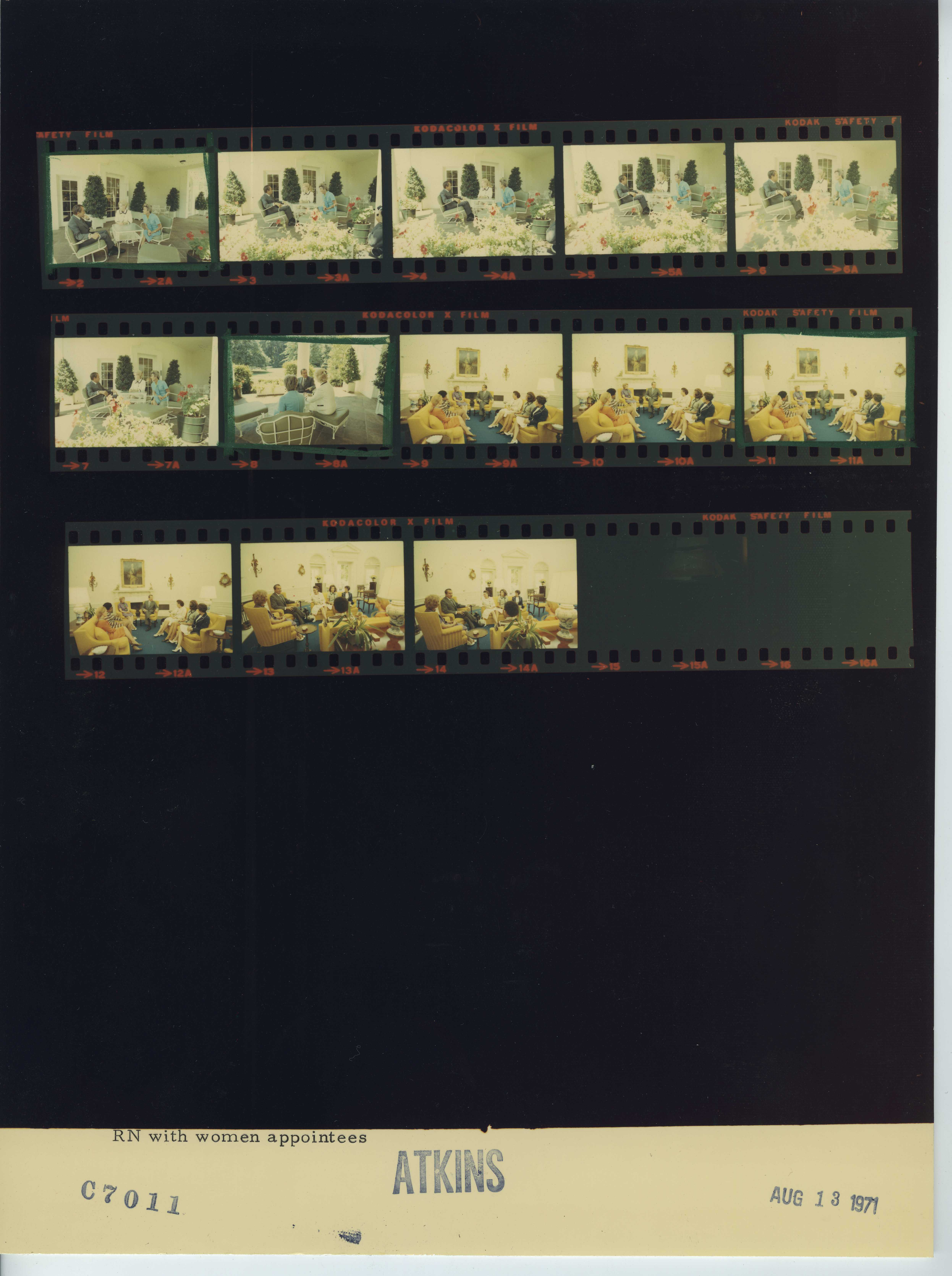
- Frame(s): WHPO-7011-02A-08A, President Nixon seated in the Rose Garden patio during a meeting with Jayne Spain and Pat Hitt, Assistant Secretary of Health, Education and Welfare (HEW). 8/13/1971, Washington, D.C. Rose Garden patio, White House, Oval Office. President Nixon, Jayne Spain, Patricia Hitt.
- Frame(s): WHPO-7011-09A-14A, President Nixon seated in the Oval Office during a meeting with top women appointees, Jayne Spain, Patricia Hitt, Helen Bentley, Barbara Franklin, Elizabeth Hanford, Nancy Hanks, Sallyanne Payton, and Ethel Walsh. 8/13/1971, Washington, D.C. White House, Oval Office. President Nixon, Jayne Spain, Patricia Hitt, Helen Bentley, Barbara Franklin, Elizabeth Hanford, Nancy Hanks, Sallyanne Payton, Ethel Walsh.
- Frame(s): WHPO-7011-11A, President Nixon seated in the Oval Office during a meeting with top women appointees, Jayne Spain, Patricia Hitt, Helen Bentley, Barbara Franklin, Elizabeth Hanford, Nancy Hanks, Sallyanne Payton, and Ethel Walsh. 8/13/1971, Washington, D.C. White House, Oval Office. President Nixon, Jayne Spain, Patricia Hitt, Helen Bentley, Barbara Franklin, Elizabeth Hanford, Nancy Hanks, Sallyanne Payton, Ethel Walsh.
Roll WHPO-7012 Photographer: Kightlinger, Jack | Color or B&W: Color
- Frame(s): WHPO-7012-03-12, TV crew members positioning Pat Nixon for an interview. 8/13/1971, Washington, D.C. White House, Library, Vermeil Room. Pat Nixon, unidentified men, woman, TV crews.
- Frame(s): WHPO-7012-13-15, Pat Nixon standing with unidentified men. 8/13/1971, Washington, D.C. White House, Library, Vermeil Room. Pat Nixon, unidentified men, woman, TV crews.
- Frame(s): WHPO-7012-16-17, Pat Nixon seated with a woman prior to a television interview. 8/13/1971, Washington, D.C. White House, Library, Vermeil Room. Pat Nixon, unidentified men, woman, TV crews.
Roll WHPO-7013 Photographer: Kightlinger, Jack | Color or B&W: B&W
- Frame(s): WHPO-7013-03-13, Pat Nixon standing with art curator Clement Conger and Mr. & Mrs. Segal. 8/13/1971, Washington, D.C. White House. Pat Nixon, Clement E. Conger, Mr. & Mrs. Segal.
- Frame(s): WHPO-7013-14-21, Preparations for an interview with Pat Nixon. 8/13/1971, Washington, D.C. White House. unidentified persons.
The White House Communications Agency Videotape Collection contains “off-the-air” recordings of televised programs produced between 1968 and 1974. Visit the finding aid to learn more.
- WHCA-4580
"The David Frost Show" Peace Corps Director Joseph Blatchford. Dr. Jerome Jaffe, Director of Richard Nixon's Anti-Drug program.
WTOP-TV
Runtime: 01:30:57
Context (External Sources)
The Vanderbilt Television News Archive is the world's most extensive and complete archive of television news. They have been recording, preserving and providing access to television news broadcasts of the national networks since August 5, 1968.
Wikipedia is a free encyclopedia that anyone can edit.