
Introduction
This almanac page for Tuesday, April 4, 1972, pulls together various records created by the federal government and links to additional resources which can provide context about the events of the day.
Previous Date: Monday, April 3, 1972
Next Date: Wednesday, April 5, 1972
Schedule and Public Documents
The Daily Diary files represent a consolidated record of the President's activities. Visit the finding aid to learn more.
The President's day began at The White House - Washington, D. C.
The Weekly Compilation of Presidential Documents made available transcripts of the President's news conferences; messages to Congress; public speeches, remarks, and statements; and other Presidential materials released by the White House.
Digitized versions can be found at HathiTrust.
Each Public Papers of the Presidents volume contains the papers and speeches of the President of the United States that were issued by the White House Office of the Press Secretary during the time period specified by the volume. The material is presented in chronological order, and the dates shown in the headings are the dates of the documents or events. In instances when the release date differs from the date of the document itself, that fact is shown in the text note.
To ensure accuracy, remarks have been checked against audio recordings (when available) and signed documents have been checked against the original, unless otherwise noted. Editors have provided text notes and cross references for purposes of identification or clarity.
The Federal Register is the official daily publication for rules, proposed rules, and notices of federal agencies and organizations, as well as executive orders and other Presidential documents.
The Congressional Record is the official daily record of the debates and proceedings of the U.S. Congress.
Archival Holdings
Any selection of archival documents will necessarily be partial. You should use the documents and folders identified below as a starting place, but consult the linked collection finding aids and folder title lists and the collections themselves for context. Many documents to be found this way do not lend themselves to association with specific dates, but are essential to a complete understanding of the material.
Selective document listing
President's Office Files
The President's Office Files consists of materials drawn together by the Special Files Unit from several administrative subdivisions within the White House Office. It is the handwriting and sensitive papers sent to the Staff Secretary that now comprise much of the President's Office Files. Visit the finding aid to learn more.
- News Summaries, Annotated News Summaries, Box 35, April 1-11, 1972 [2 of 4] [Note: Due to the way News Summary products were compiled, you should also consult nearby days for potentially relevant materials.]
- News Summary, April 4, 1972, (Monday nets, wires, mags)
- News Summaries, Annotated News Summaries, Box 35, April 1-11, 1972 [3 of 4]
- Special Report: Wisconsin Primary and Other Politics, April 4, 1972, NBC (10:30-11pm)
The H. R. Haldeman Diaries consists of seven handwritten diaries, 36 dictated diaries recorded as sound recordings, and two handwritten audio cassette tape subject logs. The diaries and logs reflect H. R. Haldeman’s candid personal record and reflections on events, issues, and people encountered during his service in the Nixon White House. As administrative assistant to the President and Chief of Staff, Haldeman attended and participated in public events and private meetings covering the entire scope of issues in which the Nixon White House engaged in during the years 1969-1973. Visit the finding aid to learn more.
- Transcript of diary entry (PDF)
Tuesday, April 4.
Well, we're back at the Catholic speech again today. Problem still being to decide whether to go and if so what to say. President wanted Ehrlichman to get on top of it, have him go over to Connally and get his view, but Connally got sick and went home. Meanwhile, Ehrlichman saw the opportunity to drop the whole speech but Colson kept fighting and the net result by the end of the day was we were back with a speech that's probably going to be acceptable, but I still won't go ahead and schedule it, we'll wait for tomorrow morning.
Got into several political discussions, President's concerned that we've got to get moving on the attack, that we should have someone attacking Muskie as a defeatist because he's saying that we shouldn't react to the Vietnam attack by the enemy. He thinks we should get Tower or someone to hit him on this, that we shouldn't let him build that line about just getting out of Vietnam. That it shows no concern for the POW's or protection for the 70,000 Gl's that are still there. We make the point that the President has the responsibility for these people and that our continued withdrawal can only go if South Vietnam is able to hold. He told me to call Hersch-- Bruce Herschensohn at the USIA and tell him the President stood behind him and very-- was very pleased with what he'd done in attacking Fulbright and resigning from the USIA.
He's concerned that we really move on tying the Democrats to big business with the contributions to Humphrey in '68, the deals Muskie's made, the antitrust fixes in the previous administration, the use of ITT airplanes, and all that sort of stuff. We met with Mitchell today and went over the key-state things but the main discussion was on whether to move the Convention. Mitchell has now concluded that we probably should move it to Miami. We'll base it on the problem with the arena in San Diego, but actually Mitchell's main reason is the cost figure and the demonstration probability.
President's also concerned about giving our list of contributors out, thought we should try to work out a better statement than we're using. I talked with Mitchell about that and he feels that we've got to stay with exactly what we've got and just play it cool, that the President should relax and not worry about it.
The President came out with a plea today that we cut off Osborne and Sidey completely, primarily because of the stuff in the news summary pointing out their adverse reaction to his press conference. He thinks we should spend the time that's now spent seeing them on seeing the guys that are favorable to us.
The Vietnam action goes on today. President has moved in quite strongly according to Henry in taking control. He really banged Moorer around yesterday on the Air Force's inability to get moving. Problem is they keep saying that the weather is such that they can't bomb. The President's massing a huge attack force, Naval ships for gunning from the sea, and tremendous number of additional bombers, and he's going to start using B-52s for the first time to bomb North Vietnam as soon as the weather clears. We'll base the bombing on the violation of the DMZ and move in hard. He feels that this will give us a fairly good chance at negotiations, which he has never really felt we've had up to now, but thinks they're doing this as a desperation move and then will go to negotiate. Henry has the same view.
End of April 4. - Original audio recording (MP3)
The National Archives Catalog is the online portal to the records held at the National Archives, and information about those records. It is the main way of describing our holdings and also provides access to electronic records and digitized versions of our holdings.
The Catalog searches across multiple National Archives resources at once, including archival descriptions, digitized and electronic records, authority records, and web pages from Archives.gov and the Presidential Libraries. The Catalog also allows users to contribute to digitized historical records through tagging and transcription.
Nixon Library Holdings
All National Archives Units
National Security Documents
The President's Daily Brief is the primary vehicle for summarizing the day-to-day sensitive intelligence and analysis, as well as late-breaking reports, for the White House on current and future national security issues. Read "The President's Daily Brief: Delivering Intelligence to Nixon and Ford" to learn more.
The Foreign Relations of the United States series presents the official documentary historical record of major U.S. foreign policy decisions and significant diplomatic activity. Visit the State Department website for more information.
Vol. VIII, Vietnam, January-October 1972
The Easter Offensive, March 30-May 7, 1972
55. Telephone Conversation Between President Nixon and the Chairman of the Joint Chiefs of Staff (Moorer), Washington, April 4, 1972
Source: National Archives, Nixon Presidential Materials, White House Tapes, White House Telephone, Conversation 22–73. No classification marking. The editors transcribed the portions of the tape recording printed here specifically for this volume. According to the President’s Daily Diary, Nixon and Moorer spoke on the phone from 9:24 to 9:28 a.m. (Ibid., White House Central Files)
56. Summary of Conclusions of a Washington Special Actions Group Meeting, Washington, April 4, 1972, 10:50-11:47 a.m.
Source: Library of Congress, Manuscript Division, Kissinger Papers, Box TS 78, National Security Council, Committees and Panels, Washington Special Actions Group, Mar. 1971–Apr. 1972. Top Secret; Sensitive. The meeting took place in the White House Situation Room.
57. Conversation Between President Nixon and the President’s Assistant for National Security Affairs (Kissinger), Washington, April 4, 1972
Source: National Archives, Nixon Presidential Materials, White House Tapes, Oval Office, Conversation 701–14. No classification marking. The editors transcribed the portions of the tape recording printed here specifically for this volume. The transcript is part of a larger conversation, 12:13–1:15 p.m.
58. Conversation Between President Nixon and the President’s Assistant for National Security Affairs (Kissinger), Washington, April 4, 1972
Source: National Archives, Nixon Presidential Materials, White House Tapes, Oval Office, Conversation 701–17. No classification marking. The editors transcribed the portions of the tape recording printed here specifically for this volume. The transcript is part of a larger conversation, 1:17–1:32 p.m. Portions of the transcript are printed in Foreign Relations, 1969–1976, volume XIV, Soviet Union, October 1971–May 1972, Document 82.
59. Conversation Between President Nixon and the President’s Assistant for National Security Affairs (Kissinger), Washington, April 4, 1972
Source: National Archives, Nixon Presidential Materials, White House Tapes, Oval Office, Conversation 702–7. No classification marking. The editors transcribed the portions of the tape recording printed here specifically for this volume. The transcript is part of a larger conversation, 3:45–5:06 p.m.
60. Memorandum From Philip A. Odeen of the National Security Council Staff to Richard T. Kennedy and John D. Negroponte of the National Security Council Staff, Washington, April 4, 1972
Source: National Archives, Nixon Presidential Materials, NSC Files, Box 96, Vietnam Subject Files, Air Activity in Southeast Asia, Vol. III, January–August 1972. Secret. On a covering note, Odeen wrote: “John—Some random thoughts on SEA. Pass on to all if you think it would be helpful.” Haig agreed that the memorandum should be circulated.
Vol. XIV, Soviet Union, October 1971-May 1972
U.S.-Soviet Relations and the Spring Offensive in Vietnam, March 30-April 18, 1972
82. Conversation Between President Nixon and his Assistant for National Security Affairs (Kissinger), Washington, April 4, 1972
Source: National Archives, Nixon Presidential Materials, White House Tapes, Oval Office, Conversation No. 701–17. No classification marking. According to his Daily Diary, Nixon met with Kissinger in the Oval Office from 1:17 to 1:32 p.m. (Ibid., White House Central Files) The editors transcribed the portion of the conversation printed here specifically for this volume.
Vol. XX, Southeast Asia, 1969-1972
Thailand
158. Letter From the Assistant Secretary of State for East Asian and Pacific Affairs (Green) to the Ambassador to Thailand (Unger), Washington, April 4, 1972
Source: National Archives, RG 59, Marshall Green Files: Lot 74 D 471, Box 13826, Department Correspondence, April 1972 Folder. Secret; Eyes Only; Official–Informal. Drafted by Hummel.
Vol. XXXII, SALT I, 1969-1972
Narrowing the Issues, October 19, 1971-April 18, 1972
250. Conversation Among President Nixon, the President’s Assistant for National Security Affairs (Kissinger), Secretary of Defense Laird, and the Secretary of the Navy (Chafee), Washington, April 4, 1972
Source: National Archives, Nixon Presidential Materials, White House Tapes, Oval Office, Conversation No. 701–14. No classification marking. According to the President’s Daily Diary, Nixon met with Kissinger, Laird, and Chafee from 12:25 to 1:15 p.m. (Ibid., White House Central Files) The editor transcribed the portion of the conversation printed here specifically for this volume.
251. Backchannel Message From the Chief of the Delegation to the Strategic Arms Limitation Talks (Smith) to the President’s Assistant for National Security Affairs (Kissinger), Helsinki, April 4, 1972
Source: Washington National Records Center, RG 330, ACDA Files, FRC 330 383–97–0010, Box 1, Director’s Files, Smith Files, Smith–White House Correspondence, SALT, March–May 1972. Top Secret; Sensitive; Exclusive Eyes Only. The text printed here is the copy Smith approved and has the message number, “#0283”, handwritten on it. At the top of the first page, Smith wrote, “Pres. confirms Sov wrong interp[retation] press conf[erence].” A stamped notation on another copy indicates the message was received at the White House at 1743Z. (National Archives, Nixon Presidential Materials, NSC Files, Box 427, Backchannel Files, Backchannel Messages, 1972 SALT) Sonnenfeldt and Odeen sent Smith’s message to Kissinger under an April 4 covering memorandum that included a proposed response that reads: “You should proceed with putting SL/ABM package to Semyonov on April 6 in accordance with NSDM 158.” Kissinger initialed his approval of the response. (Ibid.)
Vol. XXXIX, European Security
Moscow Summit, December 1971-May 1972
88. Transcript of Telephone Conversation Between Secretary of State Rogers and the President’s Assistant for National Security Affairs (Kissinger), Washington, April 4, 1972, 10:45 a.m.
Source: National Archives, Nixon Presidential Materials, Henry A. Kissinger Telephone Transcripts (Telcons), Box 13, Chronological File. No classification marking.
Vol. XLI, Western Europe; NATO, 1969-1972
United Kingdom
349. Message From President Nixon to British Prime Minister Heath, Washington, April 4, 1972
Source: National Archives, Nixon Presidential Materials, NSC Files, Box 764, Presidential Correspondence, United Kingdom Prime Minister Edward Heath. Confidential. The message was sent “via Cabinet Line.”
Vol. E-7, Documents on South Asia, 1969-1972
U.S. Relations with India and Pakistan, 1972
245. Telegram 2923 From the Embassy in Pakistan to the Department of State, Islamabad, April 4, 1972, 0708Z
Chargé Sober questioned Pakistani President Bhutto about the request for arms put forward in Washington by Secretary General Ahmed. Bhutto said he did not expect a reply on the bulk of the request until after the U.S. presidential election, but added that the need for spare parts to keep old equipment operational was pressing.
Source: National Archives, RG 59, Central Files 1970–73, POL INDIA–PAK. Secret; Exdis. Repeated to New Delhi.
Bangladesh, December 1971-December 1972
418. Letter From President Nixon to Bangladesh Prime Minister Rahman, Washington, April 4, 1972
Nixon wrote to accord U.S. recognition to Bangladesh.
Source: National Archives, Nixon Presidential Materials, NSC Files, Box 748, Presidential Correspondence File, Bangladesh. No classification marking. The text of the letter was transmitted to Dacca on April 5 in telegram 58480. (Ibid.) Secretary Rogers announced the recognition of Bangladesh at a press briefing on April 4. (Circular telegram 57428 to eight posts in South Asia, Moscow and London, April 4; ibid., RG 59, Central Files 1970–73, POL 16 BANGLADESH) Mujibur Rahman sent a letter to Nixon on April 9 in which he warmly acknowledged the recognition accorded his country. (Telegram 1301 from Dacca, April 13; ibid.) Consul General Spivack was designated Chargé d’ Affaires ad interim of the new Embassy. (Memorandum from Davis to Eliot, April 6; ibid., Nixon Presidential Materials, NSC Files, Box 591, Country Files, Middle East, Bangladesh)
Vol. E-10, Documents on American Republics, 1969-1972
Bolivia
111. National Security Decision Memorandum 160, Washington, April 4, 1972., Washington, April 4, 1972
President Nixon approved $20 million of U.S. AID funds for additional economic assistance for Bolivia without its acceptance of an IMF standby agreement. He also approved the 3 to 4 year MAP.
Source: National Archives, Nixon Presidential Materials, NSC Files, NSC Institutional Files (H-Files), Box H–232, NSDM Files, NSDM 160. A copy was sent to the Secretary of the Treasury. The recommendations of the Bolivian request for modern military aircraft are in Tab B of Document 112. The progress report has not been found.
Vol. E-16, Documents on Chile, 1969-1973
Cool and Correct: The U.S. Response to the Allende Administration, November 5, 1970-December 31, 1972
105. Memorandum Prepared in the Office of National Estimates, Central Intelligence Agency, Washington, April 4, 1972
Summary: This Office of National Estimates’s assessment of the first year and a half of Allende’s Presidency noted the resiliency of the Chilean political system, but argued that recent developments indicated a movement away from conciliation and toward confrontation.
Source: Central Intelligence Agency, Office of the Director of Central Intelligence, Job 80B01086A: White House Correspondence Files, Box 12, Chile, Office of National Estimates. Secret.106. Paper Prepared for the Senior Review Group by the Ad Hoc Interagency Working Group on Chile, Washington, April 4, 1972
Summary: This paper prepared for the Senior Review Group examined the political and economic developments in Chile during Allende’s term in office. It highlighted the deteriorating economic situation and the international Communist stake in seeing Allende’s socialist revolution succeed. The final third of the paper outlined the various U.S. policy options available.
Source: National Archives, Nixon Presidential Materials, NSC Files, NSC Institutional Files (H-Files), Box H–64, SRG Meetings, Chile 4/11/72. Secret, Sensitive; Nodis. Annexes A and B are attached but not published.
The Kissinger telephone conversation transcripts consist of approximately 20,000 pages of transcripts of Kissinger’s telephone conversations during his tenure as Assistant to the President for National Security Affairs (1969-1974) and Secretary of State (1973-1974) during the administration of President Richard Nixon. Visit the finding aid for more information.
Digitized versions can be found in the National Archives Catalog.
Audiovisual Holdings
Visit the White House Tapes finding aid to learn about the taping system's operation and archival processing.
Old Executive Office Building
- 329-1; Unknown between 8:15 p.m. & 8:45 p.m.; Nixon, Richard M. (President); Sanchez, Manolo
- 329-2; Unknown between 8:15 p.m. & 8:45 p.m.; [Unknown person(s)]; Sanchez, Manolo
- 329-3; Unknown between 8:15 p.m. & 8:45 p.m.; Nixon, Richard M. (President); Sanchez, Manolo
- 329-4; Unknown between 8:15 p.m. & 8:45 p.m.; Nixon, Richard M. (President)
- 329-5; Unknown between 8:15 p.m. & 8:45 p.m.; Nixon, Richard M. (President); Andrews, John K., Jr.
- 329-6; Unknown between 8:15 p.m. & 8:45 p.m.; Nixon, Richard M. (President)
- 329-7; Unknown between 8:15 p.m. & 8:45 p.m.; Nixon, Richard M. (President)
- 329-8; Unknown between 8:15 p.m. & 8:45 p.m.; Nixon, Richard M. (President); White House operator
- 329-9; 8:45 p.m. - 8:50 p.m.; Nixon, Richard M. (President); Kissinger, Henry A.
- 329-10; Unknown between 8:50 p.m. & 9:42 p.m.; Nixon, Richard M. (President)
- 329-11; Unknown between 8:50 p.m. & 9:42 p.m.; Nixon, Richard M. (President)
- 329-12; Unknown between 8:50 p.m. & 9:42 p.m.; Nixon, Richard M. (President); Sanchez, Manolo
Oval Office
- 701-1; Unknown between 8:31 a.m. & 9:05 a.m.; Nixon, Richard M. (President); [Unknown person(s)]
- 701-2; 9:05 a.m. - 9:43 a.m.; Nixon, Richard M. (President); Butterfield, Alexander P.; Haldeman, H. R. ("Bob"); Kissinger, Henry A.; White House operator; Moorer, Thomas H. (Adm.)
- 701-3; 9:44 a.m. - 10:08 a.m.; Nixon, Richard M. (President); Haldeman, H. R. ("Bob"); Bull, Stephen B.; Kissinger, Henry A.
- 701-4; Unknown between 10:08 a.m. & 10:09 a.m.; Nixon, Richard M. (President); Bull, Stephen B.
- 701-5; 10:09 a.m. - 10:43 a.m.; Nixon, Richard M. (President); Ingersoll, Robert S.; Kissinger, Henry A.; Bull, Stephen B.; White House photographer
- 701-6; Unknown between 10:43 a.m. & 10:45 a.m.; Nixon, Richard M. (President); Bull, Stephen B.
- 701-7; Unknown between 10:43 a.m. & 10:45 a.m.; Nixon, Richard M. (President); White House operator
- 701-8; 10:45 a.m. - 10:46 a.m.; Nixon, Richard M. (President); Shultz, George P.
- 701-9; 10:46 a.m. - 11:46 a.m.; Nixon, Richard M. (President); Haldeman, H. R. ("Bob"); Eisenhower, Julie Nixon; [Unknown person(s)]; Bull, Stephen B.
- 701-10; 11:46 a.m. - 11:58 a.m.; Nixon, Richard M. (President); Murray, Robert P.; Hathaway, Harry; McLin, Walter S., III; Eger, John Mitchell; Gray, L[ouis] Patrick, III; Scowcroft, Brent G. (Gen.); White House photographer
- 701-11; Unknown between 11:58 a.m. & 12:11 p.m.; Nixon, Richard M. (President); Bull, Stephen B.; Butterfield, Alexander P.; Dystel, Oscar; Jaffe, Markus; Schulman, Samuel; Wilson, Richard L.; Klein, Herbert G.; White House photographer
- 701-12; Unknown between 12:11 p.m. & 12:12 p.m.; Nixon, Richard M. (President); Bull, Stephen B.
- 701-13; 12:12 p.m. - 12:13 p.m.; Nixon, Richard M. (President); Bull, Stephen B.; McClintock, LynRae; Strachan, Gordon C.
- 701-14; 12:13 p.m. - 1:15 p.m.; Nixon, Richard M. (President); Kissinger, Henry A.; [Unknown person(s)]; Chafee, John H.; White House photographer; Kissinger, Henry A.; Ziegler, Ronald L.; Laird, Melvin R.
- 701-15; Unknown between 1:15 p.m. & 1:17 p.m.; Nixon, Richard M. (President); Kissinger, Henry A.
- 701-16; Unknown between 1:15 p.m. & 1:17 p.m.; Nixon, Richard M. (President); Sanchez, Manolo
- 701-17; 1:17 p.m. - 1:32 p.m.; Nixon, Richard M. (President); Kissinger, Henry A.
- 702-1; Unknown between 2:47 p.m. & 2:55 p.m.; Nixon, Richard M. (President); Bull, Stephen B.
- 702-2; Unknown between 2:47 p.m. & 3:11 p.m.; Nixon, Richard M. (President); Haldeman, H. R. ("Bob"); Ziegler, Ronald L.; [Unknown person(s)]
- 702-3; 3:11 p.m. - 3:12 p.m.; Nixon, Richard M. (President); Butterfield, Alexander P.
- 702-4; Unknown between 3:12 p.m. & 3:45 p.m.; Nixon, Richard M. (President); Andrews, John K., Jr.
- 702-5; Unknown between 3:12 p.m. & 3:45 p.m.; Nixon, Richard M. (President); Bull, Stephen B.
- 702-6; Unknown between 3:12 p.m. & 3:45 p.m.; Nixon, Richard M. (President); Butterfield, Alexander P.
- 702-7; 3:45 p.m. - 5:06 p.m.; Nixon, Richard M. (President); Kissinger, Henry A.; Butterfield, Alexander P.; Mitchell, John N.; Haldeman, H. R. ("Bob"); Sanchez, Manolo; Lucet, Charles; White House photographer
- 702-8; Unknown between 5:06 p.m. & 5:08 p.m.; Nixon, Richard M. (President); Bull, Stephen B.
- 702-9; 5:08 p.m. - 6:01 p.m.; Nixon, Richard M. (President); Kirk, Russell A.; Butterfield, Alexander P.; White House photographer; Sanchez, Manolo; Bull, Stephen B.; Kirk, Annette
- 702-10; 6:01 p.m. - 6:18 p.m.; Nixon, Richard M. (President); Ziegler, Ronald L.; Haldeman, H. R. ("Bob")
- 702-11; Unknown between 6:18 p.m. & 8:13 p.m.; United States Secret Service agents
White House Telephone
- 22-72; Unknown between 9:08 a.m. & 9:24 a.m.; Nixon, Richard M. (President); White House operator
- 22-73; 9:24 a.m. - 9:28 a.m.; Nixon, Richard M. (President); Moorer, Thomas H. (Adm.)
- 22-74; 10:44 a.m. - 10:44 a.m.; Nixon, Richard M. (President); White House operator
- 22-75; 10:45 a.m. - 10:46 a.m.; Nixon, Richard M. (President); Shultz, George P.
- 22-76; Unknown between 8:15 p.m. & 8:45 p.m.; Nixon, Richard M. (President); White House operator
- 22-77; 8:45 p.m. - 8:50 p.m.; Nixon, Richard M. (President); Kissinger, Henry A.
The White House Photo Office collection consists of photographic coverage of President Richard Nixon meeting with prominent social, political, and cultural personalities; speaking engagements and news conferences of the President and various high-ranking members of the White House staff and Cabinet; Presidential domestic and foreign travel, including Presidential vacations; social events and entertainment involving the First Family, including entertainers present; official portraits of the President, First Family, and high-ranking members of the Nixon administration; the 1969 and 1973 Inaugurals; the President’s 1972 Presidential election campaign appearances (including speeches) and other official activities of the White House staff and the President’s Cabinet from January 20, 1969 until August 9, 1974 at the White House and the Old Executive Office Building; other locations in Washington, DC, such as The Mall; and the Presidential retreats in Camp David, Maryland, Key Biscayne, Florida, and San Clemente, California. Visit the finding aid to learn more.
Roll WHPO-8811 Photographer: Kightlinger, Jack | Color or B&W: Color
- Frame(s): WHPO-8811-, A chart map showing Nixon's forthcoming May 1972 trip to Russia. 4/4/1972, Washington, D.C. unknown.
Roll WHPO-8812 Photographer: Atkins, Oliver | Color or B&W: B&W
- Frame(s): WHPO-8812-01, President Nixon and an unidentified man reflected at a distance in a mirror. 4/4/1972, Washington, D.C. White House, Oval Office and unknown room. President Nixon, unidentified man.
- Frame(s): WHPO-8812-02-04, President Nixon shaking hands and standing with LynRae McClintock. 4/4/1972, Washington, D.C. White House, Oval Office. President Nixon, LynRae McClintock, John Chafee, Melvin Laird, Henry Kissinger.
- Frame(s): WHPO-8812-06-09, President Nixon shaking hands and standing with John Chafee, and Melvin Laird. 4/4/1972, Washington, D.C. White House, Oval Office. President Nixon, LynRae McClintock, John Chafee, Melvin Laird, Henry Kissinger.
- Frame(s): WHPO-8812-10-11, President Nixon seated at his desk during a meeting with John Chafee, Melvin Laird, and Henry Kissinger. 4/4/1972, Washington, D.C. White House, Oval Office. President Nixon, LynRae McClintock, John Chafee, Melvin Laird, Henry Kissinger.
Roll WHPO-8813 Photographer: Atkins, Oliver | Color or B&W: B&W
- Frame(s): WHPO-8813-, President Nixon receiving a leather-bound edition of the Bantam book, "The President's Far East Tour," from a group of editors. 4/4/1972, Washington, D.C. White House, Oval Office. President Nixon, Oscar Dystel, Markus Jaffe, Samuel Schulman, Richard Wilson, Herb Klein.
- Frame(s): WHPO-8813-04A, President Nixon receiving a leather-bound edition of the Bantam book, "The President's Far East Tour," from a group of editors. 4/4/1972, Washington, D.C. White House, Oval Office. President Nixon, Oscar Dystel, Markus Jaffe, Samuel Schulman, Richard Wilson, Herb Klein.
- Frame(s): WHPO-8813-18A, President Nixon standing at his Oval Office desk. Mirror view from outside the doorway. 4/4/1972, Washington, D.C. White House, Oval Office. President Nixon.
Roll WHPO-8814 Photographer: Schumacher, Karl | Color or B&W: B&W
- Frame(s): WHPO-8814-, Pat Price receiving various gifts from an unidentified group of young people. 4/4/1972, Washington, D.C. unknown. Pat Price, unidentified young men and women, unidentified man.
Roll WHPO-8815 Photographer: Knudsen, Robert L. | Color or B&W: B&W
- Frame(s): WHPO-8815-, President Nixon shaking hands with members of the American Bar Association's Young Lawyer's Section. President Nixon seated with the lawyers and with Administration officials. 4/4/1972, Washington, D.C. White House, Oval Office. President Nixon, Walter McLin, III, Robert Murray, Harry Hathaway, Mitchell, Scowcroft, L. Patrick Gray, III.
Roll WHPO-8816 Photographer: Atkins, Oliver | Color or B&W: B&W
- Frame(s): WHPO-8816-, President Nixon shaking hands with U.S. ambassador to Japan Robert Ingersoll. 4/4/1972, Washington, D.C. White House, Oval Office. President Nixon, Robert Ingersoll.
Roll WHPO-8817 Photographer: Schumaker, Byron | Color or B&W: Color
- Frame(s): WHPO-8817-, President Nixon standing and talking with Bantam Books editors. 4/4/1972, Washington, D.C. White House, Oval Office. President Nixon, Oscar Dystel, Markus Jaffe, Samuel Schulman, Richard Wilson, Herb Klein.
Roll WHPO-8818 Photographer: Atkins, Oliver | Color or B&W: B&W
- Frame(s): WHPO-8818-, President Nixon seated at his desk with Ambassador to Japan Robert S. Ingersoll and National Security Advisor Henry Kissinger. 4/4/1972, Washington, D.C. White House, Oval Office. President Nixon, Robert S. Ingersoll, Henry Kissinger.
- Frame(s): WHPO-8818-03, President Nixon seated at his desk with Ambassador to Japan Robert S. Ingersoll and National Security Advisor Henry Kissinger. 4/4/1972, Washington, D.C. White House, Oval Office. President Nixon, Robert S. Ingersoll, Henry Kissinger.
Roll WHPO-8819 Photographer: Schumacher, Karl | Color or B&W: Color
- Frame(s): WHPO-8819-, Judy Agnew in various poses wearing a Red Cross nurse's outfit and then a regular dress. 4/4/1972, Washington, D.C. unknown. Judy Agnew.
- Frame(s): WHPO-8819-00A, Portrait of Judy Agnew wearing a Red Cross nurse's uniform. 4/4/1972, Washington, D.C. unknown. Judy Agnew.
- Frame(s): WHPO-8819-12A, Portrait of Judy Agnew wearing a red dress. 4/4/1972, Washington, D.C. unknown. Judy Agnew.
Roll WHPO-8820 Photographer: Schumacher, Karl | Color or B&W: B&W
- Frame(s): WHPO-8820-, Judy Agnew in various poses wearing a Red Cross nurse's outfit and then a regular dress. 4/4/1972, Washington, D.C. unknown. Judy Agnew.
Roll WHPO-8821 Photographer: Schumacher, Karl | Color or B&W: B&W
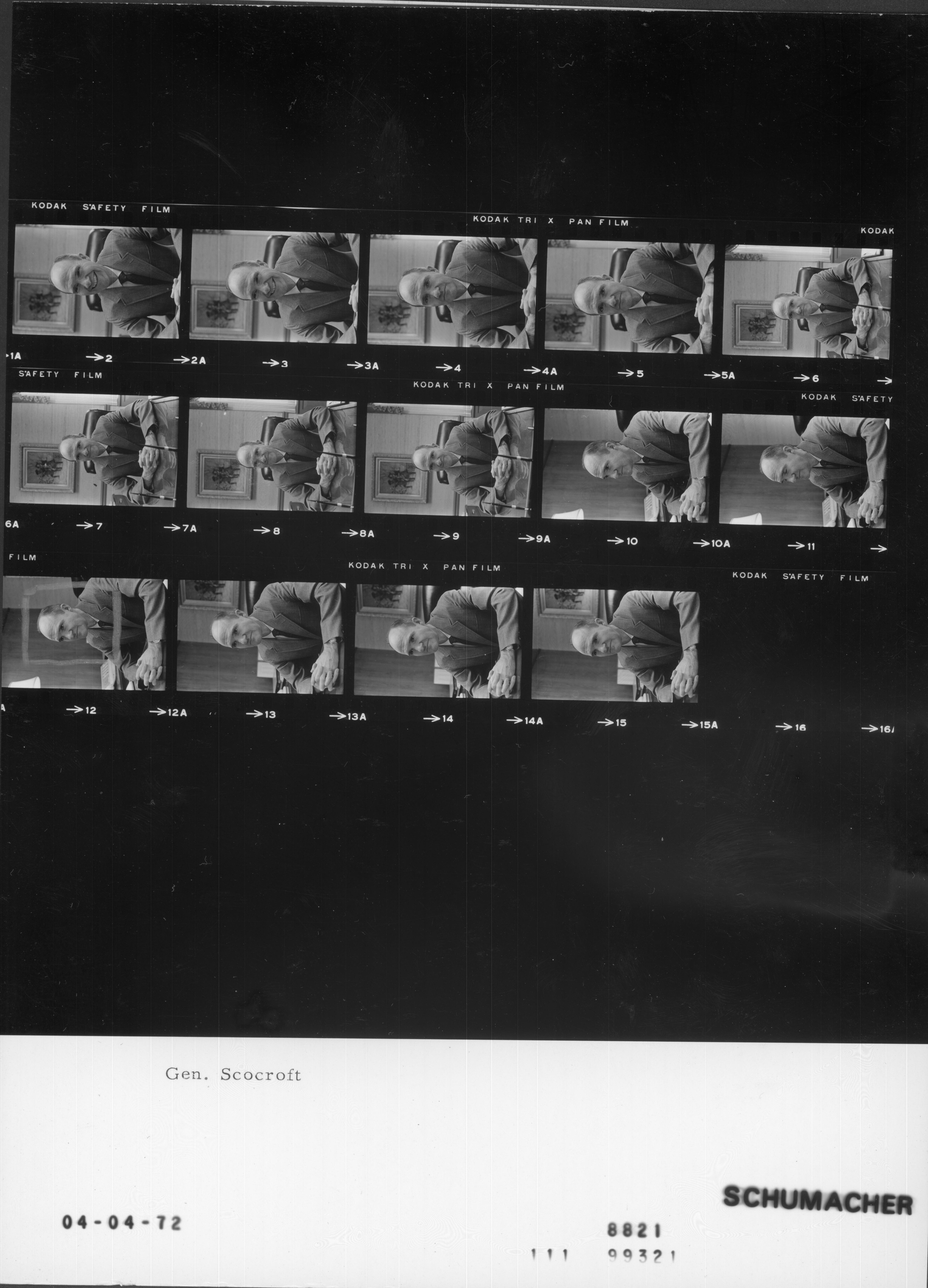
- Frame(s): WHPO-8821-, Formal Portrait of Brigadier General Brent Scowcroft at a desk. 4/4/1972, Washington, D.C. unknown. Gen. Brent Scowcroft.
- Frame(s): WHPO-8821-12, Formal Portrait of Brigadier General Brent Scowcroft at a desk. 4/4/1972, Washington, D.C. unknown. Gen. Brent Scowcroft.
Roll WHPO-8822 Photographer: Knudsen, Robert L. | Color or B&W: B&W
- Frame(s): WHPO-8822-, President Nixon shaking hands with departing French ambassador Charles Lucet. 4/4/1972, Washington, D.C. Oval Office. President Nixon, Charles Lucet.
Roll WHPO-8823 Photographer: Atkins, Oliver | Color or B&W: B&W
- Frame(s): WHPO-8823-, President Nixon standing with Russell Kirk. 4/4/1972, Washington, D.C. Oval Office. President Nixon, Russell Kirk.
- Frame(s): WHPO-8823-05A, President Nixon standing with Russell Kirk. 4/4/1972, Washington, D.C. Oval Office.
Roll WHPO-8824 Photographer: Atkins, Oliver | Color or B&W: B&W
- Frame(s): WHPO-8824-, President Nixon standing with Russell Kirk and Mrs. Kirk. 4/4/1972, Washington, D.C. Oval Office. President Nixon, Russell Kirk, Mrs. Russell Kirk.
Roll WHPO-8825 Photographer: Kightlinger, Jack | Color or B&W: Color
- Frame(s): WHPO-8825-01-08, Pat Nixon standing and talking with two men and a woman. 4/4/1972, Washington, D.C. White House, Library. Pat Nixon, unidentified men and women.
- Frame(s): WHPO-8825-09-17, Pat Nixon standing and talking with two women, from whom she is receiving a print. 4/4/1972, Washington, D.C. White House, Library. Pat Nixon, unidentified men and women.
Roll WHPO-8835 Photographer: Knudsen, Robert L. | Color or B&W: Color
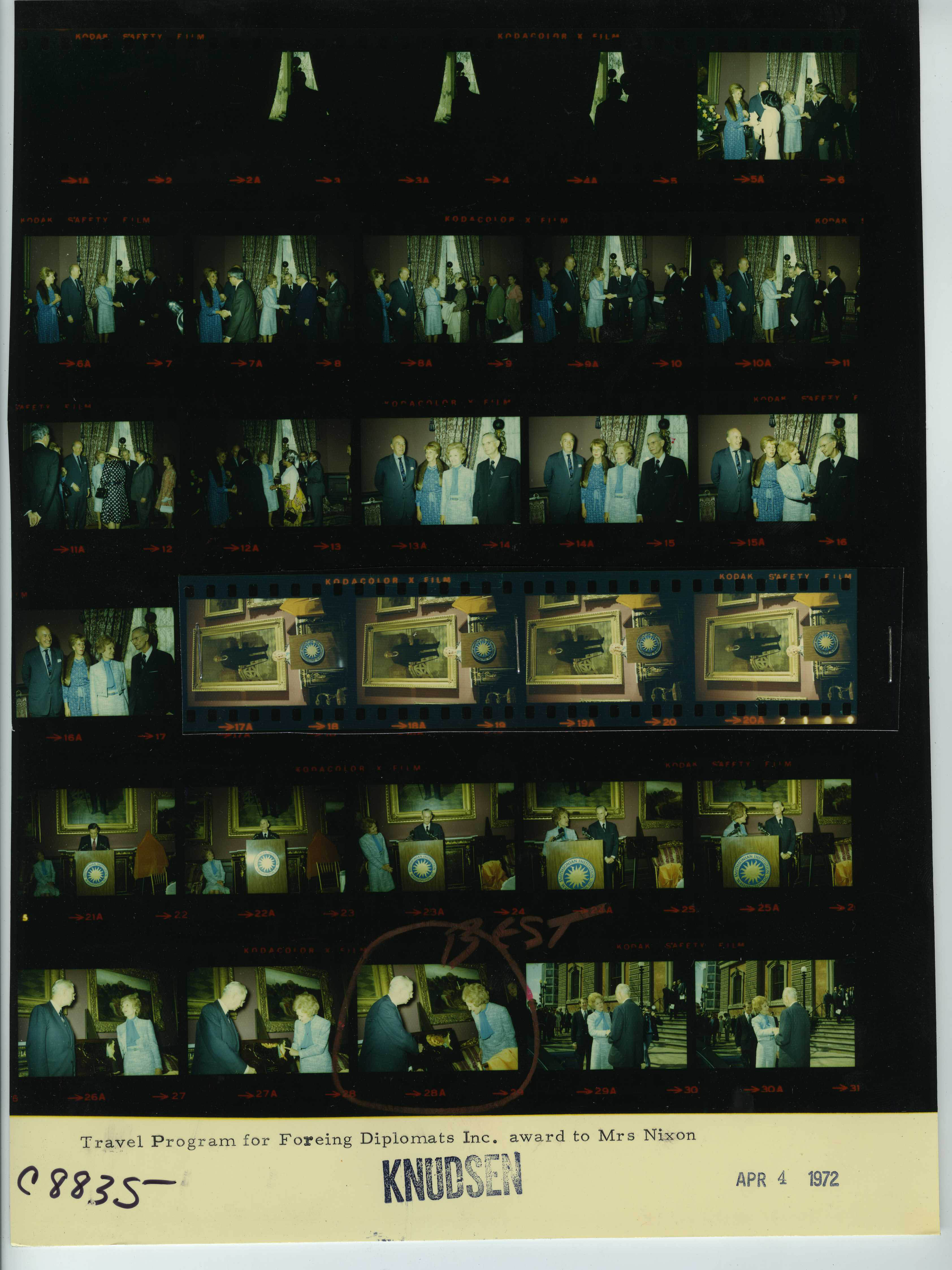
- Frame(s): WHPO-8835-, Pat Nixon in a receiving line with a group, speaking at a podium, receiving an award from the Travel Program for Foreign Diplomats, Inc., and outside the building. 4/4/1972, Washington, D.C. inside and outside, Renwick Gallery. Pat Nixon, unidentified men and women.
The White House Communications Agency Videotape Collection contains “off-the-air” recordings of televised programs produced between 1968 and 1974. Visit the finding aid to learn more.
- WHCA-5253
"Tornado". A Public Service Announcement from the Office of Emergency Preparedness Secretary of the Treasury John B. Connally.
NBC
Runtime: 00:03:04 - WHCA-5254
Wisconsin Primary. Wisconsin Primary
NBC
Runtime: 00:31:33 - WHCA-5255
"Martin Agronsky: Evening Edition" AND "Wisconsin Primary".
NBC
Runtime: 1:00 - WHCA-5256
"Wisconsin Primary".
Undetermined
Runtime: 0:30 - WHCA-5257
"Wisconsin Primary I".
Undetermined
Runtime: 1:00 - WHCA-5263
Weekly News Summary, Tape II.
ALL NETWORKS
Runtime: 01:20:00
12. Communinst offensive. Film report on battle in Quant Tri city and South Vietnamese army preparations. Time Code Start: 35:07. Keywords: Vietnam War. Network: ABC.
13. Film report on battle at Dong Ha in South Vietnam. Time Code Start: 38:46. Keywords: Vietnam War. Network: ABC.
14. Report on Vietnamese casualties during NVA [North Vietnam] offensive. Time Code Start: 41:05. Keywords: Vietnam War, killed in action, KIA, death tolls, fatalities, casualty, casualties, military, troops. Network: ABC.
15. Report on Senator Manfield's request to President Nixon to pull U.S. troops out. Pentagon's assessment of the Communist offensive. Time Code Start: 41:30. Keywords: United States Department of Defense headquarters, Armed Forces, Vietnam War. Network: ABC.
16. Report on the progress of the Paris Peace Talks. Time Code Start: 43:41. Keywords: Paris Peace Talks, Vietnam War, treaty, treaties, negotiations, government, officials. Network: ABC.
17. Voting in Wisconsin primary. The 18 year old vote. Prospects for various Democratic candidates. Time Code Start: 45:24. Keywords: Vote, voters, voting, Presidential elections, campaigns, primaries, voting, revenue, youth, age, laws. Network: ABC.
18. Smith: Commentary on the implications of the Wisconsin primary and tax structure. Time Code Start: 47:28. Keywords: Presidential elections, campaigns, primaries, voting, taxes, taxation, revenue. Network: ABC.
19. Report on the North Vietnamese Army (NVA) offensive. Film from Quang Tri province and Dong Ha. Time Code Start: 49:16. Keywords: North Vietnamese Army, NVA, Vietnam War. Network: NBC.
20. Report on North Vietnamese request for resumption of Peace Talks. Time Code Start: 53:15. Keywords: Paris Peace Talks, Vietnam War, treaty, treaties, negotiations. Network: NBC.
21. Washington comments on the communist offensive, with reports from Pentagon, State Department and White House. Time Code Start: 53:42. Keywords: United States Department of Defense headquarters, Armed Forces, Vietnam War. Network: NBC.
22. Revies of Democratic prospects in the Wisconsin Primary. Time Code Start: 57:42. Keywords: Presidential elections, campaigns, primaries, voting. Network: NBC.
23. Brinkley: Commentary on the Primary and property taxes. Time Code Start: 58:21. Keywords: Internal Revenue Service, income taxes, taxation, revenue, state taxes. Network: NBC.
24. Report on unofficial tally of Democratic delegates and the prospect of discontented voters. Time Code Start: 60:19. Keywords: Vote, voters, voting, political parties, Democrats, Democratic Party, Presidential elections, campaigns, campaigning, candidates, primaries, voting, conventions, delegations, delegates. Network: NBC.
25. Report on the North Vietnamese offensive, with combat film. Review of the F-4 Phantom jet. Time Code Start: 60:58. Keywords: North Vietnamese Army, NVA, Vietnam War, jets, aircraft. Network: CBS.
26. Report on Washington's view of the offensive. North Vietnam requests resumption of Peace Talks. Time Code Start: 65:33. Keywords: Paris Peace Talks, Vietnam War, treaty, treaties, negotiations. Network: CBS.
27. Wisconsin Primary. Candidates comment on Vietnam offensive. Film reports from the Democratic candidates and a report from the Republican contest. Time Code Start: 66:33. Keywords: political parties, Republicans, GOP, Republican Party, Democrats, Democratic Party, Vietnam War, Presidential elections, campaigns, campaigning, primaries, candidates. Network: CBS.
28. Sevareid: The Communist offensive, the South's chances, role of Soviet advisors and equipment, and North Vietnam's purpose in the attack. Time Code Start: 75:08. Keywords: Soviet Union, Russia, USSR, Vietnam War, firearms, weapons, armaments, Communism,. Network: CBS.
29. Report on Wisconsin Democratic Primary and the goals of the candidates. Time Code Start: 77:24. Keywords: Presidential elections, campaigns, primaries, voting. Network: CBS.
Context (External Sources)
The Vanderbilt Television News Archive is the world's most extensive and complete archive of television news. They have been recording, preserving and providing access to television news broadcasts of the national networks since August 5, 1968.
Wikipedia is a free encyclopedia that anyone can edit.