

Introduction
This almanac page for Monday, September 7, 1970, pulls together various records created by the federal government and links to additional resources which can provide context about the events of the day.
Previous Date: Sunday, September 6, 1970
Next Date: Tuesday, September 8, 1970
Schedule and Public Documents
The Daily Diary files represent a consolidated record of the President's activities. Visit the finding aid to learn more.
The President's day began at Andrews AFB, Maryland
The Weekly Compilation of Presidential Documents made available transcripts of the President's news conferences; messages to Congress; public speeches, remarks, and statements; and other Presidential materials released by the White House.
Addresses and Remarks
- Labor Day, 1970 (6 Weekly Comp. Pres. Doc. 1162, September 7, 1970)
Exchange of Toasts Between the President and George Meany, President, AFL-CIO, at a White House Dinner Honoring Labor Leaders. - Labor Day, 1970 (6 Weekly Comp. Pres. Doc. 1165, September 7, 1970)
The President's Remarks to Guests Attending the United States Army "Torchlight Tattoo" on the South Lawn of the White House.
Digest of Other White House Announcements
Following is a listing of items of general interest which were announced in the press but not made public as formal White House press releases during the period covered by this issue. Appointments requiring Senate approval are not included since they appear in the list of nominations submitted to the Senate, below.
- The President attended a memorial mass for Vincent T. Lombardi at St. Matthew's Cathedral in Washington.
Each Public Papers of the Presidents volume contains the papers and speeches of the President of the United States that were issued by the White House Office of the Press Secretary during the time period specified by the volume. The material is presented in chronological order, and the dates shown in the headings are the dates of the documents or events. In instances when the release date differs from the date of the document itself, that fact is shown in the text note.
To ensure accuracy, remarks have been checked against audio recordings (when available) and signed documents have been checked against the original, unless otherwise noted. Editors have provided text notes and cross references for purposes of identification or clarity.
The Federal Register is the official daily publication for rules, proposed rules, and notices of federal agencies and organizations, as well as executive orders and other Presidential documents.
No Federal Register published on this date
Archival Holdings
Any selection of archival documents will necessarily be partial. You should use the documents and folders identified below as a starting place, but consult the linked collection finding aids and folder title lists and the collections themselves for context. Many documents to be found this way do not lend themselves to association with specific dates, but are essential to a complete understanding of the material.
Selective document listing
President's Office Files
The President's Office Files consists of materials drawn together by the Special Files Unit from several administrative subdivisions within the White House Office. It is the handwriting and sensitive papers sent to the Staff Secretary that now comprise much of the President's Office Files. Visit the finding aid to learn more.
- Annotated News Summaries, Box 29, News Summaries - September 1970 [During this period, the Staff Secretary only removed pages from the News Summaries which contained President Nixon's handwriting, often leaving the document with no date. In addition to the individual document(s) listed below, you should also consult the full folder for the month.]
- [9/7/70]
- [9/7/70]
- [9/7/70]
- [9/7/70]
- [9/7/70]
- President's Daily Schedule, Box 100, [President's Daily Schedule, Sept.-Oct. 1970] [1 of 3]
- The President's Schedule, Monday - September 7, 1970
President's Personal File
The President's Personal File is essentially a President's secretary's file, kept by Rose Mary Woods, personal secretary to the President, for two purposes: (1) preserving for posterity a collection of documents particularly close to the President, whether because he dictated or annotated them, or because of the importance of the correspondent or the event concerned and (2) giving appropriate attention–letters of gratitude, invitations to White House social events, and the like–to members and important friends and supporters of the Nixon administration. This generalization does not describe all the varied materials of a file group which is essentially a miscellany, but it does identify the reason for the existence of the file group's core. Visit the finding aid to learn more.
- President's Speech File
The H. R. Haldeman Diaries consists of seven handwritten diaries, 36 dictated diaries recorded as sound recordings, and two handwritten audio cassette tape subject logs. The diaries and logs reflect H. R. Haldeman’s candid personal record and reflections on events, issues, and people encountered during his service in the Nixon White House. As administrative assistant to the President and Chief of Staff, Haldeman attended and participated in public events and private meetings covering the entire scope of issues in which the Nixon White House engaged in during the years 1969-1973. Visit the finding aid to learn more.
- Transcript of diary entry (PDF)
Monday, September 7.
Labor Day, but not much of a holiday - President in office most of the day. Discussed political campaign - especially importance of candidates taking good hard line on bombings, etc. Point of pushing opponents to the left. Doesn't want us to clean up the obscenity commission - because he wants the issue of their bad report.
President went to Lombardi Mass - good move. Talked after about how he (Lombardi) was basically a square - for God, home and country.
Wants me to assemble staff to review Buchanan analysis and make it clear we have to play the line. Also a lot of political instructions for Finch, regarding weekly issue bulletin to all candidates - keep them on three to four solid issues.
Very anxious to develop some dramatic Administration action regarding hijackings, need tough shocking steps - especially guards on planes.
Very impressed with Hook article regarding campus problems, and wants it broadly circulated with letter from him - to college presidents, trustees, TV, editors, etc., asking for their comments.
Labor dinner tonight - a real coup. Large group - and not the usual White House guest types. Meany's toast was excellent, compared Presidents, referred to Tricky Dick, said FDR just as tricky, and Lyndon no slouch either. President later said Meany was really rough on Bobby Kennedy during dinner conversation - also on McGovern, et al. Did dig us a little regarding the economy, but overall very favorable. Good Army Tattoo on South Lawn, with 4,000 union headquarters employees. Darn good move overall. Lot of press comment, and labor guys were clearly impressed. - Handwritten diary entry (JPG)
The National Archives Catalog is the online portal to the records held at the National Archives, and information about those records. It is the main way of describing our holdings and also provides access to electronic records and digitized versions of our holdings.
The Catalog searches across multiple National Archives resources at once, including archival descriptions, digitized and electronic records, authority records, and web pages from Archives.gov and the Presidential Libraries. The Catalog also allows users to contribute to digitized historical records through tagging and transcription.
Nixon Library Holdings
All National Archives Units
National Security Documents
The President's Daily Brief is the primary vehicle for summarizing the day-to-day sensitive intelligence and analysis, as well as late-breaking reports, for the White House on current and future national security issues. Read "The President's Daily Brief: Delivering Intelligence to Nixon and Ford" to learn more.
The Foreign Relations of the United States series presents the official documentary historical record of major U.S. foreign policy decisions and significant diplomatic activity. Visit the State Department website for more information.
Vol. VII, Vietnam, July 1970-January 1972
The Aftermath of the Cambodian Incursion, July 21-October 7, 1970
34. Memorandum of Conversation, Paris, September 7, 1970, 9:30 a.m.-2:30 p.m.
Source: National Archives, Nixon Presidential Materials, NSC Files, Box 853, For the President’s Files—Lord, Vietnam Negotiations, Sensitive, Camp David Vol. V. Top Secret; Sensitive; Exclusively Eyes Only. The meeting took place at the North Vietnamese Residence, 11 Rue Darthe, Paris.
35. Memorandum From the President’s Assistant for National Security Affairs (Kissinger) to President Nixon, Washington, September 7, 1970
Source: National Archives, Nixon Presidential Materials, NSC Files, Box 853, For the President’s Files—Lord, Vietnam Negotiations, Sensitive, Camp David, Vol. V. Top Secret; Sensitive; Eyes Only. Sent for information.
Vol. XXI, Chile, 1969-1973
Two Tracks: U.S. Intervention in the Confirmation of the Chilean President, September 5-November 4, 1970
65. Backchannel Message From the Ambassador to Chile (Korry) to the National Security Council, Santiago, September 7, 1970
Source: National Security Council, Nixon Intelligence Files, Subject Files, Chile, 1970. Secret. A notation on the first page reads, “Rec’d Sept 7 6:30 p.m.”
66. Memorandum From Viron P. Vaky of the National Security Council Staff to the President’s Assistant for National Security Affairs (Kissinger), Washington, September 7, 1970
Source: National Security Council, Nixon Intelligence Files, Subject Files, Chile, 1970. Secret; Sensitive.
Vol. XXIV, Middle East Region and Arabian Peninsula, 1969-1972; Jordan, September 1970
Jordan, September 1970
204. Paper Prepared by the NEA Working Group in the Department of State Operations Center, Washington, September 7, 1970
Source: National Archives, Nixon Presidential Materials, NSC Files, Box 330, Subject Files, Hijackings. Confidential. The NEA Working Group was formed to coordinate information and responses to the hijacking crisis. (Ibid.)
205. Telegram From the Department of State to the Embassies in Switzerland, the United Kingdom, Israel, and West Germany, Washington, September 7, 1970, 1448Z
Source: National Archives, RG 59, Central Files 1970–73, AV 12 US. Secret; Flash. Drafted and approved by Sisco and cleared by U. Alexis Johnson. It was repeated to Beirut and USINT Cairo.
206. Telegram From the Embassy in the United Kingdom to the Department of State, London, September 7, 1970, 1815Z
Source: National Archives, RG 59, Central Files 1970–73, AV 12. Secret; Immediate. It was repeated to Geneva (Immediate), Bern, Tel Aviv, Bonn, Beirut, and Amman.
207. Memorandum From the President’s Deputy Assistant for National Security Affairs (Haig) to President Nixon, Washington, September 7, 1970, as of 3:30 p.m.
Source: National Archives, Nixon Presidential Materials, NSC Files, Box 330, Subject Files, Hijackings. Top Secret; Sensitive. Sent for information. The time is handwritten at the top of the page.
208. Paper Prepared by the NEA Working Group in the Department of State Operations Center, Washington, September 7, 1970
Source: National Archives, Nixon Presidential Materials, NSC Files, Box 330, Subject Files, Hijackings. Secret. Drafted by Albert A. Vaccaro (INR/RNA/NE) and Peter A. Sutherland (NEA/ARN) and cleared by Seelye.
Vol. XLII, Vietnam: The Kissinger-Le Duc Tho Negotiations
Attempting the Impossible, August 1969-September 1970
6. Memorandum of Conversation, Paris, September 7, 1970, 9:30 a.m.-2:30 p.m.
Source: National Archives, Nixon Presidential Materials, NSC Files, Box 853, For the President’s File—Lord, Vietnam Negotiations, Sensitive, Camp David Vol. V. Top Secret; Sensitive; Exclusively Eyes Only. The meeting took place at the North Vietnamese Residence at 11 Rue Darthé.
In reporting to the President later in the day, Kissinger wrote: “As you know I had expected little but vituperation. Instead, the atmosphere was the friendliest of any of these sessions—indeed of any session with the Vietnamese in the whole history of the negotiations. This was particularly striking since it was the first meeting since Cambodia.” He continued: “Not only did they change their tone, but they also indicated a readiness to move on substance.” (Foreign Relations, 1969–1976, vol. VII, Vietnam, July 1970–January 1972, Document 35)
At this meeting, according to Kissinger, the United States made an important change in its negotiating position. “The most significant concession,” he later wrote, “was to make clear that the American withdrawal after the war would be complete; no residual forces, bases, or advisers would be left behind.” He also modified the schedule of U.S. troop withdrawals from 16 months to 12, calling this a cosmetic change since the United States had elsewhere committed to the 12-month timeframe. Although Kissinger made his points within the context of mutual withdrawal he did not emphasize this aspect of the U.S. position. (Kissinger, White House Years, p. 976)
The North Vietnamese, however, considered the U.S. position, in Xuan Thuy’s report to the Politburo, to be “actually a trap.” He continued: “Now the US was aware that a great part of our main forces had been pulled out [of South Vietnam] and the guerrilla forces were weak. That is why Kissinger posed the question of troop withdrawal without clearly demanding the withdrawal of our forces. On the contrary he stressed the settlement of political issues.” (Luu and Nguyen, Le Duc Tho-Kissinger Negotiations in Paris, p. 151)
Vol. E-1, Documents on Global Issues, 1969-1972
U.S. Policy Towards Terrorism, Hijacking of Aircraft, and Attacks on Civil Aviation: U.S. Response to Hijackings by the Popular Front for the Liberation of Palestine and Additional Anti-Hijacking Measures, September 1970-June 1972
46. Intelligence Memorandum Prepared in the Central Intelligence Agency, Washington, September 7, 1970
Source: National Archives, Nixon Presidential Materials, NSC Files, Subject Files, Box 330, Hijackings. Secret.
47. Memorandum From the President’s Deputy Assistant for National Security Affairs (Haig) to President Nixon, Washington, September 7, 1970
Haig provided the President with a status report on diplomatic efforts to deal with the demands of the hijackers.
Source: National Archives, Nixon Presidential Materials, NSC Files, Subject Files, Box 330, Hijackings. Top Secret; Sensitive. Sent for information.
Vol. E-10, Documents on American Republics, 1969-1972
American Republics Regional
29. National Security Decision Memorandum 83, Washington, September 7, 1970., Washington, September 7, 1970
The President decided not to increase the level of the 1970 meat import program, demurred on changes to the level of textile imports, but concurred with the recommendation to include the Options I and II lists in the trade preference scheme.
Source: National Archives, Nixon Presidential Materials, NSC Files, Subject Files, Box 363, National Security Decision Memoranda, Nos. 51–96. Confidential. The Under Secretaries Committee August 31 memorandum is printed as Document 28.
Costa Rica
177. Telegram 2278 From the Embassy in Costa Rica to the Department of State, September 7, 1970, 1900Z., September 7, 1970, 1900Z
The Embassy reported on an informal dinner between Ambassador Ploeser and President Figueres, during which they discussed Costa Rica’s policy toward the Soviet Union.
Source: National Archives, Nixon Presidential Materials, NSC Files, Box 779, Country Files, Latin America, Costa Rica. Confidential; Priority. It was repeated to Guatemala, Nicaragua, Panama, San Salvador, and Tegucigalpa.
Vol. E-16, Documents on Chile, 1969-1973
Two Tracks: U.S. Intervention in the Confirmation of the Chilean President, September 5-November 4, 1970
18. Intelligence Memorandum, Washington, September 7, 1970
Summary: This CIA memorandum contained a post-election forecast of an Allende government which suggested that Allende would move cautiously and gradually toward establishment of a Marxist state and would not threaten U.S. vital interests. The Allende Presidency would, however, create economic and psychological losses for U.S. policy in Latin America.
Source: National Security Council, Nixon Intelligence Files, Subject Files, Chile, 1970. Secret; Sensitive. Prepared in the Office of Current Intelligence and coordinated with the Directorate for Plans.
The Kissinger telephone conversation transcripts consist of approximately 20,000 pages of transcripts of Kissinger’s telephone conversations during his tenure as Assistant to the President for National Security Affairs (1969-1974) and Secretary of State (1973-1974) during the administration of President Richard Nixon. Visit the finding aid for more information.
Digitized versions can be found in the National Archives Catalog.
Audiovisual Holdings
The White House Photo Office collection consists of photographic coverage of President Richard Nixon meeting with prominent social, political, and cultural personalities; speaking engagements and news conferences of the President and various high-ranking members of the White House staff and Cabinet; Presidential domestic and foreign travel, including Presidential vacations; social events and entertainment involving the First Family, including entertainers present; official portraits of the President, First Family, and high-ranking members of the Nixon administration; the 1969 and 1973 Inaugurals; the President’s 1972 Presidential election campaign appearances (including speeches) and other official activities of the White House staff and the President’s Cabinet from January 20, 1969 until August 9, 1974 at the White House and the Old Executive Office Building; other locations in Washington, DC, such as The Mall; and the Presidential retreats in Camp David, Maryland, Key Biscayne, Florida, and San Clemente, California. Visit the finding aid to learn more.
Roll WHPO-4317 Photographer: Schumaker, Byron | Color or B&W: B&W
- Frame(s): WHPO-4317-, President Nixon motors from the White House to St. Matthews Cathedral. 9/7/1970, Washington, D.C. President Nixon and an unidentified group of well-wishers.
Roll WHPO-4318 Photographer: Schumaker, Byron | Color or B&W: B&W
- Frame(s): WHPO-4318-, President Nixon is greeted Patrick Cardinal O'Boyle and Bishop Edward Herrmann at St. Matthews Cathedral. 9/7/1970, Washington, D.C. St Matthews Cathedral. President Nixon, Patrick Cardinal O'Boyle, Bishop Edward Herrmann, and others.
Roll WHPO-4319 Photographer: Kightlinger, Jack | Color or B&W: B&W
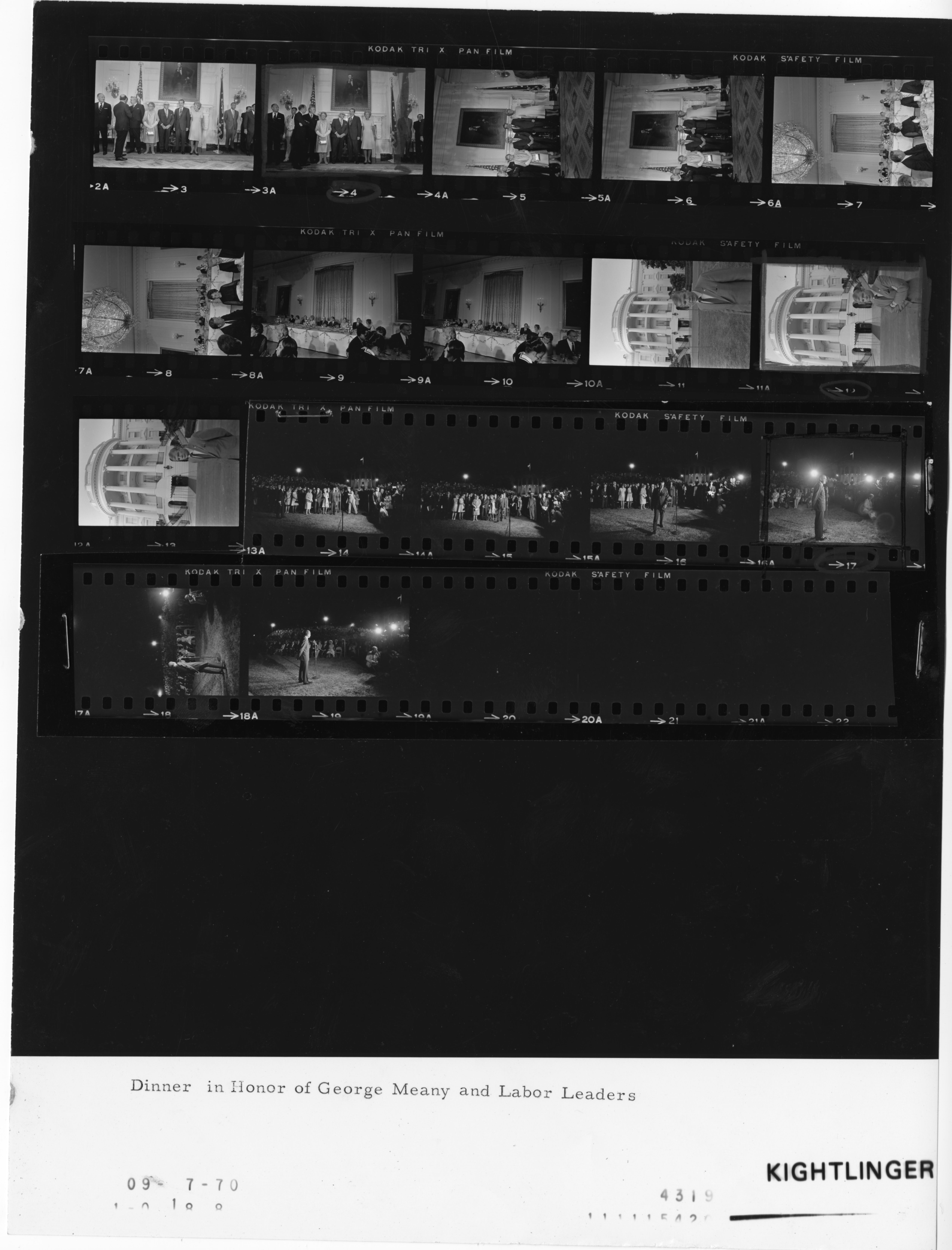
- Frame(s): WHPO-4319-, President Nixon hosts a dinner for US labor leaders, including AFL-CIO President George Meany. 9/7/1970, Washington, D.C. White House, East Room. President Nixon, Pat Nixon, William Rogers, George L. Meany, Mrs. Meany, William J. Usery, unidentified labor leaders.
- Frame(s): WHPO-4319-04, President Nixon, Secretary of State William Rogers, AFL/CIO leader George Meany, Mrs. Meany, and other Labor Leaders standing under a portrait painting of Abraham Lincoln. The Leaders attended a dinner hosted at the White House. 9/7/1970, Washington, D.C. White House, East Room. President Nixon, Pat Nixon, William Rogers, George L. Meany, possibly Mrs. Eugenia Meany, unidentified labor leaders.
Roll WHPO-4320 Photographer: Kightlinger, Jack | Color or B&W: B&W
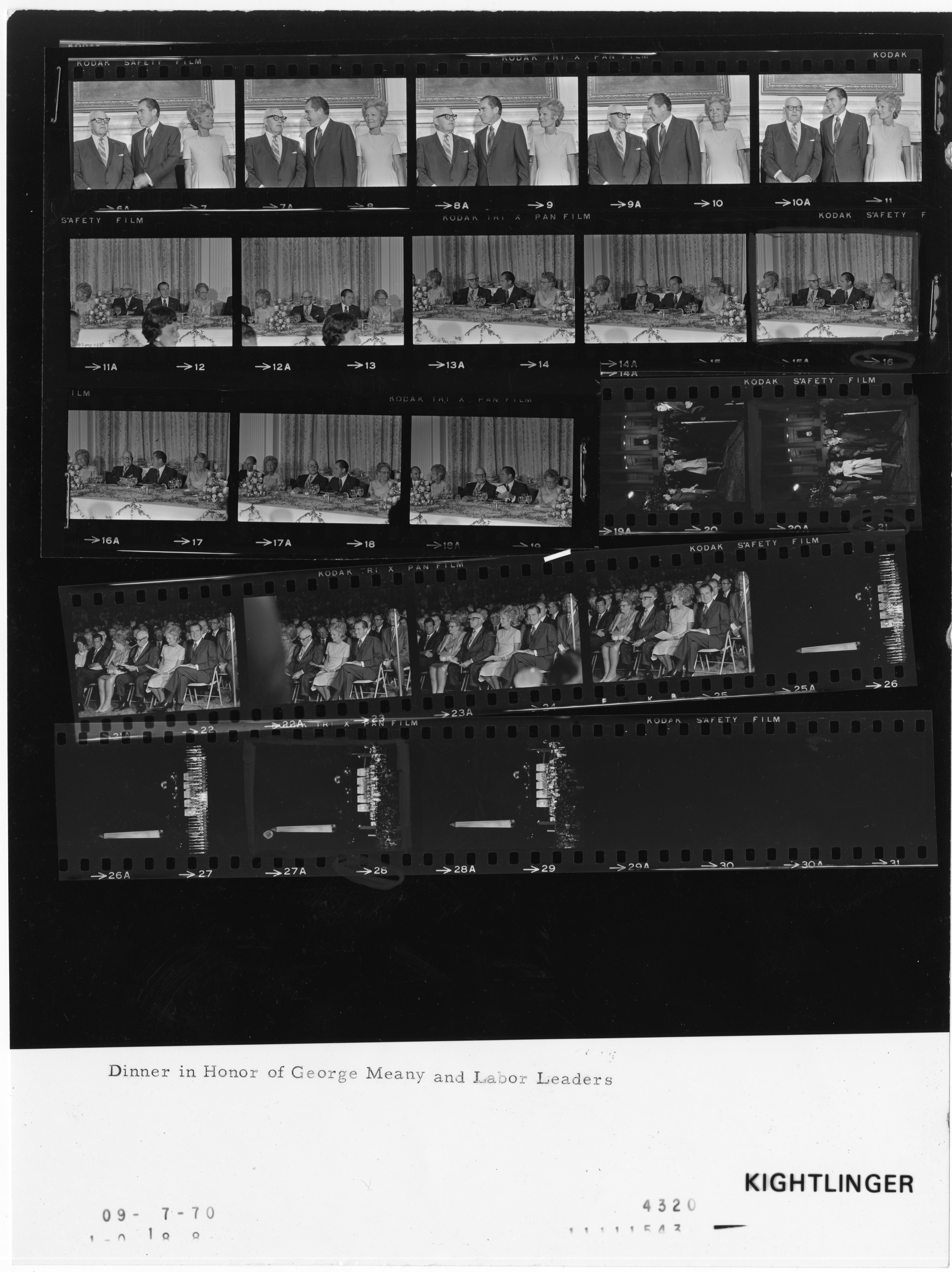
- Frame(s): WHPO-4320-, President Nixon and Pat Nixon host a dinner honoring American Labor on Labor Day, followed by a pageant, "TorchLight Tattoo" on the White House lawn. 9/7/1970, Washington, D.C. White House, East Room. President Nixon, Pat Nixon, Mr. George L. Meany, Mrs. Eugenia Meany, guests.
- Frame(s): WHPO-4320-16, President Nixon and Pat Nixon host a dinner honoring American Labor on Labor Day, followed by a pageant, "TorchLight Tattoo" on the White House lawn. 9/7/1970, Washington, D.C. White House, East Room. President Nixon, Pat Nixon, Mr. George L. Meany, Mrs. Eugenia Meany, guests.
Roll WHPO-4321 Photographer: Schumaker, Byron | Color or B&W: Color
- Frame(s): WHPO-4321-, Tricia Nixon making a benefit film spot. 9/7/1970, Washington, D.C. State Dinning Room, White House,. The President's daughter, Tricia Nixon and an unidentified film crew.
Roll WHPO-4322 Photographer: Schumaker, Byron | Color or B&W: Color
- Frame(s): WHPO-4322-, Tricia Nixon making a benefit film spot. 9/7/1970, Washington, D.C. State Dinning Room, White House,. The President's daughter, Tricia Nixon and an unidentified film crew.
Roll WHPO-4323 Photographer: Schumacher, Karl | Color or B&W: Color
- Frame(s): WHPO-4323-, The Torch Light Tattoo pageant. 9/7/1970, Washington, D.C. White House Lawn. None identified.
The White House Communications Agency Sound Recordings Collection contains public statements that took place between 1969 and 1974. Visit the finding aid to learn more.
P - Formal Presidential Remarks
- WHCA-SR-P-700903
Remarks by President Nixon at dinner honorign national labor leaders with George Meany in DC. (9/7/1970)
Runtime: 20:30
Original Format: 1/4-inch reel-to-reel audiotape. Original source type: Original. - WHCA-SR-P-700904
Remarks by President Nixon at Third Infantry "Torchlight Tattoo". (9/7/1970)
Runtime: 2:10
Original Format: 1/4-inch reel-to-reel audiotape. Original source type: Original.
The White House Communications Agency Videotape Collection contains “off-the-air” recordings of televised programs produced between 1968 and 1974. Visit the finding aid to learn more.
- WHCA-3842
Weekly News Summary.
All networks
Runtime: 01:04:30
7. Harsch: State Department on hijackings. Time Code Start: 08:50. Keywords: hijackings, skyjackings, kidnappings, terrorism, aircraft, airlines, Dawson's Field hijackings. Network: ABC.
8. Frank Reynolds: Commentary on airplane hijackings; Hijack detection and prevention devices; Pan Am and Trans World Airlines, Inc. (TWA) won't use armed guards on plane. Time Code Start: 10:08. Keywords: hijackings, skyjackings, kidnappings, terrorism, aircraft, airlines, Dawson's Field hijackings. Network: ABC.
9. Duke: Labor union (AFL-CIO). Time Code Start: 12:33. Keywords: labor, unions, American Federation of Labor, Congress of Industrial Organizations. Network: NBC.
10. Eric Sevareid: Commentary on changes in labor. Time Code Start: 14:45. Keywords: employment, unemployment. Network: CBS.
Context (External Sources)
The Vanderbilt Television News Archive is the world's most extensive and complete archive of television news. They have been recording, preserving and providing access to television news broadcasts of the national networks since August 5, 1968.
Wikipedia is a free encyclopedia that anyone can edit.