
Introduction
This almanac page for Tuesday, May 2, 1972, pulls together various records created by the federal government and links to additional resources which can provide context about the events of the day.
Previous Date: Monday, May 1, 1972
Next Date: Wednesday, May 3, 1972
Schedule and Public Documents
The Daily Diary files represent a consolidated record of the President's activities. Visit the finding aid to learn more.
The President's day began at The White House - Washington, D. C.
The Weekly Compilation of Presidential Documents made available transcripts of the President's news conferences; messages to Congress; public speeches, remarks, and statements; and other Presidential materials released by the White House.
Digitized versions can be found at HathiTrust.
Each Public Papers of the Presidents volume contains the papers and speeches of the President of the United States that were issued by the White House Office of the Press Secretary during the time period specified by the volume. The material is presented in chronological order, and the dates shown in the headings are the dates of the documents or events. In instances when the release date differs from the date of the document itself, that fact is shown in the text note.
To ensure accuracy, remarks have been checked against audio recordings (when available) and signed documents have been checked against the original, unless otherwise noted. Editors have provided text notes and cross references for purposes of identification or clarity.
The Federal Register is the official daily publication for rules, proposed rules, and notices of federal agencies and organizations, as well as executive orders and other Presidential documents.
The Congressional Record is the official daily record of the debates and proceedings of the U.S. Congress.
Archival Holdings
Any selection of archival documents will necessarily be partial. You should use the documents and folders identified below as a starting place, but consult the linked collection finding aids and folder title lists and the collections themselves for context. Many documents to be found this way do not lend themselves to association with specific dates, but are essential to a complete understanding of the material.
Selective document listing
President's Office Files
The President's Office Files consists of materials drawn together by the Special Files Unit from several administrative subdivisions within the White House Office. It is the handwriting and sensitive papers sent to the Staff Secretary that now comprise much of the President's Office Files. Visit the finding aid to learn more.
- News Summaries, Unmarked News Summaries, Box 49, News Summaries - May 1972 [1 of 13] [Note: Due to the way News Summary products were compiled, you should also consult nearby days for potentially relevant materials.]
- News Summary, May 2, 1972, (Monday nets, wires, mags)
- News Summaries, Unmarked News Summaries, Box 49, News Summaries - May 1972 [2 of 13]
- Special Report: The Ohio and Indiana Primaries and Other Politics, May 2, 1972
- President's Daily Schedule, Box 102, [President's Daily Schedule, Apr.-July 1972] [1 of 3]
- The President's Schedule, Tuesday - May 2, 1972
The H. R. Haldeman Diaries consists of seven handwritten diaries, 36 dictated diaries recorded as sound recordings, and two handwritten audio cassette tape subject logs. The diaries and logs reflect H. R. Haldeman’s candid personal record and reflections on events, issues, and people encountered during his service in the Nixon White House. As administrative assistant to the President and Chief of Staff, Haldeman attended and participated in public events and private meetings covering the entire scope of issues in which the Nixon White House engaged in during the years 1969-1973. Visit the finding aid to learn more.
- Transcript of diary entry (PDF)
Tuesday, May 2.
Kleindienst called me at 9:15 this morning to say that J. Edgar Hoover had died in his sleep during the night, raised the question of how we wanted to announce it, and what our plans were on succession. I immediately went over to the EOB, where the President was, and told him. He said definitely he wanted to announce it, talked about successors to a certain degree, but was more concerned with trying to get some Vietnam things worked out with Henry, following up on the Paris Summit report from last night. Since Henry had gotten no results, and they're now very concerned about how to handle the whole Vietnam situation.
In any event, I spent quite a little time during the morning on the FBI thing. We bounced around with Ehrlichman and Dick Moore the whole question of how to handle it. President kept calling over, felt that we ought to have Tolson function as Acting Director because he can be trusted and the President knows him. Everybody else turned that down because he's too old. Had some other suggestions.
Then Kleindienst called with the details. The maid had found Hoover lying on the floor by his bed at 8:30 this morning. Problem was that she then called his secretary, Miss Gandy, and she called Dr. Choicer, who is Hoover’s doctor. He went over immediately, said it was a natural death between 2:00 and 3:00AM, probably a heart attack, but he hasn't called the coroner because we don't want anybody to know till we are ready to make the announcement. So we delayed the coroner till we got the announcement plan worked out, and ended up having Kleindienst announce it. And then the President went out to our press room and made a brief statement on the thing. President wanted to have him buried in Arlington Cemetery with a big ceremony and all, but it turns out that National Presbyterian is his church, Austin's his minister, and that's where he wants to be, so the President said he'd do the eulogy. He finally came down on, first of all, definitely not appointing a new Director but rather an Acting Director through the election, and everybody agreed that it should be Pat Gray, so that is the plan and it will be announced tomorrow.
We then got into the problem of the Summit. The President feeling that because of the Paris problem Henry got into yesterday and Henry's recommendation now, which is that we cancel the Summit, that we've got to at least consider doing so. He asked me to run a poll to determine what the reaction will be if the President should cancel the Summit, on the basis of the continuing Communist invasion of South Vietnam supported by massive Soviet aid and military equipment. So we're running a one night poll tonight to get a reading before noon tomorrow.
End of May 2. - Original audio recording (MP3)
The National Archives Catalog is the online portal to the records held at the National Archives, and information about those records. It is the main way of describing our holdings and also provides access to electronic records and digitized versions of our holdings.
The Catalog searches across multiple National Archives resources at once, including archival descriptions, digitized and electronic records, authority records, and web pages from Archives.gov and the Presidential Libraries. The Catalog also allows users to contribute to digitized historical records through tagging and transcription.
Nixon Library Holdings
All National Archives Units
National Security Documents
The President's Daily Brief is the primary vehicle for summarizing the day-to-day sensitive intelligence and analysis, as well as late-breaking reports, for the White House on current and future national security issues. Read "The President's Daily Brief: Delivering Intelligence to Nixon and Ford" to learn more.
The Foreign Relations of the United States series presents the official documentary historical record of major U.S. foreign policy decisions and significant diplomatic activity. Visit the State Department website for more information.
Vol. VIII, Vietnam, January-October 1972
The Easter Offensive, March 30-May 7, 1972
109. Memorandum of Conversation, Paris, May 2, 1972, 10 a.m.-1 p.m.
Source: National Archives, Nixon Presidential Materials, NSC Files, Box 864, For the President’s Files (Winston Lord)—China Trip/Vietnam, Sensitive Camp David Memcons, May–October 1972 [5 of 5]. Top Secret; Sensitive; Exclusively Eyes Only. The meeting took place at 11 Rue Darthe, the North Vietnamese residence in Paris.
110. Memorandum From the President’s Assistant for National Security Affairs (Kissinger) to President Nixon, Washington, May 2, 1972
Source: National Archives, Nixon Presidential Materials, NSC Files, Box 854, For the President’s Files (Winston Lord)—China Trip/Vietnam, Sensitive Camp David, Vol. XIII. Top Secret; Sensitive; Exclusively Eyes Only. A stamped notation on the memorandum indicates that the President saw it.
112. Memorandum From John D. Negroponte of the National Security Council Staff to the President’s Assistant for National Security Affairs (Kissinger), Paris, May 2, 1972
Source: Library of Congress, Manuscript Division, Kissinger Papers, Box CL 23, Chronological File, 22 Apr.–31 May 1972. Secret; Sensitive. The memorandum is on White House stationery but both Negroponte and Kissinger were in Paris.
113. Summary of Conclusions of a Washington Special Actions Group Meeting, Washington, May 2, 1972, 10:04-10:49 a.m.
Source: National Archives, Nixon Presidential Materials, NSC Files, NSC Institutional Files (H-Files), Box H–116, Washington Special Actions Group, WSAG Minutes (Originals) 1–3–72 to 7–24–72. Top Secret; Sensitive. The meeting took place in the White House Situation Room.
114. Telephone Conversation Between President Nixon and the President’s Deputy Assistant for National Security Affairs (Haig), Washington, May 2, 1972, 4:49-4:51 p.m.
Source: National Archives, Nixon Presidential Materials, White House Tapes, Oval Office, Conversation 23–114. No classification marking. The editors transcribed the portion of the tape recording printed here specifically for this volume.
Vol. XIV, Soviet Union, October 1971-May 1972
Summit in the Balance: U.S.-Soviet Relations and the Decision to Mine Haiphong, April 26-May 12, 1972
184. Conversation Between President Nixon and his Deputy Assistant for National Security Affairs (Haig), Washington, May 2, 1972
Source: National Archives, Nixon Presidential Materials, White House Tapes, Oval Office, Conversation No. 717–10. No classification marking. According to his Daily Diary, Nixon met with Haig in the Oval Office from 11:27 a.m. to 12:08 p.m. The editors transcribed the portion of the conversation printed here specifically for this volume.
185. Conversation Between President Nixon and his Chief of Staff (Haldeman), Washington, May 2, 1972
Source: National Archives, Nixon Presidential Materials, White House Tapes, Oval Office, Conversation No. 717–19. No classification marking. According to his Daily Diary, Nixon met with Haldeman in the Oval Office from 12:08 to 12:42 p.m. The editors transcribed the portion of the conversation printed here specifically for this volume.
186. Conversation Between President Nixon and his Deputy Assistant for National Security Affairs (Haig), Washington, May 2, 1972
Source: National Archives, Nixon Presidential Materials, White House Tapes, Oval Office, Conversation No. 717–20. No classification marking. According to his Daily Diary, Nixon met with Haig in the Oval Office from 12:42 to 1:20 p.m. The editors transcribed the portion of the conversation printed here specifically for this volume.
Vol. XLII, Vietnam: The Kissinger-Le Duc Tho Negotiations
Stalemate and the Nadir of Negotiations, May 1972
14. Memorandum of Conversation, Paris, May 2, 1972, 10 a.m.-1 p.m.
Source: National Archives, Nixon Presidential Materials, NSC Files, Box 864, For the President’s Files (Winston Lord)—China Trip/Vietnam, Sensitive Camp David Memcons, May–October 1972 [5 of 5]. Top Secret; Sensitive; Exclusively Eyes Only. The meeting took place at the North Vietnamese Residence at 11 Rue Darthé. Tab A is attached but not printed.
This session was conducted during a major North Vietnamese offensive, known in the United States as the Easter Offensive, which was then reaching its high water mark with the fall of provincial capital Quang Tri. Nixon had responded to the offensive by ordering a massive air and naval reinforcement of South Vietnam, and by resuming air attacks on North Vietnam. The strategic situation was further complicated by the prospect of the Moscow Summit, which was planned for May 22–29.
In his May 2 report to the President about the meeting, Kissinger wrote: “I spent three hours today with Le Duc Tho and Xuan Thuy in a session that was thoroughly unproductive on substance but served to bolster further our negotiating record. I laid out various approaches for discussion, all of which they rejected. They made very clear that they were not prepared either to deescalate the fighting or offer anything new concerning a settlement.” Therefore, Kissinger continued, “I broke off the private talks until either side has something new to say or their offensive stops.” A stamped notation on Kissinger’s memorandum indicates that the President saw it. (Foreign Relations, 1969–1976, vol. VIII, Vietnam, January–October 1972, Document 110)
In a conversation with Haldeman that day, the President noted how disappointed Kissinger had been with the lack of progress in the negotiations. Nixon continued: “But the point is, Bob, we have got to realize that on this whole business of negotiating with North Vietnam, Henry has never been right. Now, I just can’t help it, but just have to say that, just a straight, flat-out conclusion.” Haldeman replied: “Well, Al [Haig] never thought he [Kissinger] was going to get anything.” To this, Nixon responded: “Well, I didn’t either.” (National Archives, Nixon Presidential Materials, White House Tapes, Oval Office, Conversation 717–19; transcribed in Foreign Relations, 1969–1976, vol. VIII, Vietnam, January–October 1972, Document 110, footnote 2)
In reporting to the Politburo about this meeting, Le Duc Tho and Xuan Thuy wrote: “We rejected Kissinger’s demand that we reduce the level of military activities, we rejected Kissinger’s slanderous statement that we have violated the 1954 Geneva Agreement, and we said that his statement that we violated the secret accord was baseless. We demanded that the U.S. talk directly to us about any ideas they have about a settlement and not speak to us through intermediaries.” (Message from Nguyen Duy Trinh and Le Duc Tho to Xuan Thuy, 2 May 1972, in Doan Duc, et al., compilers, Major Events: The Diplomatic Struggle and International Activities during the Resistance War Against the Americans to Save the Nation, 1954–1975, volume 4, pp. 319–320)
Vol. E-5, Part 1, Documents on Sub-Saharan Africa, 1969-1972
U.S.-African Policy
21. Memorandum of Conversation, Paris, May 2, 1972
During U.S.-French bilateral exchanges on Africa, Secretary-General Hervi Alphand said that the Soviets and the Chinese had not been successful in Africa, communist influence was not dominant, and African countries viewed the communists as sources of aid, not ideology. Newsom indicated that he was not especially concerned with the Soviets, although they might be overreaching in Somalia. However, he was concerned about Chinese economic activities, their military establishments, particularly in Tanzania, and their identification with southern African liberation movements.
Source: National Archives, RG 59, Central Files 1970–73, ORG 7 AF. Confidential. Drafted by A. Steigman (POL) on May 4.22. Memorandum of Conversation, Paris, May 2, 1972
During U.S.-French bilateral exchanges on Non-Francophone Africa, Assistant Secretary of State for African Affairs Newsom, France’s Africa Director, Philippe Rebeyrol, and other U.S. and French officials discussed Ghana, Nigeria, Equatorial Guinea, and the Horn of Africa.
Source: National Archives, RG 59, Central Files 1970–73, ORG 7 AF. Confidential. Drafted by A. Steigman (POL) on May 5.
The Kissinger telephone conversation transcripts consist of approximately 20,000 pages of transcripts of Kissinger’s telephone conversations during his tenure as Assistant to the President for National Security Affairs (1969-1974) and Secretary of State (1973-1974) during the administration of President Richard Nixon. Visit the finding aid for more information.
Digitized versions can be found in the National Archives Catalog.
Audiovisual Holdings
Visit the White House Tapes finding aid to learn about the taping system's operation and archival processing.
Old Executive Office Building
- 334-8; Unknown between 9:06 a.m. & 9:28 a.m.; Nixon, Richard M. (President); Bull, Stephen B.
- 334-9; Unknown between 9:06 a.m. & 9:28 a.m.; Nixon, Richard M. (President); Haig, Alexander M., Jr.
- 334-10; 9:28 a.m. - 10:00 a.m.; Nixon, Richard M. (President); Haldeman, H. R. ("Bob"); Haig, Alexander M., Jr.
- 334-11; Unknown between 10:00 a.m. & 10:25 a.m.; Nixon, Richard M. (President); Haldeman, H. R. ("Bob")
- 334-12; Unknown between 10:00 a.m. & 10:25 a.m.; Nixon, Richard M. (President); Haldeman, H. R. ("Bob")
- 334-13; Unknown between 10:00 a.m. & 10:25 a.m.; Nixon, Richard M. (President); Sanchez, Manolo
- 334-14; Unknown between 10:00 a.m. & 10:25 a.m.; Nixon, Richard M. (President); Haldeman, H. R. ("Bob")
- 334-15; 10:25 a.m. - 10:35 a.m.; Nixon, Richard M. (President); Buchanan, Patrick J.
- 334-16; 10:35 a.m. - 10:37 a.m.; Nixon, Richard M. (President); Haldeman, H. R. ("Bob")
- 334-17; Unknown between 10:37 a.m. & 10:43 a.m.; Nixon, Richard M. (President); Buchanan, Patrick J.
- 334-18; 10:43 a.m. - 10:44 a.m.; Nixon, Richard M. (President); Haldeman, H. R. ("Bob")
- 334-19; Unknown between 1:20 p.m. & 1:22 p.m.; Nixon, Richard M. (President); Sanchez, Manolo
- 334-20; 1:22 p.m. - 1:23 p.m.; Nixon, Richard M. (President); Butterfield, Alexander P.
- 334-21; Unknown between 1:23 p.m. & 4:38 p.m.; Nixon, Richard M. (President); Haldeman, H. R. ("Bob")
- 334-22; Unknown between 1:23 p.m. & 4:38 p.m.; Nixon, Richard M. (President); [Unknown person(s)]
- 334-23; Unknown between 1:23 p.m. & 4:38 p.m.; Nixon, Richard M. (President); Sanchez, Manolo
- 334-24; Unknown between 1:23 p.m. & 4:38 p.m.; Nixon, Richard M. (President)
- 334-25; Unknown between 1:23 p.m. & 4:38 p.m.; Nixon, Richard M. (President)
- 334-26; Unknown between 1:23 p.m. & 4:38 p.m.; Nixon, Richard M. (President)
- 334-27; Unknown between 1:23 p.m. & 4:38 p.m.; Nixon, Richard M. (President)
- 334-28; Unknown between 1:23 p.m. & 4:38 p.m.; Nixon, Richard M. (President)
- 334-29; Unknown between 1:23 p.m. & 4:38 p.m.; Nixon, Richard M. (President); Sanchez, Manolo
- 334-30; Unknown between 1:23 p.m. & 4:38 p.m.; Nixon, Richard M. (President)
- 334-31; Unknown between 1:23 p.m. & 4:38 p.m.; Nixon, Richard M. (President); [Unknown person(s)]
- 334-32; Unknown between 1:23 p.m. & 4:38 p.m.; Nixon, Richard M. (President); Sanchez, Manolo
- 334-33; Unknown between 1:23 p.m. & 4:38 p.m.; Nixon, Richard M. (President); [Unknown person(s)]
- 334-34; 4:38 p.m. - 4:39 p.m.; Nixon, Richard M. (President); Bull, Stephen B.
- 334-35; 4:40 p.m. - 4:41 p.m.; Nixon, Richard M. (President); Haig, Alexander M., Jr.
- 334-36; Unknown between 4:41 p.m. & 6:17 p.m.; Nixon, Richard M. (President); Haldeman, H. R. ("Bob"); Haig, Alexander M., Jr.; Sanchez, Manolo; White House operator; Cox, Tricia Nixon; [Unknown person(s)]; Tolson, Clyde A.; Bull, Stephen B.; Ehrlichman, John D.; Ziegler, Ronald L.; Gandy, Helen
Oval Office
- 717-1; 10:54 a.m. - 10:55 a.m.; Nixon, Richard M. (President); Ziegler, Ronald L.
- 717-2; Unknown between 10:55 a.m. & 10:57 a.m.; Nixon, Richard M. (President); White House operator
- 717-3; 10:57 a.m. - 10:58 a.m.; Nixon, Richard M. (President); Nixon, Thelma C. ("Pat") (Ryan)
- 717-4; Unknown between 10:58 a.m. & 11:04 a.m.; Nixon, Richard M. (President); White House operator
- 717-5; 11:04 a.m. - 11:04 a.m.; Nixon, Richard M. (President); White House operator
- 717-6; Unknown between 11:04 a.m. & 11:10 a.m.; Nixon, Richard M. (President); Woods, Rose Mary
- 717-7; 11:10 a.m. - 11:11 a.m.; Nixon, Richard M. (President); Ziegler, Ronald L.
- 717-8; 11:16 a.m. - 11:17 a.m.; Nixon, Richard M. (President); Johnson, Lyndon B.
- 717-9; Unknown between 11:17 a.m. & 11:19 a.m.; Nixon, Richard M. (President); Bull, Stephen B.
- 717-10; 11:19 a.m. - 11:40 a.m.; Nixon, Richard M. (President); Ziegler, Ronald L.; Haldeman, H. R. ("Bob"); Butterfield, Alexander P.; [Unknown person(s)]; Haig, Alexander M., Jr.
- 717-11; Unknown between 11:40 a.m. & 11:42 a.m.; Nixon, Richard M. (President); Bull, Stephen B.
- 717-12; 11:42 a.m. - 11:50 a.m.; Nixon, Richard M. (President); Bull, Stephen B.; Walters, Vernon A.; Tamm, Edward; Jones, Lauren; Walters, Frederick J.; Walters, James; Walters, Vincent C.; Walters, Vincent C. (Mrs.); Walters, Richard; Adams, Peter; Helms, Richard M.; Woods, Rose Mary; Tkach, Walter R.; Haig, Alexander M., Jr.; Hartley, Muriel; Ovellette, Nancy; White House photographer
- 717-13; 11:50 a.m. - 11:51 a.m.; Nixon, Richard M. (President); Butterfield, Alexander P.; Bull, Stephen B.
- 717-15; Unknown between 11:51 a.m. & 11:57 a.m.; Nixon, Richard M. (President); Haldeman, H. R. ("Bob"); Bull, Stephen B.
- 717-16; 11:57 a.m. - 12:06 p.m.; Nixon, Richard M. (President); Emborg, Erik; Frederics, Marshall; Rosing, Borge; Castenskjold, Christian; Nicolaisen, Jens; Kari-Neilsen, J. U.; Christensen, Hein; Anderson, Marius; Larsen, Holger; Nelsen, Ancher; Haig, Alexander M., Jr.; White House photographer
- 717-17; Unknown between 12:06 p.m. & 12:08 p.m.; Nixon, Richard M. (President); Bull, Stephen B.
- 717-18; Unknown between 12:06 p.m. & 12:08 p.m.; Nixon, Richard M. (President); Bull, Stephen B.
- 717-19; 12:08 p.m. - 12:42 p.m.; Nixon, Richard M. (President); Haldeman, H. R. ("Bob"); Bull, Stephen B.
- 717-20; Unknown between 12:42 p.m. & 1:20 p.m.; Nixon, Richard M. (President); Haig, Alexander M., Jr.
White House Telephone
- 23-103; 10:35 a.m. - 10:37 a.m.; Nixon, Richard M. (President); Haldeman, H. R. ("Bob"); Buchanan, Patrick J.; [Unknown person(s)]
- 23-104; 10:43 a.m. - 10:44 a.m.; Nixon, Richard M. (President); Haldeman, H. R. ("Bob"); Buchanan, Patrick J.
- 23-105; Unknown between 10:55 a.m. & 10:57 a.m.; Nixon, Richard M. (President); White House operator
- 23-106; 10:57 a.m. - 10:58 a.m.; Nixon, Richard M. (President); Nixon, Thelma C. ("Pat") (Ryan)
- 23-108; 11:04 a.m. - 11:04 a.m.; Nixon, Richard M. (President); White House operator
- 23-109; 11:16 a.m. - 11:17 a.m.; Nixon, Richard M. (President); Johnson, Lyndon B.
- 23-110; Unknown between 11:17 a.m. & 11:27 a.m.; Nixon, Richard M. (President); White House operator
- 23-111; Unknown between 1:20 p.m. & 4:38 p.m.; Nixon, Richard M. (President); White House operator
- 23-112; 4:38 p.m. - 4:39 p.m.; Nixon, Richard M. (President); Bull, Stephen B.
- 23-113; 4:40 p.m. - 4:41 p.m.; Nixon, Richard M. (President); Haig, Alexander M., Jr.
- 23-114; 4:49 p.m. - 4:51 p.m.; Nixon, Richard M. (President); Haig, Alexander M., Jr.
- 23-115; Unknown between 4:51 p.m. & 4:57 p.m.; Nixon, Richard M. (President); White House operator
- 23-116; 4:57 p.m. - 4:58 p.m.; Nixon, Richard M. (President); Cox, Tricia Nixon
- 23-117; Unknown between 4:58 p.m. & 5:26 p.m.; Nixon, Richard M. (President); White House operator
- 23-118; 5:26 p.m. - 5:27 p.m.; Nixon, Richard M. (President); Tolson, Clyde A.
- 23-119; Unknown between 5:30 p.m. & 5:35 p.m.; Nixon, Richard M. (President); White House operator
- 23-120; 5:35 p.m. - 5:37 p.m.; Ehrlichman, John D.; Ziegler, Ronald L.; Nixon, Richard M. (President)
- 23-121; 6:03 p.m. - 6:03 p.m.; Nixon, Richard M. (President); White House operator
- 23-122; 6:06 p.m. - 6:07 p.m.; Nixon, Richard M. (President); Gandy, Helen
- 23-123; Unknown between 9:14 p.m. & 9:17 p.m.; Nixon, Richard M. (President); White House operator
- 23-124; 9:17 p.m. - 9:17 p.m.; Nixon, Richard M. (President); White House operator
- 23-125; 9:20 p.m. - 9:22 p.m.; Nixon, Richard M. (President); Andrews, John K., Jr.
- 23-126; Unknown between 9:22 p.m. & 9:25 p.m.; Nixon, Richard M. (President); White House operator
- 23-127; 9:25 p.m. - 9:31 p.m.; Nixon, Richard M. (President); Dent, Harry S.
- 23-128; Unknown between 9:31 p.m. & 9:35 p.m.; Nixon, Richard M. (President); White House operator
- 23-129; 9:35 p.m. - 9:40 p.m.; Nixon, Richard M. (President); Kissinger, Henry A.
The White House Photo Office collection consists of photographic coverage of President Richard Nixon meeting with prominent social, political, and cultural personalities; speaking engagements and news conferences of the President and various high-ranking members of the White House staff and Cabinet; Presidential domestic and foreign travel, including Presidential vacations; social events and entertainment involving the First Family, including entertainers present; official portraits of the President, First Family, and high-ranking members of the Nixon administration; the 1969 and 1973 Inaugurals; the President’s 1972 Presidential election campaign appearances (including speeches) and other official activities of the White House staff and the President’s Cabinet from January 20, 1969 until August 9, 1974 at the White House and the Old Executive Office Building; other locations in Washington, DC, such as The Mall; and the Presidential retreats in Camp David, Maryland, Key Biscayne, Florida, and San Clemente, California. Visit the finding aid to learn more.
Roll WHPO-8995 Photographer: Atkins, Oliver | Color or B&W: B&W
- Frame(s): WHPO-8995-, President Nixon in group photos with a delegation from the Rebild National Park Society of Denmark. 5/2/1972, Washington, D.C. White House, Oval Office. President Nixon, Rebild Society members.
Roll WHPO-8996 Photographer: Atkins, Oliver | Color or B&W: B&W
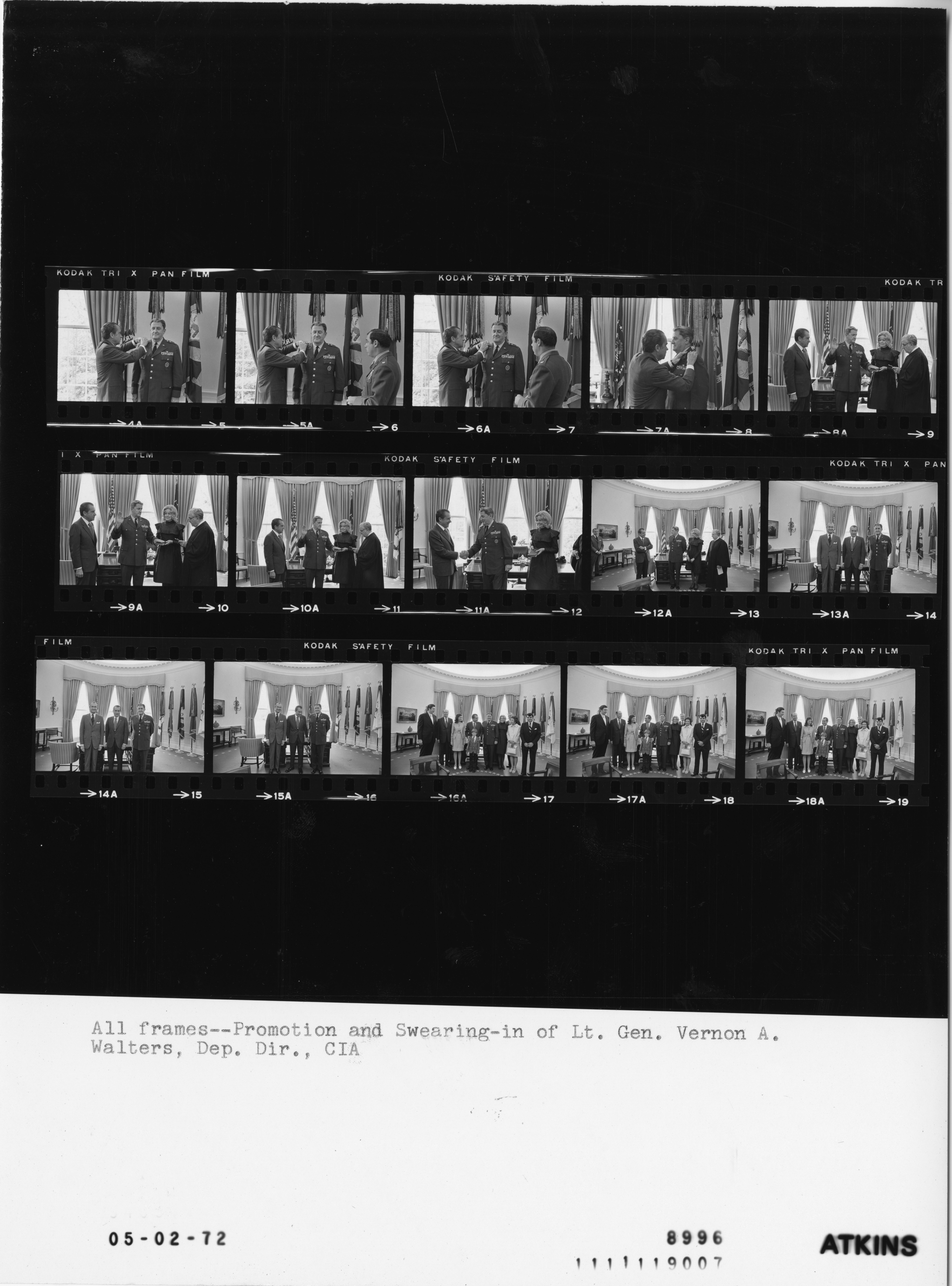
- Frame(s): WHPO-8996-, President Nixon promoting Maj. Gen. Vernon Walters to Lieutenant General, and witnessing Walters's swearing-in ceremony as Central Intelligence Agency (CIA) Deputy Director. 5/2/1972, Washington, D.C. White House, Oval Office. President Nixon, Vernon Walters, Walters family members, Haig, Judge Edward Tamm.
- Frame(s): WHPO-8996-09A, President Nixon witnessing Walters's swearing-in ceremony as Central Intelligence Agency (CIA) Deputy Director officiated by Judge Edward Tamm. 5/2/1972, Washington, D.C. White House, Oval Office. President Nixon, Vernon Walters, Walters family member, Judge Edward Tamm.
- Frame(s): WHPO-8996-11A, President Nixon shaking hands and congratulating Lt. Gen. Vernon Walters after promoting him and witnessing Walters's swearing-in ceremony as Central Intelligence Agency (CIA) Deputy Director officiated by Judge Edward Tamm. 5/2/1972, Washington, D.C. White House, Oval Office. President Nixon, Vernon Walters, Walters family member.
Roll WHPO-8997 Photographer: Schumacher, Karl | Color or B&W: B&W
- Frame(s): WHPO-8997-, Members of the Rebild National Park Society of Denmark group. 5/2/1972, Washington, D.C. White House, Rose Garden. Rebild Society members.
Roll WHPO-9000 Photographer: | Color or B&W: Color
- Frame(s): WHPO-9000-, Copy of a picture of a wooden cabinet with Chinese characters. 5/2/1972, unknown unknown.
Roll WHPO-9003 Photographer: Knudsen, Robert L. | Color or B&W: Color
- Frame(s): WHPO-9003-02-29, Pat Nixon at the National Retired Teachers Association. Event: entering a building; receiving a plaque; on the dais; speaking to attendees. 5/2/1972, Miami, Florida rooms, Carillon; airport tarmac. Pat Nixon, unidentified persons.
- Frame(s): WHPO-9003-30-31, Pat Nixon at an airport prior to departure from Miami, Florida. 5/2/1972, Miami, Florida rooms, Carillon; airport tarmac. Pat Nixon, unidentified persons.
The White House Communications Agency Sound Recordings Collection contains public statements that took place between 1969 and 1974. Visit the finding aid to learn more.
C - First Lady
- WHCA-SR-C-124
Remarks by Pat Nixon at 25th Anniversary of National Retired Teachers Association at the Carillon Hotel in Miami Beach, Florida, with Kathryn Pearce. (5/2/1972, Carillon Hotel, Miami Beach, Florida)
Runtime: 4:30
Production credits: Audio feed supplied by WHCA; Recorded by GLG (initials of WHCA engineer)
Original Format: 1/4-inch reel-to-reel audiotape. Original source type: Original.
H - White House Staff Member Recordings
- WHCA-SR-H-561
Briefing with Herb Stein. (5/2/1972, Room 160, Executive Office Building)
Runtime: 35:00:00
Keywords: Briefings, public briefings, statements to the press (see also Press conferences, news conferences, interviews, media)
Production credits: Audio feed supplied by WHCA; Recorded by RWF (initials of WHCA engineer)
Original Format: 1/4-inch reel-to-reel audiotape. Original source type: Original.
P - Formal Presidential Remarks
- WHCA-SR-P-720501
Remarks by President Nixon on death of JE Hoover. (5/2/1972)
Runtime: 1:20
Original Format: 1/4-inch reel-to-reel audiotape. Original source type: Original.
The White House Communications Agency Videotape Collection contains “off-the-air” recordings of televised programs produced between 1968 and 1974. Visit the finding aid to learn more.
- WHCA-5321
"Panorama".
ALL NETWORKS
Runtime: 01:38:00 - WHCA-5322
"The David Frost Show": Joan Rivers, Ethel Waters, Gore Vidal, B. Herschensohn. Also includes commercial for "Compramatics" (computer profiling, match-making service) (01:13:13)
ALL NETWORKS
Runtime: 01:30:18 - WHCA-5323
"J. Edgar Hoover Special".
Eastern Educational Network
Runtime: 01:03:24 - WHCA-5324
Ohio, Indiana, and Alabama Primaries.
Post-Newsweek Stations, Inc.
Runtime: 00:31:26 - WHCA-5325
Indiana, Ohio, and Alabama Primaries. FTN: U.S. Senator Hubert Humphrey (D-MN); "MTP": Dr. Hurst and Dr. Demma.
CBS, NBC
Runtime: 00:30:01 - WHCA-5326
Ohio, Indiana, and Alabama Primaries. syndicated newspaper columnist Jack Anderson.
Southern Educational Communications Association
Runtime: 00:30:54 - WHCA-5327
Ohio, Indiana, and Alabama Primaries. "Newsm": Washington Post newsroom editor Ben Bradlee
Per 2004 Vidipax report: James Keogh, George Reedy, Rep. Clarence Brown, Brit Hume, et al. no mention of "60 Minutes" AND "Newsmakers".
CBS, WTOP-TV
Runtime: 1:15:29 - WHCA-5335
Weekly News Summary, Tape II.
ALL NETWORKS
Runtime: 1:30
16. Smith/Zimmerman/Gill: FBI Director J. Edgar Hoover death; President Nixon on possible successors of former FBI Director J. Edgar Hoover. Time Code Start: 42:38. Keywords: Federal Bureau of Investigations, leaders, death, nominees, appointments. Network: ABC.
17. Reasoner/Bennet: Hue in danger; evacuations all over Vietnam. Time Code Start: 49:45. Keywords: Vietnam War, immigrants, homeless. Network: ABC.
18. Reasoner/Donaldson/Matney: Ohio vote SNAFU, Humphrey comments; the McGovern machine in Nebraska. Time Code Start: 54:14. Keywords: Presidential elections, campaigns, campaigning, primaries, candidates, voting, speeches. Network: ABC.
19. Reasoner: Commentary on Vice President Agnew and Vietnam. Time Code Start: 58:58. Keywords: Vietnam War, Vice Presidents. Network: ABC.
20. Chancellor: FBI Director J. Edgar Hoover death; President Nixon. Time Code Start: 60:58. Keywords: Federal Bureau of Investigations, leaders, death. Network: NBC.
21. Stern/Chancellor: More on former FBI Director J. Edgar Hoover. Time Code Start: 63:05. Keywords: Federal Bureau of Investigations, leaders, death. Network: NBC.
22. Chancellor/Valeriani: Vietnam; White House reaction. Time Code Start: 65:52. Keywords: Vietnam War, Presidents, statements, reactions. Network: NBC.
23. Chancellor/Brady: An Loc in Vietnam, film report. Time Code Start: 70:14. Keywords: Vietnam War. Network: NBC.
24. Chancellor/Perkins: Voting machines out in Cleveland, Ohio. Time Code Start: 74:28. Keywords: Vote, voters, voting, Presidential elections, campaigns, campaigning, candidates, primaries, voting, polling places, equipment. Network: NBC.
25. Brinkley: Humphrey in Cleveland. Time Code Start: 76:55. Keywords: Presidential elections, campaigns, campaigning, candidates, primaries, voting, speeches. Network: NBC.
26. Chancellor: Ohio and Indiana primaries. Time Code Start: 78:50. Keywords: Presidential elections, campaigns, campaigning, candidates, primaries, voting. Network: NBC.
27. Cronkite: FBI Director J. Edgar Hoover death. Time Code Start: 80:10. Keywords: Federal Bureau of Investigations, leaders, death. Network: CBS.
28. President Nixon tribute to former FBI Director J. Edgar Hoover. Time Code Start: 82:47. Keywords: Presidents, Federal Bureau of Investigations, leaders, funerals, death memorials, burials, internments, religious services. Network: CBS.
29. Rather: FBI Director J. Edgar Hoover and the Mayflower Hotel. Time Code Start: 85:47. Keywords: Federal Bureau of Investigations, leaders, hotels. Network: CBS.
30. Cronkite/Webster: Vietnam War report. Time Code Start: 87:30. Keywords: Vietnam War. Network: CBS. - WHCA-5336
Weekly News Summary, Tape III.
ALL NETWORKS
Runtime: 1:30
1. Cronkite/Curtis: The Midwest primaries (Governor George Wallace, Humphrey). Time Code Start: 00:00. Keywords: Senators, Governors, Presidential elections, campaigns, primaries, candidates. Network: CBS.
"
Context (External Sources)
The Vanderbilt Television News Archive is the world's most extensive and complete archive of television news. They have been recording, preserving and providing access to television news broadcasts of the national networks since August 5, 1968.
Wikipedia is a free encyclopedia that anyone can edit.