
Introduction
This almanac page for Wednesday, December 9, 1970, pulls together various records created by the federal government and links to additional resources which can provide context about the events of the day.
Previous Date: Tuesday, December 8, 1970
Next Date: Thursday, December 10, 1970
Schedule and Public Documents
The Daily Diary files represent a consolidated record of the President's activities. Visit the finding aid to learn more.
The President's day began at The White House - Washington, D. C.
The Weekly Compilation of Presidential Documents made available transcripts of the President's news conferences; messages to Congress; public speeches, remarks, and statements; and other Presidential materials released by the White House.
Addresses and Remarks
- Armed Forces Reenlistment Ceremony (6 Weekly Comp. Pres. Doc. 1646, December 9, 1970)
The President's Remarks at a Ceremony in the Blue Room Marking the Reenlistment of Five Servicemen.
Letters, Memorandums, Etc.
- Counsellor to the President (6 Weekly Comp. Pres. Doc. 1647, December 9, 1970)
Exchange of Letters Between the President and Bryce N. Harlow Upon Mr. Harlow's Resignation.
Memorandums to Federal Agencies
- Interdepartmental Savings Bonds Committee (6 Weekly Comp. Pres. Doc. 1648, December 9, 1970)
The President's Memorandum to the Heads of Departments and Agencies on the Appointment of the Secretary of Commerce as Chairman and the Secretary of Defense as Vice-Chairman of the Committee.
Acts Approved by the President
- H.R. 6951 -- Public Law 91-538
Interstate Agreement on Detainers Act. - H.R. 15216 -- Public Law 91-539
An Act to authorize the Secretary of Defense to lend certain Army, Navy, and Air Force equipment and to provide transportation and other services to the Boy Scouts of America in connection with the World Jamboree of Boy Scouts to be held in Japan in 1971, and for other purposes. - S. 2543 -- Public Law 91-540
Horse Protection Act of 1970.
Checklist of White House Press Releases
The releases listed below, made public by the Office of the White House Press Secretary during the period covered by this issue, are not included in the issue.
- Press conference of James D. Hodgson, Secretary of Labor, on the railway labor-management dispute.
Each Public Papers of the Presidents volume contains the papers and speeches of the President of the United States that were issued by the White House Office of the Press Secretary during the time period specified by the volume. The material is presented in chronological order, and the dates shown in the headings are the dates of the documents or events. In instances when the release date differs from the date of the document itself, that fact is shown in the text note.
To ensure accuracy, remarks have been checked against audio recordings (when available) and signed documents have been checked against the original, unless otherwise noted. Editors have provided text notes and cross references for purposes of identification or clarity.
The Federal Register is the official daily publication for rules, proposed rules, and notices of federal agencies and organizations, as well as executive orders and other Presidential documents.
The Congressional Record is the official daily record of the debates and proceedings of the U.S. Congress.
Archival Holdings
Any selection of archival documents will necessarily be partial. You should use the documents and folders identified below as a starting place, but consult the linked collection finding aids and folder title lists and the collections themselves for context. Many documents to be found this way do not lend themselves to association with specific dates, but are essential to a complete understanding of the material.
Selective document listing
President's Office Files
The President's Office Files consists of materials drawn together by the Special Files Unit from several administrative subdivisions within the White House Office. It is the handwriting and sensitive papers sent to the Staff Secretary that now comprise much of the President's Office Files. Visit the finding aid to learn more.
- Annotated News Summaries, Box 29, News Summaries - December 1970 [1 of 2]
- Annotated News Summaries, Box 29, News Summaries - December 1970 [2 of 2] [During this period, the Staff Secretary only removed pages from the News Summaries which contained President Nixon's handwriting, often leaving the document with no date. In addition to the individual document(s) listed below, you should also consult the full folder for the month.]
- Pasadena Star News, "Nixon Still Stumps Pundits," by Victor Lasky, December 9, 1970
- President's Daily Schedule, Box 101, [President's Daily Schedule, Nov.-Dec. 1970] [2 of 3]
- The President's Schedule, Wednesday - December 9, 1970
President's Personal File
The President's Personal File is essentially a President's secretary's file, kept by Rose Mary Woods, personal secretary to the President, for two purposes: (1) preserving for posterity a collection of documents particularly close to the President, whether because he dictated or annotated them, or because of the importance of the correspondent or the event concerned and (2) giving appropriate attention–letters of gratitude, invitations to White House social events, and the like–to members and important friends and supporters of the Nixon administration. This generalization does not describe all the varied materials of a file group which is essentially a miscellany, but it does identify the reason for the existence of the file group's core. Visit the finding aid to learn more.
- President's Speech File
The H. R. Haldeman Diaries consists of seven handwritten diaries, 36 dictated diaries recorded as sound recordings, and two handwritten audio cassette tape subject logs. The diaries and logs reflect H. R. Haldeman’s candid personal record and reflections on events, issues, and people encountered during his service in the Nixon White House. As administrative assistant to the President and Chief of Staff, Haldeman attended and participated in public events and private meetings covering the entire scope of issues in which the Nixon White House engaged in during the years 1969-1973. Visit the finding aid to learn more.
- Transcript of diary entry (PDF)
Wednesday, December 9.
Another day almost totally involved, on my part at least, with personnel maneuvers. The President had no schedule except for a presentation ceremony at noon. Rest of the day had been set aside for work on the press conference briefing book. Actually, he stayed in the Oval Office and worked all morning, mostly with me, and then for a while after the ceremony. He didn't get over to the Oval Office until about 3:00. Remained there the rest of the afternoon, for dinner, and into the evening.
As we discussed things in the morning, he decided that he definitely wanted to bring Bush into the White House on a general basis, and we were still hoping MacGregor would take the National Committee post. I found out later in the morning that (by calling MacGregor) that he had decided against the National Committee slot, and wanted to stay with Congressional Liaison, so that settled that. I then called Bush in, and gave him the pitch on taking a White House job. He was clearly disappointed because he had been hoping for the UN spot. Went down and filled the President in briefly, and then took Bush in to see the President. Bush made such a good pitch to the President about what he'd like to do at the UN in the way of really being an advocate for the President, not only at the UN, but in the overall New York community, that the President decided this was in fact a better use of Bush than having him at the White House. After we left the President's office, with the understanding that Bush would come into the White House staff now, and possibly take the UN job sometime early next year, the President called me over to the EOB, and said he definitely wanted to go ahead with Bush at the UN, and that I should talk to Rogers and get it worked out. I called Rogers, and it turned out there was no problem as far as he's concerned. He's seeing Yost tomorrow, to tell him he's through. He'll bring him back down to Washington tomorrow night. Yost will see the President on Friday with Rogers, and we'll go ahead and announce Bush on Friday, which will get him locked up before the Connally announcement, which is still planned for Monday. This really does work out better, because it gives Bush a more prestigious appointment and a seat in the Cabinet, which will help when the Connally blow strikes.
All of this left us with a problem as far as the National Committee's concerned, and after considerable agonizing the decision there was to go with Dole, even though he is an incumbent Senator. We'll have to find a really top-level executive director to work under him. On this basis, Harlow and I had Dole in, and raised the problems with him so that he could start thinking about solutions. We did not tell him he was the President's choice, but did say that he was very favorably regarded. It will now be up to him to get some ground swell started for himself.
President had a nice chat with Harlow to say good-bye. This is Bryce's last day. Told him how we would be counting on him for help in the future, on a general basis and that he wanted him to sit in the leaders' meetings, and that we would be using him for a lot of other things. All this made Bryce very happy.
The President's going to meet with Kennedy on Friday to tell him he's out at Treasury. This is a tough one for him to do, and he's really agonizing over it. What he wants is for Mitchell to do the spade work, and then the President finish it up, later. But Mitchell basically refuses to do this on the grounds that he's already talked to Kennedy, and it would only exacerbate the matter if he were to talk to him again, so the President and Mitchell will do it together.
In discussing ways to screw NBC, the President, thinking Nancy Dickerson is on CBS, asked me to explore the possibility of his doing a half-hour or hour night-time special with her. It would be just a warm conversation regarding his personal views of the Presidency after two years in office. It would make a darn good show; the problem is, apparently Nancy Dickerson's with NBC, so it wouldn't really screw them after all.
In order to get the human side of things out, he's come up with the idea of having Dick Moore, or sometimes Safire, attend all dinners and sit in on all meetings, looking for anecdotal material, and general human interest stories.
The President was pretty upset about the fact that 25 of the White House press corps met yesterday to try to figure how they could trap him at the press conference tomorrow night. This kind of conspiracy, ganging up on the President by a small cabal in the press group, really is sort of a despicable approach, and he feels maybe we should publicize it and get some mileage out of it for our side. The public clearly wouldn't be pleased by it.
Henry was back in today, all disturbed about the Israeli situation. He thinks that the same kind of problem is building up now as he faced all last summer, when the President wouldn't consult with him on developments, as we moved closer and closer to the brink of war. He thinks the same kind of thing's building up now, his most recent evidence is the fact that the President doesn't want him to sit in on the meeting with Moshe Dayan, and was going to have Rogers sit in. It's now been set up that only Laird will be there, which somewhat pacifies Henry, but he's still concerned. He told me that if the situation developed into the same thing as last summer, he would definitely have to leave, that he couldn't go through that sort of operation again. This has been a frequently repeated threat, but I have a feeling he's more serious on this one than he has been on some of the others.
End of the day. - Original audio recording (MP3)
The National Archives Catalog is the online portal to the records held at the National Archives, and information about those records. It is the main way of describing our holdings and also provides access to electronic records and digitized versions of our holdings.
The Catalog searches across multiple National Archives resources at once, including archival descriptions, digitized and electronic records, authority records, and web pages from Archives.gov and the Presidential Libraries. The Catalog also allows users to contribute to digitized historical records through tagging and transcription.
Nixon Library Holdings
All National Archives Units
National Security Documents
The President's Daily Brief is the primary vehicle for summarizing the day-to-day sensitive intelligence and analysis, as well as late-breaking reports, for the White House on current and future national security issues. Read "The President's Daily Brief: Delivering Intelligence to Nixon and Ford" to learn more.
The Foreign Relations of the United States series presents the official documentary historical record of major U.S. foreign policy decisions and significant diplomatic activity. Visit the State Department website for more information.
Vol. I, Foundations of Foreign Policy, 1969-1972
Foundations of Foreign Policy, 1969-1972
80. Memorandum of Conversation, Washington, December 9, 1970, 1-2:45 p.m.
Source: Library of Congress, Manuscript Division, Kissinger Papers, Box CL 269, Memoranda of Conversation, 1968-1977, Chronological File. No classification marking. Prepared by David Young of Kissinger’s office. The interview was conducted by Time magazine correspondents at the Washington offices of the magazine.
Vol. II, Organization and Management of U.S. Foreign Policy, 1969-1972
The NSC System
130. Memorandum From the Executive Secretary of the Department of State (Eliot) to the Under Secretary of State (Irwin), Washington, December 9, 1970
Source: National Archives, RG 59, S/S Files: Lot 74 D 164, Kissinger–Irwin Meetings. Confidential; Eyes Only.
Vol. VII, Vietnam, July 1970-January 1972
Planning and Decisions for Operations in Cambodia and Laos, October 9, 1970-February 7, 1971
83. Transcript of a Telephone Conversation Between President Nixon and His Assistant for National Security Affairs (Kissinger), Washington, December 9, 1970, 12:20 p.m.
Source: National Archives, Nixon Presidential Materials, Kissinger Telephone Conversations, Box 8, Chronological File. No classification marking. All omissions except those of unrelated material are in the original.
84. Diary Entry by the Chairman of the Joint Chiefs of Staff (Moorer), Washington, December 9, 1970
Source: National Archives, RG 218, Records of the Chairman, Moorer Diary, July 1970–July 1974. Top Secret.
85. Memorandum From the President’s Assistant for National Security Affairs (Kissinger) to President Nixon, Washington, December 9, 1970
Source: National Archives, Nixon Presidential Materials, NSC Files, Box 511, Country Files, Far East, Cambodia, Vol. XI. Top Secret; Contains Codeword. Sent for information. A stamped notation on the memorandum reads, “The President has seen.”
Vol. XXIV, Middle East Region and Arabian Peninsula, 1969-1972; Jordan, September 1970
Indian Ocean
49. Letter From Secretary of Defense Laird to British Secretary of State for Defence Lord Carrington, Washington, December 9, 1970
Source: Washington National Records Center, OSD Files: FRC 330–76–067, Box 73, Indian Ocean. Secret.
50. Minutes of a Senior Review Group Meeting, Washington, December 9, 1970, 11:05-11:50 a.m.
Source: National Archives, Nixon Presidential Materials, NSC Files, NSC Institutional Files (H-Files), Box H–111, Senior Review Group, SRG Minutes Originals 1970. Top Secret. The meeting took place in the White House Situation Room. According to Talking Papers prepared for the meeting, OSD was to argue for postponement of any decisions until after discussions with the British were complete because 1) it was not clear that a U.S. naval response was the best way to counter an increased Soviet naval presence; 2) the United States and its allies had significant political assets in the area; 3) an enlarged Diego Garcia facility would encounter Congressional opposition; 4) the Navy was already over-committed; and 5) the United States might be “getting out ahead of our allies and the local powers in our military presence, and thereby be contradicting the Nixon Doctrine.” (OSD paper, undated; Washington National Records Center, OSD Files: FRC 330–76–067, Box 73, Indian Ocean, 1970) The JSC recommended Alternative C, a moderate increase in U.S. presence. They based their decision on 4 principles: the importance of U.S. interest in the region, the connection between increased Soviet naval presence and economic and political inroads, the possible drawdown of British forces, and the need to be able to mount a response in the event of a naval threat. (JCS paper, undated; ibid.)
Vol. XL, Germany and Berlin, 1969-1972
Germany and Berlin, 1969-1972
141. Telegram From the Embassy in Germany to the Department of State, Bonn, December 9, 1970, 1400Z
Source: National Archives, RG 59, Central Files 1970–73, POL GER W–USSR. Secret; Priority; Limdis. Repeated to Berlin.
142. Memorandum of Conversation, Bonn, December 9, 1970
Source: National Archives, RG 59, EUR/CE Files: Lot 91 D 341, POL 39.5, 1970 Four Power Talks, Dec. Commentary on Talks. Secret; Limdis. Drafted by Dean on December 12. The meeting was held at Ambassador Rush’s residence. Van Well also drafted a memorandum of conversation; see Akten zur Auswärtigen Politik der Bundesrepublik Deutschland, 1970, Vol. 3, pp. 2251–2254.
The Kissinger telephone conversation transcripts consist of approximately 20,000 pages of transcripts of Kissinger’s telephone conversations during his tenure as Assistant to the President for National Security Affairs (1969-1974) and Secretary of State (1973-1974) during the administration of President Richard Nixon. Visit the finding aid for more information.
Digitized versions can be found in the National Archives Catalog.
Audiovisual Holdings
The White House Photo Office collection consists of photographic coverage of President Richard Nixon meeting with prominent social, political, and cultural personalities; speaking engagements and news conferences of the President and various high-ranking members of the White House staff and Cabinet; Presidential domestic and foreign travel, including Presidential vacations; social events and entertainment involving the First Family, including entertainers present; official portraits of the President, First Family, and high-ranking members of the Nixon administration; the 1969 and 1973 Inaugurals; the President’s 1972 Presidential election campaign appearances (including speeches) and other official activities of the White House staff and the President’s Cabinet from January 20, 1969 until August 9, 1974 at the White House and the Old Executive Office Building; other locations in Washington, DC, such as The Mall; and the Presidential retreats in Camp David, Maryland, Key Biscayne, Florida, and San Clemente, California. Visit the finding aid to learn more.
Roll WHPO-5237 Photographer: Atkins, Oliver | Color or B&W: B&W
- Frame(s): WHPO-5237-02-35, Portrait of Dr. Edward E. David Jr., Science Advisor to Nixon. 12/9/1970, Washington, D.C. unknown. Edward E. David Jr.
Roll WHPO-5238 Photographer: Schumacher, Karl | Color or B&W: Color
- Frame(s): WHPO-5238-07-09, Pat Nixon and an unidentified group of people walking. 12/9/1970, Washington, D.C. White House, reception room. Pat Nixon and unidentified group of men, women and children.
Roll WHPO-5239 Photographer: Atkins, Oliver | Color or B&W: B&W
- Frame(s): WHPO-5239-01-06, President Nixon participating in a re-enlistment ceremony for Army Staff Sereant William L. Howell, Navy Petty Officer Kent R.E. Taylor, Air Force Staff Sgt. Thomas J. Blazek, Marine Sgt. Timothy N. Hughes, and Coast Guard Engineman 3rd Class John R. Tidwell. 12/9/1970, Washington, D.C. White House. President Nixon, William L. Howell, Kent R.E. Taylor, Thomas J. Blazek, Timothy N. Hughes, John R. Tidwell.
Roll WHPO-5240 Photographer: Schumacher, Karl | Color or B&W: B&W
- Frame(s): WHPO-5240-03-08, Unidentified man presenting a gift to John Davies. 12/9/1970, Washington, D.C. White House, exterior. John Davies and five unidentified men.
Roll WHPO-5241 Photographer: Schumacher, Karl | Color or B&W: B&W
- Frame(s): WHPO-5241-01-34, The Nixon family dogs, King Timahoe, Vicki and Pasha, with a Christmas tree and presents in front of a dog house. 12/9/1970, Washington, D.C. White House, exterior. King Timahoe, Vicky, Pasha.
Roll WHPO-5242 Photographer: Schumacher, Karl | Color or B&W: Color
- Frame(s): WHPO-5242-02A-23A, The Nixon dogs, Irish Setter King Timahoe, Poodle Vicki, and Yorkshire Terrier Pasha, sitting in front of a large dog house decorated with a Christmas tree and presents. 12/9/1970, Washington, D.C. White House South Lawn. King Timahoe, Vicki, Pasha, unidentified man possibly dog handler Traphes Bryant.
- Frame(s): WHPO-5242-07, The Nixon dogs, Irish Setter King Timahoe, Poodle Vicki, and Yorkshire Terrier Pasha, sitting in front of a large dog house decorated with a Christmas tree and presents. 12/9/1970, Washington, D.C. White House South Lawn. King Timahoe, Vicki, Pasha.
- Frame(s): WHPO-5242-16, The Nixon dogs, Irish Setter King Timahoe, Poodle Vicki, and Yorkshire Terrier Pasha, sitting in front of a large dog house decorated with a Christmas tree and presents. 12/9/1970, Washington, D.C. White House South Lawn. King Timahoe, Vicki, Pasha.
Roll WHPO-5243 Photographer: Schumacher, Karl | Color or B&W: Color
- Frame(s): WHPO-5243-05-27, The Nixon dogs, King Timahoe, Vicki, Pasha, with a Christmas tree and presents in front of a dog house. 12/9/1970, Washington, D.C. White House, exterior. King Timahoe, Vicky, Pasha, unidentified man.
Roll WHPO-5244 Photographer: Kightlinger, Jack | Color or B&W: Color
- Frame(s): WHPO-5244-02-16, Pat Nixon greeting guests at the reception for the International Clean Air Congress. 12/9/1970, Washington, D.C. White House, reception room. Pat Nixon, unidentified guests.
Roll WHPO-5245 Photographer: Smith | Color or B&W: B&W
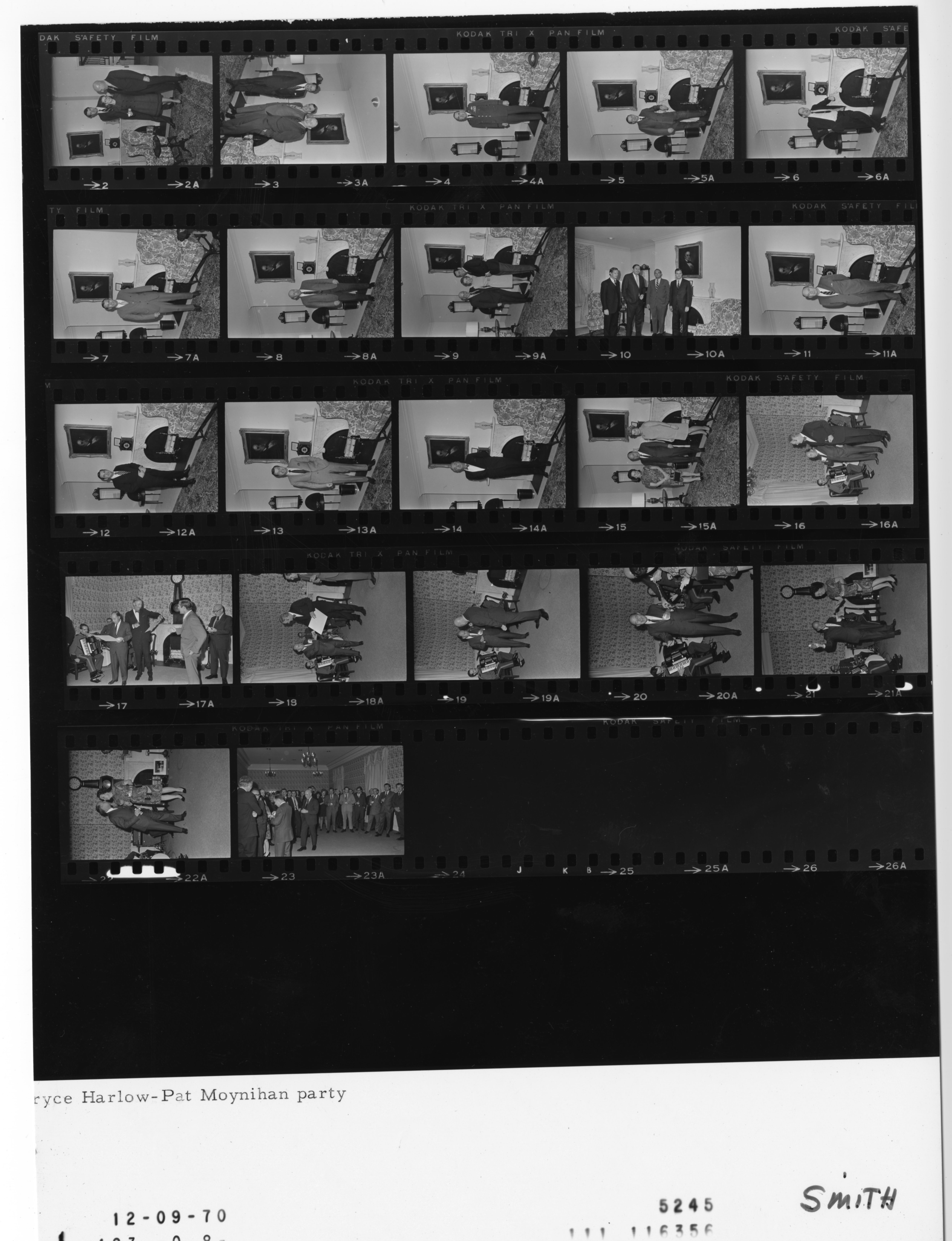
- Frame(s): WHPO-5245-02-23, Bryce Harlow attending Daniel Patrick Moynihan's party. 12/9/1970, unknown unknown. Bryce Harlow, Daniel Patrick Moynihan, unidentified men and women.
The White House Communications Agency Sound Recordings Collection contains public statements that took place between 1969 and 1974. Visit the finding aid to learn more.
G - Cabinet Officer Briefings
- WHCA-SR-G-065
Press briefing by Secretary of Labor James D. Hodgson, with Ronald Ziegler. (12/9/1970, Press Center)
Runtime: 42:00:00
Production credits: Audio feed supplied by WHCA; Recorded by RSM (initials of WHCA engineer)
Original Format: 1/4-inch reel-to-reel audiotape. Original source type: Original.
P - Formal Presidential Remarks
- WHCA-SR-P-701204
Remarks by President Nixon in re-enlistment ceremony with Dep. Secretary of Defense David Packard. (12/9/1970)
Runtime: 3:22
Original Format: 1/4-inch reel-to-reel audiotape. Original source type: Original.
The White House Communications Agency Videotape Collection contains “off-the-air” recordings of televised programs produced between 1968 and 1974. Visit the finding aid to learn more.
- WHCA-4018
"Today" Show with guests Rosemary Woods, Egil Krogh and The Gov. of U.S Virginf Islands. James Farmer.
NBC
Runtime: 1:30 - WHCA-4020
NYC Goes to College. Bud Krogh, Governor of the U.S. Virgin Islands & Rosemary Woods.
NBC
Runtime: 1:00 - WHCA-4021
"The Dick Cavett Show":guest host Buck Henry, Wally Shirra, Elliot Richardson.
The Republican National Committee
Runtime: 01:28:35 - WHCA-4022
NBC Special - Railroad Strike.
Undetermined
Runtime: 0:07 - WHCA-4029
Weekly News Summary - Tape II.
All networks
Runtime: 1:00
1. Smith/Clark: Congress moving to prevent strike through peace plan; provision with wage increase to rail workers; Union Spokesman Luna says Congress should stay out of dispute; Postmaster General orders embargo on all railroad mail . Time Code Start: 00:01:02. Keywords: unions, railroads, trains, strikes, threats, negotations, wages, raises, Congress, embargoes, postal services. Network: ABC.
2. Smith: Lithuanian defector's belonging inspected after USSR accused man of stealing money; no money was found . Time Code Start: 00:03:52. Keywords: Russia, Soviet Union, USSR, defectors, defections, accusations, theft, investigations. Network: ABC.
3. Smith: rail unions are being extravagant; extreme wage rises are self-defeating; guidelines needed for wage/price rises to prevent inflation. Time Code Start: 00:04:19. Keywords: unions, railroads, trains, strikes, threats, negotations, wages, raises, increases. Network: ABC.
4. Brinkley/Nessen: Defense Secretary Laird in Fort Bragg, North Carolina awarding medals to 96 men for bravery under hostile fire during raid on a Vietnamese POW camp. Laird says would launch new raid if needed.. Time Code Start: 00:05:58. Keywords: Vietnam War, Indochina War, Vietnam Prisoner of War, prisons, raids, rescues, attempts, military, troops, awards, ceremonies. Network: NBC.
5. Cronkite/Mudd/Rather: Congress working to prevent rail strike; House granted rail workers wage increase and extended strike delay; White House expects that there will be no strike, Nixon believes democrats in Congress forcing him into "uncomfortable box.". Time Code Start: 00:07:53. Keywords: unions, railroads, trains, strikes, threats, negotations, wages, raises. Network: CBS.
6. Stanley: Senate Labor Committee hearing; Senator Kennedy questions Secretary of Labor Hodgson on President's personal involvement in rail strike. Time Code Start: 00:10:21. Keywords: unions, railroads, trains, strikes, threats, negotations, wages, raises. Network: CBS.
7. Cronkite/Schieffer: Defense Secretary Laird flies to Fort Bragg, NC for medal ceremony for men in POW raid; Laird says he would approve a similar raid if needed; Fulbright suspects raid was carried out for other reasons than those stated by administration. Time Code Start: 00:13:02. Keywords: Vietnam War, Indochina War, Vietnam Prisoner of War, prisons, raids, rescues, attempts, military, troops, awards, ceremonies, Senators, criticisms. Network: CBS.
8. Cronkite/Schakne: Coast Guard ship "Vigilant" is put out to sea again; chronology of Lithuanian defection from USSR revealed (artist Billy Sunshine), Coast Guard couldn't reach proper State Department official; Soviet sailor Simas Kudirka jumped to United. Time Code Start: 00:15:08. Keywords: ships, travel, Russia, Soviet Union, USSR, defectors, defections, Coast Guard, captures, releases, witnesses, interviews, harrassment. Network: CBS.
9. Sevareid: President Nixon administration losing economic and political foothold; President Nixon must lay out new programs/image with upcoming new Congress members. Time Code Start: 00:18:18. Keywords: Presidents, economy, policies, public opinions. Network: CBS.
Context (External Sources)
The Vanderbilt Television News Archive is the world's most extensive and complete archive of television news. They have been recording, preserving and providing access to television news broadcasts of the national networks since August 5, 1968.
Wikipedia is a free encyclopedia that anyone can edit.